Tag: BARC

  • Currency Research Crisis: IRS Today, BARC Tomorrow?


    By Shailesh Kapoor


    The new IRS results have thrown the print industry in a tizzy. The change in research design, and a fundamental one at that, has led to drastic shifts in results, in turn influencing potentially drastic shifts in ad revenues over time. While some of the concerns expressed by the print industry areabout the credibility of the data, almost 80-90 percent of the concerns can be answered by the way of change in the research design.


    But print companies (at least the publications impacted negatively) are right in saying that the research design change is not their problem. For them, IRS is IRS is IRS. If MRUC decided to refurbish its research design, and that led to a sea change in results, are they implying that the earlier results, which have been used as currency all these years, were “inaccurate”?


    Seeming “anomalies” like Hindu Business Line showing higher readership in North-East than Chennai weaken the MRUC argument considerably, by creating a sense of “flaw” around the execution of the design on field. But the real issue still revolves around a fundamental design change.


    In six years of extensive media research, I have realized the futility of even attempting to use one research to forecast the results of another research. The error margins can multiply like rabbits, and before you know, you are handling senseless data in an attempt to achieve research-to-research parity.


    For example, there are channels whose viewers we just don’t find in field research. But their viewership data suggests they exist in sizeable numbers, much more than some competition channel’s viewers, who are much easier to recruit on field. Like a radio station in Delhi is rated high by RAM, but in extensive radio research in the market, finding its listeners has always been a challenge.


    Every research has its design, based on certain underlying assumptions. And this design has a large role to play in how the results play out. There is a fairly strong element of “lottery” when the design changes. Some players are bound to benefit and some bound to lose out. Who’s on which side of this lucky dip is anybody’s guess, till the first results of the new design come out.


    When the first BARC data is released later in 2014, this situation is bound to repeat. Some channels are bound to gain and some bound to lose vis-à-vis their TAM performance. It will be easier for BARC for two reasons. One, the TAM design has been under attack anyway, so even broadcasters who show a loss of viewership will be cautious in protesting. Two, BARC is industry-backed in the true sense, and hence, voices of dissent may be handled behind closed doors in most part.


    Yet, overnight shift in numbers can create sufficient market disruption and loss of morale in the ill-affected companies. To that extent, a ratings-dark period can provide a silver lining. If new data shows major shifts after a six-month blackout, it will be difficult to isolate the impact of the shift as a result of research design change vs. a real shift in the viewership of the research universe.


    Currency research has widespread business impact and should always be packaged with a ‘handle with care’ board. Perhaps this is where MRUC went wrong. This is where TAM certainly went wrong.


    A lesson for BARC to learn?


    TV Trails is a weekly column written by Shailesh Kapoor, founder and CEO of media insights firm Ormax Media. He spent nine years in the television industry before turning entrepreneur. The views expressed here are his own. He can be reached at his Twitter handle @shaileshkapoor


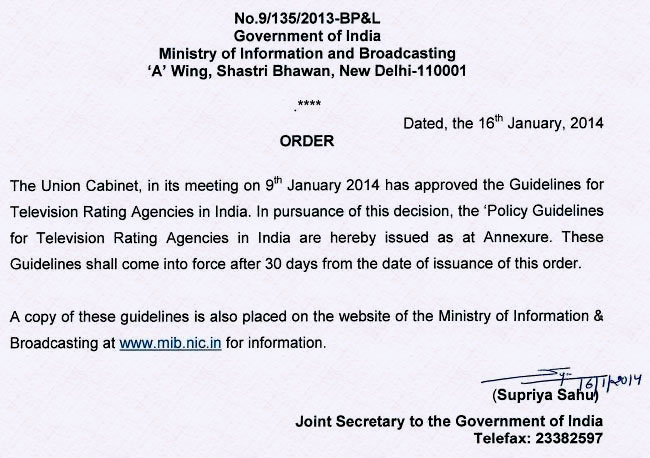
  • The clock is ticking… Guidelines on TV audience measurement issued. 30 days wef Jan 16

    By A Correspondent


    Valentine’s Day this year is when the broadcast system may need to kiss the current audience measurement system goodbye. That is, if the government, the Courts or some divine power do not intervene. Or of course if TAM, the sole operator of the current audience measurement system, is unable to take some urgent measures to comply with the guidelines.


    There was a meeting with the Minister of Information & Broadcasting and officials of the ministry and key BARC functionaries in Delhi on Thursday (Jan 16) and even though Advertising Agencies Association of India President Arvind Sharma underscored the need to extend the deadline for the guidelines by five to six months, the Minister said there was not much he could do since the guidelines were being uploaded on the website and since the Cabinet had approved them, there’s little he could do in the matter.


    The order on the guidelines uploaded on the ministry website is dated January 16 and it clearly states that the guidelines will come into force 30 days from the date of issuance. The 30th day would be either February 14 or 15 given when the 30-day notice comes into force – from Jan 16 or 17.


    Meanwhile, the industry is bracing for a measurement-free era. While some of those who got the government to intervene have reason to wonder if they have scored a self-goal, the real worry is for broadcasters who could now face the heat from advertisers.


    The pressure is also on the stakeholder-led BARC to ensure timely delivery of its measurement system. It may be recalled that BARC spokespersons have promised the commencement of a new television audience measurement regime by the second quarter of 2014.


  • We can’t be without a measurement system: Hemant Bakshi, ISA Chair & ED, HUL


    What appeared to be a quiet start of the year emerged as an action-packed one as the ghost of the TV measurement scare emerged yet again with the Union Cabinet approving guidelines on television audience measurement issued by the TRAI.  Hemant Bakshi, Executive Director – Home & Personal Care of Hindustan Unilever (HUL) and Chairman, Indian Society of Advertisers (ISA) spoke with Shobhana Nair on how no measurement system is no good for the ecosystem, and the television sector in particular. The ISA, it may be remembered, had opposed the stand of several broadcasters who had unsubscribed from TAM last year. Excerpts from an interview with Mr Bakshi


    The danger of no measurement system hangs on the industry again though the reason is different this time around. How have you thought of handling it as the ISA Chairman?

    Firstly, it has just been announced and we need to get clarification on exactly how it is going to be amended. We are trying to figure that out right now. Meanwhile, ISA’s position on this remains the same that we do need a robust measurement system and I think the guidelines will help us get that. In the short term, we can’t be without a measurement system because ratings are the currency with which we buy television and the absence of the currency will affect the industry. We want to avoid that scenario at any cost.


    Have you discussed the situation with other members of ISA and what is a possible solution that has come out?

    I think we will come to conclusions but, as I said, right now we need to understand the details of the guidelines on how things will pan out, etc. And we are working on it.


    What are your thoughts on the guidelines by TRAI for TV Rating Agencies? Do you think it is a good attempt to create a manipulation-free environment?

    I haven’t seen the guidelines fully, so I don’t want to comment on it.


    BARC has many months before it becomes operational, what is on your agenda to speed up things there?

    BARC has already been working quite well and the progress has been outstanding. We need to keep in mind that to create something of this nature takes time and can’t be done overnight. Having said that, the work on BARC is at a good pace.


    After everyone came to an agreement last year on the need for a television audience measurement, we still have many  sections in the industry against TAM…

    I think we should look ahead and not look back. Going forward, the three bodies (IBF, ISA & AAAI) are working together through BARC to create a ratings system which will be acceptable to everyone. I think we should put all our energies in that.


  • Mediametrie… who, why, how?


    By A Correspondent


    If the question in our headline is what a lot of broadcast industry stakeholders have been asking this weekend, there’s reason. The US- and UK-exposed Indian media fraternity do not know much about Mediametrie, the French joint industry body for TV measurement that’s been chosen as the primary technology vendor by the Broadcast Audience Research Council (BARC).


    The BARC Board met on Saturday, November 30 and is reported to have given an in-principle clearance for awarding the measurement contract to the French measurement body. However, that’s as per the information leaked. Officially, the BARC communiqué issued doesn’t name any vendor.


    On Saturday, the BARC Board met to decide on the technology and the path ahead. “There was unanimity in deciding on a leap in technology to be used in television measurement. The Board approved the management and the technical and commercial committees to go ahead and finalize with a couple of international companies for this. The team will be completing the pilots and will start deployments soon. The Board also decided on the funding mechanism and is encouraged by the response received from banks for funding the project,” the release noted.


    As per reports earlier this year that were later denied by a BARC official, there were five vendors shortlisted for the key function of installation of set-top boxes and generate measurement viewership numbers. These included Kantar and Nielsen. Sources say Nielsen was in the final shortlist of three and was close to being selected, but the solution it offered was far more expensive than that of Mediametrie. TAM, a joint venture of Nielsen and WPP-owned Kantar, was not involved with the bid process at this stage.


    The vendor selected will not be involved with the analyzing of data, and that contract will be awarded separately by BARC. TAM is a likely contender for this, subject to the cross-ownership not being a stumbling block in its participation in the bidding process.


    So what is it that got Mediametrie to win the race? And who and what is Mediametrie?

    The reasons, in brief:

    First, the technology.

    Second, the low cost.

    Third: Mediametrie is not married to any set-top box provider

    And fourth, Mediametrie is structured like BARC and is not a solely-for-profit body


    The technology Mediametrie is likely to deploy is called ‘watermarking’ which entails inserting into programmes a ‘mark’ that is inaudible to the human ear. This ‘mark’ contains the identification of the channel which airs the content and the regular broadcast time markers. The audimeters installed in panellists’ homes can then recognise this information. According to sources, BARC officials have discussed the viability of inserting these markers with private channels as well as with Doordarshan. The technology allows for measurement of TV content on mobile phones as well as sedentary computers.


    The watermarking technology is being licensed from a Netherlands-headquartered vendor Civolution.


    The cost is indeed low for the technology and the set-top boxes and that’s the reason why BARC is bullish about achieving a 50,000 panel base in a year-and-a-half (See: http://www.mxmindia.com/2013/10/barc-eyes-50k-panel-in-1-5-years/) .


    A key irritant in the increase of the panel base of TAM was the cost of set-top boxes deployed. While TAM was willing to buy more, the costs were high and the taxes made them even more pricey. With the Mediametrie deal, the measurement technology is the key and not the set-top boxes. In fact, the boxes will need to be procured by BARC separately through one or more vendors. As per a source, Nielsen almost won contract due to this clause, as it was a tried-and-tested offering. However, buoyed by the confidence reposed by various stakeholders, the BARC technical committee is understood to have taken the decision to get into a separate contract with one or two hardware providers who can bring in the mandatory 20,000 set-top boxes required within six months of the government guidelines for TV measurement coming into force. Cisco was also rumoured to be in the running for this contract, but sources say that it may not among the chosen ones.


    As per info on its website (hence not verified by this correspondent), Médiamétrie was founded in 1985 in response to the changing demands in the French audiovisual sector. The government encouraged the creation of an independent company to ensure that audiences of the principal audiovisual media could be measured scientifically. This independence for Mediametrie is guaranteed by the presence of all professional parties, in all its decision-making processes and in its stakeholding, including the media, advertisers and agencies without any of them having a majority holding to take a decision alone. The ownership and structure of Mediametrie is hence quite like BARC and it isn’t a solely-for-profit set-up.


    Médiamétrie is now developing its range of services and extending its scope by working on new media, telephony, new multimedia practices, crossmedia, etc. It offers original products designed for specific users and launches offers on the international market that have become essential due to changes in consumers’ listening and viewing habits. Mediametrie has also created Eurodata TV Worldwide for analyzing and distributing info on over 5500 channels across over 100 countries.


    Civolution was  formed in October 2008 as a spin-off of Royal Philips Electronics.  In August 2008, Philips Content Identification, a business unit of Philips Electronics, assumed full ownership of its joint venture Teletrax. The combined entity was spun out of Philips in October giving birth to Civolution. In July 2009, Civolution took over the Software and Technology Solution from Thomson (Thomson STS), formerly NextAmp. Mediatmetrie’s technology is aided by that of Thomson (and hence Civolution).


    So, a source close to the developments, told MxMIndia that while Mediametrie is the primary tech vendor, Civolution and the set-top box vendor(s) will also play a key role in the implementation.


    When will the new BARC measurement come into force?

    BARC as we know is a Joint Industry Body (JIB) set up in 2012 with the specific purpose of designing, commissioning, supervising and owning India’s Television Audience Measurement System. IT is a joint venture bringing together the three key stakeholders – broadcasters, advertisers and advertising and media agencies. Their respective apex bodies, the Indian Broadcasting Foundation (IBF), the Indian Society of Advertisers (ISA) and the Advertising Agencies Association of India (AAAI), represent the three sectors.


    Although the public position for BARC may be that the new measurement regime will be up and about by the end of Q2 of 2014 (that’s by June 30, 2014), MxMIndia estimates as per discussions with various stakeholders in the industry, given the criticality of the data, subscribers will switch off the tap only after they are a hundred thousand percent convinced about the data.


    “Remember Q3 and Q4 are the all-important adspend seasons and we can’t afford to risk any mess-up due to the non-availability of data that has a buy-in of all parties. So even though we want the new BARC system to be a success, we need to be realistic,” said one industryperson. A broadcast sales head was more pragmatic. “Although it appears that the market will improve and we will be done with the elections, over the last few years there have been too many extraneous factors impacting broadcast sales. We can’t have one more variable in the system,” he said, indicating that the transition to the new measurement regime from TAM could well be done in a phased manner. So the new BARC data will start coming in from August 2014, as per scheduled, but subscribers may dispense with the current system only later.


    In the meantime, BARC needs to also contend with the government and a zealous Minister of Information and Broadcasting who is keen on effecting the new measurement regime in his tenure. “Minister Tewari’s intent is well-placed,” said a key BARC stakeholder, adding: “In reality, the system just can’t be executed in the UPA-2 tenure. Also, we do not a half-baked system to get operational.”


    The minister (and the ministry) is keenly keeping tabs on the progress being made on this front and it is learnt that key BARC officials are likely to meet them in Delhi this week.


     

  • BARC eyes 50K panel in 1.5 years

    By A Correspondent


    Broadcast audience measurement research body BARC (short for Broadcast Audience Research Council) is eyeing an initial panel (households with set-top box installation) of 20,000 and 50,000 within a year-and-a-half thereafter.


    According to reliable sources, BARC is said to have zeroed in what is perceived as cutting edge technology in television audience measurement. The technology is said to be pilfer-proof, future-ready and economical.


    While the Establishment Study is expected to be complete by next month, the decision on the vendor will now be taken on the basis of the technology selected. BARC is said to have firmed up on three – international as well as Indian – players and the tests are due to begin soon.


    BARC is expected to award the contract by the end of this quarter or by January 2014. According to a source, the technology solution adopted is expected to be much cheaper and advanced than what is currently available. “What’s important is that BARC should have enough time to undertake tests,” said one CEO who did not wish to named.


    When asked whether the cross-holding rule will impact the selection of the incumbent TAM or its jv partner Kantar Media which is owned by ad conglomerate WPP, a BARC member who MxMIndia spoke with, said the TRAI recommendations have not been notified by the government yet so Kantar solely or as TAM can participate. However, it is believed that the government will toe the TRAI line and insist on no crossholding.


    On the size of the panel, the TRAI guideline says that while a minimum panel size of 20,000 must be implemented within six months of the guidelines coming into force, the panel size needs to be increased by 10,000 every year thereafter until it reaches the figure of 50,000. Also, the panel of homes has to remain representative of all television households in the country.


    BARC is a joint industry body comprising broadcasters, advertising and advertising agencies. The deliberations and final decisions on the selection of vendors is to be taken by the Technical Commiitee head Shashi Sinha. Puneet Goenka is chairman of the body and Partho Dasgupta is its CEO.


    See also:

    Earlier report: BARC close to final decision on measurement vendor


    TRAI recommendations on guidelines for TV rating agencies


  • BARC close to final decision on measurement vendor

    By A Correspondent


    The Indian media industry’s Broadcast Audience Research Council (BARC) is now close to the award of the contract of television viewership measurement in the country.


    The BARC board met on Friday and a spokesperson issued a press release saying it was recognized that “BARC has the opportunity to change the paradigm and the solution should last for the next 15 to 20 years.”


    Added the communiqué: “The Board agrees that there is a quantum jump in technology that is being envisaged. Considerable progress has been made in identifying suitable cutting edge technologies available for measurement of present and future Broadcast distribution platforms. The Board decided to authorize the BARC Technical Committee and the Management to initiate pilots with these solutions to assess the suitability in Indian conditions.”


    It is learnt that BARC has asked three vendors to initiate these technology feasibility pilots, and one among these three will finally be awarded the contract.


  • TRAI recommendations on guidelines for TV rating agencies

    The Telecom Regulatory Authority of India (TRAI) has released its guidelines for television rating agencies.


    The Ministry of Information and Broadcasting (MIB) had asked requested TRAI to provide its recommendations on issues related to guidelines/ accreditation mechanism for accreditation of television rating agencies in the country.


    Accordingly, TRAI issued a Consultation Paper on “Guidelines/Accreditation Mechanism for Television Rating Agencies in India” on April 17, 2013, seeking comments/views of the stakeholders. Open House discussions were also held on July 1, 2013. Based on comments received in the consultation process and its own analysis, the Authority has finalised its recommendations. The salient features of the recommendations are:


    i. The Authority supports self-regulation of television ratings through an industry-led body like Broadcast Audience Research Council (BARC).

    ii. To ensure that the shortcomings of the present system are addressed guidelines have been recommended.

    iii. Any agency meeting the eligibility conditions can apply and get registered with MIB for doing the rating work.

    iv. MIB to notify the guidelines for regulating the television rating agencies based on TRAI’s recommendations, within two months.

    v. All rating agencies are required to comply with the guidelines.

    vi. Guidelines to cover registration, eligibility norms, cross-holding, methodology, complaint redressal, sale & use of ratings, audit, disclosure, reporting requirements and penal provisions.

    vii. The number of panel homes for collecting television viewership data will be a minimum of 20,000; to be set up within 6 months of the guidelines coming into force. Thereafter, the number of panel homes shall be increased by 10,000 every year until panel size reaches 50,000.

    viii. The panel homes to be selected from a pool of households, selected through an establishment survey which shall be at least 10 times the number of panel homes for audience measurement.

    ix. Voluntary code of conduct by the industry for maintaining secrecy and privacy of the panel homes.

    x. Restrictions on ‘substantial equity holding of 10% or more’ between rating agencies and broadcasters/advertisers/ advertising agencies.

    xi. The rating agency to set up an effective complaint redressal system.

    xii. Data/reports generated by the rating agency to be made available, on paid basis, to all interested stakeholders in a transparent and equitable manner.

    xiii. The rating agency to get its entire methodology/processes audited internally on quarterly basis and through an independent auditor annually. All audit reports to be put on the website of the rating agency.

    xiv. Penal provisions for non-compliance of guidelines including financial penalty from Rs 10 lakh to Rs1 crore and cancellation of registration.

    xv. Six months time given to the existing rating agency to comply with the guidelines.


    Notes a communiqué: “Since 2008, the authority has been giving its recommendations/ clarifications on implementing a reliable and transparent television rating system. For over four years little to no progress has been made by the industry and MIB, in implementing the Authority’s recommendations aimed at institutionalizing a credible and transparent rating system. Since policy intent has not been translated into action for too long, the timeframe for implementation has now become a critical factor. Guidelines are designed to correct the aberrations in the existing system and prevent it from deteriorating further. Early implementation of guidelines, therefore, has become a necessity. As sector regulator responsible for overall development of the sector, the Authority cannot be a mute spectator to continued inaction and may suo motu intervene in larger public interest.”


    The full text of the recommendations is available on TRAI’s website at: http://www.trai.gov.in/WriteReadData/Recommendation/ Documents/FINALReco%2011Sept2013.pdf


  • Will the ad switch-off get broadcasters to revert to weekly ratings?


    By A Correspondent


    Logically, ads of FMCG majors who sent letters to eight broadcast group on Friday evening should’ve been off air from late last night, but given that there was a Sunday in between, the 72-hour notice given is being considered to be 72 working day hours.


    The advertisers have decided to take on the broadcasters head-on. “We’ve decided we don’t want to get bullied any longer,” one big spender told MxMIndia, adding that the channels need to acknowledge that until there is enough money from distribution, it’s the ads that are funding their business.


    While broadcasters have adopted a wait-and-watch game, privately, they admit that they are cornered this time around. Moreover, a Colgate needn’t worry about Oral B using this opportunity to over-advertise because both Colgate and P&G have sent us pull-out letters, one channel revenue head told us.


    However, the real losers, as industry analysts tell us, are the broadcasters because the revenue loss will be real when it actually starts. “Since most broadcasters are CEO-run or are publicly listed, the stakes are lower for CEOs,” the analyst told us. Except for Zee and Sri Adhikari Brothers, a blip is not a huge worry for MNC-owned or listed company CEOs. “It’s only when the losses mount that the international/regional headquarters will start putting the pressure.”


    Meanwhile, another analyst MxMIndia spoke to reasoned that broadcasters will lose out by asking for monthly data. “The monthly release is not going to be a combined number for 30-31 days. It will give you the same weekly break-up. So it’s in a sense a case of deferred live.” Advertisers and media agencies can still review the numbers and nail the channels sales team, he said. “The problem is also for the channel programming team and bosses because in the absence of weekly data, they will not be able to tweak content if ratings are going south and it’s tougher doing it after month,” said the analyst.


    The industry-watchers we spoke with believe that for advertisers the issue is now of their egos being hurt by the insistence of broadcasters to go monthly. The demand to refer the matter to the BARC technical committee has been shot down because there is a feeling that the switch to a monthly release of numbers will not get a two-thirds majority that may be deemed imperative for changing the ‘technical’ framework of measurement.


    Meanwhile, the offensive against broadcasters was raised last evening by the Advertising Agencies Association of India issuing  a statement on the current impasse on Television Audience Measurement. Said Arvind Sharma, President of the AAAI: “For fourteen years, TAM has been the TV Audience measurement system in the country. It has been the currency on the basis of which advertising planning, buying and selling have been conducted. We all agree that this measurement system needs to evolve. That is the common goal towards which broadcasters, advertisers and advertising agencies came together to create Broadcast Audience Research Council (BARC). BARC will take 10 months or so to start generating its audience measurement data. In the meantime, however, if individual broadcasters try to force unilateral changes in the current system, as some have tried, it will result in a disorderly and hybrid measurement system. It will become impossible for advertising agencies and advertisers to plan and therefore, buy TV spots. In this scenario, it is natural for advertisers to begin to question the value of advertising in this medium at all. Cancellation of TV releases by many advertisers on eight network groups that have insisted on unilateral changes is a natural outcome of that. More clients are following”.


    The statement added: AAAI believes that any change in the TV measurement system needs to be thought through and to have support from all the three industry constituents – Broadcasters, Advertisers and Advertising Agencies. “We continue to be firmly of the belief that dialogue among all constituents is essential for evolving the system. We remain open to discussions, as always,” said Mr Sharma.


    Hinting at the broadcasting fraternity’s refusal to budge, Mr Sharma said: “This does require similar openness across all constituents. We will continue to work towards a dialogue.”


    What all stakeholders are hoping for is the emergence of a back-channel to negotiate a settlement between the stakeholders. Watch this space for more.


  • Point of View: Time for TRM to measure television?

    By Amit Nevrekar


    It was seen that when TAM was suspended for a few weeks last year, Agencies and Broadcasters relied on social media, Facebook, Twitter for content likeness, especially for new launches.


    Tapping this phenomenon, can we have similar measurement which is not restricted to Facebook, Twitter but open to all masses pan-India at a minimal research cost. I’m talking about mobile phone medium which has the highest penetration of 900 million+ connections.


    It could simply work with unique 5-7 digit telecodes randomly generated everyday and displayed on channels’ programmes.


    The audiences would just need to give one ring/ missed call to assign their likes. It could also have the capability to accept comments via SMS and post on Facebook.


    The motivation to give missed calls can be done through channel promotions, contests etc. USSD questionnaire could be sent to these audiences to collect basic demographic information.


    The benefit of this method is that you could even understand content likeliness at individual market level like Kolhapur, Nashik, Nagpur etc. The main differentiation is that it’s actual audience response, NOT a sample survey and is independent of mode of access and place of viewing. IPL could easily get more missed calls than gross eyeballs over the 45 days period. It could be termed as ‘Television Response Measurement’ or  TRM.


    It would be better to have such study rather than each broadcaster and agency conducting their own research through different research agencies, till BARC rating system is rolled out.


    Amit Nevrekar is COO, AdoRoi Inc and co-author, The Advertising Mess


  • Shailesh Kapoor: If You Had To Choose: Bad Ratings or No Ratings?

    By Shailesh Kapoor


    It’s been an eventful week for the television industry, the unfolding of which has been nothing short of a taut Hollywood thriller that promises to keep you on the edge of your seat. The backstory started with NDTV’s lawsuit against TAM last year, but the real action began last week when a top broadcaster (MSM) decided to hit TAM where it hurts the most, by simply pulling the plug. Times Television and a few others have followed suit. And the second act has not even started.


    There have been many points and counterpoints, both from the broadcasting and advertising fraternity. BARC’s ratings design is not going to see the light of the day before 2014, and hence, there is a sizeable time window to handle.


    The real question that should define the framework for this debate is: “Are the current ratings credible?” For me, the question is that and only that. Credibility is not graded. Here, there is no concept of “mostly credible”, “more credible than others” or “perhaps credible”. If the ratings system is going to influence the size of advertising revenue that it does, it has to be credible in absolute terms.


    Anyone who follows ratings closely (many people) and understands statistics (only a handful) will agree that the current ratings system has error margins which lack statistical robustness the moment you begin to look at markets or segments which are narrow, e.g. C&S 25+ SEC A Males in 5 metros. The error margins could be as high as 30% in such segment, which means that a rating from 2.1 to 3.9 may in reality represent the same viewership, i.e., 3.0%. Now imagine doing the same for C&S 25+ SEC A Males in Bengaluru. The error margins would cross 100%.


    In a way, TAM may have shot itself in the foot by reporting such data and allowing it to be analyzed. This attitude towards error margins could definitely not have been a result of ignorance, given the company’s rich heritage. But it seems to be a result of over-confidence, even arrogance, resulting out of being a monopolistic player in the television currency research space.


    Understandably, you cannot install more meters because your business model prohibits the same.But is that a justification to report data that could statistically be a result of pure chance, than a reflection of reality?


    The television industry has perhaps been guilty of going soft on the issue in the past, taking tough stands only on occasions that suit their business. Over a decade, I’ve been hearing the fig-leaf argument, i.e., “in the absence of anything else, TAM at least gives an indication”. Now that’s a compromise on the principle of credibility. That argument should have never been admissible in the first place.


    What’s the solution, then? It’s surprisingly simple. TAM should define an “error margin” or “confidence level” at which it will report data, e.g. maximum error of 10%. It should communicate the same to the entire industry, and then report only the data that clears this filter. If this means that certain markets and audience segments cannot be analyzed, then so be it. Some channels, especially English channels, may find the results irrelevant because they won’t be able to look at certain desired TG cuts, but it’s better not to look at error-laden data in any case.


    This may understandably result in much lesser “data” in the system, but less data of good quality should win over more data of bad quality any day. Of course, in doing this, TAM will have to admit that their error margins have been rather abysmal in the past. But the taste of a humble pie is not that bad, is it?


    Yes, a ratings-less system will create confusion. But if I had to do the ranking, I’d say: Good Ratings > No Ratings > Bad Ratings. For those suggesting Bad Ratings > No Ratings, a masterclass in statistics is highly recommended.


    Shailesh Kapoor is founder and CEO of media insights firm Ormax Media. He spent nine years in the television industry before turning entrepreneur. The views expressed here are his own. He can be reached at his Twitter handle @shaileshkapoor


  • BARC inches closer to new measurement regime, issues global RFP

    By A Correspondent


    The Broadcast Audience Research Council (BARC) has confirmed the release of Request for Proposals (RFPs) to global providers of Technology and Research. This is consequent to the response it received for the RFI (Request for Information) issued earlier.


    Punit Goenka

    Commenting on the development, Punit Goenka, Chairman of BARC and Managing Director and CEO of Zee said, “We are happy with the interest shown by global vendors of technology and research in our project. The RFPs are going out to all of them. This will be followed by discussions and evaluation of these proposals.”


    Said Partho Dasgupta, CEO, BARC: “This is our second step towards initiating a cutting edge measurement system which will see marriage of Technology and Research. The first step was the Establishment Survey which the TechCom led by Shashi Sinha and Paritosh Joshi has already initiated.”


  • BARC appoints Partho Dasgupta as CEO

    By A Correspondent


    BARC has appointed Partho Dasgupta as the first CEO of the apex association formed by various broadcast stakeholderscompany. Commenting on the development, Punit Goenka, MD & CEO-ZEE and Chairman-BARC, said, “We are delighted to have Partho on board. BARC is moving ahead aggressively with its plans. Partho has an excellent background in leadership, in successful startups, in broadcast, in research, in consumer products and in other industries. He will help us put the organisation in place and roll out BARC’s services in a tight time frame.”


    Mr Dasgupta has had a strong background in media startups like Times Now and Future Media, and has worked in leadership position with The Economic Times during its growth years. After an entrepreneurial stint, he was with Educomp, running their Preschool business and k12 new school initiatives.


    On his appointment, Mr Dasgupta said, “The foot is on the pedal – we have to just start accelerating. On a serious note, I am happy to do another startup in broadcast and media. The Board is full of friends from the industry and I am looking forward to working with them and make BARC happen.”