Tag: BARC

  • Eric Salama slams MxM report. Says no selling TAM to BARC. MxMIndia stands by story

    By A Correspondent


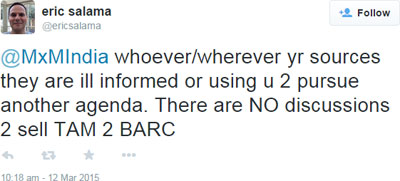
    Kantar Media CEO Eric Salama tweeted us back Thursday evening saying: “Whoever/wherever your sources, they are ill-informed or using you to pursue another agenda. There are no discussions to sell TAM to BARC.”


    This followed an earlier tweet where he said: “Happy to cooperate with BARC to improve ratings but no discussions for us to sell TAM to BARC.”


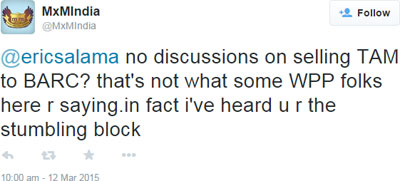
    This was reacting to our tweeting the link to the story to Mr Salama and other industrypersons.  We responded to this tweet by saying: “No discussions on selling TAM to BARC? That’s not what some WPP folks here are saying. In fact I’ve heard you are the stumbling block.”


    We are normally not so direct or rude, but in this case, we’ve heard from more than one source – on the WPP and the industry side – that the counter-offer made by the Kantar CEO was unacceptable and hence a potential deal-breaker. In fact, some industry sources even told MxMIndia in confidence, that it was because of some statements made by someone senior at WPP (suggesting Mr Salama, but not confirming it) that the talks with Kantar fell through in the early days of the BARC contract finalisation.


    One senior industryperson associated with BARC was even told that BARC will not be able to run its business without the intervention of Kantar. In fact the senior industryperson feared the future of his career because the offensive was pretty strong, he told us.


    Meanwhile, MxMIndia strongly stands by the story it published yesterday. The fact of the matter that a deal is being looked at. This could also mean that TAM will publish its ratings every week and hand over the data to BARC which will then use it for its purpose or club it with its panel size and present to its consumers.


  • Exclusive! BARC in talks to buy TAM?


    By A Correspondent


    Entertainment television is all about twists and turn in the fictional serials. Cricket, as you would’ve heard several times over, is a game of glorious uncertainties. So why then should there be surprise over the possibility of BARC buying up TAM.

    Okay, let’s cut the tease. Broadcast Audience Research Council (BARC) has indeed been in discussions to buy the television audience measurement business of TAM, the firm jointly owned by WPP’s Kantar Media Research and Nielsen. And, yes, it’s March 12 today, not April 1.

    According to reasonably reliable sources, there have been a detailed dialogue between the joint industry body-managed BARC and TAM owners Kantar and Nielsen. The talks haven’t concluded yet and the mid-point formula that was suggested by a WPP representative has been reportedly rejected by BARC bosses.

    Both BARC and TAM were unavailable for comment, but from what one learns, BARC was seriously considering the buy.

    So why gobble up TAM when the audience research measurement activity of the measurement body was under question? Well, even as doubts were being raised, there is no denying that broadcasters, advertisers and media agency use TAM as the currency for their buying decisions. Also, as industry analyst told us, TAM comes with a ready 12,000-odd panel, established processes and teams and archival data.

    And from TAM’s point of view, why sell out to BARC? Given that all stakeholders have contributed to the BARC kitty, it’s evident that sooner or later all TAM subscribers will exit the system or want to renegotiate. Given this, it’s best to sell the existing well-oiled measurement machinery to BARC which would find it of use, said the analyst we spoke to earlier.

    TAM has already made it known to subscribers (and the media) that it will continue operations even as there is a significant number (in billings at least) of subscribers who have said they would like to unsubscribe. If TAM continues to exist, there will be several comparisons made with the new measurement system, and those subscribers who may be rated poorly by the BARC system vis-a-vis TAM may quote the latter. This could even lead to advertisers questioning the BARC data and hence cause a confusion in the marketplace.

    As reported on MxMIndia earlier, the ghost of the Indian Readership Survey has raised anxiety levels in the industry. For, MRUC and RSCI, the bodies running IRS are jointly run and owned by various stakeholders in the industry. And despite it being an industry association, print players are up in arms against the new IRS.

    BARC, meanwhile, is said to be only in the discussion with the television audience measurement business of TAM. Other divisions such as the Strategy or S Group which offers advisory service on measurement, AdEx India, RAM for radio audience measurement, Eikona for measurement of earned media and PR activity and TAM Sports, which offers special analysis of sports ROI will not be part of the deal if it goes through.

    So where do things stand now? At the time of writing, the talks have been suspended. But as the date approaches for the launch of the system, and the stakes for both BARC and TAM grow higher, the deal could well be inked. Like on television, be ready for the climax.


  • Rush for BARC’s testdrive of BMW software

    By A Correspondent


    BARC India has reported a houseful of registrations for its training and testdrive programme of its user interface: the BMW or BARC India Media Workstation. (*See Disclosure)


    BMW training sessions are being conducted every Monday in Mumbai and every Wednesday in Delhi. With four batches of one hour each and over 120 attendees on Day 1, the BARC team took participants through a step-by-step introduction across the AudView, AdView, PlanView and TeleView sections of the interface.


    The feedback received by BARC seemed promising: “Better than the current software, very good learning, excellent software, user friendly, reduced man hours.


    Participants of the training session were awarded certificates. All those in media planning/ buying/ research/ strategy can register for vacant seats if any, at: http://www.barcindia.co.in/Roadshow-registration.html


    *Disclosure: MxMIndia is among the four or five media entities partnering BARC’s roadshows by way of online support. Our association in no way is 


  • Media pros hope to vroom with BARC software

    The BMW or Bimmer, as it’s known, is known to be a gold standard in motorcars. And Broadcast Audience Research Council (BARC) CEO Partho Dasgupta wants the user interface – christened BARC Media Workstation or BMW, in short – to offer unmatched ease of use with all the data that’s relevant.


    Last week, the BARC top brass went around Delhi, Chennai, Bengaluru and Mumbai to present the user software. And to those happy with the current software that’s available for TAM data, this was light years ahead.


    We asked a cross-section of those who attend the roadshows in Delhi, Chennai and Mumbai and they were all very delighted with the offering. “The BMW is indeed like a switch from to a humble City to a Bimmer,” said one senior planner, not authorized to speak to the media.


    What works in the initial reaction for BARC is that the people who actually work on the software believe it will ease their lives much. One senior user who no longer crunches numbers said the new software could well lead to some redundancy in media agencies and media departments in channels. But then hastened to add: “What it will do is take the drudgery off the data, and allow people to concentrate on the analysis, which is what matters.”


    The unique feature of the interface is TeleView which allows access of data and video on a single screen. Tracking of audience movement between channels is also actively monitored. The interface offers customized reports with graphical representation that wasn’t hitherto available. The individual analyses, built-in optimizer plus targeted batch runs are said to be unique to the BMW.


    What works in the initial reaction for BARC is that the people who actually work on the software believe it will ease their lives much. One senior user who no longer crunches numbers said the new software could well lead to some redundancy in media agencies and media departments in channels. But then hastened to add: “What it will do is take the drudgery off the data, and allow people to concentrate on the analysis, which is what matters.”


    The software has been sourced from Markdata Solutions based in Lisbon, Portugal. BARC India has signed a licence agreement with Markdata, a company of the Portuguese Marktest Group, Portugal’s leading market research and audience measurement organisation. The agreement gives BARC the right to distribute the TV Markdata Solutions to their subscribers in India. Markdata has its systems installed in 26 countries.


    Users meanwhile are keen on knowing whether all of the seven unique properties of the BMW will be part of the offering to all users or only those who cough up more. Also, while the overall response has been positive and given that the technology is tried-and-tested, the final verdict, the planners we spoke, could only be given once people get their hands on it.


    Test drive time!


  • Ghost of IRS mess may force BARC & TAM to co-exist


    By A Correspondent


    The ghost of the Indian Readership Survey released last year is seeing its impact on the new television audience measurement regime of the Broadcast Audience Research Council. IRS is still in a state of disarray even though stakeholder associations have okayed it.


    Although we are told that the next round of numbers is to be out soon, the industry is still waiting.


    MxMIndia spoke to a variety of folks in broadcast and in media agencies.  While none of them were ready to go on record on the sensitive issue, they are worried about the outcome of the BARC study. And the reason:  the proposed BARC study is dramatically different from what TAM does. So it’s not that the same sample is being studied, also the BARC’s panel is twice that of TAM. “The goalpost has moved. It’s as if the game was being played on clay and now on astro-turf.”


    A senior media planner told MxM that one must remember it’s a statistical exercise and not a census. When asked as to how does one explain the shockingly low readership figures for some publications like BusinessLine or Hitavada in IRS 2013, the planner told us: “It’s a sample survey. The sample was selected scientifically. It’s a matter of chance that those selected didn’t read these two publications. So you can’t fault IRS for this.”


    Hmmm. The third-party revalidation process conducted by veteran researcher Praveen Tripathi and adopted by the IRS determined that the process followed by IRS was okay.  “The problem with audience research is never the process. It’s the fieldwork,” said a senior executive of a research firm which has had some experience in audience measurement.  “Media companies are known to influence these in order to get favourable numbers. This is more easily done with print readership and tougher with television. When you are dealing with human beings and human intervention, you can never say. The problem is compounded because the trade associations refuse to act against erring media entities.”


    So where is the anxiety on BARC?


    The big channels needn’t worry. One hears that the BARC validation process will ensure that if there’s anything astray from the existing, it will be looked into. However, with the number of people sampled having leapfrogged, there is bound to be some change from what TAM dishes out every week presently. The unease amongst broadcasters is whether the change will be as significant as it was in the IRS results? “Yes, be ready for a few surprises. Logically, there should be no validation, because if the process is right and the industry is mature, there is no need for being alarmed. “


    So are we saying that the media industry isn’t mature? “Perhaps,” said the senior planner we spoke to earlier. “The stakes are too high, and in the case of the IRS there was an unfortunate charge that one newspaper group had influenced the field work.” But there is also a view that the MRUC and RSCI, the people associated with the IRS, did not handle the IRS mess-up too well. “You can’t be behaving like cowboys when you are dealing with sensitive stuff like audience measurement. The existence of a media brand is in question with an incorrect survey,” a media-owner had told this writer a few months back. “ MxMIndia is awaiting  a response from the MRUC chairman to a few questions.


    After this report was filed, our attention was drawn to a report in The Economic Times as well as on IndianTelevision.com on the same issue. The ET story indicated that there could be a blackout period post February until BARC ratings start since subscribers may pull the plug on TAM. The IndianTelevision report quotes Zee MD and CEO Punit Goenka saying that IBF has taken no decision to pull out of TAM. The statement assumes significance as Mr Goenka is also BARC chairman and one of the most powerful members of the IBF.


    But what puts the lid on the discussion is an emphatic assertion from TAM (to MxM) that it will not discontinue ratings even after BARC starts transmitting its data.


    “Will you’ll stop when BARC starts,” we asked. “No, we won’t,” the TAM spokesperson told us. The question of course is not of TAM continuing to publish its data, but how many agencies and broadcasters will subscribe to it.


    There have been industry rumours that GroupM, the largest media agency conglomerate in the country, which is owned by WPP which in turn is 50 percent owner of TAM via Kantar Media may still be in favour of TAM’s continuance. Although the FAQs released by BARC have clearly stated that GroupM has committed itself to BARC by investing in monies, there is a belief that the media services conglomerate will maintain a hawk’s eye on BARC.


    The good thing for BARC is that all those leading it are doing it with pragmatism and are wise enough to know where they need to exercise more caution. Also, data has already started flowing in and being assessed by BARC bosses.


    Watch this space for more.


  • Still unsure about BARC’s proposed measurement regime? Try these FAQs


    After engaging with a cross-section of the broadcast ecosystem with roadshows in Delhi, Bengaluru, Chennai and Mumbai last month, there were many questions that the BARC India management and technical committee were asked.


    While the roadshow presentation is put on the BARC website, the joint industry body also circulated an interesting set of FAQs to its mailing list as well as put up on the website (http://www.barcindia.co.in/roadshow.html).


    Here are the FAQs, which we republish with permission in the interest of broadcast stakeholders who may have missed BARC’s communication.


    How is BARC INDIA better?

    The key differences are: a) much bigger sample size, b) better representation of urban-rural divide, c) measuring catch-up TV along with linear TV d) accurate identification of channels even in simulcast situations e) adoption of the watermarking technology which has capabilities to capture multi-platform viewership and f) usage of NCCS


    How have you ensured robust sampling?

    We are going much wider and deeper (i.e. going rural, covering more towns and also going deeper in the existing towns).


    What % of TV homes is covered with BARC INDIA?

    We will capture viewing behavior of all TV owning HH’s through robust sampling and report “What India Watches”.


    What is the meter distribution between urban and rural?

    In the first batch approximately 70% of our meters will be in urban and ~30% will be in rural.


    What happens to the viewership of the channels which are not watermarked?

    They will not be reported.


    Do you see a scenario of two data providers? 

    We can speak for ourselves – we are gearing to be THE currency for television audience measurement.


    What do you mean by being future ready?

    In more ways than one.

    – All of our partners / vendors are the best in their class making each cog in the measurement wheel totally solid.
    – Viewership measurement technology – watermarking is capable of measuring viewership across screens. Going forward when digital viewership of television content aggressively competes with television viewership this becomes extremely relevant.
    – Same goes with time shift viewing which we are geared to report from day one.


    How many towns will be covered?

    As mentioned above, the sample will be both deeper & wider.


    A humungous exercise like this, has to have checks & balances as to who knows what. We will almost triple the coverage of towns compared to existing system.


    TAM currently measures 27crores individuals. What will be the corresponding number in BARC INDIA?

    BARC India mandate is to measure ‘What India Watches’. We would be going; both wider and deeper. BARC India will represent entire TV Universe footprint in the Country.


    What will be the frequency of data availability?

    We are fully equipped to report data at the frequency that the market wants to. The frequency for reporting is likely to be weekly. However for certain data types (depending on viewership numbers), we might aggregate the same either by period or time-band or geography. Announcement to that effect will be made after we have validated the data.


    NCCS: How is a particular durable even relevant today to be included in the list of durables to determine household affordability?

    It is administered by MRSI and a review will be done periodically to keep it relevant.


    What is the likely pricing going to be? 

    The idea is make affordable data available to the last mile. We are working on an ingenuous pricing model to capture the principles of BARC India of inclusivity, equality and transparency. After necessary iterations and approvals it will be revealed closer to launch.


    How many channels will be monitored by BARC INDIA? 

    All the channels that have watermarking will be monitored. Number of channels getting watermarked are increasing as we speak. All the major channels are being watermarked.


    What if watermark is switched off by the broadcaster?

    – We are not worried about that.
    – Firstly, it’s not in the interest of the broadcaster to deliberately switch off watermarking. But like any technology, such eventualities could happen due to various reasons. To arrest these instances stringent processes with escalation matrix across watermark monitoring agency, broadcaster & BARC India are in place. They will highlight even if a small bit of content is not watermarked.
    – Secondly, if the watermark is off the media agencies and advertisers will most likely stop buying the channel thereby forcing the broadcaster to correct the same.


    Would reporting be available at DTH vs digital vs analog cable?

    All decisions on reporting will be taken only after reviewing live data.


    Would data be available at TV vs other devices?

    While currently our focus is to report accurate data for the television viewership, BARC India has the technical capability to capture data across screens and therefore we will certainly do so going forward.


    Now that establishment study uses data from IRS 2013, is there a possibility of cross-media reporting?

    Establishment study uses data from multiple sources like IRS, NCAER, TRAI & Census. Our immediate focus at BARC India is to report television viewership.


    Will there be a time gap between the release of viewership data and adex data?

    BARC India is aiming at releasing both simultaneously.


    Will adex nomenclature match with TAM/ MAP?

    BARC INDIA nomenclature would be different and will be more advantageous for advertisers.


    Would the panel take into consideration MSO on ground strength?

    Panel would be a reflection of what people watch; no MSO biases would be considered for sampling.


    Would there be an overlap between TAM and BARC INDIA data?

    In any country there is only one currency which operates for trading TV advertising inventory. TAM being a proprietary set-up, may continue to report data; however industry bodies would eventually be moving to single currency.


    What is the plan on vigilance?

    A senior police official is being appointed by BARC INDIA for heading vigilance. Given the current data collection format and use of technology, tampering of data is highly unlikely.


    Would multi TV households be reported separately?

    Very few households currently have multiple televisions and we would not report this number separately though we will measure multiple TVs, wherever it is, in sample households.


    Would cable channels start getting captured?

    Watermarking technology supports this. If any MSO wants their channel to be measured, they should invest in the embedding technology.


    Since reporting is done at Urban and Urban+ Rural level, isn’t it possible to work back and arrive at Rural only figures?

    BARC India will not support or endorse this as the figures are statistically invalid, that’s precisely the reason why rural won’t be reported separately as a gold standard by BARC India. Once the sample increases from 20k to 50K we will have the capability to report rural also separately.


    Will Group M also subscribe to BARC India television viewership data? 

    Group M is a part of AAAI, who is one of our shareholders. Group M is also financially committed to BARC India.


  • Lunch with MxM: Partho Dasgupta, CEO, BARC


    By Pradyuman Maheshwari


    Instead of doing a drink or a lunch at a five star coffee shop, we decided on the headquarters of the Broadcast Audience Research Council in Parel. The office of the CEO Partho Dasgupta isn’t closed. Complete transparency assured, he laughed as he dived into some Pav Bhaji. Pav is something he loves, he told me, although he hails from Kolkata. The last two decades in Mumbai have made him a convert. Excerpts from an interview:


    It’s interesting you’ve the Rubik’s Cube as the mascot for BARC. Any significance?

    The industry has been posed with this puzzle of solving the audience measurement and numbers issue for so long. There’s a big puzzle to be solved and what better puzzle then what we’ve all grown up with – the process of solving which has been interesting, the Rubik’s Cube. With all its colours, dimensions, etc we thought it would be a good inspiration for us.


    The issue with the audience measurement business – whatever be the media type – is that it’s always puzzle people cannot unravel with ease. The Rubik’s Cube is in a sense symbolizes that as it’s not easy solving the Rubik’s Cube. So are you trying to say that you won’t be able to join the dots very easily?

    It should be signifying something which is very tough. We are trying to solve a tough puzzle.


    One of the reasons why the new system exists is because in the earlier format, people reportedly were puzzled by a lot of outcomes. Isn’t that an issue, symbolically speaking?

    Are you talking of puzzles being unraveled or the enigma that existed?


    The puzzle and the enigma!

    There are two parts. An enigma remains an enigma. We’re talking about a puzzle to be solved and we think we are solving that puzzle.


    Symbolism apart, let’s get to the real issue and the million dollar question – are we on course?

    It all depends on how you want to term it – on course or not on course. Let me tell you objectively where we are. We are fairly on course in terms of the four odd streams which on convergence will ensure that can start giving out the numbers commercially. The first is monitoring the channels that play out. That’s completely on course. The second being the placement of embedders which puts out the watermark, the technology we are basing the entire measurement process on. Roughly 250 channels have ordered and half of them have already been installed. We are looking at another 100-120 odd channels, which will come in and that also tells you that it’s completely on course. The third being the meters; the whole development of meters. Let me tell you this isn’t a very easy thing. This is embedded technology based on Intel chips that we are developing. This chip is new and hence it required a complete set of software and hardware development of all the other ancillary peripherals and stuff like that…which has all happened and they’ve already tested it out in the labs in different conditions. But now we’re trying to test it out actually on the field. From this month, the meters will be out in the field which will go up and up. We already have the back office ready to get the data back and see how the data is performing. So the third stream, the meter, back office and the related infrastructure is very well on course.


    What about the others?

    Yes, as for the fourth stream, which starts from establishment study data to the sample design to seeding of the boxes into people’s homes… here is where we have a small problem; rather a delay. This is because of the availability of data which we are trying to solve. Overall, yes we are on course. There’s a couple of months delay here and there which happens on a project of this caliber. It’s important to get it right, we’ll never want to commit a date; we’ll want to check, validate the data, be fully satisfied, get the stakeholders on board to understand this is the data and say this is good. Hence we will only announce it on a certain date when it will go live.


    Would the disputed data be from IRS? You said there’s a problem with the data, is it the same IRS data which has been the problem?

    I don’t want to name it because are a lot of data points we are using – IRS, Census data, NCR, MIB, TRAI data etc.


    Looking back, would you say that it was a bad idea to depend on IRS data as your base data?

    We’re still evaluating that. We haven’t come to a conclusion yet. Based on that outcome we’ll take a call for next year.


    Coming back to the date of launch, when do you think can the industry expect it?

    I’m not giving a date because I don’t want to make a mistake some of our other industries in similar situations have faced. I’m only telling you things of what’s going on as a process, which will give us data from the field as we go on to next month. When we see the full validated data fit for commercial use, we’ll announce and make it commercially usable. It would be towards the end of the year; around that time.


    So will Santa Claus bring in a new audience measurement system?

    (laughs) That’s for him to decide. Why should I?


    I’m pushing for a date because there are people who’ve paid money for an audience measurement system. And then there was a government which was fairly aggressively wanting a new audience measurement system.

    Uday Shankar, one of our directors, said at one of the meetings, “Understand we are doing something for a generation and not for a couple of years. Even if it takes few more months and few more iterations, do it right and at the right cost.”  It would be very easy for me like to go with one supplier of data. Typically, the world over, people take more than three years to do such a changeover but it would have been so much expensive for the Indian industry to bear, which is not funny. As you know, we are talking about 20,000 meters that are needed based on the country’s size and it’s heterogeneity so it would’ve been stupendously expensive if we would have gone with something simple used by some other countries. We took the painful, tough path purely because we thought that’s the most wise thing to do based on both cost and the country’s condition.


    Will you have 20,000 meters on Day One?

    We’ll have more meters. We’ll report from 20,000 households, not meters. If you have a multiple TV viewing household, it will have two meters.


    The government was exceedingly belligerent about wanting to have a new measurement regime. What has been your experience with the current government compared to the previous one?

    It’s been nothing different. They are not pushing us for the date and things like that. We keep them updated regularly.


    If a broadcaster asks you as to when do you think will the new system come into effect given there subscription monies to be paid to the old data system, what is your response?

    Honestly, that’s a broadcaster’s own decision. The board knows where broadcasting companies are present and they know exactly what’s happening. So they have to take their own call on that and when they want to cease a subscription or start it is completely up to them I honestly don’t want to give any advice on what they do with the other subscription.


    But clearly by this fiscal the new system will start, right?

    Should be.


    Are you worried about what happened with IRS?

    It is a big learning but I’m not worried.


    Let me elaborate. IRS was set up by esteemed members of the industry where members got together and selected a vendor. It was all done through various approved processes and when the result came in, because it wasn’t favorable to some people, it started facing issues. The same thing could happened with the BARC data too. You have people from the industry come together, appoint a committee, etc but since you can’t produce ratings or fake outcomes, are you worried that the broadcasters will not be mature enough to take aberrations or changes from the existing system?

    I don’t want to speculate at the outcome. I’m concentrating more on the process now. My belief is the outcome should reflect the process. We’re trying to do everything possible and hence I’m not giving you a date or things like that. We’ll ensure all the different processes we’re talking about to ensure the output is right. I’ll take extra precautions to validate the data and carry the stakeholders along before we go commercial about it. At the same time I won’t speculate on the outcome. I’m more concerned about the process now so that the output is right.


    What happened with IRS is that certain publications found that the data was not favourable to them. That could well happen here with BARC’s findings tooIn the validation process, how much would you want to alter in case if a certain channel was No. 1 earlier and suddenly falls to No. 3? We saw that when digitization and LC1 happened, there were some tectonic changes in the ratings. Is there a worry how the industry will take it given the fact that media people who otherwise try to sermonize from the rooftops are not very kind to being submitted to the vagaries of the world?

    Let us cross the bridge when it comes. I’m not worried about it now. The bridge is being built on a very strong foundation. We shouldn’t be worried about the bridge falling very easily; people who are working on the bridge, know the bridge very well.


    As an industry observer, isn’t it a genuine worry for all of us? Thanks to what happened with IRS, we didn’t have data for readership for a long time. Has this been discussed with BARC board on such an eventuality?

    Not really in these terms but obviously we’re taking all kinds of precautions for that. The BARC board has been advising us how to take precautions from such issues. I’m reasonably confident things will be taken care of.


    You now have 26 vendors. It must be quite a job to deal with the vendors and orchestrating the entire act together.

    To typically manage the handshakes particularly since there were many technologies involved and a lot of international vendors too, the whole handshakes thing is quite a job.


    Do you think it’s better to have it done this way rather than go with just one?

    Absolutely, 200 per cent. It’s a tough path, but it would be any day better to do it this way than any other path you mentioned.


    When you started, you selected the vendors. Has there been any change since? Have you looked at changing course if a vendor or technology doesn’t work?

    The path remains the same. A standard evaluation process is trying out different vendors. We have evaluated three vendors for the same job. The path or the principle is the same. In this, the whole board and the technical comity  have been a huge help and encouragement.


    One of the primary issues with the existing system was in terms of the integrity of the homes… how are you looking at addressing that problem?

    There are two to three basic things. One is the whole solution of technology. There’s no way the people who know homes will get to see any data. Similarly, the people who get to see the data will never get to see the homes. There are completely different vendors, processes in that. Even with the agency that is going and actually visiting the homes, we’re ensuring it doesn’t flow top-down. That means nobody in the agency at the central level gets the names and addresses of 22,000 people where the boxes will be placed. It goes to the local representative who controls not more than 100 odd homes, and that’s an approximate figure. So, even a corrupted person can’t do substantial damage. The third big thing that we’re doing is putting dummy homes. There will be normal seeming dummy motors in a lot of homes that actually will not ping. That data will not even be used.


    What percentage of it will be dummy homes?

    I won’t give that figure. Of course, it would ensure that people don’t understand where it is.


    You mentioned people who have access to the homes don’t have data but they have access to the previous week’s data.

    How would they know where it’s come from?


    The fact of the matter is that if an ‘X’ channel has not fared very well, they at least have that data and can influence people… bribe them, et al.

    It doesn’t work like that. For example, would Indore be a unit of measurement? No. He’ll never be able to figure out if it has come from there. It would typically not be. It’ll be small enough for people who won’t be able to correlate it to larger data.


    But 100 can be a significant number for a long tail channel?

    Do you think all 100 homes will actually watch it? It would never work that way. The other big thing would be outlier. The moment you give a gift or something it will come out in my outlier. It’s very easy to do. Just take the outlier completely out from the samples. I have extra homes I’m sampling in any case. If I find some abnormal things happening in certain sections, my outlier analysis will pick up those homes and take them off. This basically means I can replace them with other homes which already have my meters.


    In terms of data analysis, you have a mix of companies. Not just Hansa, but a few others too, right?

    Hansa is just putting boxes in people’s homes whereas Magic9 Media headed by Praveen Tripathi is doing the analysis.


    Are you looking to do any consulting work on how people should review the data?

    We think it can be a conflict of interest.


    For the industry, do you think there are some salient features you’d like to highlight so as to repose the confidence level that good times are here again…

    The industry should look forward to a 180-degree leap in terms of technology, in measurement which by itself is a big one. It is already seeing a leap by three times the sample size than what it is used to right now. Industry should also be looking forward to the transparency we’re bringing along in terms of what we’re doing and how we’re doing. We started with roadshows in the beginning of what we’re trying to do. You’ll see us taking the road again to tell people what kind of sample design we’re doing. Industry should also look at the way we’re overall presenting the whole data which you’ll also see when the final output comes out. The GUI we use, I’m sure they would love it a lot more than what they’re seeing now.


    There’s a fair amount to be done in terms of software the people have to install, the ones they have to read, the staffing at the organizations needs to be understood, a huge amount of education that needs to be imparted…

    In fact I’m already talking to a couple of media schools. They want to introduce courses for using BARC’s GUI so that when these guys graduate they can be easily picked up from apart from the fact that we’ll also train the users in the customer’s premises.


    Is there anything that you’re worried about? Something that’s giving Partho Dasgupta sleepless nights?

    Yes, lots. As I told you this whole handshake of technology and different businesses, there are 12 processes and about 26 vendors. This integration is something to worry about. It’s not easy and we’re doing it, but we really have to get it right. I’m not saying it’s happening without any effort. It gives me a huge number sleepless nights.


    What’s tougher to handle – technology or people?

    Ultimately, it’s all about people. Technology does what people want it to do.


  • Romil Ramgarhia joins BARC as Chief Business Officer

    By A Correspondent


    Broadcast Audience Research Council (BARC) India has appointed Romil Ramgarhia as Chief Business Officer of the organisation. This is a move to strengthen its core management team as BARC moves closer to the launch of its services. In his new role, Mr Ramgarhia will report into BARC CEO Partho Dasgupta.


    In his last role, Mr Ramgarhia was Chief Commercial Officer at ZEEL. Before joining ZEEL, he was also associated with Viacom18, Bharti Airtel, Asian Paints and ACC, in different capacities. However, he has been associated with BARC for a while and was spotted at the announcement of Mediametrie as the technology partner.


    Said Punit Goenka, MD and CEO, ZEEL and chairman, BARC: “Romil has played a key role during his limited assignment at ZEEL. It is unfortunate that he has quit ZEEL however I am confident that his rich experience will bring greater value to BARC India. As he now moves on to a new challenge in a new role and domain, I wish him luck for his continued success.”


    Added Mr Dasgupta: “BARC India is moving closer to launch. Romil has an excellent background in broadcast, in telecom and in other industries. He was already associated with BARC India as part of its Commercial Committee and hence is well initiated in the processes. With his great business acumen, he will further strengthen the organization.”


    Talking about his appointment, Mr Ramgarhia said, “My assignment with ZEEL and Viacom18 has been one of my most challenging as well as gratifying periods of my professional career. It is great to be a part of a start-up which is  slated to be the biggest audience measurement system across the world.”


  • BARC appoints Prime Focus Technologies for Play-out Monitoring Service

    By A Correspondent


    Prime Focus Technologies (PFT), the technology subsidiary of Prime Focus Limited has announced that the Indian Broadcast Audience Research Council (BARC) has contracted it to offer Play-out Monitoring Service to power one of the world’s largest audience measurement programs. PFT’s globally proven CLEARTM Media ERP platform bolstered with next generation content identification technology and Digital Services will help automatically generate play-out monitoring reports on a daily basis.


    Audience measurement data is the de facto currency for media industry, being widely used by all stakeholders for planning, pricing, selling and buying advertising inventory on the medium. PFT will offer a robust play-out monitoring service which will check the actual telecast of each channel, capture the content at every point in time, and help link it back to the rating piece of the audience measurement system.


    “It is a great honor to be selected by BARC, and we consider it equally a great responsibility towards the industry,” said Ram ki Sankaranarayanan, Founder & CEO, Prime Focus Technologies. “India has one of the largest TV ecosystems in the world and the audience measurement system ought to be highly credible. We look forward to working with BARC to help build India’s very own, trusted rating service.”


    “With PFT on board we are one step closer to our mission of indigenously building a television audience measurement system that is better than the best in the world,” said ParthoDasgupta, CEO, BARC. “PFT’s world class technology, deep understanding of Indian broadcast and advertising industry, and across the board relationships with broadcasters and advertisers as a neutral partner made them the perfect choice for this critical role.”


    India has 154 million TV households making it the third largest TV market in the world, next only to China and the US. This will be the first fully digital play-out monitoring service employed directly by the Indian broadcast industry and is scheduled to commence operations in October 2014.


  • BARC conducts workshop on Watermark Technology for broadcasters

    By a correspondent


    To enable deeper understanding of the watermark technology, BARC conducted Technical Workshops countrywide for broadcast engineers from March 18th-21st 2014. This helped in understanding the deployment of the future watermarked system at the broadcaster end.


    The workshop was conducted by technical experts from BARC’s technical partners. Watermarking technology inserts a mark inaudible to the human ear into programs. This mark contains the identification of the channel which broadcasts the program and the regular broadcast timestamps. The meters installed in panelists’ homes can retrieve this information. This audio watermark is inaudible to viewers, and is compatible with both digital and analog broadcasting.


    Partho Dasgupta

    On successful completion of this workshop, Partho Dasgupta, Chief Executive Officer, BARC said, “It was a delight to see a massive and encouraging participation from 150 plus broadcast personnel at the recently concluded Watermarking technical workshop by BARC. This technical workshop was successfully held at multiple locations in India. It gave a unique opportunity for the broadcasters to interact directly with the technology and service providers. The broadcasters have already started placing orders for the watermarking embedding technology required at their playout centres.”


  • Respite for Kantar (and TAM) as Delhi High Court hearing adjourned till July 11

    By A Correspondent


    It’s an election gift from the government to the section of the broadcasting and media fraternity which didn’t want a ratings black-out.


    So after all the back-and-forth to the Courts, the much awaited verdict that we were awaiting today didn’t happen, because, yes, you heard it right, the government’s counsel wasn’t available for hearing.


    Now, the ball will be in the new government’s court as the hearing has been adjourned to July 11, 2014.This part of the news (and not the interpretation before) was confirmed to MxMIndia by Kantar Media’s advocate, Diya Kapur on the phone from New Delhi.


    This is of course some respite for all parties. For channels – especially those banking big on reality shows because there will be ratings around, for newer channels because they can prove to the world what they are worth, for special events like the IPL because they will need the support on viewership.


    For TAM of course because they’ve got a fresh lease of life and for BARC too, as in the absence of ratings dark period, they can do their work at their normal pace.


    The Delhi High Court has adjourned the hearing in the Kantar case till 11 July as the government’s counsel is not available for hearing. Kantar counsel Diya Kapur and News Broadcasters Association (NBA) counsel Anup Bhambhani confirmed the news to TelevisionPost.com. The adjournment means that the stay on the clauses related to cross-media holding in the Television Rating Agency Guidelines will continue till final orders. The HC bench comprising Justice Manmohan had on 12 February stayed four clauses in the ‘Policy Guidelines for Television Rating Agencies in India’ pertaining to cross-media ownership thereby preventing a rating blackout. Additionally, the bench had given more time to Kantar to comply with the remaining provisions of the guidelines. It asked Kantar to register itself within two weeks under the new policy guidelines. The bench also directed Kantar to upload a list of affiliated advertising companies on its website along with the list of its major clients.


  • BARC appoints Dutch firm Civolution for watermarking tech

    By A Correspondent


    Amidst issuing requests for proposals and advanced-level testing, the joint industry body of broadcast stakeholders BARC (short for Broadcast Audience Research Council) has contracted Dutch tech firm Civolution to provide the watermarking technology for its proposed measurement platform. The decision comes weeks after the announcement of Médiamétrie as its key technology vendor.


    Partho Dasgupta

    “India has one of the largest TV audiences in the world so it was critical for us to create an audience measurement system that is gold standard,” said Partho Dasgupta, CEO, BARC. “By leveraging Civolution and Médiamétrie’s expertise in audience tracking, technology and analytics we can now study viewers’ TV habits in precise detail, enabling broadcasters and advertisers to implement efficient strategies to reach their target audience.”


    According to a communiqué, the audience measurement system – which has already successfully been deployed by Médiamétrie in a few TV markets – relies on Civolution’s audio watermarking coding technology for automated content identification and integrates seamlessly into Médiamétrie’s TV meter system for panellists’ equipment and data processing.  It provides broadcasters with a detailed analysis of their exposure to the public, whether by the number of households tuning in to the programme or the amount of time spent watching each piece of content.


    Gwilherm Nicolas, Head of International Business Development at Médiamétrie added: ”We are very enthusiastic to embark on this project with Civolution and its watermarking technology, which is definitely the most powerful and error-free content detection technique available for TV audience measurement.  This means we are future-proofed in the fast-changing world of TV.  Médiamétrie has relied on Civolution’s technology for many years”.


    ”With so many new ways of watching TV content in this multi-screen universe, precise audience measurement has become increasingly complex. Audience measurement services must now report more accurately and reliably, from a larger number of channels, delivered through a fast-changing and diverse mix of broadcast platforms, and consumed either in real time or time-shifted” said Alex Terpstra, CEO, Civolution.


    Civolution’s audio watermark is embedded in the TV’s sound track prior to broadcast. Upon airing, the content is then identified by Médiamétrie’s TV meter, in real-time. In addition to granular measurement of the content being watched, the solution features support for catch-up TV. The technology provides cross-platform audience measurement and will enable mobile device measurement, triggering the creation of new services  and the reduction of operating costs. In parallel, the same watermark infrastructure deployed by Indian broadcasters could be used to synchronize with great accuracy their own interactive second screen applications.


    ”Through our close collaboration with Médiamétrie, we have devised a powerful solution that provides accurate and reliable audience data that will allow BARC to help broadcasters plan, entertain and monetize their TV audiences,” added Jean Michel Masson, SVP Watermarking Solutions, Civolution.