Tag: Avik Chattopadhyay

  • Between a rock and a hard place!


    By Avik Chattopadhyay

     

    Avik ChattopadhyaySunday, July 11, was quite a tumultuous day in London. While in Wimbledon, Novak Djokovic fought his way to his sixth title on grass, just 8.8 miles away, Wembley was preparing for the Euro 2020 finals between England and Italy.


    Wimbledon was prim and proper, with people enjoying the game seated comfortably at centre court or relaxing on the lawns outside watching on large screens. Everything was very ‘English’ in its casual elegance and sportsmanship was displayed by one and all.


    Wembley was the epicentre of a gathering storm, with people drunk on the streets damaging public property, smashing car and shop windows, uprooting potted plants and dancing on police barriers. Everything was very ‘English’ in its feared hooliganism and total lack of social propriety towards one and all.


    What happened outside the stadium after the English lost in the penalty shootout has been shared across the world, with most English media embarrassed to cover and capture it in its brutal entirety.


    A popular social media message doing the rounds is, “Wimbledon is what England wants the world to see it. Wembley is what England actually is.”


    Screen captured from bbc.com


    So, what really is “England” as a brand?
    Is it actually Wimbledon with Wembley as an aberration?
    Or is it actually Wembley with Wimbledon as an elitist diversion?
    Or is it both in equal measure?
    Or is it a larger macrocosm with these sporting events as little parts?


    A more fundamental question that emerges is – is it England or London as a brand? Do Londoners believe they are distinct from the rest of England just like New Yorkers or Parisians do? Do they consider themselves just different or ‘better’?


    “Places as brands are some of the most complex to both understand and work on”, Wally Olins, one of the world’s last brand gurus, had told me in 2010 when he was working on the London brand as part of the oncoming 2012 Olympic Games.


    “Most place branding exercises end up being tourism campaigns,” he continued, “projecting an incomplete picture to the world at large and, more importantly, its citizens.”


    So, while the world was debating the racist hooliganism of London, there were these electric buses traversing the city carrying pithy messages in typical English humour. If one were to judge London by just a single event of either a Wimbledon, a Wembley or a London Bus, one would be very far from the total picture that depicts the city in her entire form and mind.


    Place brands are the closest to individual human brands in their complexity, mood swings, and multitude of manifestations. Their constituents make them so. Corporate and product brands are far simpler in contrast as there is greater ‘control’ on how the constituents behave.


    It is nearly impossible for place brands to be opaque to the world outside, be it a tourist, an investor, or an immigrant. Each stakeholder is well aware of all aspects of the place before experiencing it, investing in it or even wanting to be a part of it. It is not that the place willingly shares all its manifestations, but the actions of its constituents ensure this level of transparency. London would love to have wished away what happened before and after the football game, but a place does not have control over each of its constituents. And one can end up being a total embarrassment even if miniscule as today’s open world captures, amplifies and critiques it even before you can finish singing your national anthem!


    Just see what one virus from a bat did to brand China! All the hard work over the last three decades in building its ‘power and prosperity’ image came tumbling down because some constituents handled the situation so badly that it will take another three decades to restore any semblance of credibility and bonhomie with the larger world. In retrospect, it could not have been worse timed ahead of the 100th anniversary celebrations of the CPC!


    At the same time, place brands are also subject to stereotyping by the rest of the world. There are riots currently happening in South Africa but then discussion and outrage in social media circles is far lesser even though more than seventy people have already died. That is because a larger part of the world actually expects such happenings in that place. This is the other aspect of place branding that it cannot turn away from.


    Places and their citizens are stereotyped on historical records and their interpretations. A large part of this stereotyping is a post-colonial outcome with most ex-colonies taking considerable time to come out of the images cast upon them by their occupiers. The general narrative created is the deterioration of an ex-colony in quality of life, law and order and culture once it gains independence. Close to 70% of the world has spent the last half century in destroying these narratives primarily through action and credible demonstration rather than mere advertising.


    Hence whether Kerala is truly “god’s own country” will not be determined by only the tourist boats on the backwaters but also on people enjoying “beef fry and parotta” irrespective of faith and ensuring every child gets high-quality education.


    That makes place branding a slightly easier task!
     

  • Brand Lessons from Clay & Grass!


    By Avik Chattopadhyay


    Avik ChattopadhyayThe French Open 2021 tennis championships just got over and the Euro 2020 football championships are currently on. Over the last three weeks, events have happened that bear implications for the world of brands and brand management.


    To me, the French Open winners were Novak S. Djokovic [quite obviously] and Naomi Z Osaka. While both are huge brands by themselves, this piece is about the way brands associated with them have performed over the two weeks at Roland Garros, for the world to see.


    “Novak ‘S.’ Djokovic?”, you would ask. Yes. The ‘S’ stands for ‘silent’. The man silently went about winning his 19th Gland Slam title, silencing a lot of his critics. If one followed him through this year’s tournament it was easy to observe his evolved behaviour on court and off it. Gone were the ebullient celebrations after each match, especially in the semis and the finals. There was an occasional roar, but that was it. He was smiling at his own mistakes. He was calm as a monk at the breaks. One expected that all the pent-up internal pressure would see an exit valve sometime, but no. And then he gave his racquet to a little supporter on the sidelines after winning, saying that was the best way to express gratitude to his “cute little coach”.


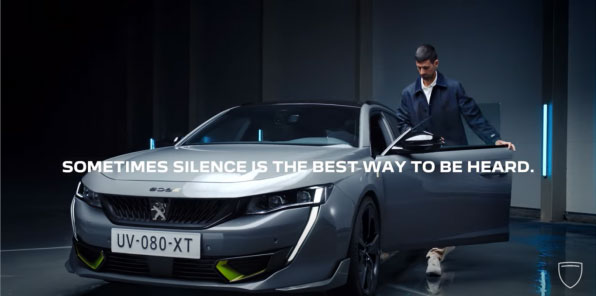
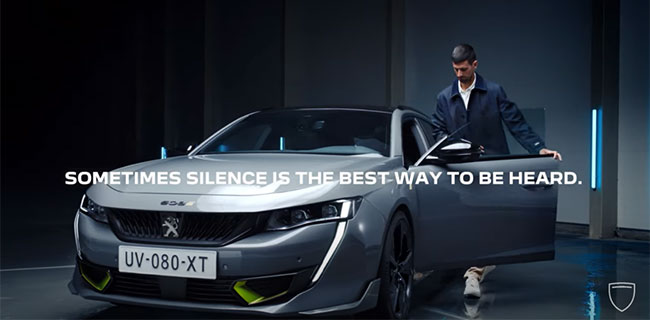
    Djokovic sports two brands apart from apparel sponsor Lacoste. One is a technology firm called UKG. The other is Peugeot. His association with the French car brand has been for more than six years now but this year, the brand, in a new avatar, took a really bold step to create a piece of communication with their brand ambassador released for Roland Garros. Announcing the launch of the Peugeot 508 SW plug-in-hybrid, it is a terrific demonstration of when the sponsor’s and ambassador’s DNAs totally are in sync.


    And the words at the end, captured here in the screengrab say it all. The commercial can be viewed at https://youtu.be/ugNSGoISTmg


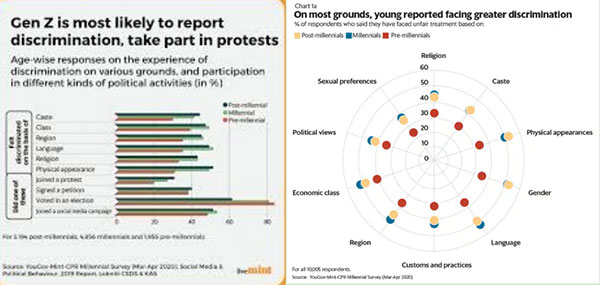
    Coming to Naomi Z. Osaka. Yes, the ‘Z’ stands for Gen-Z. It does take immense guts and candour to withdraw from a tournament of this stature because she could not agree with the rule of appearing at post-match press meets which made her uncomfortable. [Djokovic was one of the few who openly supported her stand.] Why not appear at a press meet when one gets more exposure, one would ask? But Osaka belongs to a generation that most of us managing brands are still coming to terms with. I went across and asked two of my friends for some insights to understand Gen-Z better. One, Subhash Chandra, a market research analyst shared lots of short clippings about the ‘post-millennials’ as they are also called. The other, Nirmal Dayani, shared the same sentiments of his Gen-Z son on this issue.


    [Source – YouGov-Mint-CPR Millennial Survey, March-April 2020]


    In the older times, the sponsors would have taken serious offence to such a sudden move by their brand ambassador, and one might have even decided to pull out of the contract due to an obvious breach of the same. Not in the case of Osaka. Nike, ANA, and Nissin all stayed steadfast behind her as if endorsing her decision. Also, that way they continue to connect with the Gen-Z whom Osaka represents, for their own business interests.


    Cut to the Euro 2020 being played across the continent right now.


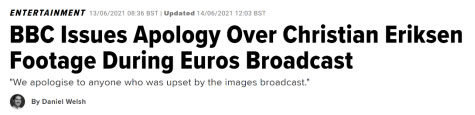
    On June 12, during a game against Finland, Christian Eriksen of Denmark had a serious medical emergency. While his teammates shielded him while CPR was being given and the stadium was in stunned silence, the television cameras were showing close-ups of the attempts to revive him and of his shocked wife being comforted by teammates Schmeichel and Klaer. After some time the cameras pulled back and stayed there. There was huge backlash on the broadcasters for getting too close to the medical activity and sharing personal moments. The BBC formally apologised the very next day.


    This is a clear indicator on the maturity with which brands need to handle totally unexpected situations. It is easy to get carried away and behave in a manner that may bring in immediate social media chatter but eventually lead to social media outrage. A clear pointer to the media brands across the world, more so in India, who tend to sensationalise events for personal gains, at the cost of social propriety!


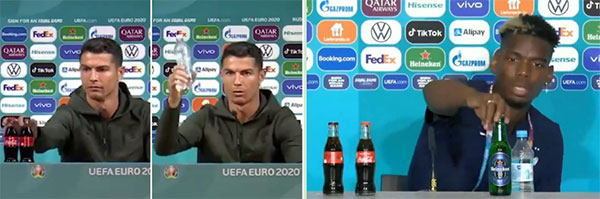
    A few days later, at their respective post-match press meets, Cristiano Ronaldo removed a couple of Coca-Cola bottles from the table while Paul Pogba removed a Heineken bottle. There were news items of how Coke lost $4.00 billion in the stock market due to that action. We are yet to know how much Heineken lost, but then Pogba is not as big a star as CR7 is!


    This is again a strong message going out to brands to be empathetic to people’s sensitivities. While one may question the very logic of having a fizzy drink sponsoring an event about fitness, the onus lies on the brand[s] to show respect. CR7 is known to espouse the cause of health food so it would be downright silly to position those Coke bottles in front of him. Pogba is a Muslim so would never like to have an alcohol brand with him. The logos of the sponsors are anyway on the backdrops, so why this urge to do the overkill with product placement? In todays times, these do not have the desired positive impact. In fact, if they boomerang, then they garner more social media space!


    Anyway, the Russians are leading the Finns by a goal while Turkey and Wales are warming up for their game which is a must-win for both. So, I better rush back to my place in front of the screen. Cheers!


  • Avik Chattopadhyay: Jo dikhta hai…

    Avik ChattopadhyayBy Avik Chattopadhyay


    Fighting the Covid virus and coming out of it in one piece teaches you one big lesson. That the recovery is more prolonged, tedious and fraught with anxiety than the actual infection is. So, the “negative” report and the visions of dead virus cells conjuring up before us are far from ground reality.


    The old Hindi saying of ‘Jo dikhta hai, wohi bikta hai!’ does not work any more in these pandemic times. ‘Whoever is visible, will sell better’ is a thing of the past. The experiences over 24 months [I expect this pandemic to definitely last that long, if not longer] will establish the truth that ‘Jo karta hai, wohi tikta hai!’ or ‘Whoever is doing, will sustain’.


    People, politicians, governments, sections of society, and brands that have actually worked at the ground level since March 2020 are the ones who the nation now recognises as worthy of respect. For the nation now well realises the difference between “showing” and “doing”, as the 15 months of the pandemic have clearly demonstrated.


    One would assume that after this debilitating second wave and the electoral reversals, the ‘Government of India’ [GoI], one of the nation’s biggest brands, would have learnt its lessons in ample measure. Why would the GoI be a ‘brand’? Why not, as it has a purpose, a promise, a set of values, a bunch of stakeholders to serve and, a logo / symbol / emblem? Everything that carries the Sarnath Lion Capital with ‘Satyamev Jayate’ written below it represents the country. The symbol is also supplemented with a smiling photo of the Prime Minister, and the political party in power.


    Two news items, in a span of four days, took my attention:

    :: Centre to set up ‘BBC-like’ channel to push India view. – The Indian Express, May 20, 2021

    :: ‘Make party visible’, BJP to workers after leaders go missing amid Covid. – NDTV, May 23, 2021


    Prasar Bharati has floated a tender for consultants to come up with plans to set up “DD International”. The Expression of Interest, issued on May 13, as per the news item, states that the objective is to “project India’s point of view globally on contemporary issues of both global and domestic significance” and to “tell the India Story to a global audience”. It also intends DD International to be the “authoritative global media source on India through credible, exhaustive and accurate global news service”.


    Said Prasar Bharati CEO Shashi Shekhar Vempati: “This is something that was something long overdue, to have an international presence for Doordarshan,” comparing it to the “first iteration of BBC or Al Jazeera”.


    So, will that mean that DD International will be fiercely independent in its opinion, state it clearly and get into investigative journalism? Does it mean it will allow programmes on the line of “Yes, Prime Minister!”, “Just a Minute”, and “Top Gear” to be telecast? Or is the catch in the “first iteration” bit which implies a BBC during the Second World War with the single objective of uniting the nation or, a BBC till the 1990s where the MI5 used to be involved in every appointment, keeping leftists and rightists out? Does it mean we are looking at a television channel in the 2020s in the style of the 1920s? Why have only a BBC or an Al Jazeera as a benchmark? Just because it will be run by the government does not mean that independent channels do not do an equally good job! The benchmark, if at all allowed in the era of being ‘Atmanirbhar’, should be on the content rather than the control. This is a classic demonstration of the GoI believing that “Joh dikhta hai…” will still work in a post-pandemic world that wishes to hear the Indian point of view.


    Now on to the second news item. Post a serious review meeting with the RSS top brass, the BJP leadership came upon the realisation that the party was losing out in the hustings when it came to grabbing brownie points on caring for the country in the pandemic. Till now, the party was totally dependent on the One Man to carry the show. Just that the game had changed along with the goalpost! No new gimmicks like lamps and claps happened while the social media team was busy creating ‘manipulated’ memes like showing a football stadium in Qatar as the world’s largest Covid facility set up in Nagpur. When you enter a football game with cricket gear, things don’t usually work out. People consuming content by the gazzilion bytes per minute had learnt to identify and appreciate content backed up by action.


    Hence the momentous decision “make the party visible”. J P Nadda announced that all functions to mark seven years of the Narendra Modi government be avoided on May 30. “Party workers should dedicate themselves in the service of the society,” he commented.


    The objective, it seems, is to make the party “visible”. It could have been to ‘make the party serve more’. The ulterior motive is to create fresh social media content that shows the party doing good, rather than necessarily doing so. Do one act and amplify it a billion times, through edits, voice-overs and copy. Also, if the party was contemplating celebrations of the seventh anniversary of GoI in these times, it was very close to buying its own burial space amidst the unfortunate others on the banks of the Sangam in Prayagraj!


    The pandemic has harshly taught us that all value and trust lie in ground-level action. In a post-pandemic world, mere visibility will not work anymore. In isolation, it is a waste of all resources…time, money, and consumer mind-space.


    We want demonstrable action to do all the talking. We want a higher level of empathy. We expect more transparency in intent and disclosure. We demand a sustainable purpose and promise to lead it all. We do not believe in ‘Jo dikhta hai…’ anymore. We need ‘Swachch, Sundar and Tikaau’ brands to engage with us if they want our eyeballs, footfalls, vouches, and votes!


    Avik Chattopadhyay is a senior brand strategist based in New Delhi NCR. He writes on MxMIndia every other week. His views here are personal


  • Avik Chattopadhyay: The religion of festivals!

    Avik ChattopadhyayBy Avik Chattopadhyay


    On the day of Holi, the festival of colours, on March 29, I wished many of my friends “Holi Mubarak!”. An old friend of mine, highly educated and erudite, responded by saying it should be “Shubhkamnayein” and not “Mubarak” as the latter was an Urdu word. On my commenting that Urdu was also Indian and therefore as appropriate, he retorted with a curt “Good night.”


    It disturbed me that an intellectual of sorts in society, whom many would typically look up to, had such a constricted view about the ‘purity’ of a festival greeting. But then, these are truly trying times when we are undergoing an period of inquisition on determining who is good enough to belong to this land called India and who is an outsider. We are recalibrating all things around us to classify them into being originally Indian and being imposed by cultures that do not belong to this land!


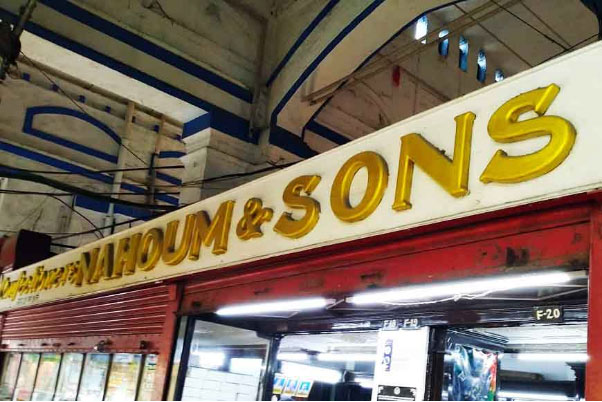
    I grew up in a city called Allahabad where, as a child I heard one cyclist greet another outside my school with “Bhaijaan, aapko Eid ka Ram-Ram.” That is etched in my mind. My parents come from a city called Calcutta where people of all faiths line up outside a Jewish confectionary called Nahoum & Sons where Muslim workers bake some of the best cakes and rum balls for Christmas.


    Nahoum & Sons, New Market, Kolkata since 1916.


    Festivals are some of the biggest ‘brands’ in any economy, impacting sentiments, livelihoods and prosperity more than most businesses.


    They are unique socio-economic-cultural events, more so today than they were a hundred years ago. The Durga Puja is the single biggest economic activity in Bengal. And that involves people of all faiths and beliefs than just the specific religious community. The ardent Hindu looks forward to authentic Awadhi Biryani on the day of Maha Ashtami as much as the Christian kids enjoy ‘pandal hopping’ clicking selfies before the idols of the goddess. When they greet you with “Happy Pujo” or “Puja mubarak ho”, nobody would retort that the greeting should be “Shubho Pujo”. In fact the more the greetings the better as it transcends a religious occasion into becoming a cultural extravaganza!


    The fervour is almost equally feverish on Eid and Christmas which everyone lovingly refers to as “Bada Din” [Big Day], not because of a colonial hangover but because everyone believes it is certainly a big day of collective celebration.


    For us, occasions like Holi, Eid-ul-Fitr, Diwali, Durga Puja, Onam, Ganesh Chaturthi and Christmas were ones where we saw different forms of celebration with their unique rituals and culture codes enjoyed by one and all. Why should a festival be constrained by only religious customs? Most festivals do have their origin in a certain religious event or reason which nobody denies, yet over the centuries they have outgrown this limited role into one of collective enjoyment. After all, the word “festival” comes from the Latin word “festivalis” and etymologically has a close connection with the word ‘feast’ implying a special day of celebration, eating, congregation and rituals. Interestingly, the Arabic word “eid” also means festival. It is due to the vastness of the interpretation of the word that it is used for any memorable occasion or celebration, be it for mangoes or music or Moliere.


    It is the slow but sure openness of a festival that has its origin in a religion that makes the occasion grow into a socio-cultural gala and the religion or faith a globally acceptable and mature one. By the way, the word gala comes from the Arabic “khil’a”.


    The attempt to shackle a festival into mere rituals and methods of greeting takes away all that make it memorable and globally acceptable in participation and socio-economic activity. Try telling the master craftsmen from Chandannagar who light up Park Street in Kolkata every year that their Christmas decorations need to be only with Biblical motifs and they would gape at you in amazement and consternation in equal measure.


    I had to give a befitting reply to my friend’s curt “good night”. So, I connected with friends across groups asking about the history of Holi celebrations over the ages. One kind soul in a group of Urdu lovers did me a huge favour and I share some wonderful bits from his expansive piece.


    Holi is lovingly called “Eid-e-Gulabi” in Indian Muslim literature. Sufi saints like Hazrat Nizamuddin Aulia and Ameer Khusrau have, in their chaste Persian and Hindvi poetry, adored the ‘pink’ festival generously. Aulia also directed his protégée to compose poetry in the language of the commoners and started celebrating Holi at his monastery.


    Khusrau was not only an enthusiastic Holi player but also composed verse for the occasion:


    “Aaj rang hai, maa ri aaj rang hai

    Morey khwaja ke ghar aaj rang hai

    Mohey peer payo Nijamuddin Aulia

    Des bides mien phiri ri, tera rang bhayo Nijamuddin Aulia

    Aaj sajan mila morey aangan mien.”

    (Its colour today, my mother its colour today, my beloved is found in my own yard).


    This tradition of celebrating Holi became such an integral part of Sufi culture that even today, a ritual “rang” is observed on the last day of the annual celebrations at every shrine.


    Holi symbolises the commencement of a new year with a rabi harvest along with nice weather and refreshing air. The Umarahs, the Rajahs and the Nawabs all exchanged rose water bottles and sprinkled it on each other amid the frenzied drumming of the ‘nagaras’.


    More colour to Holi is added as it falls near the Muslim festival of Id-ul-Fitr.


    Jahangir has been shown holding Mehfil-e-Holi in `Tuzk-e-Jahangiri’. Many artists, specially Govardhan and Rasik, have shown Jahangir playing Holi with his wife, Noorjahan. During Shahjahan’s rule in Delhi, Holi was known as Id-e-Gulabi [Pink Id] or Aab-e-Pashi [Shower of colourful flowers].


    Quli Qutab Shah, a renowned south Indian poet, wrote about Holi in his inimitable Hyderabadi Urdu, describing the festival of colours in the Braj and Bundelkhand regions in India’s north. Equally enjoyable are the poems of Mir Taqi Mir who joined the court of Nawab Asaf-ud-Daulah and wrote in praise of Jashne-e-Holi. Poets like Khwaja Haider Ali Aatish, Insha and Taban have written great Holi songs.


    Qayam, an 18th century poet, has famously depicted the real naughtiness of Holi. His importance can be understood through Ghalib’s acknowledgement of Qayam as his “ustad”.

    In his long poem ‘Chandpur ki Holi’, Qayam paints a scene of an inebriated Maulvi who has forgotten his way to the mosque. This is the state of people on Holi. People from all spheres of life whether pious or habitual drinkers, celebrate together and indulge in playing with coloured mud. It makes everyone equal and free. Qayam ends his poem with a prayer:


    “Ilahihai jab takke ye shor o shar

    ho alam mien Holi seybaqiasar.”

    [O God let the festivity of Holi survive till the world does].


    I had enough to flood my friend with and prove a point that festivals have no religion. In fact, there needs to be a new religion of just festivals from across the world, spanning all faiths and cultures and rituals that the world must embrace with open arms.


    I prepared my reply…read it once again and then deleted it. Even if he would read it, he would not possibly accept.


    Holi mubarak!


    Avik Chattopadhyay is a senior brand and strategy consultant based in Gurugram. He writes on MxMIndia every other Thursday. His views here are personal

  • Avik Chattopadhyay: A year-full of learnings!

    Avik ChattopadhyayBy Avik Chattopadhyay


    When the editor asked me to write on the first anniversary of the “Lockdown” I found it a very daunting task. There has been a lot written about it already, covering aspects like socio economics, science & technology, business & employment, politics and even cricket. What could I possibly write about that could be useful to the reader, not to pontificate but just stimulate thought?


    Then I came across two pieces of communication that provided the spark. One was a wonderful short video by my friend Gaurav Bhagat on the year gone by. Gaurav summed it up by saying, “Knocked down but not knocked out. Broke but not broken. Hurt but still fighting.” The other was a hilarious meme that I share here. Its in Hindi but I am sure you get the message.


    The last 12 months have been about revelations. I shall make it a point to check if Nostradamus had anything to say about 2020 in any of his “centuries”. We have seen contradictions and opposites co-existing, even stronger than before.
     

    The year has seen the good and the bad sides of human life in equal measure. There have been enough things to feel embarrassed about as well as pat ourselves on our backs. The pandemic and its world-wide disruption and devastation did not see any one side clearly winning. We have behaved, responded and pro-acted to the same situation and stimuli in different manners, driven by culture, belief, economic standing and provenance.


    And that to me is unique learning for any brand as it teaches me to take a clear stand rather than sit on the fence, observe and listen more than always speak and, have the patience for the long-term rather than immediate numbers.


    So, here are certain sets of opposites that have survived the pandemic together till now.


    Heroes and Heroics


    Across the world we got our new “avengers” in the form of scientists, doctors, healthcare workers, law enforcement forces, municipal teams and delivery people. They are the ones who have sustained in their selfless service.


    And then we had heroics in the form of banging vessels, lighting lamps, going to the beaches, and signing songs across balconies. Public frenzy has been stirred up to bizarre levels. And we have had almost every product protecting us from the virus up to 99.99%. Waiting for an automobile brand to make a similar claim soon!


    Democracy and Demagogy


    The US elections was a stellar example of the power of the electorate still the most potent tool in preserving the freedom to choose as well as reject. Money and fear could not be the only factors that would decide results.


    At the same time, we have seen unabated rise in demagogy. Selling fear and pandering to baser levels of entitlement and anxiety have worked quite well around us. Social divides have become deeper on lines of faith and class.


    Religion and Rationalism


    One of the world’s most profitable businesses has been used to the hilt across the world as a cure for the virus. None has held itself back from making claims on being superior to the others in protecting its faithful. Messengers of the almighty have continued to expose people to the virus, from churches to mosques, synagogues and temples, from congregations to holy dips.


    Thankfully, the rational counterforce came out with guns blazing. The occasion, unfortunately, was tailor-made for the rationalists to once again impress upon the world at large that scientific temper and blind faith are not part of the same ‘venn diagram’.


    Social and Hyper-personal


    Being engaged on social media platforms is what kept us engaged through the year, from the serious to the ridiculous. Information evangelists have done a stellar job of sharing useful documents, updates, insights and all forms of help. While the urban middle-class benefited from online links to movies and comic books, the migrant workers got to know details about trains and buses leaving for their hometowns. Proliferation of information also saw a positive trend of people verifying messages and forwards before sharing them. Services like Snopes and Alt News are part of the daily routine now.


    In tandem, going hyper-personal with solutions and services has become a near reality for many brands now that are primarily digital. Conversational AI has finally seen the light of day and the consumer has become a digital cocoon. We are actually comfortable allowing more people pry into our private lives and behaviour in the hope that it brings greater convenience and value.


    Protectionism and Universalism


    Nations have become more inward looking. Trade barriers have been built to protect one’s own turf. One is okay with foreign capital but not goods. There is a race to be self-sufficient, without much thought to how much of that is enough. In most cases, it is more of rhetoric than ground-level investments in education, health and research which form the foundation of a confident and credible nation. Somewhere, this and nationalism have been rolled into one dangerous form to create clones of the erstwhile Iron Curtain and current North Korea.


    Thankfully, just like the rationalists, the universalists have created a counterbalance and demonstrated that there needs to be greater collaboration and openness across nations once the pandemic normalises like influenza. Most of the vaccines have been created by cross-national teams. Countries making vaccines are shipping them across the world in an act of diplomatic bonhomie. Medical teams from one country have gone to others to support. Know-how and designs for critical care equipment have been shared free of cost. It goes to prove that no one nation has the solution to all of her problems by herself.


    Remotely Working and Remote Workers


    The white collar has entered a new work ethic now. The concept of work-life balance has been redefined. A complete industry has evolved to create the WFH eco-system. Hopefully it will be sustainable as we are already experiencing mild backlashes with people wanting to delink workspace from home. New remote workspace models will become established for those who do not an office to return to. Needs to be seen how non-metro and smaller towns take to this change.


    The blue and brown collars have become more vulnerable now. The ‘reformed’ labour laws and growing automation will impact them more adversely than we have calculated and provided for. The new jobs created will be qualitatively inferior to what most of them lost. This will be a people scarred for life for the administration shunned them when they were weakest. Their children will be a generation that will grow up with a grudge, just like when the jute and cotton mills of Bengal and Bombay [Mumbai] were shuttered.


    Anxiety and Activism


    According to Maria Cohut in Medical News Today, the average human being is fraught with increasing anxiety due to layoffs, job insecurity, imbalanced life, home-schooling and coping with a new way trying to make lives secure for oneself and the family. This will see new patterns of responses and behaviour. The same emotions will find different manifestations in consumption. The ever widening wealth gap and ever-growing clasp of big business are surely uncomfortable facts to grapple with.The mind is unsettled for most of us. We need release valves as well as calming corners.


    Thankfully, activism has taken on the task of a huge release valve for the world in these trying times. Across the world, movements like BLM in the US, anti-CAA & Farmers in India, pro-democracy in Russia, Ukraine, Turkey and Myanmar, electric mobility & green tech across the world have kept us awake. Sustainability has become a key touchstone for business. Transparency is being demanded in all aspects of nation building, from governance to non-government social orders. At constant clash with demagogy, one would have imagined that such movements would have taken a back seat. Luckily no!


    A couple of days back, in an interview with Alec Russell of FT Weekend, Yuval Noah Hahari commented that people will forget 2020 soon! Man does not like remembering ‘natural disasters’, though this one has had political overtones. There has been more written about World War 1 that took lesser lives than the Influenza Pandemic, though they were almost concurrent.


    I started off this piece by wondering what could I possibly write and now I have rambled on for 1400 words already. Tells you about the year gone by.


    I end with some stanzas from a beautiful Uriah Heep song called “Love in Silence”. Guess they sum up my feeling far better…


    This is our world, our future

    These are our times.

    I believe we have to see

    In silence there’s no mystery.


    The world is so busy talking

    What do they know?

    They’re missing out on being alive.

    Words are turning into lies.


    Love is the only direction

    That leads to truth.

    Knowing in your heart what’s right

    You’ll walk upon the sea of light.


    There’s something

    In love and silence,

    That you can find

    Know yourself and all around

    Listen to the only sound


  • Avik Chattopadhyay: Pioneer or Provider – which is a bigger brand?

    Avik ChattopadhyayBy Avik Chattopadhyay


    Remember the company that invented the smartphone?

    Motorola? Apple?

    It was IBM with the “Simon” in 1994.


    Who invented the steam engine?

    James Watt, of course.

    Sorry, it was Thomas Newcomen in 1712. James Watt improved upon it in 1775.


    Which was the first MP3 player in the world?

    Must be Sony, no? It was the Apple iPod, right?

    It was the “MPMan” in 1998 by a South Korean company called Sae Han Information Systems!


    Who created the first modern electric vehicle concept?

    This has to be Tesla.

    Hold on, it could be Nissan. Or Toyota?

    Surprise!! It was GM with the “Impact” in 1990 finally going into production as the “EV1” in 1996.


    Who invented commercial streaming?

    Simple…Netflix. No silly, it was Napster, no?

    Sorry, but it was a company called StarWorks in 1992.


    So, which brand do we end up associating a product or service with, the “pioneer” or the “provider”? By provider I mean the brand that takes someone else’s idea or invention, improves upon it to make it available to millions of people across the world.


    I am reminded of one of the world’s most prolific inventors and innovators, Thomas Alva Edison. He has close to 1,100 patents in his name, a record impossible to surpass. Interestingly, most of them were for improvements he did on someone else’s invention, either as an improvement in design or performance, or a product extension or simply a process improvement!


    “I start where the last man left off,” he once proudly said.

    He took a lead battery used in early electric cars [yes, they preceded the gasoline ones in the 1890s] and created an alkaline one.

    He took Graham Bell’s telephone and added the carbon telephone transmitter to improve its performance. And also created the phonograph out of it.

    Though he did not invent the light bulb, he improved on it and gave the modern incandescent bulb its eternal design and shape.

    He took a still camera and created the kinetograph [early movie camera] and kinetoscope [early peephole movie viewer].


    Brand “Edison” is not necessarily the inventor but the improver. And that is what makes him such an enduring brand even today.


    The same is true of the brands most of us would have mentioned against the five questions I started with.


    There are very few brands who have invented something and have continued with the same core product or solution till date. One may take the example of Mercedes-Benz. Interestingly, French engineer Amelee Bollee’s “La Mancelle” was the first ‘motor car’ to be productionised into 50 working units in 1878, a full six years before the Benz Patent Motorwagen got its patent #37435 on January 10, 1886! Just that he could not patent his ‘invention’.


    Pharma and software companies may be exceptions, having developed unique molecules and formulations that have manifested themselves in medicines and programmes in use even today.


    Brands that “provide” are the ones we remember better for we experience the inventions and innovations through their offerings. A feasible, usable and sharable solution is what builds an enduring relationship, not necessarily the mere invention or idea.


    Some of the world’s biggest brands have been the best providers.

    Toyota and Unilever are great examples.


    Apart from the famed Toyota Production System designed by Taiichi Ohno and Eiji Toyoda, the company is not typically known for ground-breaking inventions in the automotive world. What they have perfected is a process [TPS] as a precursor of lean manufacturing, basically taking an existing manufacturing system and improving upon it. And the spirit of ‘kaizen’ or continuous improvement makes it evolve for eternity. Toyota is never the first in a market or in a segment. They have perfected the art and science of watching, studying, absorbing and understanding before taking a step, be it a new product or a new market. Not that they have succeeded every time [like the failure of the Etios in India] but when you have a success rate of even 50% in the automobile industry, you are “Toyota San”!


    The same applies to Unilever. They have always known to be cautious players, almost to the point of being seen sometimes as conversative. They take their time to enter a consumer segment but then they do, the rollout procedure is one of the most robust in the world, right from the shelf stickers in the shops to the reach to the remotest village. Their strength lies not in ‘new’ products but ‘better’ products delivered consistently over time.


    And I will say the same about Apple. Sacrilegious, many might exclaim, but Apple is not a great inventor but a terrific ‘improver’. They take an existing benchmark product or software, turn it upside down, apply their intuitive customer insights and create a new benchmark. Hence, even if Sony came with an MP3 player before Apple did, the iPod set the new benchmark.


    I am not against ‘inventor’ or ‘pioneer’ brands at all. They are crucial to the creation of ‘improver’ and ‘provider’ brands. It is almost like a unique unspoken relationship they create, one feeding into the other and the latter almost immortalising the former’s inventiveness. Just that in my personal opinion, inventor brands are not always the biggest in equity, steadfast in terms of longevity and invincible in terms of someone else coming and unsettling them.


    Just that for me, it is better for a brand to be ‘best’ than be ‘first’!

    But the jury is out…

  • Avik Chattopadhyay: What makes us proud?

    By Avik Chattopadhyay


    Avik Chattopadhyay“Pride” – a high or inordinate opinion of one’s own dignity, importance, merit, or superiority, whether as cherished in the mind or as displayed in bearing, conduct, etc. / a becoming or dignified sense of what is due to oneself or one’s position or character; self-respect; self-esteem.


    This is how ‘pride’ is defined in an online dictionary. Certain expressions are important – dignity, merit, superiority, conduct, self-respect, and self-esteem. They are possibly the best barometers or measures of pride.


    The nation is right now gaga over Tesla entering the Indian market. Excitement is at a level as if economic emancipation is on the way and this is a validation of India’s global standing! The same happened when Apple decided to set up manufacturing in India. These are all approvals of our “Make in India” initiative. And they help position us vis-à-vis China as a destination to operate out of. these are occasions that make us “proud”.


    Tesla coming to India.

    Apple manufacturing in India.

    The tallest statue.

    The largest vaccination exercise.

    The biggest cricket stadium.

    The largest temple.

    The largest democracy.


    The measures are simple – quantitative. Be they units, feet, metres, kgs, population or donations.


    Interestingly, there are very few measures that are qualitative -most reliable, best designed, latest technology, highest quality, best service etc.


    We make the most feature films, but it has been years since an Indian feature film has won an internationally acclaimed award. [A few documentaries have.]


    We have the largest number of post offices but not a postal system that had set any global benchmarks.


    We have one of the largest network of roads, but some of the worst maintained and unsafe leading to the maximum of deaths from accidents in the world.


    We have some of the largest IT firms in the world but not one software that is globally regarded as a gold standard.


    The land of Taxila, Vikramshila and Nalanda does not have a single educational institution in the Top 25 in any discipline globally. We feel elated when one features even in the top 100!


    There are many Indians heading global corporations but hardly any Indian brand leading in any global market.


    It sure does make us feel happy to find Haldiram’s products in London or Paris or New York. But they are only in the “Indian” stores. Just like the Martin Luther King Street in each US city typically happens to be in the areas that aren’t exactly inhabited by a very diverse populace.


    We are over the top with Tesla but forget that we had the Reva way back in 1994 which, with sufficient government support, could have challenged Tesla across the world. China has brands like Nio and Xpeng that give the Tesla a run for its money. That is possibly what makes China proud. There is a OnePlus and Huawei that challenge Apple in many markets. That is possibly what makes China proud.


    When working on a project for the state of West Bengal ten years ago, we had recommended to the administration that the focus should not be on quantity but quality. The state should target for the most respected medical college and hospital in South Asia, the best managed public transport system, the most profitable Self Help Group network and world-class seats of education. That is how the state could have built true pride and self-esteem.


    I remember the Paris Motor Show of 2004 when the Tata Indica was displayed as a City Rover to hide the fact that it was from India. The official there insisted that the vehicle came from Birmingham!!


    Tata Motors may have the financial muscle to buy a Jaguar-Land Rover but it can never match the pride of seeing an Altroz on the streets of London. Money can buy you goods, not love!


    But there are a few beacons of hope too in the global market when you see an Apollo tyre saying “Made in India” selling in Frankfurt or Parisians lining up in front of Saravana Bhawan on a Saturday afternoon.


    As a nation, we unfortunately take recourse to our population to justify the numbers while excusing ourselves of the lack of quality. Therefore, the focus on being better rather than bigger is lost on us. A largely impoverished nation is sold the measure of quantity at every stage of our lives right since independence, as if we do not deserve any better. We accept a meal a day without bothering on its nutrition and manner of serving.


    And that leads both how we run our nation and our most of our brands. The obsession with market share is a prime manifestation of the same. Rarely have we heard from a brand that it wants to be the ‘most respected’ or ‘most aspirational’ in the market.


    If we are truly to be Atmanirbhar, then we need to focus on self-reliance rather than self-sufficiency. While the former focuses on capability, the latter is all about capacity. I do not imply that capacity is not required for a country of our scale, but that should be a table-stake while capability becomes the true differentiator.


    In the Hindi movie “Anand”, Rajesh Khanna famously says, “Babumoshai, zindagi badi honi chahiye, lambi nahi.” [Dear Sir, life should be big and not long!]


    Avik Chattopadyay is a senior brand and strategy consultant based in Gurugram. He writes for MxMIndia every other Thursday. His views here are personal


  • Awaiting the Amygdala Hijack!


    By Avik Chattopadhyay


    Two just-released reports are the genesis of this piece. The India Today – Karvy Insights Mood of the Nation [MOTN] Jan 2021 report and the EIU Democracy Index 2020.


    How do these two reports have any impact on the world of brands? I shall make an attempt at connecting the dots soon.


    The MOTN report is a half-yearly exercise, this one interviewing 12,232 people across 19 states [the North East is not covered]. 67% of the respondents are rural and the rest urban. Each respondent was asked a set of questions ranging from governance to jobs, the economy, Covid, Article 370, quality of opposition etc. between January 3 and 13.


    I will stay away from personalities and parties and spend some time on the issues of national interest and individual importance for building my hypothesis. I will also not get into regional variances here to keep it simple for now. Those of you who wish to get into all that can go through the Feb 01 issue of India Today.


    The Top 3 single biggest achievements of the government are the Ram Temple at 27%, Article 370 at 20% and Covid-management at 15%. The top 3 single biggest failures are Unemployment at 29%, Inflation at 13% and Domonetisation [even now!] at 10%.


    The 5 biggest problems the nation is facing are Unemployment at 23%, Inflation at 9%, Farm distress at 7%, Corruption at 7% and Economic downturn at 6%. Interestingly, Terrorism and Fake news lie at the bottom at 3% each.


    76% believe that corruption has increased, with the politicians and police being the most corrupt. 66% have seen incomes dropping and 19% lost their jobs / businesses due to Covid. 43% believe their financial situation has remained the same in spite of the ‘stimulus’ and has become worse for 20%.


    While 46% believe Atmanirbhar Bharat is a very good initiative, 39% believe that only big business will be benefitted from the government’s economic policies! 53% believe the economy will remain the same or get worse over the next 6 months.


    Issues like Universal Civil Code, ‘Love Jihad’ and Article 370 are important enough for the general population to be bothered about.


    Going by the above, an independent observer would feel that the government and the leadership would be on weak footing and vulnerable to be shaken and stirred.


    Yet, 66% believe the government has handled the economy well.

    55% believe the government had done enough to control inflation.

    67% believe the government has managed the Covid economic fallout well.

    38% believe the current Prime Minister is the best ever the country had.

    And 38% believe he would be the best for another term.


    Now to the EIU Democracy Index 2020 report.


    This is an annual feature and evaluates 167 countries on 5 parameters of Electoral Process & Pluralism, Functioning of Government, Political Participation, Political Culture and Civil Liberties. India, a “flawed democracy” ranks 53rd. South Africa and Brazil are at 45th and 49th respectively. We are hemmed in by Bulgaria and Tunisia. On the 5 parameters, we score lowest on Political Culture and Civil Liberties! The movement of the overall score is interesting, dropping from 7.92 in 2014 to 6.61 now. It has been gradual drop every year. Guess in 2014, with the overthrow of the Congress, people believed it was a bit of a democratic revolution. Over the years, the collective euphoria has died down and harsh realities are staring us in the face.


    This is a paradoxical situation. Where the citizen is aware of the hardships, pitfalls and failures yet wishes to look beyond them and be more enamoured with issues that have no direct correlation with his / her present state of being. Where the rational benefits are outstripped by the emotional ones. Where the human reactions are extreme and out of proportion to the actual stimulus as if triggered from a greater emotional threat!


    This is called the “Amygdala Hijack”!


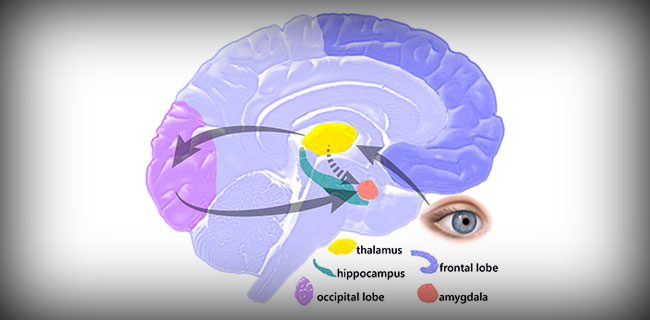
    The amygdala, according to Wikipedia, “is one of two almond-shaped clusters of nuclei located deep and medially within the temporal lobes of the brain. Shown to perform a primary role in the processing of memory, decision-making and emotional responses (including fear, anxiety, and aggression), the amygdalae are considered part of the limbic system. The term amygdala was first introduced by Karl Friedrich Burdach in 1822.”


    The neuropsychological study of amygdala activity shows patterns of anxiety, fear, social interaction, sexual behaviour, aggression, bipolar disorder and political orientation.


    The amygdala can be “hijacked” by aspects of fear and threat, leading to strong emotional reaction and a sudden onset of intense activity borne by overt aggression and orientation. The stimuli may also be irrationally positive bordering on aspects like sacrifice and protection. If the post-episode realisation of inappropriate behaviour happens late enough, the damage in a relationship or interaction may tend to be irreversible!


    So, if doses of threat of being marginalised can be balanced with those of sacrifice needed to restore majoritarianism and given to a population that has been living in a socio-economic vacuum, the results can be dramatic. Today’s deprivation can be justified by a missionary zeal for tomorrow’s hope. Remember the signs put up by the PWD when roads were dug up saying, “Today’s pain, tomorrow’s gain.”! This allows the emotional you to accept mediocrity and sub-par performance today in hope of prosperity and recognition later.


    This typically explains the contradictions in the responses in the MOTN report. They are a reflection of “Brand India” today.


    And this hijack has been used by many brands to good immediate effect, across the sands of time. “Nationalisation” and “Swadeshi” have been used right from banking to consumer perishables as a positive stimulus. Similarly, “Privatisation” has been used a negative one. We had Campa Cola being a “Swadeshi” aerated beverage when the rational mind would have asked the very logic of needing one in a poor country like ours in 1977 just because Coca-Cola was asked to exit. We have insurance companies and banks proudly boasting being “Indian” and therefore more credible than private players in ensuring your policies and money were protected. Logic of the number of public sector banks folding up and being gobbled up by larger ones would not work.


    Then there are brands that have always played the card of “protecting your interest”. This stimulus plays very well in the banking industry explaining brands like ‘North Kannara Goud Saraswat Bank’. This bank, run by a specific group of people, will be able to best protect the interests of that community. And we have more examples like ‘Catholic Syrian Bank’.


    Driving fear in areas like health and hygiene has worked in hijacking consumer response. The fear of contamination can be positively used like NDDB did with ‘Dhara’ in 1988. Or it can be a negative stimulus that Patanjali used to draw people away from direct competition like Dabur, Godrej and Unilever.


    And then, there is the TINA factor [There Is No Alternative]. Brands in near monopoly situations have used this to the hilt where the hapless customer actually justifies purchase. For years we praised the quality and service levels of a Hindustan Motors and Premier Auto dishing out the Ambassador and Premier. We were saddled with BSNL and MTNL for years, putting up with inefficiency. The nation was ‘happy’ with the Mahindra Bolero and Tata Sumo till the Toyota Qualis and Innova came along. The moment a viable alternative raises its head, the tides are turned, and the alternative becomes the near norm. The TINA factor is a mere illusion. Society and the marketplace always throw up alternatives. And they reinvent the game, set new benchmarks, and improve lives. Till the time they become totalitarian in nature.


    That is the time the amygdala waits for another hijack!


    Avik Chattopadhyay is a senior brand and business strategy consultant based in Gurugram. He writes on MxMIndia mostly every other Thursday. His views here are personal


  • Thank you for everything, 2020!


    By Avik Chattopadhyay


    German philosopher Friedrich Nietzsche had said: “That which does not kill us, makes us stronger.”


    The last 12 months have been fast, unexpected, furious, and merciless.


    They have also been full of introspection, unlearning, recalibration, and learning.


    I am not entirely crestfallen that 2020 happened despite the disruption and disaster it brought upon us. I am not one of those who wishes the year away and wants to erase it from memory. One cannot just erase the destruction of the atomic bomb on Hiroshima in 1945 or the trauma of our Partition in 1947. But if we, as humanity, come out of such events with a clearer mind and a stronger resolve, then they are helpful in the timeline of our evolution.


    On the last day of 2020 I have certain positive takeaways as a brand practitioner.


    The coming of age of “greater purpose”


    For years, this term has been doing whispers in the world of brand management and marketing. It stayed in the background as times were generally good for business and introspection into the “why” of the brand and its business space was missing for most.


    Those who did, definitely benefited from this disruption in behaviour and consumption. Those who had not, realised there was never a better time to ask oneself some fundamental questions on the ‘reason to exist’.


    As Nietzsche had said: “He who has a why to live for can bear almost any how.”


    Aligning with larger causes and movements


    The pandemic saw many significant social movements across the world. Incidents of strife, racism and authoritarianism also gave birth to causes. It was sure good to see a few brands clearly aligning themselves with such causes and movements. They consciously chose to stand for a certain belief and value system.


    In India too, we have seen a couple of brands take up certain causes or beliefs beyond business and stand tall. But they found little support. Also, most brands chose to stay away from issues of national importance like inclusion, harmony, and diversity. I shall not take specific names. The purpose is to hold a mirror before us to get more to take a stand. There is no point living in a cocoon, turning away from harsh realities around us or simply wishing them away.


    To again quote from Nietzsche: “There are no beautiful surfaces without a terrible depth.”


    The power of storytelling


    This is another crucial realisation to most brand managers and marketers that communication cannot be merely about product features and promotions but more about the life and times of the brand. It is an insult to the maturity of the Indian consumer that many categories still obsess with “best in class” and “first in class” rather than building affinity and aspiration by talking about the brand’s values and promise.


    The movement of content consumption from the newspaper to the mobile phone has allowed brands to communicate more and better, beyond transactional elements. Video and audio have become critical media for telling one’s stories. And compelling stories are not bound by space and duration. Just a count of how many videos and tracks we loved and forwarded on social media platforms is a good indicator.


    Process vis-à-vis Promise


    The deep introspection that most of us have gone through has allowed us to understand that what we typically thought of as a value or promise is actually a process or medium.


    Disruption is not a promise. Neither is innovation. Or digital for that matter. They are merely the means to an end. It is the end that needs to be clearly defined for that makes a brand distinct. The promise is the benefit or impact that the brand delivers to its consumer consistently over time.


    The brands that had this clarity realigned their promise to the current relevance of lockdowns, reduced salaries, higher anxieties, and the need for security, convenience, and empathy. They modified their business processes accordingly. For those that believed that their process itself was the differentiator and promise, failed in the process.


    To quote once again from Nietzsche: “There are two types of people in world, those who want to know and those who want to believe.”


    Conversational Augmented Intelligence it will be


    Call centres are dead. Chatbots are passe. Tomorrow’s engagement will depend on deep conversations with consumers using machines as intelligent interfaces. A 2020 joint study by IBM and O’Reilly Media predicts that the entire ‘backroom service’ industry will have to go through a massive overhaul in skills, empowerment, and enablers to deliver a more compelling brand experience.


    The consumer tomorrow will not always be a purchaser of a product or service. He /she may be one who has consumer through experience rather than ownership. This evolution in consumer behaviour was evident but has been speeded up over the last 12 months. This will need recalibration of roles, measuring scales, skilling and development of new ‘tools’ of the trade.


    For me the last 12 months have been mostly fulfilling. I have learnt to be more patient with life and impatient with the way I have peddled my trade of brand strategy and management. I have consciously unlearnt many rituals and processes in preparation of learning new ones. I have questioned the relevance and value I provide through my craft and challenged my own methods. If this pandemic had not happened and life would not have come to a standstill, I would never have done all this.


    So, I thank 2020 for all it has brought before me, from the growing economic disparities, increased social strife, greater divisions on lines of faith to the shining examples of collaboration, co-creation, and co-existence.


    As I step into 2021, I quote Nietzsche once again: “I still live, I still think: I still have to live, for I still have to think.”


  • Ubiquitous. Universal. Unanimous

    File Picture. Creative Commons


    On Maruti’s 37th birthday last week, our columnist and senior brand and auto industry specialist Avik Chattopadhyay goes first person


    Ladies and gentlemen,


    Terribly sorry for the delay in writing to all of you. Was caught up in my 37th birthday celebrations last week. It was quite something!


    So many messages. So many wishes. So many memories. So many little milestones to remember. Brought a tear to my eye actually. Never realised there is so much love for me still in the hearts and minds of people around me.


    A newspaper report announcing the big launch

    Life has been quite a roller coaster for me. it took quite some time to conceive me. Guess my mother took her time to choose her suitor and settle down. She finally did, with my Japanese father. The early days were not the best for me. you see, I was born a bit underweight in 1983. My mother was worried about my health. People kept telling her that this sickly kid would not make it. But I gave it my best, ably shielded in my mother’s lap. A few relatives came to our support in my initial years.


    By the time I was three, the tide had turned. I was a rockstar in kindergarten. The two bullies of my class were outclassed by me. The fat English one beat a hasty retreat. The slick Italian did put up a brief fight, given his extended family, but finally accepted to operate under my protection. I became a social magnet. Exams were cracked and the playground was conquered. Music and art classes were literally child’s play. I even took to the racetrack and licked it every time I stepped on to one. Teachers pampered me, the girls swooned over me and the boys wanted to be like me. school was a breeze.


    I brought about a revolution of sorts. People by the thousands came out on to the streets, from all walks of life. I gave them the freedom to move, the freedom to explore, the freedom to express themselves. Being seen with me was a matter of status.


    I entered college when I was only 14, having topped the higher secondary exams with record marks.  Stepped out of my town for the first time. There were newer people around me, from other towns, of different shapes and sizes. But my reputation had preceded me. After all, the state had never seen such a young topper in academics and all-rounder. I held my ground. Donned a new style and new ambitions to conquer a larger world now. Gave myself flashy new colours, new clothes and learnt new tricks. I might not have been the biggest guy but was still a favourite with the crowd. Was at every happening place…concerts, parties, shopping malls, marriages…you name it, and I was there. Ubiquitous. Universal. Unanimous.


    By the time I graduated, I realised that life would be getting more competitive and stressful. But my parents had never taught me to give up so easily. So, I stepped right into the professional world. Did not want to waste time on further academic qualifications. As a young lad of 18, you do not expect to get the best of jobs. You might be light on your feet, quick thinking and efficient at whatever you do but your size becomes a bit of a constraint. So, I had to plan my moves carefully. No point getting squeezed amongst the big guys without finishing my task. The early 2000s were also a turning point for India. The consumer had come of age. Life was rapidly getting global, connected and ambitious. The millions I had brought on to the roads now wanted a better experience. Quite natural of them. Life does not stand still for ever. I had to bring more millions on the roads… the ones who had never imagined so. I had to continue to be accessible and friendly. I was now this rockstar who was called in for nostalgia concerts. I knew that I could not continue this for much longer. Being on the road for twenty years non-stop does take its toll on health and constitution.


    So, I had to plan my exit…slow, smooth and steady. I had to prepare the next line of command and hand over the mantle of leadership. I had identified my worthy successor. He was now four years old. A strapping young lad in whose eyes I saw myself way back in 1988. He sure was modern, with a fresh outlook but not altogether different from my DNA. The task of drawing out more millions on to the roads had to be carried on.


    Some legends are born. They appear like the supernova. And then they go away in a burst of fireworks. And some legends are crafted. They take time to take shape and leave a lasting impact and a worthy successor. I happen to be of the latter type. And I have enjoyed every moment of this journey…the straights, the bends, the chicanes and the blind alleys.


    The last 10 years of my life were quite uneventful. Boring, to be quite honest. Just like leaders who have crossed their prime but are forced to stay put, I was made to endure the same vegetative state. But I tried to make the most of it by a thorough handover to my successor. And enjoying some special moments like when I saw a couple of 70-year-olds ambling along India Gate in New Delhi with the words “Narain Karthikeyan ka baap!” on the rear screen. Occasions such as these make a life worthwhile. Finally, after 31 whirlwind years of bringing 2.6 million Indians on the roads, I bid adieu in 2014.


    It has been six years since then. I have not had an obituary written about me. Nor an epitaph. No resting place for me. For I do not rest. I am still alive in the hearts and minds of millions. 2020 for all of you has been quite like the last 10 years were for me…waiting for it to end. For tomorrow will be better and brighter. So, here is wishing you all a terrific 2021!


    Your favourite “Mrooti


  • And the award goes to…


    By Avik Chattopadhyay


    Seems that the vaccine is playing spoilsport taking so much time to be readied and launched in India. Otherwise our world would have been so much safer by now. Damn pharma!!


    Over the last nine months, we have seen both product transformations and new product introductions that profess to either “boost immunity” or “kill 99% of the virus” or do both!


    Old brands have got resurrected in the process. Existing brands have gone into product extensions and new ‘verticals’. Thank the virus for all this feverish surge of innovation and quick-thinking. Advertising has also seen an upswing to promote all these wonderful solutions to beating the virus. Some brands have also taken the role of “public service” promoting hygiene rather than merely their own products.


    As this [calendar] year draws to a close, award functions have also started. I was waiting for one that would recognise these heroes. Why not? As long as they happen virtually, they are most welcome. Even the Nobels are going to be offsite and online this year.


    As no one has come forward, I have created my own ‘Indian Covid-19 Fighter of the Year’ Awards.


    Who qualifies for this? Not the doctor, the nurse, the healthcare worker, the vaccine volunteer or the ventilator, for they are merely ‘saving lives’ and nothing more. Boring jobs. No drama. Routine stuff. The ones who qualify are these amazing new products and solutions that boost immunity or kill 99% of the virus or do both. Highly exciting stuff, out-of-the-box thinking and disruptive. There were many that vied for a place on my list of “top 15 finalists”, across categories and segments.


    How did I arrive at the results? By studying their claims and clamour for attention through their communication across all media. Also, a quick dipstick with a few friends, and I was done with the ranking. While a few rankings had divided opinion, there were a few that drew unanimous agreement.


    So here are the 15 finalists in ascending order. They have been assigned to four clusters based on their ranking up the order. Ladies and gentlemen, boys and girls, the “Indian Covid 19 Fighter of the Year Awards”…


    Cluster #1 – The also-ran – the ones who gave a good fight but lost out in the eliminators


    15. Social distancing – started off quite well but lost steam as many took to distancing from other faiths, castes, and beliefs; clans got together stronger than before counterproductive to reasons of hygiene.


    14. Sanitiser – now as ubiquitous as salt and sugar in a household, this comes in all colours, fragrances, and concoctions; squeezees, spouts, atomisers, splash-ons; it is now India’s second most favourite cottage industry.


    13. Mask – this is the first one and who would have ever imagined that an item restricted to the hospital or a Japanese tourist would now become a fashion statement; this is haute couture now in various forms from the Madhubani cotton to one in gold encrusted with diamonds; only the Dilliwalas have been early adopters given their bi-annual tryst with air pollution.


    12. Face shield – usually comes in combination with the mask and had hoped for larger adoption but that did not happen; a nation that does not even wear helmets cannot be expected to wear a silly visor looking straight out of Star Wars; also does not have the potential of being a fashion accessory like the mask, so loses out.


    11. Soap – every soap worth its bubble now kills not only germs but also the virus…only that we do not know which exact one; pedestrian beauty soaps that only gave you supple and glowing skin are now your knight in shining armour too; but they kill only 99% of viruses leaving that one little black squiggle on the television screen staring at you, hence does not make the last six.


    10. Spray – take an aerosol can, fill it with ethanol, add some perfume and voila, you have a magic spray that kills the virus not only on surfaces but also in the air; if one were to believe some pieces of advertising, the virus behaves like those mosquitoes who hide behind curtains and sofas when confronted by the home maker and her aerosol can; definitely good business to be in as a paint brand has also thrown its own spray into the fray.


    9. Ordered Food – fright, anxiety, work-from-home and spending too much time with your spouse…all conditions for bingeing on food ordered online; a good counter to people learning culinary skills online, the service providers have had a field day, happy with the fact that crores have ordered so why should you be left out!


    8. UV Steriliser – that was not a microwave?! Case closed.


    7. Paint – if you are going to work from home, cook at home, fight at home, rear children at home and binge on OTT webseries from home, you home better be the safest ever, so, move aside sprays and sterilizers, here comes the paint that is the scourge of viruses. And it also smells good, so no more stepping onto your balcony for the morning ‘pranayama’. Just breathe in more of this wonder paint and you are taken care of.


    Cluster #2 – The winners – they nailed it and typically should have been gold, silver, and bronze but when you read further you realise why these ranks…


    6. Masala – 10,000 years ago when we were building our first city underwater, the first virus clashed with the first cumin seed leading to the ‘masala wars’; the home remedies came to the fore and our grandmothers nodded their heads in approval or smiled from garlanded frames; brands started rolling out “immunity boosting kits” containing a collection of various condiments that would put western pharma to shame – turmeric, garlic, cumin, coriander and ginger became the Panch Pandavas in our fight against the Corona Kauravas; definitely good for a bit of chest thumping but it’s just that we are going through the third wave of the pandemic!


    5. Ceiling fan – I could not believe this when I first saw this piece of advertising but one company has actually built a fan with a special coating that repels the virus; now all our problems are more or less solved with the fan and paint combination; why could this incredible piece of innovation not have happened before the virus hit the ceiling is anybody’s wonder!


    4. Namaste – if nothing else works then this definitely will; no more handshakes or hugs…just the age old “namaste” will be the answer; historical references to this posture go back to the Indus Valley Civilisation and while its purpose is surely noble, whether it keeps the virus away is worth a deep thought.


    Cluster #3 – Respondents’ choice – the final three ranks were additions were made during the dipstick; obviously beyond my ability to have even thought them up but then we are a democracy and people’s voice is what finally counts…


    3. Gamchcha – the rural towel has become a status symbol now as people in the corridors of power swear by its powers to keep the virus away; in various patterns, though always in cotton, it has symbolically built a bridge between the migrant worker and the minister for the ‘gamchcha’ is the latter’s way of demonstrating solidarity with the former. Surely a touching moment for the nation.


    2. Go-mutra – this was a special one; two drops of this magical potion can do wonders to your health, be it as a drink or as a floor cleaner!


    Cluster #4 – Legend – this requires no explanation


    1. Beard – it is THE beard, not just any beard; THE beard will ward off all evil just like it drove away the virus within 21 days of its landing on our shores; the ignorant spread useless canard about lack of hospital beds, loss of jobs and shuttered businesses for they do not realise that the more THE beard grows the weaker the virus becomes. This is what legends are made of.


    And that brings me to the end of the award function.

    Hope you enjoyed it. If you did, obviously you are having more fun in life than allocated to you. If you did not, it is expected as this year has taken its toll on our sense of humour. Hope it finally gets over and we crawl into a new one…


  • Brand lessons from the Biden campaign


    By Avik Chattopadhyay


    The Biden election campaign was one that I followed closely more from the perspective of brand building, nurturing and management right from June 2020 when he became the unanimous Democratic candidate. As a case study it is surely worth analysing if it has any lessons or pointers for brand managers and strategists.


    Maybe the campaign unfolded and grew in an unplanned manner, evolving with every passing day, but in hindsight, it sure has some key takeaways. If it was all planned as I see it then it is surely one of the most incisive and insightful campaigns to have been rolled out to such effectiveness.


    So, here are my 5 brand lessons from the 2020 Biden Harris campaign.


    Lesson #1 – Slogans or taglines not always needed

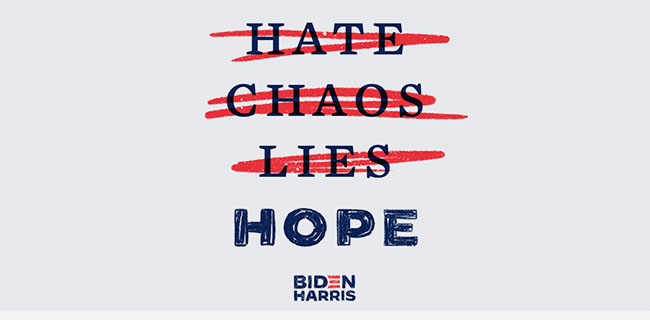
    The campaign did not have a slogan at all. It was simply “Biden for President” and then “Biden-Harris”. Simple and straightforward. No fuss. No frills. Nothing to outdo or counter Trump’s “make America Great Again”. Each state and town went ahead and built their own slogans that were most relevant to their desires and aspirations. So, every campaign need not have a slogan or tagline. As the occasion demands, being simple is simply super.


    Lesson #2 – Assert, don’t aggravate

    He knew his opponent too well and allowed him the rope to play himself to the hilt. In the process, Trump ended up alienating more than those he embraced. Guess the average American voter, irrespective of allegiances, somewhere wished less rhetoric and more substance to allow him / her to finally decide. This was crucial for it went down to the wire. So, the focus needs to be on two things for a brand manager – quality content over the mere ability to amplify, and the tone of voice to be chosen for the campaign.


    Lesson #3 – Include and involve

    Biden ensured he took along every Democratic presidential candidate with him after he became the front-runner and final choice. This was crucial to ensure maximum internal buy-in and support from all corners of the party. Trump was all about himself and a certain part of the Republican Party actually wished he lost and closed his own case. Also, the Biden campaign was hugely inclusive in actively involving people of all ethnicities and economic backgrounds. The Trump campaign was run by specific sections of American society who were either of a certain colour or a certain economic class. So, the lesson for the brand manager is that for any campaign to be successful, one needs active buy-in of all key internal stakeholders.


    Lesson #4 – Always pays to say “Sorry”

    Humility and candour never go out of fashion, in any culture and in any situation. Biden displayed both in his journey as a senator, apologising if he made a mistake. That is a quality that creates instant affinity that sustains lifelong. One just cannot imagine Trump ever acknowledging a misstep, forget a mistake. The Biden campaign obviously encashed heavily on this value system of their candidate versus an incumbent who was given to inconsistent raving and ranting. The same applies to any brand in our everyday lives. It sure is tough to say “I am sorry” before your customer or prospect but the ability to say so will reap priceless equity for the brand.


    Lesson #5 – Build in flexibility

    Planning a campaign well is good but making it water-tight is not a virtue in today’s dynamic times. The Biden team built in enough flexibility to allow modifications and changes, big and small as the campaign rolled along, without losing the core narrative. This allowed customisation of the narrative in each state and also rapid improvements based on feedback. Studying pictures of his campaign across various cities I did not see the same messages being used or carried on placards and banners. While Biden and Harris remained central, the stories around them were ably tailored to appeal to specific vote pockets. This is crucial in today’s brand campaigns too which depend more on social media platforms that are intrinsically dynamic and fluid in nature. This also requires new skills for the brand manager to be engaged in the campaign till its entire timeline and not rest easy once it rolls out.


    I am sure there are lessons from the Trump campaign too.


    It was obviously the most beautiful campaign, the most loved and the most followed.


    It was a campaign befitting that of a winner.


    It was simply humongous and awesome.


    Just that the required numbers did not take the bait.


    Thankfully!