Tag: Ashoke Agarrwal

  • Happy Birthday, ONDC! Aren’t you on a roll?!


    By Ashoke Agarrwal


    Ashoke AgarrwalIndia is proud of the digital stack it has created with Aadhar and UPI, which is bringing more of India’s informal economy into the formal financial channels. In addition, the digital stack allowed India to launch a very successful formally certified Covid vaccination programme at all levels of the socio-economic strategy—the digital stack in the public health and e-government sectors is in the works.


    Even based on the above achievement, India’s public digital infrastructure is genuinely world-class.


    Add the Open Network for Digital Commerce (ONDC) to it, and India’s digital public infrastructure will take another world-beating leap forward.


    ONDC is a Section 8 (non-profit) company launched a year ago as an initiative of the government but funded by non-government means and managed by an independent Board.


    ONDC’s launch was a low-key affair, and its progress went mostly unnoticed over most of the year. But as it celebrated its birthday this April, it is emerging as the paradigm-shifting concept it is.


    The impetus for ONDC came because of the profile of the e-commerce sector in India as it has emerged in India compared to its overall retail industry.


    1.2 crore (12 million) of Kiranas (hyperlocal neighborhood provision stores) account for 80% of India’s retail sector. However, 90% of the Kiranas are in the unorganised sector and digitally excluded. Moreover, 4.25 crore (42.5 million) of India’s medium and micro enterprises (MSMEs) are not part of the digital revolution. Only 20% of internet users are online shoppers at the shopper end.


    This is the chief reason for the low penetration of e-commerce in India. The GMV of e-commerce in India in 2020 was Rs 2.85 lakh crore (Rs 2.85 trillion, USD 38 billion in nominal terms) which adds up to just 4.3% of the total retail sales as compared to China at 25%, South Korea at 26% and the UK at 23%.


    An alternative before the decision-makers were to let private e-commerce integrated platforms like Amazon and Flipkart drive the growth of e-commerce. Such an option would leave the e-commerce market to those with the capital to make the significant investments an integrated platform requires. Moreover, dependence on integrated platforms would lead to exclusion and discretionary behaviour, which will likely leave much of India’s Kirana and MSME sector out in the cold. Another reason why integrated e-commerce platforms undercut both sellers and buyers is that the data and credibility that accumulates, which by all rights should be the property of the buyer or the seller, is appropriated by the platform. In that way, an integrated platform dams value and prevents it from flowing across the entire ecosystem.


    The solution was to build an open network for e-commerce that is akin to the open networks like Internet Message Access Protocol (IMAP) and Simple Mail Transfer Protocol (SMTP) that drive the e-mail ecosystem, the Hypertext Transfer Protocol (HTTP) that underpins the web and our own UPI that creates an open network payments ecosystem.


    ONDC’s design of an open network for e-commerce is an exercise in disaggregation. ONDC provides the plumbing and the basic rules to buyer-side Apps and seller-side Apps, along with service providers like logistics, technology, and other service providers like analytics to freely interact with each other.


    So, if a buyer through a buyer App searches for a particular product type, the ONDC network would list products from all the seller Apps. Once the buyer chooses a specific seller, he can choose from various delivery service providers. The ONDC platform has no single owner, and all the entities – buyers, sellers, and service providers – are equals and are owners of all the data they generate and can use it within the constraints of privacy rules. ONDC is an innovative breakthrough in making a community-owned e-commerce infrastructure that allows the flow of value across the community in stark contrast to the hogging of value by integrated platforms owned by a single entity.


    This design can bring India’s vast semi-organized and unorganized sectors into the low-friction e-commerce world. Hence, it has the potential to add many percentage points to India’s GDP growth.


    However, from design to delivery is a long process which needs catalysts. During the first few months, one wondered where the triggers would come from. Over the past few months, the contours of the ONDC community have emerged. HUL and ITC became part of the ecosystem. ONDC offers them a readymade platform for “e-commerce” their distribution to the millions of Kiranas they deal with. It also allows them to strengthen their trade relationship by helping Kiranas become e-commerce players in their neighborhood. After its divorce from Walmart, Phone Pe announced its initiative, “Pincode”. Pincode will be a hyperlocal commerce App that connects local stores to neighboring consumers. At the backend, they will enable its partner stores and Kiranas to become e-commerce ready. Another promising avenue that ONDC illustrates is a ride-hailing App called Namma Yatri that offers three-wheeler rides in Bangalore with zero commission charges to buyers and sellers. In a few months, 45000 auto drivers on the App and half a million users have used it. What is Namma Yatri’s business model? It all falls into place when you realise that the Auto Driver’s Union owns the App.


    Today, the ONDC has 26000 merchants and 27 lakhs products on its network. It recently extended its categories of products from food and groceries to beauty, fashion, and electronics. Its logistics provider network can serve 90% of pin codes in India. The transaction volume is still low – at 600 a day- but the signs of being on a hockey stick path are all there.


    Recently Amazon announced plans to join ONDC as a logistics provider and with SmartCommerce, an AWS-powered suite of SaaS products that will enable MSMEs to board the ONDC network. T Koshy, the Chairman of ONDC, welcomed the giant and, in a subtle dig, opined that he hopes they will soon bring their buyer and sales platforms to ONDC! Or was Mr Koshy taking the micky to Amazon? Way to go, Mr Koshy!


    As the ONDC network matures, it will open new vistas in hyperlocal and MSME marketing, branding and advertising services. The marketing and advertising services industry must figure out innovative structures and systems to serve this demand. If the ONDC universe takes 5% of the total retail cake a decade later, it will be Rs 5 trillion market. As a result, spending on marketing advisory, analytics, martech, adtech, branding and creative services can be as high as 6 % of the total sales, a Rs 30,000 crore market mainly in fees and production costs. A significant share of this market will go to agencies and consultancies that jump in today to grasp the dynamics of the ONDC system as it develops.


    In sum, ONDC will be the next giant digital leap India makes and could open a global market for one more Indian concept and service. So, let’s wish it luck and Godspeed.

     

  • Advertising in the Gameverse: The Need for a New Paradigm


    By Ashoke Agarrwal


    Ashoke AgarrwalWhile the Metaverse is just a gleam (fading?) in Zuckerberg’s eyes and Large Language Models is the latest hot tech trend, the Gameverse has, over the past decades, changed, almost unnoticed, the media world.

    The numbers are impressive enough.


    The forecast is that consumers will spend USD 185 billion globally on video games – five times more than they will spend on cinema and 70% more than what they will spend on TV streaming services like Netflix. The latest Harry Potter title, “Hogwart’s Legacy” – a video game – took in USD 850 million in two weeks. Gaming concepts are spawning TV and movie spin-offs- “The Last of Us” on HBO and the upcoming movie – “Tetris’ – on Apple TV. Increasingly powerful smartphones put gaming consoles in consumers’ pockets, increasing the time spent on games. Smart TVs, streaming and subscription libraries will further accelerate the growth of games. In 2022 3.2 billion people – four in ten worldwide played video games, rising by 100 million annually. Gaming occupies the entire engagement spectrum – from individual absorption to small and large group play to a mass spectator activity that is e-sports. E-sports is now among the big leagues of sport. For example, Riot Games sold the streaming rights of its Chinese league to Huya, a streaming service, for USD 310 million. The Asian Games in September will include digital games.


    Besides the growing audience for professional e-sports, there is an equally large audience for user-generated gaming content. With its USD 30 billion ad revenue, YouTube says gaming is its second largest category after music. In addition, Twitch, a user-generated gaming content platform, has over half a million quarterly active streamers. Gaming-As-A-Service (GAAS) is a growing business model. “World of Warcraft” offers a subscription service with regular updates to maps, missions and characters. Grand Theft Auto has blockbuster sequels, and GTA Online offers continuously refreshed content at $6 a month.


    What about gaming in India? In value terms, it is small but growing – USD 1.2 billion in 2020 and projected to grow at a CAGR of 26%. However, gaming’s reach in India is already high. Five hundred and ten million people played video games in India in 2022. 94% of Indian gamers use mobiles as their platform, 9% use PCs and 4% play on consoles.


    Over the coming decades, will India leapfrog into being an advanced video game market? Perhaps, given the fast pace of technology diffusion as a society transits upwards economically.


    Given the preferences of the young and its multi-directional growth, gaming will be the driver of a new media paradigm.


    What about advertising in the Gameverse? Does it need a new paradigm?


    Advertising strategy and grammar underwent a paradigm shift from the age of print to the age of radio and then TV. Over the last two decades, with the advent of search and social media, performance marketing has driven a seminal shift in advertising grammar. In addition, the age of generative AI will significantly impact advertising processes and economics.


    If brands and their advertising are to harness the opportunity that gaming presents, they will have to resonate with gamers’ unique needs and motivations.


    A 2020 book – Games: Agency As Art by C. Thi Nguyen – offers insight into why games engage people.


    Games engage because they are a motivational inversion of life. In life, means are for the sake of ends; in games, ends are for the sake of means.


    People play games because they offer them the chance to assume different roles within a given set of rules. The gamer plays to achieve a particular end, but the engagement and enjoyment are in the playing. The core motivation driving gaming engagement is that it offers the gamer an agency different from his real-life persona. This agency transformation is true not just for video games but even simple games like card games of poker or rummy. Many highly engaged players of these card games assume a game persona that is very different from the real persona. For example, a quiet man transforms into a chatty one at the card table, and a chatty one becomes the strong, silent type.


    The highly creative and immersive worlds of modern video games multiply the agency that games offer to unprecedented levels.


    The mediums of television, radio and advertising offer convenient spaces where advertising can insert itself without any connection or reference to the content it has interrupted. The creative challenge here is to overcome the irritation caused by the interruption. This challenge multiplied with the arrival of the multi-channel world and the remote control, but the core challenge and the response remained the same.


    In the era of performance marketing, the creative challenge of overcoming the urge to ignore remains. However, the grammar has shifted with the arrival of performance marketing; the objective now is action – click a link – and not the amorphous building of brand awareness and equity.


    In the Gameverse, interruption is not a challenge; it is taboo, given the intense nature of the engagement. Instead, the advertising’s challenge in the Gameverse is multi-fold:

    :: An advertised brand needs to be present as an integral part of the gaming experience and not as an interruption.

    :: The brand needs to allow the gamer to remain in their chosen persona.

    :: Outside the game, the gamer’s interaction with the game continues by creating and watching user-generated content and e-sports events centred on that game. The brand can maximize its impact by a) enabling the gamer to generate content and b) enhancing the gamer’s experience as a spectator of e-sports or other user-generated content.


    The path to profiting from advertising in the Gameverse is to choose a shortlist of games to focus on and build a 360-degree customized strategy for each game. The advertising strategy focused on a specific game that follows the tenet of going with the game’s flow can only be achieved in collaboration with the game creators. Therefore, good advertising within a game is not about buying space and time but about a creative partnership with the game’s creators.


    For example, a brand could offer a bonus race in a specially branded car in a car-racing game. Red Bull has done so in some games.


    The higher the degree of integration into the game, the greater the impact and, thus, the ROI for the advertiser’s brand. For example, a game-integrated brand could offer players a branded assistant who analyses, offers tips and gives pep talks. With advances in generative AI, such a strategy offers fascinating possibilities. Moreover, this assistant becomes a part of the content creation and e-sports-watching experience outside the game.


    Is the Gamverse advertising opportunity category agnostic? TV, press and digital are product category agnostic in that advertising across product categories can be effective with the right creative and media strategy.


    Given its unique characteristics, advertising in the Gameverse can be genuinely effective for categories and brands that, at the core, connote a persona and a lifestyle- fashion, personal accessories, cars etc.


    The estimate is that in 2020 advertising in the Gameverse worldwide was USD 65 billion. By consensus, the most effective brand with its Gameverse advertising strategy is Red Bull, with a Gameverse budget of nearly USD 600 million. Red Bull’s core brand proposition is that it empowers its consumers – encapsulated in the theme “Red Bull Give You Wings”. This brand proposition resonates in the Gameverse, where the primary motivation driving Gamers is, as Ngyuven’s book proposes, to find a new persona, a new agency – a new set of wings.


    To sum up, if your brand is considering the Gameverse as a medium for advertising, first make sure that there is a fit between your brand’s proposition and the essential motivation that drive gamers. The subsequent steps then consist of finding a suitable game or a concise list of games to focus on and building a partnership with the game developers to create a highly integrated brand presence in the game.


  • What’s common to advertising & cricket


    By Ashoke Agarrwal


    Ashoke AgarrwalI am a student of both cricket and advertising.


    The cricketing season in India starts in the post-monsoon months and nears its end in the dog days of April with the IPL. As the different hues of cricket play out this year, the parallels between cricket and advertising strike me.


    Cricket is the only sport with three widely played versions – Tests, One-dayers (ODIs) and the T20s. The shorter versions – the ODIs and the T20s – are later versions of the game whose oldest form is the five-day Tests.


    Let’s think of advertising agencies as the players, their client brands as the team they play for, and the advertising campaigns the agency and the brand management create as the type of cricket match.


    Test matches are games of deep strategy akin to a game of chess—the results of a Test take days to unfold. A Test match might end without a winner, but with every Test, a player’s reputation is either enhanced or diminished.


    An advertising campaign akin to a Test match focuses on creating a long-term positioning and equity for the brand. Therefore, the campaign’s planning horizon is over the long term, measured in years. Like in cricket, in the “Mad Men” era of advertising – stretching from the 50s to the 80s – Test-type campaigns were the norm. In the Test match era of advertising, the client’s management considered their advertising agencies as brand custodians and partners and paid them as such. As a result, advertising agencies could afford to hire intellectual and creative talent that could deliver long-term results, setting up a virtuous cycle.


    In the late eighties, Wall Street replaced Madison Avenue as the valued partner of companies in the US. The phenomenon soon spread across the world. As a result, the planning horizon shrunk from years to the next quarter. And the era of the ODI began in advertising.


    Client management tasked agencies with creating ODI-type campaigns to deliver sales and results reflected in the next quarter’s financials. As a result, agencies took on the role of a vendor who supplied services to specifications set by the clients. As a result, agency compensation changed to reflect the new realities, and agency talent pools shallowed.


    With the digital age coming, the era of T20 in advertising dawned. Performance marketing became the new mantra, and the planning horizon shrank further from the quarter to the click of a like, share or buy button. Agencies became clickbait suppliers, and desk jockeys’ armies paid like wage earners while the platform behemoths like Facebook and Google ate everybody else’s lunch.


    Like in cricket, all three forms of advertising – Tests, ODI and T20 – continue to co-exist with Test and, lately, ODIs yielding market share to T20s.


    Like top-rung cricket players like Virat Kohli and Ben Stokes, who are superb at all three forms of cricket, a few super agencies play, and the brands they handle continue to create all three types of campaigns. But the preponderance of agencies and brands, driven by market realities, are becoming predominantly T20 players.


    The super agencies cross-pollinate the skills and capabilities practising all three forms of advertising. Test teams, like the current English team, win Tests playing “Baz Ball”, bringing the aggression of T20 to the Test arena. Super agencies can bring speed and accountability to long-term brand-building campaigns—or strategic nous to the daily toil of performance marketing.


    Over the next decade, AI is going to change many businesses. How will it change advertising? Will AI engines take over the quotidian tasks of the ODI and T20 kind of advertising? Will the business of advertising go back to being the fine art of positioning, building and nurturing brands over periods of years and decades? Will such agencies attract, once again, a new generation of brilliant strategic and creative minds?


    While we ponder advertising in the age of AI, let me give you a taste of why the much-ballyhooed generative AI technology is unlikely to replace true creativity in advertising in the near future. I asked Chat GPT to provide me with a 50-word mini-essay on “Why Advertising is like Cricket”. Here is the response.


    Advertising and Cricket both require strategy, patience, and a keen eye for opportunities. In cricket, a team must carefully plan their moves, adjust to changing conditions, and seize moments of weakness in their opponents. Similarly, in advertising, a brand must develop a clear strategy, adapt to changing consumer behaviors, and capitalize on emerging trends. Both cricket and advertising also rely on effective communication and teamwork to achieve their objectives. Finally, just as cricket has its own set of rules and regulations, advertising also operates within a set of guidelines and best practices to ensure fair play and positive outcomes for all involved.”


    Isn’t it as bland as can be? I suspect it would be the same answer if I replaced “Cricket” with any other team sport or “Advertising” with any other business service. Try it for yourselves. This proforma response is because the core of the current state-of-the-art generative AI bases its response on probability curves trained on static data without any actual capability to explore the context and synthesize creativity.


  • Full Circle to Full-Service?


    By Ashoke Agarrwal


    Ashoke AgarrwalTime was when advertising agencies were both right-brained and left-brained. One would walk through an agency office and encounter both the joie de vivre of the creative impulse and the commercial nous of the media buyer.

    And then, about two decades ago, agencies got lobotomised.

    Now we have creative agencies who primarily work on a retainer and media agencies who earn their keep the old-fashioned way – through media commissions.

    The reason behind this split was chiefly commercial. As competitive pressures in the consumer marketing world increased, the business model of fifteen per cent agency commission on ad spending that sustained the ancient glamorous advertising world collapsed. As a result, agency honchos needed to invent a new business model, and in their wisdom, they chose lobotomy.

    They created sweatshops called media agencies that could sustain themselves on ever-falling media commissions. At the same time, they hoped that the creative-only agencies they fashioned would retain the mystique and the fat profits.

    Two decades down the road, another upheaval is on the horizon.

    The increasing dominance of digital and performance advertising is shifting the advertising landscape.

    The 24×7 A-B testing world of digital and performance advertising blurs the lines between creative and media. The lightning-fast feedback loop calls for an agile, creative response. That is why most large media agencies have digital advertising divisions armed with creative people. Furthermore, many consumer marketers also need brand management to be part of the agile response loop. They, therefore, are opting to house the digital advertising wing in-house.

    The dynamics of mass media advertising are also changing. In the heydays of mass media, advertising campaigns used to be seasonal. In India, we used to have two advertising seasons – summer and winter. So every year, ad agencies would roll out a campaign at the beginning of a season and sit back and collect commissions. A key factor driving the longevity of advertising campaigns was sky-high production budgets for television commercials. Shooting a TV commercial involved prima donna directors with inflated egos and budgets.

    Today, advertising on what remains of mass media, is fast adapting to the fast-paced rhythms of digital advertising, with tactical considerations driving frequent shifts in mass-media advertising. Another factor driving the creative challenge is that brands are more proactive in launching new products, packaging and price variants. In addition, the emergence of CGI and changes in videography and post-production technology have crashed video production costs, further encouraging a more dynamic creative scenario in digital and mass media.

    Changes afoot in media research are likely to bring the tight performance feedback loop that digital currently offers to mass media. As of now, the measurement of mass media exists only in silos. However, fully-integrated platforms will likely emerge over the next few years. These platforms will integrate the measurement of all kinds of media – TV, press, connected TV, social media, digital, e-commerce, OOH, radio and cinema – and brand lift – awareness, consideration and purchase.

    Once the performance feedback loop of all media is tight, it will become natural for clients to seek an equally agile response loop necessitating a re-integration of the media and creative functions. The full-service agency would have come full circle.

    Over the medium term, we will also see the emergence of a new kind of full-service agency. Over the next decade, AI will result in a paradigm shift in marketing communication.

    I have written about this coming shift in two recent MxMIndia columns:

    :: The Way Forward, dated Dec 22, 2022

    :: AI, B2I, CI and Advertising, dated Nov 24, 2022

    The full-service advertising agency of the coming decades will house, besides creative and media, a cutting-edge AI technology function. And this new-age full-service advertising agency will bring advertising back full circle where it will, once again, sit at the client’s high table of marketing and business strategists.


  • Ashoke Agarrwal: The Diffusion of AI: What do the marketing models predict?

    Ashoke AgarrwalBy Ashoke Agarrwal


    Artificial Intelligence (AI) is poised to be the next general purpose technology that changes human society and the economy. Indeed, as big as electricity. Some, like Satya Nadella, believe that AI will create a paradigm shift at the civilisational level, like pre-historic humans learning to control fire.

    Beyond the hype, over the past few years, AI has emerged as a reality in big business, government, and the military. For example, Palantir uses data hoovered up by the US government’s National Security Agency to feed AI engines that throw up political and military strategies to shore up the US’s pre-eminent position on the world stage. But then, no amount of AI can compete with human stupidity, as is evident in the great drama of US politics.

    AI has also made its appearance in the day-to-day lives of ordinary citizens. Siri and Alexa are two examples. And the release of ChatGPT has seen the emergence of AI in the pantheon of instant celebrities.

    It is clear now that AI will be a crucial driver of economic growth over the next few decades. This column briefly applies known models of new technology marketing to AI’s coming diffusion and growth.

    I became aware of Geoffrey Moore’s book “Crossing the Chasm” a couple of decades ago when a Silicon Valley entrepreneur I was working with insisted that we cast our strategy based on Moore’s model of the technology adoption life cycle. Over the years, I have learnt that many marketers of technological innovation swear by Moore’s model. Over the decades, Moore has refined his model further. His book “Inside the Tornado” has the latest iteration.

    However, before we look at the possible diffusion of AI through the lens of Moore’s model, we need to refer to a technology marketing theory that impacts a much earlier stage.

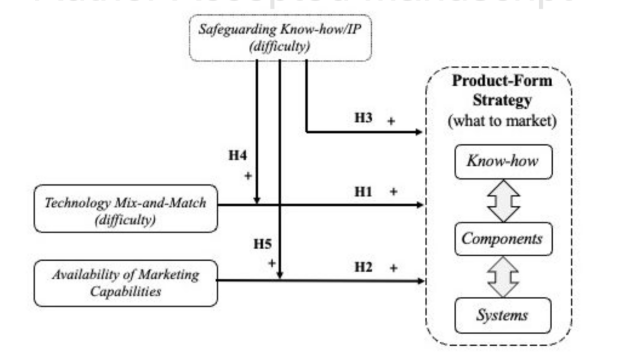
    The Theory of Product Form Strategy (PFS) postulates every innovator of new technology faces a product-form decision at an early stage of building a business out of his innovation. The innovator company has three choices: Market the Know-How, Market a Component, or Market A System.

    Frias, Ghosh, Janakiraman and Duhan, in a pre-print manuscript submitted to the Journal of Marketing titled “A Theory of Product-Form Strategy: When to Market Know-How, Component or Systems.”, have an interesting illustration of the PFS Theory. For example, consider an innovator who has developed a technology that tracks the mechanics and dynamics of a baseball bat as it meets the ball, allowing coaches to refine a batter’s ability. As a result, the innovator can decide to sell the technology to a party that decides how to market it. Alternatively, the innovator can develop the technology into a component that fits on a bat and market it to bat manufacturers.

    The third alternative is for the company to get into bat manufacturing and build a bat brand based on its advanced technology.

    Ghosh et al. found that three factors drive the PFS choice:

    :: How easy or difficult is it for the innovator company to safeguard the know-how?

    :: How easy or difficult is it for the innovator company to mix and match the technology to create the component?

    :: How easy or difficult is it for the innovator company to market a system?


    Fig I The SPF Decision Tree from a paper by Ghosh et al.


    Let us apply the SPF model to the two current leaders in the field of AI – OpenAI and Deep Mind.

    OpenAI, given its roots as a non-profit do-gooder (now largely abandoned), is likely to license its know-how. OpenAI’s licensing policy will create an ecosystem of established players and start-ups that either go to market with components or entire systems. The nature of OpenAI’s deal with Microsoft has yet to be made clear. At one level, a licensing deal allows Microsoft to incorporate OpenAI’s technology in Bing. But then Microsoft is now a substantial owner in OpenAI and can impact OpenAI’s go-to-market strategy.

    The other big player, Deep Mind, is already inhouse to a technology giant – Alphabet. However, Alphabet is unlikely to license its AI know-how or even market-specific use-case-driven components to others. Instead, its goal would be to morph into an AI behemoth which markets specialized AI systems across sectors and use cases.

    We will discuss Alphabet’s likely path to this dominance in the context of Moore’s model.

    The other tech giants in the AI game are Meta, Amazon, and Apple.

    Amazon and Apple already have Alexa and Siri as AI products in the market and have become household names. In addition, Amazon Web Services (AWS) offers a software suite to support AI development and applications as a part of its services. Apple promotes on-device AI-driven recommendation engines on its iPhones as part of its privacy promise.

    Meta’s botched soft launch of Galactica, its AI engine designed to summarize scientific research papers in any specified area, may hide a deep and evolving AI capacity.

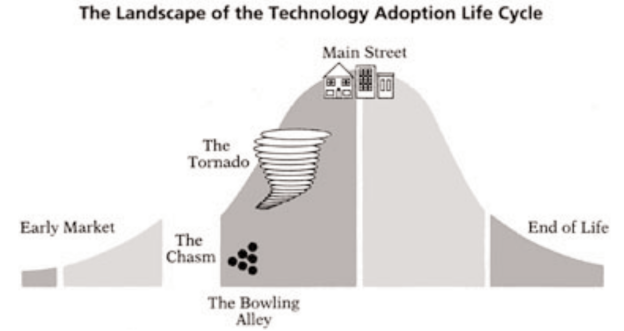
    Once an AI innovator has decided on its PFS strategy, it must navigate Moore’s Technology Adoption Life Cycle.


    Figure 2: The Technology Adoption Life Cycle as stated in Geoffrey Moore’s “Inside the Tornado”.


    Moore’s “Crossing the Chasm”, first published in 1991, was a cautionary tale about how many technology innovators could not cross the chasm between appealing to the revolutionaries and the visionaries of the small Early Market and being accepted by the pragmatists and conservatives in the much larger Main Market.

    In his 2004 book “Inside the Tornado”, Moore formulated a strategic recommendation for crossing the chasm.

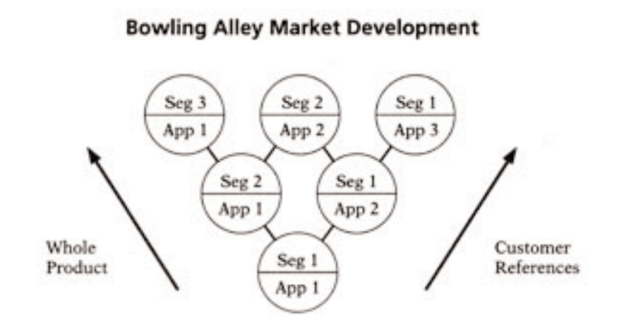
    His fundamental idea was for a tech innovator who had found success in the Early Market to focus on a niche market by developing a component or system based on the specific needs of the niche and then focus all his marketing and sales resources on that niche market. Moore calls this strategy Bowling Alley Market Development.


    Fig 3 Bowling Alley Market Development for Moore’s “Inside the Tornado”


    In his book, Moore states the cases of Lotus Notes, PeopleSoft, and Sun Microsystems as examples of the success of the Bowling Alley strategy.

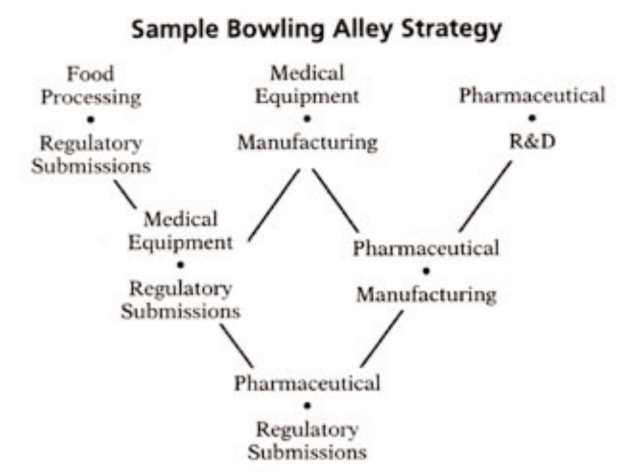
    He also illustrates the Bowling Alley strategy of a documentation company that starts by focusing on the documentation required for filing a new drug patent. Subsequently, the domino effect of falling bowling pins allows the documentation company to expand to capture adjacent markets.


    Fig 4 Example of a Bowling Alley Market Development from Moore’s Inside the Tornado”


    Can we envisage the Bowling Alley strategy of OpenAI and Deep Mind?

    OpenAI, if it sticks to the PFS strategy of licensing its technology, will leave the Bowling Alley strategy to others who license its technology. On the other hand, if the Microsoft tie-up is a buy-out, OpenAI becomes a player like Deep Mind and has to think through its Bowling Alley strategy.

    Will Alphabet’s main business of search and advertising determine the Bowling Alley strategy of Deep Mind? Many wonder whether Google, like Bing, will try to incorporate its Large Language Model driven AI into its search engine. The alternative is that Google starts its Bowling Alley play with expert systems that focus on specific areas of business and science.

    The final stage of the Technology Adoption cycle is when the technology becomes a part of the core infrastructure of society and the economy. It happened in computers.

    As Moore puts it, in the Bowling Alley phase, the product is defined by the customer’s expectation, while the product defines the market in the Tornado phase.

    In the Tornado phase, AI will become a part of society’s infrastructure, like electricity or computers. The Tornado phase will also wean out players and give rise to a couple of companies with a lion’s market share. Will t Alphabet, Microsoft, Meta, Amazon, or Apple find a place among these giants? Or will it be new players who we have yet to hear of it today?

    These are exciting times for technology watchers and prognosticators.

    The rise of AI may give rise to new models of the diffusion and marketing of technology.


  • Data Barons: Will tech hoist them on their own petard?


    By Ashoke Agarrwal


    Ashoke AgarrwalThe past three decades have seen the rise and rise of the Data Barons, chief among them Alphabet and Meta. Like the Robber Barons of old, these giants have infringed on private and public rights and sought to profit even if it meant causing harm to individuals and society at large.


    When Google and Facebook started, their implicit pact with consumers was to provide them with quality free services. However, what was in it for them could have been more explicit in the compact. But it wasn’t. I do not believe that Google and Facebook, at first, were clear about their business model. In time, however, they discovered the gold mine, consisting of sneaking in on users, hoarding their data and then using it to permit advertisers and marketers of all sorts to target them with messaging. Apple has, up until now, resisted the temptation to Data Barondom – probably because they are busy mining a gold mine of their own. However, as innovation flags, Apple is seriously considering adding advertising to its revenue stream. Over the past few years, Amazon has also set out on the road to Data Barondom. In the case of Amazon, though, their core compact with consumers of selling them goods and services makes targeting advertising to them a natural corollary. Soon the OTT giants Netflix and Disney Plus will bid for Data Barondom of their own.


    However, in a few years, these Data Barons will be reined in. The EU’s GDPR is just a first step. In time the same technology that enables these digital giants to make money based on an individual’s private data will be used to force them into a more equitable arrangement. Hoist on their petard.


    Let me explain. Linear TV and print publications serve advertising en masse—the contract to air an advertisement on specified time slots or pages on a specific day or issue. Media planners expect the ad to reach a certain quantity and type of target audience. However, there is no way to isolate the serving of the ad to a specific individual.


    On the other hand, every digital screen, be it a smartphone, a tablet, a laptop, a PC or a connected TV, can be linked to a specific user. All the powerful platforms insist on a user signing in before usage.


    In this case, the contract is, at the core, to serve an ad to a particular individual. And this fact will allow the platform to share the revenue it generates from the advertisement with the individual! But, of course, this will only happen if forced by regulation. Later versions of rules like GDPR will likely get around to doing so.


    These rules will allow an individual to pay upfront for an ad-free service. However, if the individual opts to receive ads, his subscription fee will be deducted from his share of the ad revenue.


    While this rule will pay the individual for the use of what is essentially his property – his data and his attention – it will still leave the question of the echo chambers that the algorithms that social media platforms use to increase engagement.


    While the harmful effect of these echo chambers is evident, any effort to combat them through regulations runs into the larger argument that free speech is a foundational human right. Every piece of content put out into the public sphere – books, journalism, entertainment – puts out overtly or covertly a point-of-view. It is up to the individual how she responds to that point of view. It is best to combat the rise of echo chambers using the open vistas of free speech.


    However, all the above arguments could be moot in a decade or two. Advertising will give way to two-way messaging between an individual’s AI avatar and the AI engine of brands and platforms. I envisaged this in my MxMIndia column dated January 6, 2022 titled ’The Coming Post-Digital Age’.


    As for social media algorithms that control what users see, they will go the way of linear TV. Instead, the algorithms will have to negotiate the feed with the individual’s AI avatar. And the individual will control the settings on her avatar. So AI will progress to be not the Big Brother that some people fear but an individual’s brother from another mother – protecting and enabling. Or it could be both. Whichever, we are set for an exciting ride into the AI era.


  • Generational Marketing & the Post-Post-Modern World


    By Ashoke Agarrwal


    Ashoke AgarrwalThe concept of generations as a social class began as most social ideas do in literature. Gertrude Stein coined the phrase “The Lost Generation” as a signifier of the age cohort that, in early adulthood, experienced World War I and their “directionless, disoriented, wandering” spirit after the war.


    In 1928, Karl Mannheim posited a theory of generations in his German essay – “Das Problem der Generationen”, translated into English only in 1952.


    The theory of generation entered advertising in the 1960s and 70s with the practice of market and consumer segmentation and entered product development and marketing communication. Over the subsequent decades, generational marketing became a foundational marketing practice in the US.


    In time, the practice of marketing defined a generation as “a cohort of people born within a similar span of time (15 years at the upper end) who share a comparable age and life stage and who are shaped by a particular span of time (events, trends and developments).


    With advances in travel and communications, a global culture began to develop among the affluent and educated classes. Over the past few decades, as the globalisation of consumer culture has strengthened, marketers across the globe have been using a global generational segmentation framework:

    • Baby Boomers born between 1946 – 1964

    • Generation X 1965-1976

    • Millennial 1977-1998

    • Generation Z 1996 -2010


    Generations as a market segment become relevant as the cohort ages to become decision-makers in the consumer market.


    The generational segmentation framework, as stated above, is most relevant among the developed Western countries because of a commonality in the dominant culture and a common social, political and economic history. In other countries, there have been attempts to define a more relevant framework. However, these attempts have been sporadic in India. Indian brands and advertising planning set-ups have, by and large, stuck to the global framework.


    Arun Jagannathan sets out an example of a generational framework custom-designed for India in his LinkedIn blog post:

    • Die-hards (born before 1960)

    • Conventionalists (1961-1980)

    • Progressives (1980 -2000)

    • After Google (after 2000)


    Is generational segmentation relevant among emerging trends in media and lifestyles in the post-post-modern age?


    The last few decades of the twentieth century witnessed the emergence of Big Culture and its handmaiden Big Media. As a result, the same cultural artefacts – the same pop music, the same mainstream films, the same celebrities, and the same fashion trends – influenced entire age cohorts. And it made imminent marketing sense to treat these age cohorts as a viable market and create and market products, brand positionings and advertising to target these segments. Beyond culture, in the last decades of the twentieth century, the impact of major political and economic events was governed by the individual’s stage of life and, therefore, relatively homogenous across age cohorts.


    Come the twenty-first century, Big Culture and Big Media have dissolved into myriad streams that allow an individual to live in ever smaller echo chambers. Further, the impact of these echo chambers, in most cases, outweighs the effect of demographic variables. For example, in the eighties and the nineties, an individual’s political affiliation was very weakly, if at all, predictive of his lifestyle. Today political affiliation in most democracies worldwide is strongly predictive of cultural and attitudinal values.


    It is, therefore, important for marketers to use generational segmentation in combination with other segmentation frameworks.


    One such framework would be Psychographics. Psychographic segmentation is a much-debated tool among marketers but less intensely used for various reasons. However, with the arrival of the second digital marketing revolution powered by AI, psychographic segmentation will finally come into its own. And well-researched frameworks like Myers-Briggs Type Indicator (MBTI) and VALS types will be among the most used in marketing. Psychographic segmentation and emerging directions of its use in marketing is a deep and interesting topic that I hope to explore in future columns.


    Besides using Generational Segmentation in combination with Psychographics, I would also recommend using these frameworks in conjunction with the increasingly important social construct – Tribes.


    Tribes are segments based on beliefs, affinities and interests. In today’s politically charged atmosphere, it perhaps is the most effective we start with tribal segmentation before overlaying Psychographic and Generational segmentation.


    A “whine-and-cheese” liberal, extroverted Millennial and a “bhakt” conservative, extroverted Millennial are like chalk-to-cheese.


    The post-post-modern world offers an ever-increasing ability to target multi-dimensional segmentation. Therefore, marketers must fine-tune mass-media era Demographics-based segmentation with modern-day Psychographics and Tribal affinities.


    After all, segmentation, like politics, is the art of the possible.


  • Hypertext Marketing: A Semiotics Viewpoint


    By Ashoke Agarrwal


    Ashoke AgarrwalThe interactive ability of digital and social media has given rise to the concept of Hypertext Marketing. Hypertext Marketing differs from traditional integrated marketing strategy in that it not only integrates a single brand message across multiple media but also draws upon interactive platforms that modify and generate new brand messages.


    The integrated brand strategy and management school gathered momentum in the late seventies and early eighties of the twentieth century. It began with the outmoding of Vance Packard’s famous persuasion model of marketing and the resultant “hidden persuader” school of advertising. Instead, brand strategy and management took on a consumer-centric focus on meeting consumer needs rather than manipulating consumer minds through artful advertising.


    This evolving school of marketing then further challenged the notion that rational forces and metrics drive markets. This evolving understanding of consumers, market and culture led to the Marketing Semiotics paradigm.


    Semiotics focused on the role of emotion and creativity in consumer decision-making and on applying these insights to the strategic planning process.


    Marketing Semiotics focuses on three dynamics – a) the semiotic space defined by the product category, b) the relative positions of the competitive brands in this space and c) changing cultural trends that might affect the semiotic space and the positions of brands within this space.


    The dynamic interaction between cultural norms, marketing action, and consumer interaction defines the dimensions of a category semiotic space.


    For example, in formal Western menswear, research in India has shown that two dimensions define the semiotic space – the Elite-Accessible dimension, Trendy -Traditional. In traditional analysis, this leads to four quadrants for available brand positions – Elite and Trendy. Elite and Traditional, Accessible and Trendy and Accessible and Traditional.


    In semiotic analysis, even the negatives of each dimension – Not Elite, Not Accessible, Not Trendy, Not Traditional are considered -leading to ten quadrants of positioning space to be explored. This approach allows for a) more positioning options to emerge, b) for more dimensions to emerge and c), over time, better track cultural shifts affecting the semiotic space as well as brand positions.


    Semiotics can lead to more effective marketing communication. In the communication context, marketing communication is defined by its formal and cognitive properties as a medium of consumer persuasion. Semiotics, however, defines marketing communication from the marketing context – as a vehicle for sustaining brand positioning over time, maintaining its competitive distinction and aligning brand message with cultural change.


    To sum up, Marketing Semiotics is an approach that creates and builds brands as an integrated and interactive part of the product category code and the broader cultural code within the competitive framework and responds to category and cultural code changes over time.


    Combining Hypertext Marketing with Marketing Semiotics allows integration with the ability to respond to interactive platforms.


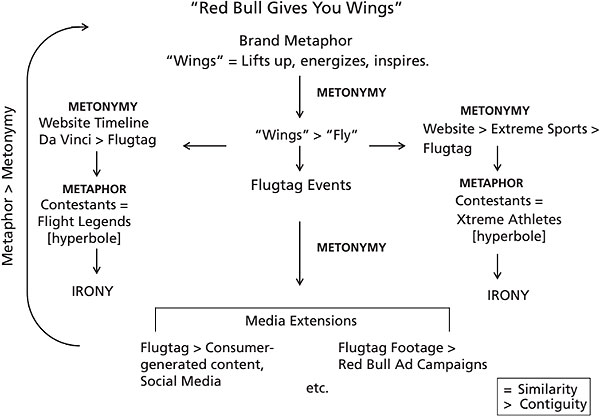
    In her book “Creating Value: The Theory and Practice of Marketing Semantics Research, “ Laura Oswald gives an example of the integrated use of Marketing Semiotics in Hypertext Marketing by Red Bull.


    Red Bull used the brand metaphor of “Wings” to signify its core benefits of “Lifts, energises, inspires” and fashioned the advertising theme of “Red Bull Gives You Wings”.


    Red Bull decided on the brand tone of “irony” because humor was the most engaging content genre with its core target audience – the young. And within humor – irony had the most upmarket appeal.


    Red Bull consolidated its functional position with its consumers by sponsoring extreme sports and high-energy cutting-edge rock music. However, in the Hypertext Marketing context, it needed to find an interactive platform that resonated with its ironic advertising and enhanced the brand’s chosen persona. It did so with the Flugtag events. The basis of Flugtag events was the concept of giving human wings – literally. The event invited teams to build a flying machine solely powered by humans and then demonstrate these at the event by flying over a water body. Most flights lasted less than a minute, with the spectacle of the contestants crashing harmlessly into the water. After a Flugtag event, social media would light up with user-generated content based on videos of the event. The zaniness of the Flugtag event, the ironic advertising on the theme “Red Bull Give You Wings”, and its sponsorship of extreme sports and rock music allowed Red Bull to build and nurture a formidable brand that was equally strong on the functional and emotional dimensions.


    Chart from “Creating Value: The Theory and Practice of Marketing Semiotics Research” by Laura Oswald


    In my decades in the Indian advertising world, I have seen much change. When television emerged as the primary media in the late nineties, the lingua franca of Indian advertising changed from English to Hindi and other Indian languages. Today as the focus of Indian marketing shifts from mass media to digital media, from linear TV to connected TV, from brick-and-mortar to omnichannel, and from Gen X to Millennials and Gen Z, the process of marketing and marketing communication strategy making needs to shift. Many consumer behavior models that today form the basis of marketing and advertising strategy need to be updated. We need to audit and continuously reframe our understanding of the semiotic and cultural spaces that constitute the operational matrix of our products and brands. Finally, we need to reinvent market research from the silos of quantitative and qualitative, ad hoc and syndicated, and move to a more strategic form of analysis and research that integrates across all marketing mix elements and time.


    We must also know and act on the actual value of digital and social media emergence. Most brands across categories solely base their digital and social media strategy on the paradigm of better and more fine-tuned targeting. The big unexploited opportunity that digital and social media platforms offer brands is Hypertext Marketing, which creates a virtuous, brand-building cycle between the brand and the consumer.


  • The way forward…


    By Ashoke Agarrwal


    Ashoke AgarrwalAs the Earth completes another orbit around the Sun, it seems appropriate to take stock.


    Is the business of advertising changing? Will it be undergone a paradigm shift over the next decade?


    In the arena of marketing, brands and advertising, the alchemy of the excellent is unchanging. The magic of synergy creates great brands. Consider Apple and Nike. Such brands were created by the coming together of inspired product ideas, marketing, branding, advertising, PR and ongoing brand management. Advertising and agencies’ role in creating such legendary brands will not change. Branding and advertising, in such cases, will remain a creative, curator-level art of its kind.


    Instead, we need to ponder the future of 99% of the advertising business, a commercial activity supporting millions of “brands” that are essentially labels of products and services.


    As the advertising business matured for the first five or six decades, many in the marketing and advertising industries pretended that advertising was an art form that created that magical entity – a “brand.”


    Over the past decade or so, these pretensions have fallen away. Most brand managers now treat their agencies as vendors of business services. Likewise, most advertising agencies have given up pretensions of being brand-builders and instead become purveyors of words, pictures, videos and memes at the creative end and intermediaries that purchase media and endorsements at the commercial end.


    And as generative AI emerges – witness OpenAI’s ChatGPT and Meta’s “Make-a-Video” – the automation of generating context and objective-driven words, images and videos – is around-the-corner.


    At the operational end, in the high-growth digital advertising business, the likes of Facebook, Google, and Amazon of the world are already the actual operators of the lion’s share of clients’ digital budgets, with media agencies, at best, acting as payment intermediaries. Other automated platforms – the independent ad exchanges that operate programmatic advertising- take whatever’s left of the digital advertising pie. And as generative AI matures, these tech platforms will extend their services from targeting to creating messaging.


    Traditional media planning and buying agencies still have a role in buying advertising on mass media – TV, print etc. However, there is a serious effort afoot towards single-source media research and planning platforms that integrate and synergize planning and buying on digital and mass media. And it could be the tech behemoths who will create and own these platforms. If that happens, technology would have, over the next decade, disrupted away the traditional media planning and buying agencies along with the conventional creative agencies.


    However, the advertising industry will morph and survive instead of lying down and dying.


    At the big business end, the advertising industry will morph into tech players that offer marketers an alternative to dependence on the big tech behemoths. One aspect of this tech-driven future agency will be Data Science driven. It will create first-party data, find innovative ways of harnessing second and third-party data, integrate and warehouse the data, mine strategy operational planning insights and operationalize and track plans. The other aspect of this tech-driven future agency will develop proprietary creative engines atop generative AI engines from the likes of OpenAI. These proprietary creative engines will act on insights mined by the data arms of the agencies.


    Even though AI will be at the core of these future agencies, they will still require innovative, creative, and creatively strategic people to run them.


    People with the understanding and skills to master and dynamically fine-tune AI engines.


    Martin Sorrel left the world of traditional advertising, and his S4Capital is searching for this new world of advertising. The jury is out on whether he will succeed. Also, the big four of the business consulting world have seen the future of advertising and are seriously considering entering it.


    The other possible dimension of the future of advertising is likely to house the guerillas.


    The tech lash evident among many could result in large communities over the next decade that abjure all platforms led by big tech. These communities will create their own online and media outlets that will define their own rules of engagement, including for brands. Specialist agencies will run commercial messaging in this world. These agencies will evolve data-gathering, targeting and message-creating protocols that will adhere to the rules of the contrarian world. Though contrarian, this world will not be Luddite. The technology that the specialist guerrilla agencies will use is likely to be as advanced as the ones used by the future agencies of the big business world.


    The balance between the future worlds of the big advertising agencies and the guerrilla agencies will be dynamic and symbiotic. In the longer term, as the broader world integrates between the establishment and the rebels, so will the agencies.


    As unloved 2022 morphs into a hopefully better 2023, we in the marketing and advertising world may look forward to an unknown, risk-filled, adventurous future because we live in exciting times. Happy new year!


  • Marketing Analytics, Rich Data and Deep Learning


    By Ashoke Agarrwal


    Ashoke AgarrwalMarketing analytics is as old as marketing. Simple arithmetic and the magic of ratios drove marketing analytics in the early days. For example, the rug shop owner in the bazaars of Istanbul would estimate his annual sales based on his year-to-date sales as a ratio of his last year’s sales. Or he would estimate price elasticity by running an experiment for a day or two and analysing the data again using simple arithmetic.


    Over the decades, as marketing evolved as both art and science, the depth and availability of data increased, and so did the sophistication of marketing analytics.


    Marketing mix modelling using multivariate analysis became a vital activity in the marketing departments of large companies. The data fed to the analytics was sales analysis by geographies, advertising spends, pricing and SKU spreads, and measures of brand lift – awareness and consideration across the company’s brands and competition. Some of the data was first-party data – collected and owned by the company. Further, second-party data – data provided by syndicated research studies like retail and advertising audits – became increasingly important over the years.


    The statistical tools’ sophistication increased, including multivariate analysis tools like Principal Component Analysis, Multivariate Analysis of Variance, and Hierarchical Cluster Analysis.


    About two decades ago, the age of Big Data, Smartphones and Social Media dawned. And as the next decade sees the emergence of the age of AI, a new dimension to marketing analytics has begun to come into view.


    Machine Learning, particularly Deep Learning, is different from statistical analysis.


    A simple explanation of the difference is that statistical analysis gives a more precise inference about the relationship between variables, while Deep Learning is more focused on making accurate predictions.


    Currently, the debate on using Deep Learning in Marketing Analytics is raging in academic circles.


    The October 2019 issue of Sloan Management Review published one such paper – “Is Deep Learning a Game Changer for Marketing Analytics?” by Glen Urban, Artem Timoshenko, Paramveer Dhillon, and John R. Hauser.


    Urban et al. studied data on credit card choices provided by NerdWallet.com. The data set was for 260,000 individuals across demographic factors like age, gender, household income, and cards owned. Zip code etc. The data set also included 132 attributes for cards offered (APP interest, reward points – miles, cash etc. and card fees – annual, transfer etc.). The study used three models to analyze the data:

    :: Linear regression of choice as a function of user demographics and card attributes

    :: The second model was a simple deep-learning model

    :: A third model used deep learning but added a step of consideration to the final purchase.


    The study found that the difference in predictive accuracy between the three models was insignificant – 70.5% for linear regression, 71.7% and 73.0% for the two Deep Learning models.


    Deep Learning is expensive to conduct in terms of the expertise required and the processing needs, including computer power. Urban et al. concluded that statistical analysis would be more cost-efficient when the data set is fully structured. They hypothesized that Deep Learning would be more efficient at analyzing “rich” databases, including user-generated content like Amazon reviews, Instagram posts, Facebook posts and comments.


    A study by Liu, Daria and Mizik supports the above hypothesis. The July/ August 2020 issue of Marketing Science reports on the study under the title “Visual Listening: Extracting Brand Image Portrayed on Social Media”.


    Liu et al. used a multi-image deep convolutional neural network model – a form of Deep Learning- to predict the presence of perceptual brand attributes in the images consumers post online for 56 brands in the apparel and beverages categories. The study checked the model’s predictions against those made by human judges and found a good fit. The model used by the study is branded as the BrandImageNet and is of use to brand owners for automatically monitoring their brand’s portrayal on social media in real-time and thus better understanding consumer brand perceptions and attitudes towards their and competitors’ brands.


    Decades ago, Ogilvy launched the Magic Lantern, which used factor analysis to create a highly appreciated compendium of dos and don’ts for advertising in a particular category. The Magic Lantern used multivariate analysis tools like Component Factor analysis to factorize a brand’s advertising and relate the factors to its market success. It is quite likely that today the Magic Lantern team has moved on to include social media imagery besides advertising imagery along with Deep Learning methods.


    Deep Learning is a valuable tool in analysing other aspects of user-generated content, as Timoshenko and Hauser reported in their paper – “Identifying Customer Needs from User-Generated Content”, published in the Jan/ Feb 2019 issue of Marketing Science. The study worked on an extensive data set of 115,099 oral‐care reviews on Amazon in the US, spanning the period from 1996 to 2014 and randomly sampled 12,000 sentences split into an initial set of 8,000 sentences and a second set of 4,000 sentences. The study then used a convolutional neural network to filter non-informative and repetitive content. The study compared user needs identified through Deep Learning analysis of User Generated Content (UGC) with needs identified by professional researchers working on industry-standard experiential interviews. In summary, UGC identifies the vast majority of customer needs (97%), opportunities for product improvement (92%), and hidden opportunities (92%). In addition, the UGC-only method identified seven hidden opportunities, while the interview‐only identified two. As user-generated content explodes, Deep Learning methods are proving to be very useful in using this expanding treasure trove to increase marketing efficiency and effectiveness.


    And as the Internet of Things (IoT) develops along with the age of AI, Deep Learning will play a more significant part in product design. A paper titled “Unsupervised Learning for Product Use Activity Recognition: An Exploratory Study of a “Chatty Device” by Nemitari, Khanesar, Burnap and Branson, published in the journal Sensors offers a fascinating insight into this area.


    In conclusion, advanced statistical analysis will continue to be more cost-efficient and effective compared to Deep Learning regarding structured data analysis. However, in a world where “rich data” – unstructured multi-media user-generated content on brands and products is exploding, Deep Learning will emerge as a valuable tool in increasing marketing efficiency and effectiveness. Further, deep learning techniques will be needed as IoT matures to effectively use the continuous chatter of embedded sensors.


  • AI, B2I, CI & Advertising


    By Ashoke Agarrwal


    Ashoke AgarrwalAdvertising sits at the interface between marketing and media.


    Therefore, the impact of technological change in the media world has had a lasting effect on advertising. Advertising’s first phase of evolution was from being a press-driven cognitive medium to the emotive resonance of the radio age. Then, in the television age, the emergence of video changed the very grammar of advertising. And now, in the Internet and social media era, advertising is trying to come to terms with a shift from being an intrusive form of mass persuasion to learning to be interactive and conversational.


    Historically, technological changes in spheres other than media have had a peripheral effect on the business of advertising. For example, computer technology has improved studio, planning and operations productivity.


    A new era of technological disruption is approaching with the gathering emergence of AI in its various avatars. But what will the effect of AI be on the business of advertising? Will the impact be peripheral, or will it affect the core? Two alternative scenarios emerge.


    Like the IT age, the AI age may only affect the productivity of advertising agencies. For example, the AI age could lead to a more efficient and faster path from idea to campaign production. Creative departments could use AI-driven CGI to create photographs and videos using avatar-licensing arrangements with celebrities, influencers, and models. Strategic and media planning could use Deep Learning engines that probe research databases and Big Data to deliver more effective plans. Operations could be more streamlined with meeting memos and day-to-day communications handled by bots. The lead in productive efficiency and effectiveness that the AI age brings to the advertising business could be as high or even higher than the IT age.


    The second scenario is when AI disrupts the very core of the advertising business. Imagine a situation where due to advances in AI, advertising as a business, if it was to continue to exist, has to sit between marketing and the individual and not as it currently does between marketing and media.


    Marketing in the AI age could morph into a discipline which truly owns the consumer relationship. Today companies act in the world of mass marketing. So much of a company’s marketing, sales and advertising budgets are wasted on addressing consumers who will never buy their products and brands. Tomorrow marketing could shift to being the art and science of marketing the brand to an individual, one individual at a time. Let’s call it B2I marketing. A B2I brand will focus on owning and nurturing the brand’s relationship with a specific individual, individual by individual.


    A B2I brand’s product development, distribution, marketing and marketing communication budget will be an accretion of the resources required to build and nurture the relationship with a specific individual, individual by individual.


    The age of B2I marketing will dawn when AI leverages a slew of other technologies. Robotics-assisted flexible manufacturing technologies will enable the customization of products. High bandwidth, low latency mobile and IoT networks combined with real-time Big Data analytics will drive true customization of services. In addition, the maturing of delivery drone technologies will facilitate D2C distribution. Finally, Deep Learning engines will sit atop the entire ecosystem to build ROI across the system.


    The brand will become, in essence, an AI entity in touch with individual customers. And marketing will shift to the next generation of the Service-Dominant-Logic (SDL) paradigm as outlined in my MxM India column dated 27th October 2022.


    The AI brand-side revolution in marketing will also have a consumer-side AI facet.


    As AI scales over the coming decade or two, it will develop as a “consumer appliance”, which I call Concierge Intelligence (CI). I have written about CI in my MxMIndia post on 6th January 2002 titled “The Coming Post-Digital Age.”


    An individual’s CI will communicate with the brand’s AI in two-way, always-on, low latency, Big Data cognisant communication. The objective will be to maximize the individual’s satisfaction levels with the brand while driving the brand’s ROI.


    The question now is if, in the AI age, marketing morphs into B2I marketing, what will become of the business of advertising?


    If it is to exist in the age of B2I, advertising will become the art and science of always-on, customised two-way conversation between two sets of AI engines- the brand-side AI and the individual-side AI (CI).


    It stands to reason that the business of advertising agencies will then become the business of creating proprietary AI designed to deliver the most effective communication between a brand’s AI and an individual’s CI. Brands would go to external agencies to develop this AI because of the same reasons they prefer external advertising agencies today over in-house cells – specialized expertise honed over multiple brands.


    The dawning of the digital and social media age allows agencies to develop the planning and creative chops to deliver effective two-way one-to-one conversations with consumers. But, alas, most traditional agencies are frittering away the opportunity by delivering digital and social media campaigns that follow the time-worn principles of aiming one-way campaigns at an amorphous mass of consumers.


    A few tech-driven marketing communication agencies are beginning to hone the technology and creative nous that will enable them to deliver the AI and two-way conversational advertising of tomorrow.


    To sum up, the age of AI in one scenario offers substantial productivity gains to both creative and media agencies. However, in the other scenario, the age of AI could make creative and media agencies obsolete.


    Under this scenario, marketing communication will morph into a specialised and customised AI engine that drives brand-building conversation between the brand-side AI and the consumer-side AI (CI).


    Tomorrow’s marketing communication agencies could then very well be AI specialists. Specialists who build and operate proprietary AI customised to a brand’s AI ecosystem to interact with various types and levels of individual AI (CIs). To nurture and develop brand-to-individual relationships.


  • An Ode to Bad Advertising


    By Ashoke Agarrwal


    Ashoke AgarrwalImagine a world without bad advertising.

    Where else would 80% of the advertising and ad sales world find gainful employment?

    Furthermore, research has proven (sort of a la BARC) that bad advertising causes channel switching that contributes to a more equitable distribution between cable channels. And equality, as the pundits tell us, is not something to be sneezed at, market economy or not.

    In his masterpiece “infinite Jest”, the much-lauded and laudanum-loaded David Foster Wallace posits that bad advertising sublimely promotes sales. He hypothesises a kind of mental jujitsu in the viewer’s mind that transfers and transforms the effect of bad advertising into a compensatory admiration of the brand’s gall leading to sales – a result of the Stockholm syndrome transported to the marketing world – a coping mechanism to a captive or abusive situation.

    Mr Wallace’s insight has helped me resolve a professional puzzle. Why do big, successful brands that control 80% of advertising put out advertising that is 99% bad? Now I know marketing and brand managers are much wiser and more insightful than I thought. So perhaps there is a case to be made for making “Infinite Jest” required reading in marketing and advertising courses. After all, we want to propagate and nurture the proliferation of bad advertising well into the future to keep unemployment in check, equity in the media world and market leaders in the gravy.

    This brings me to advertising awards and the worthies who judge them. Imagine their plight if bad advertising ceased to exist! Not only would their load increase, but it would rob them with the opportunity to reward and award their core fraternity – the confederacy of the mediocre and the smug.

    Let me take a broader societal view. In the doom and gloom of the post-pandemic, on the brink of World War, inflation-ravaged, crime-infested world, bad advertising allows us to think – “Ah! Here is at least one insufferable thing I can easily switch away from”. And that’s why society needs more bad advertising to offer more frequent relief to its suffering people.

    To dig a little deeper, is there a degree of badness in advertising?

    For example, it is the kind of advertising that damages the family relationships of the creative hack who acknowledges creating it worse than the insidious, long-running campaign that has haunted the world for years.

    Is a case to be made for Razzies in advertising to counter the usual annual awards to mediocrity? Usually, the world thinks of countering mediocrity with excellence. However, shouldn’t we, in our admiration of the all-around utility of lousy advertising, focus on countering mediocrity from the aft?

    Bad advertising has a love-and-hate relationship with the digital and social media world. Digital and social media allow advertising to work with not the Big Bad Idea and Small Bad Ideas. And as digital and social media continue their march to dominance, advertising might soon proclaim, “The Big Idea is Dead! Long Live the Small Big Idea!!”

    However, while digital and social media have made the purveyors of bad advertising that much more productive, they have also created intense competition. A whole army of content creators is now competing with bad advertising regarding the degree of badness and flow intensity. Bad advertising has, to some extent, sought to co-opt this trend with (bad) influencer marketing.

    Finally, here is a word of advice to the millions of young people seeking to make a career in advertising. Go right ahead. Some among you, the truly creative and passionate kind, will fight a righteous battle until you leave with honour intact for other worlds. Others, savvier and flexible, will find their niche in the big, bad proliferating world of advertising. Either way, you are in for an exciting time.

    PS: I have been in the world of advertising now for decades. I have seen it change from being a field of creativity to being a business vendor. This article is a satire that allows me to vent as I continue to fight the good fight to get advertising back to its core function – to build lasting brands that increase the sum total of happiness in the world.


    Ashoke Agarrwal writes on the confluence of technology and marketing. He writes on MxMIndia on alternate Thursdays. His views here are personal