 By Ashoke Agarrwal
Artificial Intelligence (AI) is poised to be the next general purpose technology that changes human society and the economy. Indeed, as big as electricity. Some, like Satya Nadella, believe that AI will create a paradigm shift at the civilisational level, like pre-historic humans learning to control fire.
Beyond the hype, over the past few years, AI has emerged as a reality in big business, government, and the military. For example, Palantir uses data hoovered up by the US government’s National Security Agency to feed AI engines that throw up political and military strategies to shore up the US’s pre-eminent position on the world stage. But then, no amount of AI can compete with human stupidity, as is evident in the great drama of US politics.
AI has also made its appearance in the day-to-day lives of ordinary citizens. Siri and Alexa are two examples. And the release of ChatGPT has seen the emergence of AI in the pantheon of instant celebrities.
It is clear now that AI will be a crucial driver of economic growth over the next few decades. This column briefly applies known models of new technology marketing to AI’s coming diffusion and growth.
I became aware of Geoffrey Moore’s book “Crossing the Chasm” a couple of decades ago when a Silicon Valley entrepreneur I was working with insisted that we cast our strategy based on Moore’s model of the technology adoption life cycle. Over the years, I have learnt that many marketers of technological innovation swear by Moore’s model. Over the decades, Moore has refined his model further. His book “Inside the Tornado” has the latest iteration.
However, before we look at the possible diffusion of AI through the lens of Moore’s model, we need to refer to a technology marketing theory that impacts a much earlier stage.
The Theory of Product Form Strategy (PFS) postulates every innovator of new technology faces a product-form decision at an early stage of building a business out of his innovation. The innovator company has three choices: Market the Know-How, Market a Component, or Market A System.
Frias, Ghosh, Janakiraman and Duhan, in a pre-print manuscript submitted to the Journal of Marketing titled “A Theory of Product-Form Strategy: When to Market Know-How, Component or Systems.”, have an interesting illustration of the PFS Theory. For example, consider an innovator who has developed a technology that tracks the mechanics and dynamics of a baseball bat as it meets the ball, allowing coaches to refine a batter’s ability. As a result, the innovator can decide to sell the technology to a party that decides how to market it. Alternatively, the innovator can develop the technology into a component that fits on a bat and market it to bat manufacturers.
The third alternative is for the company to get into bat manufacturing and build a bat brand based on its advanced technology.
Ghosh et al. found that three factors drive the PFS choice:
:: How easy or difficult is it for the innovator company to safeguard the know-how?
:: How easy or difficult is it for the innovator company to mix and match the technology to create the component?
:: How easy or difficult is it for the innovator company to market a system?
Fig I The SPF Decision Tree from a paper by Ghosh et al.
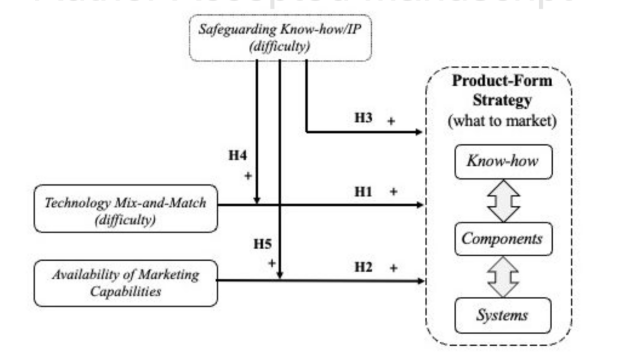
Let us apply the SPF model to the two current leaders in the field of AI – OpenAI and Deep Mind.
OpenAI, given its roots as a non-profit do-gooder (now largely abandoned), is likely to license its know-how. OpenAI’s licensing policy will create an ecosystem of established players and start-ups that either go to market with components or entire systems. The nature of OpenAI’s deal with Microsoft has yet to be made clear. At one level, a licensing deal allows Microsoft to incorporate OpenAI’s technology in Bing. But then Microsoft is now a substantial owner in OpenAI and can impact OpenAI’s go-to-market strategy.
The other big player, Deep Mind, is already inhouse to a technology giant – Alphabet. However, Alphabet is unlikely to license its AI know-how or even market-specific use-case-driven components to others. Instead, its goal would be to morph into an AI behemoth which markets specialized AI systems across sectors and use cases.
We will discuss Alphabet’s likely path to this dominance in the context of Moore’s model.
The other tech giants in the AI game are Meta, Amazon, and Apple.
Amazon and Apple already have Alexa and Siri as AI products in the market and have become household names. In addition, Amazon Web Services (AWS) offers a software suite to support AI development and applications as a part of its services. Apple promotes on-device AI-driven recommendation engines on its iPhones as part of its privacy promise.
Meta’s botched soft launch of Galactica, its AI engine designed to summarize scientific research papers in any specified area, may hide a deep and evolving AI capacity.
Once an AI innovator has decided on its PFS strategy, it must navigate Moore’s Technology Adoption Life Cycle.
Figure 2: The Technology Adoption Life Cycle as stated in Geoffrey Moore’s “Inside the Tornado”.
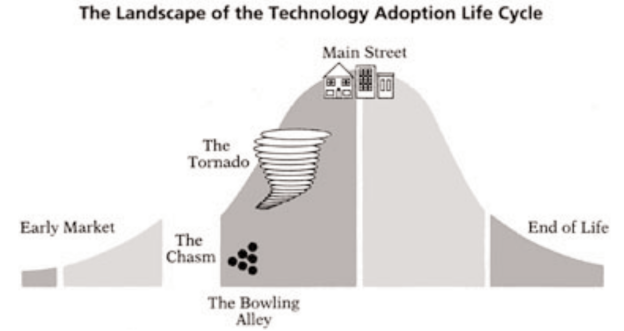
Moore’s “Crossing the Chasm”, first published in 1991, was a cautionary tale about how many technology innovators could not cross the chasm between appealing to the revolutionaries and the visionaries of the small Early Market and being accepted by the pragmatists and conservatives in the much larger Main Market.
In his 2004 book “Inside the Tornado”, Moore formulated a strategic recommendation for crossing the chasm.
His fundamental idea was for a tech innovator who had found success in the Early Market to focus on a niche market by developing a component or system based on the specific needs of the niche and then focus all his marketing and sales resources on that niche market. Moore calls this strategy Bowling Alley Market Development.
Fig 3 Bowling Alley Market Development for Moore’s “Inside the Tornado”
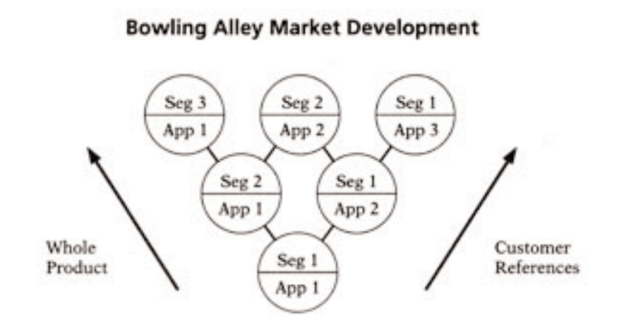
In his book, Moore states the cases of Lotus Notes, PeopleSoft, and Sun Microsystems as examples of the success of the Bowling Alley strategy.
He also illustrates the Bowling Alley strategy of a documentation company that starts by focusing on the documentation required for filing a new drug patent. Subsequently, the domino effect of falling bowling pins allows the documentation company to expand to capture adjacent markets.
Fig 4 Example of a Bowling Alley Market Development from Moore’s Inside the Tornado”
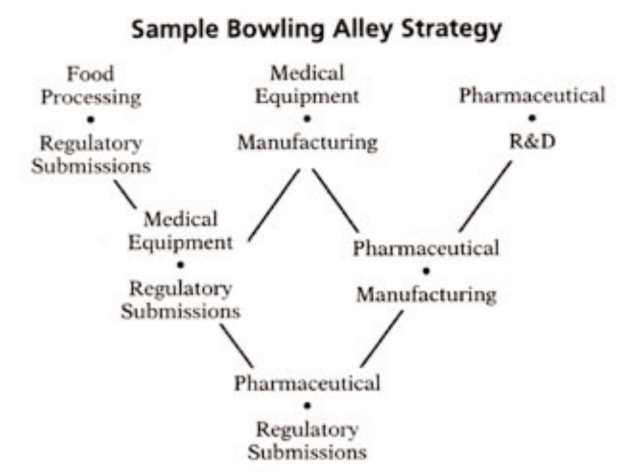
Can we envisage the Bowling Alley strategy of OpenAI and Deep Mind?
OpenAI, if it sticks to the PFS strategy of licensing its technology, will leave the Bowling Alley strategy to others who license its technology. On the other hand, if the Microsoft tie-up is a buy-out, OpenAI becomes a player like Deep Mind and has to think through its Bowling Alley strategy.
Will Alphabet’s main business of search and advertising determine the Bowling Alley strategy of Deep Mind? Many wonder whether Google, like Bing, will try to incorporate its Large Language Model driven AI into its search engine. The alternative is that Google starts its Bowling Alley play with expert systems that focus on specific areas of business and science.
The final stage of the Technology Adoption cycle is when the technology becomes a part of the core infrastructure of society and the economy. It happened in computers.
As Moore puts it, in the Bowling Alley phase, the product is defined by the customer’s expectation, while the product defines the market in the Tornado phase.
In the Tornado phase, AI will become a part of society’s infrastructure, like electricity or computers. The Tornado phase will also wean out players and give rise to a couple of companies with a lion’s market share. Will t Alphabet, Microsoft, Meta, Amazon, or Apple find a place among these giants? Or will it be new players who we have yet to hear of it today?
These are exciting times for technology watchers and prognosticators.
The rise of AI may give rise to new models of the diffusion and marketing of technology.