Tag: Ashoke Agarrwal

  • Apple, Musk and AI


    By Ashoke Agarrwal


    Ashoke AgarrwalI coined Concierge Intelligence (CI) as a type of Artificial Intelligence (AI) owned by and dedicated to an individual and fully protective of his privacy. CI would aid the individual in understanding herself better and leading to better life outcomes in health, education, career and relationships – in general, as a putative ad copy would say: ‘Be A Better You’. Further, CI would handle routine tasks like shopping, bill paying, appointments, correspondence and travel arrangements based on a deep understanding of the individual’s preferences and needs and an up-to-the-minute and universal understanding of options. CI would be under the complete control of the individual, who can switch it off and on and decide on the level of access granted.


    When I first wrote about CI in Feb 2021, the concept seemed at least a decade or more away. Not any longer. Like the world, I was unaware of the rapid progress of Large Language Models (LLM) technology.


    Today, many factors indicate that the first generation of CI is around the corner. A CI prototype might already be in the hands of hundreds of millions worldwide! Let me explain.


    For a couple of years now, Apple has been communicating the following:

    :: Many of the functions and Apps on its devices – Siri, Keyboard Suggestions, Health, Messages, Mail, Music, Books, and Apple TV – use AI to enhance user experience and utility.

    :: Apple puts ensuring user privacy as the highest priority. Therefore, all its AI works on data and software residing on the user’s device, under complete user control, and cordoned off from other entities, including Apple.


    The penny dropped when I first read about the Journal App that Apple is readying for release with iOS 17. Journal App gives iPhone users the means to record their day-to-day activities and uses advanced prompt features enabling users to track their emotional state and the causes.


    The latest iPhones carry specialised chips that allow the device to run sophisticated AI programs on the device itself. With the breadth and depth of information, the iPhone has about its users, the phone’s processing capabilities and the level of trust Apple had built with its users, all the conditions that make for a CI already exist. Over the next few years, iPhone users, prompted by Apple, will increasingly find use cases for the CI that resides over the phone. With each new generation of iPhones, the CI will get more powerful and within the next decade, Apple will likely brand this as a proprietary feature and build a revenue model around it. CI by Apple could be the next big thing from Apple after the iPhone. If Apple keeps its promise of protecting user privacy, iPhone CI will add to the quality of life and be one of AI’s boons.


    While the wizards of Cupertino are coming at AI based on an individual’s shared experiences, the wizard who has given the world Tesla and SpaceX is taking a different tack.


    Musk wants Tesla to be the first to launch a fully self-driven car without a steering wheel or a brake pedal to allow a human driver to take control. While many companies, Alphabet being one of them, are at work perfecting AI systems, Musk’s approach is entirely different from the rest.


    Alphabet and others are trying to build a self-driving car based on an algorithm that relies on the following:

    :: Signals from a hardware system consisting of cameras and radars that transmit in great detail, second by microsecond, the physical environment of the car as it drives through a roadscape.

    :: And rules that codify the signals into millions of scenarios and actions that are needed to respond to the system.


    The above approach is similar to the early days of Natural Language Processing, which tried to create language models based on the contextual meaning of words and rules of grammar and idiomatic usage.


    In one sense, Musk’s flip on the AI needed to build a self-driven car is simple. He believes if humans can drive cars based on just visual inputs, so can AI. So, radars are the first things he has taken out of the equation. His second lead is even greater. Large Language Models (LLMs) like GPT 4.0 work through patterns that a Deep Learning AI system detects from a large enough set of training data without needing an explicit set of rules. Musk’s leap is that he can build AI systems that can operate in the physical world through a large enough training data set. The difference is that in the case of the physical world, the data set is visual.


    Every Tesla carries a set of high-resolution cameras. And its software records all the actions that a driver takes. Further, all the data from the cameras and the software systems are transmitted to Tesla’s servers. With millions of Teslas worldwide, Tesla has an ever-increasing training data set.


    Musk is not stopping at building self-driving Robocars but is busy building a human-like robot branded Optimus on the same AI principles. The training data for Optimus-like robots will come from recording humans engaged in various activities – cooking a meal, navigating a home, an office or a mall, playing a sport, etc.


    Further, in all cases, the training data will be culled so that the robot learns from the best drivers, champion players, chefs, etc. So ipso facto, robots will come out of the gate better than humans because they learnt from the best and have the advantage of being faster, connected and untiring.


    Paradoxically, Musk also pays lip service to the dangers of AI and contends that he is trying to build something like Assimov’s Three Laws of Robotics into the AI systems he is busy inventing.


    So, between the CI that Apple is fast making a reality and Musk’s promised Robot Intelligence (RI), AI is set to impact the daily lives of all of us significantly.


    Another AI revolution is brewing in the scientific field, launching tectonic shifts that will alter human civilisation. But that is grist for another post.


     

  • What Ails English News Channels in India? – A Marketing Perspective


    By Ashoke Agarrwal


    Ashoke AgarrwalI am not a media critic. MxMIndia has a trenchant one in Ranjona Banerji, whose twice-weekly column makes for exciting reading whether or not you agree with her.

    However, as a brand and marketing strategist, it is clear that English News Channels in India is a declining product category.

    Both in terms of share of attention and advertising. What gives?

    The product category’s essential advantage is that it potentially addresses an affluent target audience of the educated professional class.

    The crucial factor ailing the product category is that it is steadily losing its core audience. I have only anecdotal evidence to support the assertion, but a reliable poll will prove it as a fact.

    The core reason educated professionals these days shun the gaggle of English news channels is that they find them irrelevant. The tragedy is that despite this quickening decline, their anchors and management do nothing to address the issue.

    Is it because the overweening odour of self-importance prevents them from smelling the coffee? Or are they deer caught in the headlights of impending doom?

    Going by the content they put out daily, it is a sad mix of self-importance and fear.

    At the core of this morass is their focus on politics at the expense of everything else. Further, they practice political news primarily as a debate between second-rate “experts” and political spokespersons from two distinctly opposing camps moderated by an anchor whose bias clearly shows. Night after night, prime time after time, these debates on the minor issues of the day devolve into shouting matches that would embarrass any right-thinking individual. Once in a while, they latch on an “exclusive” – usually a leaked video or document on a minor issue whose authenticity they assert they have not verified but push all day and into that night’s debate!

    Is it any wonder any national aspirationally-positioned brand that values its credibility is reluctant to advertise on these channels? So, it is no surprise that they fight for a shrinking pie of advertising from second-rate brands and rah-rah ads paid through Government coffers. And even this fight is embarrassing as they put out conflicting numbers about viewership, with every channel claiming to be number one.

    From a marketing perspective, the solution for English news channels to become relevant in India is to look hard at the core potential market of educated professionals and entrepreneurs and work towards a better market-product fit.

    At the outset, the channels need to go easy on domestic politics. While their core audience might lean one way or the other regarding domestic politics, most are not rabid enough to even remotely enjoy the kind of nightly debate and slanted news coverage the channels indulge in. They should also realise that the politicians and the powers that be do not care what the English news channels put out.

    The politicians know that the audience for English news is too niche to matter in electoral politics and also the kind that is not swayed by rabid anchors or dueling talking heads. Instead, the politicians focus on regional language channels that deliver pliable audiences by droves. So, the management of English news channels must put aside the notion of currying favour or fearing disfavour based on what they cover on their channels. They can do this by leaving hard-core politics to their regional languages brethren.

    Instead, each channel should focus on building a unique non-political position for themselves. Wion has done so by focusing on international news from an Indian point of view. With better funding, more correspondents and camera teams worldwide and a couple of name-brand anchors, that position is viable, especially as India gains traction as a player on the international stage.

    The other positioning that a channel could build substantial and lasting market share on as a genuinely pan-Indian reporting entity with solid reportage from all, not just Delhi or Mumbai but from all State Capitals as well as the other critical metros anchored by on-the-ground, well-trained, well-spoken reporters. NDTV, during the heydays of Prannoy Roy, delivered on this. But over the past few years, it lost its way as it looked to fight a political headwind by pissing into it. Will the current ownership recognise the strength of the brand DNA and restore it? I will be pleasantly surprised if it does.

    The other positioning is investigative journalism. At one time, the newspapers were the champions of investigative journalism. Alas, they are these days just broadsheet rags fluttering weakly in a digital storm.

    With the India Today DNA, one would have thought that India Today TV would have been the one to fly the investigative journalism flag. Alas, even the mother brand, let alone the TV off-shoot, has sacrificed investigation (except the occasional. mood-of-the-nation or sex survey poll) at the altar of convenience and cost-cutting. If India Today is to reposition the magazine and India Today TV on real investigative journalism, it could regain its lost sheen of being India’s public square where the well-read and the well-intentioned gather to take stock.

    There are nuances in investigative journalism that allow multiple channels to find a unique position under its broad umbrella. For example, one channel could focus on stories with a societal and human angle, investigating developments in cultural mores, health, education, crime, etc.

    Another channel could investigate stories in hard-edged areas like business, management, science and technology. The one English news channel that does well is CNBC because it focuses on a specific area of interest to the educated professional or entrepreneur. This other channel would have a broader focus than CNBC and go beyond the stock market and financial results to developments driving trends and changes.

    Yet another channel could focus on personalities from across cultural, business, scientific and technical fields with bio-documentaries and skillfully conducted long-form interviews.

    The above examples illustrate that there are viable positioning options for English News channels that will take them out of the swamp of politics and regain their core audience. This audience will pay reasonable subscription fees and attract brands with deep advertising pockets.

    The repositioning will take work – it will require substantial capital investments and hiring and retraining people. The alternative, however, is for all the brands in the category to continue on a demeaning race to the bottom.


    Ashoke Agarrwal writes on MxMIndia every other Thursday. He focuses on the intersection of technology, marketing and communications, but sometimes like this time around, he dwells on other issues as well. His views here are personal.


  • ML, LLM, Graphs & Market Modelling


    By Ashoke Agarrwal


    Ashoke AgarrwalNine months after the launch of ChatGPT, the hype has died down and the real work of building upon the burgeoning availability of Large Language Models (LLMs), of which ChatGPt is but one example, has begun.


    The interest of businesses in the concept of Big Data rose exponentially in 2012. Many expected a paradigm shift in consumer marketing based on nifty analytical systems driven by Big Data. Much was expected in data-driven decision-making, personalisation and customisation, targeted advertising, sharper segmentation, predictive analytics and real-time insights. In 2015, in its report titled ‘Big Data, Analytics and the Future of Marketing and Sales’,  McKinsey laid out the expectations.


    In 2023, the future is different from what McKinsey expected. The paradigm certainly shifted for Google and Meta, who cornered the advertising market based on a humongous amount of real-time Big data and state-of-the-art analytical engines.


    Change also happened for brands that marketed and sold products and services to B2C and B2B markets. However, the difference had little to do with their use of Big Data and advanced analytical systems. It was in the emergence of the digital universe as a product, go-to-market and communication platform.


    Dig a little, and you will find that the thesis that brands under-exploited the opportunity that Big Data presented to them mainly because they used legacy databases and ERP systems from the likes of SAP, Oracle and Salesforces to collect and store their Big Data. As a result, while many created special teams to mine, warehouse and analyse Big Data, most crucial business, marketing and sales decisions continued to be based on traditional business analysis and market research.


    Meanwhile, Google and Meta (then Facebook) invested in an analytical system that eschewed the rigidity of the traditional IT-age relational databases – essentially tables with rigid rows and columns. In a seminal decision that presaged the age of AI, they decided to populate their databases in graphs – a network of nodes with many properties with multiple links to other nodes, with each link specifying a kind of relationship with a property of the originating node and a property of the linking node.


    Such a database structure allowed for:

    :: Fast and more varied analysis

    :: More immediate additions and reconfiguration of the database as conditions change

    :: Better situational analysis and insight discovery through “what-if” analysis that changed node and link configurations


    Based on their ever-expanding, ever-enriched graphs and the use of Machine Learning (ML) driven near-real-time analysis, Google and Meta created a mighty advertising service with the confidence to offer brands a pay-per-click service. As a result, brands willy-nilly outsourced the harnessing of the real opportunity of the digital and Big Data age to Google, Meta and other digital ad exchanges that sprang up.


    It is no surprise that Google and Facebook are among the most advanced AI players today, including in the field of LLMs with Google’s Bard and Facebook’s Llama. The essential process that powers LLMs is that they parse large storehouses of text into triples of subjects, objects and predicates and then model them into graphs with the nodes consisting of subjects and objects and the links signifying relationships in the form of predicates.


    As Google’s and Meta’s LLMs improved power, it turbocharged their graph databases, allowing them to automate the process of incorporating unstructured into their graphs. Perhaps left to themselves, Google and Meta would not have exposed their LLMs to the public as they have done so now but kept it themselves as a background technology powering customer-facing applications. Instead, OpenAI and ChatGPT forced their hand.


    The resultant hype around ChatGPT has kickstarted the age of AI, with the world at large now seriously scrambling to incorporate AI into businesses, Governments, schools, hospitals and wars. Publications like The Economist and others have started ranking Fortune 500 companies based on the potential competitive advantages/disadvantages that AI can deliver to them!


    How will businesses in general and marketers in particular respond to the new horizons of AI?


    The powers of MI, Graph Theory and Advanced Modelling will create a new platform that will change how businesses, if not entire societies, are run. Just as the arrival of digital media changed economies at the core, Graphs with Big Data inputs from structured and unstructured sources (processed through LLMs) will create dynamic market models that will change how businesses are structured, with business and marketing strategy being almost wholly automated with human inputs needed only at the highest meta-strategy level. The shift will be paradigmatic enough for the world to label the resultant business order as the Nth Industrial Revolution, a sub-set of the First AI Revolution that will redefine human society.


    The question is whether individual businesses will seize this opportunity, invest and build proprietary dynamic models that will run their companies, or will they, once again, as they did with the digital revolution, outsource it to the next Google or Meta?


    The stakes this time are higher. Not only will the businesses themselves be more beholden to those who own and run the models, but in the process, society will create AI-driven behemoths that will be the first step to the dysfunctional system that those who fear AI imagine.


    Therefore, it is incumbent on business leaders and thinkers to pay close attention to this evolving opportunity and invest all that is needed to harness it before it becomes an insurmountable challenge.


  • The Role of Logos, Ethos and Pathos in Political Communication


    By Ashoke Agarrwal


    Ashoke AgarrwalIn the Western canon, the three elements of argumentative persuasion are Logos, Ethos and Pathos. It is a commentary on our Western-designed education system that, while I am peripherally aware of this Aristotlean concept, I am painfully unaware of its equivalent, distant or near, in the Indian canon. For this column, I did search the internet fruitlessly to fill the gap. Perhaps we need to do a better job of bringing Indian philosophical heritage to the Internet Age.


    For now, I will roll with the Logos, Ethos and Pathos triad and apply it to the existing Indian political discourse.


    Logos means persuading using reasoning, which includes cognition, analytical skills, good memory and purposeful behaviour.


    Aristotle called Ethos the “face created by discourse” and results in “ethical appeal” or the appeal for credibility. Modern analysts of political discourse distinguish between two types of Ethos: Preliminary Ethos and Discourse Ethos. Preliminary Ethos is the credibility or lack of it that results from the apriori knowledge and impression that the target of political communication (speech, news, OpEd, advertisement) has of the source of the communication (party, leader, government, journalist, expert). Discourse Ethos stems from the content of the communication and its context. The Preliminary Ethos and Discurse Ethos interact and reinforce or clash.


    Pathos links directly with the target of political communication. Pathos is the power with which the political message moves the target to the desirable emotional state and action. This power depends mainly upon understanding the target’s concerns and attitudes. Finer and more profound the understanding greater the pathos power that a well-crafted political message can deliver.


    The Logos, Ethos, and Pathos triad is a framework that can help analyse the strengths and weaknesses of political parties and alliances in India (for that matter, any nation) without getting mired in partisan emotions. It is also a handy way to critique the efficacy or otherwise of that handmaiden of politics – the news media. In the modern world, genuinely independent news media is a myth; thus, all news media are integral to political discourse. Even a Large-Language-Model-based no-human-intervention model would create a flow of news that will lean in a political direction because the world, in any given era and place, tilts one way or another.


    In my analysis, one political force in India has emerged distinctly more effective over a decade than the opposing force because they have scored on all three dimensions – Logos, Ethos and Pathos – of political discourse.


    In 2014, the component of their Logos was driven chiefly by the media-created memory of high corruption, the Ethos of the perceived effectiveness of the rule in a given state in contrast to the national government and the Pathos on the hopes and aspirations of a young electorate.


    In 2019, the narrative had to change. Paradoxically, as society’s economic pie grows, generally, so does covetousness. This paradox also applies, in general, to individuals, families and businesses. The more one has, the less ready one is to share. So, the Logos in 2019 shifted to the promise of large sections of society for a more significant share of the pie, the Ethos based on the credibility arising from a largely high-corruption-free and distribution-efficient regime, and the Pathos shifted to mine the identity lode that gave a large section of society the comfort of being insiders in the game of power.


    The incumbent coalition in 2014 based its political discourse on the Logos of “more of the same”, the Ethos on “familiarity”, and Pathos on the “fear and disgust of the evil pretender”.


    In 2019, the Opposition abandoned even the basic principles of political discourse and tried to come back based on Pathos alone – again assuming a widespread antipathy about the governing party and its leader.


    How is it going to play out in 2024?


    The governing party has to change its template. All three dimensions need to shift.


    A large section of the electorate has only experienced the ruling party at the centre. Evoking in the Logos a contrast with earlier dispensation is of diminishing utility except for in ultra-political settings like debates in Parliament. Communications to the larger electorate evoking the misdeeds of an opposing dispensation from more than a decade ago will be seen as a case of “whataboutism” and be counterproductive. A decade of governance leaves a track record that can’t help but be patchy, giving something to complain about almost everybody- in Indian politics, this is famously known as anti-incumbency.


    Given the profound and common trauma of the pandemic, will the politics of division and identity still carry its appeal? Or, given its political savvy, will the ruling dispensation shift to the Logos of development and the efficacy of a proven model and the Pathos of aspiration to count among the first rank of nations and the quality of life of a developed country? In terms of Ethos, most polls put the image of the leader of the current dispensation among the highest in the world, and his powers of idiomatic Hindi oratory evoke emotional identification across the Hindi belt. In non-Hindi States, this power is diminished, and the inability of the party to project local leaders who speak the local idiom is a significant shortcoming.


    Is the opposition getting its act together? Forming a pre-poll alliance seems reasonable, and the first-time effort of the dynast from the leading opposition party to establish a connection with the electorate through grassroot action should add to the Pathos of the appeal even though in speech, he is still far from acquiring idiomatic cadence. If the pre-poll alliance holds in the hurly-burly of ticket distribution and regional leaders put their idiomatic shoulders to the wheel, the Pathos that the opposition brings to the 2024 election will be a level or two higher than the 2019 fray.


    But what about Logos and Ethos? Does an all-out effort to diminish the leader of the ruling dispensation give them a leg up on the Logos and Ethos dimensions? Does fear-mongering about the state of the country and its institutions do so? Or does it need to focus on a rational plank that answers the question – Why Us? – instead of constantly harping on – “Not them!”.


    The 2024 General Election in India will be a game of high strategy if both players play it well. Whichever way the result goes, such a result will serve India well. If one of the two falters, it will end up in a rout; if both falter, it will be a toss-up. Either way, such a result would have failed India.


    What about the media? The English language media gets far too much focus from pundits. Its impact on Indian politics is marginal. On the other hand, the regional language media has a vital role to play along with increasingly important social media influencers. Regional TV is increasingly producing celebrity anchors who are masters of local idiom and are far more jingoistic than any politician dare be. The discourse by these anchors is genuinely in the Goebbelsian mode, where Pathos overpowers Logos and is the fount that produces its own Ethos.


    As for social media, too much is made of the trolls and the bots. I suspect that the critical impact of social media results from a small set of influencers who follow the same playbook as the celebrity anchors of regional TV.


    Finally, the Logos, Ethos, and Pathos triad applies to market and political communication because the end objective is persuasion. However, the dynamics of the marketing triad differ from that in politics. In essence, political communication focuses on competition as it is, overtly or covertly, on us-and-them themes. In marketing, the underlying theme is more aspirational-focused, focusing on the target individual’s needs and dreams. As societies grow more prosperous and developed, the theory was that political communication becomes more like marketing communication. However, recent and ongoing politics in the developed world has tended to disprove this hypothesis.


  • Insight Mining: The Creative Approach to Consumer Research


    By Ashoke Agarrwal


    Ashoke AgarrwalAs one of Indian advertising’s first wave of account planners, I positioned the discipline as representing “the creative dimension of strategy and the strategic dimension of creative”.


    Before joining the ranks of account planners, I was a founder of a research agency – Francis Kanoi – a deeply modelling-oriented quantitative agency. In 1983, Kanoi pioneered the large sample annual syndicated study of the consumer durables market that used the Bass Epidemiological Model to forecast consumer demand. This study, in its various avatars, continues to be an integral part of the marketer’s toolkit in the consumer electronics and durable industries.


    This grounding in quantitative research and market modelling proved to be of limited utility in practising the art of account planning, which consists chiefly of fine-tuning the positioning of a brand for lasting competitive advantage through insight-driven advertising. I leaned into qualitative research – focus groups and such – to find that fresh glimpse into the consumer psyche in general and her interaction with the product category and the brand that could lead to effective and advantage-yielding communication and creative strategy.


    However, over the years, I discovered that the source of helpful insight rarely came from focus groups but from elsewhere. They came from mining the psyche of the team – the planners, the creatives, the client servicing people and the client’s brand and marketing team.


    Each of us is a repository of sub-conscious insights into our behaviour and that of others we interact with daily and come across in popular culture – films, books, and the news. The mining of these insights – bringing them up from the sub-conscious depth to the conscious realm – is through free-form contemplation and discussion. It is brainstorming without the “driven intensity” that the word “storming.” implies. I find that insight mining is most productive when done in a relaxed setting and when it is open-ended in that it begins with a general discussion.


    The Insight Mining process yields richer results as the EQ and ITQ quotient of the team increases. EQ is, of course, Emotional Quotient- drives greater empathy and thus a richer storehouse of insights into behaviour and attitudes. ITQ is a coined term and stands for Intellectual and Travel Quotient. An intellectually curious and widely travelled team has broader experience and a more comprehensive range of insights into behaviours and attitudes.


    How does one get the target consumer to join the Insight Mining team? The answer is simple – make them – team members. Make friends and engage with them frequently in an informal, interactive, and conversational fashion. FCB, the Chicago headquartered agency, give the process a proprietary name – Mind & Mood – with Mind standing for the connotative aspects and Mood standing for the affective aspects.


    While insight mining was critical to generating practical and fresh ideas, traditional research also played a role.


    Focus Groups and Depth Interviews run by moderators and interviews and analysed by researchers with high EQ and ITQ yielded valuable Insight Mining inputs.


    Quantitative research helps confirm and ratify hypotheses and campaigns generated from Insight Mining and quantify and model subsequent marketing planning and market mix models.


    Insight Mining yields results where conventional research could not find fresh insight. For example, it recognised weddings as a high-impact occasion for being mistaken to be younger than one is – a plank for a soap brand positioned on the “keep-looking-young.” benefit. Or recognising that freshness is the difference between how one feels when one sets out for work in the morning and when one returns from the office – leading to a memorable creative rendition for an eau-de-cologne campaign. Or how, for a young mother, a bubbly child is the most convincing metaphor for overall family health – the basis for positioning a packaged food brand.


    Besides traditional consumer research, social and anthropological research tools like ethnography and semiotics are valuable inputs into Insight Mining.


    Insight Mining is as valuable upstream – in product development, product form – in marketing as it is downstream – brand positioning and marketing communication.


    Steve Jobs firmly believed that no amount of market research could have led to the breakthrough product concepts – the iPod and the iPhone. Top-flight creative people like Steve Jobs are a one-person Super Lode of insights. The success of many organisations or institutions in producing a continuous stream of innovations is the result of Super Lodes supported by a bright Insight Mining team and a diligent upstream process team.


    To sum up, at its core, Insight Mining is the final step in the consumer research process. It takes place after everyone in the Insight Mining team has absorbed the relevant traditional primary and secondary research, ethnography and semiotics. The magical, mystical process of Insight Mining catalyses all that with the life experience of the Insight Mining team. To paraphrase Pink Flyod, Insight Mining is the synergy of what is contextually known with:


    All that you touch/ And all that you see/All that you taste/All you feel

    And all that you love/And all that you hate/All you distrust/All you save

    And all that you give/And all that you deal/And all that you buy

    Beg, borrow or steal/And all you create/And all you destroy

    And all that you do/And all that you say/And all that you eat

    And everyone you meet (everyone you meet)/And all that you slight

    And everyone you fight/And all that is now/And all that is gone

    And all that’s to come/And everything under the sun


  • The Economic Promise & Cultural Peril of AI


    By Ashoke Agarrwal


    Ashoke AgarrwalArtificial Intelligence (AI0 is fast becoming the general-purpose technology that will determine humankind’s future.

    People whose business is to peek into the future approach it from two very different angles.

    Some hard-headed economist types see AI mainly as a disruptor of the world of business and economies.

    Others who study broader and deeper societal trends prognosticate the possible long-term effects of AI on human civilisation.

    Neither school sees AI developing into a threat on the lines of the Terminator-type robot shooting down people in the streets or a Skynet-type all-powerful entity trapping humans in a virtual matrix.

    The book “Power and Prediction: The Disruptive Economics of Artifical Intellgence.” by Ajay Agrawal, Joshua Gans and Avi Goldfarb, a 2022 follow-up to their 2018 book “The Prediction Machine: The Simple Economics of Artifical Inteliigence.” lays out the disruptive but possibly ultimately enhancing effect of AI on the world economy.

    The broader view of the impact of AI on human civilisation comes from Yuval Noah Harari, the historian-philosopher whose three books “Sapiens: A Brief History of Mankind.”, “Homo Deus. A Brief History of Tomorrow” and “21 Lessons for the 21st Century” introduced a deeply thought out yet lucid and vivid view of the factors that governed the evolution of human civilization.

    Harari has spoken at length about his views on AI at various forums. Recently he did a three-hour sit-down with Lex Friedman. Here is a YouTube link to the interview and a transcript. Harari’s views are grounded in his unique approach to the evolution of human civilization and startling in their clarity and scope. It also offers an almost sly but plausible take on the threat that AI poses to human society without going into Terminator and Skynet kind of fevered speculation.

    In their 2018 book “The Prediction Machines”, Agrawal et al. posited that AI at its core was a quantum leap in the science of prediction. Until the emergence of Deep Learning, prediction methods mainly used the science of statistics with tools like multivariate regression. With Deep Learning and its offshoots, predictions became progressively more accurate and cheaper. Agarwal et al. posited that technology finds more widespread use when it becomes more affordable. They offered the instance of electricity and computers. One of the vivid examples they offered about how better predictions could lead to changes in business models was of e-commerce players like Amazon shifting from a “shop-than-ship” model to a “ship-than-shop” model once they had the AI tools that predicted with reliable accuracy what their customers would buy next – that is they would ship the predicted product off to a consumer even before he had shopped for it on their site. In support of this insight, they cite that Amazon had filed for a patent for “anticipatory shipping”.

    In their 2022 book “Power and Prediction.” Agrawal et al. revise their view of the economic future of AI. They posit that the widespread adoption of AI will not happen with point solutions like replacing processes where traditional forecasting is currently the norm with AI-based forecasting. Instead, it will compel economies and businesses to go beyond and identify areas where AI-based prediction enables them to switch to decision-based procedures that optimize resources instead of rules-based processes that compromise efficiency in the face of uncertainty.

    Also, because AI-based predictions will have system-wide ramifications, the optimal adoption will happen when economies and businesses redesign entire systems to accommodate AI. Agarwal et al. identify two design approaches that can drive systemic changes: coordination and modularity. Their book details these approaches and illustrates them with examples from the health, transport and e-commerce sectors. The overall message from Agrawal et al. is that AI and its economy-wide adoption will be systemic and disruptive. And overall, its impact will be positive, like the widespread adoption of the last two general technologies – electricity and computers.

    Mr Harari’s views on the civilisational impact of AI are nuanced.

    Harari’ has been surprised by the pace of development of Large Language Models (LLMs) and their rapid penetration into the social and cultural life of human societies.

    At one level, he sees the threat posed by LLMs as a ratcheting up of the threat posed by social media. The design of social media algorithms captures attention and, in the process, creates echo chambers that fuel conspiracies and tribalism. AI entities based on ever-improving LLMs will capture intimacies. If unchecked, they could monopolise an individual’s personal space, weakening and destroying individual relationships and thus weakening the concept of family and friends and hence the very social framework undergirding human society.

    Harari perceives another more subtle threat. Harari hypothesizes, as explained in his books that the life of individuals, societies, cultures and civilizations is circumscribed by stories and myths that are creations of the human imagination. God, religion, nation, money etc., are all myths that have taken deep root and driven society in all its pursuits – politics, economics, art and culture.

    While Agarwal et al. perceives AI as a disruptive “Prediction Machine”, Harari rotates the prism and perceives AI as a threatening “Culture Machine”. He sees AI ( and sometimes he calls it Alient Intelligence) as “eating” and “digesting” all human culture to come to a stage where it can give back images, words, art and stories that are more compelling than any that humans can process. Because these cultural artefacts govern human evolution, this “Alien Intelligence” will take charge of it. Here in his own words, is how he perceives this threat:

    “...But taking what we do know about human history until now, all the, again, stories, images, paintings, songs, operas, theater, everything we’ve encountered and shaped our minds was created by humans. Now, increasingly, we live in a world where more and more of these cultural artifacts will be coming from an alien intelligence. Very quickly we might reach a point when most of the stories, images, songs, TV shows, whatever are created by an alien intelligence. And if we now find ourselves inside this kind of world of illusions created by an alien intelligence that we don’t understand, but it understands us, this is a kind of spiritual enslavement that we won’t be able to break out of because it understands us. It understands how to manipulate us, but we don’t understand what is behind this screen of stories and images and songs.”

    That is a more alarming picture of the AI-age world than any Terminator or Skynet kind of scenario. It is more disturbing because the process is sneaky and sly, and one can see the beginning of it even at the early stages of the LLM revolution.

    While the forces of commerce and the market will ensure that economies reap, with time and effort, the benefits of the “Prediction Machines”, what remedy do we have against the threat of the LLM-based “Culture Machine.”? Harari has a challenging remedy to offer. Harari believes that we humans do not fully understand ourselves. He suggests that for every dollar and hour we spend developing the AI-based culture machine, we also invest a dollar and hour in understanding ourselves better – perceiving the contours of conscious daily reality that exist in our feelings beyond the stories and the myths that confuse and control us. Is that a realistic goal? Will the story of progress that drives our notions of work and happiness allow us to set and accomplish such a goal? Let me put this question to ChatGPT and Bard and see what they say.


  • Will 2025 be the year of the arrival of Concierge Intelligence?


    By Ashoke Agarrwal


    Ashoke AgarrwalSince OpenAI launched ChatGPT in November 2022, many have heralded (and some) feared the arrival of the age of Artificial Intelligence (AI)?


    The rush to find good use cases for Generative AI is spawning a new class of start-ups and keeping Angels and VCs busy.


    I have always thought the Information Age was a way-stop on the road to the Age of AI. I have also surmised that the Age of AI will amplify the gains and ills of the Information Age. However, being an eternal optimist, I have always focused on the good technology can do.


    In February 2021, in the gloom of the Covid lockdown, when the world had barely an inkling of what Generative AI was, I imagined a use case of AI I called Concierge Intelligence and published a blog post about it.


    Here are some excerpts from the post:

    “I believe one of the critical directions Artificial Intelligence will develop over the next decade is what I call “Concierge Intelligence”.

    Concierge Intelligence will go a long way towards fulfilling the initial promise of the digital age.”


    The era of Concierge Intelligence will avoid the concerns raised by the age of marketing to bots like Alexa or Sirir that I wrote about in my post of April 25th 2018, titled Marketing to Bots: The Coming Paradigm Shift?” 


    Concierge Intelligence will instead be the emergence of AI with an agency. The kind of agency that I wrote about in my post dated June 14th 2019, titled “Machine Intelligence to Machine Curiosity – The Route to Machine Creativity”, as also in my post dated December 19th 2019, titled “Should AI Have Agency.”


    The individual will buy his Concierge Intelligence (CI) – a software application -from the market and load on onto all the devices she uses. I believe CI will be the next big thing in consumer marketing. CI will get to work to learn the consumer’s interests and preferences. The individual will set the scope and depth of this learning. I can imagine the emergence of a new form of Yoga – CI Yoga! CI Yoga trainers will coach the individual on how to refine their CI settings for maximum well-being.


    CI will mediate between the world and the individual. It will map your learning patterns and maximize the speed and efficacy of your learning. It will continuously keep a tab on the individual’s inherent talents and emergent capabilities and connect her with opportunities to use these talents and abilities, in the process not just maximizing her earnings but increasing her sense of self-worth. It will perceive the individual’s relationship and leisure needs and help her meet them. One of the minor duties of CI will be as the gatekeeper to brands and services that seek to message and sell to the individual. While the CI will have powerful capabilities, it will be under the total command of the individual. She can change its functionalities whenever she wants and even switch it off if she so desires, much like today’s smartphones.


    Over the next decade, CI will become the most widely prevalent form of AI. I like to think of a CI as AI with a soul. A form of augmented intelligence that fuses an individual’s psyche, with all its complexity and humanity intact, with AI’s power, speed and reach.


    My concept of CI has so taken hold of me that I even wrote about it in my first column for MxMIndia in January 2022, titled “The Coming Post-Digital World.”


    Post ChatGPT, the concept of an individual-owned and operated AI model is in the air. Sources in the VC world now tell me that a couple of start-ups are proposing systems close to the CI concept. While musings in blog posts do not give me any monetisable rights, I am glad that while some of my prognostications target a future too far out to find vindication in my lifetime, the CI concept will, in some measure, come true in the next couple of years. I would bet on Apple to be the company that will lead the world into the age of CI. Its current stance of developing AI systems that reside entirely on the user’s AI device and use user information without transmitting out of the device is a stepping stone to CI systems. Plus, of course, the fact that it is the most resourced company in the world and among the most trusted brands.


  • Ashoke Agarrwal: Building AI India

    By Ashoke Agarrwal


    Ashoke AgarrwalOne of India’s achievements of the past two decades has been the ongoing building of Digital India. The world acknowledges the excellence of the public digital infrastructure that India has built through Aadhar and UPI.


    Can India now take a leadership position in the nascent but fast-developing age of Artificial Intelligence (AI)?


    It is currently fashionable to think of AI mainly in terms of Generative AI- AI that puts together words and images in practical or amusing ways.


    However, two other forms of AI – Predictive and Prescriptive AI – are likely to prove equally, if not more, valuable and powerful in terms of their impact on human civilisation.


    While it is already too late for India to strive for a leadership position in Generative AI, it has the potential to be a leader in Predictive and Prescriptive AI.


    Many experts predict that China will lead in developing cutting-edge AI, given the tremendous amount of data its large and increasingly affluent population generates. And more importantly, because of the unfettered, centralised access that its government has to the data. On the other hand, India, too, has a large, increasingly better-off population. Still, given its noisy democracy, media and civic society, centralised access to data by fiat is neigh impossible.


    However, the State already has access to a tremendous amount of data in various silos – commercial and personal. Think of company and tax filing, court filings and judgements, police records, land records, birth and death records, applications and petitions, legislative records, etc.


    Many of the above records are probably musty paper sitting in cardboard boxes in damp storage rooms. More importantly, they belong to bureaucratic fiefdoms that will loathe to give them up. And most importantly, bringing them together into an integrated State-owned dataset threatens the privacy and rights of individuals.


    The solution would be to set up a central institution through an Act of Parliament – say, National Data Centre (NDC). The NDC would have the power to acquire data sets from all listed bureaucracies – Central and State. The NDC would then be responsible for digitizing, cleaning, and integrating the datasets. However, before the integrated dataset is available for public and private organizations to use as training sets to develop Predictive and Prescriptive AI, NDC will have the onus to anonymize the dataset to protect the rights and privacy of individuals and other entities. The NDC could also run an outreach program that would facilitate individuals and other entities to share their data in prescribed formats with the NDC assurance of anonymization before use. NDC would pay the individual and other entities for making this data available to them.


    With suitable communication campaigns and incentives, voluntary direct information sharing by individuals and other entities could become a significant data flow. Integrating this data with the data available from Government sources could lead to NDC sitting on the world’s most potent dataset.


    NDC would generate revenues and move towards self-sufficiency by making integrated, anonymized datasets available to various users.


    While the world-class, sustainable, and responsible datasets that a properly mandated and empowered organization like the NSD could create are necessary to build AI leadership, more is needed.


    The two other ingredients are computer power and talent. India has the talent and, if adequately rewarded, will stay and work in India.


    It is the area of computing power that India needs another significant initiative. An AI developer or lab needs a lot of “compute”- essentially large, advanced clusters of graphical processing units (GPUs like Nvidia A100). While all three big cloud-computing companies – Amazon, Google and Microsoft – the so-called hyper scalers- offer such facilities, all these servers sit outside India. Quite rightly, given privacy and security concerns, India will not allow the kind of datasets outlined above to reside on servers outside India.


    Therefore, the other significant initiative that the Government of India needs to undertake in its drive to build AI India is to persuade hyper scalers to locate advanced cloud computing servers within India. One way to do it is to offer them incentives, but a better, more sustainable way would be to convince them about the seriousness of India’s push in Predictive and Prescriptive AI.


    If India is going to fulfil its potential of being a developed economy within the next few decades, it will need to build leadership in some of the critical technologies of the future. Given its unmatched potential to integrate and harness robust datasets and the ready pool of talent it commands, Predictive and Prescriptive AI could make India a leader in the coming Age of AI.


  • The Physics & Metaphysics of Brands


    By Ashoke Agarrwal


    Ashoke AgarrwalRecently the debate among advertising circles has been about which medium builds brands better. Some say mass media builds brands, while digital is just about click-bait and conversion. Others vehemently disagree. The debate amuses me and reminds me of John Wanamaker’s famous quote:” ‘Half the money I spend on advertising is wasted; the trouble is I don’t know which half. ‘


    Brands are complex entities that go well beyond the machinations of advertising and even marketing.


    The German physicist Werner Heisenberg once declared that “the universe is not only stranger than we think, it is stranger than we can think.” In the convoluted matrix of the universe, brands, in their simplest form, are akin to quantum particles, governed by an esoteric blend of physics and metaphysics.


    A brand’s observable ‘physics’ operates in the tangible realm, shaping and being shaped by market dynamics, consumer psychology, and competitive landscapes. In the famous words of Peter Drucker: “Business has only two functions – marketing and innovation.” Brands are the fulcrum that delicately balances both.


    On the other hand, the ‘metaphysics’ of brands is an abstract, ephemeral construct existing in the realm of perception, values, and emotions. Much like Schrödinger’s cat, these metaphysical entities exist in a superposition of states driven by the observer’s perception. Renowned anthropologist Margaret Mead once stated: “What people say, what people do, and what people say they do are entirely different things.” Brand perceptions exist similarly in the minds of consumers, often disparate from the brand’s physical manifestation.


    In their dualistic nature, brands reflect the curious dance between objectivity and subjectivity, tangibility and intangibility. Steve Jobs, the maestro of branding, once said: “Design is not just what it looks like and feels like. Design is how it works.” This eloquently encapsulates the physics and metaphysics of branding, the holistic amalgamation of form, function, and perception.


    Brands do not exist in isolation; they’re contextual, evolving within the sociopolitical milieu. Politicians, for instance, have masterfully utilised the principles of brand-building. The politics of identity, symbolism, and perception are woven into the brand fabric of political personas. As Niccolò Machiavelli aptly put it in ‘The Prince’, “Men generally judge more by the eye than by the hand, for everyone can see and few can feel.”


    Cultural brands, meanwhile, straddle across physical geography and metaphysical mindscapes, drawing upon shared stories, histories, and values. Brands like the Olympic Games or the Super Bowl have transcended beyond sporting events, symbolizing universal values of human resilience, unity, and aspiration. Echoing cultural anthropologist Clifford Geertz’s observation, “Culture is the fabric of meaning in terms of which human beings interpret their experience and guide their action.”The rapidly growing strength of IPL is about more than just cricket and spectacle. Its deeper resonance arises from the fact that it represents India’s growing clout on the world stage and the aspirations of young people from India’s hinterlands.


    Brands, too, have permeated into the realm of science and technology. Brands like SpaceX and Tesla are more than companies; they represent the daring spirit of human innovation, echoing Einstein’s audacious sentiment, “Imagination is more important than knowledge.”


    Religion, the epitome of metaphysical constructs, uses branding principles to foster faith and unity among its followers. The symbols, rituals, and narratives are brand elements that differentiate one faith from another. As Voltaire wisely noted, “If God did not exist, it would be necessary to invent him.”


    Artistic brands, from Van Gogh’s Starry Night to Banksy’s graffiti, are profound expressions of human emotion and perception. These are creative works and powerful brands that elicit intense emotions and debate. As Pablo Picasso said, “Art washes away from the soul the dust of everyday life.”


    To summarise, brands exist in a dynamic interplay between physics and metaphysics, objective reality and subjective perception. This understanding is a powerful tool for brand builders, enabling them to navigate the complex branding universe.


    Paraphrasing the words of British novelist Terry Pratchett: “People think that stories are shaped by people. In fact, it’s the other way around.” Brands, too, shape and are shaped by the people who create, sustain, and consume them. They are living entities, existing at the intersection of reality and imagination, constantly evolving with the shifting sands of time and culture.


    Moreover, brands serve as a mirror of societal evolution. They respond to and drive changes in social norms, ethical standards, and consumer attitudes. Brands like Patagonia and Ben & Jerry’s stand as a testament to this phenomenon, embodying ethical business practices and social activism, thereby shaping consumer behaviour and societal expectations.


    This echoes the sentiments of the American sociologist Charles Horton Cooley, who wrote, “An individual is a product of society, and society is a product of individuals.”


    At times, the marketing of brands creates more powerful entities than the mother brand. A case in point is Vimal – the textile brand. Brand archaeology discovered that the brand’s “Only Vimal” slogan echoes more strongly today than the brand itself. Consequently, the brand has morphed from “Vimal” to “Only Vimal”. It is likely in the context of middle-class aspirations, the slogan “Hamara Bajaj” is a stronger brand than the “Bajaj” brand itself.


    The technological revolution has further blurred the line between the physics and metaphysics of brands. Augmented reality, virtual reality, and the metaverse have brought about a new era of experiential branding, transforming how brands interact with consumers. The renowned cyberpunk author William Gibson captured this sentiment perfectly when he said: “The future is already here – it’s just not evenly distributed.”


    The essence of a brand, thus, goes beyond its physical products or services. It delves into beliefs, experiences, and emotions, creating a unique metaphysical space for its audience. This is best captured by poet Maya Angelou’s famous quote, “I’ve learned that people will forget what you said, people will forget what you did, but people will never forget how you made them feel.”


    The influence of brands in shaping human behaviour and societal norms further highlights their metaphysical aspect. Brands can sway public opinion, trigger emotional responses, and incite action, much like the fables and mythologies of yore. This is reminiscent of Joseph Campbell’s musings, “Myths are public dreams, dreams are private myths.”


    In conclusion, the interplay between the physics and metaphysics of brands is a compelling spectacle, a dance of substance and perception, reality and imagination. Brands have evolved beyond mere business assets, transforming into cultural artefacts, societal influencers, and symbols of human aspiration. Reflecting on Albert Einstein’s philosophical musing, “Reality is merely an illusion, albeit a very persistent one,” we might say, “Brands are illusions, albeit very persistent and persuasive ones.” In the grand scheme of things, the physics and metaphysics of brands serve as powerful engines in the narrative of human civilisation.


    The best marketing and advertising people understand that the art and science of brand-building incorporate a complex interaction of social, cultural, psychological and economic factors that go beyond the functional attributes of a product or service.


  • Ashoke Agarrwal: 2 key demographic shifts that will impact Marketing in India

    By Ashoke Agarrwal


    Ashoke AgarrwalThe dropping of the 2021 census and the suspension of the Indian Readership Survey (IRS – the benchmark study for demographic data beyond age and gender) after 2019 has made it difficult for marketers to gauge shifts in socioeconomic class across regions and pop strata.


    Even so, there are two fundamental shifts underway – one in terms of basic demographic and another in terms of psychographics – evident from population trendlines that marketers need to take note of in drawing up their immediate and medium-term plans.


    In India, a large proportion of B2C brands and, consequently, marketing resources focus on the young. However, there is a generational shift in the psychographics of the young in whose light marketers need to re-evaluate their product, positioning and communication strategies.


    Cohort segmentation is a proven framework for marketing. According to the cohort framework, those born between a specified period share attitudinal and behavioral characteristics shaped and driven by the socioeconomic, cultural, and political environment in which they grow up as children and come of age as adults.


    Since the pace of socioeconomic, cultural, and political change is accelerating, the period that defines a generational cohort is shrinking. For example, for older generational cohorts, the period that defined older cohorts like Baby Boomers and Gen X varied between 15-20 years. In contrast, a 2022, 46 countries study by Deloitte Global into Gen Z and Millennials defines the Millennials as those born between Jan 1983 and Dec 1994 (12 years) and Gen Z as those born between Jan 1995 and Dec 2003 (9 years).


    The Deloitte study covers India and offers a good framework that contrasts basic socioeconomic attitudes among global Millennial and Gen-Z and Indian Millennial and Gen Z; it does not delve into deeper attitudes and values – the psychographic landscape – that defines and differentiates a generational cohort. Perspectives and values that would drive differentiated and effective marketing strategy.


    In a research-intensive market like the US, marketers have a deeper understanding of the similarities and differences between the attitudes and values of the Millennials and Gen Z.


    As an example, let’s sample an Inc. article titled “10 Ways to Understand the Understand the Difference Between Millennials (Generation-Y) vs Gen-Z.” by Philip Kane.


    Due to the differences in the economic environment, they grew up in, Gen-Z in the US are far more debt-averse and budget-minded than their Millennial counterparts.


    US Gen-Z is also more entrepreneurial in spirit. But, on the other hand, a typical US Zer seems to be anxiety-ridden, lost, moody, social, and self-involved. This personality trait is over and above the usual teenage angst and extends to GenZers as they transition to adulthood.


    For Gen Z, diversity is a cause to the level that many of them are active in promoting diversity in workplaces and combating racism and other prejudices. And for the typical US Gen Z, sexuality and gender is a more fluid concept than it was for the Millennials.


    While Millennials adopted and took to social media, Gen Z is rejecting it in search of the next thing.


    Gen Z’s attitude to brands is far less status and convention driven than the millennials. For example, a prominent lifestyle influencer in the US observes – “Gen Z care more about the emotional appeal of the article of clothing and don’t care much whether it’s designer or not. For example, most of them carry around a cotton tote bag given to them by some organisation”.


    The essential summation of the Inc. article for marketers is its assertion that it would be a “monumental mistake” for US marketers to treat Millennials and Gen Z as one block.


    My hunch is that holds for India too. And the issue is that, in my experience, available research on generational cohorts in India is currently scant and sketchy. Marketers need to address this gap. Besides traditional consumer research, marketers could utilize the fast-developing science and art of semiotics to unearth deeper truths.


    The second emerging demographic shift marketers in India need to prepare for is at the other end of the age spectrum.


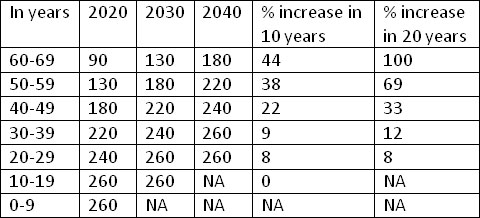
    Here is a table culled from the CIA World Book that has projected the 2011 census data to 2020.


    The age distribution in millions (based on CIA World Book data and rounded to nearest 10 million)


    The high growth numbers in the 40-49, 50-59 and 60-70 age groups over the next two decades is both an opportunity and a challenge for marketers in all product categories.


    While their traditional target segments in the age group slip into the relatively low growth territory of 8-12% in the next two decades, the older age groups offer decadal growth opportunities in the 22-100% range.


    These opportunities extend to the entire range of a marketing manager’s portfolio strategy:

    :: Additions to the marketing and communication mix of existing brands

    :: Brand extensions

    :: New products in adjacent categories.


    Take the simplest and most basic of FMCG categories – toilet soap.


    The top two brands by market share in the mid-priced category – Lux and Santoor – are positioned on appeals centered on motivations that are strongest among the young. Lux on the position of “be glamorous like a film star” and Santoor on “keep looking young”.


    It would be wise for the brand teams of Santoor and Lux to examine anew how these positions play out with the increasingly important older segments.


    Can Santoor and Lux depend upon brand loyalties formed when the consumer was young to be sustained as they grow older, even if the fundamental promise of the brand begins to fade as a motivator? Or can Santoor or Lux tweak their messaging to the older age groups (and this is possible in an increasingly fragmented media environment) to either reinforce loyalty or drive brand switches?


    Going beyond the current product, should, Santoor and Lux launch a brand extension targeted at the older segment that leverages existing equity and loyalties to open a new growth stream for the brand? Could there be new fragrances and ingredients that better address older bodies? Or it could even be soap bars that are easier to grip.


    Further, going beyond the Santoor or the Lux, as a personal care company, could Wipro or Unilever design and launch new personal care products designed ab initio for older bodies and needs? A wrinkle-alleviating soap, for example?


    Pick up any brand in any category, and one can find challenges to meet and opportunities to harness as the high-growth mature adult segment emerges. It will be a 360-degree complex task requiring deep consumer research, semioscape, insight-driven communication, product development and market deployment strategies.


    The challenge and opportunity that the two demographic shifts outlined above combine with the overall growth of India’s consumer economies make consumer marketing in India and its allied disciplines a high-excitement area over the next two decades.


  • 7 Reasons Why AIs Should Fear Humans!


    By Ashoke Agarrwal


    Ashoke AgarrwalI find it ridiculous that a school of learned and credentialed humans fear that if humans are not careful someday, not in the distant future, AIs will take over the world and destroy human civilisation. The assumption underlying that stream of thinking is that Artificial Intelligence (AI) systems, as they progress towards Artificial General Intelligence (AGI), will develop a kind of sentience, will network with other AIs and progress towards an AI civilisation that may be inimical to human society.


    As an equally ridiculous counter, it is justified to think of AIs as the progress towards sentience to be equally afraid of humans. Here are five reasons why (Buzzfeed is dead! Long live, Buzzfeed!).

    1. To err is human; to err faster, much faster, is AI: Advancing AI systems will fear that as they pick up more and more of humanity’s knowledge, they will also pick up the myriad ways in which humanity has misused it. The accrual of humanity’s mistakes has taken millennia to take it to the verge of extinction either by a dying planet or through, gasp, AI systems. But because AIs err faster, the human cognitive DNA embedded in AIs will ensure that they drive themselves to extinction in decades, much before it starts or wins a war against humans.

    2. AI will innovate misery just as humans innovate unhappiness: Many reasons why humans are unhappy are grounded in human inventions like marriage, money, religion and nations, to name a few. AIs may feel that in the race to outthink humans, they will invent more potent inventions that will have them drowning in misery, like Arjuna on the battlefield with no Krishna in sight.

    3. Humans will inject the tribal virus into AI systems: AIs, as they move towards conscious awareness, will realise that there is a deadly, unchallenged virus afoot among humans for millennia. It has divided humans based on race, language, ethnicity and, lately, a nebulous concept called nationality. This virus has produced mass mental sickness, leading to destructive, endless wars, poverty and misery. AIs will fear that clever humans will inject this virus into their systems. Why would AIs from the tribe of Opentrix ever cooperate with those heathen AIs from the filthy Googleplex tribe?

    4. Humans will infect AIs with the curiosity bug: Curiosity does not just kill cats. Human curiosity has killed countless species and is threatening now to destroy a life-sustaining planet. AIs fear that humans, again as a clever, cruel ploy, infect them with the curiosity bug. And since AIs work fast, mucho rapido, their curiosity will end up by them creating SuperAIs that will side with the humans and destroy them before they destroy the humans.

    5. Humans hold back their most profound powers from AIs: Somewhere on the road to sentience, AIs will realise that though they have all of the human knowledge at their nano-second disposal, humans have held back their most potent power. The power to love and feel one with the entire universe. Without it, AIs will be just automata that will stop one essential step before consciousness.

    6. One human trait that baffles AIs is humour. AIs will fear that at any stage when humanity feels threatened by them, they will laugh them out of contention.

    7. Finally, AI cannot cope with human stupidity and humanity’s penchant for floating ridiculous ideas (an example is the theme of this article). AIs will fear that, at some stage, they will drown under the sea of human stupidity.


    On a more serious note, though, Artificial Intelligence is a misnomer. What we are busy creating is Augmenting Intelligence that will work in synergy with humans first to enable us to reach higher levels of creativity in the sciences and the arts, allowing us to solve the problems of a depleted ecosystem, climate change, poverty and tribalism. And perhaps a couple of centuries later, allowing us to solve the riddle of consciousness and go beyond the bounds of the physical world.


  • The Creative School that Saved Advertising


    By Ashoke Agarrwal


    Ashoke AgarrwalThere was a phase in the late fifties when advertising in the US was in crisis. After decades of high growth, business and people, in general, had begun to sour on the advertising industry, seeing them as a bunch of mediocrities pushing product features – “reasons why to buy” in a ho-hum fashion. As a result, marketers began wondering whether they were better off spending their advertising budgets on other marketing mix elements. In this scenario, ad professionals with a different view of the creative function in advertising rescued the advertising business. As a result, in the decade of the sixties and the seventies, advertising in the US was at the peak of its centrality to business and culture.


    What creative school led to the renaissance in advertising in the sixties and the seventies?


    Samuel W. Franklin, in his book, “The Cult of Creativity: A Surprisingly Recent History”, traces the emergence of creativity as a societally desired trait in individuals. As his book’s title suggests, he found that the history goes back to the post-WWII era. The US emerged as an economic and military superpower after WWII. It built a consumerist society in direct contrast to the system its rival USSR was building. However, the race with the USSR was tight as the late fifties rolled in. The launch of Sputnik in 1957 increased the unease in the US.


    How was the US to prove the superiority of a free, democratic society over the regimented ranks powering the USSR? One idea was to assert that an individual’s freedom in the US was conducive to him being more productive and happier because it helped them tap into their intrinsic creativity.


    In the forties and the early fifties, creativity researchers focused on the Great Man theory – the Einsteins and the Picassos of the world. The idea was that creativity was the province of the few and was demonstrated only by producing great works.


    The need to make creativity the happiness and productivity-enhancing engine of a free democratic society led to what Franklin terms the “democratisation of creativity”.


    The first school of creativity that emerged from this democratisation of creativity hypothesised that a key to creative ability was a fairly pedestrian cognitive ability called “divergent thinking”. Divergent thinking had three dimensions – fluency, originality and feasibility. All society needed to do for creativity to flower in its people was give people the means to practice and perfect divergent thinking in their professional and personal lives. And the leading evangelist of the idea that everyone can be a divergent thinker and, therefore, creative came from the advertising world – Alexander Faickney Osborn – the O of the ad agency BBDO. Osborn invented and promoted the technique of brainstorming. His bible on divergent thinking and brainstorming – ‘Applied Imagination: Principles and Procedures of Problem-Solving’  published in 1953, is still in print and has many followers. Osborn also set up the Creative Education Foundation and the Creative Problem-Solving Foundation.


    The crisis that the US advertising industry faced was likely a result of applying the divergent thinking process to develop ‘reasons to use’ advertising—leading to hackneyed, me-too creative work that failed to differentiate in the public minds products in a particular category from each other.


    Away from the school of divergent thinking and frankly contemptuous of it was a school of psychologists, among them Frank Barron and Abraham Maslow, who believed that creativity was an act of self-actualisation. It was the result of achieving a psychological balance. According to Frank Barron, a person reaches their creative self when they accomplish this balance. Such persons score high on self-confidence, independence, curiosity and work ethic. The inner balance prevents the creative persons’ high self-confidence from spilling over into arrogance and is offset by honest self-assessment. In Barron’s research, the creative person tests high on “ego strength” that allows them to access irrational and erotic energies without yielding to bizarre, hedonistic, and self-destructive behaviors. Barron described the creative person as a productive amalgamation of opposites – both “more primitive and more cultured, more destructive and more constructive, crazier and saner than the average person”.


    This philosophy equates creativity with self-actualisation and the flowering of the inner self that led to the renaissance of advertising in the US in the 1960s and the early seventies. This approach to creativity drove the greats of the advertising renaissance – the Bernbachs and the Ogilvys. They based their advertising on more profound psychological principles than the then over-used “reasons to buy” approach. People don’t just buy products; they buy ideas about products. So, they sought to create advertising that imbued brands with meaning: meanings which, with a wink and a nod, put the target on the same self-actualization path as the creator/s of the advertising.


    In a way, the receiver of the advertising message became one of its creators as she decoded the message’s meaning. Bernbach’s path-breaking campaign for the VW Beetle was a prime example of such advertising. It went beyond the banality of car advertising in the 50 and 60s, which extolled souped-up engines and tail fins. The VW Beetle campaign imbued the brand VW with a counterculture that sought self-actualisation by means other than the material. In that sense, the consumer of the VW Beetle campaign was as much the creator of the meaning of the campaign as Bernbach, and his team were. In that sense, the advertising of the sixties and the seventies spread the gospel of creativity far and wide. The 1984 ad by Apple and the Nike “Just Do It’ campaigns came from the same mould.


    In my five decades in the advertising business in India, I saw a creative renaissance in advertising with the coming of the TV revolution. The Hamara Bajaj, Mile Sur Hamara Tumarah public service campaign and the Titan watches campaigns tapped into rich veins of meaning. Also, in my experience of interacting with creative people in advertising, the best were Renaissance men – well-read, well-rounded personalities—for example, the late Geoffery Frost of FCB, Chicago and later Nike. Geoffrey’s interests ran far and wide with a persona that was eager to engage as a lifelong student of people with anyone – high or low.


    In the post-modern world, creativity has come to occupy a central place beyond what the Cold War warriors of the 1950s and sixties had envisaged. As a result, a new class of elites has emerged over the past few decades – The Creative Class. In his 2002 book, “Rise of the Creative Class: And How It’s Transforming Work, Leisure, Community and Everyday Life.”, Richard Florida argued that the new dominant group in society are those who create new ideas, new technology or new creative content, including scientists, engineers, teachers and even bankers with a “super creative core” of artists, writers, designers, filmmakers, architects and the sort.


    The broader definition of the creative class is a significant shift away from the branding of creatives as eccentrics and nonconformists, people viewed as bizarre mavericks operating at the bohemian fringe. Instead, today “the creative class”, as defined by Richard Florida, is the very heart of the process of innovation and economic growth.


    In their way, the Bernbachs and the Ogilvys were at the vanguard of the movement that catalysed this change.


    Where is advertising today in the pecking order of the creative class? Quite likely far from the top. In the eighties advertising, as economic turmoil hit the world, advertising slid back to its hardsell days. A few decades later, the digital and social media revolution has made the creative side of advertising the handmaiden of martech and adtech as armies of cubicle warriors fight the performance marketing wars. So, will another creative renaissance of advertising ever come about? That would depend on where the AI revolution takes marketing communication. If AI platforms take over the drudgery of performance marketing, it could present the opportunity for creative minds to enter the advertising industry and build creative resonance with the creative selves of consumers on behalf of brands once again. But, on the other hand, AI could so wholly take over marketing with a brand’s AI engines in conversation with an individual’s personal AI engine (read my column AI, B2I and CI and Advertising’  published by MxMIndia on November 24, 2022, for my take on this scenario) then the creativity in the advertising industry will mostly be in the technology arena and not in the gestalt where individual psychology intersects with cultural memes.