
By Ashoke Agarrwal
 The interactive ability of digital and social media has given rise to the concept of Hypertext Marketing. Hypertext Marketing differs from traditional integrated marketing strategy in that it not only integrates a single brand message across multiple media but also draws upon interactive platforms that modify and generate new brand messages.
The integrated brand strategy and management school gathered momentum in the late seventies and early eighties of the twentieth century. It began with the outmoding of Vance Packard’s famous persuasion model of marketing and the resultant “hidden persuader” school of advertising. Instead, brand strategy and management took on a consumer-centric focus on meeting consumer needs rather than manipulating consumer minds through artful advertising.
This evolving school of marketing then further challenged the notion that rational forces and metrics drive markets. This evolving understanding of consumers, market and culture led to the Marketing Semiotics paradigm.
Semiotics focused on the role of emotion and creativity in consumer decision-making and on applying these insights to the strategic planning process.
Marketing Semiotics focuses on three dynamics – a) the semiotic space defined by the product category, b) the relative positions of the competitive brands in this space and c) changing cultural trends that might affect the semiotic space and the positions of brands within this space.
The dynamic interaction between cultural norms, marketing action, and consumer interaction defines the dimensions of a category semiotic space.
For example, in formal Western menswear, research in India has shown that two dimensions define the semiotic space – the Elite-Accessible dimension, Trendy -Traditional. In traditional analysis, this leads to four quadrants for available brand positions – Elite and Trendy. Elite and Traditional, Accessible and Trendy and Accessible and Traditional.
In semiotic analysis, even the negatives of each dimension – Not Elite, Not Accessible, Not Trendy, Not Traditional are considered -leading to ten quadrants of positioning space to be explored. This approach allows for a) more positioning options to emerge, b) for more dimensions to emerge and c), over time, better track cultural shifts affecting the semiotic space as well as brand positions.
Semiotics can lead to more effective marketing communication. In the communication context, marketing communication is defined by its formal and cognitive properties as a medium of consumer persuasion. Semiotics, however, defines marketing communication from the marketing context – as a vehicle for sustaining brand positioning over time, maintaining its competitive distinction and aligning brand message with cultural change.
To sum up, Marketing Semiotics is an approach that creates and builds brands as an integrated and interactive part of the product category code and the broader cultural code within the competitive framework and responds to category and cultural code changes over time.
Combining Hypertext Marketing with Marketing Semiotics allows integration with the ability to respond to interactive platforms.
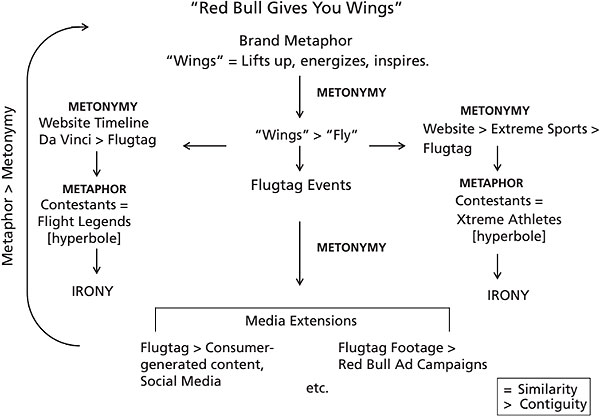
In her book “Creating Value: The Theory and Practice of Marketing Semantics Research, “ Laura Oswald gives an example of the integrated use of Marketing Semiotics in Hypertext Marketing by Red Bull.
Red Bull used the brand metaphor of “Wings” to signify its core benefits of “Lifts, energises, inspires” and fashioned the advertising theme of “Red Bull Gives You Wings”.
Red Bull decided on the brand tone of “irony” because humor was the most engaging content genre with its core target audience – the young. And within humor – irony had the most upmarket appeal.
Red Bull consolidated its functional position with its consumers by sponsoring extreme sports and high-energy cutting-edge rock music. However, in the Hypertext Marketing context, it needed to find an interactive platform that resonated with its ironic advertising and enhanced the brand’s chosen persona. It did so with the Flugtag events. The basis of Flugtag events was the concept of giving human wings – literally. The event invited teams to build a flying machine solely powered by humans and then demonstrate these at the event by flying over a water body. Most flights lasted less than a minute, with the spectacle of the contestants crashing harmlessly into the water. After a Flugtag event, social media would light up with user-generated content based on videos of the event. The zaniness of the Flugtag event, the ironic advertising on the theme “Red Bull Give You Wings”, and its sponsorship of extreme sports and rock music allowed Red Bull to build and nurture a formidable brand that was equally strong on the functional and emotional dimensions.
In my decades in the Indian advertising world, I have seen much change. When television emerged as the primary media in the late nineties, the lingua franca of Indian advertising changed from English to Hindi and other Indian languages. Today as the focus of Indian marketing shifts from mass media to digital media, from linear TV to connected TV, from brick-and-mortar to omnichannel, and from Gen X to Millennials and Gen Z, the process of marketing and marketing communication strategy making needs to shift. Many consumer behavior models that today form the basis of marketing and advertising strategy need to be updated. We need to audit and continuously reframe our understanding of the semiotic and cultural spaces that constitute the operational matrix of our products and brands. Finally, we need to reinvent market research from the silos of quantitative and qualitative, ad hoc and syndicated, and move to a more strategic form of analysis and research that integrates across all marketing mix elements and time.
We must also know and act on the actual value of digital and social media emergence. Most brands across categories solely base their digital and social media strategy on the paradigm of better and more fine-tuned targeting. The big unexploited opportunity that digital and social media platforms offer brands is Hypertext Marketing, which creates a virtuous, brand-building cycle between the brand and the consumer.