Tag: Ashoke Agarrwal

  • Psychographic Segmentation Framework – The R&D Effort Indian Marketing Needs

    Psychographic Segmentation Framework – The R&D Effort Indian Marketing Needs

    Ashoke AgarrwalIn my over four decades in the business, I have found that the critical psychographics that drive advertising are that of the client and the creative team. For example, if both the client and the creative honchos are introverts or extroverts, it leads to a happy meeting of minds, and if there is a mismatch, there is trouble ahead.

    Seriously though, over the decades, I have been part of teams that have devised marketing communication strategies for a wide range of brands – market leaders and challengers from multinationals and desi companies in FMCG, durables, fashion, and services – and yet to come across a case where psychographic segmentation was a crucial part of the strategy.

    Even the demographic segmentation that drove strategy was, by and large, of the broadest stroke – the young or mature adult, affluent or middle class, EMT (English Medium. Type) of VMT (Vernacular Medium Type) and, of course, male or female.

    Over the decades, I have seen the “young” morph from Gen X to Millennials and now Gen Z, but the picture of the young that most brand managers and advertising people cater to has remained more or less the same, except for external attributes that Gen Z are digital natives while the Millennials were partially there and so on.

    The reason for the benign neglect of psychographics among marketers and advertising people is not laziness or ineptitude but the realities of the Indian marketplace.

    For most of the past decades, the Indian people have been striving to meet basic needs, with some at the top of the income ladder doing it relatively easily and the rest. in a daily struggle for “roti, kapada and makaan”. Therefore, India’s consumer and media markets cater to basic needs with a thin patina of demographic segmentation.

    India and Indians are now climbing the income ladder.

    Household income projections by PRICE, a think tank, show that in 2016, 37 million Indians lived in households with annual income levels greater than INR 30 lakhs a month (at constant 20-21 prices). By 2021, this had gone up to 56 million, and the projections are that by 2031, there will be 169 million, and by 2047, there will be 437 million. Given the Purchasing Price Parity (PPP) conversion, as determined by the World Bank, is roughly INR 25 to 1 USD, the INR 30 lakhs plus income bracket translates to USD 1,25,000 plus income bracket in the US. Based on these numbers, Martin Wolf, the Chief Economic Commentator of FT, London, has predicted that the purchasing power of India will be 30% higher than that of the US by 2050.

    As India becomes increasingly affluent, social, cultural, political, and consumer choices will be nuanced and driven by personality, lifestyle, and attitudinal factors, in addition to basic needs.

    Therefore, it may be time for India’s marketing, media, and advertising communities to develop and invest in a common psychographic framework.

    Through the Market Research Society of India (MRSI), the community has created a solid framework for demographic segmentation through the SEC (Socio-Economic) system of classifying Indian households. It has taken a couple of decades for this system to mature and become universally applied across all marketing and media data sets. The latest tweak, released in February 2024, fine-tunes the system. While the SEC system is reflected in most data sets related to traditional media (for example, BARC and IRS), syndicated studies like TGI and Kantar World Panel and ad-hoc research studies, the community should push the social media giants like Meta and Alphabet as also the likes of Comnscore to adapt the system to the extent possible in their reporting and their targeting algos,

    Psychographic segmentation will become increasingly relevant in an increasingly affluent India. It is time for a body like the MRSI to start discussing, with all relevant constituencies, the first step to creating a psychographic segmentation framework for India. The objective should be to develop a segmentation framework that is most predictive of primarily consumers and media choices and secondarily of lifestyle, attitudinal, cultural, and political choices. Whether lifestyle and attitudinal choices will be dependent or independent variables will depend on the classification framework. To choose the framework with the highest discrimination power, we need a benchmarking study before settling on a final framework.

    We will need to evaluate a wide range of global frameworks:

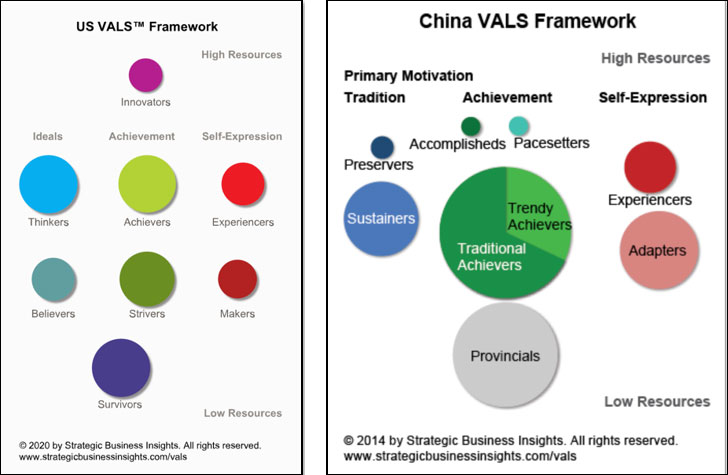
    • VALS (Values, Attitudes and Lifestyles)
      • Developed by SRI International, VALS divides consumers based on their primary motivations and resources.
      • It develops unique VALS systems for each country.
      • For example, the VLAS systems for the US and China differ widely.
    • PRIZM (Potential Rating Index by Zip Market)
      • PRIZM segments consumers into lifestyle types based on demographics, behaviours and geographic location
    • OCEAN utilises personality traits to predict consumer behaviour: openness, conscientiousness, extraversion, agreeableness and neuroticism

    The Myers-Briggs Type Indicator (MBTI), once very popular, is a psychographic framework that has recently been controversial.

    Kantar’s TGI is an audience profiling study that captures various data points—from product use to leisure activities to attitudes and media engagement. Since TGI has been present in India for decades, it offers a rich trove of data that can help develop an effective psychographic segmentation framework for India.

    Academic studies exist in the broad area of psychographic profiling of Indians, some of which can provide useful data sets or insights.

    It will take a decade or more to drive consensus and establish credibility for a Consumer Psychographic Segmentation Framework (CPSF) to become widely accepted and part of every essential marketing and media data set. If we start today, the marketing and advertising community will be in time to function optimally in an affluent and increasingly complex market called India.

    The use of CPSF will begin as early in the marketing process as product or service design and, of course, be central to marketing communication planning. A CPSF would also usefully inform social interventions and political campaigns.

    Developing a widely accepted psychographic segmentation framework is a vital R&D effort that ranks along with the attempt to create India-contextualised AI-driven martech and adtech. Let’s get on with it.

  • Ashoke Agarrwal: Mirror! Mirror! On the Wall! Which Ad is the Best of All!?

    Ashoke AgarrwalAt the peak of the mass media advertising era, a fundamental rule of creative strategy was to look at stimulus and desired response as two separate entities.

    The way the principle was explained to newbies in the planning and creative department was that if you wanted a consumer to consider going out shopping for a new refrigerator (response), the messaging needed to evoke, say, the inconvenience of sputtering old refrigerator (negative stimulus) or the joy of opening a spanking new, modern refrigerator and tasting the freshness of an apple bought two weeks ago (positive stimulus).

    However, the stimulus-response principle goes way beyond the one-dimensional Pavlovian relationship.

    An insight I have garnered over decades of strategic planning experience and working with the best creative people is the ‘Mirror Principle’.

    Most advertising works through repetition within limits. The rare ad campaign strikes home the first time a viewer comes across it. Others need repetition to overcome inertia and lead to attitudinal or behavioural change.

    However, a consumer pays attention to an ad only if it evokes interest in the first place. Suppose an ad doesn’t provoke the initial attention. In that case, no amount of repetition will make the consumer pay attention; thus, the entire campaign will be like a ship passing in the dark.

    So before the stimulus-response paradigm can work, an ad must overcome media clutter and human inertia and evoke interest.

    Some creatives take that as the cue to resort to the ‘painted pony syndrome” – a stableboy was madly in love with the master’s daughter and sad that she would not even look at him when he delivered her pony to her every morning. The stable master consoled him and said he must get the girl to address him first. So, when the boy offered the pony the following day, the girl screamed, “Who painted my pony yellow!?”. The boy replied, “I did. Can we meet in the woods this evening!”

    The “painted pony syndrome” drives much of the bizarre, supposedly clutter-busting, attention-grabbing advertising. Advertising that is not just ineffective but counterproductive.

    The “Mirror Principle” is that an ad campaign grabs an individual’s attention when it mirrors her self-image, aspirations, or beliefs.

    For example, most women do not crave to look as beautiful as a film star. On the other hand, most know that looking younger than one’s age is a sign of a well-lived and disciplined life. While few women believe that soap can be the chief instrument in their looking young, the fact that Santoor’s advertising reflects their aspirations has led to Santoor becoming India’s number-one soap brand over the years.

    Apple’s 1984 ad mirrored the American angst of the 80s and thus worked even among those who had never heard of Orwell.

    The “Hamara Bajaj” campaign worked because it mirrored the need of the first generation of Indians born after 1947, the first post-colonial generation, to discover a modern Indian identity.

    When Syska pioneered LED Lights in India, it used the persona of Irfan Khan to mirror the urge to go off the beaten path that is an overt or latent part of every individual.

    The other factor that enhances response is when an ad is layered – when a TV or a press ad reveals new facets to the viewer/ reader every time she sees it. All the four ads I have mentioned above are layered. Mirroring and layering are skills that top-rung advertising creatives have in common with their counterparts in films, television, books, and art.

    One note of caution about repeat viewing: even the best-layered ads have a limit regarding repeat viewing. Many big brands with mega budgets tend to deliver campaigns to a reader/viewer so often that they become counterproductive.

    When the digital and social media advertising era dawned, I expected advertising to reach new heights in mirroring and layering. The expectation was based on the narrowcasting that digital and social media enable that would allow for greater depth of insight. Instead, digital and social media advertising is, by and large, plumbing the depths of the Pavlovian stimulus-response paradigm, focused on the all-important click and like or share buttons.

    However, there are signs that Gen Z is tiring of click-bait advertising, and perhaps the coming decades will see a shift back to mirroring and layered advertising.

  • The Morphing of Social Media & the Putative Rise of Conversation Marketing

    The Morphing of Social Media & the Putative Rise of Conversation Marketing

    Ashoke AgarrwalAt the dawn of the internet era and, a bit later, of the social media era, many sociologists believed they would lead to a more informed and enlightened world. The events at Tahrir Square, the subsequent Arab Spring, and later the Maidan revolt in Kyiv seemed, for a period, to support this contention. Marketing gurus posited the dawning of the age of interactive and one-to-one marketing, much like the bazaar of yore but on a global, post-modern scale.

    But then the medium took over the message.

    Marshall McLuhan, in his 1964 book, ‘Understanding Media: The Extensions of Man’, coined the phrase, “The medium is the message”, which went on to become a pop phrase that was widely quoted, right or wrongly, in a wide variety of contexts.

    Marshall’s theory posits that the form of the medium embeds itself in the message, creating a symbiotic relationship by which the medium influences how the message is perceived. A corollary of Marshall’s theory was that a dominant medium would influence societal norms, politics and personal identities.

    By 1964, TV was the dominant medium in the US and most of the developed world. In its days, TV as a medium was supposed to build a sense of collective experience and this community. Instead, it promoted a culture of consumerism and passive consumption. Advertising, of course, gorged on this medium that was so much in synergy with its objectives.

    Sidney Lumet’s 1976 movie ‘Network’ is a trenchant yet entertaining critique of the Age of TV and its social impact.

    When the age of social media dawned with Facebook and Twitter, the initial hope was that the medium would redefine interaction and create a participatory culture. Instead, it became another gatekeeper medium controlled by shadowy algorithms that created echo chambers promoting tribalism across many dimensions while delivering audiences to advertisers. The fact that it could provide a more narrowly targeted audience to advertisers than could TV resulted not in a more informed consumer but in an increased ability of brands to insinuate into the social and consumption profile of the consumer. Also, more brands could get into the act as social media lowered the threshold level at which advertising budgets were effective.

    Going by the ultimate societal effect of the TV and social media eras, another corollary to McLuhan’s theory can be posited: that the societal impact of a dominant medium settles into the lowest common denominator in human nature!

    With the rise of TikTok, social media is morphing, creating and strengthening a new medium.

    Initially, social media sites like Facebook showed chronological updates from users’ friends and contacts. As the volume of posts grew, the networks employed algorithms to prioritise posts that had proved popular among the user’s friends.

    TikTok changed that. As a recent article in The Economist notes, “TikTok decided that, rather than guessing what people liked based on their “social graph” – that is, what their family and friends liked – it would use their “interest graph”, which it inferred from the videos they and people like them lingered on. And rather than show content created by people they followed, it would serve up anything it thought they might like.”

    TikTok’s growing popularity forced every other big platform to follow suit – Reels on Facebook and Instagram, Watch on Pinterest, Spotlight on Snapchat, and Shorts on YouTube.

    The result is that social media is morphing away from an interactive medium into a video-first, highly curated engagement platform. In that sense, social media is on its way to becoming a TV-like medium. Thus, marketers and advertisers are beginning to adopt a grammar akin to their TV campaigns for their social media campaigns.

    While social media platforms become places for passive consumption, users move their conversations and arguments off the open networks and into closed private groups like WhatsApp and Telegram, with implications for the business of political campaigns and the news media. Political parties like the BJP have made WhatsApp groups a key pillar of their campaign strategy. As social media platforms have moved away from highlighting news stories in their feeds, news media are increasingly trying to create channels on instant messaging platforms like WhatsApp and Telegram.

    Currently, in India, the tendency is to use it as a mass promotional channel, sending messages to an undifferentiated mass of “mobile” numbers.

    Marketers need to recognise that the platform offers two unique opportunities:
    1) it allows for a convenient one-on-one interactive platform and
    2) it allows a brand to create, communicate and enthuse a “fan group”.

    WhatsApp marketing can become the communication edge of a whole-of-marketing Big Data and data analytics-driven approach. I call this Conversation Marketing. Data collected from retail outlets, e-commerce platforms, loyalty cards, and first-party data can enrich conversations with consumers and groups. Conversation Marketing allows marketers to open a genuinely interactive, one-to-one channel with consumers. Whether this turns out to be a chimaera as from the early days of social media depends on how both the owners of the messaging platforms as they move to monetise them as well as the campaign strategies of brands.

  • The Social Consciousness of Advertising Agencies

    The Social Consciousness of Advertising Agencies

    Ashoke AgarrwalMany think of advertising people as hustlers. A few voice their opinions with wit; for example, the comedian Steven Wright said, “I saw a subliminal advertising executive, but only for a second. ”

    Those of us in advertising know that the average advertising man is only as unscrupulous as the average human being.

    There are many reasons for the societal image of advertising people. Though advertising, by and large, plays a valuable role in society as a source of helpful information and entertainment, most people, at one time or another, have been seared by it at the personal level, consciously through the post-purchase dissonance that they blame at advertising’s door. And subconsciously because the lifestyle much of the advertising portrays makes them dissatisfied with their circumstances.

    Another reason was the glamour associated with advertising a few decades ago. Advertising no longer has that problem as it has shifted from brand custodians peopled by stars to quotidian vendors largely peopled by drones.

    Beyond the general populace’s extant image of advertising people, the pertinent issue is the advertising profession’s societal responsibility. At its core, advertising is a profession with highly specialised skills as much as the practice of medicine and the law are professions. I would even include politics as a profession. The issue is that the professions of medicine, law, accounting, architecture and engineering are codified and guided by a stated or unstated set of rules; soft professions like politics, advertising and management are not. The harm done to societies worldwide by having the profession of politics open to all and governed only by the mandate of “anything goes in politics” is evident.

    Management and advertising, on the other hand, are answerable to stakeholders and the rigours of the market, and even without codification, a relatively tight set of rules and guidelines has evolved.

    What, then, are advertising’s societal responsibilities? Mark Twain once said in jest (I hope) that advertising is legalised lying. Anyone who has been in advertising knows that consumers and markets are brutal masters and will weed out those who think advertising works because it fools people. Advertising works because it is based on the consumer’s deeply held conscious and subconscious attitudes and beliefs and seeks to effect behaviour aligning with these beliefs.

    The advertising profession’s speciality is in unearthing beliefs and attitudes and crafting arresting messages that align with these beliefs and attitudes in suggesting or reinforcing an action.

    Commercial advertising does not attempt to change underlying beliefs and attitudes because doing so would require budgets far beyond the commercially viable range. Instead, it addresses an existing set of beliefs and attitudes most conducive to its commercial objectives.

    Advertising, in its commercial sense, is value-agnostic. If a deeply held belief in a vital section of the audience that driving a fast car is a symbol of sexual potency, then advertising will run with it. If being woke about gender equality or secular values is a strong belief in another section, advertising will run it no matter whether it is for a detergent or jewellery brand.

    Advertising plays a societal role in enabling a consumerist society, a central pillar of modern economies. It also subsidises media – mass, digital and social – and thus enables the cultural and communication milieu of societies.

    However, the advertising profession can go beyond its commercial role and use its unique skills to do good to society more directly.

    Advertising can do in the societal space what it is wrongly accused of doing in the commercial space. It can zero in on beliefs and attitudes that harm individuals and societies and change them with the right messaging and level of persistent exposure.

    Such advertising, blandly known as Public Service Advertising (PSA), is currently reduced to a hoax category at advertising award functions. Advertising that juiced up creatives let rip on issues and causes they barely understand.

    Decades ago, when advertising agencies sat at the business and marketing high tables and had a different image of themselves, the Advertising Agencies Association of India (AAA of I) devoted some of their resources to creating effective PSA campaigns and persuaded the media to give them meaningful exposure. One worthy recently told me that they could not think of such activities nowadays as the agencies fight for their existence in the age of Google, Facebook, ad tech, and now, God forbid AI.

    Au contraire, wouldn’t creating powerful PSA campaigns that improve societies’ dynamics be the best way to revive recognition of the high art of advertising and, thus, the prestige and influence of advertising agencies? Wouldn’t traditional and digital media wholeheartedly support such an effort because they, too, are under existential pressure?

    Time was when Doordarshan was the only TV channel in the country, Kailash Surendranath and Suresh Mallik got together to create the inimitable “Mile Sur Mera Tumhara” campaign – the ultimate PSA for its time.

    The world is much more complex today, so PSAs must dig deeper. My decades of campaign planning experience have taught me that the more complicated the problem and the deeper you dig, you come up with a startlingly simple solution. For example, one of the critical problems facing societies today is increasing tribalism, the deep division of societies into “Us and Them” factions based on politics, religion, ethnicity, age and class. At the surface level, the reasons are complex, and tackling each cause of division individually is intractable. But dig deeper; the core cause is losing the ability to listen universally and without a filter. To do so would not just create a lowering of barriers between individuals but would make life richer and more meaningful for each individual. The advertising planners and creatives will dive deep and unearth those beliefs and attitudes that prevent listening and those latent ones that can support listening and create messaging that negates one set and reinforces the other.

    The above is just one illustrative example of how deep a PSA can go.

    To reassert, advertising agencies can find the high table again if they deploy their unique skills to address society’s urgent psychographic needs. Let’s think of this as a core business development strategy.

  • Election Campaigns and the Idea of India – An Account Planner’s Perspective


    By Ashoke Agarrwal


    Ashoke AgarrwalThe election season is upon us. Soon, the taxpayer-funded DAVP-type campaigns touting governmental achievements will stop, forced by election regulations. And political parties will need to dig into their coffers and launch advertising campaigns.


    Over the decades, I have been part of the agency teams pitching for such campaigns. Personally memorable was when, in 2009, as a freelance account planner, I was part of two mainstream agency teams, one pitching for the BJP campaign and the other for the Congress campaign. Both campaigns were won by small shops with insider connections.


    The 2004 BJP campaign, ‘India Shining’, was crafted by a mainstream agency, and the result probably put off both major parties from appointing mainstream agencies in 2009.


    In 2019, the BJP overcame the reluctance and had ad stalwarts from not one but two agencies crafting its campaign. The result was the ‘Acche Din Aaane Waale Hain’ and ‘Abki Baar Modi Sarkar’ campaign. The campaign was one of the many factors that drove the election results. The campaign linked a specific promise based on a critical consumer insight – disgust with alleged big-ticket corruption scandals and a slide in the growth rate – to a particular personality. After Indira Gandhi’s campaigns in the late seventies, this was the first time in India that a Lok Sabha election took on the hue of a Presidential election.


    In 2019, the usual wheels-within-wheels decision-making matrix of a party in power did result in a somewhat diluted strategy with the campaign theme ‘Modi Hai To Mumkin Hai’. The presidential tone of the campaign continued, but a deep hook into the existing consumer psyche was missing. 2019 was won, and with a higher margin, because of a general level of satisfaction with the performance of the government and then nationalistic fervour triggered by an external event.


    Anecdotal evidence suggests that the 2019 BJP ad campaign did not have as big a hand in the BJP’s victory as the 2014 campaign.


    The Congress ad campaign themes in 2014 and 2019 were ‘Har Haath Shakti. Har Haath Tarakki’ and ‘Ab Hoga Nyay’, respectively.


    The 2014 campaign was focused on the UPA’s achievements in the past decade and fell flat in being clouded by big-ticket corruption scandals like the Commonwealth Games and 2G. The 2019 ‘Ab Hoga Nyay’ was based on the promise of a significant freebie and might have worked better than it did (for example, the 2023 Karnataka campaign) if the leadership, such as it was, dug into a ‘Chowkidar Chor Hai’-themed Rafale scandal-based campaign, in an unsuccessful effort to avenge 2014 and turn the tables on the BJP.


    More importantly, in 2014, the BJP turned the Lok Sabha campaign into a presidential one, with the electorate being asked to choose one person for the PM’s post, and it continued to do so in 2019. Congress, by contrast, continued to fight a Parliamentary election with no projected PM face.


    So what is in store for 2024? The BJP seemed to have already zeroed in on a campaign theme – some variation on ‘Modi ki Guarantee’. At this stage, the strategic underpinnings of this theme are unclear.


    The theme could be a response to the freebies-driven Congress campaign in Karnataka and Telangana, with the implication that promises made by Modi are more potent, a reactionary stance that cedes space to the opposition.


    On the other hand, if it is a guarantee of a large mission – of translating a vision of India into reality – then the ‘Modi ki Guarnatee’ theme is incomplete and needs to be completed by a vision of India that meets the aspirations of the electorate.


    India is the world’s largest and most diverse democracy, and the aspirational vision of its people’s varied aspirations constitute the idea of India. Is it time for Modi to have a co-star – the people of India? A campaign that projects individual Indians from many walks of life along with Modi. A campaign that pithily translated the many dimensions of the ideas of India that its people have. A campaign with the theme – ‘Aapka Sapna. Modi ki Guarantee’ gives the campaign a forward-looking stance that appeals to the young and increases Modi’s already high relatability.


    What about the opposition INDIA alliance? Sharad Pawar’s contention that they can choose the PM face after winning the election is a textbook example of wanting to put the cart before the horse. In the electorate’s minds, the 2024 election is about choosing a PM, and there will be no contest without the “INDIA” alliance going with a consensus PM before the electorate. Is Mallikarjun Kharge the man? Maybe. However, it is essential to have a clear consensus and projection.


    With a projected PM candidate, the INDIA campaign must launch a key promise based on a clear insight into the electorate. Can the promise be a list of freebies? Freebies, as a promise, can be quickly replicated and even outdone. The BJP learned this lesson, which is evident in Chhattisgarh, MP, and Rajasthan. Instead, the INDIA alliance needs to project an Idea of India that runs counter to the BJP’s and still has as much relevance to the people of India. Aspirations are multi-dimensional, and some of the dimensions run counter to others. For example, in the individual realm, an ambition to be rich contradicts the aim to do selfless work for the community.


    The BJP’s idea of India is a muscular India with economic and hard power. It has chosen GDP growth as the leitmotif of this idea of India.


    Could the INDIA alliance choose an alternative leitmotif – say Gross Domestic Happiness (GDH) – that defines India and grows its soft power worldwide? The idea of GDH is just illustrative, and formulating an idea that will work will require deep research and high expertise. The kind of work that I am paid to do not just write about.


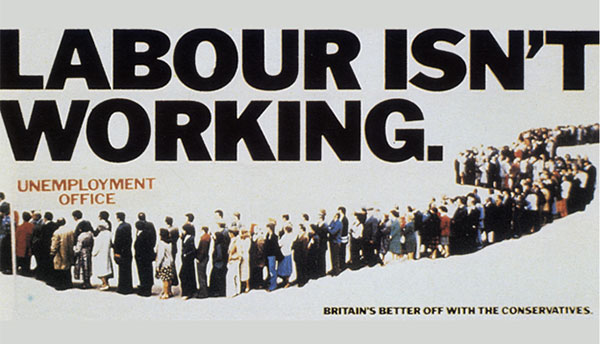
    Translating an idea into a political campaign could be creative work of the highest order. Usually, creativity is lost in the battle of egos, the size of mugshots and the listing of iffy achievements and shady promises. Once in a while, a piece of work crosses these hurdles and hits the bullseye.


    An example is the 1979 campaign poster by Saatchi and Saatchi for the Conservatives in a Britain troubled by strikes.


  • The Future of Ad Agencies is in AdTech


    By Ashoke Agarrwal


    Ashoke AgarrwalIn the early naughts, a friend left the ad agency world for academia, calling the ad world “a conspiracy of mediocrity.” I thought he was egregiously wrong and, in my mind, started comparing him to Ignatius J. Reilly, the lazy, obese, misanthropic, self-styled protagonist of John Kennedy Toole’s brilliant book, “A Confederacy of Dunces”.


    I continued to spend decades in advertising and lost touch with my friend. I have always considered the ad world mercurial and more open to new ideas and talent than any other business. At one time, ad agencies were where to have the most fun with your clothes on.


    However, over the past decade, I have started feeling uneasy about the future of ad agencies – both creative and media types. In the era of mass media, the agency was the expert partner that offered insights into the consumer’s psyche and cutting-edge culture and the insider track into the workings of the media.


    Then, as the cushioning of the 15 per cent commission disappeared, agencies shed top-drawer planning and creative talent and lost their edge in consumer understanding and cultural trends. Moreover, the ad world stopped attracting the best crop from the fine arts, social sciences, and business schools, leading to an increasing feeling of superiority among marketing, product and brand managers when dealing with their agency counterparts. Over a decade, creative and media agencies sunk for a seat at the client’s marketing strategy high table to being vendors evaluated on specifications, speed, and cost.


    With the arrival and burgeoning importance of digital and social media, the decline of ad agencies accelerated—the emergence of Google and Facebook as the fulcrums of growing importance and the relentless and cold-headed demands of performance marketing further disempowered agencies.


    With the age of AI fast dawning on the world, another paradigm shift is in the offing.


    Media strategy, planning and operations are already slipping into the realm of algorithms with minimal human intervention. As AI matures, the last vestiges of human input will disappear.


    Two ongoing societal shifts impact creative strategy and development in the post-modern era. The new consumers – the Millennials and Gen Z – are way more advertising and marketing savvy, dismiss the hard sell, and are unaffected by traditional advertising’s hidden persuaders. They get their product information from credible sources and exhibit brand preference and loyalty based on a brand’s resonance with the value systems, concerns, and culture. At the same time, the new Millennium has since mass culture fragmented into millions of niches and tribes with ever-changing configurations of values, concerns and cultural totems.


    In this changing world, brand messaging and campaigns have split into two distinct tiers – performance marketing and content marketing.


    Performance marketing is tracking an individual’s purchase journey and contextual messaging that nudges her into the next favorable stage – click to the brand’s website or click away from a competitor’s website, click on the shopping or click away from it.


    Tracking and identifying the context in performance marketing is already algorithmic beyond human intervention. The messaging in the context of performance marketing is quite simple and is currently pre-designed by humans. As AI develops, the context and the messaging will be more tightly linked and will need no human intervention.


    Content marketing is a complex creative task, especially if it were to address all the relevant niches and tribes with relevant content that resonates with their changing values systems, concerns and cultural mores. While human creative teams struggle with this seemingly endless task, today’s LLMs can do a much better task. As AI systems integrate across tracking, segmenting, developing, and delivering content, even this last bastion of the creative agency will fade.


    So, if today’s ad agency groups are to survive, they will need to morph into AdTech companies with proprietary ad tech that they can deploy as an agency or deliver as a SAAS service to clients’ in-house teams.


    The first phase of ad tech that agencies could innovate and deploy is the development of fully integrated AI-driven AdEngine, based on an assimilated, up-to-date knowledge base-information on all relevant market data across all categories based on secondary and primary sources. While the knowledge base will integrate all available secondary and syndicated research, one of the distinguishing factors of an agency’s AdEngine would be the proprietary research and information it taps into. Based on business & marketing objectives and plans, the agency’s AdEngine would offer an alternative marketing communications strategy along with budgets, targets and pros and cons. Once the client has chosen the marketing communication strategy, AdEngine will execute the plan, with periodic reviews and fine-tuning that the client team can participate in.


    The technology that will deliver AdEngines is feasible today. Meta and Alphabet already have an AdEngine, but they deploy it to maximize their revenue. Tomorrow’s global agency must create AdEngines that maximize their client’s ROI.


    The next stage of AdTech is a decade or two away. Within a decade, a brand’s AdEngine will mature into the AI avatar of a brand. Parallelly, individuals, starting with the more affluent ones, will acquire AI assistants who manage all their interactions with the world – related to work, health, finances, education, training and consumption. I have termed this assistant Concierge Intelligence (CI), first in a post in February 2022 and the latest in a MxMIndia column in December 2023.


    The development of AI avatars at both the brand and consumer end will lead to an era of “AI-to-AI Marketing” while we humans focus, hopefully, on more creative stuff than just buying and selling.


    The AdTech agency will, in such an era, become a company with a consumer product – a CI for individuals- and market it like Apple and Samsung sell their smartphones today.


    Thus, the AdTech route promises to lead from a B2B SAAS service to a B2C product that could rival the size and impact of today’s smartphone market.


    Who will lead the AdTech market of tomorrow? Today’s global ad agency groups have the resources, but will they escape the rut all big successful companies get into? Will it be Big Tech that swallows the AdTech market with the already sizeable technology lead they have? Or will it be pesky start-ups free of legacy systems and pre-conceived notions fueled by the next generation of intrepid VCs? Interesting decades lie ahead!


  • Brand Lift, Consumer Research & Digital Marketing


    By Ashoke Agarrwal


    Ashoke AgarrwalDoes John Wanamaker’s lament, “Half my advertising spend is wasted; the trouble is I don’t know which half.” hold in the digital marketing era?

    First, the question to ask is whether Wanamaker knew what waste meant.

    Did Wanamaker measure the efficacy of his advertising spending over a given period -weekly, quarterly or yearly- in terms of sales in the immediately subsequent period? Or did he also take the brand lift – changes in his brand’s top-of-mind, unaided and aided awareness and share of the consideration set -into account? Wanamaker probably did not. Sales figures are always at hand, and brand lift needs consumer research. And Wanamaker probably had another zinger ready about the cost and efficacy of consumer research.

    However, the fact that brand lift is a second-order metric does not detract from its importance. In FMCG categories, brand lift determines a brand’s position and potential shifts in the Markov Chain that determine stable shifts in market share. In categories with longer purchase cycles, low or negative brand lifts in one period could lead to a loss of market share in the next.

    In the early days of the Internet and social media, the promise was that marketing would evolve into an interactive one-on-one relationship between brands and their consumers. But then, with the arrival of the third-party cookie, this early promise crumbled.

    Digital Marketing evolved into a click-baiting exercise driven by algorithms that stalked people until they could lure them to click. The AIDA (Awareness-Interest-Desire-Action) model at the core of marketing fell by the wayside, along with concern for brand lift and consumer research. Digital marketing aided by third-party cookies continued to thrive and take an increasing share of overall spending as the ROI in immediate sales was directly visible in terms of cost per click and conversions per click and profitable. A digital-age Wanamaker would know which part of his digital campaign generated more clicks and clicks from which source led to better sales.

    Big consumer marketing companies that built brands in the mass media era embraced digital marketing while retaining the core principles of marketing.

    They encouraged their digital agencies to focus their messaging and targeting on creating positive brand awareness and consideration. In effect, these companies gave equal importance to the impact of a digital message and campaign on those who didn’t click.

    Some digital metrics measure brand lift. One such is the number of Google search words containing the brand name measuring against the searches with the category name and searches with competitive brands.

    The big established brands also had consumer research that regularly measured brand lift.

    The digital era has seen the emergence of digital-native or digital-first brands. For these brands, digital was their raison d’etre. It was digital that allowed them to be as small or niche a market; it was digital that allowed them to bootstrap; it was digital that allowed them to experiment and evolve.

    Many of these digital brands fell by the wayside. Others were like meteors, burning bright and then fading away. Quite a few lasted long enough to ask questions like where to go from here – when they start pondering growth beyond the next quarter, brand loyalty, brand equity, etc. Now, is when some of them turn to digital metrics that measure such things and even consumer research. Some of them, I can attest, take to the fundamentals of old-fashioned marketing with a vengeance.

    Though I am still waiting to see concrete data in this regard, the general sense is that digital marketing ROIs are beginning to fall. If true, the reasons are two-fold – the ongoing abolition of third-party cookies and increasing digital clutter.

    As a result, even new digital-first brands are beginning to evaluate their digital campaigns the old-fashioned way – giving importance to immediate sales and brand lift, leading to adtech and consumer research innovation.

    Tech start-ups offer SAAS solutions to marketers, and agencies are emerging, which enables them to fine-tune their campaigns to optimise between brand lift and sales. Some of these solutions sit atop the Demand Side Platforms (DSPs) within the programmatic buying ecosystem.

    In digital messaging, content marketing has become a core part of the digital communication strategy besides messaging that drives clicks and sales.

    Will the emergence of AI in marketing accelerate this brand-building trend in digital marketing? Or will it result in a virulent reversal to the click-bait era aided by the superior pattern-recognition ability of Machine Learning? On the other hand, AI may give rise to an entirely new marketing era, an era in which the AI avatar of a brand markets directly to the AI avatar of a consumer, fulfilling, in a way, the initial promise of the digital area – one-to-one AI-to-AI marketing! I wrote about such a situation in a blog post in February 2022 -“The Post-Digital Age and the Coming of Concierge Intelligence.” We live in interesting times.


  • Marketing Myopia in the Digital Age


    By Ashoke Agarrwal


    Ashoke AgarrwalIn the 1960s, the legendary Theodore Levitt penned a seminal Harvard Business Review (HBR) article that gave birth to the term ‘Marketing Myopia’. Levitt warned against the tunnel vision that plagued companies, making them obsess over immediate sales while missing the bigger picture of societal, consumer and technological change. Levitt also famously declared, “People don’t want to buy a quarter-inch drill, they want a quarter-inch hole.” This brief statement encapsulated the essence of marketing myopia, where companies focused on selling drills while ignoring the real customer need-a hole. It was a wake-up call for businesses to shift their attention from products to customer needs and aspirations.


    Levitt’s article, among other trends, led to positive developments in marketing practice. Among them are the emergence of consumer research and consumer insight mining. Madison Avenue, of course, added their twist to Levitt’s “holes instead of drills.” – “Sell the sizzle, not the steak”.


    Over the past decade, a new paradigm has emerged – the digital marketing revolution.


    Initially, digital marketing promised an era of 20-20 vision in marketing, enabling brands to engage in direct one-on-one relationships with consumers. However, digital marketing has belied these initial expectations. Instead, digital marketing has intensified the risks of marketing myopia. Companies often lose sight of the broader marketing picture in the quest for immediate online success.


    Given the business model of the behemoth of the digital age- Meta and Alphabet – digital marketing has become a part of the pernicious internet culture. As a result, most digital marketing communications, far from being based on consumer insight, have become part of the clickbait culture. Much digital marketing communication is the online equivalent of a flashy neon sign trying to lure consumers into a shady nightclub, competing with headlines like “Shocking secrets revealed!” and “You won’t believe what happened next!”.


    When the internet heralded the Information Age, many believed it would give rise to a more informed and harmonious civilisation.


    For those so inclined, the internet offers an exceedingly convenient platform to understand the world -near and far – in great depth. However, much of humanity has instead binged on the internet in a way that has lowered attention spans, trapping minds in the shallows of jaundiced opinions and echo chambers.


    One of the critical reasons for the increasing myopia of brands in the digital age is an over-reliance on the abundance of data and metrics, from click-through rates to conversion funnels. While these metrics are helpful, they lead to the pursuit of micro-optimization, often leading to losing sight of the bigger picture.


    Social media is also a double-edged sword of digital marketing.


    On the one hand, it provides a platform for brands to engage with customers in real-time, gather feedback, and build communities. On the other, it can be a breeding ground for marketing myopia, where companies get trapped in an echo chamber of their own making.


    In the digital age, we’ve become accustomed to instant gratification. Want to order food? There’s an app for that. Need a ride? Summon it with a tap. This culture of immediate satisfaction has spilt over into marketing, where companies often expect quick results from their digital efforts.


    The problem arises when companies prioritize short-term gains over long-term brand-building. This myopic focus on quick wins can lead to a lack of investment in brand identity, customer relationships, and sustainable growth. In the quest for instant success, businesses may miss out on the opportunity to create lasting value for their customers and themselves.


    Take the case of Zomato and Swiggy. These platforms initially competed fiercely, offering deep discounts to attract users. While this strategy yielded quick results, it also led to customer dependence on discounts and a need for brand loyalty. This myopic approach has forced both companies to recalibrate their strategies to focus on long-term customer engagement and loyalty, which is critical in the ever-evolving Indian market.


    Oyo, the Indian hospitality unicorn, embarked on an ambitious journey to expand globally. However, in its quest for rapid expansion, it faced accusations of overlooking quality control and customer experience. Oyos experience demonstrates how the allure of quick global expansion can lead to marketing myopia if it comes at the expense of brand reputation and customer satisfaction.


    Some brands remain focused on customer-centricity, leveraging the tremendous advantages that digital and social media platforms offer while avoiding the myopia trap.


    Dove’s Real Beauty Campaign challenges conventional beauty standards and celebrates diversity. It recognises and embraces a broader societal trend towards body positivity and self-acceptance. The campaign uses social media’s reach, impact and community-building power and has seen a substantial increase in sales and customer loyalty.


    Patagonia has leveraged social media to anchor the brand in Environmental Advocacy further.


    Apple’s focus on privacy and walled gardens and its innovation ability have allowed its digital marketing to avoid the myopia trap.


    The road to building brand equity and sales through digital marketing is to embrace a cause resonant with the brand values and an incipient societal concern and advocate for that cause using the impact of digital and social media and community-building prowess.


    This approach – Consumer-Centricity 2.0 – hooks into the latent power of digital and social media platforms to inform, elevate, and thus avoid the dangers of clickbait and echo chambers.


  • The Emerging Art & Science of D2C Marketing


    By Ashoke Agarrwal


    Ashoke AgarrwalWith India’s growing base of online shoppers (185 million in 2021), the market for D2C brands is booming. D2C brands are digital-first brands that use their online platform to sell directly to consumers without the traditional network of wholesalers, distributors and retailers. According to Statista, India currently has over 600 D2C brands with a total market size of USD 66 billion.


    D2C marketing, while holding to the core marketing principles, is a discipline with a fast-developing art and science unique to it.


    The science of performance marketing and the art of content marketing are the two pillars of D2C marketing.


    Customer journeys that lead to sales in both the offline and online worlds are complicated. The difference is that we can easily trace and analyse the online part of the journey. And when the journey ends with an online sale, the online component of the journey takes on critical importance.


    ‘Media planning’ in performance marketing goes beyond mass media metrics like reach and OTS.


    Attribution is one such key parameter.


    A paper by Lukas Kakaleick et al., “Multichennel Marketing Attribution Using Markov Chains for E-Commerce”, published in Statistics & Economy Journal in 2021, gives a good overview of the statistical frameworks used for attribution in performance marketing.


    Google Analytics currently provides for several heuristics models:

    :: Last touch model wherein 100% of the credit for an online purchase is assigned to the channel before the conversion

    :: First touch model – 100% allocated to the first channel of interaction

    :: Linear – equal amount of credit to all interaction channels


    And so on.


    Lukas et al., in their paper, propose a third or fourth-order Markov chain model as a more effective model for attribution. Markov chain analysis allows for unearthing the most efficient combination of channels.


    Meta and Alphabet also use advanced Deep Learning algos based on Knowledge Graphs to increase clicks.


    As Generative AI and GI mature, Alphabet and Meta will also undertake the content marketing function of D2C brands and combine it with the targeting abilities driven by Deep Learning to offer pay-per-conversion campaigns to D2C brands.


    Another paper, “Scalable Target Marketing: Distributed Markov Chain Monte Carlo for Baysesian Hierarchical Models.” by Frederico Bumbaca et al., published in the Journal of Marketing Research (JMR) Dec 2020, offers a model that adds to the conceptual framework for performance marketing planning. This technique provides a more effective market segment definition. Better consumer segmentation and channel attribution deliver higher ROIs for D2C brands.


    When it comes to the marketing communication side of D2C marketing, many marketers and agencies need to correct the mistake of conflating it with advertising.


    Online is where traditional advertising goes to die; for brands to be noticed and acted upon online, they need to join the raging content battle that defines the online world.


    Pretty pictures (or videos) and clever words do not work in the cramped space and attention that govern the eye and mind of the online visitor. The only way to grab attention and build brand equity that leads to purchase online is to deliver excellent and relevant content.


    A 2018 article by Joan Dolezal titled “A flight to quality? Why content marketing strategy must evolve” is a good primer.


    For D2C brands that have mastered the art of putting out relevant, high-quality content, the fact that there is unlimited online content vying for limited attention is an entry barrier that protects them against competition.


    Here are some of the dimensions of a D2C ecosystem primed to produce good quality and relevant content:

    :: Define your customer segments tightly – demographics, psychographics, U&A. The more you can flesh out the profile of each segment, the better, in other words, build personas. Create and target each persona with a tailor-made content marketing campaign.

    :: Recognise that customer journeys are multistage, and online gives you tools to target consumers at various journey stages. Tailor your content for each step of the journey of a given profile.

    :: Make use of the experimental capability of online marketing. AB test various modes of content to arrive at the most effective.

    :: Search Engine Optimization (SEO) is not just for your website. SEO of your content marketing campaigns is also advantageous.

    :: Create an effective distribution plan for your content. A D2C brand can repurpose the same content on social media, e-mail marketing, digital PR, influencer marketing, etc.


    As a D2C brand matures, it looks to expand into other channels. One critical decision which comes early in the life of a D2C brand is whether or not they engage with the Big Box e-tailers like Amazon. I wrote a well-received post in 2019 on this issue – “To Amazon or Not To Amazon”.


    D2C brands, to succeed, need nurturing of a high order at the strategy and creative levels. Operational synergies are of a lesser order of importance. That is one of the reasons why Thrasio, a US-based integrator of online sellers and brands, recently filed for bankruptcy. A recent ET Prime story has the Thrasio-like B2C aggregators in India – Mensa Brands, Good Glamm Group, GOAT Brand Labs, Upscale, GlobalBees- “stressed and nervous”. The funding winter might be one reason for this state of affairs, but the malaise can also run deeper. Building and running a D2C brand is an act of passion that combines strategic nous with creative mojo. And passion does not sit well with aggregation.


  • Onward Ahoy! India’s rising potential in the global B2C arena


    By Ashoke Agarrwal


    Ashoke AgarrwalIndia is a’rollin!


    Indian government projections see Indian GDP hitting $32 trillion by 2047. Goldman Sachs predicts India will be the second-largest economy by 2075. In the long run, we might all be dead, but our great-great-grandchildren will be rich.


    The predictions are just that – predictions. There are many socio-political, infrastructural, and geo-political challenges that India will need to meet before it realises its full potential.


    At the core of the promise of India is its demographics. Martin Wolf, the chief economics commentator of The Financial Times, London, and an avid India watcher, makes a pithy observation. He believes that the purchasing power of the Indian consumer will be 30% higher than that of consumers in the US by 2050. Goldman Sachs’ and Martin Wolf’s predictions are sourced from an article in HBR titled “Is India The World’s Next Great Econimc Power” by Bhaskar Chakravorti and Gaurav Dalmia.


    Look at our demographic trends as posited by the ICE360 surveys by research organisation PRICE (People Research of India’s Consumer Economy). PRICE periodically conducts ICE360 (Household Survey of India’s Consumer Economy). It surveyed in 2014, 2016 and 2021.


    The study in 2021 had a sample frame of 200,000 households and a sample size of 40,000. PRICE has published an analysis of the ICE360 surveys in a book titled “The Rise of India’s Middle Class”.


    ICE360 classifies Indians into four income classes – the Rich (annual household income of more than Rs 30 lakhs), the Middle Class (annual household income between Rs 5 to Rs 30 lakhs), the Aspirers (annual household income between Rs 1.25 lakhs to Rs 5 lakhs) and the Destitute (annual household income less than Rs. 1.25 lakhs).


    According to ICE360, the picture in Financial Year 2015-16 (FY16), with annual household at 2020-21 prices, India had 37 million people in the Rich category, 349 million as Middle Class, 735 million as Aspirers and 209 million as Destitute.


    The household income profile of India is set to change dramatically over the next two to three decades.


    Table: India’s Income Pyramid at constant 2020-21 prices (Source: ICE360 Survey by PRICE) in millions of individuals (% of total population)

    Income Class FY16 FY21 FY31 FY47
    Rich 37     (2.8%) 56   (4.0%) 169 (11.0%) 437  (26.3%)
    Middle Class 349   (26.2%) 432 (30.5%) 715 (46.7%) 1015 (61.1%)
    Aspirers 735    (55.3%) 732  (51.7%) 568 (37.1%) 184  (11.1%)
    Destitute 209    (15.7%) 196  (13.8%) 78   (5.1%) 25   (1.5%)
    Total 1330  (100%) 1416 (100%) 1530 (100%) 1661 (100%)


    If you think ‘Rich’ is a misnomer for a household earning Rs 30 lakh or more a year, consider this. ICE360 classifies households earning more than Rs 2 crore yearly as the Super-Rich. The Super-Rich segment, in constant 20-21 prices, were 25,000 households in 1994-95 and rose to 4.5 lakh households in 20-21. Even if we were to take a modest 12% annual increase in the number of Super-Rich households, India would have 15 million households with a Rs 2 crore yearly income at constant 20-21 prices by 2050.


    Factor in Purchasing Power Parity (PPP), and we begin to see why Martin Wolf came to his conclusion about India’s purchasing power by 2050.


    The latest (2022) World Bank estimate of PPP conversion of the Indian rupee to USD is Rupees 22.91 to 1 USD.


    India, by 2050, would have 60 million people (about 15 million households) living in households with incomes comparable in terms of purchasing power to US households with an annual income of USD 900,000 and 380 million people (about 90 million households) with PPP incomes equal to US households with incomes of USD 135,000.


    The US Census estimates the number of US households by income households.


    Table: US Household Income (US Census Bureau) in million households (% of total number of households)

    Annual Household Income In 2001 In 2022
    All Households 109.3 (100%) 131.4 (100%)
    $75 K to $100K 14.4 (13.2%0 16.4 (12.5%)
    $100 K to $150 K 18.0 (16.5%) 21.5 (16.4%)
    $150K to $200 K 8.3 (7.6%) 12.1 (9.2%)
    $200 K + 8.4 (.7.7%) 15.6 (11.9%)


    The numbers indicate the conservative nature of Martin Wolf’s conjecture of the total purchasing power of India being 30% higher than that of the US by 2050.


    While many think that India’s economic rise will be the cause of the rising income of India’s people, the truth is that it is the increasing incomes of the Indian people that will be the driving force behind India’s economic rise. Better aware and educated Indians with rising incomes will propel the socio-political and geo-political structures to turbocharge India’s economic rise, thus setting up a virtuous cycle


    When B2C marketers combine the rise of household incomes with the age distribution of India’s population, exciting insights emerge.


    Table: Age Distribution in millions (% of the total population) Source: CIA World Book

    Age Total
    0-14 348.8 (26.2)
    15-24 232.1 (17.5)
    25-54 555.1 (41.7)
    55-64 104.8 (7.9)
    65+ 89.1  (6.7)
    Total 1329.9 (100)


    The implications of rising incomes for age-income segmentation in the domestic market are seminal in terms of medium and long-term planning. I plan to take that up in a later column.


    This column focuses on the potential it opens up for Indian B2C products and services in the global market.


    Over the next two decades, India’s broadening income pyramid will provide Indian B2C products and services with economies of scale in the domestic market that they can leverage into shares in the global market. The broadening income pyramid also ensures that this leverage will exist in both the mass and premium ends of the market across both developing and developed countries and markets.


    The rich in India (as defined by the ICE360) will grow from 4% of the population today to 11% of the people in 2030 and 26% of the population by 2047. The Middle Class will increase from 30% today to 47% in 2030 and 61% by 2047.


    And given India’s demographics, as incomes rise, with time, substantial numbers of second and third-generation affluent and middle-class individuals will drive consumer trends leading and aligning with global trends.


    Some multinationals and experts quibble about the definition of middle-class and affluent in India. This is because they look at the Indian market and consumers through the lens of market rates of conversion (Rs.82 to USD as compared to a PPP of Rs 23). On the other hand, multinationals who have succeeded in India plan for pricing based on PPP and reap the benefit of India-sized markets.


    For Indian companies to leverage B2C markets for products and services in developed countries, they must reverse the PPP thinking of multinationals from the Western world who have succeeded in India.


    Multinationals coming to India compromise product quality and ingredients to fit the PPP paradigm. Indian multinationals must up quality parameters to deliver price-quality expectations in developed markets. In some cases, it might be feasible with Indian production operations. In others, the first step to addressing a developed market could be to set up production and delivery operations there.


    Either way, the experience of delivering on the product-quality expectations in developed markets will stand Indian companies as their home market becomes one.


    India’s B2C companies will also have an equally lucrative market in developing markets worldwide. In these markets, India must learn from the PPP playbook of B2C foreign multinationals who have succeeded in India. India’s rising profile as an economic powerhouse will aid in the marketing of Indian B2C brands in these countries.


    The rise of e-commerce, digital and social media have lowered threshold marketing costs and thus will ease the way for Indian B2C multinationals.


    There is a rising trend of Indian B2C companies looking to spread their wings in foreign markets.


    For example, Tanishq, Titan’s jewelry brand, plans to expand its foreign presence from seven outlets to 25 by next year, mainly in the GCC.


    The key target for most Indian B2C brands with export sales is the Indian diaspora.


    The thesis is that with India’s fast-growing middle and affluent class, Indian B2C brands can produce and market world-class products and services in India and leverage their experience and revenues to address the middle class and the wealthy worldwide.


    A Tanishq can leverage its design and sourcing expertise catering to a globally-minded consumer in India to compete with established jewelry brands worldwide. Wipro Consumer Products can take its personal care brands global, leveraging the uniquely Indian ingredient stories with quality-price expectations across markets. To do so, it might need to set up production operations in many markets, as many multinationals who have come to India have done.


    I recently met an entrepreneur who plans to enter the global market for luxury handbags by first building Rs 40,000 handbags in India. He knows millions of Indian households in the Rs 2 cores plus income bracket who would give an Indian brand a chance against the Coaches and Kate Spades of the world.


    The time has come for haute couture brands like Sabyasachi to leverage their massive success in lux ethnic wear into becoming a lux brand on the world stage, competing with the grandees from Milan and Paris.


    The scope for building India-origin global B2C brands is broad – from fashion to food, from financial services to travel, and from auto to Artificial Intelligence. The challenges to be met are huge, but so is the opportunity that beckons.


  • The Conundrum of Access & Choice


    By Ashoke Agarrwal


    Ashoke AgarrwalSociologists and economists perceive the social and economic raison d’etre of advertising and marketing as offering more access to goods and services and information about them to economies and societies. In contrast, most marketers and practitioners of advertising would believe that their discipline is about driving choice.


    Are access and choice two sides of the same coin? Semantically, more access is akin to more choice. However, look more closely, and one will find that what bridges access and choice is what marketers and advertising people term “consideration set”.


    Most marketers and advertising people would want the brand they work on to belong, due to their efforts, to a consideration set of one or, failing which, the smallest consideration set possible; thus, in psychological terms, minimising access.


    In this difference between the societal and economic imperative of access and its working on the ground as choice lies the conundrum of access and choice that goes beyond the world of brands into the very structure of human society.


    The promise of access lies at the heart of the Internet and Social Media revolutions. Access to information, education and diverse perspectives, many believed, would be the antidote to ignorance and intolerance. The reality has proven to be almost the polar opposite. In the age of information overload, the access to knowledge that was supposed to invite us has driven us apart. In the world of 24×7 news, remote sensors and satellite imagery, half the world does not agree with the other half on who bombed a particular hospital in Gaza. Instead of fostering open-mindedness, the Internet has provided fertile ground for the growth of echo chambers, where individuals are exposed only to information that aligns with their existing beliefs. Social scientists call this phenomenon confirmation bias, where people seek out and accept information that confirms their preconceived notions while dismissing or ignoring contrary evidence. The stronger the confirmation bias, the smaller the consideration set.


    As Eli Pariser, the author of “The Filter Bubble “, notes, “The Internet is showing us what it thinks we want to see, but not necessarily what we need to see”.


    In truth, the power of the confirmation bias and the consideration set lies in human nature. Psychologist Barry Schwartz popularised the concept of “The Paradox of Choice” in his book of the same name. Schwartz argues that while we might assume that more options lead to greater satisfaction, the reality is often the opposite. When we have an overwhelming number of choices, we become paralyzed by decision-making, leading to increased anxiety and decreased overall satisfaction with our choices; in other words, cognitive dissonance.


    This paradox extends beyond shopping or entertainment choices to higher-order aspects like career decisions, lifestyle choices, and relationships.


    An ancient philosophical dilemma – ‘Buridans’s Ass’ – is an extreme example of the paradox of choice. A hungry donkey placed precisely between two identical stacks of hay starves to death, unable to choose between equally appealing options.


    In advertising, the paradox of choice explains the increasing prevalence of emotional and affective appeals over functional and rational appeals.


    Suppose an ad was to give three rational reasons why one model of car scores over the competition; it would nudge the consumer into a rational evaluation of choices and thus into the paradox of choice. On the other hand, if the ad were to applaud the status-enhancing, sex-appeal-enhancing decision of the consumer to plonk for the model, it would nudge the consumer to a comfort-inducing nirvana of “little-choice”.


    Freedom, in the most profound sense, is a complete absence of or total, unconditional access. The tramp with no possessions, money, or home has no access to all the freedom in the world; of course, he has no desire to be anything but a tramp. The billionaire who has access to anything he desires also has freedom. It is the large swathe of the world in the middle that trades freedom for access only to seek to constrain access to confirmations, biases and consideration sets.


  • The Third Eye Flutters


    By Ashoke Agarrwal


    Ashoke AgarrwalThe Screen Age dawned with the spread of TV. Today, it has reached its apex with the ubiquity of the smartphone.


    There are now indications that over the next decade, a new age will dawn that lessens humankind’s obsession with the screen.


    I have always considered augmented reality more potent than virtual reality and could not fathom Mark Zuckerberg’s obsession with the Metaverse. A week ago, Zuckerberg revealed a use case for virtual reality technology that made immediate commercial sense in his interview with Lex Friedman.


    The interview itself was perhaps the first public demo of a powerful new technology that Meta has developed – Pixel Codec Avatars (PiCA): “a deep generative model of 3D human faces that achieves state of the art reconstruction performance while being computationally efficient and adaptive to rendering conditions during execution”. Behind the technical jargon is a hot new metaverse experience that led a usually stone-faced gnome like Lex Friedman to drool.


    PiCA is poised to take over the online meeting space at the high end, pending software and hardware developments.


    Beyond PiCA, the interview revealed a shift in Zuckerberg’s attitude that will make Meta more of an Augmented Reality (AR) player than a Virtual Reality (VR) player.


    Zuckerberg speaks about thinking of AR as a shift in how people experience everyday reality in contrast to VR or the Metaverse, which is about people living in a separate reality.


    Zuckerberg now sees an AR world as one that adds a 4th dimension to the 3-D world of time and space we live in – the AR-driven digital dimension – not as static or moving texts and images on a screen – but as an integral part of the lived reality – an integral part that instead of detracting us from our surroundings, immerses us deeper in it.


    Zuckerberg thinks that with advances in AI, IoT, and PiCA technology, we could be, in a decade or so, living in a world where two people wearing Quest 2030, a spectacle light VR set, can play table tennis on a holographic table with holographic paddles and ball! When the game is over the table, the paddles and ball return to the digital world, leaving the real-world 3D space accessible to the next visitor from the digital dimension.


    The failure of Google Glass in the consumer world was because it was just an uncomfortable shifting of the screen from a handheld to a lens in front of our eyes.


    AR is now in its second generation, where leaps in bandwidth and computing power combined with innovations like PiCA will allow for wearable headsets that are as comfortable for all-day use as spectacles and which project digital 3D objects into real 3D space that one can interact with through voice, gesture, and other digital 3D things.


    That will be a whole new paradigm in experiencing reality.


    When it takes hold, it will be the screen’s death. A paradigm that will add a new sense organ to us humans – the Third Eye- bringing into our lives a fourth digital but actual dimension to our old-world three-dimensional reality. The Screen Age brought us distraction and shallowness of thought- almost a collapsing of our world into 2D. What will the Era of the Third Eye get us? It is difficult to predict, but the magnitude of change in the human experience will be almost metaphysical.


    Why do I feel the Third Eye is fluttering, heralding the not-too-distant dawning of the Era of the Third Eye? Besides the revelations in the Zuckerberg interview, another rumour said that Sam Altman of Open AI and the legendary designer Jony Ive (of iPhone fame) plan to collaborate on an AI hardware device. I bet a million dollars that it will be a Third Eye design if they come up with one.


    When I was a kid in the 1960s, we used to drool over the Dick Tracy watch that did all sorts of things and fantasise about what devices advertised as X-Ray glasses would do for us. Over the next decade or so, the world will likely be flooded with Third Eye devices, a combination of a powerful wrist computer and lightweight, normal-looking eyeglasses, delivering an almost godlike dimension to everyday reality.