By Ashoke Agarrwal
 The dropping of the 2021 census and the suspension of the Indian Readership Survey (IRS – the benchmark study for demographic data beyond age and gender) after 2019 has made it difficult for marketers to gauge shifts in socioeconomic class across regions and pop strata.
Even so, there are two fundamental shifts underway – one in terms of basic demographic and another in terms of psychographics – evident from population trendlines that marketers need to take note of in drawing up their immediate and medium-term plans.
In India, a large proportion of B2C brands and, consequently, marketing resources focus on the young. However, there is a generational shift in the psychographics of the young in whose light marketers need to re-evaluate their product, positioning and communication strategies.
Cohort segmentation is a proven framework for marketing. According to the cohort framework, those born between a specified period share attitudinal and behavioral characteristics shaped and driven by the socioeconomic, cultural, and political environment in which they grow up as children and come of age as adults.
Since the pace of socioeconomic, cultural, and political change is accelerating, the period that defines a generational cohort is shrinking. For example, for older generational cohorts, the period that defined older cohorts like Baby Boomers and Gen X varied between 15-20 years. In contrast, a 2022, 46 countries study by Deloitte Global into Gen Z and Millennials defines the Millennials as those born between Jan 1983 and Dec 1994 (12 years) and Gen Z as those born between Jan 1995 and Dec 2003 (9 years).
The Deloitte study covers India and offers a good framework that contrasts basic socioeconomic attitudes among global Millennial and Gen-Z and Indian Millennial and Gen Z; it does not delve into deeper attitudes and values – the psychographic landscape – that defines and differentiates a generational cohort. Perspectives and values that would drive differentiated and effective marketing strategy.
In a research-intensive market like the US, marketers have a deeper understanding of the similarities and differences between the attitudes and values of the Millennials and Gen Z.
As an example, let’s sample an Inc. article titled “10 Ways to Understand the Understand the Difference Between Millennials (Generation-Y) vs Gen-Z.” by Philip Kane.
Due to the differences in the economic environment, they grew up in, Gen-Z in the US are far more debt-averse and budget-minded than their Millennial counterparts.
US Gen-Z is also more entrepreneurial in spirit. But, on the other hand, a typical US Zer seems to be anxiety-ridden, lost, moody, social, and self-involved. This personality trait is over and above the usual teenage angst and extends to GenZers as they transition to adulthood.
For Gen Z, diversity is a cause to the level that many of them are active in promoting diversity in workplaces and combating racism and other prejudices. And for the typical US Gen Z, sexuality and gender is a more fluid concept than it was for the Millennials.
While Millennials adopted and took to social media, Gen Z is rejecting it in search of the next thing.
Gen Z’s attitude to brands is far less status and convention driven than the millennials. For example, a prominent lifestyle influencer in the US observes – “Gen Z care more about the emotional appeal of the article of clothing and don’t care much whether it’s designer or not. For example, most of them carry around a cotton tote bag given to them by some organisation”.
The essential summation of the Inc. article for marketers is its assertion that it would be a “monumental mistake” for US marketers to treat Millennials and Gen Z as one block.
My hunch is that holds for India too. And the issue is that, in my experience, available research on generational cohorts in India is currently scant and sketchy. Marketers need to address this gap. Besides traditional consumer research, marketers could utilize the fast-developing science and art of semiotics to unearth deeper truths.
The second emerging demographic shift marketers in India need to prepare for is at the other end of the age spectrum.
Here is a table culled from the CIA World Book that has projected the 2011 census data to 2020.
The age distribution in millions (based on CIA World Book data and rounded to nearest 10 million)
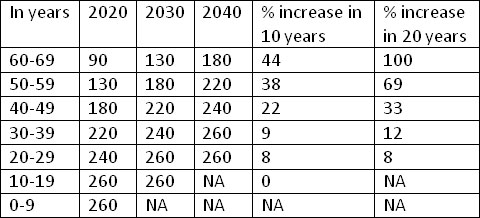
The high growth numbers in the 40-49, 50-59 and 60-70 age groups over the next two decades is both an opportunity and a challenge for marketers in all product categories.
While their traditional target segments in the age group slip into the relatively low growth territory of 8-12% in the next two decades, the older age groups offer decadal growth opportunities in the 22-100% range.
These opportunities extend to the entire range of a marketing manager’s portfolio strategy:
:: Additions to the marketing and communication mix of existing brands
:: Brand extensions
:: New products in adjacent categories.
Take the simplest and most basic of FMCG categories – toilet soap.
The top two brands by market share in the mid-priced category – Lux and Santoor – are positioned on appeals centered on motivations that are strongest among the young. Lux on the position of “be glamorous like a film star” and Santoor on “keep looking young”.
It would be wise for the brand teams of Santoor and Lux to examine anew how these positions play out with the increasingly important older segments.
Can Santoor and Lux depend upon brand loyalties formed when the consumer was young to be sustained as they grow older, even if the fundamental promise of the brand begins to fade as a motivator? Or can Santoor or Lux tweak their messaging to the older age groups (and this is possible in an increasingly fragmented media environment) to either reinforce loyalty or drive brand switches?
Going beyond the current product, should, Santoor and Lux launch a brand extension targeted at the older segment that leverages existing equity and loyalties to open a new growth stream for the brand? Could there be new fragrances and ingredients that better address older bodies? Or it could even be soap bars that are easier to grip.
Further, going beyond the Santoor or the Lux, as a personal care company, could Wipro or Unilever design and launch new personal care products designed ab initio for older bodies and needs? A wrinkle-alleviating soap, for example?
Pick up any brand in any category, and one can find challenges to meet and opportunities to harness as the high-growth mature adult segment emerges. It will be a 360-degree complex task requiring deep consumer research, semioscape, insight-driven communication, product development and market deployment strategies.
The challenge and opportunity that the two demographic shifts outlined above combine with the overall growth of India’s consumer economies make consumer marketing in India and its allied disciplines a high-excitement area over the next two decades.