Tag: Amazon

  • Ogilvy creates new campaign for Amazon

    By Our Staff


    Amazon India urges people to rethink the range of products that could be purchased from Amazon.in by asking “Aaj Kya Khareeda?” in its new campaign, created by Ogilvy India. This is to amplify the width of selection which is one of Amazon’s strengths, where the focus is on driving awareness around everyday products. It reminds customers that Amazon is a one-stop-shop for all their needs, not just the occasional, one-off needs but frequent, daily ones as well.


    The campaign comprises of four films on TV and digital along with several multi touchpoint activations on Outdoor, influencers etc. All the films have been directed by Aarti Desai of Caffeine Films and conceptualized by Ogilvy India.


    Speaking about the campaign, Neville Shah, Senior Executive Creative Director, Ogilvy said: “There is so much excitement when we get something in a box at home. But is it just as exciting, if it’s regular everyday things? Maybe not as much. The stories rely on the charming anticlimax, to remind people that Amazon.in has simple everyday things. Exciting. Perhaps just as much.”


    Added  Ravi Desai, Director, Mass, and Brand Marketing – Amazon India: “Our new campaign ‘Aaj Kya Khareeda’ reinforces Amazon as an everyday shopping destination that caters to daily requirements and needs of our customers. We want to simplify our customers life and be the shopping partner that helps you buy products from a wide selection spread across numerous categories, get reliable delivery and customer care, thus leading to a delightful shopping experience.”


  • Prime Video elevates Gaurav Gandhi to VP, Asia Pacific

    By Our Staff


    Prime Video has elevated Gaurav Gandhi from Vice President, India to Vice President, Asia Pacific. In his new role Gandhi will lead APAC, incorporating Japan and South East Asia, alongside India. Effective April 2023, he will transition into this new role and will be based out of Singapore. As Gandhi moves to take on this larger responsibility, Sushant Sreeram, currently Director – SVOD Business, will be elevated to the position of Country Director, Prime Video, India.


    Prior to Amazon, Gandhi has worked in companies such as Viacom18, NDTV Imagine and STAR India in various leadership roles. He moved into the video streaming space in 2015, and set up, launched and ran Viacom 18’s streaming service VOOT as his last role prior to joining Amazon.


    Sreeram has worked closely with Gandhi since he joined Amazon in 2018 as Director – Marketing, and was elevated to Director – SVOD Business in 2022. As the SVOD business leader he was entrusted with building the Subscription Video on Demand (SVoD) business through acquisition, growth and engagement of subscribers across B2B and B2C segments.


  • Amazon Pay film to show ease of digital payments

    By Our Staff


    Amazon Pay, an online payments processing service owned by Amazon, unveiled the second leg of its digital campaign #AbHarDinHuaAasan to celebrate the way digital payments simplify lives. The campaign film portrays day-to-day instances where merchants experience the convenience of Amazon Pay.


    Speaking about the campaign, Vikas Bansal, Whole Time Director – Amazon Pay India said: “Our aim is to simplify lives and fulfil aspirations by solving the payments and financial needs of every Indian. We make digital payments trusted, convenient, fast and frictionless, and enable the widest choice of payment options for both our merchants and customers. Our continued focus is to empower SMBs and micro-merchants through payment tools and solutions which help enhance their digital payment experience across multiple customer touchpoints. #AbHarDinHuaAasan is our endeavor to raise awareness and further strengthens the need of adoption of digital payments and encourage every merchant, customer, old or young to transact seamlessly.”


  • Feedback: the new WOM tool in town


    The second instalment of  ‘With Apologies to None at All’, a fortnightly column by Vikas Mehta


    By Vikas Mehta


    Vikas MehtaI remember that while growing up all major purchase decisions at home, be it a fridge or a mixer grinder or even a bicycle would heavily depend upon the suggestions and experiences of neighbours, relatives and friends. Not that there was much choice but even if one had to choose between a Hero or an Atlas bicycle the recommendation of someone who had bought and used the brand would matter. I still remember, how my father spoke to at least 6-7 users of Ambassador and Fiat before deciding that a secondhand Fiat will be a good choice for the family of four. That’s the car which introduced me to the world of driving.


    But I deviate. The point being that in the days of thrift and limited choices, word-of-mouth really mattered. WOM was the initial marketing tool that was used by customers inadvertently It also played an important role in brand perception. So, if I remember correctly, all our acquaintances were clear that Lambretta was a better scooter, technically and for its reliability too. But its availability was always a problem and Bajaj became the family favourite as it had a better distribution and quicker delivery time, relatively (2-3 years as against Lambretta which was bhagwan bharose).


    I have seen WOM evolve with the times. It actually became an important tool even in advertising. Some categories started using consumer testimonials as a strategy to influence consumer behaviour. Actual consumers who had used the brand became its spokesperson and seeing or hearing someone who one could identify with, talking good about the brand became a WOM experience. I think detergents as a category was the first to use consumer testimonials effectively. And Dove mastered it wonderfully. The protagonists in the ad were not glamorous or young or had a model type of smooth talking but were real consumers who seemed just like our everyday friends and acquaintance. Even real life doctors or scientists being used by brands were effectively WOM expert testimonials. The problem started when the brands became greedy and started using models, who were professionals paid to become a consumer or a doctor, who also appeared in other ads as actors, and the effect of consumer/expert testimonials was lost.


    With the advent of Direct Marketing and CRM, marketing looked at WOM with a fresh approach.  WOM agencies came into existence, which started amassing consumers who had similar demographics and psychographics and used these consumers as brand evangelists. Events would be organised, gatherings would be held where brands would entertain and educate these groups of consumers, who in turn would spread the good word around. They would also gain some benefits out of this. So, in effect WOM was commercialised. Digital made this not only easy but also more widespread.


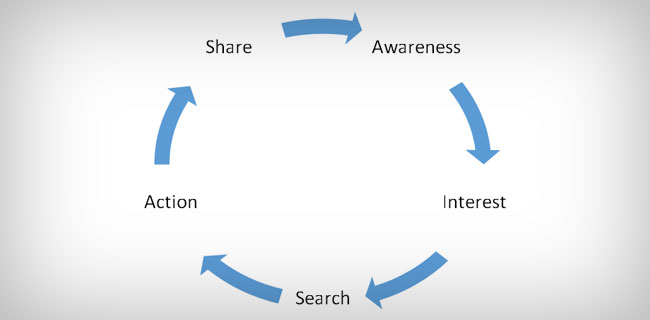
    But the last three-four years have seen another factor come into play which has recast the role of WOM. And I will use the AIDA model of buying behaviour to demonstrate the same. For decades, the model was linear. Catch attention, gain interest, create desire and close the action through sale. Digital changed this model into a never ending circular, self-perpetuating one with two additions. Search and feedback.


    Communication created interest. And thanks to the prevalence of the net, we translate the interest into search. We look for more information. We look for more brands/competition, we look for deals and then we tend to take action. Some may argue that this is not as prevalent in categories like groceries or commodities but I beg to differ. Search is still relevant. May not be for features or differentiation but definitely for bargains and offers. Even for weekly grocery shopping we do have a tendency to check if Big Basket or Jiomart or maybe even Amazon Fresh gives me better discounts or offers. Search is now second mature to us. So much so, that in US Amazon has almost 35% share in Search engines.


    And we do not stop after buying. Social media gave us a habit to share our purchases with our circle of friends. So, while we may want to show off our latest phone purchase or a dress or even a good deal, we are quicker on the draw to complain about a problem or a purchase gone bad. The habit of giving a feedback has also arrived. The habit of sharing our purchase and its experience.


    Therefore, when ecommerce companies ask explicitly for feedback on our purchases the feedback is provided for. Both good and bad. These are then classified as ratings and are posted on the product listing. Now tell me if this isn’t WOM, what is?


    And this is a tool waiting to be exploited. Imagine, you are a new player in the home accessory business. You list on Amazon. You pay to be sponsored on Amazon. Your product quality is good, your delivery is good and your consumer care is excellent. You give discounts to get the first batch of consumers and maybe 5% of these give feedback. Most of it is good, so your rating is close to 5 out of 5. Now, someone who wants to buy a new kitchen rack sees your product, likes the design but is not sure about your brand. He sees your ratings and is impressed. He then checks some of the feedback and sees mostly positive ones. He trusts these. Because these are from buyers. People like him. He may not know them, but they have used the product and are speaking up for it. A positive WOM.


    This positive WOM has now got a new customer. And the cycle continues. More positive feedback will get more new buyers. Will also reassure current buyers. The cycle will keep on expanding and a new brand can get success based on positive feedback. But if the feedback is not positive, the cycle will break. New consumers will be hesitant to buy. All because the feedback was negative. And the brand trial and usage may shrink.


    With the advent of digital Tripadvisor started customer feedback ratings of hotels, restaurants and other tourism related services. It’s success was illustrated just by the fact that many hotels etc would respond to negative feedback with apologies and promise to make the service better. Today Makemytrip and such sites also use this feedback mechanism.


    Feedback is the new avatar of WOM. It can be a strong and powerful tool. Ecommerce companies have realised its potential, travel and tourism companies have too. I think it’s time that brands in other sectors, especially new players, start looking at feedback as a digital WOM that can give them a true differentiation. It’s waiting to be exploited.


    Vikas Mehta is a senior business and marketing strategy consultant and educator. He is based in Dehradun. ‘With Apologies to None at All’ will appear every other Tuesday. His views here are personal


  • Kantar launches 2nd edition of  Creative Effectiveness Awards

    By Our Staff


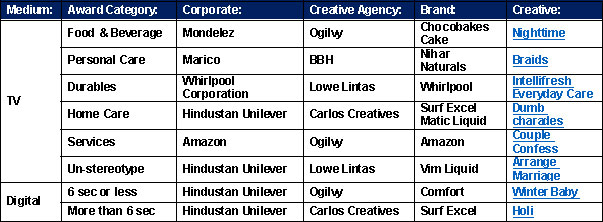
    Kantar, the marketing data and analytics company, has announced winners of the second edition of its now annual Creative Effectiveness Awards. The firm tested more than 13,000 creatives for clients around the world. Around 10% (1300+) of those creatives were tested in India alone. The India report shortlisted over 350 ads, tested across categories, markets, TG’s and media channels.


    Across television ads tested in India, Kantar has awarded standout performers in five product categories- Food & Beverage, Personal Care, Durables, Home Care & Services. Kantar has also included a special segment on social causes and this edition spotlights


    ‘Un-stereotype’ which all about celebrating gender progressive advertising.


    Here are the Kantar Creative Effectiveness Awards 2022 India Winners:


    Commenting on this year’s winners, Soumya Mohanty, Managing Director and Chief Client Officer, Insights Division, Kantar said, “The spread of ads that consumers have perceived to be both creative and effective is an affirmation of the fact that the space for creativity even in context of marketing ROI is infinite. While there is no magic formula for creating such ads, we can start with the right ingredients and refine them by testing them out with consumers. Kantar is pleased to share the learnings that we have had in the area while working with the leading marketeers in India.”


    Key highlights from this year’s report:


    >> Kantar’s Strategic Sparks identified for effective and creative TV advertising:


    1. Indians love to ride fulfilling story arcs: Stories create room for empathy, engagement, and vivid memories through which one could influence the way in which consumers think & feel about the brands.

    2. Touch of drama helps: Just the right kind and quantity of spice delivered through creative storytelling and filmmaking,  elevates even the repetitive themes, to make them more personal, relevant and aspirational.

    3. License to be extravagant in visualization: Indians are open to suspending their disbelief for the well visualised film

    4. Layer in emotional meaningfulness: Emotive contexts have the potential to make the consumers warm up to even the dry functional categories.

    5. Show, not tell: Integrating brand payoffs as an organic plot event in the script is a timeless approach toward creating vivid and persuasive memories.


    >> Kantar’s Strategic Sparks for effective and creative digital advertising:

    1. Customized and integrated content yields significantly higher ROI​: Carrying forward creative stories and elements from other media amplify the impact of digital assets.

    2. Shoot for instant meaning: Given the attention poor consumers and short window available, it pays to ensure that the consumers are not called to do any additional work for decoding what they are supposed to think and feel about the brand

    3. Ride the moment: Embrace the topical issues and trends, to engage and be relevant

    4. Strike an emotive chord: Well told stories open up consumers for longer format videos

    5. Hook them early:  Promise of a fulfilling story arc, emotive journey and humor help in ensuring that consumers stay invested beyond 6 seconds.


    >> Unstereotyping: Time to mainstream progressive gender portrayal


    Kantar’s collaboration with the Unstereotype Alliance has led to the development of the Unstereotype metric (UM) which Kantar now includes as a measure of gender portrayal in advertising as an integral part of its Link™ communication pretesting solution. Thus, setting a foundation for marketers to review the potential of their creative executions on this dimension to monitor progress over time.


    Unstereotype metric* (UM) in the long term provides learning and context for gender progressive advertisements. UM is now measured for 14,000+ ads across 70 countries, 3,300+ brands and 251 categories.


    :: Unstereotyping in advertisements is predicted to unlock higher marketing ROI. It signifies strong brand equity and is likely to impact short term sales as well. This impact is not only true for women, but progressive male role models also impact business outcomes across categories.

    :: Progressive ads are more effective and trigger positive engagement. They are in general seen to be more enjoyable, relevant, different and even pleasantly surprising.

    :: Unstereotyping affects various aspects of the brand- power, meaningfulness, difference and saliency especially seen in food & beverage, household and personal care categories.

    :: There are clear and present rewards for brands that seek to be at the forefront of embedding progressive gender roles


  • D2C Marketing’s Amazon Dilemma


    By Ashoke Agarrwal


    Ashoke AgarrwalOver the past two pandemic-infected years, e-commerce in India and worldwide has flourished.

    Parallelly, the market is in an increasing set of categories – packaged foods, personal care, fashion, electronics etc. – flooded with Direct-To-Consumer (D2C) brands.

    Contract manufacturing and an increasingly mature last-mile logistics ecosystem are the two pillars that enable the D2C revolution.

    A third dimension keeps most D2C entrepreneurs awake at night in the form of a Hamletian question -“To Amazon or Not To Amazon?”

    For an established brand with widespread awareness, a loyal consumer base and a solid traditional distribution, Amazon is just one more channel.

    However, when it comes to a new brand in a competitive market, whether or not to place their product with a big-box e-tailer like Amazon is a critical and fraught question.

    Given the increasing relevance of e-commerce in most categories, digital marketing and e-commerce offer the lowest cost go-to-market route for a new or small business.

    The question that most new or small consumer businesses and brands would therefore face is whether to focus exclusively on building and promoting their exclusive e-commerce platform. Alternatively, have their product available both on their exclusive e-commerce platform and with the relevant big-box e-tailer – the generalists like Amazon and the category specialists.

    The pros of being on a big box platform are immediate reach and visibility.

    The cons are data asymmetry and low brand engagement.

    The big-box e-tailer has all the data on consumer interest and purchases in the category, and the brand has none.

    Such a situation gives the big-box e-tailer an advantage if and when the e-tailer decides to launch its private label brand. AmazonBasics is a prime example of a data-driven private label strategy.

    However, in cases when most of the competition is already selling on the platform, the data issue is moot.

    As for brand engagement, on Amazon, the dominant brand is Amazon. Especially when to consumer searches for a category and is faced with row after row of choices. In such a case, the product brand becomes almost a commodity.

    Brand engagement is less of an issue when a consumer specifies a brand in her search.

    That, however, is likely to happen only when the brand is already an established brand.

    So how does a newcomer brand decide on the “To Amazon Or Not To Amazon” question?

    To my mind, the answer hinges, as it does with most questions in life, on a complex set of interacting factors.

    Some of the factors at play would be the stage in the product lifecycle that the category is, the price and consumer segments the brand is addressing, the competitive set and strategy, the overall distribution scenario and channel shares.

    Even after taking all relevant factors into account, the answer to the question might be different from different points-of-view

    A recent HBR case study titled “Should a Direct-to-Consumer Company Start Selling on Amazon” provides a lucid example.

    It is about PedalSpark a successful direct-to-consumer seller on the company’s e-commerce platform of $4000 luxury e-bikes.

    PedalSpark planned to launch a cheaper, entry-level model at around the $900 mark.

    The marketing and sales team had differing opinions on whether PedalSpark should put this cheaper model up for sale on the Amazon platform besides their exclusive platform.

    The case study outlines the different arguments.

    And as in all HBR case studies, two experts offer their opinion. And viola, the two offer diametrically different but equally convincing answers!

    Expert One advocates that not only should PedalSpark put the cheaper $900 model on Amazon, but it should also consider putting the $4000 model on Amazon. The extra reach that Amazon offers, according to this expert, overrides any negatives.

    On the other hand, Expert Two suggests that PedalSpark should focus on building the brand. And consider launching the brand on Amazon once the brand strength reaches a level where it can be sure that a substantial number of potential buyers on Amazon would search for “PedalSpark e-bikes” instead of just “e-bikes”.

    The HBR case study is available at around $10.

    While “To Amazon Or Not To Amazon” is a sticky question, the question of whether or not to invest in reading the entire case study is not.

    Just do it!


    PS: I published a version of this article under the title “To Amazon Or Not To Amazon” on my blog on March 11th 2019.


  • Audible brings popular Hindi stories on Women’s Day

    By Our Staff


    On the occasion of International Women’s Day, Audible, the online audiobook and podcast service of  Amazon and Delhi Press have announced the release of over 60 popular Hindi stories, from the publishing house’s magazines Grihshobha, Sarita, and Saras Salil in audio format exclusively on Audible, absolutely free.


    Said Shailesh Sawlani, VP and Country GM, Audible India: “This International Women’s Day, we are bringing some already popular Hindi stories, from some of India’s most renowned Hindi magazines to life via audio. I hope all listeners enjoy the heightened listening experience these stories offer, and the convenience it offers to those multitasking throughout the day. With such initiatives now and in the future, we want to continue to bring unique, diverse content to our listeners across the country”


    Added Anant Nath, Executive Publisher of Delhi Press, added: “Our magazines are loved and admired by millions of readers, especially women, for their heartwarming and relatable stories that resonate with the myriad of emotional hues they live through in their daily lives. This Women’s Day, we are extremely pleased to bring a selection of these stories in audio format on Audible, to a wider audience.”


  • Media consumption up for 22% of families: Axis My India

    By Our Staff


    Axis My India, the consumer data intelligence company better known for its exit polls (coming soon!), released its latest findings of the India Consumer Sentiment Index (CSI), a monthly analysis of consumer perception on a wide range of issues. The month of February encapsulates that while almost 46% views ads on the internet, only a little more than half of it shops online with the most preferred apps being Flipkart, Amazon and Meesho. In addition, while this month’s media consumption has increased for 22% of the families, a second majority of 29% reveal that online TV streaming services have changed the way one watches television.


    Commenting on the CSI report, Pradeep Gupta, CMD, Axis My India, said: “With greater relaxation from the government in terms of mobility and increased encouragement from corporates to return to physical setting, we can witness the country’s effort to go back to the ‘old normal’. Consumers are spending where necessary and exercising ‘very mild’ caution on discretionary expenditures or mobility habits. Attracting consumers’ interest is also the five state elections, as they are expected to have an overall impact on the country’s economy. In addition, positive outlook towards RBI’s proposed digital currency also reflect the nations wider acceptance towards this change. PM Narendra Modi being voted as the leader best suited to guide India’s internal & external security in the wake of the current Russia-Ukraine crisis is not a surprise. Finally, increased online ad consumption & online purchase behaviour reflect the gradual dominance of digital in a consumer’s life and the need for marketers to develop an omni-channel marketing strategy.”


    Key findings:

    • Consumption of media has increased for 22% of the families reflecting an decrease of 2% from the last month. Consumption remains the same for a majority of 57% of families same as last month. The overall, net score of this month is at +1 as compared to +2 for the previous month

    • Overall household spending has increased for 54% of families which reflects a 1% increase from the last month. The net score which was at +39 last month has increased by +5 to +44 this month.

    • Spends on essentials like personal care & household items has increased for 43% of the families which has maintained compared to last month. Spends however remain the same for 38% of the families. The net score which was +20 last month has increased to +24.

    • Spends on non-essential and discretionary products like AC, Car, Refrigerator has increased for 8% of families. Expenditure nevertheless remains the same for 87% of the families. The net score is at to +3 remaining the same as last month.

    • Consumption on health-related items more or less remains the same for 49% of the families, while a surge is witnessed among 35%. The health score which has a negative connotation i.e., the lesser the spends on health items the better the sentiments, has a net score value of -19 as compared to -20 last month. This signifies persisted apprehension for overall health and well-being of the consumers.

    • 90% families said that they are going out the same for short vacations, mall and restaurant. Increased travel is reflected only among 5% of families while 5% reported reduced mobility. The overall mobility score which was at -3 last month has remained the same.

    On topics of current national interest:

    • Axis My India further evaluated consumer’s views on the impact of streaming services on television viewing. A majority of 57% said that online streaming services has not impacted their television viewing habits, signifying that TV is still the dominant medium in India. 29% however is of the view that online TV streaming services have changed the way one watches television, this insight unravels a surging need for video on demand services that provides flexibility in content viewing

    • To gauge advertisement attention in the mind space of consumers, the survey discovered that a huge 46% notice ads on internet. This behaviour is higher in the younger age groups as expected.

    • Assessing consumer’s views on online shopping preferences, Axis My India’s survey found out that only 29% indulge in online shopping. In addition a majority of 46% prefer to shop via Flipkart, while 33% prefer to shop from Amazon. Meesho, Myntra, Snapdeal, Ajio and Paytm Mall are other preferred choices.

    • The CSI – Survey furthermore captured consumer’s views on upcoming five state elections of Uttar Pradesh, Punjab, Uttarakhand, Manipur and Goa. A huge majority of 50% strongly believe that the results of these 5 state elections will have a considerable impact on the 2024 National Elections. These are the views of people residing across the nation & not just the election states.

    • In an attempt to understand consumers view on a series of Budget announcement, Axis My India discovered that 68% believe that RBI’s proposed Digital currency/Digital Rupee will encourage safer and secure mode of online transaction/ transfer of funds. This positive outlook could mean a wider acceptance of the proposed digital currency upon its introduction. A minority of 13% and 6% believes that the digital rupee will ensure reduced dependency on cash/physical notes; and stimulate increased global as well as rural transaction respectively.

    • Exploring consumer’s views on the start-up ecosystem, the survey discovered that 85% believes that start-ups are going to be the backbone of ‘New India’.

    • Finally, 41% of respondents believe that PM Narendra Modi is best suited to handle India’s internal & external security, a factor which gains prominence considering the current Russia-Ukraine crisis.


    INDIA CONSUMER SENTIMENT SCORE

    * Health score has a negative connotation i.e., the lesser the spends on health items the better the sentiments.

    * The Overall Consumer Sentiment Score is an average of the mentioned sub-indices


  • Amazon, Asian Paints & Tata Tea are India’s Most Purposeful Brands: Kantar BrandZ India 2021

    By Our Staff


    India’s Most Purposeful Technology Brands Rank India’s Most Purposeful Non-FMCG Brands Rank India’s Most Purposeful FMCG Brands Rank
    Amazon 1 Asian Paints 1 Tata Tea 1
    Zomato 2 Samsung 2 Surf Excel 2
    YouTube 3 Jio Taj Mahal 3
    Google 4 MRF 3 Parachute 4
    Swiggy Tata Housing 4 Maggi
    Flipkart 5 Airtel 5 Britannia 5


    Amazon, Asian Paints and Tata Tea emerge as the most purposeful leaders in India across technology, non-FMCG and FMCG categories respectively. This emerged as insights and consulting major Kantar released the 2021 edition of its annual BrandZ India report on Thursday. This year, the report has moved gears to offer a ranking of 2021’s Most Purposeful Brands in India. According to Kantar BrandZ data, consumers believe that these brands lead with a clear sense of purpose to make their everyday lives better.


    The technology ranking has Amazon followed by Zomato, YouTube, Google and Swiggy jointly in fourth place, followed by Flipkart. The non-FMCG ranking is dominated by telecom brands, with Samsung and Jio jointly second, followed by MRF, Tata Housing and Airtel. The FMCG category ranks some of India’s biggest names: Tata Tea followed by Surf Excel, Taj Mahal, Parachute and Maggi both in fourth position and Britannia completing the list.


    Kantar conducted an analysis of 418 brands across 30 categories and found that in India especially, perceptions of a brand’s purpose, its ability to ‘make people’s lives better,’ is crucial to establishing a brand’s Meaningful quotient and thus, boosting prospects for growth.


    Said Deepender Rana, Executive Managing Director- South Asia, Insights Division, Kantar:  “Brand Purpose provides an anchor amidst constant uncertainty, both as a North Star for brands, but also as reassurance to consumers. Purpose as a contributor to brand equity is 10 times more important in India, in comparison to globally. This shows that a larger societal purpose is even more critical to success for brands in India. Of course, vague slogans and one-off ‘corporate charity’ events do not work, and it is not about jumping on the bandwagon of the latest fashionable cause either. Instead, real Purpose flows from, and builds on, a brand’s existing core values and DNA. This reinforces the need to understand and measure if a brand’s Purpose is perceived as adding real meaning to consumers lives.”


    Key Findings:

    2021 Kantar BrandZ data for India, in conjunction with other Kantar consumer sentiment tracking, has revealed several patterns in what Indian consumers deemed ‘Purposeful’ in 2021. Some of the key highlights:

    >> Amplifying or communicating purpose is critical.

    >> Tech brands show how everyday convenience contributes to brand purpose. These brands have been able to scale-up and showcase a wide range of products plus enter new categories at a time when consumers were desperate for at-home & delivery solutions. Everyday convenience in turn made lives easier and fueled saliency for brands

    >> FMCG brands are focusing on reducing their carbon footprint and taking a social stance. FMCG brands that score high on brand purpose have shown that purpose and profit can go hand-in-hand. They are working to reduce their environmental impact and promote social causes – which in turn attract customers, partners, and talent.

    >> Non-FMCG brands are now adopting marketing strategies that promote the brand in ways that look beyond the function of product or service; the key is to do more than just meeting consumers’ immediate needs, adding new and potentially differentiating associations.

    >> The Indian consumer, on a par with many of their Asian counterparts are actively engaging with sustainability; 77% are prepared to invest time and money in companies that try to do good


    Speaking about Kantar BrandZ’s report in India, Soumya Mohanty, Managing Director- Client and Quantitative, Insights Division, Kantar added: “Purpose can work as a strategy for brands, when it’s based on the right consumer insights, and executed effectively. In India, Kantar BrandZ data suggest that a brand’s Purpose ranking has a direct impact on its Meaningfulness score – which in turn is one of the cores, proven building blocks of brand value growth.”


    The Kantar BrandZ Spotlight on Brands in India 2021 Report, Rankings and extensive analysis are available online: https://www.kantar.com/campaigns/brandz/india


  • Kinnect celebrates 10th anniv

    By Our Staff


    Like MxM, digital agency Kinnect too is celebrating its tenth anniversary this month. The agency reports adding 23 clients including Amazon Groceries, Amazon Devices, Amazon Fashion, Amazon miniTV, and Amazon Great Indian Festival from the Amazon ecosystem. Adding to its P&G portfolio of Ariel, Tide, and Old Spice, it now also manages the digital mandates of Pampers and Charlie Banana. Kinnect has also solidified its relationship with Zydus Wellness, earlier handled Everyuth Naturals and Complan, recently added Sugar Free from their gamut. Other additions include Monster Energy, Brillon SC Johnson, Vistara, and RPSG Group’s Too Yumm!.

     

    Kinnect’s media planning and buying vertical – Media Kinnect – too was bolstered with new client additions. The list comprises fashion brands like Peter England, Allen Solly, Van Heusen, The Collective, and Louis Philippe from Aditya Birla Fashion Retail Limited (ABFRL) and other prominent brands Coursera, TVS Motors, and Polycab.


    Notes a communique: “Kinnect continues to evolve and is always on the lookout for great talent. In light of the recent wins, it has accelerated hiring across geographies. Through its #HiringMarathon, the agency looks to hire over 100 professionals for numerous positions across various verticals.”


  • MMA, GroupM & Amazon advertising launch festive season playbook

    By Our Staff


    MMA, GroupM and Amazon Advertising have launched the ‘Decoding Consumer behavior and Winning the 2021 Festive Season Playbook, a handbook for marketers on expected consumer sentiment along with recommended strategies for Diwali this year.


    Said Tushar Vyas, President – Growth and Transformation, GroupM South Asia: “Digital influence in consumer journeys has increased significantly while the e-commerce adoption has accelerated in last 18 months. Hence, Digital is no more a support media platform but is core to media plans.  Ecommerce platforms offer brands the opportunity to hand-hold consumers across the purchase funnel by not only aiding in active/passive brand discovery but also in closing the loop by measuring performance objectively. This playbook contains several key insights and is a must-read for any marketer who is planning for the festive season.”


    Added Vijay Iyer, Director-Ad Sales, Amazon Advertising India: “Digital is a part of our lives now like never before and the influence is only increasing. Ecommerce portals act as gateways to this world that we are so quickly embracing and are playing a crucial role in brand and product discovery. For marketers, this presents an unprecedented opportunity – to be able to identify and leverage customer intent at an unprecedented scale. This playbook will help brands in not only sharpening their online strategy, but will redefine how they measure and drive business outcomes.”


    Moneka Khurana, Country Head, MMA India commented: “MMA is proud to have co-authored the white paper in collaboration with GroupM and Amazon Advertising to provide the much needed insights and guidance for the upcoming festive season for the ecosystem helping brands navigate the challenging times and drive optimal visibility and performance . 76%of marketers mentioned they will be allocating more spends for digital as compared to last year. Hence it’s key to understand omnichannel users better in the changing times as we continue to drive the narrative of shaping the future of marketing.”


  • Time to Rejig the Content Mix?


    By Shruti Pushkarna


    Shruti PushkarnaThe only change we witnessed on January 1 was calendrical. 2020 was a washout, with bad news hitting us consistently from every part of the globe. The ghastly spread of coronavirus wasn’t the only peril we dealt with. Don’t forget the floods, cyclones, frequent earthquakes, economic slowdown following the lockdown, rising unemployment and brutal pay cuts. The only hope in sight was the promise of a vaccine roll-out in 2021. Just as we were getting ready to usher in a world capable with fighting the virus, the World Health Organisation announced that we were unlikely to develop herd immunity in this new year.


    On the political front too, countries are busy competing for attention. Apart from the usual blows and soap opera antics, the Narendra Modi government has been unable to placate or negotiate with the protesting farmers. And across the Atlantic, United States made history as the outgoing President Donald Trump incited supporters to storm into the Capitol and ransack offices, leading to the death of a police officer.


    I don’t think it gets any crazier. News coverage has never been so potent. The airwaves are dominated by issues that seemingly affect ‘everyone’. With the fundamental existence of every human being at stake, newsmakers have been busy chasing issues of national importance like never before. This also means that anything labeled as ‘special interest’ or ‘social responsibility’ takes a backseat.


    Unfortunately, disability-related coverage falls in the above category. The media perceives issues facing the disabled to be significant only to a handful of the country’s citizenry. Even though data indicates that fifteen percent of the global population lives with some form of disability. Add to that friends and families of the disabled. Also, the elderly who often acquire age-induced-impairment. Another common belief is that the larger political, social and economic problems have no impact on persons with disabilities.


    News is largely driven by what a select few minds deem ‘relevant’ to the majority. Needless to say, profit generation defines their decisions. Unless one of these decision-makers has any personal experience with disability, we are unlikely to see a change in what’s dished out for national consumption.


    Let’s shift focus to general entertainment. Here too, channel owners decide what sells or what type of content is worthy of mass appreciation. That’s why for years together, our choices were limited to saas-bahu drama, cheap dance and music shows and ludicrous comedy.


    Before subscription-based platforms launched in India, many of us believed the business model would fail in a market driven by cable television and piracy. But clearly we misjudged. Audiences jumped up at the idea of choosing desirable content from different genres. The market finally catered to individual interests as opposed to mass production based on banal assumptions about the target group. Restricted outdoor activity due to Covid-19 has of course taken OTT to a new level of popularity.


    Today, we live in an era where ‘content is king’. There is a market for everything and businesses targeted to a niche are likelier to succeed. The consumers are not only armed with choices but multiple (tech) devices. With squirrel-like attention spans, they are in constant search for what’s relevant at an individual level.


    Streaming services like Netflix, Amazon and Hotstar, have numerous categories such as science fiction, thriller, reality TV, adventure, crime, mythology, biopic and so on. I feel there’s a tremendous possibility of producing content on subjects like disability, or other forms of exclusion that plague the societal mindset.


    The able-bodied are unable to comprehend the challenges faced by those living on the peripheries because they don’t see or hear about it. The media can endow visibility to those who are absent from our normal course of existence. When people start seeing stories of disabled from places of education, work or entertainment, ableism will slowly begin to recede.


    Content producers have a massive influence on the general public vis-à-vis understanding of issues, people and situations. They are responsible for shaping opinions and generating curiosity.


    Are they willing to make their offerings more inclusive in light of the new content consumption patterns? Can we expect to read, see and hear all that impacts every single one of us? Can the specialized content also represent the minorities that remain faceless even in the 21st century?


    If media is a reflection of our society, then the blatant narcissism and apathy should shock us into advocating for change.


    Shruti Pushkarna heads operations of the New Delhi-based Score Foundation where she works as Director-Programmes & Communications. She is a former journalist (part of the founding team of MxMIndia) who has moved full-time to the social sector. Shruti writes for MxMIndia every other Thursday. Her views here are personal. She can be reached via Twitter at @shrutipushkarna