Tag: Amazon

  • Amazon, Flipkart investing heavily on TV ads during IPL

    By Pritha Mitra Dasgupta


    A clutch of e-commerce companies are investing heavily in the current edition of the Indian Premier League (IPL), the country’s most glamorous cricketing extravaganza, for buying onair advertising space.


    Companies, including Amazon India, Flipkart and Go Daddy, have invested heavily in IPL7, confirmed Rohit Gupta, president of Multi Screen Media, the official broadcaster of the tournament. Multi Screen Media will have nine presenting and associate sponsors for this season of IPL.


    “This is at par with previous seasons of IPL where we had eight to 10 sponsors,” Gupta said. The presenting sponsors include Vodafone and Karbonn Mobile and the associate sponsors are Amazon India, Havells, Perfetti, Marico and TVS.


    According to Gupta, while the presenting sponsors have paid anywhere between Rs 50 crore andRs 60 crore, and will get airtime of over 200 seconds per match, the associate sponsors have paid Rs 25-35 crore and will get over 100 seconds of advertising time per match.


    “We will be signing two more associate sponsors next week,” he added. The channel has already sold 60-70% of its on-air inventory at Rs 4.75-5 lakh for a 10-second spot.


    Amazon India, which launched its operation in India 10 months ago, will be launching its first Indian television commercial during IPL 7. The company’s print and online campaigns have been created by Taproot and the media mandate is being handled by IPG Group company Initiative Media.


    “Amazon.in is working across platforms for the IPL season. In line with our vision to be the most customer-centric company, we have spent the last 10 months building on our favoured, trusted and reliable global brand,” Amazon India’s spokesperson said, but declined to divulge the details of the TV commercial. “As our target customers around the country will be watching IPL, we hope to entice and delight them with our trusted online shopping experience.”


    Sharing the advertisement space with the e-commerce firms is first-time entrant and two-wheeler maker TVS.


    According to Gupta, the Supreme Court verdict helped iron out the initial hiccups in signing the deals. “There was a lot of skepticism and apprehension in the beginning whether the tournament will happen or not and therefore we faced a lot of challenges in closing the deals with advertisers. But once the Supreme Court verdict came in favour of the tournament within 7-10 days, we closed most of the deals,” he said.


    A senior media planner attributed the surge in advertiser interest to the IPL brand. “Good or bad, there is no other property on television which can give the kind of mileage that IPL can deliver. And the tournament has built so many brands over the last six years, especially mobile handset brands like Micromax, which has now become aglobal player,” the media planner, who did not wish to be named, said. Multi Screen Media is expecting a spike in viewership to over 200 million, according to Gupta.


    “Firstly, the number of matches has come down to 60. Secondly, this year, there are fewer afternoon matches, which tend to get low viewership. Finally, because of the player auction, there are no clear favourites. Anyone can win the tournament. We believe all these factors will culminate into high viewership this year.”


    Source:The Economic Times

    Copyright © 2014, Bennett, Coleman & Co. Ltd. All Rights Reserved

    Licensed to republish


  • Amazon needs to go local to crack an emerging market

    By Shelley Singh


    In just three months, MirchiMart, a Delhi-based online retailer of mobile phones, has seen its business jump by 50%. In the same period, another electronics retailer Universal, which runs 500 stores in South India, has shipped tablets and smartphones to every state and union territory in India. And AXA PDA Lounge, a Bangalore-based retailer of mobile phones and accessories, has seen its business grow by one-third, selling products as far away as Srinagar and Imphal.


    Behind the increase in sales and reach of these three retailers is their decision to sell their products also via Amazon.in, the Indian platform of the world’s largest online retailer launched in June. While this is doing wonders to their sales, it’s a small step to bigger things for Amazon India, but far from a done deal.


    Indian rules don’t allow Amazon to stock and sell products, which is how it earned 60% of its 2012 revenues of $61 billion (Rs 3,66,000 crore). So, as it bides its time for rules to change in India, it is dipping its toes in this $12 billion market by being an online marketplace, hosting and enabling 500 sellers like MirchiMart, Universal and AXA PDA Lounge. “If regulation permitted Amazon. in to be a seller, it would be good for the consumer,” says Amit Agarwal, vice-president and country manager, Amazon Seller Services. “We will be able to offer more choice.”


    In his 14 years at the 19 -year-old Amazon, Mr Agarwal has seen the company do that, with great purpose, force and results. Before he relocated to lead Amazon in India, the IIT Bombay and Stanford graduate helped build the marketplace business in the US, started its cloud computing business, did a stint with Amazon international and did two years as advisor to Amazon founder Jeff Bezos. He has seen Amazon power ahead in developed markets. And he has seen Amazon move gingerly in emerging markets, hemmed in by rules, local consumer behaviour and local competition.


    India is the 12th country for which Amazon has a dedicated website. It’s only its third emerging market, after China in 2004 and Brazil in 2012, and this is a space where Amazon is yet to stamp its presence the way it has done, say, in the US. “In Brazil, Amazon’s offering is fairly new and focuses on e-books,” says Zia Daniell Wigder, vice-president and research director, Forrester Research. “However, it will face competition from traditional retailers in Brazil, who have now gone online.”


    Amazon has been longer in China, which is also a much bigger market. According to Praveen Sengar, research analyst at Gartner, e-commerce in China is a $197 billion market, against $220 billion in US. “China will overtake the US as the largest e-commerce market in a few years,” he says.


    “But Amazon is not among the top five sellers in China. Even in developed economies like Japan, local player Rakuten is much bigger than Amazon. Companies have to localise to succeed in emerging markets and Amazon has been unable to do so in China.”


    The Local Challenge

    Like China, e-commerce in India is throbbing with local players-75-100 start-ups, driven by entrepreneurs and backed by venture capital. “It’s hard for an executive to compete with an entrepreneur,” feels Sanjeev Aggarwal, managing director of Helion Venture Partners. “The passion and energy they bring is very different.”


    Besides, adds Mr Aggarwal, these start-ups understand the local market-like lowvalue transactions, cash on delivery and supplying to 20,000 pin codes. “You can’t run retailing in India with executives installed from the US,” he says. “Amazon will replicate what has worked for it in other markets.” In developed markets, what has worked for Amazon is its large product catalogue competitive pricing, good customer orientation, a culture of innovation, deep pockets (it has about $11.5 billion in cash and marketable securities) and branding.


    In India, too, it will gradually leverage all of this.


    Globally, Amazon offers products in 40 categories and two million sellers, and draws about 100 million buyers. “Amazon is like Walmart -keep a huge inventory and sell at a low price,” says Anshul Bansal, who quit as vice-president in the investment banking division of Yes Bank in 2011 to become an online retailer of sarees on eBay, another online marketplace.


    In India, Amazon is currently offering 13 product categories and is planning to add more in time for the festive season.


    Mr Sengar calls it a “timely entry”. According to Pragya Singh of Technopak, a management consulting firm, organised, brickand-mortar retail has 7-8% penetration and does not reach small cities. “E-tailing is less than $1 billion at present, with plenty of headroom to grown, in sync with growth of mobile Internet users,” says Ms Singh, associate director, retail, Technopak.


    Ms Singh believes the tipping point in e-tailing is three to four years away.


    “VC-funded models don’t have the deep pockets to match global companies,” he says. Amazon too is in no hurry. “We are driven for the long term,” says Mr Agarwal. “We take a 7-10 years time frame for the seed to sprout and not three years or three months.”


    Mr Sengar sees Amazon making an acquisition. “It costs Rs 1,200-1,500 to acquire a customer, while an average order value per year is $200 (about Rs 12,000,” he says. “An acquisition will help it obtain customers who are used to buying online, besides warehouses.” Mr Agarwal deflects queries on acquisitions. “At, present we are focussed on customer experience,” he says. “I won’t speculate on future strategy. We are here for the long haul.”


    For now, Amazon is content to build its marketplace model by adding sellers from the pool of 14 million small and medium enterprises in India who have something to sell. That model is what eBay is founded on-it does not own warehouses and products are shipped directly from sellers-and it’s what Flipkart,the largest online retailer in the country today, launched earlier this year.


    While eBay, which has been in India for about a decade, has 30,000 sellers, Amazon has 500 currently. While sellers can express an interest to be on the Amazon platform, the company decides. “It’s a due diligence we do on the ability of a seller to provide a good customer experience,” says Agarwal.


    These, typically, include the kind of stock a seller has and its ability to complete an order on time.


    The Building Challenge

    Amazon does not charge sellers for listing products and has no cap on how many products can be listed. For the first year of its operations, Amazon has also waived its monthly subscription fee and transaction fee (about 10-15% of the price of an item). “Buyer ‘footfall’ is the biggest advantage sellers get on Amazon,” says Dinesh Agarwal, founder-CEO of IndiaMart.com, a business-to-business marketplace.


    Mumbai-based MX Information Systems has a retail outlet and 14 shop-in-shops or counters in large multi-brand retail stores or malls. It is also a seller on Amazon.


    Satish Bathija, its director, says that being on Amazon increases the catchment area for its products, helps sell on the back of a global brand, creates trust among buyers, and offers access to Amazon services like payment gateways, shipping and logistics.


    “We see online business grow faster than offline,” says Mr Bathija.


    A seller on Amazon can ship products directly or through Amazon, from its 150,000 sq ft warehouse on the outskirts of Mumbai. In case of the latter, buyers can see an FBA tag (‘fulfilled By Amazon’) alongside the product. “We don’t need to invest in manpower for shipping, packing and logistics,” says Mr Bathija, “though we have to pay for payment gateway (for credit-card sales).”


    Some retailers feel that if and when Amazon can sell on its own, it will threaten its portfolio of sellers, even as it promotes their interests. “Amazon does not share market research data with sellers and uses that data to push its own products,” says Mr Bansal, proprietor of Old India Republic, a retailer of sarees on eBay. “Small sellers feel threatened by a giant like Amazon.”


    Mr Agarwal, today, emphasises on getting the basics right. “It’s just been three months since we launched, and we believe consumers care more about low prices, wide selection and reliable delivery,” he says. “We are focussed on that.”


    Source:The Economic Times

    Copyright © 2013, Bennett, Coleman & Co. Ltd. All Rights Reserved

    Licensed to republish
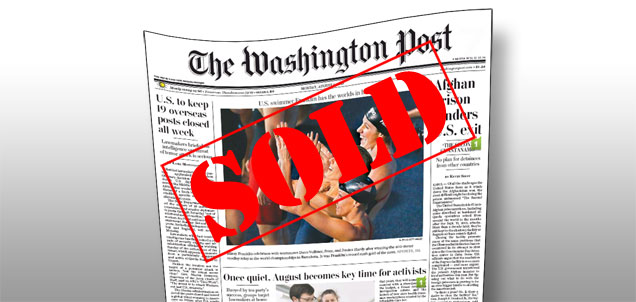
     

  • It’s true! Jeff ‘Amazon’ Bezos buys Washington Post for $250 million


    By A Correspondent


    It’s not always that you wake up, look up the news on your mobile device or computer, and wonder whether you are actually awake or dreaming.


    The milkman’s on the door, you can hear the school bus at the distance screeching to a halt. Yup, it’s all for real.


    1 Minute View: Yeh toh hona hi tha!

    And it isn’t April 1.

    You aren’t reading Onion or our own Faking News.

    It’s the NY Times and the Washington Post. It’s on Poynter, it’s everywhere.


    Jeffrey P Bezos, the man who made the world forget that Amazon is also the name of the second-largest river on this planet by creating a powerful, multi-billon dollar e-commerce empire called Amazon.com had bought the Washington Post and a slew of other publications.


    Yes, Amazon founder Jeff Bezos was the new owner of one of the world’s most powerful newspapers. The acquisition, made at a modest amount of $ 250million, puts an end to some 80 years of ownership by the Graham family.


    It’s pointless us writing a long story here.


    We’ll bring you the Top 10 links so far:

    1. The Washington Post main story announcing the deal: http://www.washingtonpost.com/national/washington-post-to-b e-sold-to-jeff-bezos/2013/08/05/ca537c9e-fe0c-11e2-9711-3708310f6f4d_story.html

    2. Another take, from The New York Times: http://www.nytimes.com/2013/08/06/business/media/amazoncom-founder-to-buy-the-washington-post.html?hp&_r=0

    3. Yet another take, from Forbes: http://www.forbes.com/sites/peterhimler/2013/08/05/why-jeff-bezos-is-buying-the-washington-post/

    4. And one more, from Heidi Moore in The Guardian: http://www.theguardian.com/technology/2013/aug/05/jeff-bezos-expeditions-amazon-washington-post

    5. The Washington Post Timeline – from 1877 to now: http://apps.washingtonpost.com/g/page/national/washington-post-company-timeline/374/

    6. The much-acclaimed statement from Jeff Bezoz where he talks of business as usual and need to invent in the future, for its future: http://www.washingtonpost.com/national/jeff-bezos-on-post-purchase/2013/08/05/e5b293de-fe0d-11e2-9711-3708310f6f4d_story.html

    7. Letter from promoter Donald Graham to employees: http://www.washingtonpost.com/national/letter-from-donald-graham-on-sale-of-the-post/2013/08/05/3e6642e0-fe0f-11e2-9711-3708310f6f4d_story.html

    8. Publisher Katharine Weymouth to employees: http://www.washingtonpost.com/national/katharine-weymouth-remarks-to-post-employees/2013/08/05/9edcf1d8-fe0e-11e2-9711-3708310f6f4d_story.html

    9. Publisher Katharine Weymouth to readers: http://www.washingtonpost.com/national/katharine-weymouth-letter-to-post-readers/2013/08/05/ff6bd6e0-fe0e-11e2-9711-3708310f6f4d_story.html

    10. Some tweets (not comprehensive): https://twitter.com/search?q=bezos%20post&src=typd


    Are there lessons for us here in India?

    Surely, there are.

    Remember, we have already an Aditya Birla group investing in the India Today group, and we’ve had other big businesses putting in money into other media entities – directly or via Trust-ed alternatives.


    Some years back, Rediff.com expanded in the US by buying India Abroad newsweekly. But can we have Hungama.com’s Neeraj Roy buying a leading film magazine? Or Naukri’s Sanjeev Bikhchandani buying a business daily?

    Nothing’s impossible, we say.


  • Paritosh Joshi: So you want a job in the Media?

    By Paritosh Joshi


    MBA from a leading business school in the American Midwest, two years with a boutique investment bank in Boston and then this young man lands up for a chat about what he needs to do to get a job in the media.


    It is still easy to think there is a clear demarcation that sets the media apart from the rest of the world. Aamir, Ashton, Arnab and Aishwarya are in the Media. (They don’t even need surnames to identify them). Media people ‘need no introduction’. Us grunts have nothing worth introducing and thus, don’t need to be introduced.


    Or is it so simple?


    There were the Media people but they were few and readily identified as such. M J Akbar dazzled us with his insight in columns for a newspaper he edited. Rajat Sharma put people into the dock, quite literally, as he hosted a talk show. Derek O’Brien got all of us furiously scratching our heads even as he quizzed school kids. Madhuri Dixit sent testosterone levels into orbit merely by counting from 1 to 13. And Lalu had to invoke Sridevi’s cheeks in search of a universally comprehensible metaphor for Bihar’s roads.


    Then Tim Berners-Lee came along and changed everything, although for years after he thought up hypertext in an obscure corner of CERN, we would scarcely have known it.


    By the late 90s, regular blokes discovered that it was possible to find a wider audience for their periodic rants on WWW than they previously could muster around a water cooler or in a cafe. The web log, then portmanteau-ed to weblog and finally truncated to blog was born either in 1995 or 1997 (you can find an interesting history here).


    Then blogger came along in 1999, bang in the heady days of the Dotcom Boom and setting up a blog became Luddite-proof. From the very beginning, the blogging community had a wide range of interests and capability. The largest majority would create an account in an idle moment never to visit it ever again. A few would invest time and effort in their posts and endeavour to reach out to an audience with regular, engaging updates. Remember that these were people operating far away from the conventional notion, but what they were doing was indisputably publishing.


    Everyman had just stormed Fortress Media.


    It began with the written word. Soon enough, authors had found ways of adding pictures to their words. And the web was becoming more clever all the time. It was able to transport not just text but sound and video too. Also, devices to record audio and video had started to shrink in price and size even as they got massively more powerful, thus putting near professional quality sound and image acquisition within reach. Events unfolded at a rapid pace thereafter. Amazon pioneered a lightweight handheld device for reading digital publications. The Kindle was a runaway success and for the first time, books could be self-published by anyone with a good idea and capable penmanship without ever being imprinted onto the dead-tree medium. Soundcloud allowed wannabe speakers, singers and instrumentalists to distribute their art and craft without surrendering themselves to the crafty gnomes of the music industry. Youtube opened doors for every standup comic, ballerina, burlesque queen and cute kitten to show off its talents on glorious Technicolor video.


    But wait, we were talking about an investment banker contemplating a career in the media. So what’s with this long riff about what we now refer to, rather condescendingly I might add, as User Generated Content?


    Well, it wasn’t just individuals that got inspired to start using the all new powers of WWW to talk to their “Audience”. Businesses of every stripe saw the opportunity too. To be rather more honest, what they saw was consumers – happy and irate, sounding off about their brand experiences in these wide open spaces and were left with little choice but to deal, for better or worse, with what they were getting. Surely we’ve all heard the now almost apocryphal story of Coca Cola’s attempt to take down a fan page on Facebook that spectacularly backfired? To the point where they had to pretty much say ‘Let bygones be bygones and let’s be friends’? (Moral: Don’t clobber, co-opt).


    You see what’s happening here. Companies and brands were becoming broadcasters and publishers.


    At no time before in the history of our human civilization has communication across every conventional fence and barrier been so easy, inexpensive and by implication pervasive or ubiquitous. And barring the rare exception, individuals and entities find it more productive to be participants in this endless feast of reason and flow of soul than mere mute spectators. There’s even a taxonomy to describe different levels of involvement with media: Paid media are, as the name suggests, those that you have to buy access to. Earned media are where the media voluntarily carry news or content about you. Finally, owned media are, again as evidenced by the name, those that you own and control. Who doesn’t want earned and owned media?


    And what was it that we were talking about when we began this ramble? Ah, yes. A job in the media.


    I told the young man, he could stop looking. After all, every job- FMCG, Banking, Automobiles, Telecommunication, <insert randomly chosen industry name here> eventually, was going to be a job in the Media.


    Paritosh Joshi was until recently CEO, Star CJ. He has been a marketer, a mediaperson and a key officebearer on industry bodies. He is Strategic Advisor, Ormax Media. He can reached via his Twitter handle @paritoshZero


  • Amazon enters India via Junglee.com

    By Correspondent


    The world’s largest online retailer is tiptoeing into India, using cover from a comparison shopping site Junglee.com it acquired 13 years ago.


    Amazon, whose moves have been closely watched for any sign of an imminent entry into the Indian retail market, will not sell or buy anything in the country for now. Instead, it will direct customers to both online and offline vendors listed on Junglee.


    Amit Agarwal, vice-president of Amazon, would only say Junglee would “help customers discover products from online and offline retailers in India and from Amazon.com”. He declined to say more about the company’s plans.


    Conspicuously missing from the list of vendors on the Junglee site is Flipkart.com, India’s biggest online retailer founded by two former Amazon executives. Flipkart expects to post sales of Rs 500 crore by March 2012. Amazon ended 2011 with revenues of $48 billion (about Rs 2.5 lakh crore).


    “Its recent moves to set up a fulfillment centre (in Mumbai) and now the Junglee launch certainly look like precursors to a retail launch whenever the government allows FDI in multi-brand retail,” said Devangshu Dutta, CEO of retail consultancy Third Eyesight. A legal expert at one of the country’s largest law firms said Amazon was making a ‘clever entry’.


    Agarwal said Junglee will display over 1.2 crore products and 14,000 brands for Indian consumers. The company has also launched Amazon seller services in India where vendors can hook up to Amazon’s portal to acquire customers.


    Source:The Economic Times

    Copyright © 2012, Bennett, Coleman & Co. Ltd. All Rights Reserved