Blog

  • Grand Prix countdown begins


    By Ritu Midha


    Countdown to the Indian Grand Prix has begun – the Buddh International Circuit will attract 1.1 lakhracing enthusiasts from India and overseas From October 28 to October 30. The seating capacity, depending on the ticket sales, can be pushed up to 2 lakh.

    The response the race is getting can be gauged by the fact that flight tickets from Mumbai for that duration are almost double the usual price on ticketing websites, and most upmarket hotel rooms in Delhi and Noida are booked – in some cases at a 100 percent premium. Gurgaon hotels too are gainers here.

    Ticket prices for the event itself are between Rs 2,500 to Rs 35,000.


    The target group

    It is a young – largely male – premium audiences expected at the race. Defining the target group for Formula1, states Premjeet Sodhi, President, The Collaborative , Lintas Media Group, “Non-Cricket sports in India are quite Niche in India and the current followers of F1 are very small in number. However, in demographic terms, currently, the primary target group for the sport would be Males, SEC A, 15-34 years in the top 6 metros.“This target group is considered to be the most elusive – and hence the brands are interested in catching them on the tracks.


    Brands riding on F1

    Airtel as known, is ‘Title Sponsor’ for this sporting event, and the official logo of the India Race reads, ‘2011 Formula 1 Airtel Grand Prix of India’. Interestingly, Airtel gave up its title sponsorship of Champions League T20 sometime back, without completing its three-year tenure.

    Indian brands, are seeing an opportunity in associating with individual teams as well. The latest to be a part of Formula 1 is Sahara Group – it has bought 42.5 percent stake, at the approximate cost of Rs 500 crore, in the Vijay Mallya-owned Force India F1 team – and now the team has been renamed Sahara Force India. Interestingly, both these brands too are connected with the pace version of Cricket – owning Pune Warriors and Royal Challengers Bangalore in IPL respectively.

    Hero Motors, meanwhile, has signed a sponsorship deal with Narain Karthikeyan, India’s first Formula 1​ driver – as of now the deal is only for India Grand Prix.

    Interestingly Amul too is in the fray. The brand has tied-up with the Sauber Team (Ranked 17th). The brand logo will be seen on the front face of the rear wing, and also on the drivers’ helmets. On Amul’s part, it is an obvious attempt to establish itself as a youthful and ‘happening’ brand.

    And then there are brands with a long-standing relationship with Formula 1: like Red Bull and Mercedes Benz. Red Bull showcased its RB3 F1 racing car in Delhi throughout September, and has largely tried to attract the student community in the capital. Mercedes-Benz is looking at a long-term strategy, and plans to launch India’s first motor racing academy next year.

    Cafe Coffee Day has associated itself with the event by selling tickets at select outlets at Delhi, Bangalore, Mumbai and Gurgaon. The coffee shop, a favourite hangout of youngsters, must definitely have seen synergies between itself and F1. Or, perhaps, it was the other way round.

    The tickets would be available at Mercedes Benz showrooms as well.

    As for which brands would derive value by associating with Formula One, Anamika Mehta,COO, Lodestar Universal, states, “F1 is in its infancy in India and will grow from strength to strength with its first ever India Grand Prix. More than VFM its an opportunity to engage brands with the thrill and experience . Over a sustained period of time, it will definitely reap dividends for brands which create an engagement platform. India in that sense is poised right ‑ economic growth, young country that loves technology, thrill and speed.”
    It is not only youth brands, but also the Government that plans to reach out to the F1 fans flocking the capital. Tourism Ministry plans to promote tourist destinations close to the circuit, and at other places of interest. Plan, reportedly, is to promote 50 lesser known destinations including beaches, monuments, mountains, sand dunes, festivals and cuisines.


    The broadcasters

    The broadcast rights, as is known lie with ESPN. DTH service provider Reliance Digital TV (RDTV) has added ESPN HD and Star Cricket HD to its kitty of channels – objective obviously is to enable its subscribers experience the highly charged atmosphere as close to reality as possible.

    ESPN states that the spots have been sold out, and also that it is not selling Formula 1 Buddh International Circuit as a separate property. On ground activity too is meant for sponsors alone unlike Cricket. nil Sathiraju, Associate VP & Head-South, Mudra Max, said, “At this point in time, it’s apparently for the sponsors only. Also many of the deals are getting done outside of India because of the fact that it is F1.”

    Coming back to Broadcast media, Winners from India has Got Talent and Entertainment Ke Liye Kuchh Bhi Karega will perform live at the race. Bir Khalsa Group, Rohan & Group, Prince Dance Troupe, Reincarnation of Indian Acrobatics, Speed Painter Rabin Bar and several others will perform throughout the day on all three days. Of course, it is in addition to Lady GAGA (who would perform on the final day) and other well known DJs and bands from India and overseas.


    The online rush

    As a large proportion of racing aficionados are web friendly, there is a lot of activity in the virtual gaming world – where car races, anyway, continue to be all time favourites. Gaming organisations like Ibibo, Zapak and 7Seas Technologies are working towards providing users the excitement of being on the original track – virtually. While, Zapak has launched the official Formula One Game – ‘Vodafone Formula GP Racing, 7Seas Technologies too has a similar game ‘Xtreame’. The game on ibibo.com offers an opportunity to own a ‘high speed racing car’ in the virtual world.


    Ambush marketing: the Vodafone way

    If all this we not enough, enter ambush marketing. Even as Bharti Airtel is the title sponsor for the event, Vodafone is trying to steal the thunder from under its nose by holding road shows across the big cities. These road shows showcase an exact replica of the McLaren Mercedes racing car to be driven by Lewis Hamilton . And as mentioned earlier – the battle is being fought by Vodafone in the virtual space also – with Vodafone Formula GP Racing.
    F1 vs IPL

    In this backdrop, can one assume that it would be as attractive or the advertiser as a mini Three-day IPL? Our experts unanimously turn down the supposition. States Sodhi, “The IPL monetized the already existing mass fan following of cricket. It managed to over-night make Cricket a very premium sport despite it being a very mass followed sport. F1 on the other hand is a very different task of actually creating active fans in India. Today, it has the premiumness but lacks the mass appeal. Hence, from the advertising opportunity perspective F1 and the IPL are in a very different class. While F1 is for a very definitive age group and appeals primarily to the affluent and the higher SECs, Cricket is very broad based. Hence, the brands that would patronize F1 would be a subset of the IPL advertisers and then some more.” He adds, “In time, surely F1 will find its core set of advertisers but I doubt if its advertising valuations will come anything close to the IPL in the near future.”

    Top of the pyramid is growing in India – the number of rich is growing, and so is the number of young adults. Formula 1 being a race extensively patronized by the young rich surely has the makings of a future success story. A lot would, however, depend on the performance of Sahara Force India, and of Narayan Karthikeyan. Thrill and excitement of Formula 1, just might capture our fancy in a big way – car racing after all is a familiar territory with the kids growing up on a staple diet of virtual races.

  • Government plans to retire analog Cable TV

    Ninety million homes in the country receiving television programmes via analog cable networks will need to switch to digital set-top boxes beginning March 2012, with the government approving complete digitisation of TV transmission over a two-year period.


    The Cable TV Networks (Regulation) Act will be amended through an ordinance, Information and Broadcasting Minister Ms Ambika Soni said after a meeting of the cabinet committee on economic affairs on Thursday. Consumers in the four main metros – Delhi, Mumbai, Kolkata and Chennai – will be the first to switch to the new system.


    The first phase will require 12-15 million set-top boxes and cost multi-system operators (MSO) about Rs 3,000 crore. The digital technology will offer improved quality of transmission and greater choice of content, albeit at a higher cost to consumers. “This will bring a paradigm shift in television viewing experience,” said Mr Avnindra Mohan president (legal) at Essel Group, which owns Wire and Wireless India Ltd (WWIL), an MSO.


    “Consumers can avail of digital cable, broadband and telephony services, all bundled in a single connection.” The announcement boosted stock prices of publicly-listed MSOs, the conduit between broadcasters and the neighbourhood cable operators. WWIL shares surged 19.92%, while Hathway Cable & Datacom rose 10.3% and DEN Networks gained 0.80% on BSE. DEN and Hathway have raised money and got listed on the stock exchanges over the past two years in anticipation of the new law.


    There are an estimated 130-140 million households in the country with TV connections. Of these, 90 million are cable and satellite homes while about 35 million have direct-to-home (DTH) connections. The remaining, in remote corners of the country, use old analog antennae-receivers.


    According to industry estimates, MSOs will need to invest Rs 25,000 crore to carry out the digitisation. “This will benefit the entire broadcasting industry, both economically, and from the point of view of content,” said Mr Uday Shankar, president of the Indian Broadcasting Foundation and chief executive of Star India.


    He said the government should ensure that the deadline is honoured. The broadcasting industry has been suffering from poor bandwidth of analogue cable, which will be resolved with digitisation, he said, adding this will also plug leakages in the revenue system by solving the problem of under declaration of subscribers in the analogue cable system.


    “India has been the world’s cheapest cable and satellite market with an ARPU (average revenue per user) of $4 (Rs 200) for a bunch of channels, a majority of which are unsolicited,” said Mr Yogesh Radhakrishnan, MD and CEO of Prime Connect, the distribution company of Times Group.


    “This move will change it drastically and people will end up paying only for what they wish to see.” A change in hardware may inflate the consumer’s cable bill. “They will pay an initial conversion fee to digital cable operators to buy set top boxes, but it will be more value for consumers,” said Mr MG Azhar, president (strategy & business development) at DEN Networks. This could lead to higher ARPU for both the DTH and digital cable industry. Currently, ARPU for the cable operators ranges betweenRs 100 and Rs 200, depending on the city or town.


    For DTH, it is betweenRs 170 and Rs 180. “The ministry and Trai will now have to come out with interconnect as well as tarriff orders as the ordinance is notified,” said Mr Ashok Mansukhani, president of MSO Alliance. “But the current level of extreme competition between DTH and cable will continue and, at best, customer will have to pay marginally more, specially for niche and sports channels.” DTH operators are hoping they will get a piece of the pie.


    “We can connect consumers with television even in the farthest and remotest of areas,” said Mr Salil Kapoor, COO of Dish TV. A senior executive with a DTH service provider said with the increase in demand, prices of DTH could go up in the first phase by 10%-15%.


    Source:The Economic Times

    Copyright © 2011, Bennett, Coleman & Co. Ltd. All Rights Reserved

  • Gelusil mandates for ideas@work

    By Shubhangi Mehta

    Ideas@work will be working as the creative agency for Pfizer’s Gelusil Xtra Cool, the agency has confirmed the news to MxM India.

    The incumbent on the business was Bates. The media mandates for them are handled by Mediacom.

    The new campaign will break in this quarter. The focus will be on television and highly targeted btl activities. The account size could not be ascertained at the time of filing the report.

    Ideas@work is a Mumbai-based boutique agency. The agency is the brainchild of co-founders and creative directors Zarvan Patel and Prashant Godbole. They handle brands like Reid & Taylor, Red Bull, Big Rock etc.

    Around the world, the Gelusil brand has become renowned for relief from an anxious stomach. Introduced in the late 1930s as a liquid and initially sold in a blue-glass wide-mouthed bottle, through its 70 years it has not only become a staple of medicine cabinets, but it has become a word associated with relief.

    Gelusil was created by the pharmaceutical company first known as William R Warner & Co. (later Warner-Chilcott, then Warner-Lambert) and was formally filed as a trademark in 1939. Warner was a pioneering pharmaceutical company known for the innovation of coating pills with sugar. Gelusil’s early slogan was “the different antacid” because it was both an antacid and anti-gas.

  • Happy 8th birthday, Spatial Access

    By A Correspondent

    Spatial Access turned eight yesterday. From a team of four eight years back, it is now 30 members  strong, and has more than 120 clients – most of them in India, but some in South Asia as well. Meenakshi Madhvani, Founder & Chairperson of Spatial Access, is ecstatic and philosophical at the same time, “It is not yet time to retire.  I still have many more years to go, but it is now time to do things slightly differently. It is the eighth birthday of Spatial Access, and time for reinvention.”

    The company is not only reinventing the services it offers but also the identity of the company. Says Ms Madhvani, “The new logo reflects who we are and what we stand for. Spatial Access is in business of audit, advisory and analytics. Our logo is fluid and mobile – growing as we grow .The small red part in the logo indicates seed – which is now growing. In spite of the growth our DNA of accountability remains intact.”

    Ms Madhvani believes that optimum value from media and marketing spends can be obtained by ‘nurturing the concept of accountability and transparency by all key constituents.’

    Talking of Spatial Access’s presence in overseas markets, Ms Madhvani states, “We are creating the first Indian translational in communication and audit space. We already have operations in Thailand, Indonesia and Singapore. We are doing sophisticated and highly complicated work, and have knowledge and proprietary technology. We can benefit global advertisers in the similar fashion as we are benefitting Indian advertisers. For the multinationals we can provide a seamless product experience.”  She adds, “Over the last three years, our Singapore Spatial Access has worked with the objective of finding out if there is any wastage in media and marketing spends– and if there is, can it be reduced and how?”

    Operations at Spatial Access have been divided in three SBUs –

    SA1 – Media and analytics business headed by  Nikhil Rangnekar

    SA 2 – Marketing Services headed by Geetanjali Bhattacharji

    SA 3 – Media & International (the media audit @ Spatial Access) headed by Harsha Joshi

    Talking about SA 1,Media and Analytics, Mr Rangnekar said, “It is important to understand how much of media money is being wasted and what can I do to minimise that wastage.”

    As per him wastage in media can be due to multiple reasons. Among them:

    1. Faulty objective setting – Am I buying more GRPs, secondage than needed to achieve my reach/frequency objectives?
    2. Lack of rigour in the plan: is the agency optimising my plans to give me the desired reach and frequency in the lowest possible GRPs/investments?
    3. Suboptimal channel mix based on favouritism – identify redundant media vehicles and make recommendations.

    Mr Rangnekar also stresses that 360-degree media should be used based on need, and not because of the feel-good factor. He believes that media mix should never be predecided or based on favouritism.

    Audit is needed not only in strategy and planning, but also in the implementations: one needs to understand whether implementation is it in line with strategy? Are there any gaps? He says, “We go back to the client with advise on how to improve implementation. Agencies need to look at us as their partners and not enemies.”

    He believes that things are changing, and marketers are keener to experiment now than they were earlier. Marketers need to question ‘How should I change my mix to improve my RoI.’ Things are definitely changing with econometric modelling.”

    Reflecting on the increasing need for Marketing services audits  (SA2) Ms Bhattacharji says, “In an advertising lacking in metrics for ‘nonmedia’ investments, marketing services audits bring measurability to the effectiveness of print and film production, PR, events and activation…The production of television commercials, marketing collateral and retail signage occupy a large share if marketing investments. However, in absence of industry-metrics, accountability is often compromised.”

    As per her BTL is now 35 to 40% of investment – and hence the need for measurement is increasingly being felt.

    She stresses that need is not to just create accountability but also appropriate measurement matrix. She expresses, “Spatial Access with its domain expertise can be the bridge to ensure that marketers get what they ask for. As validation process for quality is not in place with quite a few marketing companies – marketing audit becomes all the more important.”

    She stresses that measurement should not be based only on cost, but also resource requirement.

    Making a special mention of PR, Ms Bhattacharji states, “PR can deliver, and be controlled in the similar fashion as advertising.  Size of the release and space value does no matter. Spatial access with its revolutionary tools Prowls and PRIZARD can measure effectiveness of PR.” She adds that brand imagery needs to come across via brand vocabulary.

    Ms Harsha joshi concludes by expressing the need for media audit to measure efficiency and accountability (SA3). She states, “Media spends are growing at about 14% annually. Efficiency and accountability are key for CMOs, CFOs and CPOs across categories.”

    She points a number of reasons for media audit among them:

    1. The standalone price comparison: An advertiser should avoid being the most expensive advertiser in its category by getting its media buying performance audited
    2. Cost benchmarking through comparison to a pool of comparable data, comparison to year on year efficiencies or comparison to actual market data

    Performance of a media plan, as per her, should be based on Spends filter, Deal construct filter and Target audience filter

    Says Ms Joshi, “Though the need for media audit is being felt by 40% of marketers in India as of 2010, global average is 80 percent, and more Indian marketers need to realise the value of media audit.”

    Spatial Access is ready with a new identity, energy and reengineering – objective, as Ms Madhvani states is, “to cover new areas and address old concerns”.

  • Magazines deserve more: Tarun Rai (with video)

    Story by Akash Raha and video by Shruti Pushkarna


    [youtube width=”325″ height=”225″]http://www.youtube.com/watch?v=mhPNt1g3SXU[/youtube]

    Mr Tarun Rai, CEO of Worldwide Media, recently donned the role of President of Association of Indian Magazines. In a conversation with MxM India, he spoke about the development and the role of AIM in the magazine industry.


    Reacting to the development Mr Rai said, “It’s an honour… I have been a part of AIM for four years now, pretty much as soon as I joined the industry. For me it has been a fantastic experience. I come from advertising and I had no idea about the magazine business. Thanks to my membership of AIM, very quickly I was co-opted to the magazine industry. I have learnt a lot from my peers in AIM and I owe a lot to them.”


    Mr Rai was earlier the Vice President of AIM and took over from Mr Pradeep Gupta, Chairman and Managing Director, Cybermedia. He said, “Mr Pradeep Gupta the outgoing President, has had a terrific run in the last two years and as I take over from him I hope to continue the good job that AIM has done over the last two years. We are a small organization but I think we have learnt a lot to collaborate and make sure that we do things that are beneficial to the entire industry. Right now we are too small. We are just 3 percent of the total ad spends. We deserve more, but just by saying that we deserve more we are not going to get it. So we have to do things to convince the advertisers about the strength of our media. That is the reason we instituted the engagement survey and we are going to take it to its right conclusion by having a proper campaign around it and material which will convince the advertisers. That’s just one of the things. Generally speaking, the magazine industry can do with a higher profile.  So my attempt will be to raise the profile of the magazine industry by doing activities. One of the things it will do is to bring more talent to our business. The way our industry is growing we need a lot of people very fast. We need different kinds of people; with this digital opportunity that has come up we need different and varied kinds of young people to come to our business. By raising the profile of the industry we will also attract new talent to the business. That is going to be one of my important priorities.”


    The AIM names were announced at the annual general meeting of the apex association of magazines, held soon after the proceedings of Day 1 of the World Magazine Congress concluded. The current office bearers are Mr Mitrajit Bhattacharya as Vice-President, Mr Rajmohan as General Secretary and Mr Paresh Nath as Treasurer. Mr Rai and his team will hold office until 2013.

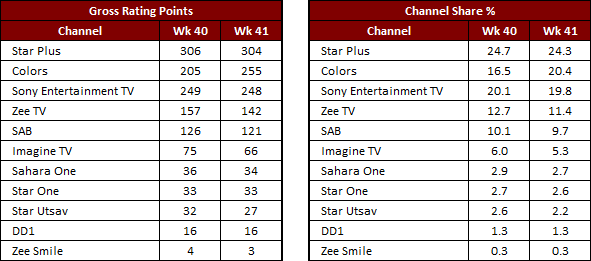
  • GRP & Channel shares of HGECs- Wk 41 2011


    Source: TAM Peoplemeter System

    TG: CS 4+ yrs

    Market: HSM

    Period: Wk 40: Sep 25 to Oct 1, 2011

    Period: Wk 41: Oct 2 to Oct 8, 2011


    About TAM Media Research

    TAM is a joint venture between Nielsen Company & Kantar Media Research. Besides measuring TV Viewership, TAM also monitors Advertising Expenditure of Television, Print & Radio through its division AdEx India. Since 2004, it extended its presence in the PR Measurement & Analysis space for Corporate/Marketing Clients by setting up a separate division Eikona PR Measurement.

    In 2007, the joint venture introduced RAM (Radio Audio Measurement) service to track Radio Listenership for the Indian Radio Broadcast Industry. In year 2009, TAM launched a division, called TAM Sports that specializes in monitoring Sports Sponsorship ROI.

    TAM Media Research’s objective is to fuel media insights that will drive the growth of the Indian Media Industry.

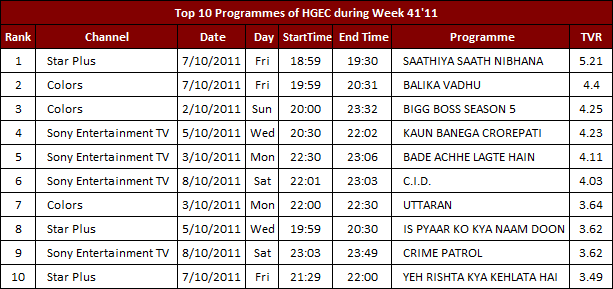
  • TAM data Top 10 programmes on HGEC – Wk 41’11

    Source: TAM Peoplemeter System

    TG: CS 4+ yrs

    Market: Hindi Speaking Market

    Period: Wk 41: Oct 2 to Oct 8, 2011


    About TAM Media Research

    TAM is a joint venture between Nielsen Company & Kantar Media Research. Besides measuring TV Viewership, TAM also monitors Advertising Expenditure of Television, Print & Radio through its division AdEx India. Since 2004, it extended its presence in the PR Measurement & Analysis space for Corporate/Marketing Clients by setting up a separate division Eikona PR Measurement.

    In 2007, the joint venture introduced RAM (Radio Audio Measurement) service to track Radio Listenership for the Indian Radio Broadcast Industry. In year 2009, TAM launched a division, called TAM Sports that specializes in monitoring Sports Sponsorship ROI.

    TAM Media Research’s objective is to fuel media insights that will drive the growth of the Indian Media Industry.

  • Shock & Amusement

    Ranjona Banerji

    It was a very amusing day yesterday in TV land. First, LK Advani’s luxury bus got stuck under a bridge. By the way it takes a great stretch of imagination to call a luxury bus a “rath”; if they want to evoke Mahabharat-type chariots of fire images they should at least have some accompanying horses (not horsepower) and some of those metallic swan wings you see in Indian small towns on carts that are all-in-one marriage bands.

    But the drama of the day was provided by poor Prashant Bhushan, Supreme Court lawyer, core group member of Team Anna and all-purpose activist. As he was about to give an interview to Times Now, a group of men walked into his chambers at the Supreme Court and proceeded to beat him up, with the cameras rolling.

    The images are shocking and whoever saw it was very distressed. Times Now shared its footage with everyone else so there was universal shock and horror at this sort of uncivilised hooliganism. There was some confusion over who these goons actually were – Bhushan said that one told him he was from the Sri Ram Sena, and then the Bhagat Singh Kranti Sena took “credit” for beating him up. Bhushan’s “crime” was to suggest that the army should leave Jammu & Kashmir, the Armed Forces Special Protection Act should be scrapped and if no other solution can be found to the Kashmir question, a plebiscite should be held. These views, according to all these Senas, are distinctly anti-national, thus justifying the attack.

    Different TV channels took different approaches. NDTV decided not to speak to the perpetrators so as not to encourage them, CNNIBN took a similar stand, Headlines Today and NewsX immediately went out and found them and Times Now at first did not make it clear that all these Senas were connected to the Sangh Parivar but pussyfooted around. Then as the night progressed and Arnab Goswami got more into it, he revealed that some of the attackers were former members of the BJP youth wing.

    The subject dominated TV debates and the BJP and RSS spokespersons sputtered their way through the debates. The most amusing of all was Bhim Singh of the Panthers, who had a peculiar faux Brit-solid Punjabi accent who talked to himself through the programme. The upshot was that Bhushan’s views on Kashmir were anathema to them but they were forced – on account of the public outrage – to condemn the violence. It’s a fine line and they were called out on it several times.

    This largely meant that Advani and his bus were given cursory attention.

    The other issue was the very clear links between the RSS and Anna Hazare’s movement with an intriguing debate on why both the RSS and Team Anna were on the defensive about it.


    **


    By comparison, it must be admitted, the morning newspapers were decidedly dull. In Mumbai, a huge thunderstorm took the front page. One main accused being acquitted by the Delhi high court in the murder of journalist Shivani Bhatnagar added another twist to a very strange case.

    Even the Bhushan story got short shrift (perhaps there was nothing left to say after TV had milked it). Of course, newspapers did carry editorials bemoaning our uncivilised response to unpleasant opinions. Well, what else can they say?


    **

    Vijay Mallya’s sale of a chunk of his Force 1 shares to Subroto Roy and Sahara was the other big story everywhere. After the smiling pictures of all have run their course, perhaps we need to see some stories on why Mallya is selling so much?


    **

    Shah Rukh Khan dominated most TV channels after 10 pm – publicity for something or the other – including a long interview with Barkha Dutt. Goswami continued with saving the nation and did not get down to such frippery stuff – doubt if he ever does. He did however end his prime time show with a demand that Anna Hazare come clean on his links if any with the RSS. Interesting.

  • Hansa bags MRSI award for innovative method for household income

    By A Correspondent


    Hansa Research has been awarded the first prize at a Market Research Society of India seminar. The paper showcased an innovative method to know real household income


    Collecting income data in India is fraught with roadblocks. While surveys are considered accurate at capturing product usage and ownership, the same cannot be said of income because of the sensitivities involved. Income tends to be over-estimated in lower classes and under-estimated in upper ones. Measuring real income requires specialized elaborate income studies, which is beyond normal research studies.

    Hansa conducted a special income study to accurately measure income. The study also measured product ownership/consumption. Based on this information, Hansa developed a model to predict real income based on product consumption, separately by population class. This model was validated with the help of ‘National Account Statistics’, traditional MHI and New SEC. To arrive at real income in any customized study, all one needs to do is to capture details of 18 products and use the model.

    Mr Suresh Nimbalkar, Senior Vice President, Hansa Research said: “Income is intuitive, easy to understand and use. It is one of the most differentiating variables. As a result, there was a constant need expressed by the industry to provide real income. The Hansa IRS team took up the challenge of providing the real income to its users.”

  • Mags hold their own in dynamic times


    By Akash Raha

    The 38th FIPP World Magazine Congress ended on an emphatic note on October 12, 2011, with several engaging sessions discussing various aspects of magazine publishing ending with a gala evening at Kingdom of Dreams.

    One of the major sponsors of the event Jussi Pesonen, CEO, UPM gave the welcome address at the Kingdom of Dreams.

    The day began with Mr Chris Llewellyn, President and CEO, FIPP, UK speaking about FIPP. He explained the various aspects of it, such as meetings and events, information and professional developments. The properties of FIPP include Worldwide Media Marketplace, Digital Innovation Summit, FIPP Research Forum 2012. FIPP also encourages researches such as Innovations in Magazine 2011 World Report, Magazine World and World Magazine Trends etc. Speaking about the efficacy of FIPP, Mr Llewellyn said, “I would especially like to mention the influence of FIPP in a fast-developing market, where we have helped several publishers grow better and faster.”  He also said that Korean publishers had approached FIPP and it is now planning an Asia-specific event next September apart from one in Central America next November.


    What advertisers want from magazine media

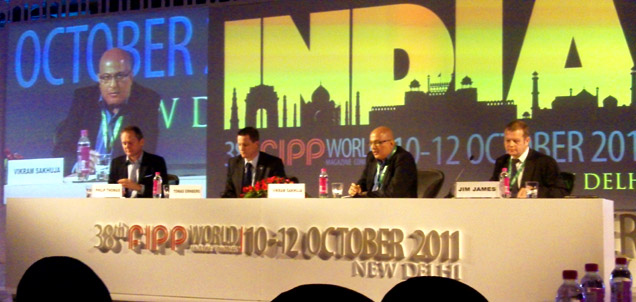
    Mr Jim James, Director, Haymarket Media Group, UK moderated the session which discussed what the advertisers want magazine publishers to do in these times of dynamic changes.  He said, “Perhaps it is a most important question what advertisers want from the magazines. Philip Thomas, CEO, Cannes Lions, UK began the discussion by talking about what advertisers want not only from the magazines but from the whole media mix. He began by talking about Cannes Lions and, which is event that celebrates creativity of communication. “Over the years we have seen more and more marketers, who were earlier, obsessed with ROIs, attending a creative event. Why is that so? It is because creativity drives effectiveness…So the question is not really what the advertisers want from the magazine. Rather, what the magazine publishers can grab from what the advertisers have to offer.” Citing examples he said, “Clients value creativity, it drives their business.” Mr Vikram Sakhuja, CEO, Group M, South Asia said, “In spite of the ad revenues seeing a growth, the growth of magazines has been rather stagnant, and that is a cause of worry. The question is where does the surplus go?  Lately, it has gone into digital mediums.” He went on to say that “Even though Indian magazines publishers are a very creative bunch, they are apologetic about numbers. Content and creativity is the heart of the business, and all they need to do is be passionate about their product.” He also observed that a lot more innovations are happening on digital mediums than on magazines. Mr Tomas Ernberg, Managing Director, Volvo Auto India said, “I think the future of magazine industry will be like what happened with the locomotive industry after a while – based on consolidation… The three important questions that one focuses on, is when we are going to advertise, what we are going to advertise and what is the mix we are going to advertise. Also, it is essential to know the psychography, belief and habits of the customer. If a magazine publisher can tell us exactly what his audience is like, there is no reason why an advertiser won’t advertise.”


    B2b Publishing: Keeping the community engaged in a 360-degree environment

    There are significant changes which have happened in the b2b space since the growth and acceptance of digital. The panelists of this session deliberated on this at WMC2011. Ms Yuko Tanaka, Director, International Sales, Marketing and Communications, Nikkei BP, Japan spoke about her group’s 39 periodicals, 17 websites which are both free access and paid access. She stressed on the importance of 3 key points of focus for Nikkei BP in 2011, Social Media, Smart phones and integration. She said, “Smart phones are gaining popularity as a device, so a need to create to content for that platform. Our research shows that different users access our website through different devices at different times in a day. There are evident trends, for instance, that show more users are accessing Nikkei BP info through iPhones in the day and more on iPad at night. There is a need to not just develop apps for smartphones but also optimize views from smart phones.” She said that there is a need for integration of digital marketing with content and users at the core. “Deeping engagement is like filling a glass with water, except earlier print was the only water you could fill your glass with. It is important to understand your glass or your audience to deepen their engagement with your brand (publication),” she concluded.

    Mr Kevin Costello, Chief Executive, Haymarket Media, UK said, “We have used technology to develop and engage our audience –  60 percent of our revenues come from print, 27 percent from digital and online, and 13 percent from face to face… Internet/Digital meant we had to compete more aggressively to get audience attention. We were faced by the sheer complexity and uncertainty of how technology would evolve. The issue is not just providing content as experts, but how to package content in a certain way that engages users at a greater level. We need to gather enough data on our audience to engage them. If we ask our audience something, we also have to listen to them and provide answers; we should know how our audience wants to interact with us.”

    Mr Pradeep Gupta, Chairman, Cyber Media, India said, “If you look at a 360 degree environment, then changes in b2b publishing have happened far before changes in b2c publishing. Out of 55 percent revenues that come from ads, 15 percent comes from Digital and 30 percent from events. We have been continuously experimenting with new technology, so that we can continually engage our audience… Adding to this revenue model, we are coming up with a new category, ‘Integrated Programmes’. These will be across media, and we plan to get 10 percent of our revenues from this category. The advantage in this model is that advertisers can engage right across to their audience with integration of different media.”


    Successful business model for multi-platform publishing

    Traditional magazine business used to be simple at one pint of time; however, it is not so any more with multiple platforms. The debate at hand was what a successful business model in such an environment is. Mr Paul Keenan, CEO, Bauer Media, UK presented what he called ‘A new dynamic for a new economy of ideas’. He started off by giving a brief overview of this dynamic. Procurement and consolidation forms the dynamic leading to commoditizing the media. “One of the biggest challenges we face is the explosion of media with multi platforms. Hence, magazine today needs to scale outstanding products that are different and better. Moreover, they have to do that with creativity.” He gave several examples of magazine innovations and multi-platform creativity to drive home his point. Thereafter, Mr Peter A Kreisky, Chairman, Kreisky Media Consultancy, USA, spoke about the integration of modern technology with old media. He said, “One of the questions that we ask in the dynamic environment of change is, what are the constants? Our trusted magazine brands, curated and valued content, and our relationship with our readers are the constants and that is something which me must focus on. And between and around that we have to build various business models… Moreover, we have to learn to harness digital eco systems. Ms Kalli Purie, Chief Operating Officer, India Today Group Digital, India gave several examples from her group and explained how multi-platform publishing works, and all that to create a successful business model. India Today is one of the largest media conglomerate with a newspaper, a few channels, digital, several magazines, events etcetera. Talking about news she said, “We try to do more exclusives. Exclusive in a world where news is commodity can make or break a media house. Celebrity power is something we understand. For example, a brand like Shahrukh Khan can help sell not only Bollywood movies but magazines too.” She added “We are a big group and we often believe in curating rather than creating. That helps in cutting costs and yet generating revenue. We don’t want to add our cost burden. We want to be lean and thin and curate content across the group and yet make profits.”


    Editorial challenges and opportunities in a 360 degree environment

    Speaking on the topic Mr Chris Johns, Editor-in-Chief, National Geographic, USA said, “It is important to build a community to keep the promise of your brand – a community of editors, photographers, designers, assistants etc… In a 360 degree environment, the need is to integrate. It is ridiculous to leave out editors, photographers saying that they don’t understand video, or they don’t understand the new platform. How can you say let’s turn it to someone else because they don’t understand the medium.” He said that there are creative people who are out to tell stories and they will do so irrespective of the medium. “At Nat Geo we take good pictures, because our teams are motivated to do their jobs, introducing video is not going to change anything about a good photographer. He will still take good pictures.”

    Mr Mathias Plica, Managing Director, CHIP Xonio Online, Germany said, “CHIP Magazine and CHIP Online – one international brand but two successful complementary products. Brand CHIP is about digital consumer technology. While the Brand strategy is common to CHIP magazine and CHIP online, they have different product strategies. While CHIP magazine is premium paid for content, online is about free content for mass consumer market. The content strategy for CHIP Magazine is to understand what is going on in digital technology, more investigative. But content strategy for online, is about answering three questions. What should I take? Where can I get it? How do I use it? It’s about answering millions of users as opposed to magazine, where you are talking about overall trends.”

    Jim Jacovides, Vice President – International, Time Inc, USA citing Sports Illustrated as a case study said, “SI was first published in 1964, so it’s as traditional as a magazine can get. Some content will overlap in traditional and new media but some will have to be crafted especially for the new media. If we look at the print and iPad workflow, edit, art and photos are common to both. Change sets in when looking at layouts, and some extra content. For instance, the ipad app of SI introduced more photos (additional to the print mag), videos, podcasts, links etc… While the idea remains the same behind content, it just gets enhanced in the digital in a different way, because it is specifically designed to be interactive.”


    Paper’s dynamic future

    The session discussed the future of print in the current media mix. The session was moderated by James Hewes, Publishing Director – Magazine, BBC Worldwide. Ulbe Jelluma, Marketing Manager, Print Power, Belgium said, “Print Power is an initiative that started two years ago. The idea is to promote print media to advertisers and media buyers. We believe that print media has a role to play in an integrated media plan. Research shows that pro print campaigns have been effective. We also have support of major advertisers, some of whom write testimonials on how they use print media in their integrated plan. Research also shows that importance of ‘online advertising’ as a subject for search (Google searches) is declining. Research also shows that perception magazine effectiveness is increasing, which mean magazines have grown in confidence. The challenge print media faces is how will Generation Y influence marketing, advertising and media decisions? Media consumption in this gen y is shaped by multi-tasking. So you’ll have to keep your content like that- more pictures, no long articles, because this gen Y doesn’t have the attention span to go through lengthy articles. Research also shows that magazine-reader relationship has grown steadily. Print media engage readers- readers have a strong relationship with magazines; and as a result, advertisements benefit from this strong relationship. Print media also has better recall content.” Jyrki Ovaska, President, Paper Business Group, UPM, Finland said, “The important issue to address is, can paper and print be dynamic. In this digitalized world? We’ve got to adjust to new demands. Some of the successful magazine editions, have adapted to new unique technology integrations, like Vide magazine, came out with an edition, in which an ad was powered with a chip, so it would play when you flipped the page. These kind of technological advances can be easily integrated into the traditional format to make a lasting impact. The need is to mart new technology ideas or forms with paper. Research shows that uniqueness of printed paper appeals to all five senses. The paper consumption might have seen a decline with an onset of broadband, wifi etc. but there is research that shows, printed magazine is the most preferred way of reading magazines in every age group (in US). Print is seen as an effective media with high advertising reach.  18 percent media use will get 42 percent of advertising revenue.”


    Engagement and magazine Media

    In a country like India, engagement in social media and digital media is limited to a handful of titles. The panels discussed how will the environment change with the advent of 3G and the expected proliferation of tablets. Also, a comparison was made with the Indian experience vis-à-vis what is happening in the international markets. Mr Guy Consterdine, CEO, Guy Consterdine Associates, UK was the moderator of the session and said, “Engagement can be measured in term of behaviours and attitude. But is engagement universal across the globe? Is engagement from magazines in India same or different from that in USA and Europe?” Mr Tarun Rai, CEO, Worldwide Media, India said that magazine are an engaging medium which, unfortunately for the publishers can garner only 3 percent of the ad revenues. He said that the quest of magazine publishers is to want more of the ad pie, hence they have come out with the ‘Engagement Study’. He said “There are expectations from the ‘Engagement Study’ that we have done, and our fraternity has a lot of expectation from ES too.” Giving a background to the Indian media scenario Mr Rai said “The speed at which media in India has galloped is immense. Only a few decades back, three decades ago we had only one television channel. Even in 1990’s there were only six television channels. Today in India we have 515 television channels. As a matter of fact, recently a study proves me wrong and said that there are 745 TV channels in India. And it’s not just TV channels; it’s all forms of media that is growing at a staggering pace. We have 400 radio stations, third largest internet user population in the world, mobile and now ipad too has a lot of penetration. And then there is YouTube, Twitter, Facebook and gaming too. And I have yet not included the large number of print publications (NP and magazines).”

    He went on to say, “Since there is so many medium it is leading to ‘unconscious filtering’ on the part of the audience. Because there is so much information one does not know what the right information is any more. This leads to the consumer being anxious. A lot of this information came from the quantitative research we did. And It is proven by research (not just by our research but many others) that the consumer today multi tasks and is involved on several mediums at the same time. Always being on media is contributing to a lot of noise. There is so much noise that there is a huge risk of the message getting lost… We believe that magazine gives the message minus the noise and is engaging. But why believe a magazine publisher and someone from the industry body? Hence we did a study conducted by two independent research organizations.” Thereafter, in a video presentation he showcased the finding of the engagement study.

    Thereafter, Ms Esther Braspenning, International Advertising Resource Manager, Sanoma Media, Belgium said that researches across the world suggest that magazines are extremely engaging, much more than other forms of media. At an average, the pickup of a magazine is 6 times and each time the reader reads it for 15 mins. She gave examples and quoted figures from various researches to drive home her point. She went on to say that “Magazines are close to people, like a personal friend and create a world of their own. Magazine can engage in different way and it is a guide, a status symbol etc.” She also said that digital magazine is an opportunity which publishers must try and appropriate. She said that very little research has been done on it yet, still the scope seems immense.” She ended her presentation by saying “Despite the difference in language and culture the character of the medium appeals the same everywhere.” Mr Consterdine ended the session by saying “We are fundamentally getting the same result in terms of engagement in both India and abroad. Clearly, engagement is a worldwide phenomenon and is a characteristic of the print magazine.”


    The 360 degree opportunity: View from the top

    In the following session a panel of leading CEO’s addressed how their companies are responding to the issues and opportunities facing media companies today. Aroon Purie, Chairman of FIPP, and Chairman and Editor in Chief, India Today Group was the moderator of this session and he asked the panelist several intriguing questions. When asked how he will spend his monies between digital and print, Mr Pierre Lamuniere, Chairman and Group, Publishers, Edipresse, Switzerland said, “We will like to develop and launch news magazines. However, we are as much of a believer of print as in internet. Hence we will give them a 50-50 priority and that is how we will spend our money on the two.”

    On how the business model of his company was changing Mr Maurizio Costa, Deputy Chairman and CEO, Arnoldo Mondadori, Italy said, “For us one major issue for us was international development. For a long time we were limited to Italy. However, now we have about 35 percent of it outside Italy in both magazine and books. Grazia, for example, is available in many markets of the world.” When asked how much of digital spends (in terms of percentage) the group will do in the next 2-3 years , Mr Costa said that the ideal number for them would be 10-15 percent of digital and the rest in print.

    When asked to contrast pint and digital Phil Scott, Managing Director, ACP Magazines, Australia said, “We are chiefly magazine publishers and we are very happy doing that. As a matter of fact we are very good at it too. We are very comfortable to stick to print being our chief product. We will continue to invest in print.  We will be launching not only print magazines but applications for tablets too. Digital is absolutely vital for the future but our chief concern will remain print.”

    Rupert Heseltine, Chairman, Haymarket, UK said, “We have to fight the traditional label of traditional media that has been thrust upon us. There is nothing traditional and old about us. Nothing that I saw in the last two days is traditional.   As a matter of fact, we are new, innovative and creative in all the way.”


    Conclusion

    The day was concluded by Mr Llewellyn who thanked all the delegates for making it a wonderful congress. He also commemorated Mr Tarun Rai for becoming the new AIM President. Thereafter, Mr Aroon Purie congratulated the audience for the wonderful conference and thanked FIPP board for giving him the opportunity. Mr Purie handed over the Chairmanship of FIPP to David Hill, President and CEO, IDG International Publishing Services.

    The next magazine congress is set to take place in Rome, Italy. Mr Maurizio Costa, Deputy Chairman and CEO, Arnoldo Mondadori, Italy, made this announcement.


    Closing Ceremony

    The closing ceremony of the World Magazine Congress 2011 happened over a gala evening at Kingdom of Dreams. Mr Jussi Pesonen, CEO, UPM gave the vote of thanks. The evening included great performances at the Kingdom of Dreams followed by spectacular fireworks. It was followed by dinner and cocktail.

  • Must make OOH likeable: Daniela Krautsack

    Mainstream advertising is going non-traditional; print media has caught up with viral; it is a manifestation of media in which the logical conclusion seems to be 360° surveillance.

    How does the consumer cope with the futuristic outlook of a media world in which everything seems to be public and nothing is private any more? Does the media industry’s guiding light of ‘branded utility’ justify an unlimited use of hi-tech chips and codes? Who are the consumers that voluntarily jump on the ambient media bandwagon?

    Daniela Krautsack, Media Innovation Strategist, Managing Director, Cows In Jackets, talks about today’s global media trends and visions with a critical eye on their creation, their degree of popularity and their lifespan in an interview with Nibha.


    Q: When did you discover your passion for the non-traditional form of out-of-home media?

    It was about a decade ago when I moved from dreamy but advertising ‘old-school’ in Vienna to London. The company transfer within the MediaCom group offered me three simple things: to watch, listen and learn how international media strategy & co-ordination is done. Today, when I look back, I know how lucky I was. “To be at the right time, at the right place.”

    The ‘Find Your London in Yellow Pages’ campaign got me ‘in touch’ with many new forms of media when I travelled from my home in Belsize Park to work in Soho. From the moment that I walked into the station to the moment I walked into our office door, I was touched by ‘The yellow pages points’.

    The company had advertised on the backside of my ticket and even on the wallet that protected it. The entire train and its seat interior were covered in bright yellow design. Never having experienced transit media in this scope before, I felt intrigued to find out more. That was the moment when my exploration started.


    Q: Does the OOH media industry’s guiding lights of branded utility justify an unlimited use of hi-tech chips and codes?

    I would like to define that term ‘branded utility’ first: it means that brands or ideas are genuinely useful to the people they touch. So, how useful are codes and chips and do they ‘touch’? The integration of codes in OOH media in countries such as Japan where I experienced the use of QR (= quick response; a two-dimensional bar code) and other 2- and 3-dimensional codes years ago has not spread considerably across the world – yet. My experience is that the percentage of mobile phone users that have an application installed which allows reading a QR code, has not even in Japan reached the mass. The use outside of Japan is still insignificantly small in order to consider an OOH campaign that would achieve reasonable results. At present, QR codes can be rated as the best and most effective technology for mobile data capture. What I like about it so much is the thought of reducing OOH media to its core function, the visual transfer of a brand and product image with the focus on “image” rather than “text”. Including a QR code within the design of an advertising campaign that uses billboard or any other ambient OOH form allows a “pull” interaction by the recipient of the message. QR technically allows future billboard designs to use significantly less space to transfer lots of information. If interested in the message, people will connect.

    So, returning to your question: Every way that ‘helps’ the community – and this touches current trends such as “economy of time” symbolizing our aim to efficiently manage time – will be embraced and appreciated. I personally do not fear an unlimited use of this code technology. At the moment companies use codes and chips within their communications strategies predominately to play with people’s curiosity and the media’s enthusiasm and willingness to publish these ‘media-first’s’.


    Q: Who according to you are the consumers that voluntarily jump on the speed media bandwagon?

    I am always quite amused to see how small the number of people is that jump on the media bandwagon. When I visualize this ‘future train’, I only count the number of passengers with two hands. I have just been to a party with a crowd of 20- to 40-year olds, people that you could describe as pretty normal when it comes to adopting trends such as the latest technology and fashion and during a discussion, someone asked: “What is a podcast?” I looked around, astonished to experience this lack of contemporary knowledge. I had to realize that only a handful of people knew that a podcast is a word fusion of the word iPod and broadcast, that it is a digital media file and that podcasts allow you to download or stream content about any topic you care about.

    The consumers who are the clever cookies when it comes to being updated of what’s going on around the world in society, culture and technology are those who jump on. And we don’t necessarily only speak about the ‘young’ crowd. They just adapt easier to new technology because they don’t think about it as much as an older, more experienced media consumer.


    Q: According to you how does the consumer cope with the futuristic outlook of a media world in which everything seems to be public and nothing is private any more? Panopticon or individual freedom of expression?

    When I observe the mood and listen to the opinions of people who share their thoughts about the ‘media’ world we live in, I notice that they appreciate the increased opportunity to express themselves, but they are also aware of being monitored. This place can be visualized as a panopticon. We still have a choice to publically plead for a higher sensibility and reluctance to give out personal data to somebody we do not know. The careless behavior of our society to wildly publish every intimate fact bears a huge risk of violating our private sphere.


    Q: What has been your greatest challenge in ambient media?

    Convincing clients who were very sceptical towards this media form. The other one was the launching of a communications agency, ie  entirely dedicated to ambient media and non-traditional strategies and that too at  a time where taking the risk and trying out new things in communications planning wasn’t fashionable.


    Q: How do you define third place marketing and creativity in the OOH media?

    While ‘first places” represent “the home”, a place that I decorate and feel comfortable living in and ‘second places” the ambience of work, ‘third places’ are landmarks with a core attraction of such extraordinary extent that seeing them is an absolute must; thus talk-of-town organically develops. Third places can be museums, wide-open spaces but also supermarkets and shopping malls. They come to life with light, video projections and special installations. These venues feature an emotionally charged ambience and for which there is no admission fee. Without creativity, I dare to say, a third place doesn’t exist. Creativity is one of the cornerstones of the third place foundation. And OOH media logically benefits from the strength of such an eye-catching place.


    Q: What all factors do you take into account when you make a media strategy, which involves innovation in the ambient media?

    • The objectives of the campaign

    •  The demographics/psychographics, moods and opinions of the target group

    • The brand status

    • The competitors’ activity

    • The creative execution

    • The budget

    • Innovative technologies or never used before ideas, techniques or material

    • A measurement tool / method


    Q: According to you what is the approximate share of ambient media advertising in terms of ad spend when compared to the total ad spend in the OOH media?

    Considering the different definitions of ambient media (in the UK, the media industry does not even use this term anymore, they call it non-traditional OOH or brand experience or shopper marketing or stunt, etc) worldwide, I can only give a rough estimate. I just looked at the OOH share in Austria, the UK, Mexico and India and it is quite similar, roughly between 5.5 percent to 7.6 percent, Mexico showing the smallest share and India the highest OOH share.

    While ambient media is a category still not being monitored in most countries in the world, the UK reports approximately a share of 6 percent. This however does not consider guerilla, ambush and experiential marketing, sampling, promotions and events. It is clear though that this is a category that will continue to grow.


    Q: How do you see the scope of ambient media in South-East Asian countries and Africa and where does India stand among all?

    Overall speaking there is a large potential for ambient media throughout Asia and Africa. Whereas we experience a counter movement by ‘the new’ traditionalist opinion leaders in cities across Europe and the United States that plead and demonstrate for an advertising-free ambience, the outdoor category overall is growing. We are challenged to create OOH media not only in a more visually attractive way but also in one that is considered as a “useful” platform again, e.g. as an information platform that hopefully focuses on core images and incorporates technological measures (e.g. code technology) to allow information to be picked-up when needed. The important model for the future is to position OOH media as “a likeable platform” that interacts with the life of city inhabitants; media to stimulate opinions and thoughts, to inform and to entertain.

    Due to its high level of ambient media activity, Thailand has become a role model for non-traditional media in the Southeast-Asian market. Some of the award winning ambient media campaigns were developed in Bangkok and rolled out across Asia. According to my own observation in India as well as the opinion of local media experts, the potential for ambient media in India is considerable. The biggest challenge for India is not the lack of investment or funds – it is about finding clever solutions to scale ideas across India and the increase execution opportunities outside main metro-cities.

  • Anil Thakraney’s Debrief: All you need is…

    The Honda guys have finally realized there’s an aam aadmi in the Indian market. So they’ve launched a hatchback called Brio, and it’s affordable. (Jazz, their other hatchback, is much too ridiculously priced… one can buy a nice sedan at Jazz’s price point.)


    The positioning for Brio is rather interesting… ‘Brio loves you back’. The commercial features a guy and his girl romancing. At the same time, the bugger also romances his Brio. This love-all saga goes on till the poor guy discovers his lover has been cheating on him. But instead of burying himself in booze, he returns to his car. Why? Well, because as the ad says, Brio loves him back!


    Despite the fact that the desi middle class doesn’t buy cars for love… they buy them mainly for economy and resale value… I think the concept of love does have potential. But the execution messes things up, because it’s a convoluted tale. The ad has to establish love between the two human beings. Simultaneously runs the story of the chap’s love for his car, and this requires many car shots to be showcased. And in this dual love story, things get rushed through, the cutting is too fast, and the victim is emotion. And what’s love without emotion?? You only see a mish-mash of many visuals. To make things worse, the video don’t sync well with the languid, easy paced background score.


    Bottom-line: Promising idea let down by a not-very-smart script.


    [youtube width=”450″ height=”250″]http://www.youtube.com/watch?v=CQJ4OOupGHE[/youtube]
    Rating: (On a scale of 1 to 5): 1.5. Didn’t feel the love.


    Anil Thakraney’s ad review column DeBrief appears twice a week.


    Â