Blog

  • Musical Tambola on Radio Mirchi Delhi

    By A Correspondent


    Delhi radio station Radio Mirchi 98.3 FM has announced a Musical Tambola contest for the month of October with RJ Naved on Sunset Samosa Monday to Friday, from 6pm to 7pm, with cash prizes up to Rs 15,000 on offer.


    To play, the listener has to SMS Mirchi <space> name to 5676729 to get a Tambola ticket with a unique number consisting of six songs. Listeners have to then tune into Sunset Samosa and tick off the songs from their Tambola ticket while RJ Naved plays super-hit songs on air and engages his fans with witty repartee. As the listeners get a Top 2, Top 4 or a Full House on their tickets, they have to SMS their name and ticket number to Radio Mirchi at 58888 and win.

  • Magazines need to be more open: Volvo MD Tomas Ernberg (Video)

    By Shruti Pushkarna

    In today’s digitalized world where advertisers and marketers have options aplenty to choose from, when it comes to their vehicle of communication, traditional media has a tough battle to fight, feels Mr Tomas Ernberg, Managing Director, Volvo Auto India Pvt. Ltd.

    Speaking at the 38th FIPP World Magazine Congress 2011 in New Delhi, Mr Ernberg said, “The world is going for the digital and that’s why there’s a scary scenario for magazines, so to say…”

    Sharing a client’s perspective, Mr Ernberg said that the marketer feels a bit blind when it comes to ROI from putting an advertisement in magazines. “If magazines could be more open and could find more information about the customers, the subscribers…especially psychographics, it would give the marketers a very good platform to decide which magazines to advertise in”, added Mr Ernberg.

    Advertisers and marketers, emphasized Mr Ernberg, are looking to engage their audiences in entertaining and effective ways, so even though creative content is at the heart of all communication, magazines which are proactive and transparent in sharing information with clients, are the ones which will survive.

    Having spent 17 years at Volvo, Mr Tomas Ernberg took over as company’s Managing Director in July this year. In his last position as the Regional Marketing Director in Dubai, he managed 13 markets in the Middle East and North Africa. Mr Ernberg started his journey with the Swedish auto manufacturer in 1994 as the Tourist and Diplomat Sales Manager at Volvo Cars, Turkey.

    [youtube width=”350″ height=”250″]http://www.youtube.com/watch?v=XyYQZEWhdGM[/youtube]

  • Anil Thakraney: Brand SRK needs help

    Celebrities are brands. And just like detergents, condoms, noodles and cars, they need to build and nurture their brand image. Because that’s what ultimately decides their performance in the market place. People like to be associated with desirable brands. And that’s also the reason advertisers like to associate their brands with celebs. To have the values of the celeb brand rub off on their own brands.
     

    When I examine how Shahrukh Khan has been going about building his own brand of late, it kind of confuses me. Clearly the actor isn’t really thinking out here. Let’s first study his movie brand. Instead of competing with Aamir Khan, and experimenting with new forms of cinema, he seems to have made it a mission to target Salman Khan. Perhaps in reaction to the success the latter has enjoyed with his recent mindless action films. SRK is now taking his brand into the ‘Mine is bigger than yours’ space. Completely ignoring his own core brand strengths, which is the soft, vulnerable, caring, sensitive, romantic persona… the image that endears him to his fans… and is now trying to compete with a macho star on values alien to him. I really have a bad feeling about the so-called India’s most expensive film Ra One, and its debacle will hurt the SRK brand considerably.


    Next, his choice of brand endorsements and his performances in them. You’ll notice glaring fault lines here too. Not only is there no attempt at being discerning, which once again Aamir Khan is, SRK agrees to endorse just about anything that comes his way, and acts the same in every commercial, convinced the buyers will buy into whatever nonsense he does on the screen. Frankly, it’s embarrassing to watch him in ads for Hyundai i10, Linc Pens, Videocon and many others. There’s another cringeful ad he’s done with wife Gauri (it’s so silly, can’t even recall the brand name). Guess baniyan and chaddi brands are next up. If this continues, and his movie career stagnates, SRK will find the going quite difficult.


    Celebs, like all brands, must fiercely guard their value. So that it remains powerful, relevant and enduring. The hit-and-run approach won’t work. Guess SRK badly needs a brand manager.


    ***


    PS: Watch this brilliant ad from Pro Infirmis, a Swiss organization that supports handicapped people. THIS is the way to use emotion in advertising. A big hug for the creator of this advert.


    [youtube width=”400″ height=”300″]http://www.youtube.com/watch?v=zFWr-CKMWGY[/youtube]


  • Reviewing the Reviews: Mod

    Mod

    Key Cast: Ayesha Takia Azmi, Rannvijay Singh Singha, Raghubir Yadav, Tanve Azmi, Ananth Mahadevan

    Written and Directed By: Nagesh Kukunoor

    Produced By: Sujit Kumar Singh, Elahe Hiptoola


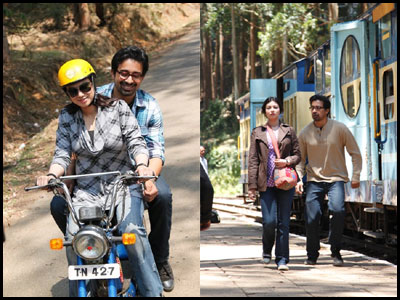
    In the glut of releases this week, Mod is the pick, simply because Nagesh Kukunoor is the director, and even though his last few films have been heart-breakingly bad, there are still hopes from the man who made Hyderabed Blues and Dor.

    The title is confusing, most read it as the abbreviation of modern, when it is intended to mean turn. Most critics, perhaps relieved that it wasn’t as awful as Kukunoor’s Bombay to Bangkok, found good things to say about it. Readers would be confused, however, when ratings range from one to three and a half. What is slightly off-putting that Kukunoor has given up on originality. This one too, is taken from Korean film, Keeping Time.

    Mayank Shekhar of the Hindustan Times gives it one and a half stars, but perhaps nails it when he writes, “Most still recall Kukunoor for Hyderabad Blues (1998), a game-changer in low-budget Indian films, which could instruct and delight at the same time. He has since become a pure genre filmmaker. Which is truly what separates the so-called “indie” from the supposed hard-core mainstream. Traditional Bollywood directors pack in every genre into one movie, alternating action with romance, comedy, drama etc. “Cutting edge”, “independent”, “Hindie”, potentially global “crossovers” would be too flatulent an epithet for those who don’t do that. But they don’t produce anything extraordinarily personal, astonishingly moving or real, either.”

    Trade journalist Komal Nahata on koimoi.com gives it one star and writes, “On the whole, Mod may win critical acclaim but it will remain a dull fare at the box-office, its poor initial and the dull pre-Diwali days only adding to its problems.”

    Another trade man, Taran Adarsh, writing in bollywoodhungama.com gives it two stars and states, “Mod is an emotional love story of two completely mismatched people – a genre Kukunoor has never tackled earlier. In fact, in his earlier movies, love was a part of the main plot, but it’s the central theme this time. Mod boasts of an interesting idea and even Kukunoor’s mature handling of the material needs to be lauded, but the film suffers for two reasons – it unfolds at a sluggish/lethargic pace and is prolonged.”

    Rajeev Masand on IBNLive goes with two stars but is brutal. “Mod is a test of your patience because the screenplay is a complete drag. The film unfolds lazily well after the twist has been revealed; and the central conceit isn’t even true to its own logic. There are plot holes the size of craters here. Ayesha Takia has a calming presence, but Ranvijay Singha, despite his earnest efforts, simply doesn’t have the chops to carry off such a complex part… Let down by sloppy writing, this is one hard slog.”

    Aakanksha Naval-Shetye and Soumyadipta Banerjee of DNA, however, give it three stars and say, “The film feels straight out of a book of short stories and has a certain old-world charm. The downside is that everything is too picture perfect here, and things just fall into place rather conveniently towards the end. The music doesn’t help much. The slow pace especially in the first half drags on forever, even though thankfully Ayesha’s cutesy act won’t let you complain too much.”

    Surprisingly, Nikhat Kazmi of the Times Of India gives it a low (by her standard) two and a half stars. “It’s a sweet, small and simple film spilling over with charming locales and charming people too. It’s the pace of the film that takes its toll on you. Understandably, life follows a languid rhythm on the hills and cannot move at lightning speed. But hey, a film’s got to have sufficient movement and pace to keep the drama flowing. Here, the events unfold with extenuating lethargy and test your patience time and again.”

    Ganesh Nadar writing in rediff.com gives it two stars. “Out of 12 reels, 10 are focused on Ayesha (Takia). The rest of the cast have to make do with the remaining two. All one can say of the hero is that many a time one is left wondering why he does what he does, and many a time he looks like he doesn’t know why he does what he does. It’s a lovely story with great actors, and great scenery. What screws it up is the slow movement. You really have to have patience to watch the movie or be happy just to watch Ayesha. Wish director Nagesh Kukunoor had someone to tell him that slow and steady doesn’t win races any more. You have to be fast and racy. A must-see for Ayesha fans; the rest can give it a miss.”

    The level-headed Shubhra Gupta of The Indian Express says, “It’s so obvious that Andy is not who he says he is that you wonder why Kukunoor takes so long to get to the point. But then, he needs to pause to show off all the nice waterfalls and the rocks and the winding roads. The scenery is fine only for a bit, but then gets overtaken by situations which you can see a mile off. You know that that Andy is disturbed much before the doctor (Mahadevan) pronounces his diagnosis. The reason for his being the way he is unspools with no surprises. Takia is her familiar wholesome-girl-next-door but has to shoulder too much of the film, and Rannvijay is one-tone.”

    The unsigned NDTV.com review goes off on a tangent: “Mod is like a gentle sonnet played on a cosy winter morning. It is the tenderest love story in ages with a central performance by Ayesha Takia that strikes a chord deep in your heart. It’s a film you want to adopt, embrace and hold close to your heart.”

    No wonder audiences go by friends’ tweets or word of mouth to decide on which movie to watch!

  • Huge expectations from ‘Good Food’: Tarun Rai

    Tarun Rai has been the CEO since 2008 of the Worldwide Media group which, during his tenure, has seen several new launches and titles. The most recent in the long list of magazines is BBC Good Food which is to be launched on October 21. In a conversation with MxM India’s Akash Raha and Shruti Pushkarna, Mr Rai, who took over as AIM President from Mr Pradeep Gupta, Chairman and Managing Director, Cybermedia, talks about the Engagement Study, Good Food, Zinio platform and the future of magazines in India.


    [youtube width=”350″ height=”250″]http://www.youtube.com/watch?v=KKPL01uKuDA[/youtube]

    Q: You are launching BBC Good Food in India. What are your expectations from the magazine?

    I just got to hear that the magazine is ready; it’s bound, ready for dispatch. We are launching BBC Good Food on Good Food Day, October 21, which we are celebrating and we are encouraging people to try something new on the day. We have huge expectations from Good Food. India is changing, food habits are changing. People are experimenting with food both in their kitchen as well as when it comes to eating out in restaurants. We believe that the time is right for such a magazine. There are no precedents; there are no international food magazines in the country. We are going into uncharted territory and we are beating a new path. There are dangers but as I said, somebody has to do it and we believe that the potential is huge. And the response we’ve got from advertisers for the magazine is excellent and you’ll see it in the number of ad pages we’ve got in the first issue.


    Tarun Rai on Indian magazines becoming successful international brands
    [youtube width=”350″ height=”250″]http://www.youtube.com/watch?v=-gdT17SBAtk[/youtube]

    Q: Several international brands are licensed to India. When do you see an Indian title becoming a successful international brand?

    As you know Femina and Filmfare are heritage brands for us and they are doing fantastically well. Femina already is present in Sri Lanka. Filmfare we’ve licensed last year to UAE and we’re hoping that we will take it to many countries; there is already interest because Bollywood today is international. The Indian diaspora still wants to connect with Bollywood and I think very soon you’ll see Filmfare in many other countries. The other advantage is, thanks to what people say the ‘digital issue’ but I see it always as an opportunity, we are already on the Zinio platform with Filmfare for the past month; and the response has been fantastic. Almost 60 percent of our total sales of all the magazines that we’ve put on Zinio have been for Filmfare because this is the demand which is coming from the international markets and now suddenly it has become very easy to subscribe to Filmfare just at the click of a button. So I think there are going to be huge opportunities on some of the brands like Filmfare and Femina.

    Q: What do you feel at being appointed the President of the Association of Indian Magazines? What does this responsibility mean to you?

    It’s an honour… I have been a part of AIM for four years now, pretty much as soon as I joined the industry. For me it has been a fantastic experience. I come from advertising and I had no idea about the magazine business. Thanks to my membership of AIM, very quickly I was co-opted to the magazine industry. I have learnt a lot from my peers in AIM and I owe a lot to them. Mr Pradeep Gupta, the outgoing President, has had a terrific run in the last two years and as I take over from him I hope to continue the good job that AIM has done over the last two years. We are a small organization but I think we have learnt a lot to collaborate and make sure that we do things that are beneficial to the entire industry. Right now we are too small. We are just 3 percent of the total ad spends. We deserve more, but just by saying that we deserve more we are not going to get it. So we have to do things to convince the advertisers about the strength of our media. That is the reason we instituted the engagement survey and we are going to take it to its right conclusion by having a proper campaign around it and material which will convince the advertisers. That’s just one of the things. Generally speaking, the magazine industry can do with a higher profile.  So my attempt will be to raise the profile of the magazine industry by doing activities. One of the things it will do is to bring more talent to our business. The way our industry is growing we need a lot of people very fast. We need different kinds of people; with this digital opportunity that has come up we need different and varied kinds of young people to come to our business. By raising the profile of the industry we will also attract new talent to the business. That is going to be one of my important priorities.”


    Q: Do you think the Engagement Study that AIM has come out with will solve the measurement woes of the industry? Moreover, do you think that the advertisers will accept it as a robust currency?

    You never know until you try, and this is our attempt. Now it’s up to us to convince them. One piece of research is not going to do it. The good news is that the media buyers and the advertisers themselves are trying to understand media better. Ambika Srivastava spoke about the touch point study, the brand experience points, about how magazines score very highly when it comes to influence. So the conversation has already started. We want to push that conversation along where the judgment on one media is not only dependent on the numbers but also dependent on the quality of numbers, on the quality of engagement. And therefore the engagement survey is just the first step; it is not going to persuade people overnight but we don’t know whether we’ll be able to persuade people till we make our first step. So this is our first initiative to do that.

    Q: What are the take-aways from the India edition of the World Magazine Congress, moreover, on the 360-degree opportunity theme?

    It is called the 360-degree opportunity, not challenge, because I am of the firm opinion (and the board of FIPP was of the firm opinion) that we should look at it as an opportunity rather than as a threat. I just think it’s a fabulous place to trade ideas, to get to know what people in the developed market are doing, what people are doing in the South East Asian market which is still coming up. It’s new territory for us. Organization structures are being experimented with; we had this whole thing about how do you manage content along with so many platforms, do you have a core editorial team…? Business models are being experimented with. So to me it’s still a time of flux. Everyone agrees it’s an opportunity which we cannot ignore; do we have the right answers yet, maybe we don’t but this is a forum where you can learn, you can share, you can discuss and hopefully going forward we will arrive at some solutions which will work for different magazines.


    Q: What according to you is the future of magazines in India?

    I think the potential for magazines in India is huge. I always say that magazines, specially the lifestyle and special interest magazines, in India are a sunrise sector. So if it’s a sunrise sector, we are only 3 percent, the only way is up. We are too small to go any lower than that, the only way for us is up and I am very bullish about magazines in India.

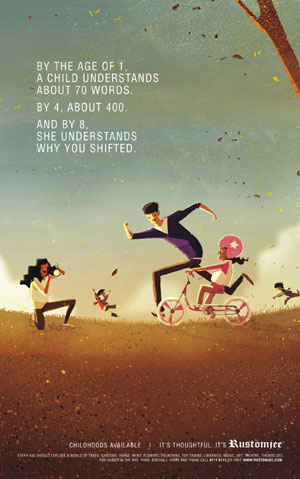
  • AdStrat: Childhoods available from ideas@work

    The campaign:

    Childhoods Available


    The client:

    Rustomjee Group


    The agency:

    ideas@work


    The brief:

    In a world of luxury, sometimes the true luxury is giving your child a childhood. This was what we needed to communicate.


    Research insights:

    Vijay Chidambaram and his team from Centre of Gravity conducted extensive research across the city across socio-economic classifications to uncover consumer needs and came up with the insight that the one thing most Mumbaikars wanted to do a better job of giving their kids the kind of childhood they themselves enjoyed.


    The thought process behind the creative:

    Ideas@work, Rustomjee Group and organizational branding firm Centre of Gravity worked together as a team to produce the campaign. The on-ground implementation of the campaign was done by Rutu Modi, and of course, Rustomjee’s in-house marketing team and their media partners.


    Media vehicles chosen:

    Print, outdoor and digital. Since the target audience is limited to the Mumbai metropolitan area, it makes sense to maximize ad spends within its limits. Press ads include full pagers in all the leading newspapers. Outdoor locations number more than 50. Digital is another media vehicle that will go live soon, with Radio being considered. Further, all moments of truth both for internal and external customers are being designed to carry the same message.


    Key issues kept in mind while executing the ad:

    Creating a visual that breaks the current and typical formats of clutter. Even messaging was to be kept concise so as to allow accentuating the customer experience at the point of sale.


    Does the treatment do justice to the brief?

    A lot of people remember stories from our childhood, like Alice in Wonderland, Winnie the Pooh, Aladdin, and so many others. So that was the category as far as the look of the campaign was concerned.


    The differentiating factor about the ad:

    For the first time in the history of Indian advertising a real estate company has delivered a communication so single-mindedly focused, the results of which can only be achieved off numbers, and the clutter-breaker approach further helps.


    Market and client feedback:

    Industry feedback has been immensely positive with rave reviews pouring in from all quarters of stakeholders, and business transactions have kept sales teams busy.


    Compiled by Shubhangi Mehta

  • The Empire seems to be wobbling other stuff standard

    By Ranjona Banerji


    This is a mini review, as I look forward to the weekend and all the creativity which newshounds are forced to display. Cooking shows and endless movie stuff is the usual fare on TV, long features and short forays into the unusual are on the menu for newspapers.

    Meanwhile, the Times of India and Economic Times appear to have great glee in the Guardian expose on the Wall Street Journal’s dodgy circulation game – buying back unsold copies in some transatlantic transactions.  You have to feel sorry for Rupert Murdoch; the Empire seems to be wobbling. Perhaps India’s biggest newspaper group is sending a warning to NewsCorp with regards to its India intentions?

    The fact that Blackberry has started working again may end our global hysteria with different telephones and their features and failures. CNN however did put a hilarious clip about one of its staffers having a bit of a hissy fit on the stories they were missing because of the BB collapse at a news meeting.

    **


    The fact that members of the Sri Ram Sene or Sena and Bhagat Singh Kranti whatever beat up Anna Hazare supporters in Delhi seems to be a clear indication that they are looking for cheap publicity. But what a way to become famous!


    **


    The fact the Information and Broadcasting ministry has had to issue a clarification about its licence-cancelling law is only a minor victory. The battle to stop government control of the media has to continue.


    **

    There is a cricket match on today. Will the media turn all its attention there or will corruption, law and order, terrorist attacks continue to dominate? Hmmmm…

  • Hard Knocks: No superstitions please!

    By Anil Thakraney


    The Times of India Mumbai’s colourful supplement, Bombay Times, is not something you read. At least I don’t. It’s a fun thingy one usually glances through. Especially with all the, er, oomph on display.


    However, cricket commentator Harsha Bhogle noticed something extraordinary in their issued dated October 12, and immediately tweeted about it. (Harsha engrossed in BT? Hmmm.) The paper reports on its cover that Amitabh Bachchan’s still-to-be-born grandchild is likely to be a boy. And this stunning forecast was given to them by a numerologist called Sanjay Jumaani. Harsha tweeted this: “i do hopebombaytimes realise they are promoting blind faith and irrationality by putting “numerologists” on their front page.”


    He is absolutely right, of course. And this is something newspapers should be very careful about. Already some of the vernacular news channels are super busy propagating myths about snake women, angry demons and other frightening creatures… in their lust for TRPs… and the last thing we want is the English press to be doing ditto. Not only will such an article result in a longer queue outside Mr Jumaani’s door, it will have more parents rushing to fake babas and other charlatans to predict the sex of their unborn child. In fact, these crystal ball gazers will become a threat to the livelihood of illegal gender test clinics!


    Guess it was an editorial error of judgment on the part of Bombay Times. Whether they admit to it or not. But it must serve as a pointer to the rest of us in the media. One of our jobs is to move the nation forward by creating awareness and carrying out sharp analysis. And not to set it back into the dark ages by promoting superstitions. The vernacular channels are already doing a fine job of it. Let’s leave it to them.

    PS: Chanced upon this outstanding international Coke ad. This is the sort of work they should be doing inIndia. And not that ridiculous ‘Brrrr’ stuff.
    [youtube width=”500″ height=”300″]http://www.youtube.com/watch?v=9dHOzw5KSlE[/youtube]
  • The Anchor: Prathap Suthan on 10 character indicators for an agency to dump a client

    Nothing is more rewarding than a client who sees the agency as its redeemer, partner, marketing dept., brand builder, wealth creator and undying fan. Most of us have had the pleasure to work with some fantastic and inspirational clients.

    But there are also times when you are saddled with clients who aren’t worth your aching back. People so daft, you’d rather terminate them than self-destruct yourselves. I once worked for a global automobile client who turned out to be the worst kind, and I bayed for sending them a sack letter screen-printed on a jute sack. However, the agency bookkeepers were too bothered about pending bills and we eventually had to pitch a bigger automobile client, win the business, and then eject the client.

    I am sure you can do without a couple of clients in your portfolio. Clients who don’t let you do great work, clients who have stopped contributing to your bottom line, clients who keep you on a diet of insults, and clients who don’t share your passion. You don’t need me to tell you what you need to do. But just in case, you missed the signs, here are some telltale client characteristics or characters you must look out for. There are more, but these are perhaps the more evident symptoms.


    #1 When the client turns Scrooge

    Here’s the client who changes stance all of a sudden. Every cost, expense, investment has to be borne by the agency. Almost like it’s the agency’s fault that the client has to spend money to advertise. This is a reflex to a cost cutting drive initiated by the CEO, and it’s a time when they’d like to evaluate all past spends. With supporting bills. From here on, you aren’t going for meetings on advertising and brand building. They will be all about haggling. Trust me, this relationship will lead you to Shylock.


    #2 When the client turns Cinderella

    This usually happens when the Lala’s young son or daughter takes over the business. Armed with a fancy MBA from hinterland USA, this zero advertising brain will never get the big picture. Do all you want, and waste all your adrenaline. Everything that you do will never be up to the mark, and everything you do will be incomprehensible. Criticism, blame, and threats are what you’d now hear. And if you are not an agency making names in the wine circles, your time was up yesterday. This pumpkin will implode.


    #3 When the client turns Piyush

    There comes a time when the CMO changes his role. Overtly. Instead of ensuring that the marketing team gets their briefs right, the head of marketing suddenly becomes the CD on the account. Once is a while, all CMOs will like their pet idea to bloom into life. We will even indulge them. There will be scripts thrown at you, plots suggested, headlines rattled off, references to Nike, ‘when I met Piyush’, etc. But when these become a daily affair, and when the regal curls of your agency’s moustache droop, pull the damn plug.


    #4 When the client turns Titanic

    All of sudden, you’d notice that your client has hit an iceberg. There’s been an inexplicable end to work. Even a little sticker is on its 9th iteration. And the discussions are all over the place with hints of sarcasm and remorse. Somewhere he or she has become unsure, rudderless, and powerless. He or she has lost clarity, focus, and is possibly on grace period. Your bills too have been on hold for a couple of months. This is a sinking ship, determined to take the agency down with it. Get the lifeboats out.


    #5 When the client turns Jellyfish

    This is a variation to the above. This is about the disappearance of the conviction bone. When major campaigns are presented to the Board,or when budgets are shared with the CEO, or when a piece of creative has to be defended, this variety will make its appearance. They will turn white, or pretend to take an urgent call, or look at you with a pleading sweetness. Beware, this is poison. Soon, everything you do will come back to you, everything is your mistake, as are the listless results of every campaign. When this becomes a habit, stand tall, show spine, and squash jelly.


    #6 When the client turns Shakespeare

    Ah, here is the drama queen or king. Nitpicking rajahs and ranis. This is when the smallest of mistakes take on the biggest of proportions. Imagine you haven’t delivered on a label, or a small proofing error gets noticed in the layout, and suddenly mobiles are whipped out and your holidaying CEO is hauled over coals. Every client is allowed this show of power to belittle the CD and the Account Head once in a while. But if every meeting gives you the feeling that you are no longer what you think you are, that you are redundant, and you are no longer capable of anything right, it’s high time you bring down the curtains.


    #7 When the client turns Hitler

    This is when the reign of the tyrant begins. This lady or gentleman is all about telling you and emphasizing where you stand or squat in the pecking order. Impossible deadlines. Impossible language. Impossible tasks. Just to ensure that the agency is always kept in a servile mode. Usually we revel in being challenged. When we go out and do things impossible. Pulling off magic, saving the day etc. But when this begins to happen day in and day out, time and respect are of no consequence or importance, and every piece of work is a struggle to sell, assassination is the only recourse.


    #8 When the client turns SlimeBall

    Some of these otherwise incorruptible gentlemen have a completely different face. Slowly and surely you will be made obvious of his penchant for the crooked. This is when you are deftly asked to keep a cut on the side for the films that he is approving, or the print run he has authorized. He is also pretty blatant about his appreciation of single malts, the next holiday destination he is contemplating, and his ‘I am so looking forward to some stimulating evening company during the film shoot.’ Most agencies would rather not accept severe morality breaches. But if I were you, I’d call in the mafia, er..media.


    #9 When the client turns Unicorn

    For a client who was always accessible, you’d notice that you don’t get to meet him or her anymore. Meetings are called, only to be postponed. Appointments are given, only to be cancelled. Calls aren’t put through, and the mobile is always ringing, never answered. Chances are the CMO is busy. But more often than not, he or she is talking to another agency behind your back. Or is gutless to tell you that the relationship is over. Or has been instructed by the MD that his friend’s agency will be taking over. A client who strangely transits to the mysterious and mythical side of life is more than enough warning for you to see the last of this beast.


    #10 When a client turns SonofaPitch

    I don’t know why they do this. But there are some clients who believe that ‘I will call for a pitch’ is enough to send their agency scurrying to get their brains back. Pity. Fear will only make an agency timid, and not cleverer. Ideally, call their bluff and tell them to go ahead and announce the pitch. Chances are they won’t. The pickings will be slim. Personally I love pitches. Because I believe that a pitch on an existing business is one more opportunity to show the client that I am better than anyone else. But then, if every second meeting is to keep cribbing and keep echoing the pitch intent, sack the moron. He or she doesn’t deserve you. Oh yes, change the P to a B.


    Prathap Suthan is the Chief Creative Officer at iYogi.

  • Dina Thanthi takes over Metronation Chennai

    By A Correspondent

    New Delhi Television Ltd. (NDTV) and Kasturi and Sons Ltd (KSL) have entered into an agreement to sell their respective stake in Metronation Chennai Television Ltd (MNC). The stakes have been sold off to Educational Trustee Company Pvt Ltd (ETCPL), promoters of Tamil Daily Dina Thanthi.

    The deal is worth Rs 15 crore after the completion of which Metronation Chennai MNC will become a 100 percent subsidiary of ETCPL.

    Metronation Chennai Television Ltd was a joint venture of NDTV and The Hindu wherein MNC operated and managed Chennai’s first and only city-specific English news and current affairs channel, NDTV Hindu.

  • Nissan launches film audition on Facebook

    By A Correspondent

    Nissan India and actor Mr Ranbir Kapoor are searching for 20 passionate members of the public to star in the world’s first Bollywood movie auditioned entirely on Facebook.

    From October 19, movie-fans will be able to join in one of the world’s largest on-line talent hunts by uploading a short clip of themselves dancing for a chance to appear alongside Mr Kapoor in the three-minute Bollywood blockbuster – New Star of India.

    Members of the public will vote to decide who the 20 lucky co-stars will be, and will also help produce the movie by shaping the plot, choosing the music, picking the wardrobe and naming the characters.

    As well as being screened to millions on Facebook, New Star of India will be premiered at exclusive red carpet events in cities across India in January 2012, where there will also be a chance to win one of six all-new Nissan Micras.

    Mr Kapoor said, “I’m incredibly excited to be involved in this ground-breaking movie with Nissan – no-one’s attempted anything like it before. Speaking to all Bollywood fans out there, this is your once in a lifetime opportunity to join me in the magic of the movies. I’m looking forward to seeing your auditions and can’t wait to meet my co-stars, so get dancing, get voting and get involved!”

    Taking part couldn’t be easier. All would-be stars have to do is record a 45-second audition of themselves via their webcam, smartphone or video camera showing off their best Bollywood moves and upload it to the dedicated New Star of India page on Facebook, www.facebook.com/nissanindia.

    There are just three steps to stardom…

    1: Choose your favourite soundtrack on the Facebook page

    2: Get dancing – either solo or with up to nine friends

    3: Upload the clip to the site

    Nissan will also be taking New Star of India on the road and will be touring shopping malls across the country to film live auditions in Mumbai, Delhi, Bangalore, Chandigarh, Kolkata, Pune, Ahmedabad, Hyderabad and Aurangabad from October 22 – check the Facebook page for details.

    Even non-dancers can get involved. Everyone who votes, shares or takes a test drive from Nissan’s model range will be entered into a competition to win one of the hottest tickets in town – a chance to attend one of the movie premieres and win a Nissan Micra.

    Mr Kiminobu Tokuyama, Managing Director of Nissan Motor India Pvt. Ltd said, “Nissan is all about innovation. It’s in the cars we build, the way we do business, and now we are offering members of the public a genuine world’s first – an opportunity to become a Bollywood star”.

    Mr Kapoor added, “I love that this movie is going to take 20 people from their living room or bedroom and onto the movie set in three simple steps. If you’ve ever wondered if you have what it takes to make it in Bollywood, now’s your chance to find out!”

  • Newspapers’ reach greater than internet’s

    By A Correspondent

    Newspaper circulation declined in print world-wide last year but was more than made up by an increase in digital audiences, the World Association of Newspapers and News Publishers (WAN-IFRA) has said in its annual update of world press trends.

    “Circulation is like the sun. It continues to rise in the East and decline in the West,” said Christoph Riess, CEO of WAN-IFRA, who presented the annual survey Thursday at the World Newspaper Congress and World Editors Forum in Vienna, Austria.


    The survey found:

    – Media consumption patterns vary widely across the globe. Print circulation is increasing in Asia, but declining in mature markets in the West.

    – The number of titles globally is consolidating.

    – The main decline is in free dailies. “For free dailies, the hype is over,” said Mr Riess.

    – For advertisers, newspapers are more time efficient and effective than other media.

    – Newspapers reach more people than the internet. On a typical day newspapers reach 20 percent more people world-wide than the internet reaches, ever.

    – Digital advertising revenues are not compensating for the ad revenues lost to print.

    – Social media are changing the concept and process of content gathering and dissemination. But the revenue model for news companies, in the social media arena, remains hard to find.

    – The business of news publishing has become one of constant updating, of monitoring, distilling and repacking information.

    – The new digital business is not the traditional newspaper business.


    Mr Riess’s presentation focused on six key areas: the media consumption shift; economic developments; newspaper circulation and number of titles; advertising expenditure by media; newspaper revenue; and internet versus mobile.

    This represented a significant shift from past versions of the world press trends survey, which WAN-IFRA has been carrying out since 1988. Long a statistical compendium of information from more than 200 countries, the 2011 report focuses on the 69 countries that account for 90 percent of global industry value in terms of circulation and advertising revenue. “We’re concentrating on value rather than volume, focusing on key numbers in key markets,” said Mr Riess. “Our approach puts a premium on insight over numbers.” This reflects feedback from industry stakeholders, as part of the new WAN/IFRA review. But the survey will continue to monitor all countries.


    Media Consumption Shift

    When measured in minutes per day, media consumption patterns vary widely. For example, television dominates in the United States, internet accounts for one-third of media time in Austria, and digital gets just a fraction of consumption time in Russia. Time spent with newspapers is low when considering their impact and influence on society, compared with other media – and to their advertising revenues.

    “Newspapers have always had a lower percentage of the time spent by the media user, relative to the high advertising revenues that newspapers produce,” said Mr Riess. Newspapers account for 8 percent of media consumption time, but 20 percent of all advertising revenue. “We have always been extremely efficient in using the time of our readers. But now we are in a more challenging environment, because readers are more promiscuous, they have more choices, they read newspapers with less frequency. We have to do more to attract them, find new ways to garner loyalty.”

    There is no doubt that internet consumption is increasing world-wide, to the cost of broadcast more than other media, the report found. Radio consumption. in terms of minutes per day has fallen 23 percent since 2006, compared to 7 percent for newspapers, it found.


    Economic developments

    There appears to be a structural shift in advertising and newspaper revenues. Long mirroring the growth and contraction of Gross Domestic Product, both global advertising revenues and newspaper revenues appear to be decoupling from their patterns related to GDP.

    In the 20 years to 2001, advertising revenue increased more than GDP in an upturn, and fell farther than GDP in a downturn. “But this has not been true since the 2001 downturn,” said Mr Riess. “After 2001, we have had good growth in Asia, but, contrary to the previous 20 years, advertising revenues increases were not higher than GDP during a recovery. And we have a greater decoupling of newspaper advertising revenues, which don’t follow the recovery as in the past. We have a structural change in general, especially in newspapers.”


    Newspaper circulation

    Daily print newspaper circulation declined from 528 million in 2009 to 519 million in 2010, a drop of about 2 percent. But what has been lost to print has been more than made up by digital newspaper readers. Digital audiences are typically a third of print readership. So against a 2 percent decline, digital growth is significantly greater.

    In fact, when measured in terms of readership, newspapers reach 2.3 billion people every day, 20 percent more than the 1.9 billion that the internet reaches world-wide.

    But the significance of this is not the total numbers, but in changes in purchasing patterns. “We get readers, but less regularly,” Mr Riess said. “It’s the same with digital – the problem isn’t visitors, but frequency and depth.” Mr Riess said the patterns required a reconsideration of newspaper subscription models, and of finding new ways to convince readers to come back.

    Again, circulation patterns vary greatly world-wide. In the Asia Pacific region, circulations increased 7 percent from 2009 to 2010, and 16 percent over five years. Latin America also saw significant circulation increases – 2 percent last year and 4.5 percent over the past five years. But drops occurred in Europe – 2.5 percent year-on-year and 11.8 percent over five years in Western Europe and 12 percent last year and 10 percent over five years in Eastern and Central Europe. The decreases were greatest in North America, where newspapers have lost 11 percent of circulation year-on-year and 17 percent over five years.

    The number of newspaper titles worldwide increased by 200 in 2010, to 14,853, but the rate of increase is slowing due to consolidation in many markets as publishers close unprofitable titles and the number of free newspaper titles decreases worldwide. This was particularly pronounced in Eastern Europe, where freedom of expression led to the creation of numerous titles that were not sustainable economically. The number of newspaper titles declined 4 percent in Eastern Europe in 2010, and 8 percent over 5 years.

    In fact, free newspapers took a big hit in 2010 – a drop in total distribution to 24 million copies from a high of around 34 million in 2008. “The hype is over,” said Mr Riess. “In many cities, too many free titles were launched. There were newspaper wars. Now the market is maturing, and though the number of titles has declined, there are still opportunities.

    Mr Riess noted that free newspapers have a strong impact on younger audiences. “Free newspapers added energy to our industry,” he said. “They encouraged a lost younger generation to read newspapers, and this was positive.” Audience research across European cities where free newspapers are available shows that readership among 15- to 24 year-olds is 50 percent higher for free dailies than for paid-for dailies.

    Newspaper readership is highest in Iceland, where 96 percent of the population reads a daily newspaper, followed by Japan (92 percent), Norway, Sweden and Switzerland (82 percent), and Finland and Hong Kong (80 percent). Japan is the leader when it comes newspaper sales, with the average circulation of its newspapers at 461,000 – an enormous total. Austria comes second with an average of 162,000 per title.

    But bigger isn’t always better, said Mr Riess, noting the worldwide circulation average is about 17,000 per newspaper. “Newspapers are about communities, either of geography or of interest,” he said. “It is in satisfying these communities that newspapers can still flourish.”


    Advertising expenditures by media

    Television continues to be the world’s largest advertising medium, with a total ad expenditure of 180 billion US dollars in 2010. Newspapers were second with 97 billion, followed by internet (62 billion), magazines (43 billion) and radio (32 billion).

    But newspapers are lagging behind both television and internet when it comes to growth trends, and internet is outpacing both, the survey found. Internet advertising grew 22 percent year-on-year in Asia in 2010, compared with 11 percent for television and 3 percent for newspapers. In Europe, internet advertising rose 14 percent from 2009, compared with 9 percent for TV, while newspaper advertising fell 1 percent.

    In South America, internet advertising rose 31 percent year-on-year in 2010, compared with 19 percent for television and 6 percent for newspapers. In North America, internet advertising was up 13 percent and television 8 percent, while newspaper advertising fell 9 percent. Internet’s share of the advertising market has surpassed newspapers in the United States, and will reach newspaper levels in Europe and Asia very soon.


    Newspaper revenues

    Newspaper advertising revenues took a big hit in the global recession, but the decline slowed in 2010. Globally, newspaper advertising revenues declined 23 percent over five years and only 3 percent last year.

    In North America, newspaper advertising revenues were down 17 percent for the five-year period but increased 1 percent last year. In Western Europe, they were down 12 percent over five years and up 2 percent last year. Eastern Europe saw advertising revenues fall 3 percent over five years and 3 percent last year. In the Asia Pacific, newspaper advertising revenues were down 1 percent over five years but up 4 percent last year. In Latin America, the revenues declined 23 percent over five years and 3 percent last year.


    Mobile vs internet

    Which offers a better business model for newspaper companies – internet or mobile? Again, it depends on the market, said Mr Riess, and there are wide variations around the world.

    In Russia, for example, mobile penetration is 130 percent compared with 30 percent for internet, so clearly mobile offers better opportunities. The same goes for India, where 60 percent of its 1 billion population has mobile telephones. In the United States, where the penetration of both mobile and internet is high, both platforms offer opportunities.

    The internet advertising model has been well-established, but most of the revenue goes to search engines – 65 percent to Google alone.

    On the mobile platform, the paid-content model is well-established, since users accept monthly contracts, pre-paid phones and paid-for apps. But here too, new players – Apple and the mobile operators – take a large share of the revenue. “If we’re not careful in the newspaper industry, they will take away our business,” Mr Riess said.

    “But this world isn’t easy, it isn’t either internet or mobile, there will be different ways to use these channels and there will by hybrid ways – like tablets – that will use both the paid content and the advertising models. Every company has to look at its target group and readership, and this group defines how best to reach it. And this has to be reconsidered constantly.”

    WAN-IFRA, based in Paris, France, and Darmstadt, Germany, with subsidiaries in Singapore, India, Spain, France and Sweden, is the global organisation of the world’s newspapers and news publishers. It represents more than 18,000 publications, 15,000 online sites and over 3,000 companies in more than 120 countries. Its core mission is to defend and promote press freedom, quality journalism and editorial integrity and the development of prosperous businesses.

    Learn more about WAN-IFRA at http://www.wan-ifra.org or through the WAN-IFRA Magazine at http://www.wan-ifra.org/magazine.