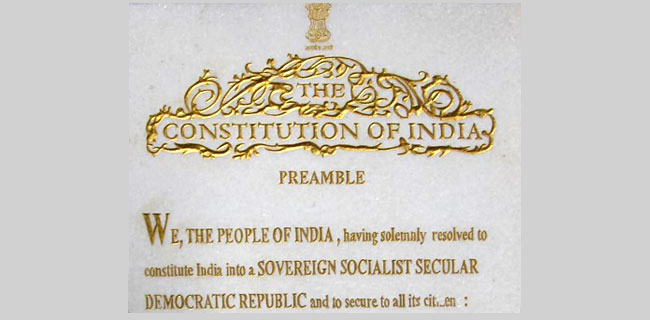
Preamble to The Constitution of India. Source – internet
By Avik Chattopadhyay
 In the fourth of my series on India@75, I deal with one more brand that we have grown up with that has now subsumed a significant portion of our coffee table conversations, social media activism and newsroom studios – Secularism.
Secularism as a brand is a bit like ‘Kumbhakarna’ from the Ramayana – a humongous sleeping giant that needs huge coaxing to be stirred into action. In slumber since 1947, it was rudely woken up in May 2014. An integral ingredient in the concept called India that happened at the stroke of the midnight hour, the brand was a silent performer. It was woven into the fabric of a new nation just as freedom and justice were in the Constitution we gave ourselves. Given the complexity of the fabric, provisions were created by Dr Ambedkar and his team to define what “secularism” implies in the Indian context. This was crucial as the very nation was born out of a division on religious lines.
Secularism is a foreign concept to the subcontinent. It is closely intertwined with another concept called ‘Socialism’. It was an outcome of a conscious effort in certain European countries like France to formally delink the state or polity from any religion or faith for the early socialists believed that only then would a true people’s government be established that worked for the greater good of all people, irrespective of colour, caste or faith.
Our subcontinent was only a geographical entity which housed close to 500 odd kingdoms and principalities till the British called it a day. Each individual king or nawab or begum ruled with their specific faith as the official one. Most of their royal standards, flags and coins would carry elements of their faith. The outsider would easily identify whether the kingdom was Hindu or Muslim or Sikh or Christian with just one look at the flag!
The state was never delinked from religion. The progressive ones patronised other religions too to allow a multicultural citizenry that enriched the arts, food, music, science, and architecture of the times. Rulers like Ashoka, Harsha and Akbar were exceptions to the rule. While Ashoka changed his faith, Ashoka dabbled with creating a new one and also had his sons convert to Christianity for some time. It is such broadness of their minds that make us address each of them as “the Great”. The subcontinent was a milieu of kingdoms and states each ruled by a family and a faith.
With independence in 1947 and the trauma of the Partition, India could not afford to encourage any open patronage of any faith or even a bunch of faiths. And we had to be different from the part we lost that was born out of a single faith. Patronage was also a relic of the monarchies. Therefore, the new brand of ‘Secularism’ was introduced through the Constitution. It was well accepted in principle by most of us as we had higher priorities than building places of worship. The growing popularity of socialism as a post-war and post-colonial governing system also played a critical role in establishing the need for secularism to ensure success.
Thirty years later the government, facing severe criticism of moral corruption all over the country, needed to divert attention of the common people and change the narrative of the media. Hence, both operating principles of ‘socialism’ and ‘secularism’ were used as political tools to be incorporated in the Preamble through the 42nd amendment to the Constitution in 1976. The rulers wanted to demonstrate their commitment to removing poverty [“Garibi hatao.”] before the electorate to ensure they stay in power. This one act of rashness brought the concept of ‘secularism’ into the limelight. People now started questioning what it really meant. And since then, it has been degraded into becoming a political tool rather than an underlying operating value.
Appeasement of specific faiths, castes, clans and tribes became rampant under the garb of being secular. They were seen as vote-banks and nothing more. The rulers were never interested in actual alleviation but only appeasement in the aspiration of a better life. The rotten quality of life of these vote banks has further decayed over the decades of this deployment of secularism at the ground level. Otherwise, we would have at least seen the quality of life of certain communities having improved over time
We still expect a Hindu election candidate from a Hindu area and a Muslim from a Muslim one. Political parties use the excuse of understanding the needs of the specific community better to justify such open “divide and rule” practices. This is one of the key legacies of the British that we have adopted very well.
Since 2014, secularism has become a bad word. While it has been correctly described as a tool used to divide through selective appeasement, the new narrative denounces the very principle rather than question its misuse since 1976. Those who are truly secular in their individual lives are addressed as “Sickular”. It is a dirty word, bordering on being anti-national and disrespectful of our cultural heritage. The brand had been sullied with the 42nd amendment and has now assumed pariah status.
So where have been the key shortcomings in managing brand ‘Secularism’?
Mere ad-speak!
Incorporating the term in the Preamble is not equal to actually believing in it and living by the principle. It’s like adding the term “corruption-free” to the Preamble through another amendment. Operating principles need not be openly advertised for they then remain only as advertising taglines. Across the world we have seen that the nations having the term ‘Socialist’ in their names have been the least so. You need to behave as socialist and secular and not merely talk about it.
Lack of purpose
True secularism totally delinks polity from religion. Not only does the state not have any religion but none of its constituents have anything to do with any activity or promotion of any faith. This is to ensure universal laws, rights and duties for every citizen, irrespective of faith.
India is a classic case where we have adopted the word but operated just as before. As a culture we follow the tenet of “Sarva Dharma Sambhava” [Confluence of faiths] rather than the principle of “Dharma Nirpekshata” [Neutrality of faith]. We have eulogised Ashoka and Akbar who have patronised various faiths rather than a ruler who decided not to have any state religion.
From patronising, we have moved to “peaceful co-existence” and not adopted the principle of secularism in its entirety. One may counter by saying we have adapted it to our conditions and requirements, but then, before 1947 we did not have democracy either! Hence, instead of choosing equi-distance from all faiths and have a set of universal social laws, we have deliberately chosen equi-proximity. That allows us to divide and rule and be selective towards one set of target segment / customer segment over others as market forces demand. This cannot be a sustainable proposition for any brand as word gets out and other segments either rise in defiance or shun you.
Personality conflict?
The current narrative tends to club the ‘sickular’ with the ‘communists’ and the ‘liberals’. This is dangerous for the current rulers as you will alienate more than you will accept. The communists abhor the concept of ‘secularism’ as they do not accept any religion at all. The socialists choose to delink while the communists choose to destroy. Therefore, calling communists as secular makes a laughing stock of the caller as you do not understand the fundamental differences. The liberals are again different from being secular. Theirs is a vastly open system of acceptance and allowance that follows the ethos of universal tolerance. And the true liberal will tell you that there is nothing called ‘religious tolerance’ as every faith teaches its believer to be tolerant towards others.
Any promising showcase?
The application of secularism in India really does not have any showcases to be proud of. According to data from the National Human Rights Commission, since 2005 an average of 100 lives have been lost and 2000 people have been injured due to inter-faith riots every year. More than 700 cases of rioting are reported every year. The Anti-Sikh Riots of 1984, the Kashmiri Pandit Exodus of 1990, the Christian-led separatist movement in the Northeast in 2000, the Gujarat Riots of 2002 and the Delhi Riots of 2020 are glaring examples where the stated value of secularism has been trampled with the powers that be being mute spectators.
The underlying tensions can be easily brought to the surface for political benefit and the law-and-order machinery sadly falls prey to adherences to individual faiths from time to time.
Just like the Shah Bano Case in 1986 and the Babri Masjid Demolition of 1992. Both were to undermine the Constitution and pander to specific electorates. The deliberate deprivation of basic rights to women of a faith while allowing them for others especially when the Supreme Court had passed a judgment against the same was a sure low point in our secular journey. Couple with the decadent destruction of an unused place of worship to drive home a divisive agenda for political momentum. The aftereffects of both incidents are being faced by the entire nation till date.
So, secularism as a brand has not had a good journey in a 75-year young nation like ours. Its purpose is unclear, its personality is a bundle of contradictions, its promise totally shredded to bits by various pockets of powerbrokers. It has been used as a tool by some and a target by the others. All in all, a terrible situation for any brand. Especially when a ‘monk’ becomes a member of the polity and runs a religious administrative agenda.
Appeasement gives way to aggrandisement!
And that is the last nail in the proverbial coffin.
Or piece of sandalwood in the pyre.
Or fistful of soil in the grave.
I finish my eulogy to brand ‘Secularism’ with a quote of Swami Vivekananda, one of the truest of seculars that ever walked this land. “A ‘sanyassin’ cannot belong to any religion, for his is a life of independent thought which draws from all religions; his is a life of realisation, not merely of theory or belief, much less of dogma.”
Avik Chattopadhyay is a senior brand strategist based in Gurugram. He writes on MxMIndia every other Tuesday. His views here are personal