Category: RADIO

  • Rana Barua quits Red FM, may start own venture

    By Robin Thomas

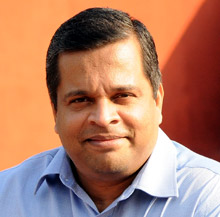
    Red FM COO Rana Barua is moving on. MxMIndia learns that he has put in his papers and amongst other things is mulling starting out on his own. Mr Barua and the Red FM spokesperson were not available for comment.

    Prior to joining Red FM, he was EVP – Programming & Marketing at Radio City. Before he moved over to radio, he was VP and Head – Mumbai at Bates. And earlier: Client Services Director at Rediffusion DY&R, Account Director at McCann, Senior Account Exec at Ogilvy & Mather and Account Exec at JWT.

  • Very challenging times for radio: Rana Barua


    By Robin Thomas


    Rana Barua is a veteran media professional. He is Chief Operating Officer (COO) at Red FM. Prior to joining Red FM, he was the EVP – Programming & Marketing at Radio City. Before he moved over to radio, he was VP and Head – Mumbai at Bates. And earlier:

    Client Services Director at Rediffusion DY&R, Account Director at McCann, Senior Account Exec at Ogilvy & Mather and Account Exec at JWT. He’s been through it all.

    In conversation with MxMIndia.com, Mr Barua speaks about FM phase III, and how radio can emerge stronger from the ongoing slowdown.


    Q: How did your transition from advertising to radio happen?

    Advertising was getting a bit stagnant, the market in media was opening up, television had opened up in a big way at that time, newer media were on the anvil, movie marketing was also opening up, radio was also growing at that point in time (ie about six years ago). I have always been very keen to move into a domain which is more or less a specialized medium. Since radio was also into huge expansion mode with phase II at that time, it made more sense to move into radio rather than any other medium.


    Q: And the advertising experience came in handy…

    Oh yes! I think it comes in extremely handy if you come in from classical advertising or communication which is more specialized. Since I moved as Head, Marketing, it made a lot of sense because I worked with a lot of brands, and had the entire expertise of knowing clients, advertising, communication skills, media and creative agencies. Thus the entire gamut came in handy which helped me settle in easily. So, the transition was good, it was just that the scope was very different.


    Q: Can you throw some light on the overall importance of phase III for FM radio?

    Phase III is extremely, extremely important for radio growth. This is probably going to be very exciting, at the same time a really challenging time for the industry because radio is multidimensional. There is huge expansion, multi frequency will be allowed and news will be available but not in its best form as it will be sourced from All India Radio (AIR). FDI gets raised from 20 percent to 26 percent. I’ve always said it should have been higher because that would have allowed more international players or private investors/ equity holders to look at it in a more serious way. Fourthly, networking will be allowed, which means one will be allowed to run the FM station sitting out of a main hub; as a result the cost may come down. Therefore if you look at it on the whole, these are definitely exciting times and we will probably know how all of us shape up in the next two years. There are going to be many challenges and a great number of opportunities for everybody in the radio medium.


    Q: And this will help increase the ad pie…

    It should! The only contrary point is that you may have new FM players entering, but the ad pie will grow because of different genres coming in, as a result new clients may also come in who would have not necessarily advertised on radio. And since costs will also come down, you will find a lot of innovative programming happening in radio. Nevertheless, these are still early days; the overall scenario looks very positive, but the challenge is, what will be the benchmark for research? There are also other challenges like the music royalty issue, the entire migration process from phase II to phase III, the e-auction as bidding process etc.


    Q: Do you view e-auctions favourably?

    We are pretty okay with e-auction, and from what I have understood from a lot of people, it is a much cleaner exercise.


    Q: Are there any setbacks…?

    Everyone will have some issues which are different from each other. The common factor however is the music royalty issue which is still unresolved. We are still a little unclear about the multiple licensing because if the e-auction bid goes into some preposterous amount it will naturally lead to some kind of setback for the overall industry, so we are hoping that this does not happen. News could have been better if it had been a bit more independent and I am sure we would have invested in the entire medium/department. Nevertheless if you see the overall picture, especially the way radio has been growing over the last three or four years, this gives you an impetus. Today if you look at the global economic scenario you just can’t predict any more but, yes it is a movement forward, with exciting times, greater challenges. Yes, certain things could have been better or more favourable for us, but we will go step by step.


    Q: How is Red FM gearing up for FM phase III?

    We are still weighing the pros and cons. Yes, we will be seriously involved in Phase III. We are clear about being present in most of the markets which will have some kind of ROI but we will weigh the pros and cons, we will see the costs, we will be extremely cautious about the approach because breaking even in radio is not the easiest of forms as it will all depend on the return on investment (ROI), the advertising revenues etc. If you ask me whether we are serious about phase III, then yes we are definitely looking at it in a very serious way.


    Q: Any specific cities that you are looking at?

    No, we are not looking at certain cities, but we are looking at towns… say where we are not available, which are important for advertisers. We are looking at these as one of our strategies, but we are weighing all the pros and cons and only then are we going forward.


    Q: Is there any lesson or takeaway that the radio industry should learn in Phase III from Phase I and II?

    One of the critical learnings for a lot of us in phase I and II is probably going to be that we must not overestimate the potential of the market. We also know that we look at certain benchmark figures and we tend to overestimate and because of that one tends to overbid. This is one of the key learnings one is hoping that everybody puts on the table before one gets into the e-auction process because at the end of the day it’s a fixed pie and from that fixed pie you would probably get a certain amount of revenue for radio. More than phase I, and phase II, one of the learnings for all of us is the uncertainty of the markets as we don’t know what’s coming up in the next three months. Therefore, I think the biggest challenge that lies ahead for all of us is the uncertainty, which has become such a huge thing that everybody is talking about the uncertain future. Hence I think a cautious approach is going to be extremely critical.


    Q: So, is the uncertain future – the global economic slowdown that seems to have come back – is that something to worry about?

    Yes, absolutely. However, more than worry I believe we should be taking complete cognizance of the fact that there is definitely a slowdown. The clients, advertisers, everybody are extremely, extremely careful about the money they are investing in any form of media. Taking things for granted and creating business plans for the next two or three years seems passé now. It’s more like making a business model and reviewing it every month because the numbers keep changing every month, not because of wrong projections of estimation, but because the moment costs go up, inflation goes up, prices go up. The environment has become so dynamic – which it wasn’t even a year ago; every day there is a new story. So, it’s great to plan for the future, but I think one needs to be very cautious about any kind of numbers or projections or predictions made by various studies and research etc, which will however be reviewed very soon.


    Q: How would you sum up 2011 for Red FM?

    We have definitely grown; even this year we have made overall growth in our entire network, at a certain target we had set for ourselves. But as I said, with the environment being so dynamic naturally those numbers are nowhere close to what one would have guesstimated maybe earlier, say last year when things were so much on the rise and one had hoped that coming out of a slump the next two or three years would be on the way up. What we have managed to do very well is that as a network we have grown extremely strong – into a formidable player post the RAM numbers which were released I think a month or two ago, wherein for the first time RAM went into the nine markets which they are hoping to do more frequently. So we are pretty confident that all the efforts of building the brand and all the efforts in programming have really helped. We are confident because we have got people and our talent in place.


    Yes, we are aware that with phase III coming in there would be a lot of movement again, but that’s part of the business. We have got a great team going, who are extremely motivated and work passionately for their brand and numbers therefore are showing very well. As I said the larger markets are not showing growth that it should have ideally shown, but it’s the mini metros and towns which have grown much more dynamically for us.


    Q: And how would you sum up 2011 for the radio industry?

    Overall if you look at the numbers one had predicted for radio, the growth has not been as dramatic as one would have expected because it is understood that there has been an overall slowdown. One of the things we need to look out for is some kind of consolidation which is how we would want the medium to grow.

  • Radio Mango in 4th anniv mode, to consolidate in Kerala for Phase III

    By A Correspondent


    Radio Mango, an FM radio venture by Malayala Manorama, a Malayalam daily, aims to consolidate its position in Kerala once FM Phase III is officially rolled out. It is however not known which cities the FM station would bid for as they are currently awaiting clarity on the phase III. “We would definitely look to consolidate our position in Kerala. We are still unclear about the reserve price calculations and await clarity before finalising our phase III plans,” said Ravindran Nair, Director Programmes, Radio Mango.
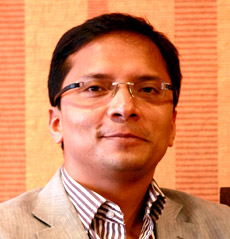
     

    He further said, “We are confident of growth in 2012 since we have been steady since the last 4 years. The key factor in the quantum of growth, of course, would be phase III.”

    In Kerala Radio Mango is aired in Kochi, Trissur, Kozhikode and Kannur. Red FM and Club FM are its main competitors in these cities besides the All India Radio (AIR) FM stations. On November 29, 2011 Radio Mango will celebrate its fourth anniversary however the FM station seems to be in no mood for big celebrations.

    Radio Mango claims that its national and local advertising ratio is almost 50:50. Some of its national advertisers are Maruti, Hero Motors, Nokia, Blackberry, Max Bupa, Kenwood, Airtel, Docomo, Belkin, Ford, Hyundai, Sharp, and Philips etc. Nearly 80 per cent of songs aired on Radio Mango is Malayalam film songs and the rest 20 per cent from non-Malayalam music ie Hindi and Tamil songs. Besides its on-air activities, Radio Mango is quite active online too. It has over 5,700 likes on its Facebook page and nearly 300 followers on Twitter.


    In conversation with Ravindran Nair, Director Programmes, Radio Mango.


    Q: Since November 29, 2007 when Radio Mango first went on air, until the year 2011 how has the journey been for Radio Mango? 
    Radio Mango has had a great period of sustained growth since launch. We have been consistently No.1 in the state and have been figuring in the top 20 nationally in terms of reach. In IRS Q2, Radio Mango is 16th nationally, in terms of reach (11th if AIR stations are excluded). In terms of reach within a state, Radio Mango ranks 5th nationally! Radio Mango has grown by 45 percent in Yesterday’s listenership over the last one year. Within Kerala, Radio Mango leads the no 2 station by 81 percent in terms of reach. (All figures are from IRS Q2 2011).


    We have won several national and international awards including New York Festival silver and bronzes, Wow Experiential Marketing Award golds, ERA golds etc. In fact, we are the only radio station in India to have won Mirchi Kaan Award golds for two years running.  We also figure in the Limca Book of Records for our musical reality show ground event.
    Q: How do you plan to celebrate Radio Mango’s fourth anniversary?
    We don’t look at months and years as landmarks. We would rather have our achievements be the milestones. Hence, all our anniversaries are private internal affairs and we don’t tom-tom in public.
    Q: Can you throw some light on your phase III plans? Will the FM station expand in cities/ towns of Kerala or will the expansion be beyond Kerala i.e. other parts of India?
    We would definitely look to consolidate our position in Kerala. We are still unclear about the reserve price calculations and await clarity before finalizing our phase III plans.


    Q: How has the response from advertisers been? What is the national-local advertising ratio?

    The response from the advertisers has been good so far. The national and local advertising ratio is almost 50:50. Some of the national advertisers are Maruti, Hero Motors, Nokia, Blackberry, Max Bupa, Kenwood, telecom majors like Airtel, Docomo, Belkin, Ford, Hyundai, Sharp, and Philips etc.


    Q: For 2012 what are your growth targets? How will you sum up 2011 for Radio Mango? 
    We are confident of growth in 2012 since we have been steady since the last four years. The key factor in the quantum of growth, of course, would be phase III. 2011 has been a great year and we are very pleased with our overall performance. The Radio Mango brand has never been more robust and recognised.


    Q: Who is your creative and media agency?
    Our creative and media agency is Stark Communications.

  • Amritendu Roy catches Fever

    By Robin Thomas


    Amritendu Roy is now Regional Head – East, Fever FM. Prior to Fever FM, he was Head, Radio Business, Friends FM. Mr Roy who joined Fever FM in August 2011, is based out of Kolkata and will be reporting to Mr Harshad Jain, Business Head, Fever FM.

    One of his main responsibilities as Regional Head- East will be to drive the sales for the region.

    Confirming the news to MxMIndia, Mr Jain stated, “With substantial industry experience, he will be able to add a lot of value into the existing system and will prove to be an asset for Fever FM.”

    Mr Roy was instrumental in setting up Friends FM from scratch. Mr Roy started his career in advertising with Mudra Communication in 1990 and went on to become the Group Business Director at the time he left in 2004. In the 14 years with Mudra he worked in various cities like Kolkata, Delhi and Mumbai. He handled various clients with Mudra, the prominent ones being McDonalds, Indian Oil, Orient Fans, National Insurance, Reliance Telecom and Kitply. Mr Roy then moved to the FM radio industry in 2004 when he took over as Vice President and Station Head of Radio City in Delhi.

  • Be cautious in slow market: Rana Barua

    By Robin Thomas


    The government has enhanced the foreign investment limit in FM radio to 26 percent from the earlier 20 percent. E-auction for FM phase III is reported to have received a nod from the Union Cabinet. Multiple frequencies if allowed will bring different genres of FM station in the same city, the overall media spends and advertising revenue in radio will see humongous growth. FM stations will soon be allowed to air news although not independent of the government owned AIR (All India Radio), nonetheless it seems good times are ahead for the Indian radio industry.


    While the FM phase III rollout has moved a little closer to reality, there is always something to learn from past experiences, even for the Indian radio industry. MxMIndia tries to find out one of the critical learning for the radio industry in FM phase III from the earlier phase I and II. In conversation with MxMIndia, Mr Rana Barua, COO Red FM observed, “One of the critical learning that a lot of us had in phase I and II is not to overestimate the potential of the market. The biggest challenge that lies for all of us is knowing that uncertainty has become such a huge thing today, therefore I think a cautious approach is going to be extremely critical.”


    “We should be completely taking cognizance of the fact that there is definitely a slowdown, the clients, advertisers and everybody else is extremely careful about the money they are investing in any form of medium. Taking things for granted and creating business plans for the next two three years seems like a passé now. It is more like making a business model and reviewing it every month” he added.


    Mr Barua also shed some light on how Red FM is gearing up for FM phase III. He spoke about Red FMs cautious approach and its keen interest in participating in FM phase III. “We are still weighing the pros and cons but, yes we will be seriously involved in phase III. We are very clear that we would like to be in most of the markets which will have some kind of ROI but, we will weigh the pros and cons, we will see the costs and we will be extremely cautious about the approach. We are looking at towns where we are not available and which are important for the advertiser. So we are definitely looking at this as one of our strategies” explained Mr Barua.

  • RAM releases the first 9 cities sweeps

    RAM has released its first set of findings basis sweeps in nine cities. The findings have been arrived at, based on Universe Establishment Study and Panel based Respondent data collected during May-August 2011. These nine additional cities are Ahmedabad, Chennai, Hyderabad, Indore, Jaipur, Kanpur, Lucknow, Nagpur and Pune.


    For the last 4 years, RAM operated out of the four Indian metros – Bangalore, Delhi, Kolkata and Mumbai.


    As per RAM, This initiative will help the Radio industry – Broadcasters & Media Planning Agencies, to assess the impact that Radio medium is having on Audiences in towns other than the major Metros.


    RAM communiqué states that given the favorable response from across the industry, RAM will continue to undertake the next sweeps during February-March 2012.


    To quote LV Krishnan, CEO, TAM Media Research, “Our commitment to take RAM beyond the  four metros has fructified. This time, the RAM roll out is much wider and deeper. These 9 cities will throw light to Advertisers the interaction Radio is bringing to their Consumers and also help Broadcasters fine tune their basket of programming to these Audiences. This will help propel higher commercial viability for the Industry at large. As always, we will work very closely with the Industry to help them understand the dynamics of this very high potential communication and brand building medium from these markets as well. Like in 4 RAM metros earlier, we believe that in these 9 metros too, RAM’s entry will boost the Radio advertising investments.”


    The study offers trends about Radio listenership or consumption behaviour between the different cities. Some highlights are:


    • The universe size of the newly added 9 markets is an impressive 50% of the existing 4 RAM markets (Bangalore, Delhi, Kolkata and Mumbai).
    • Southern markets observe higher FM penetration as compared to northern markets.
    • On an average, there is 95% FM universe has been reached in a week across all the markets.
      • Chennai and Jaipur observe 100% weekly reach.
    • Time spent listening among the 9 new markets is comparatively more than the existing 4 metro markets. Markets like Nagpur and Jaipur observe 28.29 (hh:mm) and 24.05 (hh:mm) time spent on a weekly basis.
    • Indore and Lucknow observe least OOH listening among the new RAM markets.
    • Majority of the new markets have heavy composition from male audiences whereas existing Mumbai and Kolkata market witness substantial composition from female audiences.
    • Listenership in Northern cities like Delhi and Jaipur are skewed towards higher SECs. Market like Nagpur and Kanpur are skewed towards lower SECs.
    • Morning time band observes highest listenership contribution across the day. Indore market observes highest listenership contribution from Mid Morning time band

    Listenership contribution on Saturday and Sunday are higher for the new markets whereas in the existing markets Saturday observes least contribution

  • Red FM’s Malishka is RJ No 1 in in Mumbai!

    By A Correspondent


    Radio Jockey Malishka is found to be Mumbai’s most popular RJ for the second year in a row, according to an Ormax Media study. The Red FM 93.5 RJ Network the most preferred radio station in India has an immense listener base in Mumbai. This is evident by a recent study conducted by media research firm Ormax Media that pronounced RJ Malishka as the most popular Radio Jockey in Mumbai for the second time in a row. Undoubtedly RED FM’s RJ Malishka is an unmatched talent in the radio industry!

    The study by Ormax Media was conducted in the month of September amongst 600 radio listeners in Mumbai and Delhi in the age group of 15-44 yrs, SEC ABC. From across the radio stations in Mumbai, Red FM RJs Malishka, Mantra and Rishi Kapoor emerged as instant favorites amongst listeners!

    Commenting on this much celebrated achievement, Nisha Narayanan, Senior VP Projects & Programming, RED FM 93.5 Network said, “Red FM’s leading Morning Show RJ – Malishka has been rated number one in Mumbai by Ormax Media for the second year in a row. This just proves that despite various researches that happen across mediums and the claims by respective radio stations of being number one, we still continue to win the best recognition and awards across categories and hence undoubtedly make us the most awarded radio station in the country.”

    ‘Morning No1’ with Malishka is designed to be exciting, energizing, stimulating, light-hearted and at the same time thought provoking, notes a Red FM communiqué.


  • [MxM Radio] Prashant Panday on Mirchi in A’Dhabi, what’s wrong in Delhi & how radio ads aren’t rip-offs from TV

    By Robin Thomas


    Prashant Panday has been with Radio Mirchi right from its inception. He has several achievements to his credits including the phase II roll-out of the company radio stations, and now expanding the FM station to the UAE in association with the Abu Dhabi Media Company. Radio Mirchi is available in 32 markets across India and boasts of commanding a market share of 42 per cent in terms of revenue. Radio Mirchi is a listed radio company and claims to lead in listenership in 25 markets out of the 32 markets.


    In conversation with MxMIndia, Mr Panday, who is Executive Director and CEO, Entertainment Network (India) Ltd (ENIL), spoke at length about Radio Mirchi’s foray into the UAE. He also shared his views on why FM listenership is on the decline and why he disagrees with the RAM numbers.


    Q: How would you rate the year 2011 for Radio Mirchi? Are you satisfied with the growth numbers that have been thrown up?


    No one can say that 2011 was a great year! The first quarter (Jan-March 2011) was of course fantastic, but the next three quarters (April – December) have been very muted for most media companies. For Mirchi, we had a terrific first quarter, decent 2nd and 3rd quarters and a not-too-exciting 4th quarter!


    Q: You have recently moved into the UAE – what are the listenership trends in the market there?

    The UAE is an extremely important country from an Indian radio station’s perspective. It’s very rich, and its people are much sought after by advertisers. It’s a heterogeneous mix, with many people from South India, UP/Bihar and of course, all over India. Most of the radio listenership in the UAE is in cars. Since many people travel between Abu Dhabi and Dubai on a regular basis, there are long drive times and long radio listenership hours. Our research and our initial response data indicates that Mirchi is a much sought after brand in the UAE.


    Q: Can you throw some more light on the proposed UAE venture – content, RJ mix, language of songs, etc?

    Our associate in the UAE is a well-respected and large media group, whose business includes TV broadcast, newspapers and radio stations. Radio Mirchi in the UAE is similar to Radio Mirchi in Delhi or Mumbai or any of the other Hindi markets. We are largely a contemporary Hindi music station, with a show dedicated to 1990s music in the afternoon and one dedicated to retro music (1960s-80s) in the night just as in India. The RJs are brilliant! They are from India but they are smart enough to adjust to a new country. In any case we want to create a nostalgic feel about being back home in India, and hence we chose India-based RJs to be the voice of Mirchi in the UAE.


    Q: What does the launch of an international FM station mean for Radio Mirchi? Is the business model going to be advertising-led or otherwise?

    The business model will vary from country to country depending on the regulations of the country; the opportunity there; and the timing. In the UAE, we have a brand licensing agreement with the Abu Dhabi Media Company (ADMC). We provide all programming insights as well as proprietary Mirchi content (not music). We also provide guidance in revenue generation, in which we are particularly good. I cannot share details of the financial agreement with ADM – suffice it to say that it is a win-win deal for both ENIL and ADMC.


    Q: Mirchi had no competition in Delhi for a long time, but now the competition has become tough. What went wrong? Did the programming strategies backfire? Because everything seemed to have gone well until there were few changes in programming…

    Nothing has gone wrong. The RAM research in Delhi (alone) is flawed. In reality, Fever is the #4 or #5 station in that market. Just check IRS and you will know what I mean. The RAM fieldwork in Delhi has probably been compromised. Not only IRS, we have at least three other research data points – all of which show that Fever is a #4 or #5 brand. We normally do not question any research data – but in the case of Delhi, the error is humongous. Mirchi is by far the leader in Delhi followed by Radio City, Red FM and Big FM. Fever is not even 40 percent of Mirchi in Delhi by IRS.


    Q: IRS results too for a while have been highlighting a decline in listenership. Do you agree? What reasons do you attribute to this decline?

    Well, there are two factors here. One is that there has been no growth in the number of radio stations for 4-5 years now while in the same time, there has been a surge in the number of TV channels and newspaper editions. So radio is losing out competitively against these two mediums. Secondly, I do feel that IRS may be perhaps under-reporting the reach of all the radio stations. At least, that’s what a comparison of RAM and IRS indicates. While RAM indicates that there are 1.4 crore-odd listeners in Delhi, IRS indicates a figure around 30 percent of this. How can this happen?


    Q: Does FM radio lack good creatives or radio commercials? Most of them we hear are a rip-off from television… Do you agree?

    This is absolutely wrong. These days, radio creatives are part of a larger campaign plan. Hence all creatives – radio, TV, print – reflect the same basic theme. You may think they are similar because you start with TV and then say radio sounds similar. If you started with radio, you would find TV ads to be a copy! In reality, radio is now integrated into the overall creatives and hence each medium builds uniquely on the same theme.


    Q: On a lighter note, what is a typical day like for Mr Prashant Panday, Executive Director and CEO, Entertainment Network (India) Limited?

    Making sure my team works really really hard and I spend time writing my blog, or sampling new music, or running in the gym or watching a film or sampling good food at new restaurants or answering queries from inquisitive journos like you!


  • Hello and Welcome to MxM Radio!

    Hello and Welcome to MxMIndia’s exclusive ‘channel’ for Radio… FM, All India Radio, Community Radio, Internet Radio and whatever else is happening in the world of radio in India.


    There have been various attempts to cover radio, but not being the most fashionable of media segments, it’s largely neglected. The reason is perhaps that there isn’t enough money backing the business.


    As we completed five months of existence yesterday, we stepped back to our commitment of Day 1: cover media like no one else in the business. At MxMIndia, we are committed to support the ‘underdogs’ amongst the various media segments. So: journalism came first. Then PR and now Radio.


    With Phase 3 set to take off soon and a maturing of minds – from amongst listeners and the players, we expect a lot of activity in radioland. MxMIndia has a dedicate resource to bring you a ringside view. Senior Correspondent Robin Thomas painstakingly covers radio like few others in the trade.


    We do not hesitate to ask the tough questions and cover issues that some may find uncomfortable. For instance, should RJ mentions be considered as paid content.


    So, behenon aur bhaioan, stay tuned in to MxM Radio. And do let us have your feedback.


    Email Robin who is coordinating the channel. He can be reached at robint [at]mxmindia.com. And feel free to call any of us in the MxM team.


    Cheers!


    Pradyuman Maheshwari

    Email: pradyumanm[at]mxmindia.com,

    BBM: 23050B5D

    Gtalk: pradyumanm[at]gmail.com,

    Twitter: @pmahesh

    Telephone: 98338 76278.


  • Is radio not good enough for premium brands?


    By Robin Thomas


    Over the years, growth of Radio as a medium has been restricted, thanks to TV. But, to the credit of many a radio expert over the years and advertisers who have believed in the medium, radio continues to sail; and sail even more promisingly when times are choppy.


    Also, sample this: The FICCI-KPMG Indian Media and Entertainment Industry Report 2011 states that the radio industry in India is expected to grow at 20 per cent CAGR (Compounded Annual Growth Rate) from the current base of around Rs 1000 crore. Radio’s share of media spends is also expected to rise from 4 per cent to 5 per cent by 2015. Among categories that advertise on Radio, Real Estate, Telecom, Retail, Education and TV channels are the ones advertise the most.


    The medium promises reach, greater recall and marketing solutions that are cost-effective. Despite this, why do premium advertisers shy away from advertising on the medium? It is known that premium brands prefer speciality magazines, internet and mobile and TV more than radio.


    Harish Bijoor, CEO, Harish Bijoor Consults agrees that premium brands don’t advertise much on radio. “Premium brands look at radio as a non-premium medium. There is ample research available which reveals that premium-category shopper do not depend on awareness scores for luxury brands from radio. In fact, radio tends to negate effort for luxury brands as of now and proves counter-productive to the effort. Radio is much too mass for luxury brands.”


    According to B Surender, Senior Vice President and National Sales Head, Red FM, the share between national and local advertisers on radio are 50:50 of which premium advertisers contribute merely six to eight per cent of the overall national advertisers. BMW, Volkswagen, Mercedes, Skoda, Blackberry, Marks & Spencer, Louis Philippe, Tanishq, smartphones , Lufthansa , British Airways ,Virgin Atlantic, Singapore Airlines, Emirates are some of the premium advertisers advertising on radio.


    For most of these premium brands radio is more or less a reminder medium, it is an extension of the television or print advertisements. Luxury watch brand, Seiko for instance does not advertise on radio at all whereas Jet Airways and HDFC Life heavily advertise on internet and television.


    Both internet and television have an edge over radio on premium luxury brands. While television has the benefit of being an audio-visual medium, internet is a highly interactive medium.


    Manish Dureja, Vice President, Marketing, Jet Airways said that the airline brand banks more on internet and mobile as against radio. “We are not advertising much on radio or on television as most of our marketing budget is performance driven, where we look to generate sales through search engine marketing and predominantly digital marketing. With internet penetration and the emergence of internet mobile, it has become mandatory for us to be present in the online domain. Radio, on the other hand is a localised medium and caters to a specific city. More importantly through digital media, I am able to reach consumers far more effectively than any other medium.”


    For Sanjay Tripathy, Executive Vice President-Head Marketing and Direct Channels, HDFC Life, television and the internet are the preferred medium because of the reach and better ROI. “Television is the preferred medium for HDFC Life because of the awareness it creates, and maximum reach it offers, whereas the internet has delivered better ROI for us. Radio on the other hand is more of a brand recall medium so most of our marketing budge or the media spends is skewed towards television and the internet” he said.


    Disagreeing that premium luxury advertisers are apprehensive about advertising on radio, B Surender of Red FM said that although there was a perception issue in the past, some of them wrongly assumed that the quality of FM listenership profile may not be very good. “Contrary to this belief, there are instances of advertisers abroad specifically using radio to target billionaires and rich entrepreneurs, since radio could reach out to them better than other mass media. But, in the past one or two years there is a positive change in our country as well with more and more premium brands in automobile, international airlines, consumer durables, telecom, jewellery, finance, retail etc have regularly started using radio as a part of their media plan. However, I feel there is enough scope to further improve the usage of radio by luxury brands in the near future.”


    With the rollout of phase III, radio will see an increase in reach in India. Multiple frequencies will allow FM stations to offer targeted or niche programming for the elite listeners. However, there are many challenges too: The radio industry will have to educate the premium luxury advertisers, not only about the effectiveness of the medium in delivering better ROI for their brands, but also about the quality of its listenership profile.


    Perhaps for now at least, radio is too large, too ubiquitous; a bit too common a medium for the un-common luxury brand. There is more thinking required on the part of radio station heads to get premium brands on board.


  • [MxM Radiol]: 5 reasons why internet radio scores over traditional radio

    By Anil Srivatsa


    1. Internet radio offers more room:

    The main difference that triggers all other differences between Internet radio and FM radio is the platform itself. The Internet lends more room for flexibility, cost saving and personalization.


    2. Internet Radio offers a variety of choices in comparison to FM radio:

    This is true, particularly in the Indian context. FM stations tend to follow the beaten path for a variety of reasons, but to the consumer it just spells ‘boredom and monotony’. Radio can be classified broadly into mass radio and niche radio.


    InIndia, mass radio is pretty much the order of the day, but it leaves a lot of content-hungry people dissatisfied. Niche radio does not justify the investment from a business point of view, but presents a vibrant opportunity to internet radio operators, who for a lot less money can create and serve these niche content seekers with better quality content in a variety of genres.


    3. Content on Internet radio is more personalized; FM radio caters to collective choices of masses:

    Internet radio is more amenable to personalization at a micro-listener level, with the choice of content being delivered with accuracy according to the taste of the consumer, while FM radio is not as hospitable.


    Of course, Internet radio is a loosely used term that could mean content delivered via the Internet in a linear fashion (non-interactive just like FM) or as an on-demand service (interactive). Linear Internet radio makes available several choices of content differentiation in one place while FM radio is devoid of choice and is, within a specific urban or semi-urban dwelling, limited to the number of frequencies in that region. This makes Internet radio more interesting choice.


    4. The ability to influence opinion on topics and issues on a wider scale:

    FM inIndiagenerally reaches out to the least common denominator while throwing up some specific content catering to special interest. This generally happens when the channel is omni-present in that geographical location, which makes Internet radio look even more obscure. But in reality, Internet radio’s reach is well beyond what a single FM station can do with one channel, giving the flavour of programming more room to breathe and giving it the possibility of more substance and depth.


    However, nothing can compete with FM for super localization en masse …even if one can create and distribute a super local internet radio station.


    5. Internet radio offers broader spectrum of artists and more room to showcase talent:

    Historically NAB, who was then the lobby for AM radio operators, perceived FM radio to be a huge business threat. Today they have embraced it (FM) and are now perceiving the same threat coming from internet radio. Traditionally, on either side of theAtlantic, FM radio is in cahoots with the music labels where there is a carefully orchestrated promotion plan for the labels, sidelining air play for the unsigned bands leaving FM playing the same 20 top of the hour.


    InIndia, too, things are not very different. Large market-leading labels restrict FM radio to play more of their music to ensure constant promotion in exchange for favourable licensing terms resulting in the same disenfranchisement on un-signed quality content. This goes against free speech and violates the anti-competitive spirit of equal opportunity to succeed in business. So, both, from a business and talent perspective, Internet radio is totally unrestricted, allowing small label artists to showcase their talent in all kinds of music and non-music content and without gate keepers.


    Labels today see Internet radio as a threat but in reality it’s an opportunity to discover new talent, promote unconditionally and widen their repertoire. Given the right environment, FM radio would rebroadcast on the Internet in a heartbeat and this in itself tells the whole story.


    Mr Anil Srivatsa is the Co-Founder, CEO Venturenet Partners Pvt. Ltd. (promoters of Spot Radio and Radiowalla)


  • [MxM Radio] RAMcheck: Mixed fortunes for Mirchi

    By A Correspondent


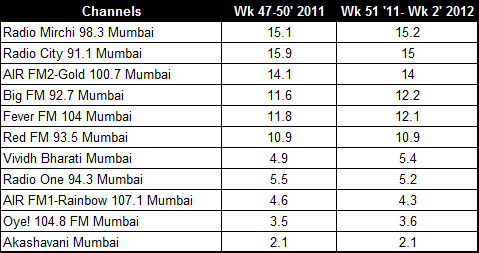
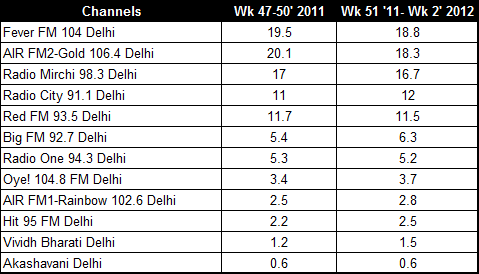
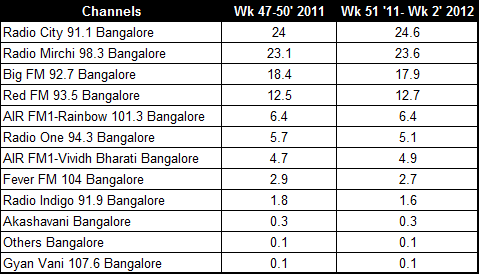
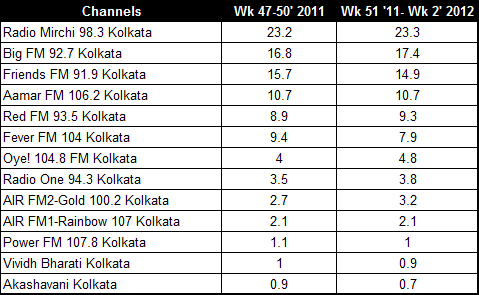
    TAM Media’s Radio Audience Measurement (RAM) – which covers four key metros, Mumbai, Delhi, Kolkata and Bengaluru – released its latest radio listenership figures for Wk 47- Wk 50 (Last two weeks of November and 1st week of December 2011) and Wk 51- Wk 2 (Last three weeks of December 2011 and 1st week of January 2012).


    According to the latest RAM data, for listeners of 12 years and above, and according to radio channel shares, Radio Mirchi, Radio City, Fever FM, Big FM, Red FM, Radio One, Oye! FM were some of the top FM stations in the big four metros.


    Mumbai:

    There is some amount of volatility for the number one spot in the Mumbai market. The latest RAM data for week 51 to week 2 has brought back Radio Mirchi as the number one FM radio station in Mumbai. The lead over Radio City is marginal. What remains to be seen is whether next month, Radio City regains the numero uno position or will Radio Mirchi retain the number one spot. It may be recalled that Radio Mirchi had long retained the leadership position in Mumbai until Radio City toppled it to become the number one FM radio station in terms of market share.


    Ranked three is AIR FM2 Gold which has more or less remained stagnant in listenership share followed by Big FM and Fever FM, ranked four and five respectively. Both Big FM and Fever FM made slight gains in week 51 to wk 2, 2012 as against week 47 to week 50, 2011. The other FM stations in Mumbai market include, Red FM, Radio One, Oye! FM, AIR FM1 Rainbow, Vividh Bharati and Akashavani Mumbai.


    Delhi:

    Once known as a Radio Mirchi stronghold, Delhi today has become quite an unpredictable market for FM radio listenership. This is what wk 51 to wk 2, 2012 RAM data reveals, according to the latest RAM data, Fever FM has reclaimed the numero uno position from AIR FM2 Gold to become the most popular FM station in Delhi while Radio Mirchi continues to rank three in listenership share. Interestingly the battle for the number one position is between Fever FM and AIR FM2 Gold, what remains to be seen is whether Radio Mirchi bounces back to reclaim the number one spot or whether Fever FM continues to lead among the private FM stations.


    A distant fourth is Radio City followed by Red FM and Big FM ranked fifth and sixth respectively. Although Fever FM is leading the Delhi market it has shown a decline in listenership. The other FM stations to have grown in listenership shares are Radio City, Big FM, Oye! FM and Hit FM. The other FM stations in Delhi are AIR FM1 Rainbow, Vividh Bharati and Akashavani Delhi.


    Bengaluru:

    The Bengaluru market has also seen a sea change in FM listenership rankings. Once a Big FM stronghold, the market is now dominated by Radio City which has not only retained its leadership position in Bengaluru, but has also significantly increased its listenership. Close behind Radio City is Radio Mirchi followed by Big FM, a distant third and Red FM ranked four. Radio City, Radio Mirchi and Red FM are the only FM stations to have seen an increase in listenership share on wk 51 to wk 2, 2012 as compared to the wk 47 to wk 50, 2011 RAM data. The other FM stations in this market are Fever FM, Radio One, Radio Indigo, AIR FM1 Rainbow, and Akashavani Bangalore.


    Kolkata:

    The only RAM market which has maintained the status-quo in listenership ranking; Radio Mirchi continues to be the most popular FM station in Kolkata, followed by Big FM and Friends FM continues to rank third. Radio Mirchi is comfortably at number one position in Kolkata with 23.3 per cent of the listenership share followed by Big FM which is a distant second with 17.4 per cent share and Friends FM with 14.9 per cent of the listenership share.


    A distant fourth is Aamar FM followed by Red FM and Fever FM ranked fifth and sixth. Radio Mirchi and Big FM ranked one and two have already seen an increase in their listenership share. The other FM stations in Kolkata to have witnessed growth in their listenership share are Red FM, Oye! FM, Radio One and AIR FM2 Gold. AIR FM1 Rainbow, Power FM, Vividh Bharati and Akashavani Delhi are the other FM stations available in Kolkata.