Category: RADIO

  • It’s Golden Mikes time again

    By A Correspondent


    92.7 Big FM, India’s No. 1 FM radio network and winner of the Golden Mikes Broadcaster of the Year Award, today announced the second edition of the Big Regional Entertainment Awards – the biggest celebration of regional entertainment in the country. Big Regional Entertainment Awards is a first-of-its-kind property which honors regional entertainers who have contributed and brought to the forefront the rich cultural heritage and diversity in India. Being organized across 7 Indian regions including Central India, Punjab, Rajasthan, Maharashtra, Andhra Pradesh, Karnataka and Tamil Nadu the Big Regional Entertainment Awards will recognize exceptional talent from across fields which include films, music, dance, theatre, sports and television.


    With close to 18 unique categories of awards being presented, the Big Regional Entertainment Awards are presented to entertainers who have been selected basis votes received from 92.7 Big FM listeners in the region. The Big Regional Entertainment Award will be promoted through a complete 360 degree holistic marketing campaign which includes on-ground activations, OOH, print, television, radio, and digital platforms which enable marketers to increase and maximize their brand visibility and target a wider audience base for their products while ensuring a long term presence in the market. The on ground events are scheduled to take place between December 2012 and January 2013 across all regions.


    Commenting on this initiative, a company spokesperson said, “The Big Regional Entertainment Awards is a unique property that celebrates and salutes the regional talent in the country. The Awards received a phenomenal response in every region last year and we are looking forward to replicating the impact while engaging more listeners. We will be deploying a more robust outreach strategy which will include further direct interaction, integration and innovations to ensure an increase in the value created for marketers.”


    The Big Regional Entertainment Awards promise to be a bigger and better affair this year while bringing together the biggest names and best entertainers from across genres including movies, music, dance, theatre, television and sports.


  • Red FM goes Hindi in Bengaluru

    By A Correspondent


    Popular FM radio network Red FM has turned its Bengaluru frequency into a 24×7 Hindi radio station: Red FM Bangluru. The move follows the station’s observation where listeners expressed a keen liking for Bollywood music over their current songs playlist. The move is expected to help the brand become more popular across the metropolitan audiences and at the same time break through the clutter of homogenous sounding Kannada radio stations in Bangalore.


    Nisha Narayanan

    Commenting on the initiative, Nisha Narayanan, Senior VP – Programming & Projects, 93.5 Red FM said, “We are in constant touch with the evolving needs of our listeners and have concluded that the choice of music is moving more towards Bollywood. Moreover, the listeners prefer to listen to superhit songs all the time and Red FM is going to cater to this emerging need gap in the Bangalore. We will continue to retain the ‘Bajaate Raho’ attitude of the brand which gives us an edge over the others.”


    The station promises to offer a whole new level of entertainment with new RJs and a completely new identity. The change took effect from yesterday (November 28)


  • Former news anchor and RJ Akash Banerjee is Radio Mirchi Delhi programming head

    Akash Banerjee

    Radio Mirchi today announced the appointment of Akash Banerjee as the Programming Head for Delhi station. Mr Banerjee’s first stint at Radio Mirchi was in 2002 as a Radio Jockey where he used to host the station’s popular late night show ‘Dil Chahta Hai’


    As the programming head, Akash would be responsible for conceptualising the station programming in accordance with the brand vision and Delhi’s pulse and flavour.


    Commenting on his appointment, Mr Banerjee said, “I am happy to be a part of the ENIL Group again. I am thrilled to be part of such an iconic brand and look forward to new challenges and responsibilities.”


    Prior to joining Radio Mirchi he worked with the TV Today network as Senior Special Correspondent and Anchor. He has also done a stint with Times Now with his book ‘Tales from Shining and Sinking India’ that draws from his experiences on the field (and has a foreword by Arnab Goswami).


  • My FM announces Jiyo Dil Se Awards

    By A Correspondent


    India’s local FM network 94.3 My FM has announced the Jiyo Dil Se Awards to recognize and acknowledge the work of the common man in bringing about a positive difference in people’s lives in various fields. The campaign has been rolled out in My FM markets covering the seven states of Rajasthan, Punjab, Madhya Pradesh, Chhattisgarh, Maharashtra, Gujarat and Haryana. There are nine award categories: Education, Environment Conservation, Health & Sanitation, Public Service, Culture & Art, Sports, Women’s Welfare & Empowerment, Child Care & Development and Economic Development.


    The key criterion is that it must benefit people or a community at large and should have been done for the betterment of the society. The individuals applying for the award will be judged on various parameters like innovation in their initiatives, the impact they created, scalability and sustainability of the initiative and the challenges faced while executing the initiative. My FM has signed on Ernst & Young as the official tabulations for the Jiyo Dil Se Awards. They will be assisting My FM right through the selection criteria up to identifying winners in each category. This will be a multimedia campaign with the impact of the My FM brand property resonating across radio, print and online


    Speaking on the initiative, Harrish M Bhatia, CEO, 94.3 My FM, said “We are proud to announce the Jiyo Dil Se Awards as it takes further our brand’s belief that every individual, or entity should also give back to the society in which it dwells. Jiyo Dil Se Awards is an effort to recognize the individual who has showcased immense dedication and passion for a cause bringing about a difference in peoples’ lives. These awards are also is a continuation of My FM’s efforts like the Ek Koshish-Ek Rupiya Abhiyan to do good while spreading happiness to further strengthen our bond with our listeners”


    To apply for the award, people can log on to the My FM website www.myfmindia.com and download the form. The forms along with supporting documents will have to be sent to the My  FM offices in the respective cities in hard copy. The last date for receiving the entries is December29, 2012. The selected top entries in each category will be put for public voting and jury and listeners votes will determine the winners.


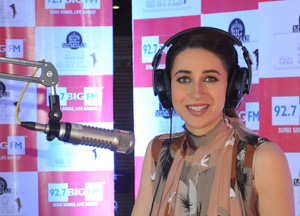
  • Karisma Kapoor debuts as RJ on 92.7 Big FM’s women-targeted show Big Memsaab

    By A Correspondent


    Bollywood actress Karisma Kapoor will be on board with 92.7 Big FM as an RJ for its women-centric radio show Big Memsaab. Through a specially created segment, Big on Style, Ms Kapoor will play the role of a personal grooming and beauty expert who will share her fashion and style knowledge by imparting interesting beauty and style tips to listeners. The segment will air on Big Memsaab every day between 11am and 2pm across 31 stations of 92.7 Big FM beginning December 24, 2012.


    Speaking about her association, Karisma Kapoor said, “Having worked in movies and also television, I was extremely keen to try a new medium – hence I decided to do radio. The Indian media scenario is constantly evolving and radio is the perfect medium for me to be closer to my fans than ever before. I am very excited about my radio debut on 92.7 Big FM’s afternoon show, Big Memsaab. I am confident that my fans will continue to support me as I undertake this new journey and will enjoy the show even further.”


    Commenting on the launch of the new segment, Manav Dhanda, Network Programming Head, 92.7 Big FM, said, “Beauty and style are two topics which never grow old with women. We are extremely excited about presenting the ultimate style diva, Karisma Kapoor as an RJ to our listeners for the first time ever. With the show reaching  audiences across 31 stations, our association with Karisma Kapoor, who is already a household name, will enhance our reach and enable us to keep our listeners engaged.”

  • 94.3 My FM wins three awards

    By A Correspondent


    Harrish M Bhatia

    In an award-winning spree, radio station 94.3 My FM has bagged three major awards recently. It won the Asian Leadership Awards in Dubai, in the category ‘Radio Station of the Year’. It also won the award for ‘Brand excellence in Media & Entertainment’ category in the Global Awards for Brand Excellence organized by the World Brand Congress Awards in Mumbai. 94.3 My FM shared the award with SAB and Movies Now in the category.


    The station was also recognized for its new and innovative initiatives in the mobile application space. 94.3 My FM bagged the Best Mobile application in the media category award at the Mobbys Awards held recently in Mumbai. The mobile application from My FM which won the awards has unique integrated features for listeners to connect and engage with the station.  Features like My Connect allow users to go to their city-specific social media platforms. Other features include My Message where one can send a song request or contest participation SMS to My FM with a one-touch key and My Download where end users can download My FM tones as their mobile ringtones.


    “I am elated at the recent award wins and the industry recognition for the brand. It not only showcases the growing preference of the brand among its listeners but also strengthens our belief in the localized approach we take in the markets we operate in to reach out to our listeners. I would also like to thank my staff which has worked seamlessly for us to reach this level of excellence. With the recent award wins,  94.3 My FM has not only spelt out its brand pull but also the prominent position that it has taken in India’s radio market,” said Harrish M Bhatia, CEO, 94.3 My FM.


  • Karisma Kapoor debuts as RJ on 92.7 Big FM’s show

    By A Correspondent


    Actress Karisma Kapoor has taken on the mantle of an RJ with FM radio network 92.7 Big FM.


    On December 24, 2012 Ms Kapoor will debut as an RJ for a women-centric radio show called Big Memsaab. Through a specially conceptualized segment, ‘Big on Style’, she will play the role of a beauty and style guru who will share her expertise on fashion and trends. The segment will air on Big Memsaab every day between 11am and 12noon across 31 stations of the radio network.


    Apart from a multi-media marketing campaign across radio, television, outdoor, on ground and social media, contests will also be hosted on air, wherein lucky listeners from across the 31 cities stand to win a personalized grooming consultation with Ms Kapoor.


    Speaking about her association, Karisma Kapoor said, “Having worked in movies and television, I was extremely keen to try a new medium – so I decided to do radio. The Indian media scenario is constantly evolving and radio is the perfect medium for me to be closer to my fans than ever before. I am very excited about my radio debut on 92.7 Big FM’s afternoon show, Big Memsaab. I am confident that my fans will enjoy the show thoroughly and will continue to support me as I undertake this new journey.”


    Commenting on the occasion, Manav Dhanda, Network Programming Head, 92.7 Big FM, said, “Ms Kapoor makes a daily appointment with radio listeners, which is a pioneering move. The features of the show will be the first across media, which is very exciting. The format of the show, the pegs that we will touch upon and the innovations planned are what makes the show unique and appealed to her. Radio is a live medium and highly engaging allowing for direct interaction with crores of Indians and fans across the country for a celebrity.”


  • Radio Mirchi, HDFC Life launch Season 5 of Spell Bee

    By A Correspondent


    Radio Mirchi 98.3 FM and HDFC Life have announced the launch of the fifth season of ‘HDFC Life Spell Bee – India Spells 2013, the Indian counterpart of the highly acclaimed Scripps Spelling Bee, USA. With the theme ‘Celebrate Words. Save the Language,’ the spelling extravaganza will travel to 35 cities and will aim to reach more than 5,00,000 students from Standard 5th to 9th. This year’s Spell Bee will be backed by Times NIE in promoting the campaign and encouraging participation.


    The National Champion of Spell Bee – India Spells 2013 will win a grand prize of Rs. 2,00,000 apart from the opportunity to witness the prestigious Scripps National Spelling Bee with a parent and the school principal/teacher in Washington DC, USA, in an all-expenses paid trip. The four semi-finalists will win a cash prize of Rs. 50,000 each.


    Sanjay Tripathy

    Commenting on the launch, Sanjay Tripathy, Executive Vice President and Head, Marketing, Product and Direct Channels, HDFC Life said, “The era of abbreviated text messaging is having a detrimental impact on the English language, with an increased surge in their acceptance as a convenient replacement for the original word. HDFC Life Spell Bee – India Spells, an annual spelling completion, has been making an effort over the last four years to improve the spelling skills of students in a unique and stimulating format. To maximize the reach, we are continuing with the digital leg, giving an opportunity to students across the country to register and participate online.”


    Prashant Panday

    Prashant Panday, Executive Director and CEO, Entertainment Network (India) Limited said, “We started off Spell Bee with an aim to sensitize young children to the basics of the language. The hunt to find spelling enthusiasts, since then, has continued. Already in our 5th season, we are expecting tremendous success and phenomenal participation. This year Spell Bee will raise the bar of competitiveness as we seek registrations from across 35 cities. It gets tougher as participants from previous seasons re-enrol to make this championship fiercer. Like every year, the competition will be televised to encourage and prepare students for the upcoming season.”


    In the initial phase, an on-ground exercise will be conducted across 1,000 schools where children will be given spelling tests. Later they progress to the city finale round. The top two students from each city will then appear for an online test which will choose the best 16 spellers across India. These students will then battle it out in the grand finale to be held at Mumbai to win the title of Spell Bee Champion.


  • FM radio will generate Rs 14bn in coming year: E&Y report

    By A Correspondent


    India’s private FM radio segment is expected to generate revenue of around Rs 14 billion in 2012–13. With 245 private FM stations operating in 86 cities, the sector has been growing at a CAGR of 14 percent annually. Furthermore, the sector is expected to grow to INR 23 billion, at a CAGR of 18 percent, within three years of Phase III being rolled out, according to ‘Poised for Growth: FM radio in India’, the latest study by CII and Ernst & Young. The sector accounts for around 4 percent of the country’s total ad industry. Globally, radio’s average share of the total ad industry is between 5 percent and 10 percent.


    According to IRS 2012 Q2 data, radio has an estimated audience of 158 million people (out of which FM radio accounts for 106 million), as compared to 563 million in the TV segment and 352 million in the print sector. Advertising revenues comprise more than 85-90 percent of the total revenue generated by FM radio companies; non-FCT sales can contribute up to 20 percent of a radio company’s total revenue today.


    Ashish Pherwani

    Ashish Pherwani, Partner, Ernst & Young said, “The report is a compilation of the views of 23 industry stakeholders including radio companies, regulators, music labels, etc. It highlights the need for a speedy implementation of Phase III, which can grow the radio industry from INR14 bn to INR23 bn in three years, subject to enabling networking and cost management, development of a measurement metric which supports the industry, and ensuring license fee prices during Phase III auctions are not irrational. The report also highlights operational, tax and technology implications of the industry.”


    Current state of the industry

    Radio is not considered a primary advertising medium due to its limited number of stations. While larger cities are mostly covered by it, advertisers interested in regional ad campaigns prefer using regional print (which can enable them to reach several more cities and towns than radio currently can) or regional TV, which has grown significantly since 2005. Therefore, radio is only used as a back-up medium for most ad campaigns. However, with the implementation of Phase III, with 839 frequencies being made available for auction, radio is expected to provide advertisers with a much deeper reach.


    More than 50 percent of FM radio consumption is in homes, followed by people listening in transit (on mobile phones and in-car listening) and out-of-home listening at restaurants, offices, shops and so forth. Around 25 percent of total radio listenership is now on mobile phones, fuelled by handset manufacturers that have made FM radio a standard feature in most of their models. Some radio companies claimed that their research indicates that mobile phone listenership in metros comprises more than 75 percent of their total listenership.


    The study highlights the fact that the key challenges faced by this industry today include limited inventory, inability to demonstrate ROI and slow recovery of ad effective rates (ERs). Therefore, the need of the hour is for radio industry is to collaborate and implement a measurement system that supports the growth of the industry.


    Phase III

    Phase III of FM radio licensing promises further growth opportunities for the Indian FM radio industry, since it covers 294 cities and 839 licenses.  However, only 52 of these licenses are in high revenue-generating category A+, A and B cities.


    They expect the share of local retail advertising to increase from current levels to more than 50 percent of the total revenues generated in the segment, and activations and other below-the-line marketing initiatives to play a more important role in generating revenues. The margins of radio stations are projected to decline in the short run, stabilize in three to five years and then rise. The growth in mobile and internet ad spends could, however, pose a threat to the rise of FM radio.


    Phase III is also likely to make the industry more conducive to M&A due to proposals such as reduction of the license lock-in period from 5-3 years, an increase in the license period from 10 to 15 years, significantly more networking between all the stations to enable cost optimization, ownership of multiple frequencies in a city and an increase in the foreign investment limit to 26 percent from the current 20 percent. The industry needs to push for parity with the FDI norms of other media segments such as broadcast TV.


    In the long term, significant growth for the private FM radio industry will only be possible if several thousand stations are operationalized, burden of high licence fees is removed by increasing the variable component and reducing fixed costs, and news dissemination is equated with other media.


  • FM Radio: Facing challenges, embracing growth

    By Ananya Saha


    The Confederation of Indian Industry (CII) organised the CEOs Roundtable on Radio in New Delhi last week, to discuss and chart the growth of the radio industry with the Phase III auction of the FM spectrum coming up, though dates are yet not out, and the ministry is said to be tweaking the loopholes. The conference saw private FM operators being critical of govt policies that did not allow them to carry news on their stations. The event also saw the release of CII- E&Y report – ‘Poised for growth: Fm radio in India’ (Read about it here: http://www.mxmindia.com/2012/12/fm-radio-will-generate-rs-14bn-in-coming-year-ey-report/)


    Prashant Panday

    Amit Khanna, Chaiman, CII Committee on Media & Entertainment and Chairman, Reliance Entertainment, requested the government to encourage diversity in programming by giving incentives. He said, “The existing policy has created clones of same station and has stalled the exponential growth of FM that could have happened.” He also spoke about how the cost of reach of radio was much higher than the cost of reach of radio, thus pushing the FM operators to stick to mainstream genre of Bollywood music to generate revenues.


    Prashant Panday, CEO, Radio Mirchi advocated multiple channels, 25 or more for cities such as Delhi and Mumbai for efficient usage of spectrum and diversification in genres. He pointed out, “FM gets only 40 lakh listeners per week. And daily only about 25 lakh people tune into FM. Why is that we reach 25 percent of population? The population needs variety, and we are often compared to TV when it comes to programming.” He also said that in 4-5 years FM radio will lose business to digital radio as consumer moves to internet radio. “The numbers are clearly growing. Saavn currently commands 10 million listeners. FM spectrum has finite life span. It is important to re-consider spectrum policy before broadcasting goes kaput,” he said.


    Anurradha Prasad

    Anurradha Prasad, President, AROI and CMD, BAG Networks, opined that the all stakeholders related to FM industry are missing the larger picture. “We sell airspace one-hundredth of TV ad revenue. It is clear that nobody is taking it seriously,” she said. She pointed out how advertisers look at radio as a ‘bonus’ medium and not as a serious medium.


    However on a positive note, Ashish Pherwani, Partner, Advisory Services, M&E, Ernst & Young, said, “Phase 3 is going to be imperative for growth of the industry. There are good things happening in the industry that will allow consolidation. Yes, it is important to extend licensing by 10-15 years. The lack of inventory is happening because of lack of licensing. But even then, one out of two campaigns currently use radio is a medium, even when ROI is not as well-defined in this medium.”


    Uday Varma, Secretary, Ministry of Information & Broadcasting, began on a very candid note. He quipped, “If the industry itself is calling a 10-12% growth bleak, what percentage of growth will make it look bright? The industry in itself is not clear what it wants – whether it wants fast growth or slow growth. Of course, the business aspirations of the industry and national interest will not go hand in hand and meet, and it should not for good.” He also pointed out why there is a delay in the auction of Phase III licenses, “There was an issue of migration fee. The process and auction will be done in very transparent manner. There are trade-offs but I am sure we will sort them out with the industry and other stakeholders like TRAI.”


    Mr Varma on a lighter note said, “If you as an industry player are sure that it will die, why expand at all? And if it is so, the government should re-look at the FM policy. We, as an industry, need to begin on a far more positive note. Of course, you cannot wish government away. There is a divergence of motive here – the industry is working for profits and we have to look at the working of the industry as a whole,” while responding to Mr Pandey’s statement that the FM industry will face the music the next 4-5 years. On the question of allowing private FM to air news, Mr Varma asked the industry to begin with AIR news feed and give it a time of 4-5 years.


    The Secretary and Rajesh Kumar Singh, Joint Secretary) Broadcasting (MIB) assured the delegates that Phase III was on the top of their agenda. Mr Singh said, “My agenda was to get the Phase III rolling by March 2013. But we hope to work on the areas that cause concern and do it thoroughly.”


    Harshad Jain

    Harshad Jain, Business Head, HT Media (Fever FM) said, “The market size is roughly Rs 12-1500 crore, for a medium (radio) that is absolutely free for the consumer. Compared to overall media industry, this is the fraction of revenue. The bidding cost for Phase III is unfair to the industry that is so small. While the numbers might look impressive when you see CAGR, the prices of this medium have actually declined keeping inflation in mind.”


    Anil Srivatsa

    Adding to the debate was Anil Srivatsa, CEO Radiowalla Network who said that the reserve price will deter new entrants into the industry. He recommended more frequencies with lesser space between two frequencies. To this, Wasi Ahmad, Advisor (B & CS), TRAI, responded that number of FM channels should be consummate to how many channels can a market absorb while Harrish Bhatia, CEO, My FM wished to make the industry more investor-friendly while pointing out “stations that are backed by news media houses should be allowed to carry news.” On an optimistic note Mr Jain of Fever FM wished that “radio industry becomes a $ 2 billion industry,” while Uday Chawla, Secretary General, AROI, wished for a level-playing field between radio, print and TV.


    Harrish M Bhatia

    The panel and delegates also pointed out how the industry is facing the dearth of good talent. On a positive note, Asheesh Chatterjee, CFO, 92.7 Big FM concluded, “We are going to grow at 30% in Phase III when 245 FM stations would result in four times in inventory with more comprehensive spectrum. Radio is set for huge jump. The ad revenues are falling because we are selling cheap. We, as an industry, have to focus on good content. The growth and the ability to grow lies within us. We need better and concurrent movement.”


    A Must Read for every Professional in Media Industry ….

    Extracted with permission from Authors of ‘The Advertising Mess’


    Universe Projections and a well-known Listenership Survey

    The existing Radio listenership survey from a ‘credible and trustworthy research organisation‘has shown utter carelessness and total lack of responsibility which has hindered the growth of this nascent medium.


    The listenership survey, which launched in 2007, used NRS 2005 universe estimates without applying growth rates for the intervening two years, which means its figures were two years out of sync with reality. This lethargic output was produced after charging humongous fees from the client for subscriptions.


    Logically, in any such media currency, the critical factor is the ‘estimation of the universe’, which needs to be done as accurately as possible. This can be done by using the latest available census figures and applying the intermediate growth rate to arrive at the current universe, OR by using IRS figures (since IRS provides updated universe estimation by demographics on a quarterly basis.)


    Moreover, this listenership survey continued to report these wrong universes for the next 3 years till the end of 2010. Not only was the universe underestimated but the radio penetration figures were also wrongly reported as compared to the baseline.


    When this ‘credible and trustworthy research organisation‘ finally updated the universe in January 2011, some markets showed growth in population by 143% over the previous year. (Obviously, since for five years, the research agency had not bothered to update universe, now there was a sudden leap).


    The basic demographics such as gender ratios changed almost inversely for male : female from 57 : 43 to 41 : 59, socio-economic classes observed stark differences. For example, upper socio-economic class demonstrated a drastic drop where as lower socio-economic classes showed significantly unrealistic rise over the previous year.


    Conventional wisdom says that the demographic proportion takes almost one full decade to show the kind of change in proportion that this listenership survey showed in a single year. Such drastic changes in gender ratio were last witnessed during World War II, when millions of members of the male population were killed in a single year of warfare at the front. They cannot radically change in just one year.


    Can we expect such blunders from an organisation which is looked upon as the ‘Messiah’ of media research in India? Unfortunately, YES.


    Such are the follies of these surveys which are unfortunately highly respected by the industry and form the basis on which most of the MarCom investments are made today.


    Different methodologies lead to different results with disastrous consequences (Diary v/s DAR)

    Different methodologies for the same objective appear to provide different results in research surveys. Each of these methods has their own disadvantages and advantages and that includes how the market perceives them. The different numbers emanating from the usage of different methodologies mean different opportunities to advertisers, broadcasters and agencies for revenue impact, visible return on investment and content formulation.


    Obviously all these methodologies cannot be giving the accurate results. Let’s take an example of MRUC which started India’s first radio listenership survey, ILT (Indian Listenership Track). MRUC had conducted a research to evaluate which methodologies out of DAR (day after recall) and Diary were the most robust and with minimum error. It was found that DAR reported a 55% inaccuracy, whereas Diary reported 85% inaccuracy.


    Post the results of these findings, TAM media research released the first round of Radio Audience Measurement with Diary methodology, pitching hard for real-time capturing of data.


    The radio station which according to ILT was the undisputed market leader for two consecutive years, suddenly dropped to number four position according to RAM, whom do we believe ILT or RAM? Further, this discrepancy occurred when there were only a total of 7 private FM stations available.

    The question is whether real time capturing of data (Diary), which was developed to overcome the inaccuracies of the previous methods (DAR), truly presents the actual picture.


    Another example which can be looked at is a famous radio station which recently converted from 100% Hindi content to 100% English content in Mumbai. When comparing three months of Hindi content (Pre-Launch) with 3 months of English content (Post-launch), the existing listenership survey conducted by a ‘renowned media research agency’ reported NO significant changes in either demographic consumption of the station across age groups, gender and socio economic class OR in tune-ins and time spent. On the contrary, lower socio-economic class showed growth for 100% English content for the same radio station.

    This either shows that all listeners are deaf or it shows how real time capturing of data could mislead due to some lesser known reasons or leakages in validation process or it shows that the data capturing and analysis are being done in a thoroughly unprofessional manner. Or could it be that there is a short-coming in the methodology itself and that fresh, new methods are urgently needed?


  • MxM Monday: Expectations from Phase III FM radio licensing


    By Ananya Saha


    FM Radio is set for exponential growth. Even as advertisers are yet to take this medium seriously, the industry players are waiting for Phase III with anticipation. The industry is positive that the third phase would result not only in differentiated content but will also interest the advertiser and listener alike.


    We speak to private FM players for their expectations from Phase III of licensing.


    By Ananya Saha


    Harrish M Bhatia, CEO, DB Corp Ltd - Radio Business (94.3 My FM)

    We all want Phase III to happen. It is an industry’s requirement to grow. But it is important for the government to remove hurdles like the issue that happenedinChandigarhor not allowing us to carry news. What is the objective of taking AIR news? If it the issue of keeping tab or administering the news we carry, they can ask us to keep our news recordings for 30 days and they can review it. How does the government control cable telecast? Why cannot they trust us?


    From the advertisers’ front, I am sure that the advertising in the medium’ will continue to grow. What is required is proper decisions by the government to ensure that the private FM players also gain.


    Asheesh Chatterjee, CFO, Reliance Broadcast Network Ltd (92.7 Big FM)

    The more number of Spectrum licenses in Top A, B cities will only benefit the industry. It will add to content loyalty. Phase III licensing will result in closure of music royalty issues when the tariff rates will resolve the ambiguity issues that exist at the moment. And yes, the FM players will be investing in Category C and D towns. Kozhikode, Chandigarh and the South will make the things uncomparable. Those areas need a bit of correction.


    These three are broadly the issues, apart from smaller issues such as news. Even while protecting the identity of your brand, we will be able to cover news in the same manner or better manner. Otherwise you are too restricted in communicating it in the same manner.

     

    Harshad Jain, Business Head, HT Media (Fever FM)

    The highest bidding of Phase II will becomes the lowest bidding price in Phase III and that is a cause of concern. I hope the government understands the fact that the cost of doing business is high. And I hope they do pay attention to this fact apart from solving the issues such as transmitter and infrastructure.


    It is no doubt that the Phase III is going to do better to the industry, but the back-end processes will have to be taken care of and sorted.

     

    Anurradha Prasad

    Anurradha Prasad, President, AROI and CMD, BAG Networks

    We want the processes of Phase III radio licensing to begin as soon as possible. We, as an industry, do not want something that becomes unviable. Hence, we are awaiting the process to begin soon so that industry gains. You cannot compare telecom and radio spectrum together. The consumer does not pay for radio. The medium requirements are different.


    It looks like the issue of music royalty will get sorted as Phase III licensing comes into play. However, I am concerned that in Phase III, the bidding prices might go haywire and people will not be able to pay, nor would they be able to make it profitable.



    Prashant Panday, CEO, Radio Mirchi

    The objective of any policy should be to ensure growth of the sector. In the case of FM radio, Phase-3 policy should attempt to expand FM in a big way.


    The Phase-3 policy as it stands today only partially addresses the objective. It does seek to expand geographically into some 250 new towns. However the auction methodology (electronic ascending auctions) and high reserve fees (highest bid received in Phase-2 in a similar category town in the same region) will frustrate this goal. The radio industry believes that FM auctions will be a flop with most new cities not being taken up. The industry prefers electronic tendering, just like done successfully in Phase-2. This would also take care of the problem of reserve fees, since they are set post-auctions (25% of the highest bid).


    The policy allows for networking across the network, which should help cut operating costs in small towns. It also allows broadcasters to operate more than one channel in the bigger cities, which should help in consolidation. The policy also allows news broadcast, but limits the content to AIR feeds. This is blatantly unfair, since news without restrictions is allowed to all other media.


    However, the biggest problem is conducting auctions under scarcity conditions. There is only 1 channel in Delhi, Bangalore, Chennai, Ahmedabad and Pune and 2 in Mumbai. This will lead to exorbitant “desperate” bidding. Further, this high bidding will become the base for the next round of auctions, which will put the radio industry into a cost spiral. Instead, the government should accept TRAI’s recommendation of halving “channel separation” to 400 KHz and doubling the number of channels. This way, the government will get more overall license fees, the public more programming variety and the broadcasters reasonable license fees.

     

    Suresh Sanyasi, National Sales Director, Radio Indigo

    Our expectation from Indigo are fairly simple: we are looking at larger market space in terms of international quality music available pan India. We current fall into very niche A+ segmentation. We are looking at Mumbai,Delhi as a market and may be a couples of Town A and B where we see potential like the way we got Goa where we can harness our brand and give listeners good music. Invariably connecting them with good brands and advertisers and giving them pan-India reach. Currently, if any advertiser wishes to advertise with us, they have to locally listen to our station in Mumbai and Goa. Once, we get license, the advertisers will be able to connect with our brand pan India. We already have offices in Delhi and Mumbai and once we get license, we will start expanding horizontally. We have, maybe about 20%, of business coming out of Mumbai and Delhi irrespective of the fact that they do not have touch-and-feel of Radio Indigo and they have only heard about our brand.


    Once Phase III begins, the market will grow. More radio stations coming in, licensing will become larger, the government is definitely going to get lot of revenues and a lot of employment will be created. There is huge amount of growth that we are looking at.


    However, radio in India has not reached maturity yet. By maturity, I imply, consumption of radio is not a very-well accepted norm right now. I say it comparing it to more mature medium like a television. People buy in terms of brand and advertising people do not know how to use radio. Radio is a very tactical medium. Advertisers do not understand the medium since it is not a visual medium, even as it remains the most cost-effective medium to advertise and there is a definite return that comes through. With larger number of stations coming in, people would like to try out and understand the value of radio in itself.


    We are looking at Phase III with much positivity and optimism.


  • Jaldi 5 with Asheesh Chatterjee: FM will grow five times

    Asheesh Chatterjee, CFO, 92.7 Big FM is positive about Phase III of FM radio licensing and the new spectrum being freed. MxM India caught up with him recently to talk about the FM industry, pre- and post-Phase III.


    01. With Phase III coming into play, do you think that the issues such as royalty, taxes etc that the FM industry has been struggling with, will be sorted?

    I am very optimistic. If you look at the efforts the government has taken towards digitization, the intent is to have a consensus and resolve the issues and make the industry grow. Most of these issues have been identified, and yes, there will be solutions. The phase III guideline itself solves many issues. We tend to look at the glass as half-empty, why not look at it as half-full? There were many things which have been addressed, and some which need to be addressed which I am confident will happen soon.


    02. Does the current RAM measure the listenership of FM radio appropriately?

    Ratings and measurement requires investment. So once you have strong players with a pan-India footprint, they will have the necessary revenues for the investments to make these measurements appropriate.


    Yes, today the measurement is restricted to the top markets, and this is set to expand. You do not need daily or weekly measurement to tell you that radio reaches where literacy has not reached yet or where, because of electricity problems, TV does not work. It is enjoyed as a passive medium, even while you are working. Radio does not really have a prime-time at all. So research will capture all this and much more. I am sure with phase III, and stronger players, there will be sweeps that will be done to bring out the statistics.


    03. Prashant Panday of Radio Mirchi recently said that FM radio will have strong competition from internet radio. Do you agree?

    Digital is one of the areas, which by no means implies that FM radio has little future. FM radio is itself going to grow five times from its current numbers. There is immense future in FM radio. And also, yes, digital radio with its uniqueness to be able to search, social networking, and customize, will offer another product. FM players who have the understanding of the audience, as well as content, will be able to monetize internet radio better than anybody else. However, if you are going to make it a paid service, there are not going to be many takers for it.


    04. Phase III: Challenge or opportunity for FM radio industry?

    I see only opportunity: to make good use of the spectrum that will be freed after the Phase III auction happens, and to execute on product innovation and product differentiation to make a profitable business model for all stakeholders, whether it is the advertisers who will look at this medium for its cost-effectiveness or listeners who will look at it as a passive medium for enrichment and entertainment, and us as radio operators who like to reward both investors and employees. It is going to be a work-work solution for everybody. The opportunity is right there at the section point and we need to execute it to the plan.


    05. Are advertisers taking this medium more seriously in their traditional media mix?

    Advertisers have always taken this medium seriously. Nobody buys you cheap, you sell cheap. The fractured spectrum that some us have had, because we are there in two towns in Gujarat, does not mean that no advertiser can do a Gujarat-plan with you. So those are the problems that will go away, and you will have the spectrum to reach the targeted region or TG. I think once that gets corrected, advertisers will start using FM as the primary medium.


    As told to Ananya Saha