
Category: Opinion – Archives

  • Happy days may be here again, for adspends


    Indrani Sen
    By Indrani Sen


    Two months back on June 22, 2021 I reviewed here the TYNY Midyear report for 2021 and commented: “It seems though the pandemic may not disappear from our lives in 2021, the dark shadow of the pandemic will be lifted from our advertising Industry.” Today, when two months of the second half of 2021 are almost over, it looks like Indian advertising industry is well set on the path of recovery in 2021 H2 with prediction of increased advertising spends during the festive seasons and during the forthcoming back-to-back sporting events.


    Onam ushers in the festive period in India. In Kerala, Onam sales account for more than 50 per cent of the annual sales of the businesses. Advertising during Onam festival accounts for 30-60 per cent of the total turnover of the various media houses in Kerala. This year, Onam (August 12 to August 23, 2021) has been celebrated in Kerala with cautious optimism, the run up to the festival was below the expectations as the number of Covid cases in Kerala again went up. However, going by the latest reports coming out from Kerala, it seems that both sales and advertising spends picked up with the approach of the festival and have performed better than last year.


    The next big festivals are Ganesh Charurthi in Maharashtra (September) and Durga Puja in West Bengal (October) and in both the states, the marketing and advertising industries are feeling upbeat as Indians are learning to live with Covid-19 and its variants. In spite of the predictions that the third wave of the pandemic will hit India during September and October 2021, marketers are expecting good return on advertising investments during the national festival Diwali scheduled on November 4, 2021. The GEC channels are also gearing up for the festive season with properties like Kaun Banega Crorepati (KBC) and Bigg Boss in different regional languages. Print, which saw a bonanza of full page ads with the Independence Day offers, is expecting a repeat of similar advertising with festive offers.


    The Dentsu Global Ad Spends Forecast June 2021 estimated India will be one of the top five markets in terms of advertising growth rate in 2021 which also supports the growth of advertising spends in 2021 H2.


    As per the above report in India, the ad market is “forecast to grow by a further 12.4% in 2022, recovering to pre-pandemic levels, particularly led by Digital and TV versus a longer recovery for Print, Cinema, OOH and Radio.”


    The back-to-back sporting events in 2021 H2 has raised the level of expectations for advertising spends, particularly among the sports broadcasters. It is estimated that Star Sports may earn INR 2500 crore plus between second half of IPL and T20 WC. The Olympics saw a fair number of advertisers and the advertising inventory for the India-Sri Lanka cricket series in last month was fully sold out. Industry experts estimate that the total advertising spends on various sporting properties like Olympics, India-Sri Lanka series, India-England series and UEFA Euro 2020 will contribute another INR 2000 crores taking the total advertising spends on sporting properties to INR 4500 crores on TV alone. It is expected that there will be a good advertising investment in digital media also for a total coverage of the sports fans.


    To sum up, unless another disaster like the second wave of the pandemic hits us during the next two months, the advertising industry is well set on the path of recovery in 2021 H2. The chances of an intensive attack of the pandemic during the third wave is estimated to be less as around 50% to 60% of our total population has already got COVID 19 during the first and the second waves and have developed some immunity. However, a lot depends on the success rate of the vaccination drives currently being untaken by the central as well as the state governments and we are running sadly behind many other countries with only 13% of the eligible population fully vaccinated till now (https://www.bbc.com/news/world-asia-india-56345591).




  • Small is Significant


    This is the sixth in our 10-part fortnightly series where Shaziya Khan focuses on the allyship of brands for financial savviness of women and girls. Link to the first three parts: https://www.mxmindia.com/category/columns/shaziya-khan/


    By Shaziya Khan


    Shaziya KhanA key attitude shift in modern times is that women and girls should be financially savvy.


    This shift presents an opportunity for allyship to almost all brands, both in the financial categories and beyond.


    Our understanding of current personal finance behaviour reveals a pervasive lack of comfort with personal finances, several related emotional and social barriers.


    Interestingly, there are a few experiences which are also significant in the opposite direction – enabling a growing sense of comfort, eventually savviness, in personal financial matters. These were candidly, generously shared as real-life anecdotes, early lessons, personal stories by women. These ranged from their own lives, their own families, their friends’ families, relatives and others they knew well. All upclose experiences, where the impact and benefits were well-known, appreciated over time. These small experiences stood out on their mental radar, as vital steps of informal, yet conscious allyship.


    WELL-BEING STARTS WITH SMALL STEPS

    Micro steps are all the rage in formation of constructive habits,  positive change. Especially in areas of health and well-being. In the domain of personal financial savviness, a kind well-being and health, too, small steps and experiences go a long way.


    It is practically evident that small steps and their related first-hand experiences are useful at three vital, inter-related levels.  They facilitate

    • familiarity with personal finance

    • ritualisation of taking financial action

    • informal training in a disciplined financial approach.


    Small steps, consciously encouraged, early on, are likely to ripple positively in the long term. What is of particular significance, is that these steps are not difficult to implement and can be encouraged, adopted or adapted in ‘as is’ conditions.


    PURCHASING: Being responsible for small errands of purchase, for oneself or for the household, helps women and girls, with early and simple familiarity with personal finance.  Being given shopping errands to run, enables familiarity with handling money, in a responsible way, an understanding of the right amount of change to bring back, a grasp of the value of things, a knowledge of balancing the target versus the actual expense.


    In many homes, partly due to protective reasons, or simply due to established patterns, girls are not so much involved in making the purchases. Though they give the recommendations on what to buy, they may not be the ones doing the actual purchasing (online or physically). The fact is, girls being engaged in making purchases can potentially and simply land several positives – summarised as a familiarity with handling financial aspects, from an early age.


    RECORD-KEEPING: Record-keeping of expenditure, savings, gifts is another beneficial small step. Early, child-like record keeping of one’s small finances can be utterly simple – envelopes, handwritten lists, orderly clipping of bills, a small note book mentioning gift amounts or even just a close watch on piggy bank treasures. Parents are quick to notice how some young children are meticulous in being up-to-date on these matters. They remark how being careful, having detailed record keeping helps build a mindset of accuracy, awareness and order when dealing with personal financial matters, later in life.


    FESTIVE INVESTING & SAVING: Festive investing and saving is a useful and fun small step too. Charming yet impactful stories recalled by women (who are relatively savvier than average), relate to early investing and saving encouraged by parents. During the festive new year, there was a choice of investing that was specifically encouraged for the young child – a small amount but nevertheless one that was chosen by the child. Other empowering accounts, relate to children being encouraged to save “their” money (via gifts) in a methodical manner. Building a nest to buy a prized toy, game, dress or shoe.


    These small steps of investing or savings were often ritualized, around special occasions (festivals or occasions like new year, birthday, start of holidays, start of new school year and so forth). The reason for this ritualization, was it helped to imbue a goal orientation, a sense of ‘independence’, of decisiveness, of choice making between attractive options. Also,  learning the value of being patient, encouraging anticipation as opposed to instant gratification.


    BUDGETING FOR GIFTS: Budgeting for gifts, wishes, requests is another helpful small step in building the financial savviness muscle. Innocent yet powerful stories were related on how children are encouraged to stick to a ‘budget’ for their ‘wish list’. As a result of this ‘constraint’, they learnt, early on, to think smarter, in the ‘wish list’ area. For instance, do their homework on the options they seek, find the best one within their budget, look at timing, discounts, offers that are available, consider swapping where possible.


    This necessarily brings in a disciplined approach even towards much looked forward to choices. In this way, providing a certain amount of financial indulgence yet also imparting an early experience of financial savviness.


    DOCUMENTATION: Handling financial documentation personally is something many women or girls avoid or defer as much as possible. They would rather that documentation be handled by spouses, parents and siblings (due to their perceived or actual lack of knowledge, fear of errors, etc.) Yet, caring empowering allies in real life, encourage women and girls to personally and directly engage with financial documentation. Both, for personal and professional matters.


    These include writing cheques, opening a bank account (at the branch or online), figuring out GST related details (small business owners), start handling paperwork for the filing of their tax returns (working women), making insurance applications and so forth. Financially savvy women, remark that familiarity with personally handling financial documentation brings on clarity and empowerment. One learns at each step. These learnings increase financial savviness.


    SMALL STEPS OF ALLYSHIP FOR BIG STRIDES OF FINANCIAL SAVVINESS.

    Small steps, and their related first-hand experiences, encouraged early on, are lauded by savvy women as one of the key reasons for their savviness. These small yet significant life experiences seemed to even break through the most entrenched personal financial category barriers. Factors like discomfort, social conditioning, stereotypical roles and rules, “limited expectations” that often ‘hold back’ women and girls, in the financial domain, can loom less.  Small steps are especially significant because they are generally about everyday actions, possible in ‘as is’ conditions. Yet, they lead to bigger strides. Sowing small steps of financial familiarity can reap big strides of financial savviness.


    Shaziya Khan is National Planning Director, Wunderman Thompson. She has won the Jay Chiat Grand Prix  for Strategy and Three WPP Atticus Global Awards for ‘Original Thinking in Marketing Communication’. Her views here are personal. 


  • Digital Duopoly changes to Triopoly


    By Indrani Sen


    Indrani SenIt is established now, the Google and Facebook duopoly in digital advertising has been converted to a triopoly by Amazon. With the rapid growth of Amazon’s share, the global online advertising size is expected to cross $88 billion by end of 2021. Google and Facebook together hold above 50% market share with other major players like Amazon, Microsoft and Twitter competing with each other for the rest. The data released by eMarketer in October, 2021 for a period 2019-2023 shows that the combined share of Google and Facebook are going to decline further over the next two years to be just 50.5% in 2023 as against 55.2% in 2019. Along with Amazon, the triopoly will hold 65.1% share in the online advertising market in 2023. Industry experts feel that similar effects will soon be seen all across the world.


    A recent article (https://www.exchange4media.com/marketing-news/digital-advertising-is-not-a-two-horse-race-between-google-and-facebook-daryl-lee-117323.html) based on an interview of Darry Lee, the global CEO of IPG Mediabrands, was published using a quote from Darry Lee as the headline “Digital advertising is not a two-horse race between Google and Facebook.”


    In this connection, read recently an excellent analysis by P.K. Kannan, Dean’s Chair in marketing science in the Robert H. Smith School of Business at the University of Maryland, who analysed the impact of increased Amazon’s presence in digital advertising and the reasons behind Amazon’s success( https://www.clickz.com/amazon-presence-digital-advertising/220935/).


    Prof. Kannan argued that in order to understand the unique advantage of Amazon, we need to address the basic question of what marketers gain from advertising online, which is primarily acquiring customers at the lowest cost. He argued that “Google and Facebook provide marketers access to the online traffic they control and use sophisticated targeting algorithms to match a marketing message to the right set of online users.” However, as we all are aware the final effectiveness of this targeting is based on the motivations and inclinations of the online consumers as they surf through different websites on the internet. A consumer may just be interested in interacting with her friends on Facebook. A visitor at Google may just be looking for references related to his research studies. Against this the motivations for consumers on Amazon is either shopping or searching for making a decision related to shopping. So, the chances of a consumer reacting to a context-appropriate message is much higher for visitors in Amazon, which increases the click through rates. Internet users are also in the right mindset when they visit the Amazon site than when they are on Google and Facebook.


    As the platform itself is a marketplace, Amazon has a unique advantage of having previous knowledge of shopping behaviour of the consumer and can use that to position the message of the advertiser more effectively and also use AI and other techniques more effectively to provide recommendations to the advertisers. Prof. Kannan argues that “Amazon Prime shoppers are an especially attractive segment for marketers to go after, and Amazon could charge even more for online ads targeting them.” With precise targeting brands advertised on Amazon may become more prominent with the shoppers quickly. This has two built-in benefits. Firstly, it enables in relationship building with the consumers and secondly, it improves the organic search rankings.


    In addition, a marketer may have to worry about the type of user generated content his/her ad would appear on Google’s YouTube or on Facebook. Amazon, on the other hand has a complete control of all the content that appears on its own e-commerce platform. Advertisers may prefer Amazon as it reduces the risk of ads appearing in the wrong environment.


    So, it seems almost certain that the digital duopoly of Google and Facebook is in the process of changing to a triopoly not just in the US market, but across the world in developed and developing countries.


  • Looking Ahead at 2022


    By Indrani Sen


    Indrani SenThe Indian advertising industry showed a strong trend of recovery in the second half of 2021. The market became quite buoyant and industry experts began to predict a strong double-digit growth in advertising expenditure in 2022 with digital and TV driving the growth. Print, radio and outdoor were expected to recover their revenues faster than what was envisaged earlier. The experts making these predictions assumed that we would not have a Third Wave of Covid-19 in 2022 and there would not any major economic disruption.


    But, before 2021 ended, our world again became under the shadow of Covid-19 and its new variant Omicron. Over the last two days of 2021 and the first two days of 2022, almost all the states where the cases are rising, have taken various measures from partial lockdown to night curfew to stricter vigilance by the authorities. Though national health authorities have not yet declared this upsurge as the “third wave”, we need to recall that AdEx had a degrowth of 25% to 30% between April-June 2021 due to the effects of the second wave on our economy. As per our AdEx, the April to June quarter has the second highest level of advertising expenditure after the October to June (festive) quarter. The number of Covid-19 cases are increasing on a daily basis and according to an announcement made by Union Ministry of Health and Family Welfare on the first day of the new year in 24 hours India registered 27533 new Covid cases, a substantial spike in the ongoing resurgence of the pandemic. The current situation makes it extremely difficult to predict the trends of AdEx in 2022.


    The traditional media will bear the burnt of various regulatory guidelines if the situation becomes serious, particularly if Maharashtra and Delhi declare a partial or full lockdown. However, it is quite certain that digital media would be growing in spite of the resurgence of Covid-19 in India and certain new trends are going to emerge in 2022.


    We have been hearing lately a lot about NFT, the short form of Non-Fungible Tokens which are used to denote digital assets or cryptographic tokens available through the blockchain. The key idea on which NFT is based is non fungible, which means that it is a unique item which cannot be replaced with another similar item. Non-Fungible Tokens can be understood as basic digital assets, which are ‘copies’ of real or tangible objects/ actual instances and they come encoded with the same infrastructure of blockchain which enables the cryptocurrencies. NFT can be sold or bought between two different parties online, just like the cryptocurrencies. However, non-fungible tokens and cryptocurrencies have many differences. Although NFT has the word ‘token’ in its name, it’s not a virtual currency like Bitcoin (BTC) or Ether (ETH). But they both operate on the same underlying technical mechanism, the blockchain technology.


    NFT has unique identification codes and metadata which cannot be copied or replicated. NFT can be used to represent various types of digital assets like music, audio, video, photos, artworks and other digital files. It can be considered as a certificate of ownership of any digital content or digital asset owned by any company which has invaded not only the blockchain industry, but also the other media and our popular culture.


    Read a useful article in May, 2021( https://www.jpmorgan.com/commercial- banking/insights/future-blockchain-media-entertainment ) which discussed why blockchain is going to play an important role in Media and Entertainment industry. “Media and entertainment places a premium on protecting and monetizing intellectual property. For media companies, blockchain has industry-wide applications that can transform the way content is created, consumed and protected.” If the pandemic persists globally in 2022, then in media & entertainment industry 2022 will perhaps be known as the year of NFTs driven by the blockchain technology.


  • Boom, Boom! India’s Short Form Video (SFV) market explodes. And how!


    By Indrani Sen


    Indrani SenThe Indian government’s ban on TikTok in June 2020 along with 50+ other Chinese apps was a blessing in disguise for the homegrown user generated short video apps. TikTok, introduced in India in September 2016, opened up a new category of users in digital media consumption and had almost 90% share of the total time spent by Indian netizens on creation and consumption of short video contents.


    In fact, as I wrote here on May 4, 2020, (https://www.mxmindia.com/2020/05/indrani-sen-tiktok-ticks-fast-in-india-during-lockdown/) during the first two weeks of the lockdown in 2020, TikTok along with Aarogya Setu were the two most favourite apps downloaded by the Indians.


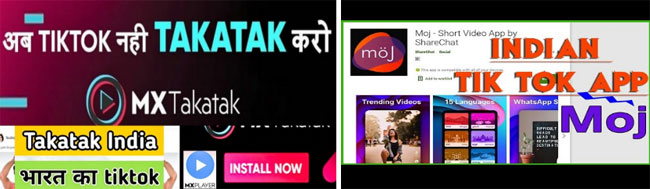
    Six months after the ban on TikTok, we saw many homegrown apps like Times Internet’s MX TakaTak, ShareChat’s Moj, InMobi’s Roposo, Dailyhunt’s Josh, Tech4Billion Media’s Chingari, etc. trying hard to fill in the void left by the sudden disappearance of Tik Tok. In June 2021m the combined efforts of all the homegrown apps got back nearly 97% of daily active users compared to June 2020. Aggressive influencer marketing and content creation in local languages on these platforms were the two main factors which helped in getting back lapsed users as well as create new users. Many of these platforms initially used Tik Tok’s name for promoting their apps on digital media.


    A year after, in October 2021, a report by Redseer Consulting revealed that homegrown Indian short video apps have nearly 250 million monthly active users (MAU) compared to Tik Tok’s monthly active users (MAU) of 170 million users at the time of its closure in September 2020. These platforms’ offer of creating short videos in local languages as well as simple interfaces accessible by cheaper smartphones helped to make inroads to small towns and rural areas. The Redseer report estimated that active users spend up to 45 minutes daily on these platforms.


    The combined monthly active userbase (MAU) of the homegrown short video apps stood at 170-190 million beyond India’s 50 cities, as per the Redseer report titled ‘Short-form video – The Rise of Made in India Digital Content.’ The report stated that 60-62% of the short-form video users are from Tier 2+ cities, a proof of the fact that India’s short-form video (SFV) market has spread to “Bharat”. There is a huge scope of growth as compared to more than 90% of internet users in China using online videos, in India the penetration of online video users is below 60% of Internet users.


    India’s short-form video (SFV) market is set for an exponential growth over the next few years to 500-600 million by 2025. RedSeer has further predicted that short-form content would be overtaking the over-the-top (OTT) or streaming video content users by middle of this decade. The entertaining content supported by influencers has made short-form video the fastest-growing content category in Indian digital space. The marketing and advertising strategies of the major platforms have also changed as shown in the more recent advertisements of MX TakaTak featuring Virat Kohli and Chingari featuring Salman Khan.
     

    Last month, an article in www.exchange4media discussed how “after successfully filling in the void created by the ban of TikTok, the desi short-video platforms are now looking beyond advertising revenue”. Many of the platforms are now exploring revenue streams like live and social commerce and are actively driving the growth of live creator driven social commerce in India and the SFV market.


    Let me share a few examples of this changing scenario here. Trell, an early adopter, entered the social commerce space in 2020 by setting up Trell Shop marketplace which today offers 500+ brands. Moj has entered into a deal on video commerce partnership with Flipkart. Bolo Indya renamed itself Bolo LIVE in order to emerge as a leading social live-streaming platform in India. Roposo has fully transformed from a short video platform to a creator-led live entertainment commerce platform. Woovly has targeted youth in T2, T3 cities with short videos on lifestyle products through by short videos created by micro/ nano influencers in regional languages. Chingari has recently launched its own crypto token $Gari and NFT marketplace. $Gari token will become the default currency for transactions made on Chingari platform. All these moves have been possible due to various high profile investment deals made by these platforms.


    Our local short video apps also have a scope to go global. Dailyhunt launched their short video app Josh about a year back. Recently Josh featured in the Top 10 of App Store and Play Store downloads in May 2021. As per Sensor Tower, Josh ranked as the world’s 10th most downloaded app overall, and as eighth most downloaded on Play Store. Chingari’s crypto token is listed in top 13 exchanges across the world. There is no doubt that India’s SFV market is all set for an explosive growth in the coming years which will create a disruption in the current digital media consumption pattern of Indians.


  • Expectations from Union Budget 2022


    By Indrani Sen


    Indrani SenThe Budget session in the Parliament is going to begin today and tomorrow, February 1, 2022, Finance Minister Nirmala Sitharaman will present Union Budget 2022. It’s an unprecedented situation when degrowth induced by pandemic has set back most industries in our economy by two years or more which has also been reflected in our GDP. The Advertising & Media (A&M) sector was severely affected by the shrinking of our GDP and researchers predicted last year that it would take the industry four to five years to recover to recover the pre-pandemic revenues across all media. What are the expectations of the A&M sector from the Union Budget at this critical juncture?


    The pandemic has accelerated the growth of digital media taking its access beyond the upper-class to a large middle-class population. Simultaneously, it has boosted investments in new digital opportunities in regional languages beyond textual content, search engines and e-commerce limited to English. In fact, during the sliding of advertising revenues under the cloud of Covid-19, digital media was able to resist degrowth. It is estimated that by next year the digital media will have a one third share of the Indian advertising pie.


    The digital industry is naturally expecting technology friendly taxation policy which will support its current growth momentum. However, unless the Union government combines the financial measures with suitable legal reforms later, the digital industry may not be able to take full advantage of the financial measures, if any, announced by the FM.


    The digital industry flourishes with the use of their technology by MSMEs and Start-Ups. Favourable tax relief, subsidies, exemption on FDI and credits policies for MSMEs and Stary-Ups will not only help their growth in non-metro and smaller towns, but will also help digital industry indirectly.


    The traditional media industry, particularly owners in the print and radio industry, have a lot of expectation from the Union Budget this year. The Print industry suffered both loss in advertising and circulation revenue in 2020 due to the lockdowns ushered by central and state governments following the out beak of the first wave of the pandemic. During the second wave of the pandemic, it was able to resist further degrowth of advertising revenue which was set on a path of recovery in the period between the two waves of the pandemic. The industry is expecting the FM to introduce an incentive package and to waive or reduce the 5% custom duty on import of newsprint and 12% custom duty on import of ink.


    The print industry also has pending demand for an upward revision of the DAVP rates which have not been revised for a considerable time period. Apart from increase in the DAVP rates, industry also has a pending appeal for issuing a directive that commercially viable PSOs and PSUs should pay for their display advertising at the commercial rate and not at the DAVP rates, which should be reserved only for the central and state governments advertising on various government schemes/initiatives.


    Radio advertising was the worst hit due to the pandemic and they have a pending long list of demands which includes relaxation on payment of license fees, reduction of GST on radio advertising spends, tax benefits on upgradation of technology to digital broadcasting and Capex expansion. FM radio owners are earnestly hoping that a few measures from their wish list would be implemented in the Budget 2022.


    The TV industry has been set on a comfortable course of recovery after the initial set back during the national lockdown. The industry has been fighting with the Union Government over many legal issues and taxation policies which are a part of the proposed regulations. TV manufacturers, however, want the FM to reduce the tax on TV sets from 28% to 18% or at least introduce a differential tax structure based on the features of the TV sets based on the argument that TV can no longer be described as a luxury durable.


    The advertising industry on the whole is expecting that this Budget will introduce some direct tax benefits for the consumers at large so that they can have higher disposable income which in turn will give a push to the sluggish demands which is being noticed in many product and service categories. We will know by tomorrow if they are hoping in vain or not.


  • Indian ad industry nears 100k cr milestone


    By Indrani Sen


    Indrani SenLast week, both GroupM’s This Year Next Year (TYNY) and Madisons Media’s Pitch Madison Advertising Report (PMAR) got released and their basic findings have already been reported by all business and trade media. The general mood in the advertising industry is exuberant as both the reports have confirmed that AdEX zoomed in 2021, by 37% as per PMAR and by 26.5% as per TYNY in spite of the third wave of the pandemic. In 2021, India was the fastest growing market in the top 10 countries, ranking 9 globally and ranking 5 on incremental ad spend predicted for 2022.


    The current year also promises to be a good year for Indian ad industry with PMAR predicting 20% growth and TYNY predicting 22% growth in adspend in 2022 over 2021. However, this year the two reports raises a paradox, will the ad industry cross INR 100,000 crore milestone in 2022 as predicted by TYNY or touch 90,000 crore as predicted by PMAR? It seems that we will be celebrating the milestone of achieving INR 100,000 crore ad expenditure twice, once in 2022 by GroupM, its constituent agencies and clients and once again in 2023 by another large part of the industry who prefers to use PMAR.


    It is acceptable that two or more research studies done by different agencies may yield different estimates of adspends by media and as long as the trends are the same, all such estimates can be used by the industry. Indian media, advertisers and agencies have learned to live with different estimates for the industry size, growth rates as well as predictions from different sources including TYNY and PMAR. However, as the difference of almost INR 21,000 crore between the estimates for 2022 in the two reports is huge, it may be prudent to analyse the macro level statistics of PMAR and TYNY to find out the source of such huge difference.


    As digital, TV and print account for a total share of 94% to 96% of the total ad expenditure in both the reports, a review of the adspend across these three media will suffice for finding out the sources of the difference in estimates.


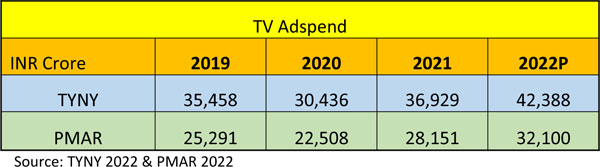
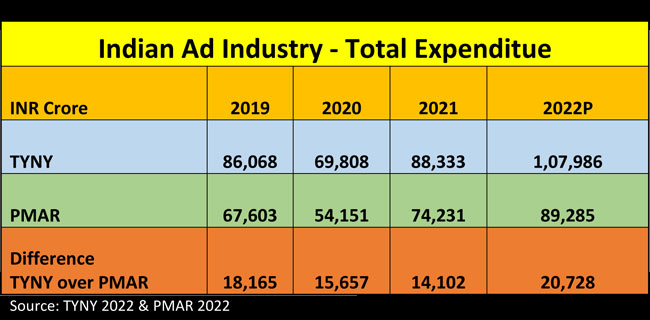
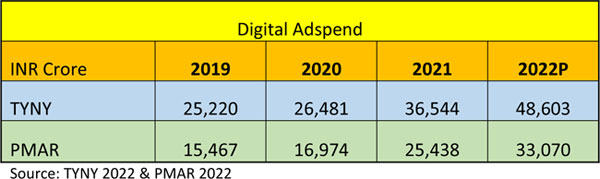
    Both GroupM and Madison Media have reported digital as the fastest growing media in 2021 and a continuity in the momentum of growth in 2022. In TYNY, digital adspends has equalled the TV adspends in 2021, where as in PMAR the digital adspends will equal or cross TV adspend in 2022.  Over the last three years, TYNY has been consistently reporting about INR 10,000 crore more in digital media ad spend than PMAR. In 2022 the ad spend in digital media is estimated to be INR 15,533 crore higher in TYNY than in PMAR.


    Similarly, in case of TV adspend, the estimate by TYNY was higher than TYNY by INR 10,000 crore in 2019, which reduced to INR 8000 crore in 2020 and 2021. However, in the estimate for 2022, the same has again become higher by INR 10,000 crore. So, the estimates for digital and TV taken together account for a difference of INR 25000 crore between TYNY and PMAR in their predictions of 2022.


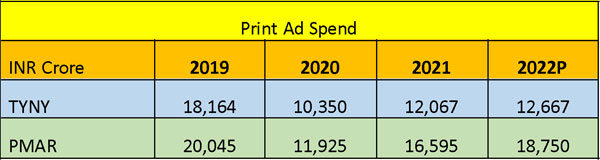
    When it comes to print adspend, the table is turned as PMAR has been consistently estimating higher spends in print than TYNY. In 2022, PMAR’s prediction for print ad spend is INR 6000 crore higher than that of TYNY. So, by combining print with digital and TV and other traditional media, the difference of INR 25000 crore gets reduced to INR 21000 crore.


    Source: TYNY 2022 & PMAR 2022


    It seems a bit unfair that TYNY has condemned print adspends in India to almost zero growth in 2022. As TYNY is done as a global report, has this estimate for Indian print ad spend been influenced by the global scenario where in most countries print ad spends have been steadily declining for years?


    I have written about the difference in the findings of TYNY and PMAR earlier in www.mxmindia.com. I know that we will never really get to know the reasons for such huge differences between the estimates of TYNY and PMAR, but it is becoming increasingly difficult to explain the reasons for the same to students of media management in a classroom as there is a danger that they may get confused and lose faith in media research.


    Read past commentary by Indrani Sen at:


    https://www.mxmindia.com/2021/02/so-how-do-the-groupm-madison-forecasts-compare/

    https://www.mxmindia.com/2020/02/a-roller-coaster-ride-of-adspends/

    https://www.mxmindia.com/2020/02/well-pitched-delivery/

    https://www.mxmindia.com/2019/02/indian-ad-industry-are-happy-times-really-here-again/

    https://www.mxmindia.com/2018/02/indrani-sen-mind-the-tv-adex-gap/

    https://www.mxmindia.com/2017/02/what-is-the-real-size-of-indian-ad-industry/

    https://www.mxmindia.com/2016/02/indrani-sen-boomtime-for-media-a-review-of-the-pitch-madison-advertising-report-2016/


  • Will BARC’s new policy for news ratings clear the mess?


    By Indrani Sen


    Indrani SenThe announcement was long overdue. Finally on last Thursday, the advertising and media industry was glued to the release of TV news channels’ ratings which was released by Broadcast Audience Research Council (BARC) after 17 months starting with Week 10, 2022.


    BARC announced that an Augmented Data Reporting Standards for news and special Interest genres has been developed and tested over some weeks before releasing the ratings to the industry. The revised approved standards prescribes that the audience estimates for these genres will be released every week based on a rolling average of ratings of 4-weeks to meet with the industry’s needs. BARC briefed their shareholders in details about the new method through webinar and Q&A sessions.


    The release of the ratings for week 10, 2022 was followed by the release of the past data for the previous 13 weeks from Week 49, 2021 to Week 9, 2022 though the ratings were not available from week 40, 2020 to week 9, 2021. It is to be noted that the channels within the news and special interest genre subscribing for BARC ratings were given an option to opt out form getting the details of the past data and consequently they have been clubbed together as “other channels” in the reports of the past 13 weeks.


    The renewal of reporting of the ratings of the news channels has come at a time when most of the annual deals for TV channels across different genres are planned and negotiated. Lately the free to air news channels have been up in arms against BARC accusing them of delaying tactics by not releasing the ratings of the news channels before the crucial period when decisions about annual distribution of TV ad revenues are made. BARC defended themselves with the argument that data processing as per the new methods and testing of the data had to be given adequate time.


    The document on ‘Policy for Augmented Data Reporting Standards for News & Special Interest Genres’ is available on the website of BARC India and clarifies the definitions of

    1. Genre-Language Classification of Channels and

    2. Definition of News and Special Interest Genres


    It also details out Augmented Data Reporting Standards which has been developed “In order to preserve data security and integrity and keep the cadence of advertisement planning consistent for all channels” (Source: https://www.barcindia.co.in/policy-updates/barc-india-policy-for-augmented-data-reporting-standards.pdf)


    Every week, BARC will release two databases of which the currency data will be a “4-week rolling average channel level audience estimates for the News and Special Interest genres and regular daily unrolled audience estimates for all other genres/channels.” This currency data will be available to all subscribers in the YUMI software and will be used for all transactions including rate negotiations. The second database will be weekly unrolled data and will be released only to broadcasters having one or more channels in the news and special interest category through a separate YUMI database and license. The broadcasters will only get to see the unrolled data for their own channels and not for their competitive channels. This unrolled data cannot be used for transactional purpose, but only for analysis of performance of own channels and future planning for the same. Many features of the currency data will not be available for the unrolled data. Respondent Level Data (RLD) audience estimate will be available for the news channels only on a rolling average of 4 weeks basis and under currency data and will not be given under unrolled data.


    The new policy has provision for Customized Event Reports (CER) with well defined target groups for different genres. It also provides Currency Data Usage Guidelines to the news and special interest genres. Finally, it has provisions for News Query Resolution for Current & Past Data with rules and regulations applicable for the same.


    On the whole, it seems that BARC India has come up with a technology driven solution for taking care of the issues of high variance and bounce found earlier in the audience estimates of News and Special Interest genre channels. The problem was largely related to low sample size tuned to these channels and their specific target audiences. Let us hope that this new policy would satisfy the channels in the News and Special Interest genre and will end their grievances against BARC India.


  • Remembering my friend, Pradeep Guha


    By Indrani Sen


    Indrani SenPradeep Guha would have been 70 today, had he not passed away last year on August 21 after a short battle with cancer which unfortunately was detected at the last stage. As I was not aware about his disease, the news of his death was a big shocker for me. The MxMIndia editor asked me then if I would like to do a piece on Pradeep and I declined.


    I met Pradeep Guha in Mumbai in 1976, when I was a rookie media planner in Ulka Advertising and he, a fresh graduate from St Xavier’s College, Mumbai, was a trainee in media sales with TOI. Pradeep was a few years younger than me, but we hit it off very well from our first meeting. He had been a left-leaning student leader in his college days and I had been actively involved with leftist student politics during my college and university days in Kolkata, yet both of us were disillusioned with the state of left politics in India. In our own ways both of us we were eager to explore the roles media can play in advertising and marketing industry. We had a lot to share and much to discuss. Gradually we became sounding boards for reviewing each other’s ideas.


    We discussed about how to use readership research more effectively for media planning and selling; we debated the scope of value additions and innovations in newspapers and speculated about the possibility of rate negotiations when the word was a taboo in the industry. Pradeep had an ability to think laterally ahead of his time and never failed to amaze me with his zest for new and innovative ideas and his energy for planning and executing their implementations. These inborn traits, which I found in him in his mid-twenties, later helped him to excel in his career and become a larger-than-life personality.


    I still recall visiting the Colaba office of ‘Centre of Education & Documentation’, Pradeep’s dream project where he had started to build a library, a resource and research centre based on clippings from published news and articles. He firmly believed that reports in print media had the latest information which published books did not have. Before the internet age, Pradeep was able to think out of the box and visualize the importance of having latest information at the fingertips. After Larry Page and Sergey Brin conceived Google in a dorm of the Stanford University and subsequently marketed Google Search in 1998, I recalled about Pradeep’s CED which had the same seed of idea minus the new media technology.


    In 1982, Sameer Jain took charge of BCCL and Pradeep Guha became one of his trusted lieutenants. During the eighties and nineties, Pradeep continued with BCCL was responsible for executing the vision of Sameer Jain and transformed the Times media sales department to Times Response, he mentored a formidable salesforce well trained in concepts of media planning, advertising and marketing. Under his guidance the rate cards for BCCL publications morphed to “Mastermind” encouraging advertisers and agencies to buy space in various newer/ smaller editions along with the main editions at reasonable prices ensuring no loss to the marginal editions. The concept of “Invitation Pricing” was also Pradeep’s brain child. He literally gave a new lease of life to the print media industry of India. He was the real architect behind the “Samir Jain Years” (ref Indian Media Business by Vanita Kohli Khanderkar) in print media.


    It is difficult to decide if Pradeep’s contribution was greater in space marketing or in brand building. He changed TOI and other BCCL publications to well defined brands supported by multiple branded properties. The Bombay Times Annual Party, Filmfare Awards, Femina Miss India, Femina Look of the Year, the Economic Times Entrepreneurship Awards all were turned from mere events into branding properties by Pradeep which built the brands individually and collectively built the group. He was also credited with conceptualizing the Page 3 Culture through TOI’s metro editions.


    Pradeep’s efforts behind lifting up the standard of the Femina Miss India show led to India’s successes at Miss World and Miss Universe. These branding properties built by him in turn accelerated the growth of other industries like beauty, modelling and Bollywood. Driven by his passion for advertising, he was responsible for associating BCCL with Cannes Lions and creating India’s visibility at Cannes Lions Festival. He was its first Country Representative from India and held that position for 10 consecutive years at Cannes. I became an ardent admirer of Pradeep as I watched his exponential growth over three decades in BCCL. I salute his other friends and admirers who took the initiative to name the lane before the Times of India building in Mumbai as “Pradeep Guha Chowk” earlier this year. A fleeting tribute to his monumental leadership.


    Meanwhile, I had come back to Kolkata for family reasons in mid-eighties. Pradeep was heading the Kolkata office of BCCL at that time, but he returned to Mumbai shortly to take charge of Times Response. Till mid-nineties I had opportunities to meet and catch up with Pradeep during either his visits to Times Kolkata office or my official trips to Mumbai. In 1996, Pradeep helped me to pull off a media coup when he agreed to publish and distribute the Official Handbook of Wills World Cup with TOI’s Mumbai and Delhi editions free of cost against the right of selling ad space in the handbooks. It was a copy book case of a win-win negotiation.


    After nearly 30 years, Pradeep left BCCL when he was President of the Times of India Group and a member of the Board of Directors to join as CEO of Zee Entertainment and launched the English daily DNA in 2005.  However, he left Zee after a short stint of 3 years and became an entrepreneur by purchasing 10% stake in 9X Media (where he remained as the MD till his last days) and launching his own consultancy firm. Pradeep had produced two films earlier, Fiza in 2000 and Tehzeeb in 2002; his third production Phir Kabhi was released in 2009 after his exit from the Zee Group.


    There were lot of speculation in the industry about his exit from BCCL and many predicted that Pradeep Guha’s best years were over. His critics were blissfully unaware that he continued to support our Ad Industry at large by dawning various hats during his tenure with BCCL as well as after his exit from BCCL. He was the President of the Advertising Club Bombay, President of the Indian Newspaper Society, Chairman of the National Readership Studies Council, Chairman of Ad Asia (Jaipur), Chairman of the Asian Federation of Advertising Associations (AFAA), the Vice President and Area Director of the International Advertising Association (IAA), Asia Pacific region and the first Chairman of the Broadcast Audience Research Council (BARC) which was launched in 2014 and started reporting TV ratings from 2015. Pradeep Guha was the Chairman of the Steering Committee of the successful World Congress of the International Advertising Association held in India for the first time in February 2019 at Kochi. At the time of his death in 2021, he was affiliated to the Board of Directors of Raymond Ltd, Pritish Nandy Communications Ltd and Whistling Woods International.  The Ad Industry had never before seen such a versatile leader who always delivered the desired result and many times exceeded the expectations!


    After the nineties, Pradeep and I had gradually drifted apart, meeting only in certain big industry dos where Pradeep used to be super busy with organising the shows. Whenever I could manage to snatch a few minutes with him for a chat, he was always the same old Pradeep with the same twinkle in his eyes and the same warmth in his smile. His wife Papia Guha recently requested me to write a few lines on him for inclusion in the coffee table book on him. However, in the small write up, I could not express all my thoughts, so here is my tribute to my old friend Pradeep Guha, an extraordinary man who walked tall during his life time and left a long tail of unforgettable impressions on many other men and women who were fortunate enough to come in contact with him.


  • Smalltown India is the future for SVOD


    By Indrani Sen


    Indrani SenOrmax Media, a specialised Insights consultancy firm, was established in 2008. In its own words: “Over the last 13 years we have pioneered the usage of various testing, tracking and forecasting-based tools, designed to achieve higher profitability in films, television, streaming, print, radio and other categories in the Indian media industry… We are constantly innovating to introduce new tools and build knowledge that can help the Indian media & entertainment industry use consumer insights and data analytics to create businesses, brands, shows, films and campaigns that are both consumer-centric and profitable.”


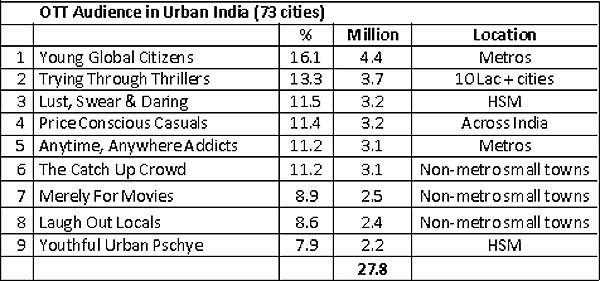
    Ormax Media launched the first edition of its Ormax OTT Audience Report 2019 with a promise to conduct similar reports year on year. In its first report, Ormax analysed the viewing behavior by preference of content watched and divided the urban OTT audience into interesting segments of nine different types.


    Source: OTT_AudienceSegments_OrmaxMedia__1_.pdf


    The onslaught of Covid-19 and the national lockdown forced them to miss the opportunity of conducting field research in 2020. But Ormax was back in 2021 with the 2021 report based on a 12,000 sample size across urban and rural India. As per that report, OTT audience universe in India in 2021 stood at 353.2 million (35.32 Crore) people. In other words, the penetration of OTT viewing was of 25.3% of the population, “which means that one in four Indians watched online videos at least once in the last one month”. The report was aligned to other syndicated media research and presented analysis of the universe by gender, age, NCCS, pop strata, states and cities.  This second report elevated OTT from a niche medium to a mass medium with huge prospect for further growth. It was possible to calculate reach of the OTT medium in different target audiences for the first time. The report also revealed that in 2021 there were 353 million OTT users in India of which 40.7 million were paying (SVOD) audiences accounting for 96 million active OTT subscriptions. In other words, each unduplicated paying audience member was subscribing to 2.4 OTT subscriptions on an average. This SOVD audience were dominated by male members who constituted 66% of 40.7 million.


    Last month, Ormax Media released The Ormax OTT Audience Report 2022, which has some interesting insights related to viewing habits of OTT audiences including content watched in different languages. The latest report is based on a sample size of 6,000 SVOD and AVOD audiences in urban India, and is probably India’s largest profiling study of the streaming /OTT audience.


    The report has revealed that Indian SVOD viewers use the dubbing and subtitling options on their OTT platforms and watch content in four to five languages on an average, while AVOD viewers watch in at least two languages, primarily due to less content options available to them. AVOD viewers watch a lot of content on YouTube where no dubbed content available.


    Content in the four South Indian languages have a large audience outside their home states, 88 per cent Malayalam SOVD content viewers and 82 per cent Tamil SOVD content viewers are respectively from outside Kerala and Tamil Nadu.


    This research also has highlighted the difference in preferences for content between SOVD and AOVD audiences.  The latter do not prefer to use web series instead they want more of shorter formats, like comedy scenes, songs, knowledge videos, including recipes, education and health, and films.


    The research has predicted that the next level of growth of SOVD viewers would come from small towns as 60-70 per cent of the top six metros’ population has already converted to SVOD audience, making the metros a near-saturated market. The male domination of the SOVD audience segment continues which may be due to other socio-cultural reasons and not just financial independence of women.


    On the whole, The Ormax OTT Audience Report 2022 has opened up a new vista of opportunities for content strategy and content creation for the Indian OTT platforms. It is interesting to note that Ormax media so far has not repeated any research on OTT audience in India, but has looked at a new concept for research every year to provide the users in the industry with either better estimates or in-depth insights.


  • Thoughts on IPL Media Rights, a week after


    By Indrani Sen


    Indrani SenLast week, on June 14, 2022, the final results of the e-auction conducted by the Board of Control for Cricket in India (BCCI) were declared with the Board earning a whopping Rs 48,390 crore for all the packages offered by them for auction. The amount is almost three times of Rs 16,376.5 crore, the money which Star India paid for TV and Digital media rights for the 2017-2022 cycle. This has made IPL the second most valued sports league in the world, next to America’s National Football League pushing English Premier League to the third position.


    By now everyone knows that this time Disney Star India has won only Package A containing telecast rights (India sub-continent) for next five years 2023-27 by bidding Rs. 23,575 crore. Viacom18 has bagged Package B containing digital rights (India subcontinent), Package C containing digital rights of 18 matches per season and part of Package D containing media rights (both TV and digital) for three global regions, Australia + New Zealand, the UK and South Africa, the main cricket playing countries whose players have been regularly participating in the IPL tournament. There is some confusion in the market related to the total payment of Rs.23,758 crores made by Viacom 18 to BCCI as lot of people have concluded that the amount has only been paid for the domestic digital rights whereas Viacom18 actually paid Rs 20,500 crore for the domestic digital rights. The media rights for the balance global regions have been won by Times Internet.


    Lalit Modi has been getting lot of coverage related to IPL media rights auction this time as cricket historian and author Boria Majumdar timed the release of his book on Lalit Modi “Maverick Commissioner” last week right after the announcement of the winners of IPL’s e-auction for media rights for 2023- 2027. Majumdar also announced that his book will soon be made into a film. Suddenly. media channels are busy interviewing Lalit Modi who is having a field day. At the time of writing, I read his interview on www.mykhel.com where he has said that BCCI should make it mandatory for all IPL franchises to own a women’s team in order to start a Women’s IPL in India. Last week, in an interview to NDTV Sports, he said that value of media rights will double again in next cycle as IPL viewership is probably the highest in the world in terms of people watching the matches (https://sports.ndtv.com/ipl-2022/ipl-viewership-probably-highest-in-the-world-lalit-modi-to-ndtv-3079226 ).


    While the Indian M&E industry is still struggling with its overall growth after the pandemic, one wonders from where the growth in the value of IPL media rights will happen? According to the EY FICCI report 2022, digital advertising grew by 29% in 2021 and TV advertising grew by 25% in 2021 which was still slightly short of the pre-Covid 2019 level. TV subscriptions continued to fall in 2021 for the second consecutive year. In the last few weeks of IPL, there was a sharp fall in the TV viewership which had raised doubts about the base rates fixed by BCCI for the e-auction. If any particular media property grows at a much higher rate than the market average for a certain period, it does so at the cost of other media properties in the same media bucket which cannot be sustained in the long run. Only time will tell if the value of IPL media rights based on the current e-auction will be actually attained.


    Back in 2016, when Star India won the TV and Digital rights for IPL (2017-2023), a lot of doubts were raised about the possibility of their success in achieving the targets. This time, industry people are speculating more about the winning bid of Rs 20,500 made by Viacom 18 for the digital rights and the implications of TV and digital rights going to two different organisations.  The Reliance-backed Viacom18 seems to have played its cards well based most likely on a deep-routed strategy for increasing their market share in online video viewing backed by the huge share of Jio in the telecom market. The introduction of 5G is expected to change consumers’ choice for live viewership of sports events from TV to mobile during this 2023-2027 cycle.


    According to an article by Javed Farooqui on Exchange4media on May 7, 2022, London-based Omdia’s recently published report on online video viewing trends shows that in India Disney+Hotstar leads the chart with 41% share. The article also shared the following graphic from the research.


    Source: https://www.exchange4media.com/digital-news/disney-hotstar-has-41-share-of-indian-online-video-subscription-market-omdia-112817.html


    Disney+ Hotstar’s subscription base tripled during pandemic years from 8 million to around 25 million by the end-2020, thanks mostly to IPL’s coverage and the competitive pricing of its annual plan. Omdia believes Disney+ Hotstar will continue to lead the standalone subscription online video market. The same report estimated that online video-on-demand (VOD) subscription market in India reached a value of $639 million in 2020, up by 142% from 2019. Disney+ Hotstar and Netflix together accounted for 78% of the total online video subscription market.


    ViacomI8 may be planning to revive Voot with this bid for digital media rights of IPL and may be also ready to write off losses, if any, as part of marketing cost for promoting Voot. With 41% marketshare, Disney+Hotstar was not required to invest proportionately high amount in winning the digital rights of the IPL. On the other hand, Disney Star India has a greater need to protect its turfs in the various TV genres where competition is much stronger.


  • Indian M&E CAGR 8.8%, nearly twice that of global

    Note: 2021 is the latest available data. 2022–2026 values are forecasts.
    Source: PwC’s Global Entertainment & Media Outlook 2022–2026, Omdia


    By Indrani Sen


    Indrani SenPWC’s 23rd annual Global Entertainment and Media Outlook released on June 23, 2022 shows that globally after a setback in 2020 due to the pandemic, the entertainment and media industry is set on a steady path of recovery with a CAGR of 4.6% during 2021-26 to reach a market size of US$ 2.9 trillion in 2026 as shown in the chart below.


    Under the title “Fault lines and fractures: Innovation and growth in a new competitive landscape” the report says: “But amid all the unpredictability, there is greater clarity about the overall trends of the market and the forces driving growth, and a better understanding of the fault lines and fractures that are altering the entertainment and media landscape.” It is worth quoting another interesting observation “But the stable overall growth pattern masks an underlying volatility. It is clear that the pandemic accelerated changes in consumer behaviour and digital adoption in ways that will affect future growth trajectories. Some of the sectors that saw immense gains amid the pandemic will not be able to sustain that growth, while others will continue to build from their higher bases.”


    Turning its focus to India, the PWC report has made some interesting predictions. The Indian media and entertainment industry is expected to reach INR 4,30,410 by 2026 growing at a CAGR of 8.8%, nearly double the global CAGR of 4.6%. Deeper penetration of internet and mobile devices along with the roll out of 5G over next five years, are expected to fuel the growth of digital media and advertising while the traditional media, particularly TV will continue to hold a steady growth rate.


    Let us take a closer look at the new media sector.


    In terms of growth, India’s total video games and esports segment leads the media pack increasing at a CAGR of 18.3% from a revenue of INR 16,200Cr in 2021 to INR 37,535Cr in 2026. Given the size and population of India, it is comparatively a small market for video games and e-sports. Dominated by social and casual gaming, India currently is the third fastest-growing video games market in the world, after Turkey and Pakistan.


    The OTT segment will have the second highest growth with a CAGR of 14.1% and will touch a total revenue of INR 21,032 crore in 2026. This growth will mostly be driven by various subscription services accounting for 90.5% of revenue in 2021 with a forecast to account for 95% of revenue in 2026.


    OTT will be followed closely by the internet advertising with a 12.1% CAGR to reach INR 28,234 crore in 2026. Within the segment the mobile sector accounted for 6 0.1% of the total revenue in 2021 which is expected to increase to 69.3% in 2026.


    India’s TV advertising market saw a -10.8% decline in 2020 over the 2019 levels due to the pandemic, but recovered in 2021 with a 16.9% growth to INR 32,374 crore. The market is predicted to grow at a 6.3% CAGR to reach INR 43,410Cr by 2026. According to PWC, this will make India the fifth-largest TV advertising market globally, after the US, Japan, China and the UK.


    The total newspaper revenue is predicted to grow at a 2.7% CAGR from INR 26,378Cr in 2021 to INR 29,945Cr in 2026. India will become the fifth-biggest newspaper market by 2026 overtaking France and UK. Interestingly, in spite of a low CAGR, India will be the only country globally to grow total newspaper print revenue consistently across the 2020-26 period. During this period, India will also be the only country to grow daily print newspaper copy sales (by volume) at a 1.3% CAGR.  By 2026 India is expected to have 139mn daily average print newspaper sales, one-third of the global daily total earning the distinction of the biggest world market for print putting China in the number two position.


    Among the other smaller media and entertainment segments, India’s music, radio & podcast segment grew at 18% in 2021 and is expected to grow at 9.8% CAGR to reach INR 11,536Cr by 2026. The subsegment recorded music industry will continue to make steady progress at a CAGR of 13.6%, thanks to audio streaming platforms and touch INR 4,849Cr by 2026. In comparison, live music industry continues to remain small.


    India’s out-of-home (OOH) advertising market is predicted to grow at 12.57% CAGR to reach INR 5,562Cr in 2026. In 2020 this segment faced the biggest fall in revenue globally, however, it also recovered spectacularly in 2021 by 63.4% over the 2020 levels to INR 3,076 crore.


    As far as cinema industry is concerned, India was the third-biggest market globally in terms of ticket sales after China and the US in 2021 and is expected to grow at the highest growth rate of 38.3% CAGR during 2020-26 to reach INR 16,198 Crore in 2026. It should be noted that in 2021, the number of total tickets sold was still much below the pre-pandemic level. In terms of advertising revenue, the share of cinema advertising is miniscule due to the inherent problem of building reach and OTS through the medium, though the big screen impact offered by cinema is undeniable.


    To sum up, the Indian media and entertainment industry seems to be running on a healthy track with various prospects of creating new world records. Compared to various other such industry reports, the global comparisons across different segments makes the PWC report an interesting read.