
Category: Opinion – Archives

  • Brand Purpose & Credibility: Key to survival for Brands


    By Bhuvi Gupta


    Bhuvi GuptaThe last few weeks have had us all heaving a huge sigh of relief. The hold that the Covid-19 Delta variant had taken over our lives seems to have abated for the time being. We are all now in between where we have a longing to return to business as usual (usual being the new normal) at least for the short term but are scared about when the Third Wave will rear its ugly head.


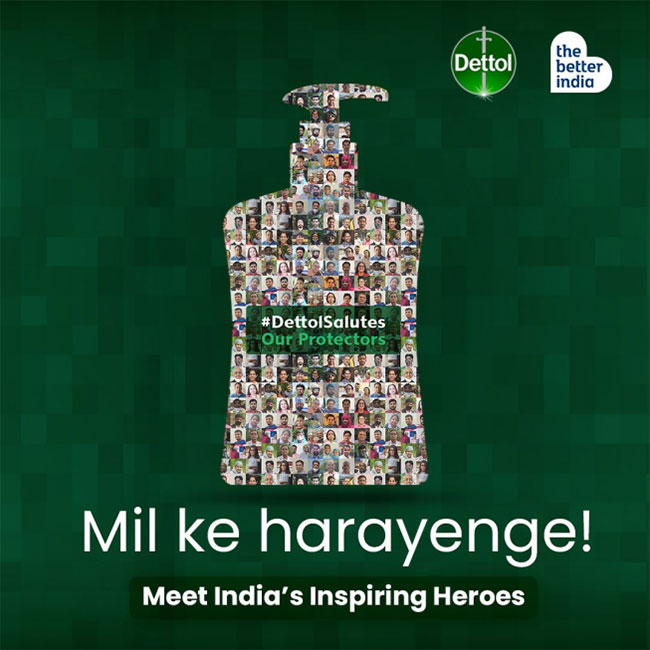
    The storm of the last month made us all grateful for the positive power of the social media. And Dettol captures this sense of gratitude perfectly in its timely Covid warriors campaign which has just been launched. It hits the ball out of the park for multiple reasons – the timing, the ‘grateful’ mood of the nation, how it captures brand’s promise of protection and safety, and its high virality quotient.


    We all depended on Covid warriors the past few months – these are people who managed to save lives by foraging for medicines, ventilators and beds by using social media and extending their networks. It is influencer marketing campaign but in a respectful way because atypical ‘influencers’ are being used. By using influencers, Dettol gets the benefit of their reach and engagement thereby ensuring virality. The campaign replaces its branding on the package to celebrate these unsung heroes. Packaging has long been an under-leveraged branding vehicle. The campaign is hence a win all the way and is bound to pick up many a pencil, elephant and metal.


    Dove and  ‘Hair Love’


    I have talked about how with the information overload that the internet and specifically social media has decreased mental bandwidth for retaining advertising in many of my pieces.  Long-form marketing, content marketing, product placements that add credibility to the product narrative hence become more important to kindle a desire to purchase. Internationally, Dove and Nike are both investing in being true to their brand purpose.


    It has always fascinated me that the 2020 Oscar-winning short film, Hair Love was funded via a Kickstarter campaign and that a major participant in the Kickstarter was Unilever-owned Dove. Despite funding the short film, Dove did not try an overt product placement but kept its participation covert.  Just as other entities that contributed to the Kickstarter, Dove only appears in the ending credits. Because the messaging was true to the brand narrative, it helped market the film by arranging for community screenings, and reaching out to tastemakers and media.  This did not help them to sell products but it did help them to cement their perception as a brand which was genuine.


    Nike – Breaking2

    A similar case is of Nike. Nike has set the bar for sports marketing in the last few decades and they are constantly raising it to ensure they maintain a high share of voice.  In 2014, Nike set out to do what was impossible at the time – a project to break the two-hour marathon barrier. The documentary Breaking2 captured the entire three-year journey that culminated in an unsuccessful attempt in May 2017. While the star marathoner, Eliud Kipchoge missed the 2 hour mark by a mere 26 seconds in 2017, he achieved the feat in 2019.


    The project leveraged science and research to create an optimum environment which enabled the carefully chosen athletes a shot at breaking the record. The environment comprised of the perfect shoe, the best possible time of year, the track, a mechanism to manage headwinds (which affect speed) and many other miniscule parameters.


    While the project executed over a three-year period was directly linked to Nike’s products, it was the larger objective of relentless effort to enhance performance to test the limits of human endurance and capability, which made it closer to brand purpose than marketing communication.


    It was hence a perfect balance – communication that served a larger purpose while also enabling the company to sell shoes.


    Brand purpose is key in 2021. Customers want brands to embody an inspiring ethos, have a strong point of view and take actions to spread their purpose rather than communicate only to sell products.


    In a crowded market, the only way a brand can stand out today is to add credibility in communication.  Marketing is inherently transactional in nature, but communication which leads with brand purpose is key to move customers down the funnel and make them return, especially for products which are easily replaceable.

  • How Meme Marketing has become a Must-have Arsenal for the Modern-day Marketer


    By Bhuvi Gupta


    Bhuvi GuptaDifferent reports peg India’s social media user base anywhere between 350–400 million users. That is roughly the population of the United States. The millennial and Gen-Z generations that form a bulk of this number talk in a universal language of emojis and memes. Memes have penetrated our style of communication indelibly.


    A subset of moment marketing – Memevertising – is not just having a moment but is here to stay. Like emojis, the language of memes is universal. Memes work because they take universally relatable scenarios coupled with a striking expression on the faces of the meme star(s). This creative hence can lend itself to multiple and different interpretations and hence spreads.


    The word meme has its origins in the Greek word mimetic, which means to imitate. As per Wikipedia, a meme is formally defined as “a unit for carrying cultural ideas, symbols, or practices, that can be transmitted from one mind to another through writing, speech, gestures, rituals, or other imitable phenomena with a mimicked theme. Considering the increase in time spent online due to the pandemic, and difficulty in communicating via non-verbal signals, now more than ever before memes should be an essential part of a marketers toolkit.


    In today’s hyper-connected world where all brands aspire to go ‘viral’ at all times meme marketing or memevertising is a great way to actually accomplish the goal.


    Don’t be blatant, be subtle:

    Memes have a unique structure in which they put a humorous or relatable twist in a piece of communication that is essentially derivative. However, the best memes do not reference brands via their name but the more intangible elements such as the personality, positioning and values. Like moment marketing, memes capitalise on contemporary situations such as sporting tournaments like IPL, Wimbledon, politics, trending TV shows and movies etc. Hence, most memes have a shelf life so timing becomes key.


    Doing it right:

    Today, brands have elaborate content calendars where in they play to every celebrated stereotype and day just to ride on the trend. A lot of this effort often gets lost because the messaging is generic, it doesn’t fit the target audience, and there is a glut of content.  While leveraging memes, this risk is heightened, as memes by their nature are light-hearted. So treading with caution is essential to avoid a misfire.


    The caveat is of course that even when consciously trying to ride on trends, brands must understand their brand, target audience, consumer behaviour profiles so that relevant people discover the generated virality.


    Agility & Responsiveness: 

    Brands need to be agile and responsive to create and sustain brand value today. This is true of managing their reputation online, assessing dynamic consumer behaviors and moment marketing. Most of this, brands are already doing. Memevertising is but an extension of that.  To capitalise on the day that social media posting has to create a few different expression and globally known stars.


    Spreading the message:

    In terms of the marketing funnel memevertising fits into  ‘awareness’ stage. By capitalising on trends, brands have an opportunity to get discovered by an audience that may not have been exposed to the brand before.


    Hence, if brands nail their memevertising they must ensure there is an effort to distribute their messaging. This can be done by animating memes into GIFs and sharing them on GIPHY, and Google-owned Tenor. These platforms allow brands to have brand channels and are integrated with social media platforms like Instagram, WhatsApp and Facebook etc.


    Netflix, Drake & Irrfan Khan – The meme:

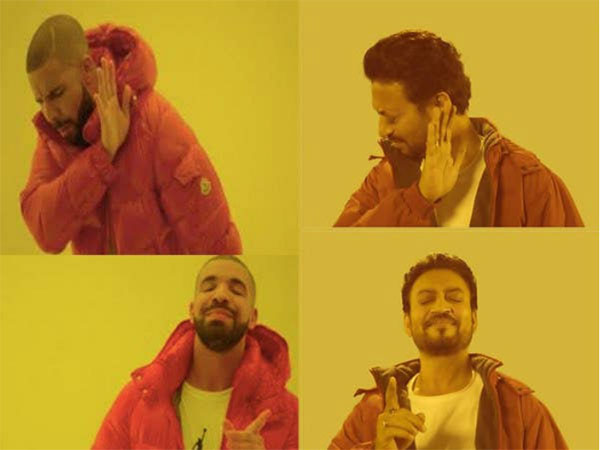
    More than his music, Drake would be remembered for how he has used memes to create his indelible brand across the world. Whether or not one has heard his music the world has definitely seen and mostly forwarded one of the renditions of his ‘Hotline Bling’ meme. A designed strategy, which has helped him gain worldwide, fame and has a million lessons for marketers.

    Irrfan Khan also famously replicated this meme while marketing the film ‘Hindi Medium‘ with AIB in 2017. Khan replicated the Top 6 trending meme formats at the time. The irony of course is that all six original memes are as popular today as they were four years ago.


    Netflix is another master at memevertising. A glance at their social media timeline is a lesson for budding memevertisers, because they are witty, on trend, never blatant about their brand name.


    In conclusion, memes and gifs are here to stay and to brand must use them in their digital marketing calendars.


  • Will the New I&B Minister fulfil M&E Industry’s Expectations?

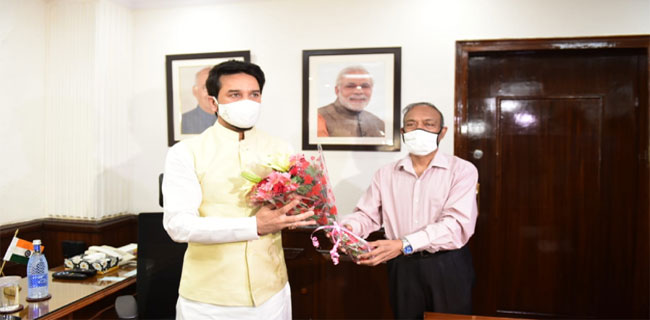
    The Minister taking charge (PIB photograph)


    By Indrani Sen


    Indrani SenLast week, in the reshuffling of the cabinet of ministers of the Central Government, Anurag Singh Thakur took over a double-barrelled charge of Sports & Youth Affairs Ministry from Kiren Rijiju and Information & Broadcast Ministry from Prakash Javadekar. He was elevated to full cabinet minister rank from minister of state rank in which capacity he has been working in the Finance and Corporate Affairs Ministry since 2019.


    Two years back, I first read about Anurag Thakur when he was appointed as a Minister of State “…’You elect Anurag with a record margin, I will make him a big leader,’ Shah had urged the voters at an election rally in Bilaspur, Hamirpur, on May 12. They did. And Shah kept his word, with Thakur being sworn in as a Union minister last Thursday.


    (https://economictimes.indiatimes.com/news/elections/lok-sabha/india/from-bcci-to-union-cabinet-anurag-thakur-enters-big league/articleshow/69585917.cms?from=mdr). Thakur first got elected to Lok Sabha from Hamirpur through a bypoll in 2008 and then won the same seat three times in 2009, 2014 and 2019.


    Amit Shah has continued to honour his promise as in two years Thakur has not only got elevated to the rank of a full cabinet minister, but has also been entrusted with the charges of two key ministries considering the importance of young voters in India and the dynamically changing media scenario in the digital age. It is expected that Thakur will be able to resolve the issues faced by both the M&E Industry and the sports industry given his record as a parliamentarian from 2008, former Chairman of the IT Committee and President, BCCI.


    Last week, various leaders from M&E industry welcomed Thakur as the newly appointed I&B minister and expressed their hopes that he would be looking into various concerns and demands of the various sectors and would provide a level-playing field for TV broadcasters, publishers on print & digital platforms, radio operators, cinema producers, etc. The various issues which are on the cards currently can be divided into two categories, one related to the content of the media and the other related to all non-content issues. Let us first look at the issues in the first category related to the content of media.


    Starting June 18, the Centre has sought public comments on the draft bill of the proposed Cinematograph Amendment Bill (2021) which includes fine and a jail term for film piracy, introduces certification on the basis of age and empower the Central government to order recertification of an already certified film following receipt of complaints. Centre had sought public comments on the draft bill starting June 18, 2021. Six film trade associations have already sent a joint representation to I&B Ministry objecting to the revisionary power sought to be provided to the Centre. Well-known filmmaker Shyam Benegal has also opposed this bill, saying that the government has no role in film certification and recertification. As this proposed amendment enhancing the role of the Central Government in deciding on the content of the films seems to be part of a bigger gameplan of the Central Government to choke the voice of Indian media, it is doubtful if Thakur in his new role will be prepared to listen to the voice of the industry.


    The timely adoption of the new IT rules by OTT and digital news channels also belongs to the content category and the bigger game plan mentioned above. Under this rule digital media publishers, publishers of digital news linked to traditional media, and over-the-top (OTT) media service platforms to furnish basic information about themselves and their self-regulatory mechanisms creating a role for a government appointed regulator for overruling the decisions of self-regulatory bodies. As I wrote earlier on this topic (https://www.mxmindia.com/2021/06/will-indian-netizens-lose-their-digital-rights/), so will not elaborate on it again. Subsequently, many publications moved court against the IT rules 2021. The Supreme Court has turned down a transfer petition filed by the Centre seeking transfer of all cases related to IT Rules to the apex court. Thakur will be expected to handle the legal cases and resolve the issue to the satisfaction of the Central Government.


    About two weeks back, the Central government introduced a three-tier grievance redressal mechanism as an amendment to the Cable Television Network (Regulation) Act with the intention of making the content related grievance redressal system for TV Broadcasters at per with the OTT and digital news platforms. The TV industry requires more clarity on this issue and its implementation.


    Among the pending issues pending for some time in the non-content category, the following require immediate attention from the new I&B minister:

    :: Certain long-standing demands of broadcasting sector related to their demand for an infrastructure status, liberalised licensing regime and a stable regulatory climate. The proposal of IBF seeking stimulus package based on economic relief and flexibility in the regulatory system.


    :: Addressing broadcasters’ concern about 5G system disrupting their transmission. Almost all C-Band satellites use spectrums between 3.7 GHz and 4.2 GHz for their downlinks and band of frequencies between 3.7 GHz and 4.9 GHz are used by most television channels for their operations which are adjacent to the band of frequencies identified for 5G usages in the country in the range of 3.00 GHz to 3.6 GHz.


    :: To come up with a solution for audience measurement of TV channels by either introducing reforms in the current system of BARC or by setting up an alternative TV measurement system. In November, 2020 I&B Ministry formed a committee headed by Prasar Bharati CEO Shashi Shekhar Vampati to examine the matter and to give a recommendation. The Vampati Committee submitted its report to the I&B Ministry in January, 2021, but the content of the report was not shared with public at large. The recommendations may also provide some guidelines for resuming the ratings of the news channels which have been suspended by BARC.


    The M&E industry at large and the TV broadcasters in particular are hoping that Thakur will address their immediate concerns impartially and will take positive steps towards making constructive changes in the media ecosystem. Industry watchers like me are keeping our fingers crossed as only time will prove the efficiency and effectivity of our new I&B Minister.


  • Bhuvi Gupta: How Marketers can both make money and save money via behavioural targeting

    Bhuvi GuptaBy Bhuvi Gupta


    It’s often said half of the monies spent on advertising are wasted, you just don’t know which half. Before the advent of digital advertising this was true. I ‘d say that the vast majority of advertising was a waste and only a fraction reached the right audience, because marketers relied on high-budget, high frequency ATL campaigns to get mass visibility. This was because while behavioural targeting made sense in principle, it was near impossible to execute and marketers had no choice other than relying on demographics to reach potential customers. Hence, attributing marketing spends to customer acquisition always ended up being vague and immeasurable.


    While demographics like age, gender, financial status are a precursor to behaviour, they are not a determining factor. Statements like ‘she doesn’t act her age’, ‘spendthrifts’, being mannish, ‘spinsterhood’ et al while used derogatorily have always been common and defined a larger part of the population than we‘d like to believe. Therefore, depending solely on demographics means losing customers, which may not even feature in the target audience. With gender fluidity, freedom and credit cards gaining acceptance, demographics have lost relevance even more as people can afford to now fit into which ever buckets they like.


    With digital advertising demographic targeting should hence be used only as a filter. There is a wealth of information that digital advertising platforms like Facebook (via Custom and LookAlike Audiences) and Google (via Tag Manager) allow you to access that can help marketers to target consumers in more nuanced ways through their behaviour, personal interests and hobbies and life stage.


    In 2019, P&G changed its targeting strategy from demographic based to a psychographic based. They called it ‘smart audiences’ and described it as “reinventing brand building from wasteful mass marketing to mass one-to-one brand building fuelled by data and technology. Based on a 1 billion strong customer database they defined up to 350 + new narrowly targeted audiences focused on the intersections of behaviours, mindsets and P&G products minus typical demographic information. Examples of these newly targeted audiences included ‘first-time moms’, ‘first-time washing machine owners’ etc. The move helped them cut $350 million from their advertising budget while increasing sales.


    The caveat here is that a company the size of P&G has a wealth of first-party data that it can leverage to great effect. However, for smaller companies, this is just not possible. A similar way to reach audiences is to leverage third party cookies or lookalike” or “actalike” audiences offered by large advertising platforms (like Google, Facebook, Snapchat, and Pinterest).


    Cookies to avoid the cookie-cutter approach

    Bad puns aside, Cookies are trackers that are placed on a user’s computer by a website or application. These trackers collect data that is used to provide the user with a more relevant web-surfing experience. Cookies also store user settings, login information, and other useful information. There are two main types of Internet cookies: first-party cookies (like used by P&G) and third-party cookies.


    First-party cookies are stored by the website and third-party cookies are created by domains other than the one currently being viewed. First-party cookies make a user’s experience on the website more streamlined, while third-party cookies streamline user experience across the Internet by serving relevant ads on other websites.


    Third-party cookies can be used to personalize user experience across the Internet. For smaller companies that do not have access to first-party data, they must be used for retargeting and advertising.


    Hence, focusing on behaviour and life-stage that are now disassociated from demographics like gender, income, location, age is key to measuring the Return on Investment for marketing. As technology evolves using tools like Artificial Intelligence and automation, personalisation to improve customer experience will become crucial. Behavioural targeting will be key to unlock the future. The sooner marketers jump on the bandwagon, the better it is for them and the customer.

  • Identity Crisis within Social Media

    Image courtesy: https://anchordigital.com.au/


    By Indrani Sen


    Indrani SenThe discussions about the identity crisis faced by the users of social media, particularly the younger generation, started almost from the inception of social media. Lately researchers, academics and industry watchers have been talking about other identity crisises within the social media. The first crisis relates to managing one’s identity on the internet across various work related and social media related accounts/ apps and it is often said that if a person has more than a dozen of such accounts with different IDs and passwords then the person needs a ‘password manager’. A movement has ben going on for some time advocating for an unique identity per every consumer on internet which will enable them to acces all internet accounts with the same ID and password. However, this may lead to a breach of trust between consumers and their individual internet accounts as all personal information shared by them on any account can be accessed through their unique identities.


    The second crisis is the intense identity aggregation of consumers by Google and Facebook which has started pushing some internet users from the two giants to other anonymous platforms. For the purpose of marketing through their networks Google and Facebook create such aggregated buckets of identities which many consumers find unacceptable.


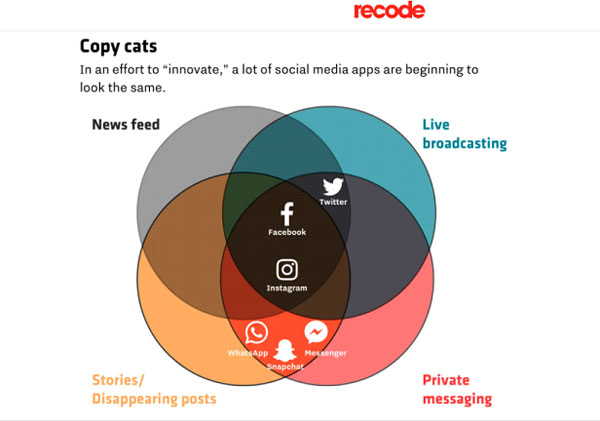
    The third and perhaps the biggest crisis is the loss of identity of different social networks / apps which has emerged during the last 5 due to the blatant copying or adopting of features of another social network. Last week I listened to an interesting podcast on www.emarketers.com talking about “…. what Facebook has become and is trying to be, what to make of social media platforms looking more and more alike, and which of these “copycat” moves might strike gold. We then talk about the significance of Nextdoor going public, how India’s social media content liability laws could impact Twitter (and others), and some changes as to what advertisers can, and can’t, do on social media.” The podcast can be accessed through the following link https://www.emarketer.com/content/podcast-facebook-and-social-media-identity-crisis-twitter-liability-retouching-ads?ecid=NL1009.


    Source: https://www.vox.com

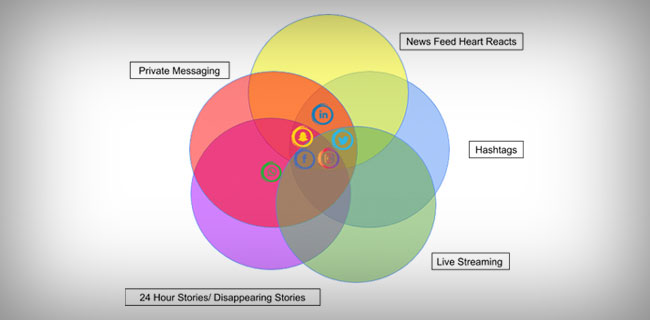
    There is an extensive list of services/ features which have been copied since their introduction in one social media platform by others. In 2010 Instagram launched with the feature “double tap to heart react”. Instagram copied Snapchat’s stories feature first which was followed by Facebook adopting the same application from Instagram. In 2012, Facebook acquired Instagram and adopted the “heart react” feature from Instagram. In 2015, Twitter replaced it “star react” feature with “heart react”. In 2019 Linkedin introduced a set of “react” features including the “heart react”. There are many more such examples.


    In the digital age, we have seen a shift of power from organisations to consumers which has been labelled as ’transformed consumer contexts’ by Neil Perkin and Peter Abraham in their book titled Building the Agile Business Through Digital Transformation. Consumers once experiencing once a satisfactory service or a tool on a social network, expect the same capability from all other social media networks. As a result, this trend of extensively copying from each other has started in the social media sector for winning over the consumers. This trend has attracted lot of criticism as it is becoming increasingly difficult to differentiate among the social media platforms, but no immediate solution for countering this trend is in sight for reversing the identity crisis within social media.


  • What’s ‘Said’ Scratches the Surface of What’s ‘Experienced’


    The second in our 10-part series where Shaziya Khan focuses on the allyship of brands for financial savviness of women and girls. Link to the first part: Is there a Burden of Hidden Emotions Women carry in it?


    Shaziya KhanBy Shaziya Khan

    Women are known to be prudent shoppers and savers. Yet, women need to become more savvy in personal finance. This is a key and progressive attitude shift among, both, men and women.


    Several women, confess to being uncomfortable about taking decisions in financial matters (seeking validation, often procrastinating etc.). Also, women feel emotionally vulnerable taking financial decisions in a life context of dependency (spouse, father, brother), social “rules” and roles, subtle conditioning favoring a persona that “knows little about such matters”. These ‘silent yet significant’ barriers, lurk deep, generationally and must be surfaced and reassuringly addressed. Thereby, enabling financial savviness of women and girls as a happy ‘normal’ in the present and future. Guided by the truth that the spoken word is different from the lived experience, we looked far below the surface of what is merely ‘said’.


    GNAWING FINANCIAL WORRY EXPERIENCED SILENTLY. Women experience a gnawing threat and worry related to “their safety net”. Research reveals that one of the biggest advocates for purchasing general insurance, is the woman of the house, albeit with a deeply subdued voice. Wives and mothers instinctively, quickly, silently understand that “if anything were to happen”, it would sadly, blow a big hole in the family’s savings. They especially worry about the adverse impact on children’s education and future, etc. Yet, despite this threat perception being experienced deeply, they rarely voice it. Why?

    There are ‘obvious’ restrictions to voicing a ‘bad omen’, even if one is speaking practically or thoughtfully, with ‘good intention’. Due to the ‘bad omen’ factor and related manifestations of it, women barely voice their financial inclinations. This could be with regard to banking, investing, insurance, earning etc. Thus, out of fright, superstition, “not speaking out of turn”, “being a nag”, “having a black tongue” etc. women learn to live with their gnawing financial worries. Unable to voice their inclination towards purchasing relevant financial instruments. Unable to actively ‘solve for’ financial needs, protective financial measures, in good time.


    SOFT SKILLS MASK THE INTENSITY OF THE FINANCIAL NEED OR DESIRE. Women know, there is an art and science of successfully navigating any financial discussion. Personal finance, being a sensitive topic, and theirs being a layered authority, it needs careful ‘handling’. For instance, even blurting out a spontaneous practical suggestion, takes practice. At other times, they learn, or are taught, silence is golden. Many women “have to” master diplomacy, timing and discretion to adroitly discuss a financial matter at home. Mustering courage, faultless logic, impeccable timing and pitch perfect tone of voice are intangible and tangible ‘notes of harmony’ that women orchestrate. These soft skilled expressions, others like them, are common. “I’ll try and cajole over a few days”, “after meals is best time to discuss it”, “so and so, was suggesting”.

    Women admit to picking their battles carefully, wisely, especially financial ones. They fear that if a stray remark is seen by their spouse, elders, ‘authority figures’ of the family, to be strident or ill timed, several of their future financial needs and wishes might never see light of day. Or be denied for a long time.


    LACK OF ASSERTION OF FINANCIAL AUTHORITY. Many women admit that even when their financial rights exist, they feel, or are made to feel awkward, uncomfortable or guilty, when asserting them. Anecdotally there is much, varied evidence pointing to this lack of assertion. Seeking “permission” to assert what is financially due. Forgoing some part of their financial rights, is ‘taken for granted’. Being the last in the queue to get their financial due is “accepted”. Withdrawal of other familial support, if she claims her financial rights, is familiar to many middle-class women.

    This could be partly due to early subtle conditioning, across several aspects. To take just one aspect, several parents mention observing, early on, differing behavior related to gifts. The girl child is passive or vague about what she wants as a gift, versus, a boy child assertively negotiates a gift in return for “x”. Years later, this gets cemented as a ‘pattern’. Women passively “let go” of personal financial matters, preferring vagueness over ‘details’. They candidly admit to being carefree, haphazard, even “lost”, about ‘their own’ finances! Some learn a ‘hard lesson’, better their ways.


    ALLIES MUST EMPATHISE WITH THE EXPERIENCE BEHIND THE WORDS. We are learning, that alongside the rational budgeting and saving skills, women have an emotional (roller coaster) experience of personal finances. They live silently, or with hushed words, or muted expressions, with this experience. With gnawing financial worry, a marshalling of soft skills to mask intensity of financial needs, desires and ‘letting go’ rather than asserting financial authority. Words seem to scratch the surface of these deeply felt and lived daily “normal” experience. Brands, keen on allyship with women, must empathize with their lived experience, behind the words.

    To ally with a woman on her onward journey of financial savviness – let her know you ‘get’ her experience. Let that inspire innovation, communication, inclusivity to enable her financial savviness. You might hear just a muted phrase or see just a passive nod, trust me, her heart is probably jumping with joy, hope. It is just that her words don’t capture that. Yet.


    Shaziya Khan is National Planning Director, Wunderman Thompson. She has won the Jay Chiat Grand Prix  for Strategy and Three WPP Atticus Global Awards for ‘Original Thinking in Marketing Communication’. Her views here are personal.


  • Hello, New Urban Consumer with a Hermit Mindset… Frugal, Contemporary, Creative


    By Shaziya Khan


    It is an introspective time of the year. Added to which are exhaustive charts, healthy discussions and sceptical eyebrows. Many are seeking a cloudless clarity. Above the blinding glare of information overload. Or worse, the opaque fog of misinformation. All to do with the new urban consumer. What has changed for now? What seems to have changed mainly due to the lockdown (unconscious bias – recent effect)? What has changed for the longer term?


    Recap of data highlights: The Wunderman Thompson and Kantar reports highlight key consumer shifts and trends which are briefly recapped here. Shift to savings, loss of personal space, security and convenience paramount, health at the forefront, digital to the rescue, media rejigged. Reskilling, back to home life as epicentre. Philanthropic brands wanted. Accelerating the purpose agenda of brands, in practical ways.


    New value system: Accelerating the drive toward more inclusive heroes, meaning, sustainability, nature. Future of communication: there is an acceleration of the need for checks and balances of evolved communication modes. Every business is a health business in terms of whether it informs or misinforms. Connected communities: rebuilding community and connection is a top priority. Nurturing the tribe is an accelerating trend.


    Health’s next frontier: Healing anxiety and well-being of the digital self – existing trends, that have intensified, given the need gap in investing proactively in health.


    New retail models: not only is there more contact less shopping and handsfree payment. There is also a fast tracking of initiatives like virtual services and live streaming, based on consumer journey and experience.


    Stitching a quilt: With hard numerical data and ephemeral qualitative texture, patch by patch, here’s a handwoven quilt on the new urban consumer. Like a patchwork quilt, this understanding is stitched with the hope of connecting past, present and future. And above all, to help the new urban consumer be treated with warmth, comfort and empathy. A patchwork quilt of understanding is not only for a new consumer but also for one living in a far from normal context. A context that has euphemistically been called the new normal, or next normal, or better normal.


    This is simply the examined normal – a “reading” of the lived experience of urban consumers. Their mindset. A short take on a very large topic in a very new context. The examined normal – new/next/better, normal or otherwise. What does this examined reality reveal?


    Emerging hermit mindset: It yields an emerging chrysalis portrait of a kind of contemporary hermit, frugal to an extreme. Digitally savvy, by necessity. A personal growth enthusiast, even an explorer, not at the level of mastery, nor competence, yet. Frugal at many levels. Urban consumers have lived frugally for an extended period of time. Spartan food, simple clothing, sore isolation, repetitive, harsh schedules, uncertain work, education, future, several blurring “lines”.


    A kind of life, perhaps, only ever experienced somewhat, at retreats or camps. That too, for a few days only. And voluntarily, by a niche group, that was into “this sort of thing”. This is utterly different from the urban consumer life context (not short, voluntary, niche).


    Nevertheless, it could be illustrative to recap what brushes with “capsule frugality” are, to shed light on the new experience of extended frugality.


    Capsule frugality recalled. Capsule frugality, voluntarily embraced, evoked positive feedback. Nirvana is a booking away (“you should try it”). The waiting lists are long. Despite the agenda being very tough (repeat, very tough) love. Including regimented schedules, bland food, cold baths, demanding exercises, isolation, minimal conversation. These are seen to yield the benefit of detoxification, bliss, escape, even release.


    Extended frugality, examined. Significantly the lockdown lived experience was not mindful. In fact, mind numbing is a better description. Yet, after the extended dismay, discomfort, resignation, a new emotion is being expressed. Out of the depths of extended frugality of the daily life, strikes the rubber slippers epiphany. It goes simply as: It is okay. Surprisingly, I am okay, you are okay.


    Rubber slippers epiphany: “Been wearing rubber slippers, 12 hours a day, for months, and you know what, it is okay”. Acceptance.


    Even a kind of liberation. The relief of survival with so little. The triumph of knowing hell we could, so now we know, we can. A struggle with disruptive frugality, at many levels, has given the urban “indulgent class” a glimpse of mettle lurking beneath the surface of shiny aspirations. A private gemstone rich mine of raw instinct. And it evidently feels rejuvenating, despite the steep and stoic efforts involved in ‘mining’ these instincts.


    WT research reveals that developing market consumers view change as eventually leading to betterment. Frugality, not just financial. The extended daily lived experience of frugality yields many, many (unasked for) lessons for surviving, thriving, changing, adopting, adapting, shedding, decluttering, exhuming, sacrificing, missing, dropping, coping, creating, shutting, cancelling, learning. (For instance, a much loved corporate cartoon talks of the immense transformation in companies, wielded not by the wand of the “chief transformation officer”, but due mainly to the disruption of remote working)


    In effect, frugality, which at first glance seems a hard word, is actually an interesting word. It has interesting associations like moderation, less waste, temperance, simple, mindful, thoughtful. Many, resonating qualities of our times. In shifting scenarios, a steady mindset. As scenarios evolve, expectedly, many of the creature comforts may sweep back in. To the extent affordable and desirable.


    However, the hermit mindset, it appears, has dug in, for a longer term. Even toward embracing simple living and high thinking, in degrees. Degrees may vary, but “hermits in the mind” are likely to be or do these. Hermit mindset takes ‘tough love’ calls. Be able to take tough decisions faster, due to less attachment and more acceptance of uncertainty. Several pending, sitting on the fence, long gestation periods of consideration kind of decisions, will find the button pressed. What doesn’t kill you, makes you stronger is the decision making mettle in the making (washing machines debated for five years, got installed in five weeks, hobbies on the back burner were officially launched as commercial home-preneur brands, relationship bridges long overdue, over troubled waters, got built).


    Hermit mindset marches to inner rhythm more. Be less outwardly motivated, be more inwardly mindful and particular in prioritising what truly matters. Having managed much, whilst “making do” with little, has been a kind of maturing. “Autumn is about the beauty of letting go”. Aspects outgrown out of deep necessity have been ‘let go’. Authenticity and transparency are not just the desirable mantras, they are live – being broadcast in real time.


    (Less conscious of manicured “appearances”, more relaxed about one’s private self being shared – messy hair, unshaven faces, informal or casual dressing, help sought openly, advice taken professionally, simple menus, vernacular and voice communication, desire for more expression and less suppression , comfort zone friends or family over “IT” acquaintances/ influentials and “zoom fatigue”, pursuit of learning, upskilling, new creative endeavours). Hermit mindset uses a fine toothed comb of value for sorting & sifting priorities. There appears a wholesome embrace of not just value, but value-consciousness-to-an-extreme.


    Born of the head: financial necessity, anxiety and generally trying times. Born of the heart, too: further, reverence and fresh appreciation, deeply heart felt, of modesty, temperance and efficiency in nearly all matters of consumption. (Recycling of items, utilising ignored kitchen goods like casseroles, skillets, old clothes and furnishings, utterly “locking down” on previously eagerly anticipated purchases, like branded sales, selling items to the kabadi to declutter one’s own home and to help keep others home fires burning, searching and waiting patiently for best deals, pack sizes, combinations, bulk buys, best times for purchase, on a steep curve digitally – accelerating knowledge, access, engagement, commerce).


    Especially with regard to digital interface, what matters most are simplicity, speed more than engagement or relationships is “brand respects us” via apt, timely, relevant value. A hermit mindset leans into preciousness of trusted vintage. A broad love for the enduring, both for the utility it provides, as well as of the emotional meanings it signifies, is sweeping upon the new urban consumers. There is an abiding sense of reconnecting with rootedness, including our own roots, indeed whatever gives the daily life it’s rootedness. In turbulent currents, strong anchors, help steady the boat.


    What started off as “making do” has turned a page, as there is a realisation of the richness of the rooted. The preciousness of the familiar, tried and trusted. The trusted motor car, or efficient two-wheeler, hardy pressure cooker, homely safe beauty routine, sturdy absorbent towel, loyal fluttering old curtain, that like us humans, is soldiering on, reliably, is often complimented. Sepia photographs of boarding school friends, paradise lost and then re-discovered, of colleagues at conferences that pre dated the virtual meetings era, are widely commented upon. The loved but slightly sagging armchairs, wherefrom the family takes fresh daily blows on the chin, from the news, are familiar comfort zones.


    On an unforgiving day, day after day, trust in brands has primacy more now than in the past. The trusted is gold, to have and to hold. A hermit mindset is mindful of people over things. As generations in the family retreat to their “cave”, the main treasure to cherish is conversations with people. Caves by definition are bare, whatever the cave. Conversation, hence connection is all there is. Teens in their rooms, children on their screens, parents in their kitchen, bathroom, desk, chair, senior citizens in front of heaters, singletons on their social media channels, the long distant couples on their phones, the brave retailer in his shop, and so on. Starved of experience, each realised, all we ever really can have, is a sense of connection. So the person to person connection reigns more than ever before.


    (Fractured generational relationships, everywhere are getting rebuilt one conversation at a time. As huddles after dinner, mutters while cleaning, even when sweating, slipping and swearing, at rare times of just chilling, intellectually debating, just simply calling to say how are you).


    The “hot” buttons. These are emerging as the five ‘slow living’ hot buttons of the hermit mindset.

    :: Tough love calls.

    :: Inward motivations.

    :: Extreme value consciousness.

    :: Primacy of trust and the trusted.

    :: People bridges.


    For these five reasons, despite the shock experienced, the hermit mindset appears braced for simple living and high thinking, relatively speaking, for an extended period of time. Born of necessity – of disruptive as well as accelerated change. Matured of experience – in living through it.


    Word of the year

    In a cold place (few distractions), in warm lamp light (illuminating comfort), my word of the year 2021 crystallises. Synthesizing several threads of quantitative data, qualitative insights, expert discussions. Culminating in the notion that “serious is the new cool”.


    Serious is the new cool


    Large problems demand large, simple solutions which in turn compel larger, loftier vision and thought. Serious stuff.


    WT 2020 surveys across developed and developing markets suggest that consumers now believe that the challenges and opportunities humanity faces loom large and new, in scope, scale and yes even, scariness.


    Firstly, consumers prefer brands that demonstrate a new kind of civic leadership – in tackling these big world problems, not just small ones. There is a vital need for fresh, innovative and holistic approaches, like never before. There is optimism that a fresh generation of thinkers and doers will provide this unique and much needed perspective.


    Secondly, consumers also believe that brands (more than several other social organisations) are best placed to provide effective, innovative, well thought through, consumer centric ideas and solutions.


    What serious is and is not 


    A world pushed to transform, has had a giant, collective wake up call. And a seriously thoughtful approach is emerging as vital in several fields of endeavour. Not only that, it is transforming the grammar of transformation itself.


    Serious is not niche, it is mainstream, part of the “what’s going on” culture. Serious is not obscure, distant nor intimidating, it is viscerally part of the lived daily existence of many. True to context, relatable, relevant. Serious is not cold, nor dry, it is vitally, warmly people centric, even more – generational / community / relationship centric. People first. Serious is not distracted or complicated, but distilled, clear and patiently resilient.


    Above all, serious is not boring, nor pedantic, serious is the good it does, and protects and nurtures; and what makes it the new cool. Re-orienting brands, coaching examined. It was always cool to deep dive, take a long view, dig into what really matters. It has intensified manifolds.


    It is cool to seek serious help. Seeking help is no longer just for losers, but also for winners, who need it most and especially for movers and shakers who might be yearning for it unknowingly. As much as normal or average people. Getting help is simply being responsible and human. Coaching spells growth. In any arena of life, work, play.


    The clever bit, in the coaching conceptual framework, is that the seeker is a client and not just a patient. The expert is a friendly coach not an intimidating authority. There’s a coach offering a master class package, a phone call away, and people are gratefully opting in. Are brands listening ? Are brands observing the re-orientation going on in seeking and receiving serious help via the coaching frame.


    Brands can be the poster child of the coaching narrative. We open the door to a year ahead of continuing disruptive change, as well as accelerated change. In such a context, brands can be the poster child of the coaching narrative. Connecting to a new consumer in new and apt ways.


    1. The new consumer has a slow living hermit mindset that is inclined to being frugal, contemporary, creative.

    2. The five buttons, of this mindset, are seen to be operating at multiple levels – functional, mental, emotional, social, transactional, relational.

    3. The dots connect to signify serious is the new cool. Based on fresh research on how consumers view change across markets, and their expectations from brands at a time of change. Constructive, innovative, holistic solutions are being sought from brands to address real and big issues/consequences/opportunities.

    4. Brand as coach – ushers brands that build connections like coaches via an ecosystem of empathetic serious help. To reassuringly accept new contexts and leverage new mindsets.

    5. In sum, the quilt of new consumer understanding highlights the significance of : an emerging hermit mindset, serious as the new cool brand narrative, engaging in a coach-client manner.


    Purpose of the “quilt of new consumer understanding”. This is primarily stitched, patch by curated patch, to help brand custodians provide much needed empathy and warmth to a hyphenated two tone consumer. Who is at the same time, isolated-connected, anxious-mindful, frugal-creative, contemporary-rooted. And coping amazingly, at full stretch, and counting.


    As a patchwork quilt, true to its name, this new understanding too is stitched with the hope of connecting and creating. Being a means for others to add their inputs too.Thus, all together, becoming the basis for enabling much warmth and empathy when brand custodians market, innovate, price and communicate products and services to new urban consumers.


    Shaziya Khan is National Planning Director, Wunderman Thompson. She has won the Jay Chiat Grand Prix  for Strategy and Three WPP Atticus Global Awards for ‘Original Thinking in Marketing Communication’. Her views here are personal. First published on LBBOnline at https://www.lbbonline.com/news/hermit-mindset-frugal-contemporary-creative-hello-new-urban-consumer


     

  • Tote of Personal Finance: Is there a Burden of Hidden Emotions Women carry in it?


    By Shaziya Khan


    Shaziya KhanFor many women, a lingering, pervasive discomfort about personal finance exists, despite growing finances. Women confess to feeling uncomfortable about taking personal financial decisions. Women also feel the need for permission or validation from significant others (spouse, parent, brother etc) in matters of personal finance. For some, despite taking many financial decisions, at work, they are still uncomfortable about personal finances.


    It matters to understand why women are uncomfortable about personal finance. Why? In modern times, both men and women believe, it is important for women and girls to be financially savvy. This is a key attitude shift of our times. Encouraging an all-out pursuit of financial savviness is a key area of allyship for brands related to women’s progress.


    How can brands provide allyship to enable women and girls in this area of growing importance? This is an important question for brands in financial categories – banking, insurance, investing, saving. Also, a relevant question for brands in other categories, as financial aspects impact most purchases.


    A starting point, is what is already well-known about women’s financial experiences

    It is known that most women try to have a small financial cushion.  They literally, and figuratively, stuff it, every opportunity they get. Quietly, prudently, cautiously, providing for a little more. This could be via  the ingrained ‘small saving’ experiences, home budgeting skills and a growing influence on big ticket purchases.  Yet, attitude shifts and indeed lifestyle expectations, demand a lot more than a small financial cushion! In effect, it is about “bigger, better financial cushions wanted!” for women and girls.


    Synthesise the Well-Known with the Well-Hidden

    Guided by the truth that people hide their true emotions, it is key to ‘read’ the well-hidden factors alongside the well-known factors. There could be ‘well -hidden’ emotions women experience related to personal finances. These are not revealed via conventional research.  Rather they are revealed, whilst unpeeling the women’s life context, learning from experts within that life context, adjacent to it or in some way intimately related to women’s lives as well their ‘financialscape’.  Stepping outside the functional lens of category creation, to empathize with the emotive lens of category creation, is vital. I call it, synthesising the ‘well-known’ with the ‘well-hidden’.


    This perspective helps unlock priorities for allyship.  Sheds light on ‘what is going on, silently’ and how practically, brands can provide allyship. In short, looking at women’s (halting, tentative, uncomfortable) journey towards financial savviness, within the context of their life journey, is revelatory.


    Life context cannot be ignored. Women navigate personal finances in the broader context of navigating their everyday life. Women’s life context – the relationships, social norms, psychological frameworks, individual versus collective aspects, all impact their financial choices, or lack of them. Each life context is influentially and sensitively related to personal financial matters. A bit like the proverbial pea hidden underneath the soft mattress – causing a sleepless night for a sensitive person.


    A ‘Well-Hidden’ Emotional Vulnerability

    We unearthed a ‘well-hidden’ emotional vulnerability, that holds women back from becoming more financially savvy, even when they wish too. This emotional vulnerability is a triangulation ‘compromises’, ‘rules’, ‘understanding’ operating silently yet strongly in women’s life context. There is a combination of dependency, role expectations and perceived personas that women “have to” usually abide by.


    Firstly, by mid-life, many women are financially dependent. Having ‘given up’ financial independence when younger (by necessity, choice, whim. They are then, compelled, to make compromises in personal finances, in mid-life. Secondly, women internalise social, cultural and family ‘rules’ on financial matters. Their ‘role and rule-based’ involvement is restricted mainly to home and lifestyle finances. Thirdly, stepping beyond a certain ‘boundary’ of financial savviness, women carry a psychological risk. That of possessing a negatively perceived persona, in the eyes of significant others, as too ‘money minded’ for their own good.


    Need for Allyship

    Hidden emotions are a double weight that women carry. Not only does the vulnerability of their life context, weigh heavily on them, the fact that it cannot expressed nor resolved, makes it ‘heavier’. The emotional vulnerability related to personal finances often cannot be discussed, in a context of dependence, role expectations and conditioned personas. It crystallises, helplessly, as “What choice do I have” or “what choice does she have”. These phrases surface frequently. Providing proof of both the vulnerability being experienced, and also, alas, its acceptance. Allyship, from brands, is much needed to lift the lid off hidden emotional vulnerability and then provide practical choices to help discuss and resolve it. Here are some thought starters


    Dependency is a key context. Experts like psychologists, life coaches and marriage counsellors shed light on women’s personal finances journey, its impact in the context of her life relationships and dependency.


    Many women entertain a certain ambiguity, or a casual attitude about personal finances. This can end up becoming a fault line in long term relationships. Sadly, even among the educated, working married couples. Resulting in emotional inequality, lack of sensitivity, shrinking of choice. Typically, young women ‘give up’ financial independence.  They realise, many years later, how vulnerable they have personally become. Subject to threats, social posturing, forced masking of growing distance, compromised life choices. Women ‘live with it’, as they literally cannot afford not to! A role for allyship is bring out the importance of financial independence in a woman’s life, early on, and practical avenues for sustaining it.


    A role for strategic development is understanding and milestones of the lifetime value of financial independence, the zones of ambiguity, the zones of certainty, for women.


    Unspoken ‘rules’ are a key context, too.  Life contexts have silent influence, on women’s personal finances, via family ‘norms’. The “unspoken rules” silently dictate where a woman can and cannot have a say.  Where she can and cannot take a “stand”. The “unspoken rules” exist in nuclear families, extended families, middle-class & upper-class families.


    These “norms” are imbibed early, “understood” and adhered to, by all involved. A ‘need to know’, ‘be happy with you’ve got’ frame governs the family’s financial ‘equation’ with women folk. Women’s indulgences are financed (jewellery, vacations, home, personal makeovers, entertainment, socialising) yet, in doing so, a ‘boundary’ is also set. There are generally few questions asked, or entertained, on personal financial matters beyond the above. A role for allyship is create new women centric personal finance ‘rules’ and help them gain acceptance among both men and women. A role for strategic development is unearth the financial “rules” and “borders”, help women better navigate them, eventually redraw them.


    Subtle conditioning is another key context. Another subtle life context relates to verbal and non-verbal cues about womanly personas. Oft heard remarks, glances, grimaces, nick names, informal network exchanges, excluding and including behaviour on who is ‘in’ and ‘out’ are types of subtle conditioning. These can associate a woman who is less involved in money matters, as a “good (naïve, harmless) woman”. Coy comments unwittingly cue this type of ingrained conditioning e.g. “I know nothing about finance”, “I have hardly ever gone to the bank”, “I can’t recall when I last signed a cheque”, “I am so unfamiliar with an ATM”, “My brother/husband/father knows every time I use my card”. Such remarks are associated with a certain type of womanly persona – likeable, comforting, trusted, reliable, safe. Thus, lack of interest, or knowledge in financial matters is endearingly ‘acceptable’. It is subtly encouraged.


    In contrast, a woman who asks for details on finances, or has questions – about bank accounts, single versus joint cheque books, her own ATM card, seeking professional financial advice etc., is regarded warily. In some cases, even negatively referred to e.g. “money minded”, gold digger, climber, “shrewd (calculating) type”. Thus, interest in and knowledge of financial matters are subtly discouraged. A role for allyship is to help to positively reframe the perceptions and personas of financially savvy women. A role for strategic development is to uncover the negative myths, associations and fears perceived with women being savvy; uncover positive role models, behaviour, values, rituals associated with women being savvy.


    Ease the Burden of Hidden Emotions

    The hidden emotional vulnerability women experience, due to life contexts, must be assuaged, to the extent possible. This will help to ease and accelerate the journey toward functional savviness. Infusing clarity, where casualness and ambiguity abound. Inviting refreshing, empowering ‘rules’ in families. Reshaping the naïve versus shrewd stereotypical personas. These are starting points for building allyship with women. Emotional lightness makes room for functional savviness. When you see a woman striding confidently with her tote, ask if she is truly feeling emotionally lighter about being more actively involved in matter of personal finances. If she is feeling lighter, it is likely, she will become savvier, too. And sooner, than later, one hopes.


    Shaziya Khan is National Planning Director, Wunderman Thompson. She has won the Jay Chiat Grand Prix  for Strategy and Three WPP Atticus Global Awards for ‘Original Thinking in Marketing Communication’. Her views here are personal.


  • India Shining in Ecommerce Growth


    By Indrani Sen


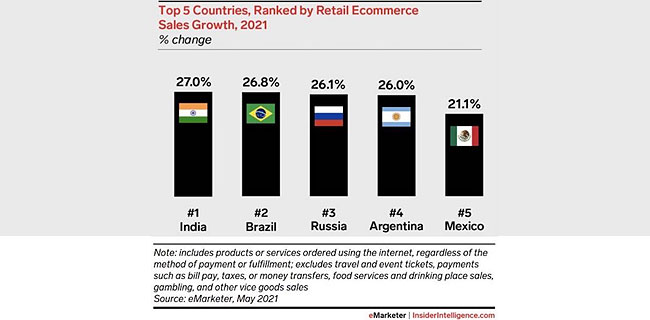
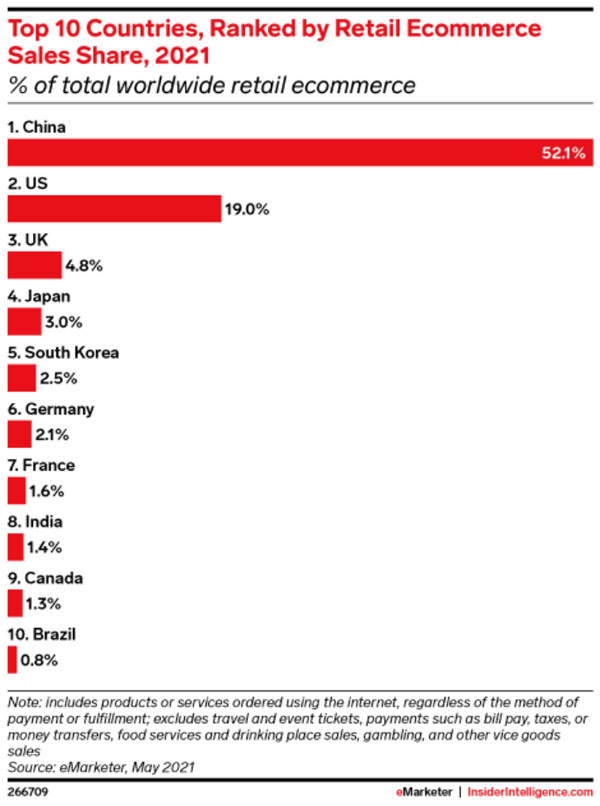
    Indrani SenA study “Global Ecommerce  Forecast 2021” conducted earlier this year, followed by articles published in www.emarketer.com recently show that India ranked eighth in the share of retail Ecommerce  sales in the world in 2020, while leading in the growth rate along with a pack of Latin American countries and Russia. The trend is estimated to continue during 2021 with China leading the pack of countries with US featuring as the poor second. India, thanks to the huge population base and the accelerating drive for a “Digital India”.


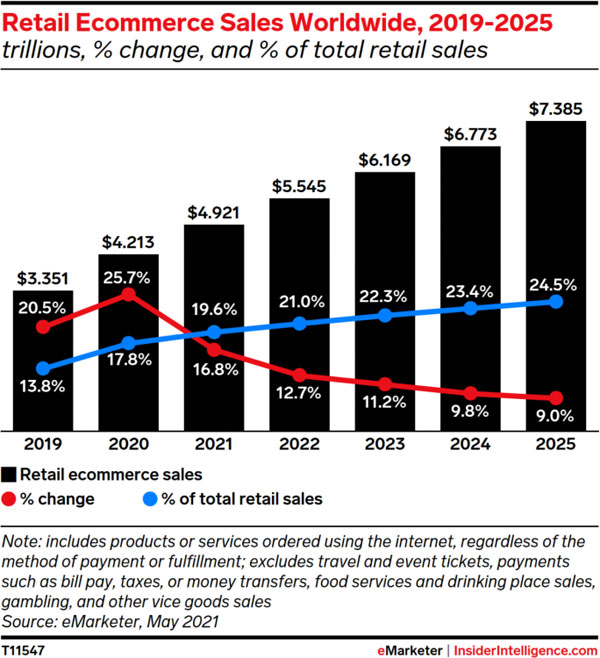
    The retail Ecommerce grew dramatically across the world at the cost of the physical stores sales in 2020 as COCID 19 raged across both developed and developing countries. In an article published on July 7, 2021 Karin Von Abrams wrote “Before the pandemic, we had forecast that total retail sales worldwide would rise by 4.4% in 2020, to $26.460 trillion. We now estimate that retail sales amounted to just $23.624 trillion last year-a decline of 2.8%. But in 2021, this figure will rebound to pre-pandemic (2019) levels, reaching $25.052 trillion.” (https://www.emarketer.com/content/global-Ecommerce -forecast-2021) 


    Another chart published in the same article reflects the worldwide growth of Ecommerce  from 2019 to 2020 and the subsequent drop in the same.


    India, however is expected to have an increase in the growth rate of Ecommerce  in the coming years and reach a size of US$ 99 billion by 2024 as also indicated in another article published on May 9, 2021 (https://www.ibef.org/industry/Ecommerce .aspx)   which lists a series of initiatives taken by the Ecommerce  industry along with Government initiatives and increasing investments as the key factors behind this surge of growth apart from growing demand and attractive opportunities. The road ahead also seems to be full of promises. The growth in this sector has been beneficial for the MSME sector in India and is expected to fuel their growth in the long run.  Along with the growth, the share of India in the world wide retail Ecommerce  is also supposed to increase propelling its rank from eighth to third after US in the coming years.


  • Why Humans are Obsessed with Sports & Why Marketers Maximise it


    By Bhuvi Gupta


    Bhuvi GuptaWell aware that I belong to the minority I have always been surprised by the widespread obsession around sports. Why do so many of us care about wins and losses, have heated debates around teams and players, stay up at odd hours (to catch up on international matches) for something that ultimately has no impact on our lives?


    Last week, I went down the rabbit hole to find out how science explains it. Turns out scientists are mystified too, But they’ve been working on it, and this ASAP Science video shares some logic, which adds up. Apparently, watching the team you support, win, leads to a spike in both testosterone and dopamine levels. Testosterone helps spike brainpower, awareness and muscle growth and Dopamine activates the pleasure centers in the brain, helping increasing memory and learning. Hence, we are biologically wired to watch Sports.


    These biological hormonal spikes are not limited to Sport but even to Politics. This explains the mystifying skyhigh TRPs during exit polls and 24/7 on counting day, even for state elections too far from your location to have any impact on your life.


    Marketers know that this works and that possibilities are endless. With the ubiquity of the mobile phone there are now a plethora of options for advertising across budgets. With easy access to content, India is also moving beyond cricket for advertising, product placement and brand ambassadors.


    Generating mass awareness at mega sporting events

    From a marketing POV, sports advertising works best for the ‘generating awareness’ peg of the marketing funnel. Every year, records are broken for advertising revenues earned during IPL in India, the Super Bowl in the US and other tournaments across the world. IPL and Super Bowl ads are recognised sub-genres. And marketers can use the various platforms available. These include in-stadium advertising, advertising on TV, and digital, second screen advertising, social media advertising and digital content platforms for post-match analyses. There is a well-oiled ecosystem that works to maximise eyeballs and using it well, while no cakewalk reaps dividends.


    Work + Play for B2B

    B2B companies have been using international sporting tournaments to create awareness at both B2B and B2C levels while building new business opportunities. Case in point, Indian IT companies in the last decade. In 2015, HCL officially partnered with Manchester United to innovate a unified fan experience. This partnership used technology to transform both the real-time stadium customer experience as well as the digital user experience. A ‘physical’ UnitedXperience Lab was also set up at Old Trafford Stadium.


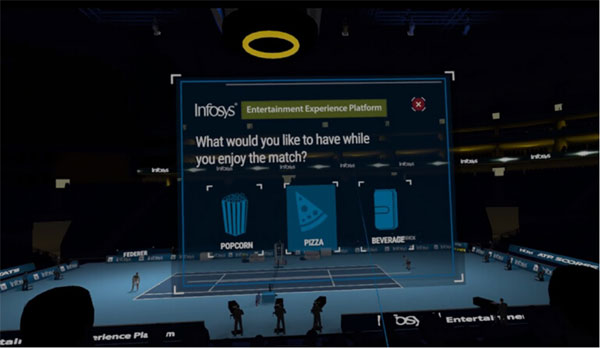
    In the same year, Infosys also executed a similar partnership with the Association of Tennis Professionals (ATP), the governing body of the men’s professional tennis circuits. They have been instrumental in supporting ATP’s development of key digital assets and infrastructure, including ATP PlayerZone, ATP Stats Leaderboards, ATP Second Screen, and the ATP app.


    Such partnerships help showcase the company’s skills while getting them eyeballs globally.


    Brand Ambassadorships

    The oldest trick in the book, but still so effective are vanilla brand ambassadors. The medal and match winners are role models for ordinary citizens. Their tough journeys to the pinnacle of sporting success occupy reams of media coverage and remembered. All players have clearly defined value systems and choosing an ambassador whose values align with the brand can work wonders to generate awareness and credibility. I like the way Indian brands are now gravitating towards Olympians, Badminton, Boxing and Weightlifting stars and looking forward to the advertising that Tokyo 2020 winners will bring in the wake of their wins. An international favourite is the world’s largest pasta company, Barilla’s long-term association with tennis legend, Roger Federer.  The brand releases one campaign about every one-and-a-half years that highlight quality, simplicity, and excellence which are values synonymous with Federer.


    Watch the 2020 Covid-19 campaign ‘The Rooftop Match’


    Sports are the best of reality TV and give all the thrills except those voyeuristic. The viewer gets unedited and unscripted emotion, drama and discord, fun and all the dopamine hits described before. There are underdogs and alphas, strategizing and wild cards and even fixing. Marketers need to expand their budgets beyond cricket in the long term and not just in the wake of wins. The urge to watch is biological and there is so much that can be done!


  • Amidst Informal Ties & Prying Eyes


    This is the fourth in our 10-part fortnightly series where Shaziya Khan focuses on the allyship of brands for financial savviness of women and girls. Link to the first three parts: https://www.mxmindia.com/category/columns/shaziya-khan/


    By Shaziya Khan


    Shaziya KhanA key attitude shift is the need for women and girls to become financially savvy.

    Women have well-known home budgeting skills, yet when it comes to personal finances, they are uncomfortable. Plausible reasons being contexts of dependency, subtle conditioning. There are other well-hidden emotional factors in play too. For instance, women’s financial experiences necessarily include masking intensity of financial needs or desires, “letting go” instead of asserting financial authority, staying quiet about gnawing financial worries. Thus, women hold themselves back or are held back from purchasing or advocating financial instruments, actively solve for financial needs, take protective financial measures, in good time.


    Guided by the truth people hide their true emotions, we dived a deeper to understand what could be areas of allyship to help women and girls to become financially savvy. These areas for allyship matter for brands across all financial categories such as banking, insurance (life & general), investing, saving as well as brands in categories beyond finance to whom impacting progressive attitude shifts for women and girl matter.


    “Old ways” of ‘a secret pocket or secret lining’ linger in some fashion. (Traditionally, it was not uncommon to hear of people carrying money, precious items, important papers “hidden securely” in clothes, sewn in by women discreetly, for family members). Informal versions of “hiding securely”, continue. There lingers a certain familiarity about ‘informal safe-keeping’ of personal financial assets. Lack of familiarity, ease of access, affordability, to formal avenues (bank accounts, lockers, home safes, cupboards with safes, financial instruments etc.) reinforces the loop. Many women are habituated to informal ‘corners’ (literally). This, however, is a relatively minor aspect. The issue is the informality of financial ties per se.


    DOUBLE BURDEN OF INFORMAL FINANCIAL TIES


    Women’s informality goes deeper than “hiding of notes in sugar pots or cloth linings”. There is a pervasive and worryingly, acceptable lack of formality vis a vis women’s personal finances.


    Women a ‘significant absentee’ on documents. Often, women are simply absent in the formal aspects of personal finance. These formal aspects could relate to financial documents or forms, deeds, signatures, nominations, accounts, cards. Most women accept, or are unaware, that their names do not feature in financial documents. This is acceptable not just for large assets like a home but also for small assets like an account, card or scheme.  Being a common pattern, in many homes, it is shrugged off as the “norm”.


    Accepted it might be, yet undoubtedly it lingers troublingly, as a denial or neglect, of formal financial acknowledgement and agency. Voiced or not, it is a fact that women are conscious of. For instance, during banter, or argument, or outburst, being ‘reminded’ that a financial asset is not truly “theirs”.


    Informality in financial ties, for women, is a potential iceberg to watch out for. It can threaten, bring about a crash, silence or in other cases loom large, more below the surface, than above, as a deterrent of choice, a type of cold non-verbal control.


    Open access by others to women’s personal finances. Anecdotal evidence abounds of women’s earnings being “handed over” to significant others in the family almost entirely or to a very significant extent. Women’s earnings, it is ‘accepted,’ are “managed” in accounts held by others entirely, or jointly. It is also generally ‘accepted’ that women’s savings, earnings, gifts are the first and easiest to access when the family’s need or desire for money arises. “took my money for buying x”, “had to give my money to y” “ I cannot refuse z”.


    As a result of this open access of others to her personal finances, women find themselves having to ‘answer’ to others when they spend, save, invest their money! Reinforcing the informal hiding loop described earlier.


    THRIVE NOT SURVIVE LENS


    Women generally have less formal agency on personal financial matters, at the same time others have open access to their personal finances. Thus, many, many women find themselves in a life situation of bearing a double burden of financial informality and it being “acceptably” demanded of them as the norm, for the long term. As a result, women’s innate resourcefulness turns into survival mode. For their financial self- preservation, their attention is on discretion – to extract some semblance of ‘personal’ in personal finances. While that helps them survive, the progressive shift of our times, is towards helping women and girls thrive and become financially savvy. Allyship by brands can provide timely, progressive measures to enable this in degrees. Supportive, empathetic and modern means of security, privacy, agency, in personal finance for women and girls, matter. Enabling a fresh habit loop for women and girls, to financially thrive, not just survive.


    Shaziya Khan is National Planning Director, Wunderman Thompson. She has won the Jay Chiat Grand Prix  for Strategy and Three WPP Atticus Global Awards for ‘Original Thinking in Marketing Communication’. Her views here are personal. 


  • The Push & Pull of Print


    By Indrani Sen


    Indrani SenPrint media in India was the worst affected by the coronavirus pandemic last year. As per the FICCI EY Report on M&E industry 2021, the revenue of print shrunk by 41% from INR 206 billion in 2019 to INR 122 billion in 2020.  The report estimated that while TV will recover its 2019 level of revenue by 2022 and the combined revenue of traditional media will recover the 2019 level by 2023, it will take print at least till 2025, if not more to recover the 2019 level of revenue.


    I commented on print media in an earlier article in www.mxmindia.com “However, the industry seemed to be recovering well during the first quarter of 2021 as TAM AdEx data for Jan-Mar 21 showed that 1350 new brands advertised on print during that period.  When compared with Jan-Mar 20, the quarter also showed 9% increase in ad space mostly from Hindi and other language newspapers. Similarly, April-May 2021 recorded better results compared to April-May 2020.”


    Now, it appears from the latest TAM AdEx report that the print media has begun the first month of the July-September quarter with an upward swing. At the end of July 2021, ad space per publication on an average has grown by 35% when compared to July, 2020. Multiple educational courses, cars, hospitals/ clinics, two wheelers and real estate have topped the list of categories who advertised in print media during last month. Media planners are hopeful that the next months of August and September will see further increase in print advertising with many regional festivals, Onam, Independence Day, Raksha Bandhan and Ganesh Chaturthi dotting the calendar.  The dhamaka of 15% discount has already begun in newspapers, the tempo will surely build up further before August 15, 2021, the 75th Independence Day. This year, Onam in Kerala begins on August 12 and ends on August 23, overlapping Independence Day and Raksha Bandhan on August 22. Ganesh Chaturthi will be celebrated next month on September 10. Together these festivals will be the precursors of the main festive season of Dussehra (Durga Puja) and Diwali.


    Why print media still works in India, particularly during festivals? It is convenient to execute sales and other promotional campaigns in newspapers at short notice. The entry cost or the cost of creating static creative content for print media is less expensive than creating video creative content for TV, OTT and other digital formats. The local advertisers with comparatively small budgets rely on print media for advertising throughout the year. By definition all traditional media are push media delivering content to the users with little interactions between the media and the users. Pull media by definition is the opposite of push media where the users seek out information from media. During festive season, print media plays a dual role of both pull and push media as brands step up their advertising activity and consumers seek out information on various offers and discounts available in different stores and retail outlets. This interplay of push and pull of the print media will definitely continue for the next two or three years enabling the print media to recover its lost revenues.


    In the last month, we saw many full-page and jacket advertisements in newspapers, a trend which is likely to continue well into the main festival season. Ads placed below the mastheads as well as some other formats which were considered as innovations when first introduced by newspapers, have now become part of the regular options like half page, quarter page, etc. offered by regularly by newspapers. As per market reports the deal sizes in the print media has started going up, demand for inventory for advertising space in newspapers is also on the rise. It can be safely assumed that if the pandemic does not cause any other disturbance, print media will recover a substantial portion of their lost revenue during 2021 and will reach the 2019 level much before 2025.