Category: Opinion – Archives

  • DD Free Dish Latest Auction: Who wins, Who loses?


    By Indrani Sen


    DD Free Dish has come a long way since its launch in 2005. Last year during the pandemic while Prasar Bharati had an auction of 53 MPG2 slots in March, 2020, followed by various auctions for limited number of channels for limited periods, allowing the Broadcasters to experiment with the pros and cons of having more than one channel from their stable on DD Free Dish.

    This year finallym the 52nd DD Free Dish Auction was announced inviting applications from eligible channels across six buckets of TV channels for the period of one year beginning from April 1, 2021. Prasar Bharati announced the reserve price for MPEG-2 slots according to the below bucket/categories:

    Bucket A+(All Hindi GEC TV channels) – 15 Crore

    Bucket A(All Hindi Movie TV channels) – 12 Crore

    Bucket B(All Hindi Music channels, Hindi Sports channels, Bhojpuri GEC channels, Bhojpuri Movie channels and Hindi Teleshopping channels – 10 Crore

    Bucket CNews & Current affairs (Hindi / English / Punjabi) channels – 7 Crore

    Bucket D– All other remaining Genres/ Regional channels and Regional Teleshopping channels – 6 Crore

    Bucket R1– Devotional / Spiritual / Aayush channels – 3 Crore

    Any channel participating in the auction had to bid above the reserve price in that particular category.


    During the last week, there has been a lot of excitement in the TV industry over the 52nd DD Free Dish Auction. According to industry sources, there was keen competition among Broadcasters for getting the slots across all buckets. Particularly in the News & Current Affairs category, the news channels have ended up investing huge amounts to secure slots on the distribution platform of Prasar Bharati. The final round of auction took place on last Saturday and the final list has been released on March 1, 2021. The results declared shows that 10 players have won the slots in A+ category while 15 players have won the slots in A category as shown below. The results also shows clearly that DD Free Dish has become an essential component of the marketing strategy of all the major Broadcasters.

      Category A + Hindi GEC   Category A Hindi Movies  
    1 ABZY Cool 1 Wah Movies* 9 Maha Movies
    2 Azaad 2 ABZY Movies 10 Manoranjan TV
    3 Big Magic 3 B4U Kadak 11 Movie Plus
    4 Color Rishtey 4 B4U Movies 12 Rishtey Cineplex
    5 Dangaal 5 BDM 13 Sony Wah
    6 Shemaroo 6 Bflix Movies 14 Star Utsav Movies
    7 Sony Pal 7 Dhinchaak 15 Zee Anmol Cinema
    8 Star Utsav 8 Enterr10 Movies    
    9 The Q India * Expected to be relaunched as Dhinchaak 2
    10 Zee Anmol        

    Bucket B earlier used to be reserved for only Hindi Music, Sports, Teleshopping, etc. The inclusion of Bhojpuri channels in that bucket reflects growing viewership of Bhojpuri language beyond its linguistic territory. Of the 13 TV channels winning slots in this category, 7 are Bhojpuri channels. In bucket C, 12 News Channels have fought the auction and both buckets D and R1, have 5 applicants each. As per the information available the news channels winning slots in the auction are Aaj Tak, Aaj Tak Tej, ABP News, India TV, NDTV India, News18 India, News Nation, Republic TV Bharat, TV9 Bharatvarsh, Zee Hindustan and Zee News. The industry grapevine is saying that the news channels have ended up investing proportionately major chunk of their expected annual revenue in the DD Free Dish auction and couple of them may back out subsequently.


    As of now, Prasar Bharati has got INR 730 + crores from the sale of 57 MPG 2 slots on the DD Free Dish from the 52nd DD Free Dish Auction which shows a 23% increase over the last auction of INR 594.25 crore collected from the sales of 53 MPG2 slots in March, 2020. The Bucket A of Hindi Movies Collectively has got the highest collection at Rs 194.85 crore, but a Hindi news channel has come out as the single highest bidder at Rs 22.05 crore.

    .

    The total number of channels participating in the auction has crossed the number of 53 slots which were available for the auction. The senior officials of Prasar Bharati have been huddled together in meetings over last Friday and Saturday trying to decide which Doordarshan channels they should delete from the DD Free Dish offerings to allow all the private channels to come on board.


    It is not really fair for a Public Broadcaster to take such a step as the axe is bound to fall on some smaller Doordarshan Channels catering to small states. Prasar Bharati is yet to declare which Doordarshan channels have been taken out from DD Free Dish to accommodate the private channels. Last year, I wrote in this column about the silent coup by Prasar Bharati. I am an ardent supporter of the DD Free Dish strategy, however, Prasar Bharati should not promote this strategy at the cost of depriving smaller states from the viewing Doordarshan programmes in their own language on the DD Free Dish.


     

  • Brands, don’t let FOMO drive your social media strategy


    By Bhuvi Gupta


    Bhuvi GuptaUnless you have been living under a rock the past month the words ‘Pawri ho rahi hai’ would definitely ring a bell. Chances are that you did not see the original video from Pakistani content creator, Dananeer Mobeen, (link: https://www.instagram.com/p/CK9JmaXBEtc/) but the maelstrom of content around the phrase would have made you curious enough to Google it or go back to the original post and figure it out. (If not, I congratulate you; you are definitely more evolved than the rest of us.)


     

    Just like social media has created stars of people who are famous for being famous, content today trends for the sake of trending. The world of marketing and communications has changed in unimaginable ways post the digital revolution, but the real challenge is that the medium’s pace of evolution – by the time marketers learn about a particular digital best practice and start to apply it, it or facets of it are no longer relevant.


    So what do marketers do and what should they not do?


    Don’t become a victim of social media FOMO

    There was a time in the early 2010s, when Facebook advertising was still very new and the platform gave brands high organic reach. Hence, posting quality content regularly and often a few times a day helped brands build big communities and generate high awareness and drive sales.


    Those days are long gone but best practices of those times, which are bad practices today, still remain.


    The content calendar dilemma

    Google ‘number of posts brands should post per week on social media’ and you will get millions of responses, most of which is bad advice because it is dated. Unless you are a Fortune 500 company investing precious financial and human resources in ensuring that your brand posts content relevant to every single festival, special days (a construct of the greeting cards industry) and remain on your toes to play fastest finger first on any ‘trend’ is a waste of time.


    Brands have a positioning and clearly identified target audience – all trends, all festivals, all ‘days’ need not be celebrated. Case in point all brands made ‘Pawri ho rahi hai’ content, but even if it got engagement unless it helps strengthen your community, what’s the point?


    Trends often get created today because platforms are designed to make people scroll infinitely. As a result, content often trends not because of its quality but because of FOMO displayed by all and sundry on the platform to be seen as relevant. Thereby creating a vicious circle of creating content around a ‘trend’, which helps it ‘trend’ even more.


    Platforms today, unlike in the days of (their) yore, are limiting reach and engagement for organic content on basis of unknown defined parameters. Hence, even when posting trending content it gets little reach unless boosted.  Hence, forced content creation to reach an irrelevant target audience gets a brand no benefit and it must stop.

    WHICH PLATFORM WORKS FOR WHICH TARGET AUDIENCE?
    Platform Target Audience
    Facebook Millenials, Gen Y
    Instagram Gen Z, Millenials
    YouTube All users
    Twitter News enthusiasts
    LinkedIn Professionals
    Pinterest Women, Craft enthusiasts, Fashion enthusiasts


    The platform dilemma

    Brands do not need to be on all social media platforms. Every mainstream social media platform has a specific niche audience. To enable presence across all platforms, most brands end up reposting the same content on all platforms. While this can work for some posts, it defeats the very objective of being on different platforms.

    Ideally, brands should look at their website’s Google Analytics to assess where their traffic comes from and/or alternatively which platform gets the maximum engagement to identify priority platforms. Once identified, they must devise a social media strategy specific to the platform. The strategy should include three key parts – the content, regularly analyzing metrics to revise strategy as and when needed, and responsiveness on comments on posts.

    Social media bears dividends when a brand creates a well-engaged, loyal community. Hence, brands should utilise their limited financial and human resources to build an engaged community that can yield dividends rather than spreading themselves thin across all platforms without achieving anything.


    When used strategically with proper planning and thought, Facebook, Instagram and Twitter can be used to pinpoint-target very specific audiences at scale. They can be used to distribute valuable content that resonates with those audiences to create awareness, improve brand perception, and generate a predisposition to purchase and to encourage loyalty.


    As per the ‘Digital in India’ report by the Internet & Mobile Association of India (IAMAI), as of November 2019, there were 504 million active Internet users with 10% more rural users than those in urban areas. As hitherto unconnected users access the interwebs the most effective way of reaching them would be the Internet. It is a goose that can lay golden eggs, but brands can benefit only if they don’t get greedy by being everywhere!


  • Legacy Media Must Leap Ahead


    By Bhuvi Gupta


    Bhuvi Gupta

    The media industry the world over is in a state of flux. The internet has made us all both publishers and reviewers and the odd part of that is that it has made the world both biased and unbiased in equal measure. It has never been easier to publish and publicise your opinion and it has never been easier to polarise either. But leaving propaganda aside, the fact that we all have access to multiple media in function and form means that media models are themselves obsolete. While the pandemic has accelerate the print medium’s deceleration, aural media has had a comeback with podcasts going mainstream. But noteworthy in this comeback is the role played by the individual creator.


    This comeback will define what media will come to represent as a whole across the world.  Individual creators will define media because:


    Traditional Media Measurement is Broken

    In India, media as a whole has been slowly losing its credibility. In the earlier part of the last decade both, which I consider a load shed decade for media measurement, both IRS and TAM/BARC overhauled their entire systems to keep up with the times and both ended up getting boycotted or sued – IRS in 2013, and the TAM by NDTV  in 2012, which eventually  resulted in the formation of BARC (LINK – https://timesofindia.indiatimes.com/business/india-business/ndtv-sues-nielsen-for-fraud-negligence/articleshow/15302393.cms). The latest alleged BARC TRP-manipulatiom investigation highlights the flaws of a system based on extrapolation of a relatively small sample data set, especially in a country the size of India.   This is not to point fingers at a case currently sub-judice but to make a case for system which is not so advertising-dependent, that such misdeeds become commonplace. (https://economictimes.indiatimes.com/industry/media/entertainment/media/indian-newspaper-society-rejects-irs-2013-findings/articleshow/29871308.cms?from=mdr)


    Monetisation Models are Fragmented

    The media’s monetisation in itself has gone through many changes.  Once almost entirely run on ads (and later on advertorials as well), media houses realised that their strength lay in the deep networks and complementary relationships they had built with the elite and powerful, which was monetised via events. Then came the digital era when media houses put all their content on the web only for brand visibility with advertising as an afterthought (hence, letting the Google-Facebook duopoly control digital advertising which is now coming to bite them) and now finally the era of subscriptions and donations because survival for media companies has become harder.  What will work going forward is a system based on subscriptions with a content aggregator probably charging the consumer on the basis of the quantity of content consumed


    Media Biases are Clearer than Ever

    While I believe that all individuals have deep-seated biases which are hard to displace even when they try their best, media today seems to align strongly to either the Right or Left. This can become inexcusable when defending a political party in the face of visible wrongdoing.  Once biases become visible by the viewer, especially on major mainstream media, viewers/readers start deserting them.


    For entertainment, a lot of TV content seems to be scripted for audiences in the 90s – the quality of script, actors and direction especially when compared to international content easily accessible on OTT platforms. That has had an impact on TV viewership.


    So, Is there a Way Ahead for Legacy Media?

    Yes, of course, there is. I feel as platforms like Substack and the OTTs move towards the maturation phase in their product lifecycle, there will be further fragmentation in media consumption and clear market leaders will cease to exist. While consumers who are early adopters might have already given up their legacy media subscriptions in favour of Substack, The Ken et al, the majority of the market is yet to catch up. It is here that traditional media outlets must evolve to remain relevant enough.  They have the advantage of knowing what the audience wants, and robust role models like New York Times (NYT) which in November 2020 generated more digital revenue than print with 7 million digital subscriptions. There’s also pay-as-you like journalism which has been implemented in part by Newslaundry.


    Early signs of traditional media evolving are there. Today, most traditional media outlets whether Print, TV or Radio have robust video and print teams and soon-to-be-announced podcast teams as well.


    But as they all put their fingers in more and more pies, I hope they don’t lose the entire plot by spreading themselves thin too soon.


    Bhuvi Gupta is a marketer with over 10 years across industries, of which the last six have been in Media & Entertainment. She has been a part of many launch marketing campaigns – specifically at the Times of India group, Republic TV and the latest in marketing a Bollywood film. She will write on A&M (mostly marketing, but often on advertising too) every other Tuesday. Her views here are personal. She tweets at @bhuvigupta3


  • IPL 2021: The Show Will Go On, but…


    By Indrani Sen

    Indrani SenThe second wave of the pandemic has hit India, record number of cases have been reported across the country just a week before the IPL 14 scheduled to take off at the Wankhede Stadium in Mumbai on April 9, 2021, Maharashtra has been declared as one of the worst affected states by the second wave, night curfew has been declared in Mumbai, Pune and other cities of Maharashtra, yesterday a lockdown over weekends has been announced in Maharashtra, at the same time the BCCI has announced that IPL matches will be held as per schedule.
    On April 3, a total of 18 people connected with IPL tested Covid positive, 2 players, 10 groundsmen of Wankhede Stadium and 6 members from IPL Event Management Team. BCCI has already arranged to replace the groundsmen, which was not easy as five IPL teams are currently in Mumbai training on different grounds. Alternative venues in other cities have been lined up in case matches cannot be held at the Wankhede stadium. Huge logistical issues will arise in case last minute changes are made in venues. In order to hold night matches and matches over the weekends in Mumbai during night curfew and weekend lockdown, BCCI must have sought special permissions from the state authorities.

    The show must go on as too much is at stake financially not just for BCCI, but also for all the IPL franchisees, the players playing in the teams, the official broadcaster of the tournament on TV and OTT platforms – Disney Star India, many advertisers and ad agencies who have already invested in the property and have planned marketing activities accordingly and last but not the least the viewers who are eagerly looking forward to watching again the annual festival of live cricket and provide the currency for justifying the rates charged by the broadcaster to the advertisers.

    It is estimated that in 2020, Star Sports and Hotstar together earned around INR 3000 crore in ad revenue from IPL 13 held in Dubai in 2020. This year, they are apparently eyeing a target of INR 3600 to INR 3800 crore. A more conservative estimate also envisages a 17% to 18% growth over last year’s ad revenue. As per the recent TVC released by Disney Star India, the broadcaster has bagged 17 sponsors for IPL 14. Disney+ Hotstar has already acquired 14 sponsors and are negotiating with couple of others. Altogether more than 100 brands across different categories are expected to advertise on TV and OTT platforms riding on the band wagon of IPL 14.

    As per industry estimates, co-presenting sponsorship on Star Sports is priced at Rs 110-Rs 125 crore and associate sponsorship at Rs 65-70 crore. While the cost of 10 seconds is pegged in the range of 13.2 lakh to 13.6 lakh for sponsors and cosponsors, the same for spot buyers is charged at the rate of Rs 14 .3 lakh. Traditionally 50% of the total time available for advertising is allotted to the sponsors and the other 50% is sold to the spot buying deals. The broadcaster has already announced that from April 1, 2021 the remaining ad inventory will be sold at 20% higher rate as apparently 90% of the total time available has already been sold. Usually, before the semi-finals and finals, IPL spot buying rates on TV are hiked again for last minute spot buying deals, so a further hike may be expected.

    Ever since the IPL 14 was announced, we have seen many articles based on various advertisers’ experience of advertising with earlier IPLs, particularly IPL 13 and the returns which they got on their investments in terms of growth in awareness and consideration scores. IPL has established beyond doubts that there is no other TV property which can deliver the leap in awareness and consideration scores within the span of 8 weeks. It is the ability of IPL to connect with target audiences across age, sex, education, occupation, income groups and states which attracts advertisers to invest in the property.

    Many women-centric brands have been considering the option of advertising with IPL 14 as the popularity and viewership of IPL among women has seen an increase over the last few years. As per the BARC Report, women viewership of IPL 13 grew by 23% over 2019 while the male viewership grew by 22%. In 2020, IPL 13 registered 171 billion viewing minutes of female audience, while in 2019 IPL 12 registered 139 billion viewing minutes of female audience. From 2018 to 2020, the share of male viewing has dropped from 58% to 57% while the share of women viewing has increased from 42% to 43% in the total IPL viewing minutes.

    Most industry sectors are now on a path of recovery after the disastrous year of 2020, as discussed earlier many advertisers have already invested in IPL 14, ad agencies have been hoping to earn relatively better fees from their clients advertising in IPL 14, when the increasing fury of the second wave of pandemic is threatening to upset all the plans. Postponement of a cricket tournament of the scale of IPL and finding another slot of 8 weeks in the international cricket calendar is not an easy task. Cancellation of the tournament at this stage is not desirable as it will amount to huge loss for all concerned. BCCI needs to get ready for firefighting on a day-to-day basis to hold the tournaments of IPL 14 on home grounds in 2021.

  • Cult of the Influencer CEO


    By  Bhuvi Gupta

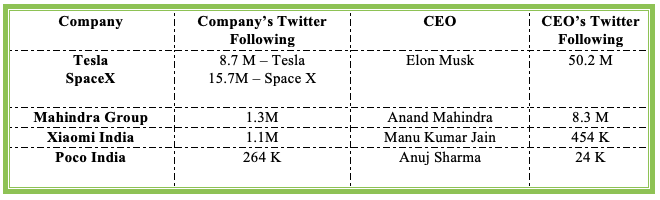
    Bhuvi GuptaElon Musk. Anand Mahindra. Manu Kumar Jain. Anuj Sharma. Thomas Edison. Richard Branson. Steve Jobs.


    What do all the above have in common? Well, a lot. They are all CEOs of companies, which have impacted the world via their products either technologically or pricewise. But what they also have in common is a strong personal brand, which was bigger than the company they led, and which helped that company more than a brand ambassador might have. If Edison, Jobs and Branson are anything to go by, what is noteworthy is that while digital has made it easier, carefully crafting and curating personal brands can have immeasurable impact on the company irrespective of how they have being built.


    CEOs who have leveraged their personal brand to great effect to help the company have follower counts which compete with their company’s


    The cult of the CEO has always existed. Digital access has made it easier to leverage it even as curating a personal brand remains as difficult. But with the sheer din of marketing messaging and competition for quality talent, companies are missing out if they don’t leverage their CEOs.


    Firstly, because it is such a great source of gathering information from customers, and (junior) employees who communicate actual issues, which often a times get lost in Chinese whispers while going from middle to senior management.


    Secondly, an active and engaged CEO as the face of the brand helps in building trust and credibility over and above celebrity brand endorsers who are endorsing multiple brands and on-hire for the highest bidder. Hence, while celebrities may help build brand awareness, they won’t contribute as much to help target consumers travel down the marketing funnel.


    Thirdly, a responsive CEO makes the company and brand approachable. All consumers want to feel heard and a CEO who is willing to listen to feedback, compliments and complaints makes the audience all the more invested in the product and brand.


    Anand Mahindra explains how much his followers on Twitter have helped him connect to both employees and consumers thereby enabling him to become a Big Brother of sorts to reward good behaviour and correct wrongdoings.


    When the CEO gets feedback so freely it also reduces the need for traditional market research where extrapolated data and inaccurately curated focus groups can often result in wrong takeaways. Hence, a CEO who can remain connected to his audience can greatly help the company’s overall strategy and speed of execution.


    Lastly, an engaged CEO acts as a great tool to build the employer brand. Having a strong personal brand (also crucial to help gain followers in the first place) will help showcase a company’s values and help attract talent which resonates much more than that ‘Great Places to Work’ Badge.


    Using your employees as influencers – Employee Advocacy Programmes


    While all the above reasons have high impact coming from the CEO, in 2021, with a socially connected population all employees have a sphere of influence that collectively can help a company via Employee Advocacy programs.


    Creating a strong brand for a CEO requires the creation of a personal brand backed by a robust content calendar, ORM (Online Reputation Management), PR and public appearances.


    Employees, if guided and empowered with similar tools and content, can become brand evangelists on social media, while also getting positioned as subject matter experts and create stronger personal brands.


    A well-implemented employee advocacy programme raises brand awareness, improves customer satisfaction, saves money in marketing spending, and, ultimately, grows business in much the same way as an Influencer CEO albeit at a micro level.


    It is very interesting to see the power that influence has on consumption. Whether coming from CEOs, celebrities, or content creators, social media in 2021 has made business & marketing come a full circle with influencers  launching their own brands and CEOs are becoming influencers.

  • Scanning the Indian Pay TV Market


    By Indrani Sen

    Indrani SenIndian Pay TV market is highly fragmented due to the multi-lingual distribution of TV content through many regional distributors along with national distributors covering the HSM and all major regional markets. As per different available research, 50% + share of the subscribers of Pay TV are currently being held by several small regional players. None of the available estimates except the FICCI EY reports takes into account the subscribers of DD Free Dish while estimating the total TV households in India. DD Free Dish subscribers do not have to pay for the TV content so do not contribute to the pay TV market revenue.

    Media Partners Asia (MPA) has recently published a report titled “Indian Pay TV Distribution 2021” which predicts that by 2025, the Indian Pay TV industry will reach revenue of USD 12.3 billion and total Pay TV subscribers will increase to 134 million in 2025 from 127 million in 2020. According to the same research, DTH homes in India will grow from 58 million in 2020 to 68 million in 2025 at the cost of the cable TV homes during the same period. Compared to estimates published by various other research organisations, the total pay TV subscribers’ base in India seem to have been underestimated while the revenue may have been overestimated by MPA.

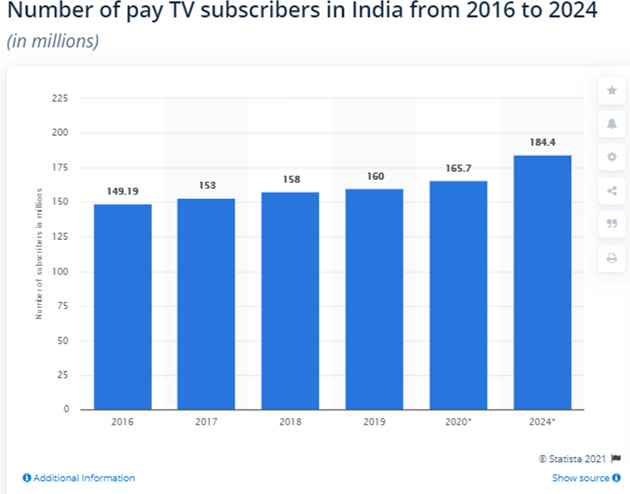
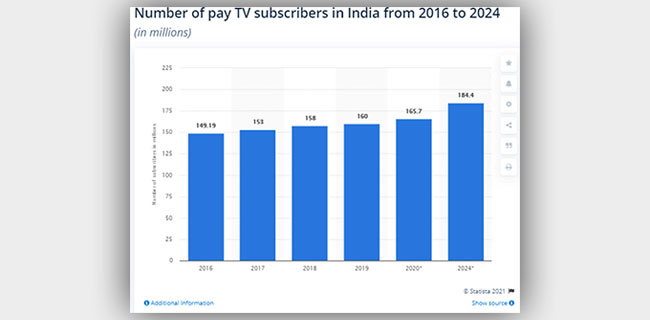
    According to an estimate published by Statista Research Department on March 19, 2021, “India had over 160 million subscribers of pay TV in the year 2019. This figure was around 149 million subscribers in 2016 and was estimated to go up to over 184 million Pay TV subscribers by 2024.” These estimates are higher than the estimates made by the FICCI EY in their report on the Indian M&E industry 2020.

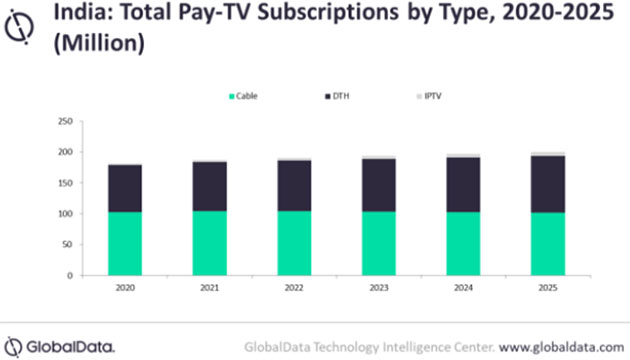
    Another report India Telecom Operators Country Intelligence report published by www.globaldata.com in 2020 supports the estimates of Statista. As per this report, Cable will be the leading Pay TV technology in India throughout the forecast period, followed by DTH with a small presence IPTV which is expected to grow in India at a very fast rate during the next 4 years. As per www.globaldata.com the total Pay TV revenue in India is expected to grow at an annual growth rate (CAGR) of 0.7 percent from USD 3.19 billion in 2020 to USD 3.30 billion in 2025, which is much lower than the FICCI EY estimates.

    The above picture reflects the trends in TV distribution by technology in the global market, though the pandemic has reduced the share of the cable TV subscribers in India. IPTV is expected to grow at a CAGR of 19.4% in India during the next 4 years riding on the fixed broadband penetration in India as well as smart TV sets.

    According to the report published in www.grandviewresearch.com: “The global Pay TV market size was valued at USD 225.9 billion in 2019, registering a CAGR of more than 1.5% from 2020 to 2027.” This report spoke about the growth in penetration of Pay TV in rural households in China, India and Indonesia creating overall growth in the Pay TV industry.


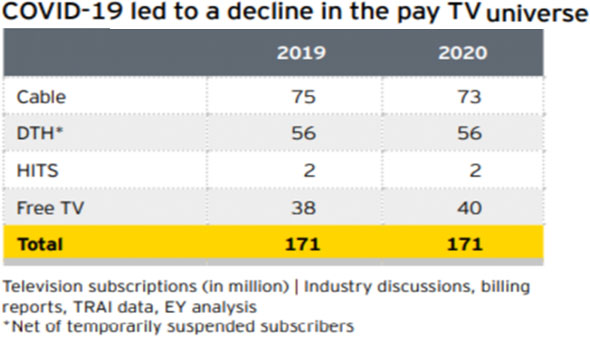
    Source: FICCI EY Indian M&E Industry Report 2020

    As per the FICCI EY report on the Indian M&E industry 2020, there are 171 million TV households in India of which 40 million are Free TV households. The report estimates distribution revenue of the Indian TV Industry to reach INR 502 billion (USD 6.72 billion) in 2023 from the current level of INR 434 billion (USD 5.80 billion). The FICCI EY estimates seem to be the best one available currently for the size as well as the revenue of the Pay TV market in India.

  • A Trillion-Dollar Digital Economy Beckons


    By Indrani Sen


    Last week, in a virtual event, Assocham released along with The Dialogue, a research report titled ‘Enabling A Trillion Dollar Digital Economy – Interdependent, Interconnected and Digital’. The media coverage of the event highlighted the gist of the speeches given by the various dignitaries which did not do justice to the actual content of the report.


    The report by The Dialogue presents an in-depth analysis of the telecom industry of India and the way it has enabled the digital economy. It also reviews the challenges of privacy, security, intermediary liability, competition and financial loss which the industry is facing currently along with the opportunities and the action points for achieving the target of a trillion-dollar digital economy by 2025.


    As action points, the report offers solutions like reducing regulatory levies, addressing the AGR issue, reducing GST burden, progressive regulatory policies, an online portal for transparency of approvals along with introduction of new technologies. In an indirect way, the report challenges some of the current rules and regulations related to the telecom industry.


    If our government takes the suggestions given in the report seriously and activate the action points suggested by them, then we shall definitely achieve the target of a trillion-dollar digital economy in four years.


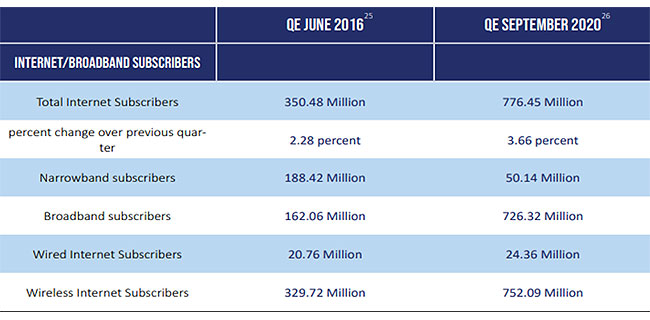
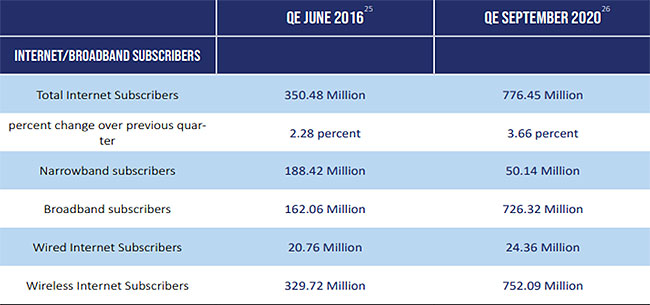
    The report gives an estimate of the size of the internet users in India, which shows 97% of internet subscribers (752.09 million) are wireless internet subscribers. A comparison of the internet subscribers between June 2016 and September 2020 shows that the wired internet subscribers increased by only 3.6 million while the wireless internet subscribers increased by 422.37 million in four years. Broadband subscribers grew by 564.26 million during the same period from 162.06 million to 726.32 million.


    Source: https://thedialogue.co/wp-content/uploads/2021/02/Enabling-a-Trillion-Dollar-Economy-The-Dialogue.pdf


    In November 2016, Assocham had published along with Deloitte a research report titled “Digital India: Unlocking the Trillion Dollar Opportunity”. There is no reference to that report in the recently published report except the use of the June 2016 data for comparing the internet/ broadband subscribers.


    Said Kazim Rizvi, founding director, The Dialogue in the introduction of the report: “I hope that for years to come, this serves us as a guiding document on the regulatory issues to be debated and discussed, in order to enhance the potential of India’s digital economy.” I not only agree with him, but congratulate The Dialogue team for producing a comprehensive guide for solving the problems of our telecom industry which is the backbone of our growing digital economy.


  • Advertising goes down 29%


    By Indrani Sen


    Indrani SenThe FICCI EY report on Indian M&E industry 2021 titled “Playing by New Rules” was released last Friday, March 26, 2021 at a virtual event. By now, we know that M&E sector posted INR 1.38 trillion in 2020 (a decline of 24% from 2019). Except Digital Media and Online Gaming, all other media suffered degrowth as an effect of Covid-19. Print media lost its #2 position to Digital Media, while Television managed retain the #1 position.

    Let us turn our focus to the advertising industry, which according to the FICCI EY report, saw the highest single year drop in the history of Indian advertising. The industry saw a degrowth of 29% in 2020, higher than the 24% degrowth of the overall M&E sector. The report describes 2020 as “a watershed year for advertising spends”. A review of how advertising revenue was distributed among different media in 2020 and how did the distribution compare with 2019 is shown in the table below:


    Ad Revenue by Media: Source FICCI EY Report 2021

    Advertising in traditional media experienced a degrowth of 37% from 2019 to 2020, but advertising in digital media remained steady and did not suffer any loss. Advertising in Print sufferred due to reverse migration, changed consumer habits and cost-cutting while advertising in Radio and OOH was affected by reduced mobility of consumers. The experienial industry comprising of Events and Cinema degrew due to lockdown guideline, social distancing norms and consumer fear of crowded places.

    The advertising industry is not expected to recover the losses of last year in next two years (2021 and 2022). While the total advertising spend is expected to regain the pre-Covid-19 levels in 2023, the individual traditional media are estimated to regain the same levels over a period of 5 years: 2021 (none), 2022 (Television), 2023 (Events & Cinema), 2024 (OOH), Radio (2024+) and Print (2025+).  Digital media is expected to grow by 22.5% over the 2019 level in 2021.

    In a Marketer Survey conducted by EY in 2020, 88% of marketers were confident that consumer spends in their sector would grow in 2021. 66% of the marketers felt that their advertising expenditure would grow in next two years. However, 33% of the marketers surveyed felt that their advertising expenditure either would not grow or would decline in the next two years.

    The same survey showed the marketers incresed investments in D2C initiatives during the pandemic in 2020 as shown in the above chart and 74% of them expeted to spend over 20% of their total spends on digital media against 45% who had shown interest in investing in digital media in 2019. A significant increase in digital spend were expressed by most.

    The survey probed further on how the marketers were assessing the state of their future readiness in terms of their digital maturity and found that the advertising agencies are playing a crucial role.

    :: “92% of respondents were actively monitoring their digital readiness, at a time when complex ecosystems are emerging across the business and marketing landscape.

    :: 53% of respondents surveyed depended on their agency partners to update them on leading practices in their digital transformation journeys”

    The FICCI EY report finally sums up the section on advertising by listing how advertisers are turning uncertainty to opportunity through Martech adoption, investments in brand purpose and architecture, hyperlocalisation, building and retaining immersive consumer experience, diversification of media, colaboration and last but not the least ensuring digital effectiveness. The experts’ comments at the end of the section on Advertising makes it clear that in the digital age advertising agencies need to invest in data, technology and analytics to stay relevant for their clients.


  • So how do the GroupM & Madison forecasts compare?


    By Indrani Sen


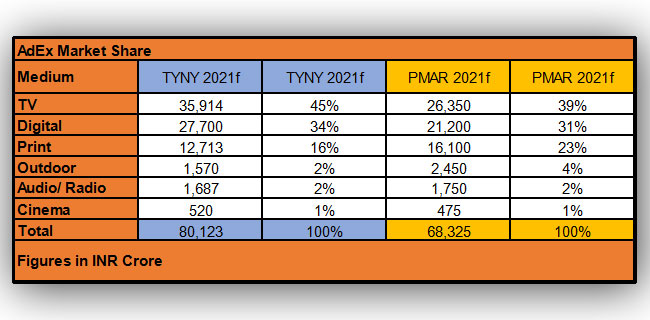
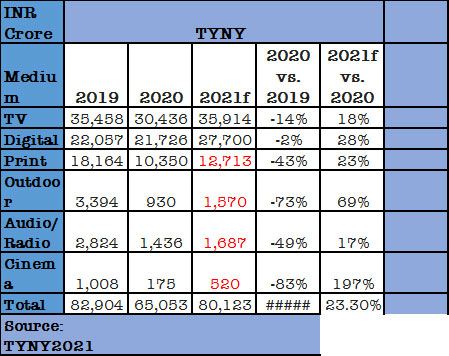
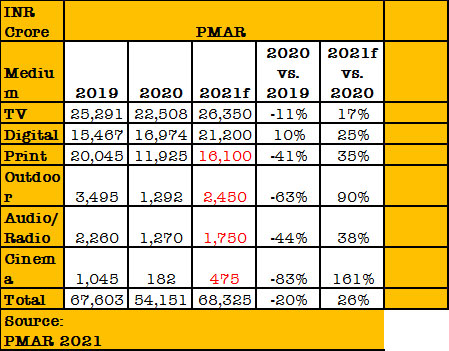
    Like every year, last week we saw the release of both This Year Next Year 2021 (TYNY2021) by GroupM and Pitch Madison Advertising Report 2021 (PMAR2021) by Madison Media. Both agreed that the pandemic year 2020 was a disastrous one for the Indian Media and Advertising Industry, when the overall AdEx dropped by 20% (PMAR2021) to 21.5% (TYNY2021) from the 2019 level. Both have predicted better days in 2021 with the overall AdEx growing by 23.3% (TYNY2021) to 26% (PMAR2021).  According to PMAR2021, the predicted AdEx INR 68,325 crore in 2021 will touch the AdEx INR 67,603 crore in 2019. According to TYNY2021, the forecast for 2021 is INR 80,123 crore, which falls short by 3.35% from the AdEx in 2019 which was INR 82,904 crore.


    In spite of the huge gap in the overall AdEx estimates by the two agencies, it is relieving to find that the trends predicted by both of them are similar. The gap in the estimated size of the Indian AdEx between the two reports has been existing over many years and the Media and Advertising Industry has learned to live with the differences. TYNY2021 has estimated both TV and Digital AdEx at much higher levels than PMAR2021. On the other hand, PMAR2021 has estimated Print AdEx at a much higher level than TYNY2021. The following two tables show the details of the two reports by medium for making easy comparisons.


    According to PMAR2021, the pandemic year 2020 will go down in the history of Indian Media and Advertising as the year when Digital overtook Print and became #2 in terms of market share of overall AdEx. However, TYNY2019 showed Digital as the #2 and Print in the #3 positions in terms of market share. In 2020, GroupM estimated a 2% degrowth in Digital from 2019 level, while Madison Media estimated a 10% growth in Digital over 2019 level. Both the reports show Print AdEx in 2021 would be below the 2019 levels, while Digital AdEx would be crossing the 2019 levels in 2021. So, we can now conclude that Digital has the second highest market share in overall AdEx and it is unlikely that Print would be able to regain that position in 2021 or later.


    TV which holds the #1 position in Indian AdEx in both the reports, had degrowth of 11% (PMAR2021) to 14% (TYNY2021) last year, but is expected to grow at higher rate 17% (PMAR2021) to 18% (TYNY2021) in 2021 and touch or cross the 2019 AdEx levels.


    Both the reports show the huge loss which was suffered by the other traditional media, Outdoor, Radio and Cinema during 2020.  In spite of the overall growth of AdEx predicted for 2021, these three media would be far below their 2019 benchmarks. The combined market share of these three media continues to be less than 10% in both the reports. A difference in reporting between TYNY and PMAR has been noticed this year regarding Radio. While PMAR2021 has reported only on Radio, TYNY2021 has changed the nomenclature to Audio. It is however not very clear what other audio component apart from Radio has been included under that definition.


    It is encouraging to find from the two reports that the worst effect of pandemic is over; Media and Advertising industry is on the path of recovery; the process of digitisation has been accelerated; we are expecting a robust GDP growth and globally India will continue to be the second-fastest growing AdEx market among the top ten countries in 2021. At the same time, it is also frightening that the economic effects of Covid-19 have manged to wipe off two years of overall AdEx growth (2020 & 2021) and many media-owners and some media agencies still have to fight battles for survival.


  • The Grave Crisis in OOH Continues


    By Indrani Sen


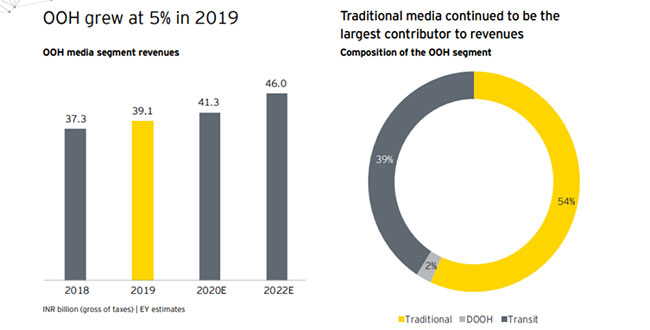
    The EY-FICCI 2019 Media & Entertainment Industry Report estimated that the Indian OOH industry grew by 5% in 2019, taking the industry size to Rs 37.1 billion. The traditional OOH formats, driven by increased advertising opportunities in tier-II and tier-III cities, contributed 54% to the overall revenue. However, according to the report the main driving factor behind the growth is recent development of infrastructure network, including upcoming airports, smart city projects, malls, metros, bus shelters, public utility, coffee shops, etc.


    Source: EY-FICCI 2019 M&E Industry Report


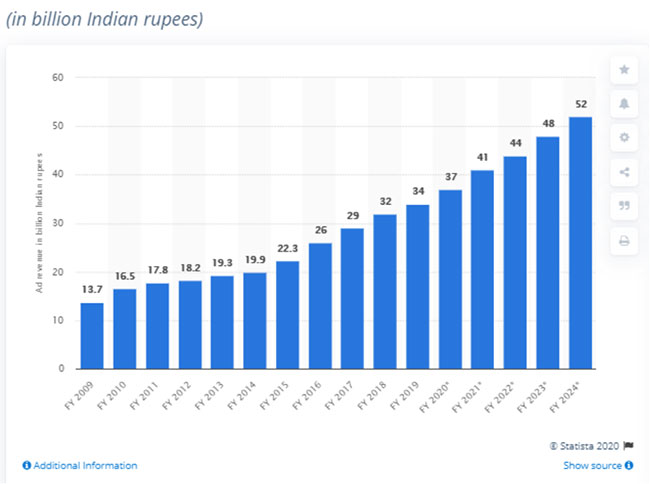
    A couple of years back, www.statistia.com published an estimate of out of home advertsing in India from 2009 to 2024 as shown below. It is interesting to note that overall size of OOH industry estimated In the FICCI EY report is higher than shown in the chart for 2019 (Rs. 34 billion).


    Source: https://www.statista.com/statistics/233491/out-of-home-advertising-revenue-in-india/


    The growth of the OOH industry has been stalled completely as an effect of Covid-19. In the ‘FICCI Frames 2020’ virtual conference, WPP’s CEO Mark Reed remarked that OOH was the most impacted medium due to Covid-19. While we are seeing some signs of revival in digital, TV and print media, the trend has not yet been seen in OOH media under the gradual process of unlocking. While we are still waiting for FICCI EY to release a revised estimate for M&E industry in 2020, the mid-year review of the Pitch Madison Advertising Report 2020 has estimated 35% to 50% de-growth in OOH advertising revenue in 2020.


    At the early stage of lockdown, IOAA also estimated that their annual revenue may see a 50% drop in 2020 and appealed for financial relief to the various state governments who have not yet responded positively. The association also requested the central government to declare the pandemic as natural calamity which is covered under ‘force majeure’ clause of all OOH contracts which also has not received any definite response. In US and couple of other countries, OOH industry registered as small business has received some financial relief, but we have not seen any such relief measures for the OOH industry in India.


    An article published on August 10, 2020 has predicted four key trends for OOH medium in 2020 and beyond (https://www.advendio.com/4-key-ooh-advertising-trends-2020-beyond): 1/ build brand awareness with smart creatives; 2/ adapt value for money messaging approach; 3/ the evolution of touch screen OOH advertisements and 4/ curbside pickup and digital OOH are here to stay. Apart from the first trend, there is hardly any scope seeing of the other trends happening in India. It is high time that our outdoor advertising agencies take stock of their inventories and consider disinvesting in traditional formats and channelize their attention to building up standardised digital OOH formats as per the global trends.


  • Is Legacy Media Recovering in the Unlocking?


    By Indrani Sen


    During the last two or three weeks, we saw many reports on how the AdEx has improved in June 2020 ensuring us that not only digital, but TV and print are also on the path of recovery after Covid-19. TAM AdEx for June has shown that TV advertising volumes increased by 74 per cent per day in June compared to April, when adspends declined sharply due to decline in demand during the nationwide lockdown. TV ad volumes saw 46% growth in June compared to May.


    Print, which suffered a bigger hit in terms of revenue due to distribution problems during lockdown, has recorded a higher increase of 325% in average ad volume per day in June 2020 when compared to April 2020. Most of the business newspapers and industry websites reported on the recovery of digital and TV media. None of the articles highlighted the comparison between the first quarter and the second quarter of 2020 which could have given a better idea about the recovery of ad volumes in digital and TV media.


    I saw only one article in details on Print AdEx on the recovery of Print AdEx which also did not have any such comparison (https://www.financialexpress.com/brandwagon/print-advertising-on-the-road-to-recovery-as-average-ad-volumes-per-day-rose-325-in-june-2020-tam-adex/2032701/). This trend of lack of reporting on print clearly indicates that the medium has lost its position to digital not just in terms of share of the advertising pie, but also in the share of mind map of the audience, the advertisers and agencies.


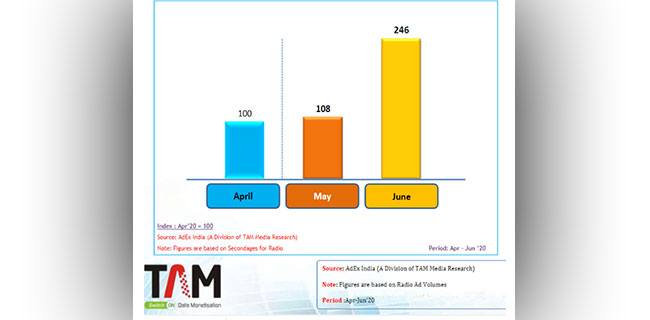
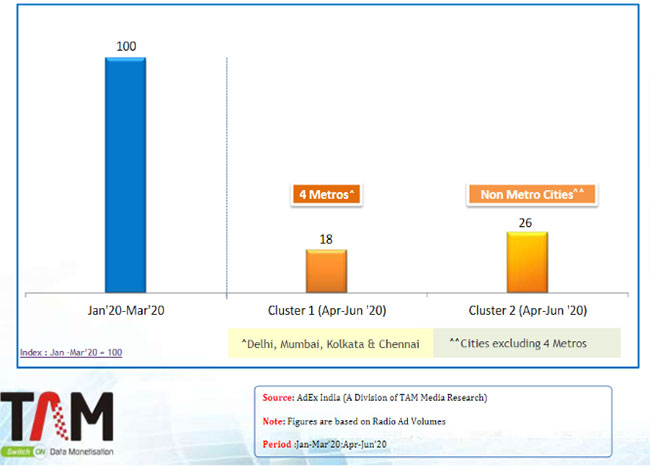
    The Advertising Report on Radio – April-June 2020 published by TAM shows that average ad volume per day increased by more than two-fold in June compared to April and May. However, a comparison with the first quarter of the year (Jan-March) shows that the ad volumes in radio are still much below the pre-Covid-19 phase. It is interesting to note that FM Radio ad volumes in Non-metro cities have recovered better than metro cities.


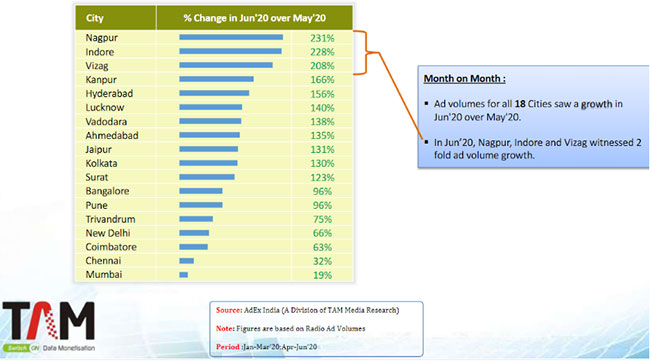
    The ad volumes of radio advertising in all 18 cities grew in June 2020 over May 2020. The chat below shows that the eight non-metro cities, Nagpur, Indore, Vizag, Kanpur, Hyderabad, Lucknow, Vadodara and Ahmedabad have shown much better growth in June 2020 compared the four metro cities. Kanpur, Indore and Vizag led the chart with each accounting for two-fold growth in ad volumes. Among the four metro cities, Kolkata has shown the highest percentage change in June 2020 over May 2020 with Mumbai showing the least percentage change. The listenership of FM radio increased during the period of lockdown and has retained the level, but advertisers across different cities are investing in the medium in different way.


    The report has detail analysis of radio advertising by categories, advertisers and brands as well as city wise analysis of the performance of radio AdEx. It also presents comparative analysis of TV and radio and digital and radio advertising during Jan-June 2020. The Top 10 common categories, advertisers and brands between TV and radio shows that during the first six months of 2020, Top 10 common categories, advertisers and brands added 33%, 14% and 4% on TV while they added 10%, 7% and 4% on radio.  Similarly, the Top 10 common categories, advertisers and brands between digital and radio shows that during the first six months of 2020, Top 10 common categories, advertisers and brands added 47%, 18% and 12% on digital while they added 19%, 2% and 1% on radio. The role of radio in the media mix needs to be reassessed by advertisers and agencies for the growth and survival of the FM radio industry during this period of unlocking and subsequent return to normalcy.


  • Rise & Shine of the Digital Duo


    By Indrani Sen


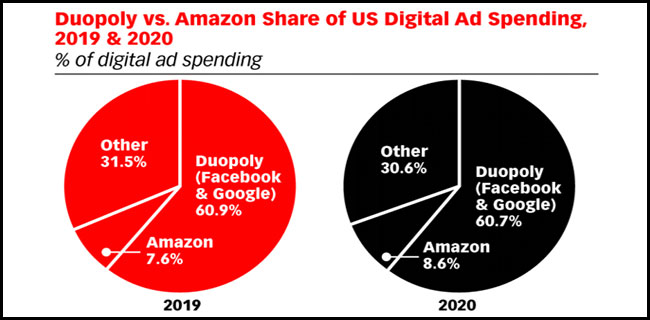
    The digital marketing trends in US indicate the trends across the world (except China). Recently, an article in www.emarketer.com indicated that the Facebook-Google duopoly will continue in the US market in spite of the amazing growth registered by Amazon which has been steadily increasing its share (https://www.emarketer.com/content/facebook-google-duopoly-won-t-crack-this-year?ecid=NL1009). Google is the leading partner in this duopoly across the world.


    The same duopoly enjoys together 68 per cent of India’s digital ad market and it is likely to grow as the digital advertising spending is expected to also increase by 30 per cent in 2019. Even if the growth forecast takes a dip as foretold by the less than expected yield of digital media during Diwali 2019, it will not affect the stronghold of the duopoly.


    Google India, the arm of the technology giant, reported total revenue close to ₹ 9337 crores in FY18.  A most unprecedented financial result reported by Google India for FY19 has created confusion in the market place. Google India reported a 56 per cent fall in revenue to ₹ 4147 crores in the year ended March 31, 2019 (https://www.statista.com/statistics/717633/google-revenue-value-india/). The fall was attributed to a new accounting standard introduced by the Ministry of Corporate Affairs, Government of India.


    Google is the undisputed leader in India’s mobile search engine market, but its biggest cash cow- Google AdWords, is registered under the Google Asia Pacific division. As such, the revenue and profits from AdWords cannot be filed as part of the Indian division without incurring certain burden of taxation as per the amended rules. So, advertising revenue, the biggest contributor to Google’s  overall revenue is missing from the revenue posted by Google India.


    On the other hand, Facebook Inc’s Indian operation has reported revenues of ₹ 892 crore, compared to revenues of ₹ 521 crore, a 71% jump in revenues last fiscal for fiscal year ended 31 March 2019  (https://economictimes.indiatimes.com/markets/stocks/earnings/facebook-reports-84-jump-in-net-profit-for-india-at-rs-105-crore-for-fiscal-2019/articleshow/71891826.cms?from=mdr) As a result, share of Facebook has gone up in the duopoly in Indian market, though it has a long way to go before its revenue gets closer to Google’s revenue. It remains to be seen if Amazon will be able to grow its share in the Indian market following the US example.


    As advertisers and agencies continue to use Google AdWords and place digital advertising through Google, the analysis of the revenue sources will not match with the money spend on digital advertising across various platforms offered by Google and will add to the computing confusions in media planning.