Category: NEWS

  • Bindass celebrates seven years with new offering

    By A Correspondent


    Celebrating its seventh anniversary, Disney India has announced the launch of a refreshed channel offering – bindass PLAY with a promise to celebrate, inspire and empower the youth of India through one of their core passions – Music.


    In the last seven years, bindass has been defining youth entertainment by celebrating their hopes, dreams and aspirations and has been gratified with an overwhelming response and the loyalty of its fans. In keeping with this theme, bindass is now creating yet another immersive experience with bindass PLAY. The channel will continue to celebrate the everyday lives of Young India while entertaining them with a unique blend of music and musically themed content.


    “At bindass, we celebrate every passion of Young India through entertainment that is reflective of their interests and they love us for it.  From pioneering concepts to unique initiatives, we have helped shape their thoughts and actions over the years. The vision for bindass play is to celebrate moments, to entertain and to inspire. And like all good friends, to understand them and offer them the power of choice through interactivity that is both meaningful and personal,” said Vijay Subramaniam, Vice President – Content and Communications, Media Networks, Disney India.


    Nikhil Gandhi

    “Over the last seven years, we have been immensely successful in offering our associates unique engagement opportunities to address one of the largest sections of the audience today. With the launch of bindass PLAY, we are presenting them with another promise that we believe will scale new heights of popularity amongst our audiences, while staying true to the promise of bindass,” said Nikhil Gandhi, Vice President – Revenue, Media Networks, Disney India.


    While the underlying theme will be music, bindass PLAY will showcase distinct programming that will continue to bring the bindass experience with elements that revolve around music. Empowering fans to choose their brand of music, fans can select and dedicate any song of their choice from the popular social networking platforms. The channel through music will encourage them to celebrate their feelings while inspiring them to express themselves with their choice of song. In addition to these, the channel will focus on presenting music that is in tune with their moods and desires mapped through the day through different bands. bindass PLAY will soon launch musically themed vignette series and short form storytelling to further deepen the engagement with its audiences.


  • Fifth edition of Chitralekha’s Watch World Awards held in Gurgaon

    By A Correspondent


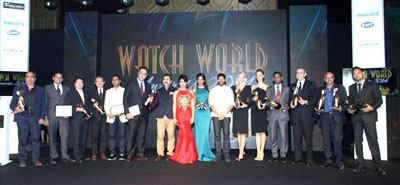
    Watch World from the Chitralekha Group hosted the fifth edition of the definitive roll-call show in the world of horology – The Watch World Awards recently. Hosted at The Westin, Gurgaon, in presence of luminary guests from a cross-section of the society, the awards saw eclectic watch brands winning commendations across 10 product and six market categories. These top brands were adjudged by acclaimed jurists including Antoine Simonin, Neeraj Pandey, Raghavendra Rathore and Adhiraj Singh who unanimously adjudged CARTIER Rotonde de Cartier Astrocalendaire as the ‘Watch of the Year 2014’.


    The event saw attendance by eclectic timekeeping brands vying for the top awards. The winners in the Marketing categories included SEIKO for their Kolkata Knight Riders IPL Campaign bagging the ‘Best Marketing Campaign in Print’ award and TITAN Edge and XYLYS picking up the award for ‘Best Marketing Campaigns on Television’. BREITLING New Bond Street, London picked the ‘Best Boutique’ award, while HUBLOT FIFA 2014 and IWC Mercedes AMG Petronas partnership was adjudicated as the ‘Best Integrated Marketing Campaign’.


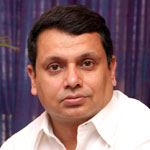
    Mitrajit Bhattacharya

    Mitrajit Bhattacharya, President & Publisher, Chitralekha Group & Creator of Watch World Awards said, “Watch World Awards has reached a stature which the watch industry looks upto. The list of marquee brands and participating product line-up continues to grow reiterating the importance of the platform. To match the incredible watches we once again had put up an incredible jury comprising the best from across watch making, designing, sports, creative and marketing. No wonder the watches which come through this tough jury and emerge victorious stand for the best in timekeeping.”


  • JD Power APAC report reveals struggle faced by automotive brands

    By A Correspondent


    The inaugural JD Power Asia Pacific 2014 India Brand Influence and Positioning Study (BIPS) has found that very few automotive brands in the intensely competitive India passenger-car market are able to establish a distinct position in car buyers’ minds.


    The study measures automotive brand influence in India of mass market passenger car brands, based on consumer awareness and perceptions of the brand. Strong brand influence may have a positive effect on purchase intent for a particular brand, as brand influence scores correlate highly with brand consideration rates. The study also segments the market using psychographic, demographic and behavioral attributes to help automakers identify and understand who their best prospects are in the new-car market.


    “Brand image and reputation have gained significant importance over the last five years for consumers in the Indian auto industry and are key purchase criterion,” said Mohit Arora, executive director at JD Power Asia Pacific, Singapore. “Brand Influence Scores measure the impact a brand has in the market, which is critical for automakers to track and measure.”


    According to the study, consumers in India have substantial difficulty distinguishing between many of the larger European and U.S automotive brands such as Fiat, Ford and Renault. This is particularly prevalent in the Northern and Eastern regions of India where consumers perceive many global brands as having similar vehicles and business approaches.


    In contrast, Japanese brands, such as Honda and Toyota, are able to more effectively differentiate themselves from other brands. Consumers in India perceive these Japanese brands to be more contemporary-offering the latest technology and engineering-and perceive them to have a more global image than their European, Korean and U.S. counterparts.


    Despite its Japanese origin, consumers view Maruti Suzuki as an Indian brand, less modern than other brands but distinctly positioned as offering affordable and fuel-efficient cars. Similar to Maruti Suzuki, Tata also is seen as a brand primarily positioned on affordability and fuel efficiency.


    The study also finds there is marked divergence between automakers’ brand messages and the degree to which customers actually internalize these themes. Although many advertisements focus on excitement, elegance and trendiness of a new vehicle, such messages often do not resonate with customers. Instead, customers prefer advertising that provides information on a vehicle’s new features, technology-related improvements and innovation in order to distinguish it from other vehicles in the market.


    “Understanding their current positioning relative to the competition from a consumer’s perspective as well as the type of messaging themes that appeal most to a target segment helps automotive manufacturers sharpen their marketing efforts,” said Arora. “Generally, consumers are able to differentiate more effectively on vehicle features they can see, touch and feel than on intangibles.”


    The 2014 India Brand Influence and Positioning Study is based on interviews with 8,009 car owners who have owned their vehicles from 30 to 42 months and who were asked to compare two vehicle brands. The study was fielded from January through April 2014 across 30 cities in India.


  • SMJ to take ‘Change is possible’ tack in third season

    By A Correspondent


    Game-changing television series Satyamev Jayate is returning for a third season on Star Plus and key channels of Star Network. After influencing change at an individual, societal and policy level in the first two seasons, the show is returning with the core theme ‘Mumkin Hai’ or ‘Change is Possible’. The focus will be on creating hope and positivity, and showcasing how Satyamev Jayate has truly become a brand of the people.


    Uday Shankar

    Talking about the new season, Uday Shankar, CEO, Star India said, “We began Satyamev Jayate to build awareness around urgent social issues. But it’s now gone way beyond that and has emerged as the best showcase of the role media can and should play in driving change in the country. I am particularly proud that Satyamev Jayate has also become the most powerful platform to inspire individuals and groups and acknowledge the extraordinary contribution that seemingly ordinary people are making to our country. For us at Star India, it has given purpose to why we exist.”


    Aamir Khan, Producer and Host of the show added, “Ninety per cent of my time this entire year has been spent on Satyamev Jayate, and it is with great anticipation that I look forward to the new season. We have an unusual mix of topics, and some really moving and inspirational first person accounts. Importantly, the major new aspect of our show is what I am really looking forward to, and that is the live response of the audience. Hope is the key word for me and it is with great hope that I look forward to the show’s launch on 5th October.”


    Satyamev Jayate has created awareness on several issues, portraying success stories in a bid to encourage more people among us to take actionable steps toward positive change. The entire campaign for the new season has been divided in two phases focusing on the change already inspired by the show and how change is possible when all of us take active interest and act responsibly.


    The big innovation in the show this season is live show called “Mumkin Hai” wherein Aamir Khan will be interacting with viewers live through phone calls and social media interactions. This was based on feedback from viewers that they wished to interact and have their voice hear and their opinion registered. The live show will air right after the main episode and will be telecast each week from a different city in India.


    Satyamev Jayate launches on 5th October, Sunday mornings at 11 am. This season will have six episodes in total. The show will be aired in five languages (Hindi, English, Marathi, Tamil and Malayalam) across eight channels (Star Plus, Star Utsav, Star Pravah, Star World, Star Vijay, Asianet, ETV Telegu and Doordarshan).


  • SOS! Editor Kingshuk Nag laments decay in values at The Times of India

    This eloquent appeal to Times of India journalists and editors to reclaim their dharma found its way into the MxMIndia mailbox over the weekend. Written by Kingshuk Nag, Resident Editor of The Times of India in Hyderabad, it is a reaction to the whole fiasco between the glamour sections of the newspaper and first film star Deepika Padukone and then the world at large. The Times of India’s blatant sexism has been attacked by the national and international media and the open letter written by Priya Gupta, head of all Times’ supplements, only made matters worse.


    Mr Nag was earlier RE of The Times of India’s Ahmedabad edition where he and the newspaper took a resolute stand for justice during the Gujarat riots of 2002. He has also written a biography of Narendra Modi, now Prime Minister of India, plus books about the rise of the BJP, the Telangana crisis and the fall of Satyam.


    Mr Nag’s letter to his colleagues points to the dilemma faced by all journalists when they have to deal with a powerful marketing department and with impossible diktats that run counter to the ethics they have nurtured for years. It raises questions that we have all had to deal with at some point and underlines the fact that we cannot and must not give in. There is more at stake than individual careers.


    We publish the letter as is. MxMIndia has verified that the letter was indeed written (and mailed) by Mr Nag. Although this letter is published without Mr Nag’s permission, given its content and the fact that MxMIndia is read essentially by the media fraternity, we think it merits wider discussion in the news media ecosystem. – Ed


    Here goes the letter:


    Dear Editorial colleagues and co- pilgrims:


    Subject: Reclaiming Journalism

    The Navaratris having begun and Vijaya Dashami will follow in a few days. Traditionally this is considered to a very auspicious time and legends have it that this was when Lord Rama had invoked goddess Durga before launching all-out war against Ravana. Vijaya Dashami is the day when Ravana was vanquished the occasion is celebrated as the victory of good over evil.


    Good and evil are however subjective words and evil could mean to denote not only our external enemies but also our internal obstacles. In fact most often than not we are inhibited by obstacles that we place before ourselves and victory is to surmount these impediments to go forward on our path and practice our dharma.


    Nightmare

    For the last few days I have been disturbed a lot. This followed the by now widely publicized row that Bombay Times has had with Deepika Padukone. Our ‘vagina and tits’ reference in a story carried in the supplement has lot a drawn of adverse reference in even international media. I feel shamed and humiliated by the comments being freely passed about us including in competing publications.


    For me the worst nightmare would be if someone went to the Supreme Court with a PIL seeking printing of a statutory warning on the masthead of the paper. The warning is that “some of the news carried in this paper is paid for.” This would be a statutory warning like that carried on cigarette packets: “Smoking cigarettes is injurious to your health.” Somebody could also file a PIL asking for a definition of what a newspaper is.


    This is not an implausible scenario considering that the supplements carried along with the TOI main paper have provisions for medianet. These supplements – though they have their own editors and imprint lines – are distributed along with the main paper. Of course, we carry on the masthead a line called advertorial, entertainment promotion feature, as a safeguard. But can a court not go beyond this?


    A few months ago- in February end- at our brand editorial meeting in Sri Lanka- the managing editor of Bombay Times (the same person with non-editorial background who has written the vagina and tits story) made a suggestion that on Sundays probably the Bombay Times could on top and the main paper could be wrapped within.  I recollect vividly that the suggestion was met with a hushed silence and disbelief, till the CEO dismissed it saying: ‘that’s just an idea (which I read as meaning the idea of the person suggesting).


    Journalism: a lifestyle

    Almost all of us came into the sacred profession of journalism by choice. At the beginning of our career many of us had other options but through affirmative action chose this path. By doing so we forsook many ordinary pleasures of life. For us, there is no Sunday, no Holi, no Diwali. For us there is no watching a movie in a hall in the evening 6-9 show. Thus journalism has become a lifestyle for us and this is something that we wear on our sleeves- very proudly. For us nothing gives us more kick than paper well brought out, a page well designed, a story well written and a picture well displayed. Nothing is more dampening to us that spotting errors and misses in our paper every morning. It spoils our mood. Yet we cannot be described as living in our own world. We are perpetually on the ball, and I reckon the fastest decision takers. This is not only regarding news but also designing strategies to take on competitors. We can cut through clutter and zero on problems and devise solutions, faster than the fastest ‘managers.’ This is not an empty boast.


    The only constant in life is change. Times change and so do realities but values that we imbibe remain. We are all aware that a paper that we sell to our readers for Rs 3 costs us upwards of Rs 20 to produce. The difference is paid by the advertiser. Considering this I can affirm and proudly so that the advertiser has almost no say in the content our paper. This is something that is amazing and unbelievable but so it is. Also over my long years in the TOI – I am now in my 22nd year -I have not been subject to any owner/ senior management pressure on what can be carried in the paper. I have worked in four different centers of TOI: New Delhi, Bangalore, Ahmedabad and Hyderabad. In some of my job profiles I have faced external intimidation but no internal company pressures. For over 14 of these 21 plus years I have been the editor of an independent edition.


    Yet a bias against journalists can be discerned. Though this may not be an institutional bias but it sometimes does percolate down the line and is not pleasant to encounter. As an example two years ago just before Diwali, I ran into the director in charge of the Management Assurance Services (MAS), a function which is akin to internal audit. The director who had come visiting Hyderabad told me (in words to that effect) that all journalists were corrupt. When I glared back at him, he said ‘at least in Delhi’ but withdrew because I started at him harder. I wanted to tell him that he had no idea and clue about the complexities of the job of an Editor but thought it a waste of time to educate him.


    There are many other ways too where these biases show up but they are too numerous to be listed. All of you must have discerned this as well.


    Once upon a time, TOI was infested with union politics. I remember my early days in Delhi in the first half of the 1990s when the editorial floor would be taken by union netas who would climb on the table making incendiary statements and create ghadar all around. I have also seen political netas (including one who became a minister soon thereafter) throw stones on the glass door on the ground floor of the TOI office. Thank god we have left those days long behind. Yet at the same time the pendulum has swung from one extreme to other.


    Change but is all for the good?

    The country has also changed a lot in these years and we have to adapt ourselves to the new changes. Yet some things do not change. One of them is that good journalism is all about reporting events around you -without biases and taking sides. It is not about the worship of Mammon. In fact the worship of Mammon leads nowhere and our recent national history proves this.


    Ever since 1991 when the economy was opened, profits have become a sexier word. But this has been to what effect? When Manmohan Singh became finance minister in 1991, the rupee was around 26 to a US dollar. As is write as on September 26 2014, the rupee is 61 to a dollar. Our currency has declined sharply. What was all this liberalization all about, I wonder. If you want to get a reality check and feel first- hand how you ‘disempowered’ you are, you have to go abroad. India is actually a nation that lives beyond it means, which is why imports are higher than exports and our currency is getting constantly devalued. We not only import oil and coal, but also gold and even fruits and vegetables. What a sorry state of affairs! Increased consumption and consumerism may not be bad but only as long as you can afford it.


    Of course it has to be admitted that liberalization also unleashed the creative urge amongst the entrepreneurially inclined and the importance of this cannot be underestimated. As a result our business landscape has changed and there are tremendous opportunities all round. Yet our manufacturing remains below par and most of the so called economic growth is only real estate boom and pure speculation. This is not growth, but just an illusion of growth. Creating a monoculture and façade of unappetizing concrete structures cannot be described as growth; it’s just a pretension of growth. A huge part of the money created by speculation has entered politics and led to huge corruption, fall in moral values and resulted in ‘contractorization’ of politics. All these are valid concerns, which our journalism must aim to articulate.


    National Interests

    All of us have individual interests. Above them we have the interests of our family, friends and relatives. Above all this is the societal and national interests. What our societal interests are and what our national interests should be – could be a matter of debate. But we cannot forget that there has to be national interest. When a soldier goes to war we expect him to fight for the country and even die in national interest. We will not pardon a soldier who draws his salary but runs away from the battlefield. As journalists we cannot be say that we can run away from the national interest, whatever the compulsion is.


    Friends, I took the liberty of writing to you because you are my co travelers and co pilgrims on this path of progress of this great nation. I write to you because I am extremely troubled and nowhere to turn to. I hope we will be able to work together and reclaim journalism and give back to society what we take for it. This is what we owe to our great nation. This is our dharma.


    With Best Wishes foryou and your nears and dears for Vijaya Dashami

    Thank You,

    Kingshuk Nag

    27 September 2014


  • India Matters for Billionnaire Bezos


    By Pankaj Mishra & Karthik Subbaraman


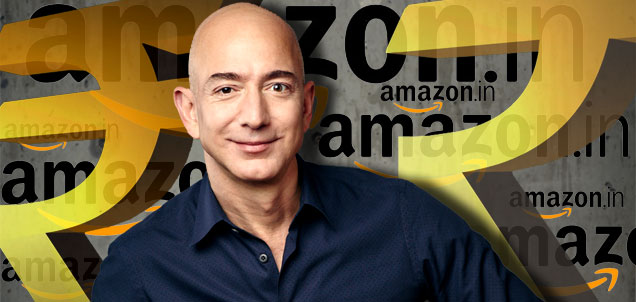
    India has surpassed the highest expectations for Amazon, the company’s founder and CEO Jeff Bezos said, promising to keep the money tap open for a business that he announced has sold goods worth more than $1 billion (Rs 6,000 crore) in just over a year of operations.


    “We had very high expectations and this team has blown past our highest expectations… It’s going extraordinarily well,” said Mr Bezos, 50, who is making his second visit to India and his first after Amazon launched its India retail business in June 2013. “The results are very good. Now that’s why we are doubling down our investments… If there is an opportunity to invest more, we will. We are not capital-constrained, we are ideas-constrained,” he said in an interview.


    In July, Mr Bezos committed to invest $2 billion in India, just a day after India’s biggest online retailer Flipkart announced $1 billion in funding, setting the stage for a battle for top honours in a market that retail advisory Technopak expects to be worth $32 billion (Rs 1.9 lakh crore) by 2020.


    With an estimated net worth of $30 billion, Mr Bezos is one of the world’s richest men and India is crucial to his plans for Amazon, given the country’s size and potential, and especially since it has failed to make much headway in China.


    Unfazed by Alibaba

    His company launched relatively late in this country. Amazon’s share price has fallen by around 20% on the Nasdaq this year, and China’s Alibaba is flush with cash after its IPO and ready to challenge Mr Bezos around the world, including India. But Mr Bezos, who swears by the credo of long-term thinking, is unfazed.


    “Judging just based on results, I would say we have come exactly at the right time,” Mr Bezos said in response to a question about whether he has left India until too late, and let out a full-throated guffaw, one of several that punctuated the 40-minute interview.


    Amazon’s main rivals in India are Bengaluru-based Flipkart and Snapdeal, the Delhi-based company that counts eBay, Azim Premji and Ratan Tata as investors. Together, they have sold goods worth more than $4 billion, with Flipkart alone estimated to have crossed $2 billion. Alibaba, too, is keen on India, and the Chinese company has the money, experience and ambition to succeed here.


    Does Alibaba’s $25-billion IPO earlier this month put Mr Bezos under added pressure? “If so, I haven’t felt it,” he said, bellowing once again with laughter and reiterating his focus on good business results over the long term.


    Asked what was his message for Sachin Bansal and Binny Bansal of Flipkart (both former employees of Amazon India) especially after it appeared to have tauntingly welcomed him with giant billboards across Bengaluru, including one outside the Sheraton hotel where he is staying, announcing its upcoming ‘Big Billion Day’ sale, Mr Bezos refused to be drawn to speak about competition.


    “I have this long-standing practice about not talking about other companies. We have a somewhat unusual or rather unique approach of mostly ignoring our competitors,” he said.


    With revenue of nearly $75 billion in 2013 and a market value of $150 billion, Amazon is best-known as an online retailer. But it also runs a fast-growing cloud computing business called Amazon Web Services and makes Kindle tablets and Fire smartphones. Mr Bezos, in his personal capacity, bought The Washington Post newspaper last year. In India, Amazon started its technology operation first and employs a total of about 12,000 staff at offices in Bengaluru, Hyderabad, Chennai and Delhi.


    Dressed casually in beige trousers and a light blue shirt, Mr Bezos was unstinting in his praise for country head Amit Agarwal, whose team has made sure that India is the fastest country to reach $1 billion in gross sales for Amazon. “He is going to blush because I am going to say so many good things,” Mr Bezos at the start of the interview said about his former technical advisor at Seattle headquarters.


    Some of the innovations by the India operation are being exported to the rest of the world, Mr Bezos said, pointing to its ‘Easy Ship’ service of delivering goods for sellers who don’t stock their products with Amazon.


    “I am super-excited,” he said. Traditionally, Amazon has grown organically but it is open to acquisitions in India, Mr Bezos said, as he spoke of the Indian operation along with AWS, Kindle and fashion as the company’s new frontiers. “Mostly we grow organically and that’s true in India. But if there are opportunities to do acquisitions, we’ll always consider.”


    Asked whether India’s marketplace-based e-retailing model was a bother – Amazon operates an inventory-based model at home – Mr Bezos said his company had no issues whatsoever, dispelling a perception that the Indian system was an irritant and he would lobby with the government during this visit to change it. “Our marketplace model is working phenomenally well… I always tell my team that whatever the rules are, we are the ones who would have to adapt to the local rules,” he said.


    Some five years ago, Mr Bezos made a quiet two-week visit to India, allocating the first half of his trip for business and rest for leisure. The father of four took his nine-year-old son to the main tourist attractions, including the Taj Mahal in Agra and Varanasi, a city now represented in the Lok Sabha by Prime Minister Narendra Modi.


    “I find India and the people not just energetic but personally energising,” he said.


    Source:The Economic Times

    Copyright © 2014, Bennett, Coleman & Co. Ltd. All Rights Reserved

    Licensed to republish

     

  • dna celebrates World Heart Day with unique song initiative

    By A Correspondent


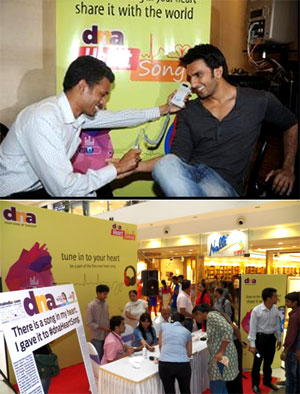
    dna came out with a first-of-its-kind initiative titled – “dna Heart Song” -  a video, bringing Mumbaikars together to celebrate World Heart Day on 29th Sep 2014.


    We can keep our minds sharp and muscles toned, but a healthy heart is extremely important as it helps to add emotion to our logic. It is the very beat that helps us connect with the world, keeps us smiling and lets us live a healthy life.


    What makes the #dnaHeartSong project unique is that it is the first ever crowd-sourced song made using actual heart beats of Mumbaikars including that of actor Ranveer Singh. The initiative was commenced by recording the heart beats of Mumbaikars at Oberoi Mall Goregaon.


  • Srinivasan Swamy re-elected President of IAA in India

    By A Correspondent


    Srinivasan K Swamy

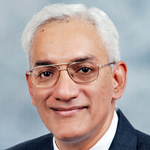
    Srinivasan Swamy, Chairman of R K Swamy Hansa Group was elected President of IAA for the third consecutive term at the Annual General Body Meeting. He already serves on the IAA Global Board as Vice President – Development, IAA Asia Pacific.


    Neeraj Roy of Hungama, Monica Tata of HBO and Jaideep Gandhi of Jaya Advertising were also re-elected Vice President, Honorary Secretary and Treasurer respectively the year for 2014-15.


    The other members elected into the Managing Committee were – Abhishek Karnani of The Free Press Journal, Vishakha Singh of Aurora Comms, Manish Advani of Mahindra SSG, Janak Sarda of Deshdoot, CVL Srinivas of Group M, Avinash Pandey of ABP News, M. V. Shreyams Kumar of Mathrubhumi, Partho Dasgupta of BARC, Bhaskar Das of Zee Media and Rajesh Kejriwal of Kyoorius.


    In addition, the following would serve in the Committee as invited members for the year 2014-15: Pradeep Guha, Pheroza Bilimoria, Sam Balsara, Kaushik Roy, Raj Nayak, Ramesh Narayan, M G Parameswaran, Neville Taraporewalla, Gayatri Yadav, Anita Nayyar, Pradeep Dwivedi, Anand Sankeshwar, Sunil Lulla and Punitha Arumugam. “A few more have been invited and their names will be announced after they accept our invitation”, said Srinivasan Swamy.


    In his outgoing President’s address, Srinivasan Swamy said that the year that went by was an active one, where 32 events were organised by IAA India. Some of these included two IAA Debates, four IAA Conversations, five IAA Mentorship Webinars, six Knowledge Seminars, three IAA Young Turks Forum events and other marquee events like the IAA Olive Crown Awards and the IAA Leadership Awards. There were a few other special ones like the IAA Retrospect & Prospects events in Gurgaon and Mumbai and the IAA Mentorship Programme. The year was off to a terrific start on 30th September 2013 with the IAA Platinum Jubilee Global Marketing Summit where the BJP Prime Ministerial candidate and CM of Gujarat the Hon’ble Shri Narendra Modi delivering his valedictory address on his vision of Brand India.


    IAA India will be celebrating its Silver Jubilee year in 2014-15. “We have identified at least 20 different platforms to peg our events for the coming year. We have a very good committee and I wouldn’t be surprised if we have more than 52 events during the year”, said Srinivasan Swamy. Commented Pradeep Guha, Area Director, IAA Asia Pacific, “IAA India is already seen as the most active industry body in India as well as in the IAA world. With the plans that are made for 2014-15, I have no doubt that this will be the best year ever and would set a new benchmark”.


  • Mirriad, UMG, Havas announce new brand integration venture

    By A Correspondent


    Mirriad, the leader in native in-video advertising, Universal Music Group (UMG), the world’s leading music company, and Havas announced that the companies have signed an agreement that enable UMG to feature digital brand integrations in select music videos by using Mirriad’s Academy Award-winning video technology.


    In addition, Havas, through its Havas Media network, becomes the first global agency to partner with Mirriad and UMG for strategic native in-video advertising from key clients including LVMH, Dish Network, LG, and Coca-Cola.  Havas’s venture 18-Siliwood, a research center launched in collaboration with Orange Silicon Valley, will also incorporate Mirriad technology and UMG content in ongoing research it is conducting in media, content, technology and data science.


    Mirriad’s technology integrates products, signage, video and other forms of branded assets into professionally produced video content. The company has more than four years of global broadcast experience, working with many of the world’s top broadcasters and content owners. Mirriad’s pioneering form of advertising has been described as “the cure for ad blindness” with research proving brands are two times more likely to be top of mind with consumers watching native in-video ads than comparable pre-rolls or interstitial spots.


    This agreement builds on Mirriad’s recently announced launch with distribution partner Vevo, the world’s leading all-premium music video and entertainment platform.


    Mirriad’s technology will allow agencies such as Havas Media to run multi-title campaigns in select UMG music videos on-air, online and on mobile. For the first time ever, Mirriad’s native in-video ads can be planned and executed with the same reach and frequency metrics as traditional ad campaigns. Mirriad offers content owners and creators complete editorial control over brand integrations, as well as the incremental revenue stream to UMG and its artists.


    “Through innovative technologies such as Mirriad’s, and leading global agencies such as Havas, we can offer our artists additional opportunities to generate revenue from their music videos,” said Lucian Grainge, Chairman and CEO, Universal Music Group. “And with Mirriad’s highly customizable platform, we have the ability to insure that artists’ and brands’ interests are aligned while we remain focused on presenting fans with the most compelling music experience possible.”


    “Partnering with Mirriad and UMG is an innovative way for us to help brands build more meaningful relationships with consumers,” said Yannick Bolloré, Chairman and CEO of the Havas Group. “Mirriad will make it possible for us to create a more authentic, logical and in-context connection with our clients and audiences that have insatiable appetites for content across multiple screens.”


    “We are thrilled to work with UMG and Havas as we grow our brand globally and extend our technology beyond broadcast television to online digital video.   We want to help bring a better experience to fans”, said Mark Popkiewicz, Mirriad’s Chief Executive Officer “We designed Mirriad with content producers very much in mind so our platform allows all stakeholders to painlessly review and approve campaigns ahead of launch.”


  • Times of India Editor Kingshuk Nag clarifies: As Editor at TOI one is far more autonomous than can be imagined

    We chose to publish what was essentially a letter for internal discussion and consumption essentially to start a discussion on the issues plaguing not just The Times of India but a large part of the Indian news media.


    We know there’s widescale owner-/management-interference in editorial affairs. The Times of India suits do it in the open, many don’t. Paid content rules. Politicians strike deals with news media owners for plugs.


    Private Treaties (or ads against equity) is no longer a preserve of TOI owners BCCL. Many others are doing the same. Even those publications that once wrote loads damning the TOI’s Medianet policy, decided to introduce similar schemes for brands/lifestyle events/parties.


    And it’s not that all journalists come with a squeaky clean reputation. Vested interests play a huge role here too.


    As Kingshuk Nag, suggests in this clarification, The Times of India is one of the better places to be in for quality journalism. There’s a great deal of functional autonomy for editors of the main paper.


    Indeed, we are aware that at the time of the Gujarat law-and-order mess in 2002 that led to then Chief Minister Narendra Modi being denied a visa to the US, the newspaper’s Ahmedabad edition adopted a neutral stance and did not buckle under extreme political pressure at that time.


    Here’s Kingshuk’s Nag letter, published as is:


    The Editor,

    MxM India


    Dear Editor:


    This is regarding my letter to senior colleagues at TOI. While the letter you have reproduced is the one that I had written it was only meant for internal discussion.


    Though as a journalist I cannot question your rights as a journalist to reproduce information that you have accessed, your note that precedes the letter says that we at TOI (as journalists) face a dilemma on how to deal with a powerful marketing department. Unfortunately this has placed a somewhat misleading emphasis to the letter.


    Further down in the letter I have explained how I have never faced pressure internally from management about the stories in the paper. In fact, in my position I have really never had the occasion to interact (much less receive diktats) from the top management. As Editor at TOI one is far more autonomous than can be imagined. Two incidents come to my mind –although two decades old. I am citing these old incidents and not present examples only to maintain confidentiality in many matters (that have nothing to do with Deepika and BT).


    In my days, as Chief of Business News in New Delhi in the mid -1990s, I was approached by a top industrialist who was very upset about a report carried by us about his company. “I will complain to your vice chairman Sameer Jain, who is my childhood friend,’ he threatened and slammed the phone. A week later the guy was at my door. “What happened,” I asked. “Yaar that Sameer does not even take my calls. You only solve my problems”, he confessed.


    In the second incident, we (at Business Times, New Delhi) were summoned for a meeting to his room by our then chairman (now deceased Ashok Jain) a year or two after liberalization. The meeting went on for three hours but at the end it we were non plussed about what he was trying to communicate. After talking amongst ourselves we realized that our chairman was implying the following: “hey you young journalists you are going gung ho about liberalization and opening up the economy. But think of old industry also and what will happen to them. Write about them also.” He was very conscious about this and therefore beating around the bush. He would not even say anything directly


    If the owners keep a hands off approach in TOI, that may not be true everywhere else. A decade ago the owner of a leading newspaper invited me and told me that he wanted to appoint me as his publications National Political Editor in Delhi. He thrust an appointment letter which had the salary details unfilled and said: ‘you put your own figure.’ I was a little non plussed and before I could react he added: “To make your job easy, I have already hired the guys who will work with you and even decided their beats.” Needless to add, I terminated the conversation immediately.


    To reiterate, in my present job assignment the top management of TOI has no clue about what how I go about my work and neither do I intend to tell them!


    Thanks,


    Kingshuk Nag

    29 September 2014


  • Komli unveils CRM Remarketing Platform – RevX

    By A Correspondent


    Komli Media has announced the launch of RevX, a new integrated cross-channel CRM remarketing platform. RevX moves beyond first generation remarketing solutions by enabling marketers to leverage the full spectrum of consumer insights across web, mobile and CRM to reach users across devices. Marketers have complete transparency and control to integrate their customer data with RevX and run highly personalized campaigns across multiple channels including display, mobile and Facebook.


    “Customer interaction with a brand is not limited to websites anymore. With the evolution of multiple channels like mobile apps, social pages , support channels, etc., customers are engaging with brands from multiple sources and are leaving rich data about their preferences,” said Amar Goel, Founder and CEO, Komli Media. “The next wave of personalized marketing involves leveraging these customer interactions and processing them intelligently to run targeted cross-channel campaigns. With RevX, we are offering this with our hallmarks of transparency and control.”


    Although Komli has operated as a remarketing DSP since February 2014, with RevX, comes the introduction of CRM remarketing and Facebook’s Custom Audiences and Website Custom Audiences capabilities. This allows marketers to leverage their CRM data like email ids and phone numbers to run cross-device campaigns on Facebook. Additionally, marketers can also run display and mobile remarketing campaigns to achieve their end goals of driving transactions, user engagement or app installs. Komli’s existing remarketing clients can seamlessly onboard their CRM data to RevX and immediately extend their campaigns to Facebook.


    “Marketing complexity is continuously increasing as users are engaging with us via multiple devices from multiple locations across multiple properties. The challenge lies in tying these customer interactions to build complete user profiles and then leveraging this information for personalized messaging. RevX’s early move in the CRM remarketing space and their integrated approach to display, mobile and social is a very exciting proposition and we are working closely with them to scale our business across channels.” said Gagan Arora, Chief Marketing Officer, Printvenue.com, India’s leading printing and personalization portal.


  • MxM closed for Gandhi Jayanti, Dassera. Back on Monday, Oct 6

    It’s what could be called a Super Weekend. Gandhi Jayanti + Dassera + Saturday + Sunday and a holiday for some on Monday for Bakri Eid.


    But we generally sync our holidays with GroupM’s (just!) and so are shut only till Sunday.


    So, if you too are closed on these days, have a great weekend. If you aren’t shut, then sorry about not being around. Do dig into our archives and go through some of our rich content.


    Meanwhile, we will be back on Monday. We are of course going to have our antennae up all the time. So if there’s something really striking, we’ll be on air near-instantly.


    And, yes, Greetings on Gandhi Jayanti and Dassera!