Category: NEWS

  • Amritendu Roy catches Fever

    By Robin Thomas


    Amritendu Roy is now Regional Head – East, Fever FM. Prior to Fever FM, he was Head, Radio Business, Friends FM. Mr Roy who joined Fever FM in August 2011, is based out of Kolkata and will be reporting to Mr Harshad Jain, Business Head, Fever FM.

    One of his main responsibilities as Regional Head- East will be to drive the sales for the region.

    Confirming the news to MxMIndia, Mr Jain stated, “With substantial industry experience, he will be able to add a lot of value into the existing system and will prove to be an asset for Fever FM.”

    Mr Roy was instrumental in setting up Friends FM from scratch. Mr Roy started his career in advertising with Mudra Communication in 1990 and went on to become the Group Business Director at the time he left in 2004. In the 14 years with Mudra he worked in various cities like Kolkata, Delhi and Mumbai. He handled various clients with Mudra, the prominent ones being McDonalds, Indian Oil, Orient Fans, National Insurance, Reliance Telecom and Kitply. Mr Roy then moved to the FM radio industry in 2004 when he took over as Vice President and Station Head of Radio City in Delhi.

  • RAM releases the first 9 cities sweeps

    RAM has released its first set of findings basis sweeps in nine cities. The findings have been arrived at, based on Universe Establishment Study and Panel based Respondent data collected during May-August 2011. These nine additional cities are Ahmedabad, Chennai, Hyderabad, Indore, Jaipur, Kanpur, Lucknow, Nagpur and Pune.


    For the last 4 years, RAM operated out of the four Indian metros – Bangalore, Delhi, Kolkata and Mumbai.


    As per RAM, This initiative will help the Radio industry – Broadcasters & Media Planning Agencies, to assess the impact that Radio medium is having on Audiences in towns other than the major Metros.


    RAM communiqué states that given the favorable response from across the industry, RAM will continue to undertake the next sweeps during February-March 2012.


    To quote LV Krishnan, CEO, TAM Media Research, “Our commitment to take RAM beyond the  four metros has fructified. This time, the RAM roll out is much wider and deeper. These 9 cities will throw light to Advertisers the interaction Radio is bringing to their Consumers and also help Broadcasters fine tune their basket of programming to these Audiences. This will help propel higher commercial viability for the Industry at large. As always, we will work very closely with the Industry to help them understand the dynamics of this very high potential communication and brand building medium from these markets as well. Like in 4 RAM metros earlier, we believe that in these 9 metros too, RAM’s entry will boost the Radio advertising investments.”


    The study offers trends about Radio listenership or consumption behaviour between the different cities. Some highlights are:


    • The universe size of the newly added 9 markets is an impressive 50% of the existing 4 RAM markets (Bangalore, Delhi, Kolkata and Mumbai).
    • Southern markets observe higher FM penetration as compared to northern markets.
    • On an average, there is 95% FM universe has been reached in a week across all the markets.
      • Chennai and Jaipur observe 100% weekly reach.
    • Time spent listening among the 9 new markets is comparatively more than the existing 4 metro markets. Markets like Nagpur and Jaipur observe 28.29 (hh:mm) and 24.05 (hh:mm) time spent on a weekly basis.
    • Indore and Lucknow observe least OOH listening among the new RAM markets.
    • Majority of the new markets have heavy composition from male audiences whereas existing Mumbai and Kolkata market witness substantial composition from female audiences.
    • Listenership in Northern cities like Delhi and Jaipur are skewed towards higher SECs. Market like Nagpur and Kanpur are skewed towards lower SECs.
    • Morning time band observes highest listenership contribution across the day. Indore market observes highest listenership contribution from Mid Morning time band

    Listenership contribution on Saturday and Sunday are higher for the new markets whereas in the existing markets Saturday observes least contribution

  • [MxM Radio] Prashant Panday on Mirchi in A’Dhabi, what’s wrong in Delhi & how radio ads aren’t rip-offs from TV

    By Robin Thomas


    Prashant Panday has been with Radio Mirchi right from its inception. He has several achievements to his credits including the phase II roll-out of the company radio stations, and now expanding the FM station to the UAE in association with the Abu Dhabi Media Company. Radio Mirchi is available in 32 markets across India and boasts of commanding a market share of 42 per cent in terms of revenue. Radio Mirchi is a listed radio company and claims to lead in listenership in 25 markets out of the 32 markets.


    In conversation with MxMIndia, Mr Panday, who is Executive Director and CEO, Entertainment Network (India) Ltd (ENIL), spoke at length about Radio Mirchi’s foray into the UAE. He also shared his views on why FM listenership is on the decline and why he disagrees with the RAM numbers.


    Q: How would you rate the year 2011 for Radio Mirchi? Are you satisfied with the growth numbers that have been thrown up?

    No one can say that 2011 was a great year! The first quarter (Jan-March 2011) was of course fantastic, but the next three quarters (April – December) have been very muted for most media companies. For Mirchi, we had a terrific first quarter, decent 2nd and 3rd quarters and a not-too-exciting 4th quarter!


    Q: You have recently moved into the UAE – what are the listenership trends in the market there?

    The UAE is an extremely important country from an Indian radio station’s perspective. It’s very rich, and its people are much sought after by advertisers. It’s a heterogeneous mix, with many people from South India, UP/Bihar and of course, all over India. Most of the radio listenership in the UAE is in cars. Since many people travel between Abu Dhabi and Dubai on a regular basis, there are long drive times and long radio listenership hours. Our research and our initial response data indicates that Mirchi is a much sought after brand in the UAE.


    Q: Can you throw some more light on the proposed UAE venture – content, RJ mix, language of songs, etc?

    Our associate in the UAE is a well-respected and large media group, whose business includes TV broadcast, newspapers and radio stations. Radio Mirchi in the UAE is similar to Radio Mirchi in Delhi or Mumbai or any of the other Hindi markets. We are largely a contemporary Hindi music station, with a show dedicated to 1990s music in the afternoon and one dedicated to retro music (1960s-80s) in the night just as in India. The RJs are brilliant! They are from India but they are smart enough to adjust to a new country. In any case we want to create a nostalgic feel about being back home in India, and hence we chose India-based RJs to be the voice of Mirchi in the UAE.


    Q: What does the launch of an international FM station mean for Radio Mirchi? Is the business model going to be advertising-led or otherwise?

    The business model will vary from country to country depending on the regulations of the country; the opportunity there; and the timing. In the UAE, we have a brand licensing agreement with the Abu Dhabi Media Company (ADMC). We provide all programming insights as well as proprietary Mirchi content (not music). We also provide guidance in revenue generation, in which we are particularly good. I cannot share details of the financial agreement with ADM – suffice it to say that it is a win-win deal for both ENIL and ADMC.


    Q: Mirchi had no competition in Delhi for a long time, but now the competition has become tough. What went wrong? Did the programming strategies backfire? Because everything seemed to have gone well until there were few changes in programming…

    Nothing has gone wrong. The RAM research in Delhi (alone) is flawed. In reality, Fever is the #4 or #5 station in that market. Just check IRS and you will know what I mean. The RAM fieldwork in Delhi has probably been compromised. Not only IRS, we have at least three other research data points – all of which show that Fever is a #4 or #5 brand. We normally do not question any research data – but in the case of Delhi, the error is humongous. Mirchi is by far the leader in Delhi followed by Radio City, Red FM and Big FM. Fever is not even 40 percent of Mirchi in Delhi by IRS.


    Q: IRS results too for a while have been highlighting a decline in listenership. Do you agree? What reasons do you attribute to this decline?

    Well, there are two factors here. One is that there has been no growth in the number of radio stations for 4-5 years now while in the same time, there has been a surge in the number of TV channels and newspaper editions. So radio is losing out competitively against these two mediums. Secondly, I do feel that IRS may be perhaps under-reporting the reach of all the radio stations. At least, that’s what a comparison of RAM and IRS indicates. While RAM indicates that there are 1.4 crore-odd listeners in Delhi, IRS indicates a figure around 30 percent of this. How can this happen?


    Q: Does FM radio lack good creatives or radio commercials? Most of them we hear are a rip-off from television… Do you agree?

    This is absolutely wrong. These days, radio creatives are part of a larger campaign plan. Hence all creatives – radio, TV, print – reflect the same basic theme. You may think they are similar because you start with TV and then say radio sounds similar. If you started with radio, you would find TV ads to be a copy! In reality, radio is now integrated into the overall creatives and hence each medium builds uniquely on the same theme.


    Q: On a lighter note, what is a typical day like for Mr Prashant Panday, Executive Director and CEO, Entertainment Network (India) Limited?

    Making sure my team works really really hard and I spend time writing my blog, or sampling new music, or running in the gym or watching a film or sampling good food at new restaurants or answering queries from inquisitive journos like you!


  • ‘Food Food is a lifestyle channel themed around food’

    FoodFood,India’s first Hindi 24-hour food lifestyle channel, launched by celebrity chef Sanjeev Kapoor in association with Malaysian based company – Astro, has completed a year.


    The channel caters to food lovers inIndiain the SEC A B, Metros and mini metros market.  Company officials state that the channel has produced an average rating of 11 GRPs in the year gone by, and promises to cover a lot of ground this year.


    At the time of launch – January 2011- the food lifestyle channel had got Madhuri Dixit on board as the life ambassador. While the central programming is centred on food, special attention has been paid on bringing the lifestyle elements too in the shows. Shows like   Ladies First, Firangi Tadka, Mummy Ka Magic, Sanjeev Kapoor’s Kitchen, Turban Tadka, Secret Recipe, Tea Time with Rakesh Sethi, and Food Food Maha Challenge are some of the shows aired on the channel.


    The channel is available on both analog as well as digital platforms panIndia. Outside ofIndia, it is currently being telecast in theMiddle East countries. It was brought to UAE by Etisalat, a telecom operator and TV service provider inMiddle East. The Middle East is an important market for a food channel, primarily becauseAbu DhabiandDubaiare popular destinations for expat Indians.


    “It has truly been a memorable year for all of us at Food Food. Going forward, we plan to enhance our presence across the world, appealing to the expat Indian population,”  says Sanjeev Kapoor, celebrity chef and one of the promoters of Food Food.


    The popular chef spoke to MxMIndia’s Rishi Vora on Food Food’s journey so far and the plans ahead. Excerpts:


    How has the journey been so far?

    The journey so far has been very good. In a sense, it has been like a dream because not many people believe that a 24-hour channel dedicated to food and lifestyle can work in this country. But the response has been fantastic. In terms of viewership, we are three to four times higher than the channels that have been around for years.


    Has the market for a food lifestyle channel evolved in the past one year?

    There was always a huge market to explore through food, which has remained marginalised for too long. The food gamut is endless and offers a huge opportunity for growth. Food covers a vast sphere, from travel to entertainment to culture and even kids. Almost every aspect of media lends itself to some aspect of food, be it game shows, travelogs, lifestyle features, talk shows, or even soaps.


    After the advent of satellite television in India, food and lifestyle shows did not grab much attention initially from advertisers. But things have undergone major changes now with the growing demand for food-related shows. Advertisers have started spending a substantial part of their budget on food and lifestyle shows.


    What particular time-band is considered to be prime time for the channel?

    At Food Food we defied the concept of prime time through research and market study. While other channels have their original programming in the evening, our channel has its original programming in the afternoon. This helped us catch the interest of our target audience.


    What is your core TG?  And do you find traction from small towns and cities?

    Food Food is a channel for the middle class Indians in urban towns and cities. The core audience is the average Indian belonging to SEC AB in metros, mini metros and the top towns.


    How big is the market for a dedicated food channel in India?

    Food, today, is not a mere consumable; it’s not just a hunger-driver. It is rapidly acquiring a lifestyle halo. As prosperity invades Indian households, food is coming out from the kitchens and well into our entire lives. Today food is not only being devoured, it is being relished; it is becoming integral to our lifestyle aspirations. In an introduction to one of her books, Nigella Lawson wrote: “the kitchen is not a place you escape from, but the place you escape to”. Indeed, food, today, has become experimental; it has gone cosmopolitan; it has discovered fusion.


    Being a 24-hour food channel, what are the challenges you face in the business?

    There are certain business challenges which will always be there. As a specialty channel with mass approach, we are a new category. Food Food is not only a food channel, it’s a lifestyle channel themed around food. Food on TV is no longer just about stand and stir cookery shows. The viewer has changed. He demands richer content, more innovative programming, even in the realm of food.


    In GRP terms, how well has the channel done?

    Our viewership is three times higher than some channels that have been around for years.


    How has been the response from advertisers?

    The food genre today is what news and GECs were a few years back. This speciality genre is not only a natural fit with consumers (given the love we Indians have for food), it also allows a high degree of interactivity and entertainment. Both of which the consumer seeks from the media. It took some time for the advertisers to understand the potential of food and food lifestyle platforms. But today, advertisers are more than willing to spend on this category.


    Distribution wise, what is the reach of the channel? Is the channel operational on all DTH platforms?

    The channel is available in both analog and digital formats. With 360 degrees of food available across multimedia platforms like TV, web, mobile, food is all set to become the new entertainment. Food Food is not just a food channel, we are here to provide Indian viewers their very own Khushi ki Recipe!


    How has been the growth of the channel revenue wise?

    This is a specialty genre and we have very unique programming. It would not be fair to gauge this genre with revenue. But looking at the response, I can surely say that our advertisers and viewers are very happy with us. So in that way we definitely see tremendous opportunity and growth in the future.


    How do you see the channel grow say in another year’s time?

    We have expanded beyond HSM markets such as Kolkata, South Indiaand so on. We’ve gone international.  We’re already available in Middle East. This year, we also plan to expand further internationally. Keeping alive our promise of 360 degree entertainment, we will continue to offer exciting repertoire of food-related products to keep the family entertained and engrossed.

     

  • How Cool-averi! Emami places brand in ‘Kolaveri Di’ song

    By Rajiv Singh


    Now, it’s Emami’s turn to sing “Why this Kolaveri Di”. The Kolkata-based FMCG maker’s Himani Navratna hair oil will have its place in front of the camera when the viral hit song is shown in Tamil film ‘3’, stated CEO Mr Krishna Mohan.


    Dhanush, actor and producer of the movie and lyricist-singer for the song, confirmed that a number of national and local brands have tied up for product placement during the song sequence. “Yes, brands have tied up for in-song placement, but I can’t disclose the details,” he told ET.


    A person familiar with the development said other brands tying up for the song include luxury carmaker Audi, mobile service provider Aircel and Chennai-based consumer durables retailer Vasant & Co.


    ‘Kolaveri Di’ has become a national rage with more than 42 million hits on YouTube, over 2.5 million ringtone downloads and 3.5 million video downloads since its digital release on November 16 last year.


    For Emami, it will be the first product placement in a Tamil movie. The maker of Zandu Balm pain reliever rub and BoroPlus anti-septic cream has had its brands present in some Bollywood super hits songs such as “Munni Badnaam Hui”.


    “The tie-up will give extra mileage to Emami products (in the south Indian market),” said Mr Mohan, adding that Navratna oil with its tagline ‘ Thanda thanda cool cool’ makes a perfect connect with the song. “From Kolaveri di to coolaveri di,” he added.


    Navratna Oil, an Rs 450-crore brand that is already endorsed by top South Indian actors such as Suriya, Junior NTR, Chiranjeevi and Mahesh Babu, has more than 65 per cent share of the Indian cooling hair oil market, estimated at close to Rs 700 crore. While Emami dominates the cooling hair oil category in Tamil Nadu and Andhra Pradesh, its volume share in the overall hair oil segment in the two states are 14 per cent and 18 per cent, respectively.


    BEACH SONG, STREET SONG

    Arun Pradheep, CEO-director of Brand Workx, an experiential marketing firm that helped Emami seal the deal for “Kolaveri Di”, said that the song was recently filmed in a set made to replicate the crowded shopping street of Chennai’s Marina beach.


    “The sequence is such that the hero, played by Dhanush, does a choreographed step in front of the Emami stall while we show a lot of consumers buying Navratna oil,” says Pradheep. He said the placement was planned according to the lyrics and the mood (hero’s heartbreak for heroine, played by Shruti Hassan).


    Association with top Bollywood actors and product placement in songs and movies has been Emami’s hallmark marketing strategy for years.

    While ‘Munni Badnaam Hui’ helped push Zandu Balm sales in 2010, Emami funded the entire cost of a Bhojpuri film song last year which had a mention of Himani Navratna Extra Thanda hair oil.


    Pritie S Jadhav, chief operating officer of P9 Integrated, the in-film marketing agency of Percept Group, said brands use films as a medium to gain higher return on investment as compared to conventional advertising.


    The lubricant brand Mobil was displayed prominently in the Kishore Kumar-starrer chartbuster “Ek ladki bheegi bhaagi si” from Chalti Ka Naam Gaadi movie in 1965; yellow Rajdoot motorcycle became famous when lover boy Rishi Kapoor rode it in 1973 superhit Bobby.


    Jadhav, however, warns that this strategy will benefit a brand only if it is seamlessly integrated with the script. “Otherwise the work will look forced and jarred.”


    Source:The Economic Times

    Copyright © 2012, Bennett, Coleman & Co. Ltd. All Rights Reserved


  • CarTrade to take a creative ride with Salt Brand Solutions

    By Shubhangi Mehta


    Salt Brand Solutions have registered their first win of the year by walking away with the creative business of CarTrade.com. Agency sources close to the development have confirmed the news to MxMIndia.


    The win is a result of a multi-agency pitch. There wasn’t any incumbent on the account. The account size of the same is estimated to be Rs6-8 crore.


    CarTrade.com was launched in October 2006 by Akshay Shankar and Nick Silderhuis. The website was founded to provide more transparency to the Indian car and bike market, so that vehicle buyers and sellers are able to close better and more informed deals, in a more efficient way.


    CarTrade.com isIndia’s largest online vehicle market, where buyers and sellers of used and new vehicles can meet and deal. It caters to buyers and sellers of new cars, used cars, new bikes and used bikes. It is a comprehensive vehicle platform, offering finance, insurance and other such services, too. In 2009, CarTrade.com was acquired by MotorExchange.in, a solution for business buyers and sellers of vehicles.


    Salt Brand Solutions is an agency, founded by Mahesh Chauhan and Minakshi Achan, advertising stalwarts, that offers holistic brand solutions.


  • Is radio not good enough for premium brands?


    By Robin Thomas


    Over the years, growth of Radio as a medium has been restricted, thanks to TV. But, to the credit of many a radio expert over the years and advertisers who have believed in the medium, radio continues to sail; and sail even more promisingly when times are choppy.


    Also, sample this: The FICCI-KPMG Indian Media and Entertainment Industry Report 2011 states that the radio industry in India is expected to grow at 20 per cent CAGR (Compounded Annual Growth Rate) from the current base of around Rs 1000 crore. Radio’s share of media spends is also expected to rise from 4 per cent to 5 per cent by 2015. Among categories that advertise on Radio, Real Estate, Telecom, Retail, Education and TV channels are the ones advertise the most.


    The medium promises reach, greater recall and marketing solutions that are cost-effective. Despite this, why do premium advertisers shy away from advertising on the medium? It is known that premium brands prefer speciality magazines, internet and mobile and TV more than radio.


    Harish Bijoor, CEO, Harish Bijoor Consults agrees that premium brands don’t advertise much on radio. “Premium brands look at radio as a non-premium medium. There is ample research available which reveals that premium-category shopper do not depend on awareness scores for luxury brands from radio. In fact, radio tends to negate effort for luxury brands as of now and proves counter-productive to the effort. Radio is much too mass for luxury brands.”


    According to B Surender, Senior Vice President and National Sales Head, Red FM, the share between national and local advertisers on radio are 50:50 of which premium advertisers contribute merely six to eight per cent of the overall national advertisers. BMW, Volkswagen, Mercedes, Skoda, Blackberry, Marks & Spencer, Louis Philippe, Tanishq, smartphones , Lufthansa , British Airways ,Virgin Atlantic, Singapore Airlines, Emirates are some of the premium advertisers advertising on radio.


    For most of these premium brands radio is more or less a reminder medium, it is an extension of the television or print advertisements. Luxury watch brand, Seiko for instance does not advertise on radio at all whereas Jet Airways and HDFC Life heavily advertise on internet and television.


    Both internet and television have an edge over radio on premium luxury brands. While television has the benefit of being an audio-visual medium, internet is a highly interactive medium.


    Manish Dureja, Vice President, Marketing, Jet Airways said that the airline brand banks more on internet and mobile as against radio. “We are not advertising much on radio or on television as most of our marketing budget is performance driven, where we look to generate sales through search engine marketing and predominantly digital marketing. With internet penetration and the emergence of internet mobile, it has become mandatory for us to be present in the online domain. Radio, on the other hand is a localised medium and caters to a specific city. More importantly through digital media, I am able to reach consumers far more effectively than any other medium.”


    For Sanjay Tripathy, Executive Vice President-Head Marketing and Direct Channels, HDFC Life, television and the internet are the preferred medium because of the reach and better ROI. “Television is the preferred medium for HDFC Life because of the awareness it creates, and maximum reach it offers, whereas the internet has delivered better ROI for us. Radio on the other hand is more of a brand recall medium so most of our marketing budge or the media spends is skewed towards television and the internet” he said.


    Disagreeing that premium luxury advertisers are apprehensive about advertising on radio, B Surender of Red FM said that although there was a perception issue in the past, some of them wrongly assumed that the quality of FM listenership profile may not be very good. “Contrary to this belief, there are instances of advertisers abroad specifically using radio to target billionaires and rich entrepreneurs, since radio could reach out to them better than other mass media. But, in the past one or two years there is a positive change in our country as well with more and more premium brands in automobile, international airlines, consumer durables, telecom, jewellery, finance, retail etc have regularly started using radio as a part of their media plan. However, I feel there is enough scope to further improve the usage of radio by luxury brands in the near future.”


    With the rollout of phase III, radio will see an increase in reach in India. Multiple frequencies will allow FM stations to offer targeted or niche programming for the elite listeners. However, there are many challenges too: The radio industry will have to educate the premium luxury advertisers, not only about the effectiveness of the medium in delivering better ROI for their brands, but also about the quality of its listenership profile.


    Perhaps for now at least, radio is too large, too ubiquitous; a bit too common a medium for the un-common luxury brand. There is more thinking required on the part of radio station heads to get premium brands on board.


  • [MxM Radio] RAMcheck: Mixed fortunes for Mirchi

    By A Correspondent


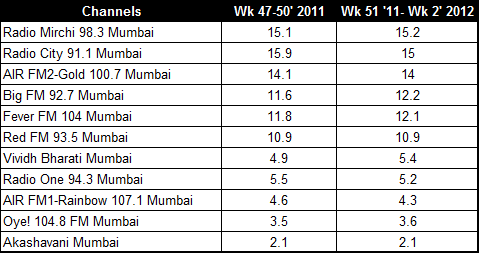
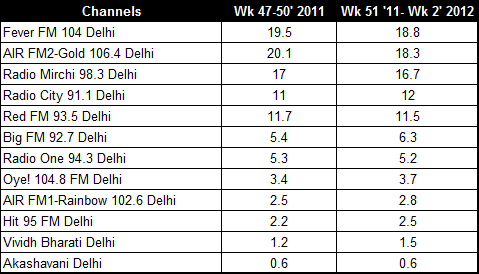
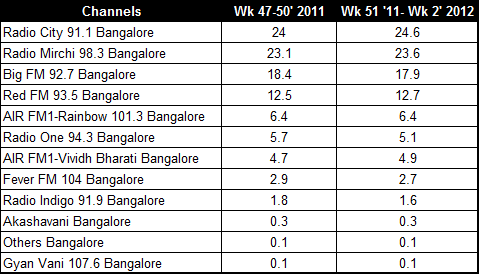
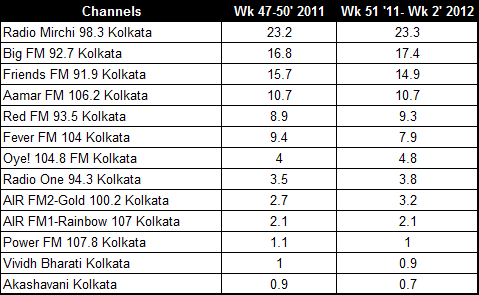
    TAM Media’s Radio Audience Measurement (RAM) – which covers four key metros, Mumbai, Delhi, Kolkata and Bengaluru – released its latest radio listenership figures for Wk 47- Wk 50 (Last two weeks of November and 1st week of December 2011) and Wk 51- Wk 2 (Last three weeks of December 2011 and 1st week of January 2012).


    According to the latest RAM data, for listeners of 12 years and above, and according to radio channel shares, Radio Mirchi, Radio City, Fever FM, Big FM, Red FM, Radio One, Oye! FM were some of the top FM stations in the big four metros.


    Mumbai:

    There is some amount of volatility for the number one spot in the Mumbai market. The latest RAM data for week 51 to week 2 has brought back Radio Mirchi as the number one FM radio station in Mumbai. The lead over Radio City is marginal. What remains to be seen is whether next month, Radio City regains the numero uno position or will Radio Mirchi retain the number one spot. It may be recalled that Radio Mirchi had long retained the leadership position in Mumbai until Radio City toppled it to become the number one FM radio station in terms of market share.


    Ranked three is AIR FM2 Gold which has more or less remained stagnant in listenership share followed by Big FM and Fever FM, ranked four and five respectively. Both Big FM and Fever FM made slight gains in week 51 to wk 2, 2012 as against week 47 to week 50, 2011. The other FM stations in Mumbai market include, Red FM, Radio One, Oye! FM, AIR FM1 Rainbow, Vividh Bharati and Akashavani Mumbai.


    Delhi:

    Once known as a Radio Mirchi stronghold, Delhi today has become quite an unpredictable market for FM radio listenership. This is what wk 51 to wk 2, 2012 RAM data reveals, according to the latest RAM data, Fever FM has reclaimed the numero uno position from AIR FM2 Gold to become the most popular FM station in Delhi while Radio Mirchi continues to rank three in listenership share. Interestingly the battle for the number one position is between Fever FM and AIR FM2 Gold, what remains to be seen is whether Radio Mirchi bounces back to reclaim the number one spot or whether Fever FM continues to lead among the private FM stations.


    A distant fourth is Radio City followed by Red FM and Big FM ranked fifth and sixth respectively. Although Fever FM is leading the Delhi market it has shown a decline in listenership. The other FM stations to have grown in listenership shares are Radio City, Big FM, Oye! FM and Hit FM. The other FM stations in Delhi are AIR FM1 Rainbow, Vividh Bharati and Akashavani Delhi.


    Bengaluru:

    The Bengaluru market has also seen a sea change in FM listenership rankings. Once a Big FM stronghold, the market is now dominated by Radio City which has not only retained its leadership position in Bengaluru, but has also significantly increased its listenership. Close behind Radio City is Radio Mirchi followed by Big FM, a distant third and Red FM ranked four. Radio City, Radio Mirchi and Red FM are the only FM stations to have seen an increase in listenership share on wk 51 to wk 2, 2012 as compared to the wk 47 to wk 50, 2011 RAM data. The other FM stations in this market are Fever FM, Radio One, Radio Indigo, AIR FM1 Rainbow, and Akashavani Bangalore.


    Kolkata:

    The only RAM market which has maintained the status-quo in listenership ranking; Radio Mirchi continues to be the most popular FM station in Kolkata, followed by Big FM and Friends FM continues to rank third. Radio Mirchi is comfortably at number one position in Kolkata with 23.3 per cent of the listenership share followed by Big FM which is a distant second with 17.4 per cent share and Friends FM with 14.9 per cent of the listenership share.


    A distant fourth is Aamar FM followed by Red FM and Fever FM ranked fifth and sixth. Radio Mirchi and Big FM ranked one and two have already seen an increase in their listenership share. The other FM stations in Kolkata to have witnessed growth in their listenership share are Red FM, Oye! FM, Radio One and AIR FM2 Gold. AIR FM1 Rainbow, Power FM, Vividh Bharati and Akashavani Delhi are the other FM stations available in Kolkata.


  • Madhu Trehan & Co to show journos the mirror with Newslaundry.com

    By Shruti Pushkarna


    With the ‘want to turn the mirror’ on themselves, the latest offering from the world of news is the launch of a website called Newslaundry.com. With their unique and explicit tagline, ‘Newslaundry – sab ki dhulai’, the agenda is set from the very beginning. A website which will work as the media’s watchdog.


    The site was launched on February 6 and is the brainchild of one of the pioneers of modern-day news journalism in the country: Madhu Trehan. Ms Trehan founded Newstrack, a video news offering, and newsmagazine India Today.


    The website has been launched with a four-member team and a few others on board. Abhinandan Sekhri, one of the founding partners told MxMIndia: “Newslaundry founders are Madhu Trehan, Prashant Sareen, Roopak Kapoor and Abhinandan Sekhri. We have three in-house writers, other than the founders. We have video editors, production people and directors.”


    So why did Ms Trehan start this? What did she have in mind before she launched Newslaundry? We have the answer from the lady herself. Madhu Trehan told MxMIndia: “It evolved between my partners – Abhinandan Sehkri, Prashant Sareen and Roopak Kapoor. I have always enjoyed creating a product that doesn’t exist. That happened when I started India Today. The leading magazine at that time was The Illustrated Weekly, which belonged to a dated post colonial time. Newstrack was developed because there was no television news other than Doordarshan. Newslaundry is a product which is not a clone of any other website in the world. The nature of it creates a new space.”

    So, could she not have done a similar media analysis show on mainstream television instead of doing it online? Ms Trehan was candid in her reply when she said: “It is because we did a media analysis that showed a channel is a losing proposition, so we chose to go online.”


    However, Mr Abhinandan Sekhri indicated that they did try and go the television way at first: “We did try. We mentioned such a show to various TV channels but they were not ready to put it on their own channel. Also we have so many ideas and so many shows we want to make, and no channel will give us that kind of time. Besides, this is the future. The new irreverent generation consumes media online through mobile devices. Sooner than you think, more people will be consuming media in the online space than conventional TV/magazine. Time will tell which ones work better than others but one thing is for sure – there has to be a change in how we tell our contemporary political and social narratives. News has to be more than it is right now.”


    On whether there is space for such a media website, Sevanti Ninan, Editor, The Hoot, commented: “Yes, there is. There is so much media and so little media watch. There is room for more entrants in this space.”


    Ms Ninan echoed Mr Sekhri’s views on how no television channel is open to self-criticism. “Where is the mainstream TV channel which is willing to carry criticism of itself and its peers?”

    Even though slowinternet speeds could be hurdle in an uninterrupted visual experience online, Ms Ninan is sure that the site will ‘click’ with viewers. She said: “Journalists love gossip. I think Newslaundry.com will click with them, particularly on account of the interviews with media biggies. What Barkha Dutt or Karan Thapar or Vinod Mehta say will give them something to gossip about. The interviews are a strong point.”


    Ms Trehan believes the website will work because “it answers a need that is not fulfilled yet.” In fact Ms Trehan seemed confident of the differentiating factors that NewsLaundry brings to the table. She said: “The difference is that we are combining all of today’s technologies. We have text articles called Criticles. We have what we call Washboards; these are a combination of text, videos and links. We have TV shows webcast. We have cartoons. You cannot do all that on a TV channel. We have the freedom to be far more irreverent. Mainstream TV does not make journalists or journalism accountable. That’s what we aim to do. We ourselves are open to being accountable.”


    On being asked on the revenue channels for the website, Ms Trehan replied that they expect revenues from the usual places. As for now, there are partnerships on with Google (and YouTube). Mr Sekhri added: “Advertising is the obvious immediate way, but in future, this space is going to change dramatically with podcasts and apps. And if anyone wants to put it on air on their channel, we’re more than happy to. We think stuff like this should be on TV too. Being able to take a dig at yourself is a sign of self-confidence which news channels need to have. And if anyone wants to pay us coz they think we deserve it, write in your cheques. Online is the future.”


  • What TV viewers watched in 2011


    By A Correspondent


    Digital viewing of television grew a phenomenal 63 per cent in 2011, indicating the shape of things to come in 2012 and forthcoming years. This and various other results are part of TAM Media Research’s third annual report on television viewing patterns inIndia.


    Titled ‘Impatient Generation’, the report was launched by Union sports and youth affairs minister Ajay Maken at the Indian Merchant Chamber’s ‘Fusion 2012’ conference. Ms. Bhavna Doshi, President, Indian Merchant Chamber and Mr LV Krishnan, CEO, TAM, were also present on the occasion.


    “We conduct such a study every year. The study, ‘Impatient Generation 2011’, is a quick, reader-friendly compilation of TV viewing trends in 2011. It gives a patient update of the impatient world of audiences consuming TV content. This annual feature attempts to update all advertisers, marketers and other stakeholders on how to reach out to their target groups,” said Mr Krishnan.


    Here are some of the highlights of the report:


    The TV Viewing Universe

    • C&S at All India level is currently 126 million Households, Digital Households (42 mn) have grown at 63 per cent.
    • C&S and Digital grew by 5 per cent and 61 per cent respectively in TAM reported markets.


    Viewing trends in key genres


    • Hindi General Entertainment Channels (GECs)
      1. Viewership of Hindi GECs genre has seen a 6.5 per cent dip.
      2. Viewership share of Hindi GECs is 38 per cent of all TV viewing and Top 6 GECs account for 90 per cent of the audience shares gained by the genre.
      3. In 2011, Hindi GEC genre has shown a consistent growth in 1-hour special fiction episodes during Prime Time on Weekends.
      4. Delhi, Maharashtra, UP & Gujarat have been the Top performing markets for Hindi GECs genre across years and the viewership returns from Metros have seen a slight drop.


    • Hindi Movie Channels
      1. Hindi movie genre holds about 15 per cent of total TV viewing.
      2. Number of unique movies aired in 2011 has decreased by 10 per cent.
      3. Both airtime and viewership of South-dubbed movies has seen a clear growth in 2011.


    • Hindi General News
      1. Share of Hindi News genre has witnessed a 10 per cent growth in 2011 after decreasing in 2010.
      2. Returns from News Bulletins has witnessed an appreciable increase while viewing proportion from telecast of Review/Reports has witnessed a decline across years.


    • English Entertainment
      1. Overall GRPs have increased by almost 50 per cent with Reach & Time spent contributing to the gain.
      2. Digital penetration increasing in key Metro markets has led to greater access for the channels.
      3. The growth in Consumption led by Time Spent is showing a 15-20 per cent increase.


    • Kids Channels
      1. The overall genre with 18 per cent share seems to be on a growth path with new channel launches in 2011. Today, 14 channels constitute the genre.
      2. The Reach levels for 10-14 years age band has improved in 2011.
      3. With the increase in number of channels, Kids genre witnessed a continuous increase in viewership share since 2008.
      4. Homes with Kids are faster in adopting to Digital TV platforms with growth rate touching almost 60 per cent in 2011.


    • Sports Genre
      1. Sports genre witnessed 200 million unique viewers in year 2011.
      2. There has been 18 per cent rise in Sports content on TV during 2011.
      3. Live sports coverage continued to garner over 50 per cent of the viewing for any sports content.
      4. 2011 saw 35 per cent growth in advertising volumes, but 70 per cent of volumes continued to be garnered by cricket.


    Launch_of_Impatient_Generation_by_Mr.Ajay_Maken, Hon’ble Minister of State for Youth Affairs and Sports, Ms. Bhavna Doshi, President, Indian Merchant Chamber and Mr. LV Krishnan, CEO, TAM Media Research


    Viewing trends in select regional markets


    • Tamil Nadu
      1. Digital penetration increased by 17 per cent in Tamil Nadu market.
      2. Increase in viewership is because time spent levels increased by 3 per cent in Tamil Nadu market.
      3. Tamil GECs, Music and Sports also witnessed increase in viewership.


    • Andhra Pradesh
      1. Digital penetration has just touched 8 per cent in AP market.
      2. While overall Time Spent on TV is high (over 3 hours daily), its growth is just 1 per cent over 2010.


    • Karnataka
      1. Kannada GECs, News are primarily on a growth track in viewership.
      2. While serials provided almost 3 times ROI, the growth in viewing for this genre has continued to be excellent with an average of almost 20 per cent in 2011.


    • Kerala
      1. Fall in Time Spent by 6 per cent has resulted in overall TV viewing coming down in 2011 but the introduction of new channels has resulted in a growth in viewing again the last few weeks of 2011.
      2. Malayalam GECs dominate with a lion share of 50 per cent with news, movies and music following.
      3. Malayalam Kids Content pick viewing with launch of New channel – Kochu TV.


    • West Bengal
      1. Viewership of Bangla regional has witnessed a steady and fast growth from 5 per cent share in the year 2000 to 43 per cent as of 2011, eating into Hindi channels’ share.

    There has been a growth in ratings for regional movies and events as compared to Hindi movies and events.


    • Maharashtra
      1. Although total TV viewing remained steady, viewership of Marathi yegional has seen a growth over last year.
      2. The growth is seen maximum on Digital TV platforms (31 per cent), as compared to Analog set of viewers (13 per cent).
      3. Unlike 2010, the Marathi GEC genre had prioritized the airtime mostly for the higher ROI generating contents like fiction, movies and reality shows.
      4. Chat shows/ Interviews (on Marathi news channels) now constitute about 12 per cent of airtime, contributing about 14 per cent of total viewership.


    According to Mr Krishnan, the study provides a useful perspective to TV broadcasters and production houses of the where, when and how TV audiences are changing in their tastes and preferences, what content they are rejecting or accepting. “The dynamics that shape an average Indian household viewer’s relationship with TV each day starting from morning to evening is another block that this TAM feature attempts to throw light on,” he said.


    MxMIndia will bring you more viewership trends over the next week.


  • It’s comedy time in English entertainment!

    By Rishi Vora


    English entertainment channels now have one more serious contender, which has already left an impact at its launch. Comedy Central, from the Viacom 18 stable, has taken the No 3 position in the category in week 1, with 14 per cent market share. It may be noted that Comedy Central is Viacom 18’s sixth channel.


    Comedy Central was launched in theUSinitially, and post 2006, extended its presence to other countries. InIndia, it has been launched in seven cities -Delhi, Mumbai, Kolkata,Hyderabad,Bangalore, Pune and Ahmedabad, reaching 20 million households across analog, digital cable and DTH.


    It is said that the Indian version will have localised content apart from the international library of shows.


    Now that the channel is at a reasonable position, the challenge is to keep the momentum going and, slowly but surely, be the No 1 player in the genre. Yes, there are established players, such as Star World and AXN, but Senior VP and General Manager of English Entertainment channels, Viacom 18, Ferzad Palia is of the opinion that Comedy Central has a differentiated offering. It is the first 24-hour comedy channel in English which catersSECAB+ audience.


    On why there was a need of a comedy channel in the English entertainment category, Palia explained: “Comedy Central comes as a light hearted channel in an environment which is so much stressed and depressed; something which came up very strongly in our research.”


    He added: “Also, the audience which we’re catering to are not on the lookout for crime and drama. And the pattern of the TG which we’ve observed is seen to be non-decisive in a way, where there is not much clarity on what the viewer wants to watch. But, with Comedy Central he knows he is going to get light-hearted humour – all the more reason for him to stick around with the channel.”


    With the English speaking population on the rise, consumption of English content too will rise. It is said that 8 per cent of the total population understands English and a subset of that percentage can converse in English. Because English channels reach out to the premium audiences, there are advertisers and brands that look to advertise on English entertainment channels, and Comedy Central is already on the ball as far as tapping advertisers is concerned. It has already got Volkswagen on-board, and a few more premium advertisers will follow.


    Apart from advertising, the channel is looking to add to the revenue via subscription, events and merchandise. “We are catering to an audience which no advertiser can afford to ignore. They’re a bunch of aspiring people, very discerning and those who enjoy quality programming. And this audience looks at English entertainment as the only form of entertainment on TV, apart from sports and movies.”


    Though the channel seems to have carved out a niche within a niche segment (launching a comedy channel in the English entertainment category), Palia disagrees: “Comedy cuts across gender and age. So in that sense, it isn’t very niche.”


    The channel, in next few weeks, will see a full-blown marketing campaign covering, print, outdoor, radio, Internet. The channel was launched with a TV campaign which ran across network channels. Social Media will be one big thrust for the channel as far as marketing is concerned.


    Though the market looks a bit crowded with players like Star World, AXN, FX, Fox Crime, Big CBS channels – Spark, Prime, Love and BBC Entertainment, it will be interesting to see how the genre grows and which channels emerge on the top.


  • Eye on volumes, Coca-Cola to revive Citra after 19 years

    By Ratna Bhushan


    Coca-Cola will revive Citra, a clear-lime drink it bought from Ramesh Chauhan two decades ago but junked in favour of Sprite, in a move that analysts believe is more to target price-sensitive consumer segments than to unlock the brand’s heritage value.


    A person familiar with the top beverages maker’s plans said Citra will be priced about 20 per cent cheaper than existing lime-lemon drinks such as its own brands Sprite and Limca as well as PepsiCo’s Mountain Dew and 7 Up, to target a wider audience and take on smaller brands.


    A Coca-Cola spokesman confirmed the company is introducing Citra in “a few towns in Maharashtra and Gujarat” on a pilot basis. This will be followed by a staggered launch across other metros and bigger cities.


    The move has surprised industry watchers because Coca-Cola’s Sprite, the second-largest soft drink brand in the country after Thums Up, leads the lime-lemon drinks segment, which is the fastest-growing soft drink category in India’s Rs13,000-crore fizzy drinks market.


    Among those surprised is Ramesh Chauhan, who created brand Citra and made it popular in the late 1980s and early 1990s.


    “After keeping the brand in cold storage for so many years, it’s strange they want to re-introduce it now, especially when they have a strong presence in the clear-lime segment,” Chauhan said. “If they are looking for retention and heritage value, then logically even Gold Spot should be revived.”


    When Coca-Cola re-entered India in 1993, it bought out all Parle brands except Bisleri from Chauhan.


    Move aimed at mopping up volumes

    While Citra and Gold Spot were phased out to make way for Coca-Cola’s global brands Sprite and Fanta, respectively, Thums Up, Limca and Maaza were retained. Shashi Kalathil, CEO of management advisory firm Y-factor and partner at private equity fund Exponentia Capital, said the move may be aimed at mopping up volumes. “Coca-Cola probably doesn’t want Citra’s pricing to impact its larger brands. So this could be more of a pricing game and about treating Citra more as a trademark than a brand,” he said.


    Parle brand again

    It’s history that the US major sidelined Parle’s cola brand Thums Up to promote its own brand Coca-Cola for years before waking up to the potential of the Indian brand and backing it.


    Now it seems like deja vu for Coca-Cola as it is banking on a Parle brand once again to push market share in the lime segment. The Coca-Cola spokesman said Citra would not cannibalise its existing lemon drinks because there is ample room for multiple brands in a developing segment like sparkling fizzy drink in a high-potential market such as India.


    Devendra Chawla, president of food & FMCG segments at the country’s largest retailer Future Group, said the move will aid the growth of the clear-lime category, which is already seeing heightened brand activity. “To grow carbonated soft drinks’ per capita in India, apart from growing colas, it’s critical to activate flavours which have natural acceptance from Indian consumers such as lime and mango,” said Chawla, who formerly worked with Coca-Cola.


    India’s per capita consumption of carbonated drinks is just 11 litres a year compared to 34 litres in China and 675 litres in Mexico.


    The lime-lemon category in India has been growing 16-17 per cent a year, ahead of colas at about 11-12 per cent and orange drinks at 8-9 per cent. Apart from being a familiar flavour that Indians consume at home (in the form of nimbu paani), lime-lemon drinks are considered ideal thirst quenchers.


    Both Coca-Cola and PepsiCo have been promoting their brands aggressively in this segment. PepsiCo has Bollywood star Salman Khan endorsing Mountain Dew and actor Sharman Joshi for 7 Up, while Coca-Cola pushes clear-lime drink Sprite and cloudy lemon drink Limca on the irreverent and freshness platforms, respectively.


    Source:The Economic Times

    Copyright © 2012, Bennett, Coleman & Co. Ltd. All Rights Reserved