
Category: NEWS

  • Vital Stats: Kareena, HUL & Idea top Celebrity Endorsement & Buzz in Jan-June 2014

    Celebrity Endorsement during Jan – June 2014

    Source : TAM AdEx


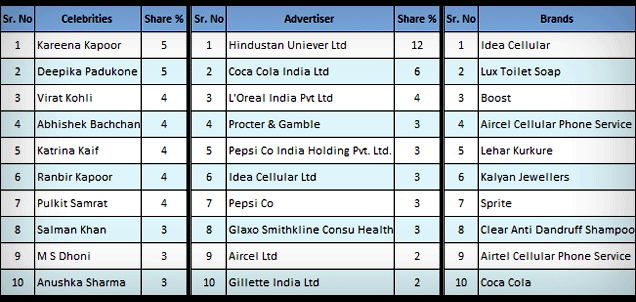
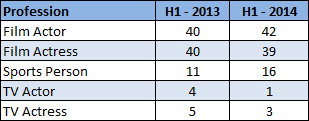
    Presenting Celebrity Endorsement Data which comes from TAM AdEx and Celebrity Buzz Data that is from Eikona. Here’s how this data can be helpful for the media industry and professionals:


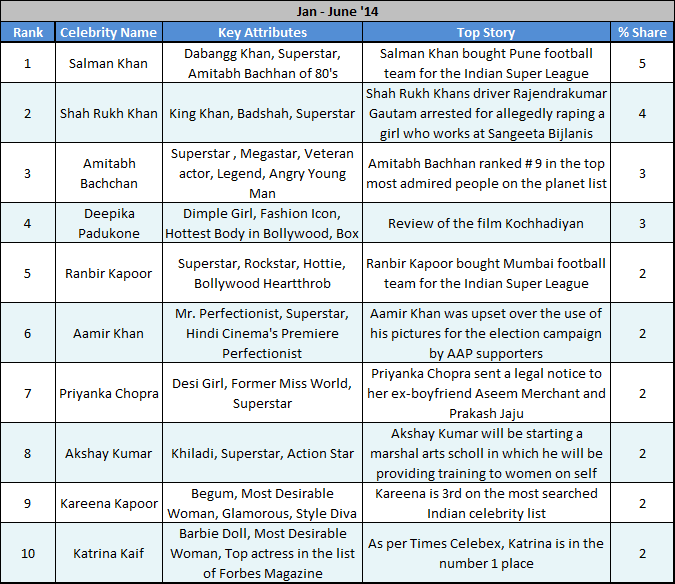
    Eikona Data(Celebrity Buzz): While selecting a celebrity for a brand, the connect between brands and a celebrity is always important. The brand personality and celebrity personality have to complement each other. Eikona data with the help of attributes/adjectives used to describe the celebrities can be helpful for the advertiser/advertising agencies to select the proper fit for the brand.


    TAM AdEx Data (Celebrity Endorsement): Celebrity Endorsement Data showcases the visibility of celebrities during the breaktime on TV through Ad Volumes. This can be a great help for advertiser, advertising agencies, celebrity management companies to keep track of their celebrity brand endorsement.


    When we are talking of celebrities and the buzz they create, why have words. Let the figures (no pun intended) do the talking.


    Source: Eikona


  • Aimia forms JV with Fractal Analytics

    Aimia, a global leader in loyalty management, has formed a strategic long-term partnership with Fractal Analytics, a leading provider of advanced analytics. The exclusive commercial agreement will deepen Aimia’s analytics capabilities, extending its unparalleled customer insights to deliver a more comprehensive understanding of consumer behavior and improve marketing return-on-investment. It will also extend Aimia’s loyalty expertise to Fractal’s existing clients. As part of the partnership, Aimia is making a minority equity investment in Fractal.


    The partnership expands Aimia’s analytics operations, giving it access to best-in-class analytics to enhance its current core capabilities and the opportunity to rapidly embed some of Fractal’s existing predictive analytics solutions such as Customer Genomics® into Aimia’s loyalty solutions.  It will also allow more rapid development of new offerings leveraging rich customer data across its programs, products and regions.


    “This strategic partnership gives Aimia dedicated access to specialized and scarce top talent as our global analytics business continues to grow,” said Eric Monteiro, Chief Strategy and Analytics Officer, Aimia, who will join Fractal’s board of directors as part of the equity investment.  “Fractal brings a mature and experienced team of sophisticated analytics professionals to meet the complex needs of our clients.”


    “CMOs across industries increasingly recognize the importance of deeply understanding their customers and hyper-personalizing their experience to inspire their loyalty,” said Srikanth Velamakanni, Co-founder and Chief Executive Officer, Fractal Analytics. “Our partnership with Aimia gives companies access to the world’s best loyalty analytics expertise.”


  • Micromax unveils ‘Roobaroo Micromax Unite Anthem’

    Urging the citizens of the country to rise above the diversity of languages and embrace music that unites all, Micromax Informatics Limited has unveiled the ‘Roobaroo Micromax Unite Anthem’ in a first of its kind initiative bringing together 10 artists, singing one song in 9 languages. Recreating the cult patriotic song, ‘Roobaroo’, the Anthem is an extension of the Unite 2 campaign, again a first from Micromax offering users 21 languages in 1 phone, thus democratizing technology for the masses.


    Speaking on the occasion, Shubhodip Pal, Chief Marketing Officer, Micromax said, “With the successful launch of the Micromax Unite 2, we have managed to create a powerful medium for our consumers to interact in their preferred language using their phone. The Roobaroo Micromax Unite Anthem celebrates the spirit of unity in diversity bringing alive the versatility of India where myriad cultures merge to form the country’s identity.  We would like to thank all the 10 artists and Sony Music who extended their support for this stunning initiative.” He further added, “Initially conceptualized as an online initiative by Interactive Avenues, we realized the power and the potential of this unique concept and have now decided to execute a 360 degree campaign directed to engage with our target audiences instilling a sense of pride of using their mother tongue. With Sony Music, we have been able to identify the right track – Roobaroo, which is an iconic anthem that connects emotionally with the youth and was most suited to deliver the message of unity.”


    Launched in association with Sony Music Entertainment India, the Micromax Unite Anthem is based on the extremely popular track – Roobaroo, which has been rewritten and re-mastered with new lyrics in 9 languages performed by 10 artists. The track has been created to bring in the sounds of a United India covering genres like Classic, Folk, Acapella, Beat boxing & Rap. The artists are Benny Dayal, Raghu Dixit, Neeti Mohan, Brodha V, Voctronica, Sanam Puri, Swaroop Khan, Kamaal Khan, Apekhsa Dandekar and Shruti Pathak.


    Amardeep Singh, CEO, Interactive Avenues said, “Micromax is a brand which is always open to try new innovative things, making it one of the reasons why the brand has grown leaps and bounds. For the Unite 2 campaign, we wanted to highlight the most appealing feature of the phone of giving users the freedom to express in their mother tongue. Hence, we came up with the idea of a multilingual theme song as an extension of the main campaign. The Roobaroo Micromax Unite Anthem celebrates the fact that we live in a country which is united despite its different cultures, communities and languages. We are sure that it is going to strike a chord with every citizen of the country.”


  • Grey says ‘Hello Life’ for Fiat Punto

    After establishing a decent fan base, Fiat has introduced the all-new Punto Evo with a revamped design. The car has retained its strengths while packing on oodles of style and plenty of new features.


    For Punto’s advertising agency GREY group the task was clear: announce the new Punto Evo, re-instate its strengths while promoting all the new additions, and ensure the car is a part of Fiat’s overall brand positioning of ‘Hello Life’. The major challenge that GREY group faced was that the communication had to capture the famed solidity of the car and yet promote the stylish new looks and features.


    GREY has come up with a campaign that ticks all the checkboxes while driving home the point with a lot of flair. The creative idea is ‘Life just became more interesting’ and it uses the device of adding a different take to any situation. While something is enjoyable in its own way, it can be made even better by simply incorporating a different aspect to it.


    Nagesh Basavanhalli, MD and President Fiat Chrysler India said,” Punto Evo is a stylish, premium hatchback embodying Italian design flair making it a preferred choice of a style conscious consumer. Agency was given the task of communicating the strengths of Punto while making it appeal to its target consumers who are life maximizers – Youthful ,Carefree, Cool, Hep, Happening, Stylish, Energetic who is a evolved and is tech savvy in today’s world. While we had a choice to talk just about the product, we wanted to keep it around the consumer and what the car promises to be to his/her life and hence, we developed the proposition of New Punto EVO, life just became more interesting. The TVC maintains the premium and international imagery of the brand and keeps the communication to the point yet very eye-catching and full of life.”


    Malvika Mehra, National Creative Director, GREY group India says, “Most car advertising in this segment typically sounds very transactional and competitive. It’s mostly about mileage, power, legroom etc. which while being an important part of the decision making process, sometimes leave out the ‘experience’ of what it ‘feels’ to drive that car. We forget that cars are actually an extension of one’s personality. With the new communication for the Punto Evo, with it’s exciting new features and great Italian design pedigree (an intrinsic part of the Fiat lineage), we have tried to occupy the mind space of a discerning consumer who while being reassured of the ‘basic asks’ of a great car (obviously) also has a chance to have an ‘interesting’ driving experience with this Italian hatchback.’


  • Proprietary planning tool ‘Resolve’ launched by Maxus

    Maxus has announced the launch of a bespoke tool, Resolve, based on a proprietary survey of consumer insights in India. The findings of the survey are the most in-depth ever to be carried out in the country.


    Resolve is Maxus’ comprehensive proprietary communications planning tool built using the knowledge and expertise of the agency’s planning leaders. The tool is supported by bespoke consumer-based surveys called Compose, which go beyond simple media usage to explore consumer sentiment towards media channels and the messaging those channels employ. The tool is used by global and local clients worldwide to gain insights on particular markets.


    Kartik Sharma, Managing Director, Maxus South Asia, said: “Maxus’s dedication to data inspired us to create a tool to help our teams make tough decisions and have them supported with strong logic and data. The Compose surveys get behind the attitudes and behaviours of consumers – not just their media usage – and how they view specific channels to deliver specific messages. Resolve has been a success so far not only for our clients, but also helping to push our teams out of their comfort zones, to try new channels and ways of thinking.”


  • Akash Chawla appointed Business Head of Essel Vision Productions

    Zee Entertainment Enterprises Ltd (ZEEL) has appointed Akash Chawla, who has successfully been heading the Marketing Function for National Channels at ZEEL, to take charge as the Business Head – EVPL.


    Akash has been given the mandate to head the TV Production (all languages), Movie Production (all languages except Marathi), Studio Production Business, Digital & Online Production, Events & IP creation. Akash will drive the organizational aspiration of EVPL and contribute in multiplying its business from its current business levels. For this role, Akash will report to Nittin Keni.


    “Essel Vision is very focused in the film & television production, digital, events and the IP creation business. Having spearheaded marketing for Zee TV, Zee Cinema, Zee Classic and Zee Cine Awards, Akash has worked successfully towards the launch of three of ZEEL’s new brands in the last one year – &pictures, Zee Anmol and Zindagi. He will work towards strengthening our presence in Hindi and other languages movie production & marketing and the digital business to catapult the organization’s ambitions to the next level.  We will produce content not just for the Indian audiences but also for companies and audiences the world over. While IP rights provide the foundation upon which innovation is shared and creativity is encouraged, the digital age provides many opportunities within the entertainment media industry to improve efficiency, costs and viewer experiences. Everything we do is driven by an unyielding passion for excellence-and an unfaltering commitment to develop the best products. We are in talks with various leading collaborators for the same and will soon announce new initiatives,” shared Nittin Keni.


    Essel Vision’s consistency and success are built on its unwavering dedication to setting benchmarks and excellence. It has already made a mark on the map of Television and Feature Films – both in the Hindi and Marathi space. With blockbuster films like ‘D-Day’, ‘Gulaal’, ‘Natrang’, ‘Kaaksparsh’, Essel Vision has taken its first steps to another high with its ventures like “Time Pass”, “Lai Bhari” and  ‘Duniyadaari’ which have been the highest grossers in the Marathi film space. Its other creation ‘The Lunchbox’ has already received accolades around the world. In the television space, the company has been successful with qualitative programs like ‘Fear Files’, ‘Dance India Dance’ and ‘India’s Best Dramebaaz’, ‘Saregama’, ‘DID L’il Masters’, ‘DID Super Moms’, on Hindi TV, and ‘Eka Peksha Ek’ and ‘Fu Bai Fu’ amongst others on Marathi TV.  The upcoming feature films include ‘Mad About Dance’ which is promoted by Shah Rukh Khan himself and another film called ‘3AM’ (horror film) is on the anvil.


    Just as ZEE is an innovative leader in developing new business models for the evolving television and film landscape, Essel Vision’s objective is to be a one-stop shop for all Film, Television, Digital, Events & IP creation related services where it will produce, co-produce, market and distribute.


  • Nusli Wadia wants Britannia to be Cookie King

    By A Correspondent


    India’s second-largest biscuit maker Britannia Industries plans to invest Rs 150-200 crore over the next two years to overtake Parle and become market leader, chairman Nusli Wadia told shareholders at the company’s 95th annual general meeting on Tuesday.


    Britannia’s share of the biscuit market increased by more than 1.2 percentage points in the last fiscal. “The difference with Parle is just 3%, which is not much and we want to bridge it in the next three years,” Mr Wadia said.


    Over the next two years, Britannia will use the investment to launch new products, expand capacity and upgrade technology, he said.


    “We should grow faster than the market, which was not possible in the last few years, but we managed it last fiscal when we outgrew both by volume and value,” Mr Wadia said.


    Britannia embarked on a turnaround strategy last year after inducting veteran executive Varun Berry into the management team. Mr Berry was designated managing director in April. Mr Wadia said the Daily Bread Gourmet Foods subsidiary, which sells premium bakery products through its own stores in Bangalore, may be shut or sold off.


    “The Daily Bread business is not a shining star and a business we do not need to stay in. We will take a call soon,” he said. Daily Bread reported sales of around Rs 20 crore last fiscal and made a loss of around Rs 3.3 crore. Britannia Industries has made a provision of Rs 20 crore for diminution in the value of its investment in Daily Bread.


    Source:The Economic Times

    Copyright © 2014, Bennett, Coleman & Co. Ltd. All Rights Reserved

    Licensed to republish


  • One Minute View: TRAI misplaced views on media ownership


    The Telecom Regulatory Authority of India has done some great work as a regulator.  While the cellular phone would have turned ubiquitous even if the TRAI hadn’t existed, one must recognise the superlative work put in by the TRAI ever since it was set up in 1997.


    However, in our mind, in the case of the broadcast sector, not all of the work is in order and in sync with business realities and progressive thinking.


    Digitization happened (not everywhere, but it’s in progress), but the 10+2 ad cap is still not implemented. There is some stuff on cross-media ownership, but most of it is a grey area. The fact of the matter is that the governments of the day do not have the spine to take on the news media. They use TRAI regulations to police news vehicles, but finally nothing happens.


    The TRAI has spent a fair bit of time and effort on the issue of ownership of the news media as well as on paid content. But to say that there should be a restriction on corporate ownership of the news media is bizarre. Let there be restrictions on the concessions given to the media or the favours in the form of DAVP ads. Don’t give media concessions on land if the turnover exceeds an x amount or if there is evidence (circumstantial included) to know that the owners have deep pockets and don’t need a concession, let them be run as any other business.


    Also, if you find a news entity involved in paid content, penalise it. Suspend the licence for a few days, if necessary. Knock off concessions like postal certificate and accreditation to staff. But let’s not say that corporates or political parties can’t enter the media. Most of the big media companies have a corporate or political past. This includes The Times of India (Dalmias and then Sahu Jains) and the Hindustan Times (Birla). Even regional media biggies like Dainik Jagran and Dainik Bhaskar have interests other than the media. There are very media companies which were started by career media professionals or entrepreneurs and have now grown into big entities. Ditto with politicians. Mahatma Gandhi started Indian Opinion, Lokmanya Tilak had Kesari… the list is endless here too. There are also many examples of publications which have some political connections but are fairly professionally run. We must also not overlook case of newspaper companies diversifying into other businesses thanks to the profits or the clout. Now does the TRAI have it in it to take on the mighty newswallahs?


    The Recommendations can be read at:

    http://trai.gov.in/WriteReadData/Recommendation/Documents /Recommendations %20on%20Media%20Ownership.pdf


    Read the Press Release issued on the Recommendations :

    TRAI releases Recommendation on “Issues relating to Media Ownership”

    The Telecom Regulatory Authority has today released the Recommendations on the Issues relating to Media Ownership. The recommendations cover – a comprehensive definition for control; cross-media ownership; vertical integration; and internal plurality.


    The key recommendations are:

    1. A comprehensive definition of ‘control’, in line with earlier recommendations proposed.


    Cross-Media Ownership


    2. The News and Current Affairs genre is of utmost importance and direct relevance to the plurality and diversity of viewpoints and, hence, should be considered as the relevant genre in the product market for  formulation cross-media ownership rules.


    3. Television and print should be considered as the relevant segments in the product market. For print, only daily newspapers, including business channels are allowed to air news generated on their own and become significant in the relevant market, a review of the cross-media ownership rules should be undertaken.


    4. The relevant geographic market should be defined in terms of the language and the State(s) in which that language is spoken in majority.


    5. A combination of reach and volume of consumption metrics should be used for computing market shares for the television segment. For the print segment, using only the reach metric is sufficient.


    6. For calculating market shares, in the relevant market for the television segment, the GRP of channel should be compared with the sum of the GRP ratings of all the channels in the relevant market and the market share of an entity would be the sum of the market shares of all the channels controlled by it.


    7. Similarly, in the relevant market for the print segment, the market share of a newspaper would be the circulation of all newspapers in the relevant market, and the market share of an entity would the sum of the circulation of all the newspapers controlled by it.


    8. The Herfindahl Hirschman Index (HHI) be adopted to measure concentration in a media segment in a relevant market.


    9. A rule based on HHI be implemented, i.e., if the television as well as newspaper markets are concentrated ((HHI> 1800 in each), then, an entity contributing more than 1000 to the HHI of the television market, cannot contributing more than 1000 towards HHI in the newspaper market as well, and vice-versa. If it does so, it will have to dilute its control in one of the two segments. This rule applied only if the HHI thresholds are violated consecutively for two years.


    10. The cross-media ownership rules be reviewed three years after the announcement of the rules by the licensor and once every three years thereafter. The existing entities in the media sector which are in breach of the rules, should be given a maximum period of one year to comply with the rules.


    11. Mergers and Acquisitions (M&A) in the media sector will be permitted only to the extent that the rule based on HHI is not breached.


    12. Detailed reporting requirements, which are to be made on an annual basis to the licensor and the regulator, worked out.


    Vertical Integration amongst Media Entities


    13. Reiterates its recommendations on vertical integration amongst broadcasters and DPOs as contained in its “Recommendations on Issues related to New DTH Licenses” dated July 23, 2014 and recommends early notification and implementation of the same.


    Issues affecting Internal Plurality


    14. Given that about six years have elapsed without any concrete action being taken by the Government, strongly recommends that its Recommendations of 12 November 2008 and 28 December 2012 may be implemented forthwith. These Recommendations inter alia specified:


    (a) the entities (political bodies, religious bodies, urban, local, panchayati raj, and other publicly funded bodies, and Central and State Government ministries, departments, companies, undertakings, joint ventures, and government-funded entities and affiliates) to be barred from entry into broadcasting and TV channel distribution sectors;


    (b) that in case permission to any such organisations have already been granted an appropriate exit route is to be provided;


    (c) that the arm’s length relationship between Prasar Bharati and the Government be further strengthened and that such measures should ensure function independence and autonomy of Prasar Bharati; and


    (d) that pending enactment of any new legislation on broadcasting, specified disqualification for the entities in (a) above form entering into broadcasting and / or TV channel distribution activities should be implemented through executive decision by incorporating the disqualifications into Rules, Regulation and Guidelines as necessary.


    15. Even surrogates of the entities listed above should be barred from entry into broadcasting and TV channel distribution sectors.


    16. Given the inherent conflict of interest arising from practices such as “private treaties”, such practices be immediately proscribed through order of the PCU or through statutory regulations. This would cover all form of treaties including (i) advertising in exchange from the equity of the company advertised; (ii) advertising in exchange for favourable coverage/ publicity; (iii) exclusive advertising right in exchange for favourable coverage.


    17. “Advertorials”, or for that matter any content which is paid for, a clear disclaimer should be mandated, to be printed in bold letters, stating that the succeeding content has been paid for. Placing such a disclaimer in fine print will not suffice. Action on advertrials and other material which is paid for may be taken immediately.


    18. On “paid new”, in addition to the above, it is imperative that liability reposes in both parties to the transaction if it is tried to be passed off as news.


    19. On ground of the inherent conflict of interest, ownership restrictions on corporates entering the media should be seriously considered by the Government and the regulator. This may entail restricting the amount of equity holding/ loans by a corporate in a media company, viz., to comply with provisions relating to control.


    20. Editorial independence must be ensured through a regulatory framework.


    21. With respect to the “media regulator”, the Authority recommends that:

    (a) Government should not regulate the medi;

    (b) There should be a single regulatory authority for TV and print mediums;

    (c) The regulatory body should consist of eminent persons from different walks of life, including the media. It should be manned predominantly by eminent non-media persons;

    (d) The appointments to the regulatory body should be done through a just, fair, transparent and impartial process;

    (e) The “media regulator” shall inter alia entertain complaints on “paid news”; “private treaties”; issues related to editorial independence; etx, investigate the complaints and shall have the power to impose and enforce an appropriate regime of penalties.


    22. The above recommendations, once implemented, will address the immediate objective of curbing unhealthy media practices. The Authority notes that there would still exist the need for a comprehensive evaluation of the legislative and legal framework in order to establish a robust institutional mechanism for the long term. The Authority, therefore, recommends that a Commission, perhaps headed by a retired Supreme Court Judge, be set up to comprehensively examine the various issues relation to the media, including the role and performance of various existing institutions, and the way forward. More than 5 years have elapsed since the Authority released its ‘Recommendations on Media Ownership’ on 25 February 2099. The situation has became graver. Clear time-lines may, therefore, be indicated to the Commission so appointed.
     

  • Jai Hind and Happy Independence Day! Since you’re closed, we too are!!!

    It’s India’s 67th Independence Day tomorrow. It’s the day when we celebrate our freedom from the British rule. A country partitioned, but United. And Free.


    So why are we celebrating it with a holiday? Shouldn’t we work that much more on Independence Day? Burn the midnight oil for the sake of all those who fought for our freedom?


    We aren’t sure if there’s any country which works on its Independence/National Day.  For most of us with families unaffected by the freedom struggle, I-Day may not mean much. It’s a holiday. Prime Minister’s speech. Sales at the hypermarkets. Family day out (or in). Dry day (except Clubs) but stocked up. Time for a spa. Or just taking a break given the loooong weekend.


    Since you are taking a day off (except if you are working in the electronic and digital media or other essential services), we are doing that too. We aren’t happy about it, but then there’s no point producing editorial content for very few readers.


    So we’re closed on Friday, August 15 (hence no newsletter and no editorial updates), but our antennae are up and we’ll be tracking news feeds and our mails. If there’s anything urgent, we’ll do an update. Else, we’ll be back on Monday, August 18.


    Celebrate responsibly.

    Happy Independence Day!!!


  • Kellogg’s Special K takes ‘No More Excuses’ positioning in latest TVC

    By A Correspondent


    Kellogg’s Special K has unveiled ‘No More Excuses’ campaign to initiate a movement for women to get rid of their excuses and begin to manage their weight every day. Post the 2 Week Challenge campaign, Kellogg’s Special K brings ‘No More Excuses’ to sustain the momentum of one’s weight management journey.


    This campaign has been born out of the insight that today’s woman is constantly trying to fulfill her duties as a wife, daughter, mother or professional.  Kellogg’s Special K aims to inspire these women towards reclaiming their lives. The ‘No More Excuses’ campaign highlights a woman’s weight concerns and inspires her to keep her weight management journey on track through the new-found confidence in herself.


    The TVC for this motivational campaign features brand ambassador Deepika Padukone who effectively drives the importance of everyday weight management through the ‘No More Excuses’ theme. Deepika motivates her friends to overcome their excuses and start managing weight by eating breakfast everyday like low fat Kellogg’s Special K. In the TVC, Deepika is unwinding at a salon, along with her friends and plans a summer dress shopping spree. When her friends say that they don’t have the right shape to carry off a dress, she shares her new mantra of ‘No More Excuses’ and inspires them to get on the weight management journey. The film ends with both her friends emerging from the trial room wearing stunning summer dresses, with style and confidence, bringing to life the ‘No More Excuses’ theme.


    Throwing light on the insight behind the new campaign, Harpreet Singh Tibb, Marketing Director, Kellogg India stated, “The new campaign is driven from a brilliant insight, which has been cleverly executed through ‘No More Excuses’.  Kellogg’s Special K strives to consistently cater to women’s weight management needs and this campaign addresses a specific need for women to prioritize themselves and give up their excuses.  We are very glad to have initiated an association with Femina and will partner with women to motivate them to start and more importantly, continue their weight management journey and get back to life.”


    Nandita Chalam, Vice President & Executive Creative Director of JWT who leads this campaign shared, “After crossing the age of thirty or after marriage, many women give up wearing short dresses, going dancing or doing many other things that they once loved. That’s often because they are no longer confident of their weight and appearance. Yet when it comes to actually doing something about weight management, they have countless excuses for not doing anything. Our new campaign for Kellogg’s Special K says. “No More Excuses. Get back to life.” Deepika Padukone, known for her disciplined approach to fitness, urges her friends to stop making excuses and start making Kellogg’s Special K a part of their breakfast routine. And then she tells them, and all the other women out there, to get back to doing the things they once loved.”


  • O&M unveils latest campaign for Fevistik

    By A Correspondent


    Following its earlier positioning of Fevistik being the original glue stick, Ogilvy & Mather has unveiled a new TVC that’s based on the same theme. The campaign shows a fake hero trying hard to impress the shopkeeper by somersaulting his way into a stationery shop but ends up banging his head on the wall. After a series of failed stunts, he asks the shopkeeper for Fevistik. But, the shopkeeper gives him some other glue stick. He takes huge offense to being offered a duplicate and accepts only the original glue stick Fevistik from the shopkeeper.


    Abhijit Avasthi

    Commenting on the campaign, Abhijit Avasthi, National Creative Director – O&M, India said, “The challenge before us was to make sure that people insist on buying only the original glue stick Fevistik from the shopkeeper and not fall for local imitations. And what better way to drive the point than showing that even duplicates reject the fake glue stick and demand only Fevistik. The new commercial with the fake superhero delivers this message in an entertaining manner.”


    According to Anil Jayaraj, Chief Marketing Officer, Pidilite Industries Limited “Fevistik is a market leader in glue stick category and enjoys significant top of the mind recall. It is the only glue stick brand which consumers remember and recall. The new communication aims at reiterating the same fact and encouraging consumers about making the right decision when it comes to choosing the glue stick. The communication also aims at educating consumers to be aware of look-alike products. We believe this new communication takes our brand ahead and stands out in an entertaining manner.”


    Apart from television, on-ground activations and branded digital content are also on the anvil.


  • FCB Ulka highlights ‘Shake Feature’ for Snapdeal

    By A Correspondent


    Smartphones have empowered consumers to shop on the go, at a time convenient to them. This calls for a shift in focus to a more tech savvy way of shopping i.e. via a mobile phone. But how do online retailers get consumers to download their mobile app instead of the competition? One way of course, is to innovate and introduce new features and thereby create a superior shopping experience. Snapdeal’s Shake Feature does exactly that. The new TVC created by FCB Ulka gets the message across, by highlighting the app cleverly.


    Keeping the quirkiness that is the hallmark of Snapdeal’s communication, the Shake Feature TVC, crafted by FCB Ulka, shows the protagonist (played by actor Pulkit Samrat) dancing at a colorful Indian wedding. Every time he does a shake with his smartphone in hand, he is given money by an enthusiastic relative in the wedding party. The voice over meanwhile tells the viewers that using Shake Feature is a sure shot way to get additional discounts from Snapdeal.


    Sachin Das Burma, Group Creative Director, FCB Ulka, commented on the campaign “The shake feature is a new thing and we wanted the communication to demonstrate this in an interesting manner, without losing out on the entertainment quotient and slice of life situation that has been our attempt for all work we do on snapdeal. I think we have managed to achieve that.”


    Sandeep Komaravelly, Vice President Marketing, Snapdeal.com, said, “The smartphone has become an extremely important medium to reach out to our customers. 50% of our transactions on Snapdeal.com come via our mobile app. The Shake feature is an innovative step to amplify the user experience while shopping on the mobile application. The customers will be able to avail exciting offers on diverse range of 4 lakh products across 6000+ brands.”