Category: NEWS

  • Industry veterans remember Ulka founder Bal Mundkur

    By a Correspondent


    Draftfcb Ulka Group held a prayer meeting in memory of the late Bal Mundkur, veteran adman and founder of what is today Draftfcb Ulka. The prayer meet was held on Thursday, January 19, 2012 at Yashwantrao Chavan Pratisthan in Nariman Point, Mumbai.


    Piyush Pandey, Executive Chairman and Creative Director, South Asia Ogilvy & Mather India; Alyque Padamsee, theatre personality and ad film-maker; Gerson da Cunha, stage and film actor, social worker and author; and theatre veteran Dolly Thakore were some of the notable personalities from the advertising and media fraternity, other than the leadership team from Draftfcb Ulka who attended the prayer meeting.


    Shashi Sinha, CEO, Lodestar UM remembered the late Mr Mundkur as a man who was always a leader, and never a follower. A man who was very generous, always ready to help those who needed help, and a man who did not work for money alone but, also for a lot of noble causes which he did not give up even after his retirement. Mr Sinha pointed out that Mr Mundkur had left his cushy job to start his own agency, and that he named the agency – Ulka – at his mother’s suggestion.


    A two-minute silent prayer was observed in memory of Mr Mundkur which was again followed by close friends, associates, former colleagues etc. sharing their thoughts and memories of the late advertising veteran.


    Mr da Cunha highlighted the recently released ‘Ad Katha’, a special volume tracking the history of Indian advertising, as one of Mr Mundkur’s huge achievements. Mr da Cunha was also quick to point out that a lot of people not just owed Mr Mundkur the brands he created for them, but many owed him their career as well. Mr Mundkur has created great professionals, he said, while dedicating the 300-page ‘Ad Katha’ to the memory of Mr Mundkur.


    Mr Alyque Padamsee was also among those who spoke about Mr Mundkur at the prayer meet, saying he remembered Mr Mundkur as a man of rumbustious character. A man who had big ideas and was determined to see each one through. Mr Padamsee also added that his inspiration comes from Mr Mundkur, who was always ready to defend someone – ie, if you believe in something then stand up and fight for it.


    Mr Mundkur passed away in Goa on January 7, 2012 due to heart failure. Mr Mundkur had founded Ulka in 1961, ten years after he joined the world of advertising. In a span of another ten years, Ulka had become the fourth largest agency in the country, and by far the largest independent Indian start-up.


  • Colors launches sports reality show Ring Ka King

    By A Correspondent


    After having entertainedIndiawith their impressive bouquet of fiction shows, format shows and a number of successful reality shows, Colors, is all set to introduce a fresh format to its audiences.


    For the first time ever, the channel is launching the biggest sports entertainment reality show called ‘Ring Ka King’, which will feature 30 top Indian and international wrestling superstars including Jeff Jarrett, Matt Morgan, Scott Steiner and Monster Abyss; Indian wrestlers who have received international-level training like Jwala, Mahabali Veera, Romeo Rapta, Zoravar and Deadly Danda will also be among the participants. Indian cricket superstar Harbhajan Singh has been roped as the goodwill ambassador.


    The show will bring a mix of drama and reality by adding some Indian tadka to the good old wrestling matches that we have grown up watching. The show will go on air from January 28 at 8pm with subsequent episodes airing on Saturdays and Sundays.


    Colors CEO, Raj Nayak said: “We have always vowed audiences with some of the biggest reality shows like Bigg Boss, Khatron Ke Khiladi,India’s Got Talent and now we are proud to present yet another explosive first of its kind sports reality show – Tata Prima Trucks Ring Ka King. Coming down to participate in the show are international wrestling sensations.India, for the first time will witness the excitement of a sport and the intensity of a drama, both rolled into one.”


    He added: “We truly believe that the show will appeal to our viewers and advertisers who are constantly looking for new and innovative platforms to reach out to their audiences. We are glad to be working with Tata Prima trucks and hope that our relationship only grows hereon.”


    In what could be called a modern day clash of the Titans, some of the world’s most renowned wrestling superstars will be seen battling Indian pehelwans to capture the title of ‘Ring ka King’.


    In the first four weeks of the show, audiences will see matches that will crown a ‘Heavy Weight Champion’ and a ‘Tag Team Champion’. During the subsequent weeks, the champions will have to save their honour and title and fight against the other contenders who will challenge them to claim the belt.


    Through the show, audiences will get an insight about the intricacies of wrestling and what goes into making a show as enjoyable as this.


    Explaining the concept of the show Deepak Dhar, MD, EndemolIndiasaid: ”It’s an exciting format for us to work with. For the first time ever, we are combining sports and entertainment to create something very different and exciting. While the focus, of course, will be on the wrestling matches, it is the entertainment and the drama aspect of the show that will make the matches a lot more interesting. Endemol has entered into a partnership with TNA Entertainment, LLC to popularize professional wrestling. Endemol fulfils its commitment toIndiaby constantly bringing best-in-class entertainment toIndia. ”


    Jeff Jarret from TNA, who represents the international wrestlers participating in the show said: ”Tata Prima Trucks Ring ka King is a very exciting project for us at TNA. We know TNA has a lot of fans inIndia, especially young fans, so the enthusiasm levels are higher than ever. At the same time, the format of the show is very interesting which will allow our fans to see their favourite wrestling stars as not just wrestlers, but real people. Of course, we are looking forward to put on an adrenaline filled show that will get all our fans super excited.”


    On being title sponsors, Mr. Vinod Sahay, Head- Sales & Marketing, Medium & Heavy Commercial Vehicles, Tata Prima Trucks said: “We believe integrating our majestic Tata Prima heavy weight trucks with Ring ka King. It represents a natural fit for both our brand and the show. The Prima range of trucks, tractor trailers and tippers bring to India international standards of power, performance and endurance, which ties in very well with the Ring ka King format which aims to bring international standards of wrestling to our country incorporating the same attributes of power, performance and endurance.”


  • Digital Summit: Social media and content consumption

    By Shruti Pushkarna


    Day 2 of the 6th India Digital Summit organized by the Internet and Mobile Association of India (IAMAI) began with an informative session on where social media stands today. The session also touched upon some legal nuances with reference to the recent controversy on freedom of expression online.


    Social Media: Whose Food, Whose Poison?

    The panel consisted of Pawan Duggal, Advocate, Supreme Court of India & Cyber Law Expert, Pranesh Prakash, Programme Manager, Centre for Internet & Society, Shubho Sengupta, Digital/Social Consultant & Integrated Marketing Council, Coca Cola and Supriyo Gupta, Founder, Digilogue Communication. The session was moderated by Pradyuman Maheshwari, Editor-in-Chief & CEO, MxM India.


    Cyber law expert Mr Duggal started by outlining for the audience where the law stands on freedom of expression as far as the online medium is concerned. He agreed that as per the Constitution, every citizen has the right to freedom of speech but this is not necessarily an absolute right. The recent amendments in the law have changed quite a few things in cyber law jurisdiction; the most important being the introduction of the term ‘intermediary’. As an intermediary if one does not comply with the law, and allows inappropriate/offensive content to be published online, one can be exposed to both civil and criminal liability, depending on the case in question. While Mr Duggal agreed that there is no escaping the law, he also emphasized on the need for organizations like the IAMAI to step forward and ask for amendments to be made to the almost ‘draconian’ IT Act.


    For Pranesh Prakash the picture seemed grimmer than it’s painted out to be. He cited some examples of how the law is formulated in the country in a ‘cut & paste’ manner rather than with a proper understanding of the larger issue at hand. He expressed concern over how in the physical world law catches up in a very different manner as compared to the virtual world. He said, “Police can’t just walk into a bookstore and remove a book saying it is obscene, there has to be a valid court order banning the book. Then why should the likes of Facebook, Twitter etc. be held responsible for which they are not…”


    Intermediaries, said Mr Duggal, “…are not supposed to use their mind or judgment over an issue. They should just act upon a complaint or government’s advice.” It is when the intermediary starts using his/her judgment, that problem arises.


    According to Supriyo Gupta, the issue of intermediaries is not as big, rather it’s just a flawed process in a developing law. He noted, “The issue of intermediary is going to be a short lived one…the larger issue is that one has the right to publish but does one understand what it carries with it?” He said there is a need for companies to think whether they are going to be able to fix the way people are using social media, whether they use it responsibly or not.


    Talking about whether despite all controversy, social media is still the place for brands to be in, Shubho Sengupta was of the view that social media and brands don’t go together. He said, “Social media and brands aren’t an easy fit, and brands don’t understand this. What social media does is that it creates opportunity for two way communication. Brands need to understand that it’s (social media) the consumer’s world, and brands that are doing well in this space have taken cognizance of this fact that in social media space, consumer is the king.”


    The session concluded with all panelists agreeing with the fact that the law needs amendment and the government needs to be sensitized that for businesses to grow, legislation will have to be minimal. But unfortunately as Mr Duggal mentioned, “In an environment of coalition politics, amending the IT Act Is not a top priority.”


    Moving from Memorable to Meaningful

    The session started with a keynote by Anthony Rhind, Co-Global CEO, Havas Digital, and it was moderated by S N Bhaduri, Country Manager-Consumer Media, Thomson Reuters.


    Mr Rhind , in his presentation, stressed on the fact that we all live in an extremely well connected world, where consumers are influenced by choices and validations more so because of the growing social media experience. In such an environment, where consumers have ample choices to choose from, and where they also have the ability and option to avoid all kinds of communication, the big challenge faced by companies and brands is to engage the consumer at an all new level. For this to happen, Mr Rhind emphasized the need for data integration. He said, “Consumers are most likely to share their experiences post-purchase, especially if the experience is negative…” So there is a need for companies to target consumers in a more relevant way, and once that happens, more involved customers will influence a larger group. To target relevant consumers, it is important to ‘integrate and interrogate’ user-level data. Once you have the required data, companies can target the customers with personalized, more creative messages which will enable and encourage ‘dialogue’.


    So data integration is important to bring about more meaningful ways of targeting the consumer.


  • [PR Channel] Being small is our strength: Vivek Sengupta

    By Johnson Napier


    With a career spanning the domains of journalism, PR, public policy and advocacy there is very little that Vivek Sengupta, Founder & Chief Executive of Moving Finger Communications, hasn’t tackled in the field of communication. Though a small shop, Moving Finger has its hands full in offering mundane services to its clients apart from other specialised offerings that include messaging and media training workshops as well as modules in crisis preparedness and crisis communications. It also offers a cloud-based service for global PR and sometimes works with other PR agencies which do not have these offerings.


    In conversation with MxM India, Mr Sengupta analyses the plight of the PR industry in India, how small agencies stack up to the larger forces and why regulation against lobbying isn’t a desirable option for the industry in India. Excerpts:


    Q: How would you analyse Moving Finger as being a distinct communications agency in India?

    We are a communications consulting firm that provides solutions in the realms of PR, public affairs, public policy and advocacy. We also offer standalone products like messaging and media training workshops as well as modules in crisis preparedness and crisis communications. We also offer a cloud-based service for global PR. In these areas, we sometimes work with other PR agencies which do not have these offerings.


    We are small, and that is our strongest suit. For our size, we offer unmatched experience and expertise. It’s a lot like how independent bookstores hold their own in a market awash with large chain bookstores.


    Q: As founder and head of Moving Finger, what were the initial challenges you faced in putting the firm together?

    The challenges were the challenges of a start-up. They come with the turf and you take them in your stride.


    Q: How would you differentiate between running a specialist agency of your own versus working for a large PR house in India?

    Where I am concerned, in a large agency, running the business profitably and growing it were my primary concern. Servicing played second fiddle. Now, servicing is my primary concern. Running the business is secondary; though, in and of itself, it is of paramount importance.


    Q: How would you analyze the performance of the PR and Communications industry in India? Has it recorded a commendable growth story in 2011?

    In a challenging market scenario, the industry performed creditably. When the business environment is tight, CEOs and marketing heads watch spends very carefully. PR tends to do better than advertising because the spends are way smaller and, I dare say, you get bigger bang for the buck.


    Q: How do you view the increasing entry of international PR firms in India?

    This is not a very recent development. It has been happening for some time and had to happen. These firms have their own markets, we have our own. The pie is large enough for everybody.


    Q: In a changing communications scenario, how has the journalist-PR nexus evolved over time?

    I am not sure what connotation you attach to the word ‘nexus’. I hope it is positive! I think the journalist and the PR person have come to have a better understanding of each other’s role. The PR person understands that the journalist is looking for information, while the journalist understands that the PR person is looking to provide information. Both have the common objective of purveying information. When there is a match between the two needs, there is win-win – a consummation devoutly to be wished for.


    Q: How do you see digital impacting the way a PR agency functions?

    The goal of purveying information does not change. Digital is just another platform or means to that end.


    Q: What are the immediate challenges facing PR agencies in India?

    The single biggest challenge, which overshadows everything else and is already upon us, is the crisis of talent. You can get the business, but do you have good, competent people to service the business? However, this talent issue is something that many verticals grapple with. In the communications industry, the media itself is assailed by this challenge. Every editor whom I talk to laments the lack of talent.


    Q: Why is the PR and communications industry devoid of a strong and agile regulator? How will the industry grow without proper policing mechanisms in place?

    Why would our industry need a regulator? Who has asked for one? There has been some talk of “regulating” lobbying, as it has come to be understood in India (which is wider than the US or EU definition of engaging with law-makers). But, in my view, even that is not called for. We have before us the experience of the media with the Press Council of India. A watchdog for lobbying must surely not traverse the same path. It would be better to limit regulation to existing laws.


    Do you think consolidation will be the order of the day soon?

    Some amount of consolidation will happen and that will be perfectly in order.


    Vivek Sengupta is Founder and Chief Executive of Moving Finger Communications. He has had a varied career in journalism, public relations, public policy and advocacy. He can be contacted at vivek.sengupta@movingfinger.in


  • Digital Summit: Business in the time of the cloud

    By Akash Raha


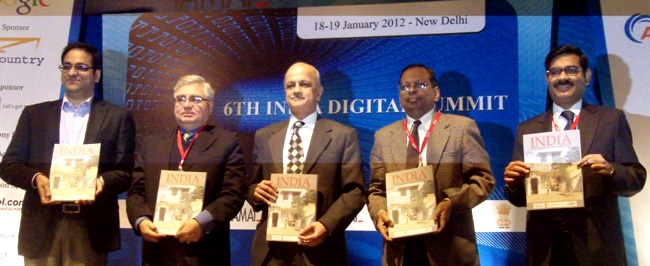
    The second day of the Sixth India Digital Summit hosted by IAMAI and Ministry of Information & Technology got underway in Delhi on January 19, 2012. The last day of the summit featured a wide array of discussions and debates between prominent members of the industry.


    Leadership Session 3: The connected home: devices and service revolution

    In the current scheme of things there is a proliferation of newer devices. Each and every day there are a plethora of newer devices coming in the market. To support all these devices a new service industry came up to support them. The session spoke about the nexus of devices, connectivity and the service sector in the back drop of the nuances of the industry, such as security.


    The session was chaired by Mr Sanjay Trehan, Head MSN India, Microsoft and the stage along with him was shared by Mr R Sivakumar, Managing Director, Intel South Asia.


    The discussion started off with Mr Sivakumar talking about the connected home. He said that the times have changed from connected homes to connected life. Earlier, Home was where the first use of technology begins. We have been using technology over the past decade without knowing about it. But some of those ideas are fast dissipating as our devices are no longer wired and we can move outside the periphery of our house and hence the idea of connective life.


    As technology has developed, the proliferation of devices too has increased. He said that the technology in the future will be dominated by three screens out of all the new devices based on convenience and ultra mobility – smart phones, netbooks and large television screens.


    He spoke about the growth of ecommerce and gave the example of the Indian Railway site irctc.co.in which does business of Rs 500 cr each month. The service provided is getting more sophisticated and more available as time goes by. With proliferation of device and connectivity, services provided online are increasing.


    When posed a question on security threats by Mr Trehan, Mr Shivakumar said that the security capabilities are still at its early stages and have to be built on. In terms of new technology, the bogey that we often ride is the talks of national security. National security and integration of security protocol is very important and yet there has to be ways to streamline the whole process and allow newer technologies to come in.


    Power Panel 7: Cloud Cluedo – Solving the mysteries surrounding the cloud

    The following session tried to unveil the mystery of cloud computing technology. Even though everyone in the technological domain are talking about this technology and its use, few people know about the intricacies of it, which the panel tried to unveil. Cloud computing gives one the ability to put business applications on the ‘cloud’ which would then make it possible for the users to access it from wherever he or she wants to.


    The following session was moderated by Manoj Chugh, President India & SAARC, EMC Corporation while the panelists were Mr Fredric Moraillon, VP – Marketing, Asia Pacific & Japan, Akamai Technologies and Rajnish Menon, director – ISV & Cloud Strategy, Microsoft.


    In his opening remark Mr Chugh explained that there are various kinds of clouds, such as Private Clouds and Public Clouds… Moreover, there is a whole mix of these clouds which gives rise to Hybrid Clouds of all shapes, sizes and colors. Cloud computing saves cost of infrastructure and will help businesses grow in the future, thereby creating new job opportunities. Moreover, while the old skill sets are going to remain important, new skill systems are needed for Cloud.


    According to sources, 50% of the cost of infrastructure can be saved when a business employs and moves their infrastructure to the Clouds. The initial cost of the infrastructure will depend on what kind of a Cloud it is. No two clouds are alike and clouds constantly grow and make newer clouds.


    Mr Menon explained to the audience that Cloud is very useful as it standardizes IT capabilities. To show the efficacy of cloud, he pointed out how all the fortune 500 companies have some sort of Cloud or the other. The point is, that Cloud is already here and is all pervasive.


    The next question that Mr Menon talked about is, is Cloud secure? The answer that he proposed was, yes, it is one of the most secure one as authority is given to only one or two who can see all the data. For those who wondered how costly cloud is, Mr Menon told that “Cloud is really cheap, but it depends on what applications you are using etc.”  In terms of regulation, currently, there is no cloud law in place in India and it is all about interpretations of the other existing laws.  Cloud computing has therefore become a new way in which one can deliver and consume IT.


    Talking about the cloud, Mr Moraillon said “From the Cloud perspective the consumer and the business are constantly merging.” He said that one can put anything on Cloud…But the question is what do you want to put on the cloud but the question is what the security level you have to secure that data is? Information is of value and it is important to keep it in the vault. But yet Cloud is useful as it is helpful and makes work and processes much easier. “You can do a campaign, a budget, file travelling expenses etc… Cloud can do all of that very easily and efficiently.” Today, one feels disconnected when ones hard disk crashes – a lot of hard work goes away, but such a thing does not happen with Cloud as the data will be present and secure on the cloud.


    The three important aspects which Cloud is efficient on is Time, Money and Labour; Wherein, it saves time and money, and allows employees to work just the way they want to work, from wherever they want. In the modern times markets are extremely fragmented and clouds helps adapt, open newer avenues to connectivity and the way work is done. The only possible concern that some businesses still have today is that of accessibility and security, however, cloud is developing and is developing fast. It is imperative that businesses move to cloud to be successful in the future.


    The panelists explained that one should move easier process on the cloud first and then go on to bigger process which have legacy and are relatively harder to move. But to start moving to the Cloud, maintained all the panelists, is essential.


    Power Panel 8: “To be or not to be an Entrepreneur”

    Being an Entrepreneur and building a business out of the scratch is never easy. In the current session the panelist discussed and talked about their difficulties in becoming successful Entrepreneurs. The talked about their experiences and shared their visions with the crowds.


    For many, starting a venture was a triggered by their situation, for some it was a choice and for the rest it was a mix of the two. The session was moderated by Manish Vij, Founder and CEO, Vun Network. The panel members for this session were Dhruv Shringi, Co-Founder & CEO, Yatra.com; Dinesh Aggarwal, Founder & CEO, IndiaMart; Rishi Khiani, CEO, Times Internet and Anisha Singh, Founder & CEO, Mydala.com.


    Mr Shringi said that currently the entry barrier is low to get into the business and it is a very good time for people to get into the business as the growth rate is good. Yet, Mr Aggarwal warns that people should not get into the business just because there is opportunity and growth. What is really required is a will to do ecommerce.


    To start off a business, funding is an important issue… Ms Singh pointed out that to garner funding and make profit eventually one has to have conviction in once business. Funding is tough and one has to have the ability to convince the investor, moreover, immense trust in once own vision is required.


    A few of the members in the panel also had a co-founder and investor… Talking about the aspect, Mr Khiani said that it not important that your partners are like you and think like you, but it is important that they have the same vision as you and believe in the product as much as you do.


  • PM commends media while releasing book on Tribune

    By A Correspondent


    Prime Minister Dr Manmohan Singh released a book titled The Tribune 130 Years: A Witness to History, in New Delhi on January 19.


    In his speech on the occasion he said:

    “I am delighted to be in the midst of The Tribune family once again. The last time I was involved in your celebrations, I had the pleasure of releasing an anthology of selected writings to commemorate 125 years of this magnificent paper.


    “Today marks the release of a comprehensive history of The Tribune, on completion of 130 years of its publication. It is truly pleasant to go down the memory lane with the newspaper of my choice which has been my staple reading every morning for decades.”‘A Witness to History’ is an apt title of a book that records the 130 year old history of The Tribune. Indeed, this history stands closely intertwined with the story of our country’s journey during this turbulent period.


    “Sardar Dyal Singh Majithia, the newspaper’s founder was a man of rare foresight and a great reformist. He was inspired by high ideals and wanted The Tribune to be free of any sectarian or commercial bias, and unaligned to any dogma or political party. I am happy that the newspaper has by and large lived up to its founder’s vision. While being an effective watchdog of the interests of the people it has practiced responsible and credible journalism.


    “The Tribune has also been a wonderful example of good what trusteeship is about. Its Trustees have been men and women who have distinguished themselves in their respective professions and who embody the spirit of The Tribune very aptly.


    “The newspaper is one of the very few in the country where the editor is insulated – as much as is possible – from managerial demands and proprietorial interests. But even more importantly, the newspaper has always been blessed with Editors of impeccable credentials. My friend Raj is one of them, with many very illustrious names before him and some of them are present on this happy occasion.


    “I compliment all those who have helped shape The Tribune into the newspaper it is today-the generations before us and the current torch-bearers of this fine institution.


    “I congratulate the author of ‘A Witness to History’ Professor V N Datta for writing such a fine book. Prof Datta recounts how in the early years of the 20th century The Tribune became passionate as a patriotic and nationalist newspaper. He elaborates how from 1920 onwards, as events began moving at a fast pace and as communal tensions began building up, the newspaper’s sober and reasoned approach attempted to bridge the divide between the Hindus and the Sikhs on the one hand and the Muslims on the other. The Tribune was opposed to the dismemberment of India and made sincere efforts to prevent it, but in vain.


    “Glancing through the pages of ‘A Witness to History’ I was struck by the words of an avid Tribune reader who wrote to the newspaper on September the 25, 1947, the day The Tribune resumed publication from Shimla, after Partition had forced it to move out of Lahore. And he wrote: “The heart of Punjab has begun to beat again, though the pulse is yet faint.”


    “On May 13, 1948, to mark the Tribune’s shift to Ambala, the then Prime Minister Jawaharlal Nehru wrote in a special message to the newspaper in his inimitable style: ‘You have passed through many difficulties and have stood many tests. I trust you will not be carried away by momentary passions but will function with a vision of the future before you.’


    “We have come a long way from the early years of The Tribune. Today, while India sits at the high table of nations and is looked upon and heard with respect, a vibrant media is crucial to our needs-a media that informs and educates, a media that is inspired by public interest and not guided by sectarian or commercial considerations.


    “The Indian media of today has its inevitable highs and lows. Every day we see examples of journalism of a very high calibre. There are instances of fair and accurate reporting, free of biases. There are stories with painstaking research to back them up. Journalists often expose wrongdoings even at considerable risk to themselves. There are efforts to report constructively on subjects that are of vital national importance.


    “But we also see sensationalism, driven by a desire to sell a story at any cost. There are stories without a clear understanding of the underlined issues. There is reporting which is prejudiced. There is trivialisation of important matters. There is corruption. The prevalence of the practice of ‘paid news’ exposed recently has come as a shock to all right-thinking people.


    “It has been our government’s avowed belief that the Fourth Estate is an essential pillar of our democracy. We believe in complete independence of the media from external control. It is true that sometimes irresponsible journalism can have serious consequences for social harmony and public order, which the public authorities have an obligation to maintain, but censorship is no answer. It is for the members of the Fourth Estate themselves to collectively ensure that objectivity is promoted and sensationalism is curbed. It is for them to introspect how best they can serve our country and society and advance their well-being, and how best they can earn the respect of our common citizens. Those in the media should come together to exercise a degree of self-regulation to combat perversions like paid news.


    “It is an important responsibility of the media to expose corruption and other ills in our polity and society. It should also advise the government and even reprimand it when it goes wrong. But let me also suggest that it should not be all gloom and doom all the time. The world is looking up to us today and it would be but fair that positive news is also given its due share. The Indian development story is an exciting one and should be told through the print and visual mediums.


    “I believe that good journalism is very serious business and a very difficult work. The responsibilities that journalists carry are onerous – to inform and educate the public, to keep a watch on the government’s work and to highlight issues of critical importance. It is hard to be a good journalist – ever willing to learn, ever alert to new developments, objective, fair, sensitive, balanced and constructive in approach.


    “However, I also believe that collectively the country’s journalists have acquitted themselves reasonably well. I am convinced that the Indian media is on the balance responsible and attuned to serving national interest. I am also sure that the coming years will see even higher standards from our media.”


  • Pankaj Pachauri is Communications Advisor in PMO

    By A Correspondent


    Senior television journalist Pankaj Pachauri has been appointed communications advisor to the Prime Minister’s Office.


    Mr Pachauri, 48, was managing editor of NDTV India. A statement from the government said, “The Prime Minister is pleased to announce the appointment with immediate effect of Shri Pankaj Pachauri as Communications Advisor in the Prime Minister’s Office. Shri Pachauri, who will report to the Principal Secretary to the Prime Minister, will advise on communicating the Government’s programmes, policies and achievements to the media and the public at large, particularly using the electronic, print and new and social media.”


  • Ogilvy expands in Australia with 33.3% stake in DTDigital

    By A Correspondent


    DTDigital, one of Australia’s largest and most successful digital agencies joined STW Group in 2003 and during the next eight years grew revenues from $1 million per annum to forecast revenue for 2012 of $14 million. Clients include Bunnings, Myer and NAB.


    For the past four years, DTDigital has been working alongside Ogilvy in Melbourne. Today DTDigital has more than 110 full-time staff in its Melbourne office.


    STW Group CEO Mike Connaghan said, “It’s not in our nature to sell parts of our prized assets but the logic in this instance was overwhelming. DTDigital already partners closely with Ogilvy Group Melbourne, and there are intentions to expand this partnership with Ogilvy to other markets. The integrated nature of many of our client campaigns makes it absolutely right for Ogilvy that we have DTDigital even further aligned with that business. It’s a good deal for all stakeholders.”


    STW Group owns 66.7 percent of Ogilvy Group Australia, with WPP holding the remaining 33.3 percent. The investment by WPP in DTDigital brings its ownership in line with that of Ogilvy Australia.


    “Ogilvy knows brand, social and CRM while DTDigital provides great digital, channel and technology skills making the combination a winning formula. We have worked in partnership for the past four years and acquiring part of DTDigital cements that relationship, allowing us to offer first class integrated digital to clients inside Australia and across Asia,” said Paul Heath, CEO, Ogilvy & Mather Asia Pacific.


    DTDigital is an award-winning digital marketing design and technology company that has been a pioneer in the industry for more than 15 years.  Founded by STW Group’s Chief Digital Officer David Trewern in 1996, DTDigital evolved from a multimedia design studio into a business that’s helped transform some of Australia’s leading brands in the digital age.


    Success has come through a unique, full-service offering, which includes deep specialization in high-growth areas that are not typically part of an ‘advertising agency’ offer. DTDigital has developed capabilities in specialist areas beyond strategy, creative and production such as user experience, design and consulting, advanced web application engineering, e-commerce, email marketing, data and analytics, social media and social business strategy, mobile marketing and application development, and immersive ‘beyond the browser’ digital experiences.


    This breadth of specialist capabilities allow DTDigital to focus on innovation, conceptualizing, developing and connecting the entire digital ‘ecosystem’ for sophisticated clients that increasingly connect and transact with consumers via digital channels.


    “This deal accelerates DTDigital’s launch to the Sydney market. Andrew Baxter, David Trewern and Brian Vella were instrumental in bringing the businesses together in Melbourne and the same team will ensure it is an instant success in Sydney,” Mr Connaghan said.


  • The Impact of Internet in India


    By A Correspondent


    Access to Internet and broadband are widely regarded as catalysts for economic and social development of a country. A number of research studies have demonstrated the positive impact that Internet and broadband penetration have on national income (GDP) as well as its transformative impact on businesses and livelihoods. Internet (among other means of access such a fixed line or mobile) is increasingly viewed as an efficient mechanism for accessing information.


    Several case studies have highlighted the role that information can play in inspiring economic activity and good governance. In this sense, information can be viewed as a public good, access to which yields positive externalities. Internet allows better access to information and hence the existence of ubiquitous information infrastructure becomes a key input to the efficient functioning of markets and government.


    One of the chief tasks of this report is to provide a compelling basis for government intervention in the internet market in general and broadband in particular.


    Scope of study:

    To the best of our knowledge this is the first study that systematically investigates the growth impact of Internet and broadband at a sub-national level. India is ideally placed for such an analysis because it has more diversity within its borders than any other country. Over 1.2 billion people live and work in India in very different circumstances and geographies. Yet critical telecommunications policy is formulated at the national level and applicable across the country. The study would be incomplete if it failed to demonstrate the manner in which Internet and broadband create growth impacts.


    Assessment of internet and broadband impacts – international experiences

    Two broad approaches have been used to measure the economic impacts of broadband and Internet; these are the input-output method and the multivariate regression analysis.


    The former technique relies on input-output matrices to estimate the impact of broadband infrastructure deployment on output and employment generation in a country.


    The latter are largely international cross sectional studies that attempt to gauge the impact of broadband infrastructure on economic activity by establishing a causal link between broadband deployment and economic growth.


    An influential and widely cited study in this genre is the World Bank inquiry into the economic impacts of Information and communication technologies (ICTs) including broadband (Qiang et al 2009). It draws its intellectual inspiration from Roller and Waverman [rW] (1996, 2001), who were the first to quantify the positive impact of investment in telecoms on the economic growth of a country. The research suggests that the contribution of broadband to economic growth is indeed substantial, and may be more profound than comparable narrowband or voice-based ICTs. The study finds that 10 per cent increase in broadband penetration boosts GDP growth by 1.38 per cent in developing countries.


    Many other studies support the growth-dividend hypothesis for broadband. McKinsey & Company found that 10 per cent increase in broadband household penetration delivers a boost to a country’s GDP that ranges from 0.1 – 1.4 per cent. Booz & Company found that 10 per cent higher broadband penetration in a specific year is correlated to 1.5 per cent greater labour productivity growth in the next five years.


    The point of departure for this report is to measure the Internet-growth linkage within the national boundaries using the multivariate regression model.


    Analyzing the growth impact of Internet in India

    India’s teledensity has shown extraordinary growth since private participation was allowed in the sector, rising from less than 1 per cent in 1998 to 61 per cent on September 3, 2010. Several studies have found that the telecommunications infrastructure is one of the significant factors in economic growth, alongside others such as overall investment, education, energy and transportation networks. Despite the rapid growth in mobile penetration rate – an acknowledged driver of growth – India lags behind other countries in Internet and broadband penetration. Based on TRAI data, while there were 687.71 million mobile subscribers as of June 2010, the corresponding numbers for Internet and broadband were 17.9 million and 10.31 million respectively. Net additions in broadband subscribers are merely 0.2 to 0.3 million per month compared to around 15-18 million mobile connections.


    The benefits and externalities associated with greater Internet and broadband penetration are far too significant to wait for the market to deliver these outcomes. India’s federal structure, with some states such as Uttar Pradesh, Maharashtra, and Madhya Pradesh having significantly higher population and geographical area than most European countries, readily lends itself to such analysis.


    Moreover, balanced regional development has always been an objective and therefore studying the impact of telecom’s liberalization across states will provide valuable insights for this policy aim.


    While the rapid spread of mobile telephony has been the most visible demonstration of the benefits of telecom sector liberalization, attention needs to shift to data and Internet. Accordingly, we attempt to answer three questions:


    • What is the impact of Internet penetration on state growth rates?
    • Do less-developed states show a greater impact of Internet penetration?
    • What is the mechanism by which Internet affects growth; and what are the constraints, if any, which limit its impact.


    Our first major finding is the existence of a positive and significant coefficient on Internet. The result shows every 10 per cent increase in Internet subscribers delivers, on average, 1.08 per cent increase in output. Accordingly, Indian states with higher Internet penetration can be expected to grow faster. What it means is, if Bihar had half as many Internet subscribers as Punjab, it would have resulted in an increased growth of 7.02 per cent in state per capita income.


    We also estimate the impact of mobile telecommunication on growth in order to compare it with the growth impact of Internet; the model is the same as used in the 2009 study (ICRIER 2009).


    The coefficient for mobile penetration that 10 per cent increase in mobile penetration delivers, on average 1.5 per cent increase in GDP, is a marginal increase from the earlier estimate of 1.2 per cent in 2009. Given the low Internet penetration levels in India, it is not surprising to find a lower growth dividend for Internet than for mobile (1.08 versus 1.5).


    (Extracts from the report by the Indian Council for Research on International Economic Relations along with the IAMAI and the Government of India’s Department of IT)


    Shruti Pushkarna’s interview with ICRIER’s Rajat Kathuria, who has co-authored the report with Mansi Kedia-Jaju.


    [youtube width=”400″ height=”200″]http://www.youtube.com/watch?v=fzagYBZ19AQ&hd=1[/youtube]

    On the findings of ICRIER study on impact of internet

    The finding of the study is that an increase in internet penetration by about 10 per cent leads to GDP effect of 1.08 per cent, which means that for every increase in internet, we are going to get GDP impact. And this is fairly a large impact but we hope that once internet reaches a critical mass we’ll have even larger impacts.


    Right now internet penetration in India is fairly low, so we haven’t reached what’s called critical mass. But once critical mass is reached, this impact could go up to even 1.5- 1.8 per cent.


    But even at 1.08 per cent, it’s a fairly large impact. So the manner in which internet is beginning to impact India is through small things such as overcoming the constraints of alternate infrastructure, lack of roads, lack of information, and internet is able to breach that gap fairly efficiently and quickly.


    So what internet is doing in India today is allowing small businesses to access information, allowing students to get access to information they never had, allowing doctors to expand the scope of their geographical activities, and if you aggregate all these little impacts that internet is having at the level of entrepreneurs, at the level of individual experts and then at a much higher level, at what it’s doing to a huge retail outlet, to say a WalMart; it improves the supply chain of an entity like WalMart as it improves the efficiency of a farmer or a doctor.


    So internet can have impact across the spectrum of activities, social and economic impacts. And those impacts are beginning to show up in India.


    [youtube width=”400″ height=”200″]http://www.youtube.com/watch?v=eOBMiKpLBM4[/youtube]

    On the recommendation of ICRIER study on impact of internet

    The recommendations of the report are as follows: If you wait for the market to deliver these outcomes, internet will happen, it will eventually happen but it might take a bit too long because private sector is not interested in making such huge investments in the core infrastructure.


    The secretary has recently announced a Rs20,000 crore fund just to lay optical fibre across the country to connect the 250,000 gram panchayats. The private sector is not going to do this because the gestation period is very high and the revenue stream is uncertain.


    But once the government does it, and that’s what we are recommending, the government should shortcircuit this process, otherwise internet and broadband will grow in islands clusters in India. In Gurgaon, Delhi, Ahmedabad and other cities, they will get good internet connectivity and the rest of the country will be deprived.


    In fact, it should be the other way round, we need internet connectivity more in areas where the other infrastructure is weak. So what we are recommending is, short circuit this process, overcome the market failure.


    The government should become a protagonist in investing huge amounts of money upfront and then the private sector will deliver what it does best, create business models around infrastructure.


    [youtube width=”400″ height=”200″]http://www.youtube.com/watch?v=QtjCaItw0lY[/youtube]

    On constraints faced in documenting ICRIER report on impact of internet

    If we had access to more data…one of the constraints we faced in documenting the report is access to information, and if we had better quality information, we could have come up with probably more robust estimates. The estimates would not change maybe but we would have more confidence in the robustness of our estimates if we had improved quality of data access. But that’s something we have to live with in India.


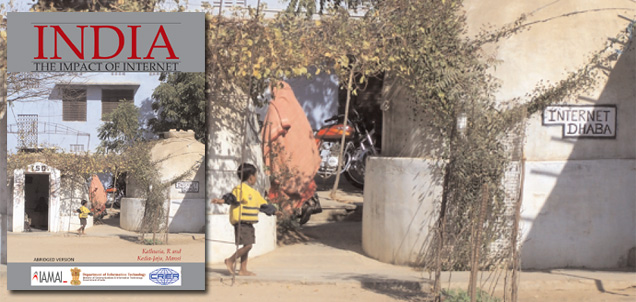
    Image courtesy: cover of ‘The Impact of Internet’.

    Copyright 2011 ICRIER
    All Rights Reserved
    Cover Photograph by Digital Empowerment Foundation
     

  • Sonal Dabral to head crack team at DDB Mudra Group

    By Amit Bapna


    Sonal Dabral, India chairman and regional executive creative director at WPP-owned Bates, is set to head the crack team at DDB Mudra group as its chairman-chief creative officer, people with direct knowledge of the development said.


    Prior to this, Mr Bobby Pawar, who recently moved to JWT India as the chief creative officer, was the group Chief Creative Officer at Mudra group.


    When contacted, both Mr Madhukar Kamath, group CEO and MD of DDB Mudra Group and Mr Sonal Dabral refused to comment. John Zeigler, Chairman & CEO (Asia Pacific, India and Japan) of DDB Group too refused to comment. He, however, said in an email reply, “I will answer all questions when we make our formal announcement on our choice for the Chairman and CCO for DDB Mudra.”


    While Sonal will be the creative face of the organisation, Madhukar will be the busness head, say sources. For over some weeks now, many names were doing the rounds regarding the new creative face of the DDB Mudra. Interestingly, Dabral, one of the hottest Indian creatives of the 90s, was being seen as the best contender, say industry sources.


    Dabral spent his best creative years with ad veteran Piyush Pandey at Ogilvy India, where the two forged a great chemistry and worked on brands such as Asian Paints, Cadbury and Fevicol.


    Another industry veteran points out that Mudra in its new avatar-post Omnicom buyout-would obviously have ambitions of occupying a much bigger space in Indian advertising, for which they would need a creative face with right clout of local and global experience. And Dabral fits the bill, as he turned around the Ogilvy offices in Malaysia and Singapore before moving to Bates.


    Interestingly, this would be Dabral’s second stint at Mudra. He had a short stint with the agency almost 20 years ago, but it did lead to one of the first and most memorable Hinglish campaigns of the country – ‘ Humko Binnies Mangta. Let’s see what he may have in store this time.


    Source:The Economic Times

    Copyright © 2012, Bennett, Coleman & Co. Ltd. All Rights Reserved


  • Indranil Roy to take charge from Maheshwer Peri @ Outlook from April 1

    By A Correspondent


    The change of guard at the Outlook group is now official. Though in the works for a few months, it happens due to president and publisher Maheshwer Peri’s decision to concentrate on his own business – Pathfinder Publishing Pvt Ltd which publishes Careers360 in English and Hindi, and Competitions360 amongst others.


    With effect from April 1, Mr Indranil Roy, who has been working with the Outlook group for over a decade-and-a-half, will assume all the non-editorial responsibilities that Mr Peri held. Mr Peri will, of course, continue to be on the Board and be available for advice.


    Speaking to MxMIndia, Mr Roy indicated that the revamp Outlook Business has seen could be visible in other brands too. For instance, Marie Claire will soon make a strong positioning statement of a premium luxury magazine.


    As part of the restructuring, Ms Vidya Menon will head the lifestyle and entertainment brands of the group and Mr Johnson D’Silva will head the Western region in addition to Outlook Money. Mr Roy will relocate to New Delhi.


    The Outlook group will continue to steer the distribution for Mr Peri’s magazines.


  • Filmwallahs, scribes mourn film critic Nikhat Kazmi’s death

    By A Correspondent


    “After people die, they become stars. Nikhat Kazmi just became four and a half”, a tweet by @NumbYaar as a tribute to Nikhat Kazmi aptly summed up feelings at her untimely death at the age of 53 on January 20, 2011. She was suffering from cancer.


    “Was truly shocked to hear about the untimely death of nikhatkazmi…the TOI critic of several years…prayers and thoughts with her family,” tweeted Karan Johar  (@kjohar25).


    “Tragic news. Extremely sad to know about the demise of Nikhat Kazmi, one of the most persistent film critics. Am sure wherever you are, it’ll be a 5 star rating, RIP. May God give strength to your loved ones,” tweeted Akshay Kumar (@akshaykumar).


    Ms Kazmi was the film critic at Times of India where she had been working for almost 25 years. According to media reports, she continued working till the very end. The last films she reviewed were Sadda Adda, Chaalis Chaurasi, Ghost and Blitz  (a Hollywood film). Ms Kazmi was always generous with her ratings, making no distinction between mainstream Bollywood and smaller independent cinema. And her generosity and grace were greatly appreciated by Bollywood.


    “Nikhat Kazmi was generous! Having come to terms with mortality she looked for something good in every film she viewed,” tweeted director Mahesh Bhatt  (@MaheshNBhatt).


    “Nikhat Kazmi was a great support for alternate cinema. Her reviews of Red Alert and Mee Sindhutai Sapkal, reaffirmed my faith in going global,” tweeted director Ananth Mahadevan (@ananthmahadevan19h).


    Many youngsters also gave her credit for always encouraging them in her reviews.


    “RIP Nikhat Kazmi. You enjoyed cinema and therefore encouraged us more than criticized us. We will miss you,” tweeted writer and director Milap Zaveri (@zmilap).


    “The 1st ever review I read of Refugee, my 1st film, was by NikhatKazmi. She always pointed out the road to improvement to me. RIP ma’am,” tweeted Abhishek Bachchan, (@juniorbachchan), mere hours after her demise.


    “Nikhat Kazmi ji the one person who has always encouraged me. Wrote so beautifully and one film critic I respected a lot! May her soul RIP 🙁 ,” tweeted Neil Nitin Mukesh  (@neilnmukesh).


    Not only Bollywood, Ms Kazmi’s death shocked many of her colleagues in the media fraternity too.


    Khalid Mohammed, film critic and filmmaker, said he wished he had known her better. “She was based in Delhi, while I worked in Mumbai. We would meet mostly at film festivals which required a group to cover the functions. I can’t say I knew her well, but I wished I had. I admire her perseverance, for she would review Indian as well as foreign language films,” he told MxM.


    Trade analyst and fellow film critic Taran Adarsh too expressed his condolences via Twitter: “Deeply saddened by the news of Times of India movie critic NikhatKazmi’s demise. RIP.”


    Parsa Venkateshwara Rao Jr, a senior journalist with DNA, had met Ms Kazmi once but she left quite an impression on him. Though he did not agree with her, he said liked her because: “Her heart was in the right place. She understood the importance of Hindi cinema and how it mirrored changing political and social winds of change. She was an anguished liberal,” he told MxM.


    Apart from being a film critic, Ms Kazmi was also an author who had written three books, Ire in the Soul: Bollywood’s Angry Years, The Dream Merchants of Bollywood and Times Guide to Hollywood Blockbusters. She had also written two plays.


    Whether people agreed with her critiques or not, there is no denying that her reviews in TOI will be missed. “RIP Nikhat Kazmi. A beautiful large theatre, with the coziest seat n all your favourite movies await you:) #respect” – Dia Mirza (@deespeak).