
Category: NEWS

  • Mobile on voice is where middle India really is: Neeraj Roy

    Hungama Digital Media, along with singer and music composer Shankar Mahadevan, recently launched MOBisur – touted as India’s first digital talent hunt property. Taking time from the launch, Neeraj Roy, MD and CEO, Hungama Digital Media Entertainment Pvt. Ltd. spoke at length with MxMIndia about this new brand property, the efforts put into it, and also about Hungama Digital Services post JWT acquiring a majority stake, his focus for the company in the next two years and much more.


    You say that it has taken nearly a year to conceptualize the entire brand property – MOBIsur. Can you share with us the efforts that went into building this property, how it all started, and the kind of research you may have undertaken and so on?

    This idea was conceptualized nearly three years ago by my colleague Anuj Bajpai who heads our voice business. As we moved into it, we realized the complexities, but at Hungama, we have a very deep rooted understanding about both consumers (because we have a lot of large consumer properties, which are all digital), and at the same time, we understand digital content. However, we still felt that something was missing and that’s where Shankar Mahadevan and his team came in because it was important that we run past them what we are thinking.


    Do you have a dedicated team working on this initiative…?

    Yes! It is driven by a voice team, but we have leveraged the entire group’s assets because there is a web interface aspect to it, there is a social media aspect because for any new service we launch, there is always a core product team. Once the product is approved and has a go-to market strategy at that stage, it moves from the product team to the operations team, which will then run this and ensure that it has momentum.


    Hungama launches digital talent hunt MOBIsur
     

    The mobile medium in the last many years have grown significantly, especially with 3G and now 4G coming in, there is great expectations from this medium. As wireless subscriptions continue to grow, billions of apps continue to be downloaded worldwide and India said to have the second largest mobile subscribers in the world.


    Taking into account the growing popularity of the digital medium, ITC’s Vivel FaceWash, along with Hungama Digital Media Entertainment Pvt. Ltd. and musician Shankar Mahadevan has launched ‘India’s first digital talent hunt’ – MOBisur.


    Mr Neeraj Roy, MD and CEO, Hungama Digital Media Entertainment Pvt. Ltd. said: “The reach of Internet and Mobiletechnology has grown tremendously in the past few years. The aim of MOBisur is to create a talent-scouting engine in spaces that haven’t been explored in the past, via an entry ticket that is their everyday communication device.”


    This unique mobile- and internet-based talent hunt promises to give every Indian an opportunity to prove their singing talent. The property was launched by Shankar Mahadevan, Nilanjan Mukherjee, Head of Marketing, Personal Care Products Business, ITC Ltd; Bhushan Kumar, MD, T-Series and Neeraj Roy, MD and CEO Hungama Digital Media Entertainment in Mumbai on July 13. T-Series is the official music partner for the property, which elevates the talent hunt to an even higher platform.


    Mr Bhushan Kumar, MD, T-Series, said: “It gives us immense pleasure to be able to bring new talent in to the industry. As a music label, we are always looking for fresh talent and with a truly digital talent hunt; we have access to talent across the country. We are looking forward to releasing an album composed by Shankar Mahadevan for the winner of the hunt”.


    The entries for the digital talent hunt, MOBIsur is said to continue for the next 45 days and the duration of the property will be for three months. The marketing budget is pegged at Rs3-4 crore.


    Mr Nilanjan Mukherjee, Head of Marketing, Personal Care Products Business, ITC, said: “Vivel FaceWashis delighted to present Mobisur, an exciting and innovative platform to discover hidden musical talent. Vivel Face Wash MOBisur, in line with this brand philosophy provides a unique opportunity to aspirants to live their musical dreams.”


    5,000 talented female participants selected from entries submitted on the Vivel Facebook page www.facebook.com/itcvivel will make it to the second round.


    The contestants who clear the first stage of the auditions will be given specific tasks by Shankar Mahadevan, who said: “When I conceptualised this property with Hungama, the thought was to give every Indian an opportunity to participate in a unique contest to try and reach the pinnacle of musical genius. Music is a powerful medium that can come from the most unexpected places.”


    Based on their performance in the tasks and the votes secured for each task, they will be chosen for the next round. There are three tasks in all and after clearing all three tasks the contestants make it to the final round, which is the On-Stage Performance. Ten finalists will be chosen to perform in front of Shankar Mahadevan and two other prominent personalities, where the final two winners will be announced.

    How different will the user experience be for mobile and internet users?

    In internet, there have been initiatives of this nature – they have been done in the past. Over the years, even the mainstream entities that do reality shows have created web interfaces for people to upload and so on. We are, in fact, going to be unveiling a lot of newer applications which will have stronger internet experience to it. So we have innovated on that front, knowing fully well that as a process it has been done. On the other hand, this was never done on mobile. In fact, mobile on voice is where middle India is, in reality. We needed to build this property and we had our limitations in terms of what we can do and not get cumbersome. At the same time, I needed to capture certain amount of information data to be ethically appropriate in the whole process. Overall, we have balanced it well and we are happy with the product.


    What about the duration of MOBIsur and its timeline and so on?

    There will be three different phases. The entries will go on for the next 45 days, wherein it is all about reaching out and getting as many people to participate. Then it goes through zonal rounds, which will then culminate into final round. The entire property is on, however, for three months. We didn’t think that we ought to have a real world angle to it in terms of going on-air and so on, but the way it is panning out, we might even consider that as the response has been very positive.


    Tell us about your marketing activities planned around MOBIsur?

    There is a fivefold approach to marketing. First, it starts with announcing the initiative through media and we then backed it up with a television campaign. Hungama has about 20 million consumers on the internet which are accessing our media properties, and we will obviously actively promote it there. We have also have 3.5 million social media community and we will promote it there as well. The most vibrant community is going to be the telco-ecosystem – one of the most unique thing we have done – because it is a universal number. We want every one of the telcos to take ownership of this as their own activity event/ product and that will be the one that will give us the maximum reach.


    Television promotion will be across channels, a lot of them music channels. Overall, my sense is that we should be putting in about Rs3 to 4 crore across mediums, in terms of the entire activations programmes, but a lot of that focus will be in areas where there is direct call to action. So don’t expect that skew to be driven completely by television, we will in fact do a lot more on digital and mobile mediums.


    Now, post JWT acquiring majority stake in Hungama Digital Services, what changes have taken place, especially on internal developments?

    JWT now has a 51 per cent stake in our business. There has been absolutely no change operationally, as it is the same team that runs the business, we are operating out of the same premises, we are handling the same clients. Clearly, over a period of time, we hope to be able to tap into and grow, leveraging their network onto other areas as well but, as of now it is business as usual.


    What about expansion plans into newer cities, any new verticals in the Digital Services business?

    Expansion is an ongoing process for us, the big focus is going to be to try and do as much of digital and physical promotional activations. The second area we are looking a little bit closely are trade-based marketing activations, which is the new area of growth for us.


    What are your views on India’s drawing a blank in digital at the Cannes? Does digital creativity lack steam in India?

    In fact, it is just the beginning in India, I think in the each passing quarter, you will find more focus on digital from both mainstream agencies as well as from brands. There are times when you have a good year or not so good ones, it’s alright.


    What are your plans for Hungama Digital Services in the next one or two year time?

    Our first objective is to make the new entity fully integrated; to align ourselves in certain manner and ensure that appropriate synergies are brought about. Our objective is to ensure that our existing clients benefit from a wider, more global network that exists for them. The third objective is that the team, about 120 people who’ve moved there, feel a renewed sense of enthusiasm and energy towards creativity. All of this has to happen in the current fiscal, then we gauge how do we scale this and go forward.

     

  • Grey wins creative duties for Muthoot group

    By A Correspondent


    The Muthoot Group (M George Enterprise), gold loan business set up in 1887, has now also diversified into financial Services, securities and a host of allied interests. Grey Worldwide has been mandated to handle the creative duties for all of these.


    The business will be primarily handled out of Delhi office, with Grey’sBangaloreoffice playing a key role for the South Market. Having established itself in the South, the Muthoot Group is now seeking to enter and consolidate its presence in the North, West and East markets.


    According to Dip Sengupta, VP and Branch Head, Grey Delhi: “It’s a great win! From the very first meetings with the Muthoot Group, we were moved by the ethics and value systems that drive this great brand. Our task is to help make the brand iconic.”


    “It was great to be a part of such a diverse pitch and of course, win it eventually! It takes a lot to identify a powerful brand idea and to make it relevant for Muthoot’s diverse markets. It was a great challenge and we look forward to this partnership,” added Hari Krishnan, VP and Branch Head, Grey Bangalore.


    According to Cherian Peter, Chief Marketing Officer, Muthoot Group: “We are delighted to have Grey as a partner and look forward to some great work!”


  • NewsX finds a benefactor in owners of India News & Aaj Samaj [updated]

    By A Correspondent [updated]


    The ITV Group promoted by Kartikeya Sharma and its associates have acquired control of INX News Pvt. Ltd. which owns and operates the English news channel NewsX.


    Speaking on the occasion Mr. Sharma, Managing Director, ITV said, “This is a logical market expansion for us and enables us to enter the English news domain while strengthening our presence in the broadcast and digital media space.  NewsX has emerged as a quality news provider with great growth potential and making it part of our group’s network of seven regional news channels will bolster news gathering abilities and create multiple synergies all around.”


    In 2009, Mr. Vinay Chhajlani and Mr. Jehangir S. Pocha had joined hands to run NewsX.  In a joint statement Chhajlani and Pocha said, “We are happy to hand over the channel to the ITV Group and acknowledge the contribution of the team that has earned NewsX much recognition.  Being part of the ITV Group will help NewsX transcend the limitations of being a stand-alone channel and give new thrust to the channel’s editorial and commercial development.”


    Our earlier report:

    Indi Media Network-owned English news channel, NewsX has finally found a suitor in ITV Media (Information TV). The details of the financial transaction are not known yet, though sources close to the development have confirmed the news to MxMIndia.


    ITV Media is the parent electronic media company which broadcasts 24/7 Hindi news channel, India News. ITV Media is part of the Piccadilly Group which also runs a print division that publishes a daily Hindi Newspaper, Aaj Samaj as well as a weekly Hindi magazine, India News. Headed by Mr Kartikeya Sharma, the company also has two regional news satellite channels, India News Haryana and India News Bihar. Mr Sharma is son of leading Haryana Congress leader Venod Sharma and the brother of Manu Sharma, a convict in the Jessical Lal murder case.


    NewsX which was earlier owned by INX News, was launched with much fanfare in March 2008. Later in January 2009, it was bought over by Indi Media Network, a partnership between the then Nai Dunia CEO Vinay Chhajlani and Businessworld Editor Jehangir S Pocha.


    Mr Pocha is currently CEO and Editor-in-chief of NewsX. An official announcement was made by Mr Pocha to the existing staff about the transaction in the afternoon and the new management is likely to speak to the team later today. MxMIndia learns that Mr Pocha reassured the team that he will continue as Editor-in-Chief. There were indicators that some resource sharing may happen with IndiaNews. A press communiqué is also to be issued.


  • Network18 elevates Kshipra Jatana as group general counsel

    By A Correspondent


    Network18 Group has elevated Kshipra Jatana, EVP & Head Legal, News Networks to Group General Counsel. In her new role, Ms Jatana will oversee legal operations and regulatory matters for all group businesses and joint ventures including A+E Networks | TV18, Viacom18, HomeShop18 and India cast.


    Earlier, Ms Jatana was the General Counsel at Capital18, the group’s investment arm where she was responsible for deal structuring, legal and compliance for its portfolio investments.


    Commenting on this development, Raghav Bahl, Founder & Editor, Network18 said: “Kshipra has been instrumental in managing legal and structuring matters for us, across the group. While, our growth has been led by strong management teams at each of our businesses, the role played by group level talent in driving ‘Network’ synergies cannot be overemphasised.”


    Speaking on this, B Sai Kumar, Group CEO, Network18 said: “Apart from managing legal matters, Kshipra has played a critical role in structuring key ventures and transactions in the recent past. Her unique ability to work across businesses and address a range of challenges, positions her well for the task ahead, as the group moves into a new phase of growth.”


    Ms Jatana added: “It’s been a great journey and has been full of exciting milestones and the opportunity to work with some of the brightest minds in the industry. As a group we are well poised with a strong foot print across all segments of the industry.  The challenge is to enable a strong defensive framework that allows all our businesses to grow while meeting high standards of legal compliance.”


    She brings with her 17 years of work experience in the legal advisory and corporate law space. Prior to joining Network18, she was the General Counsel/Head of M&A at MIH India and has also worked with Star TV and AZB & Partners in the past.


  • Google, HT Media, Vodafone bag ‘Best Companies to Work for’ accolade

    By A Correspondent


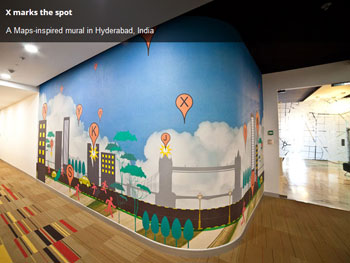
    A Google Maps-inspire Mural in the Hyderabad office. Photograph courtesy: Google.com

    It may not be the best of times to release a report like ‘The Best Companies to Work for’, given the low morale on the economy front and crunch in job opportunities prevailing in the marketplace. But there are companies that prefer to stand aloof from the depressing lot and would like to be counted as being amongst the best places to work for.


    The Economic Times in partnership withGreat PlaceTo Work have released ‘India’s Best Companies to Work for 2012′. The study throws up a diverse line-up of companies as favourites to work for.  Emerging the number one employer is Google India followed by Intel and NTPC at third. Further, five out of the top 10 companies are multinationals, pointing at the role played by global HR practices in stimulating employee satisfaction across workplaces in India.


    The study has been divided into the Top 50 and Top 25 best workplaces. When analysed further, only two out of the Top 25 Best Workplaces are companies which are new to the list of Best Workplaces, the rest having featured in the list in previous years. However, similar consistency is not seen in the Top 50 list in which there are 14 companies which have never featured in the list in India before.


    As for the standings, Gurgaon-based Makemytrip occupies the fourth spot, a drop from last year’s third rank. Amongst the media companies, HT Media Ltd is the only player to figure in the Top 25 list and is ranked 16th.


    Reacting to the win, Rajiv Verma, CEO, HT Media Limited, said: “This recognition is a testament to the strength and integrity of HT Media’s corporate culture. A few years ago, when we crafted a set of long-term goals for our company, we embraced the vision of being an ’employer of choice’. The recognition that we received from the study is a compelling sign that we have been moving in the right direction.”


    Other nominees include Cactus Communications that has been placed at number 20, Cleartrip Travel that is placed at 29th spot, Music Broadcast (operates radio channel Radio City) at number 41, Viacom18 placed at number 48 and Vodafone at number 49.


    In the category of Best in Class, Outdoor Advertising Professionals India Pvt. Ltd. achieves the top spot under Advertising & Marketing; Vodafone India Ltd. is number 2 under Telecommunications; Godrej Consumer Products Ltd., Procter & Gamble, Mars International India Pvt Ltd. and Mother Dairy Fruit & Vegetable Pvt. Ltd. are selected under FMCG; and Google India under IT.


    Some prominent companies that came up trumps across 22 sectors include: Vodafone India in Best Company in Large Organisations (more than 10,000 employees); Makemytrip, Cactus Communications & Cleartrip Travel Services under Professional Services, and HT Media Ltd and Viacom18 Media under Media.


    The study

    TheGreat Placeto Work® framework is based on over 27 years of research of the best workplaces across the globe from employees’ point of view. Some key trends spotted include: overall employee perception of their workplace culture has not changed significantly from 2011 – this is true for all companies, the Top 50, and Top 25 best workplaces in the Study. Thus, while individual companies may have done well or poorly in building trust with their employees, the workplace culture in India Inc., as perceived by their people, remains the same.


    Positive perceptions about their workplace culture continues to be high for senior management category compared to supervisory staff, with 7 per cent less supervisory staff giving positive feedback about their workplace culture. The study further reveals that 75 per cent of employees are below 35 years of age. While they are the majority in most organisations, their views about the workplace culture are significantly less positive than employees over 45 years in age. Only 20 per cent of employees, on an average, have worked in the same organisation for more than five years. There is a slow but gradual improvement in employee perception as one stays longer in an organisation, the study notes.


    As in the previous years, the Top 50 best workplaces are concentrated in Mumbai, NCR and Bangalore, but also have representation from Chennai, Pune, Hyderabad and Ahmedabad. 35 of the Top 50 have more than 1,000 employees, with 14 out of 50 having more than 5,000 employees. Only 7 of the Top 50 Best Workplaces saw employee increases of more than 30 per cent in the previous year, and 6 actually reduced their workforce.


    Also, the percentage of women continued to be low with only 5 of the Top 50 employing more than 40 per cent women employees. Women constitute less than 10 per cent of employees in seven of the top 50. Only three of the Top 50 have more than 30 per cent of their senior management as women. While 15 out of Top 50 best workplaces have employee attrition of over 20 per cent, however, in all major industries, attrition for the Top 50, on an average, is less by one-third to two-third of the industry average.


  • What makes Google top ‘best companies’ list

    By Devina Sengupta


    It is difficult to pinpoint what exactly gives a giant corporation like Google its famous startup culture. Perhaps it’s the independence people enjoy, the absence of red tape or the freedom to disagree.


    Or it could be that the search giant has managed to pick the right lot of people – those who can come up with next big idea, or better still, help a colleague come up with it. And this becomes glaringly obvious to those for whom Google was not their first employer. Ramesh Ravishankar had worked with other firms before he joined Google Hyderabad and realised that this was a wholly different workplace.


    “Bosses work closely with you and you are never penalised for your failures,” he said. This is starkly different from most other companies where numbers and targets are paramount and there is no excuse for not achieving them. “We are in the business of selling ideas,” said Rashi Tyagi, who works for Google’s online sales team.


    A lot of the credit for creating this culture goes to Google’s hiring policy. The company is not always looking for the smartest candidates; it wants people who fit in and that gets gauged by the peers, juniors and bosses in an interview. When Jayashri Ramamurti, currently head of people operations, first walked in for an interview, she was interviewed by her (future) juniors before being accepted at Google.


    “They wanted to know my views on the compensation structure,” she recalled. While this was an unusual experience for Ms Ramamurti, she eventually realised why it was necessary. Google wants people who seamlessly fit into its culture. That’s why it pushes its employees to ask their friends to join them. It takes time for new people to settle into any organisation but if they’re known to employees, the transition becomes easier.


    Newcomers are given six months to watch and absorb Google’s ways of working before being put on a team. Mit Koradia said this led to a smooth transition for him, “Despite being surrounded by IIT and IIM graduates, I wasn’t uncomfortable with the transition at all. On the contrary, I was made to feel comfortable from day one.”


    Teams play a central role in the professional and personal lives of Google’s staff. Whether it’s a query on income tax or a piece of code, all one has to do is create a discussion thread online and the solutions come pouring in. Ms Ramamurti just returned from the US with medicines for an employee she had never met, after seeing a request on one such thread.


    Similarly, when Rashi Tyagi and her US-based colleague faced a roadblock in their project, they needed some clarifications from their Tel Aviv team. Within a few hours, they were patched on to a video conference with the team from Israel.


    At Google, roles are defined but not rigid. The company likes to whet the risk appetite of its employees by challenging them. Ayesha Chauhan was accepted as an account planner and within a few months, was moved to a specialist role, despite being relatively new at the firm.


    During appraisals, metrics are clearly defined and regular one-on-one sessions are arranged so that there is no haziness at the end of the year. The firm is making its reward system more frequent, flexible and fast so that employees will be rewarded for good work immediately. Every business decision has the HR as business partner to ensure that it remains about the people and not merely markets.


    Even the washrooms echo the entrepreneurial spirit of the company with zero per cent attrition. A poster featuring a Google employee talking about his working style is slapped behind the restroom doors. He says: “Keep doing your own thing. Till they fire you”. And firing someone for an idea, no matter how bizarre, is simply not Google’s style.


    Source: The Economic Times

    Copyright © 2012, Bennett, Coleman & Co. Ltd. All Rights Reserved


  • Getit gets Aidem for corporate ad sales

    By A Correspondent


    Media consulting, marketing and advertising sales company, Aidem Ventures, has announced its appointment as the corporate advertising sales representative for Getit for the next 5 years.


    Getit originally pioneered the concept of Yellow Pages in India and has now transformed into an integrated digital media organization specializing in local search and classifieds. It is India’s leading ‘directional media’ platform providing quality leads to businesses and brands, across media and devices, thereby helping their business grow.


    Announcing the appointment, Sidharth Gupta, CEO, Getit Infoservices (P) Ltd. said: “We have appointed a strategic sales partner in Aidem and going by their track record and level of commitment to their partners, we are confident that we can take our business to new heights. The search advertising industry is one of the fastest growing industries in India and trade analysts have pegged it to grow 5 folds in the next year. We at Getit want to ensure that we set the pace for the growth of the industry and appointing our sales partner is a big step in that direction.”


    Through this mandate, Aidem will be responsible for marketing Getit’s synergistic product suite to leading brands, agencies and corporates. While Aidem will be responsible for services to large corporate clients, key brands and agencies, GETIT will continue to sell directly to its SME clients in over 70 cities, through its 1200+ strong sales force.


    “We are excited with the mandate to enhance the advertising potential of Getit that will provide brands with a perfect platform for a sustained engagement with consumers. This partnership also complements our plans to expand Aidem’s footprint in the digital and new media space. It is our constant endeavor to enable the Indian advertiser base to explore lucrative media platforms,” said Kaushal Dalal, Executive Vice President, Aidem Ventures.


    “The effectiveness of creative advertising is significantly enhanced when used in conjunction with Directional ad spends. Getit has tremendous potential and we are glad to be associated with it”, added Neena Dasgupta, Head, Digital & International Business – Aidem Ventures Pvt. Ltd.


  • Good news! End-season sales lure shoppers back to malls & high streets

    By Rasul Bailay, Sarah Jacob & Sagar Malviya


    After a lull of more than two months, Indian shoppers are thronging malls and high streets once again, lured by the end-of-season discount sales, and bringing some relief to nervous retailers.


    Retailers say early signs are encouraging than the same season last year, although these are early days and total actual sales numbers cannot be predicted yet. “So far it has shaped better than last year,” said Kailash Bhatia, chief executive of Pantaloons department chain.


    Dipak Agarwal, chief executive of DLF Brands, that markets products of brands including Mothercare, Mango, DKNY, Alcott among others, said the average sales at the brands under the company’s portfolio doubled in the first week of July compared to the same period in June when the discount sales had not started.


    Retailers have been nervous about whether shoppers would open their wallets amid a slew of negative news on the economic front such as increasing fears of below-normal monsoon rains, slowest GDP growth rate in nine years, US President Barack Obama expressing concerns about India’s investment climate, increasing food prices and prevailing high interest rates.


    After lukewarm sales in May, many brands including Arrow, French Connection and Puma advanced the start of their end-of-season sales to the last week of June instead of the traditional July.


    Now, with a whole host of other retailers joining in with discounts, consumers are back in the street in large numbers, causing traffic jams in main shopping areas this weekend.


    At the Noida Sector 18 market near Delhi, for example, hundreds of shoppers were driving up and down this weekend looking for a parking space.


    “It seemed I was shopping in the US. The sale looked genuine. I bought two Lee and two Wrangler T-shirts, two pairs of Albatross leather shoes and five pairs of sandals for my six-year old from Lifestyle and I paid just Rs7,500,” beamed a shopper holding a clutch of shopping bags at The Great India Place, the largest mall in Noida.


    DLF Brands’ Mr Agarwal says many retailers were apprehensive of the slowdown and through early sales they were trying to avoid an inventory build-up. And he expects consumer spending to remain high in the coming months.


    Jitendranath Patri, head of marketing at Central, a department chain owned by Future Group, shared Mr Agarwal’s optimism. “There is a long festival season starting from August and consumers will have something to celebrate each month during Ramzan and Diwali,” he said.


    Others such as Arvind Lifestyle Brands CEO J Suresh and Indus League Clothing CEO Rachna Aggarwal, however, warn that the positive response to discount sales need not necessarily mean that the good run will continue post August when most of the sales are over. “End-of-season sales never gives the true picture,” said Mr Suresh. “It is more important to see if sales will stabilize after the discount sales period or if a slowdown will continue,” he added.


    Mr Bhatia of Pantaloons said more and more customers now wait to shop during the sales seasons. Almost 30 per cent of Pantaloons’ revenues are generated during the discount seasons for the last four-five years.


    While the footfall has grown this discount season, Mr Patri of Central said the average ticket size of a Central customer too has increased to 2,500 this from 2,300 last year, making it a double whammy.


    A spokesperson for German sportswear brand Adidas AG said the company was expecting double-digit growth at its like-to-like stores during the sales season and it has achieved that target.


    Lavina Rodrigues, marketing manager at Metro Shoes Ltd, which sells multi-brand footwear through 175 outlets across the country, said the company is yet to gauge the sales records for the two-day flat 50 per cent sale this year, but indications are it is same as July last year. She says Metro is generally able to sell almost 60 per cent of the old stocks during the sales periods. In some cities like Rajkot, where consumers are more receptive of the discount season, the company would get rid of almost 85 per cent of the old stuff.


    Source: The Economic Times

    Copyright © 2012, Bennett, Coleman & Co. Ltd. All Rights Reserved


  • Strategy to use TV & radio simultaneously for max impact: Anand Chakravarthy

    By Meghna Sharma


    That regional channels are not a new phenomenon is evident when one surfs through various channels available today. And the available channels don’t seem to be enough as networks have launched, or are planning to launch, regional channels to tap specific target audience.


    So, when Reliance Broadcast Network launched Spark Punjabi, a regional channel for the PHCHP (Punjab, Haryana,Chandigarh, Himachal Pradesh) region, earlier this year, there was no surprise or shock.s.


    Anand Chakravarthy

    Speaking on the role regional channel play for a network, Anand Chakravarthy, executive vice president, Marketing, RBNL and business head, Big Magic said: “India is not one country, but is formed of various countries. And in the past five-six years, there has been an increase in number of regional channels. Traditionally, only southern states had separate channels, but today the markets have opened up in other states too. And this is because of availability of better quality content.”


    Localization of content has helped channels and networks to know and capture their TG well. Mr Chakravarthy states that it’s not only regional channels which are going local, but also national Hindi GECs too. “Take a look at any primetime show on a GEC – you’ll be seeing the differences – right from costumes to language used by the characters is localized as well as the story of the show. This is because even GECs know that if they do so, it becomes more relevant to a certain set of audience.”


    The network wants to give its audiences a very local feel and want to be seen as part of the region. “We show dubbed international shows, along with specially created programming because it helps us reach our audience better. It’s our USP. And we’ll continue to make shows which are very regional in their approach.”


    However, what is unique about the Reliance Broadcast Network is its strategy to use radio and TV simultaneously to strengthen the hold in a region. “We do a lot of marketing on our radio stations which helps a show’s launch on television, as it is able to create a lot of buzz. We plan to strengthen our regional footprint and our strategy is to launch in regions where we have very stronghold as it will help us and also form a unique advertising  offering which will get us advertisers and help us grow as well,” pointed out Mr Chakravarthy.


    And this is why the channel – Spark Punjabi – along with 92.7 BIG FM, came together to conceptualize BIG Boli Star - a talent hunt contest aimed at promoting Punjabi Boliyaan (a traditional Punjabi form of art). “Punjab has a very rich traditional art forms and Boliyaan have been passed down from generation to generation. Spark Punjabi and 92.7 BIG FM are ensuring that this traditional art continues to flourish, both in the rural and urban areas of the Punjab region. The BIG Boli Star talent hunt is creating a new wave of enthusiasm for traditional Punjabi culture as well as bringing new talent to the forefront.” The show is currently the no 1 reality show in Punjab and was able to deliver a 0.77 TVR in the CS4+ category (week 27).


    The network also plans to launch more regional specific shows as well as two more regional channels in the coming few weeks.


  • InMobi & Cricbuzz announce partnership

    By A Correspondent


    Bangalore-based independent mobile ad network InMobi and Cricbuzz, the cricket property with over 17 million unique users, has announced an exclusive partnership for bringing mobile ads to consumers on Cricbuzz’s mobile site and applications, for the India market. This partnership will make it easier for advertisers to reach premium mobile consumers on Cricbuzz.


    Under the terms of the partnership, InMobi will have exclusive rights to monetize Cricbuzz’s mobile properties across all devices on phones and tablets in India. Advertisers that want to advertise on Cricbuzz’s mobile application on these platforms will now engage with InMobi.


    InMobi delivers reach to 578 million consumers, in over 165 countries, through more than 93.5 billion mobile ad impressions monthly. It provides end-to-end solution for mobile advertising including rich media ad creation, distribution, tracking and optimization.


    With a presence across multiple digital platforms, Cricbuzz attracts over 17 million monthly unique visitors on its web and mobile properties. This partnership is for ad monetization, and on all their properties – mobile web and apps on phones and tablets.


    “Since inception, we have focused on making cricket information available on mobile devices of varying capabilities and were the first to launch a WAP-enabled version as early as 2005. We are excited to announce this partnership with a global leader in mobile advertising, such as InMobi. Being the top cricket destination on mobile, we were looking for a globally renowned partner and InMobi was the obvious choice,” said Pankaj Chhaparwal, Founder and Managing Director at Cricbuzz.


    Sandeep Deshpande, Country GM -India at InMobi said: “This exclusive agreement with Cricbuzz reinforces InMobi’s leadership position in the Indian market. Cricbuzz’s mobile properties on all platforms have been immensely popular in India and abroad. In a Cricket fanatic country like ours, where all brands want a share of this pie, advertisers will now be able to reach their target audience wherever they are, through this partnership.”


  • Business Line launches ‘Weekend Life’

    By A Correspondent


    Does Horlicks sell more than Coca Cola in India? Why is the Amul girl suddenly pushing milk, instead of butter? What made a music channel stop airing music? Ever wondered why European kitchen equipment stores are popping up everywhere? Find out all this and more about the business of brands, in one handy, 8-page packet, Weekend Life, being brought out by Business Line from July 6.


    One of the sections, Brandline, brings you the stories and the stories behind the stories from the world of advertising and marketing. Along with insight and analysis from some of the leading lights of the industry.


    Whether it is food and wine and gyan from leading chefs of India, or an insight into gender issues and how women, including rural women, are changing the face of India, it is all included in the supplement.


    Even the tech-savvy will be satisfied with eWorld’s updates on the latest trends, fads and analysis from the world of information technology.


  • Paritosh Joshi: _____________ Maketh A Man

    By Paritosh Joshi


    Surely, you are wondering why I chose to leave that first word blank when everyone knows the word that completes the aphorism?


    A Methuselah of our Media & Communications business came by a few years ago, when I was still gainfully employed and not a lily of the field, to talk about the media and their place in our lives. The conversation made an impression on me, abiding enough that I am compelled to develop it in today’s essay.


    Let me rewind to my early memories circa 1968.Kanpurhad no local English newspaper. The Times of India would ship theDelhi‘Dak’ Edition to our mofussil outpost. By the time the (now only of distant memory) Toofan Mail with her imposing steam locomotive growled intoKanpurstation with the precious newspaper, it would already be a day late. The news wasn’t yet stale, mind. After all, the only other source of news and current affairs we had, was the nightly bulletin on All India Radio delivered in the richly textured baritones of Jasdev Singh, Ashok Bajpai and their ilk. I must add that the scratchy Short Wave signals that our prized Murphy radio managed to extract from the ether made listening challenging at the best of times. Barring the most momentous of events and emergencies, the world beyond the nearest 10 kilometers was at least two days away. And it didn’t matter. Life, as we led it then, had little or nothing to do with the world beyond.


    Fast forward to 1977, nearly a whole decade later. We lived inNasikjust 175 kilometers fromBombay. Yes, in those days it was stillBombay.  Here was a city that offered not just one but TWO local (also local language) newspapers, Gavkari and Deshdoot. Times ofIndia,Bombay’s Dak edition would reach us the same day except it probably carried the previous day’s stories. There was still no television inNasik, so we still were served only by the stale newspaper and the highly expurgated radio. Not a lot had changed. Our lives continued to be led in the isolation and serenity of small townIndiaand, quite frankly, we didn’t think we were missing anything.


    Things began to change with the move toBombayin 1980. Suddenly, a television arrived at home. Black & White it may have been and only for a few hours of low fidelity transmission every day. And featuring exciting content such as missing people’s reports and Krishi Darshan, the farmers’ show, only occasionally spiced up with Chitrahar and Chhayageet. From consuming less than an hour’s worth of assorted media (perhaps half an hour each of radio and newspaper), our days now had at least another hour dedicated to TV.


    Television continued to grow. Print began to proliferate, not just in the form of a growing range of magazines, but also as a daily in the form of the afternoon or evening tabloid. Soon there was a Mid-Day fan and an Afternoon aficionado; an India Today enthusiast and a Week loyalist; a Stardust addict and a Filmfare feeder. Between all the diversity now available to them, many consumers were spending several hours a day just consuming all the options they were fond of.


    Cut to 2012. From perhaps 2 or 3 hours of exposure to various media a day, the modern urban Indian probably spends 4 or more hours a day consuming or in some way interacting with one medium or another. And it is no longer just urbanIndiaeither. DTH is available all over the country and a subscriber in the most remote hamlet has to just train its little antenna toward the sky to receive the latest content from around the world, a lot of it for free, in full digital video and Dolby Stereophonic Audio.


    People are defining themselves by the mix of content they consume.


    Can there be a segmentation approach that is based on shared commonalities AND uniquenesses in the way people consume the media?


    Which is why I left that heading blank.


    It really ought to read:


    Media maketh the man!


    Paritosh Joshi was until recently CEO, Star CJ. He has been a marketer, a mediaperson and a key officebearer on industry bodies. He is Strategic Advisor, Ormax Media. He can reached via his Twitter handle @paritoshZero