Category: NEWS

  • Brand Rajnikant to move beyond cinemas…

    By Sangeetha Kandavel


    Rajnikant, the movie star who has never lent his name to any commercial activity so far, will do so for the first time with Anjana Reddy, part of the family that owns the Deccan Chronicle group.


    Anjana’s celebrity commerce firm Collectabillia, which is already working on brand tie-ups for Rajnikanth’s upcoming 3-D movie Kochadaiyaan, will extend the Rajni brand beyond the realms of entertainment.


    The appeal of Rajinikanth, 61, the Bengaluru-born bus conductor-turned- hero, goes beyond the boundaries of his adopted home Tamil Nadu and the Tamil film industry. He keeps a very low public profile and has never endorsed any brand. Collectabillia, founded only a few months ago, has tied up with cricket icon Sachin Tendulkar and India’s number one woman tennis player Sania Mirza on a similar mandate, Anjana, 24, said.


    “We are working on extending their brands beyond their respective careers. This doesn’t include endorsements,” she said.


    In perhaps Rajnikant’s first deal, Karbonn Mobiles will launch an exclusive range called Rajinikanth Kochadaiyaan mobile phones, which will hit the market when the film is released. A Karbonn spokesperson confirmed that the Indian mobile handset maker plans to sell about five lakh Rajinikanth Kochadaiyaan mobile phones.


    Anjana, who holds a masters degree in finance from the University of Illinois, is the vice-president for business development at Deccan Chronicle. She is the daughter of Vinayak Ravi Reddy, the vice chairman of Deccan Chronicle that has defaulted on its debt and seen its short-term borrowings being downgraded by CARE earlier this month.


    Over a 35-year career and 150 films, Rajnikanth’s reach spans thousands of fan clubs from the remotest parts of Tamil Nadu to Japan. On the internet, his mannerisms and style have triggered a huge collection of outlandish factoids, much like for American actor Chuck Norris.


    “An example of what we are doing is what the Olsen twins with professional help from Beanstalk have been able to achieve. They have set up a billion dollar business which hasn’t got anything to do with their movies or acting careers,” Anjana said.


    Part of the Omnicom group, Beanstalk is known for its work on brand extensions, including developing actors Mary-Kate and Ashley Olsen’s lifestyle programmes and extending a consumer brand into the restaurant space with the Harley-Davidson Cafe.


    The idea has its genesis in Anjana’s meeting with Rajinikanth a few months ago regarding Kochadaiyaan. “Rajni sir put me on to (his daughter) Soundarya. That’s when this branding idea sparked we wanted to do something different which hasn’t been done in the market so far,” she said. “Rajni is a global brand and I am looking at global sales. He has a market everywhere right from India, to the Middle East to North America.”


    Soundarya is directing the movie, which is slated for a December release. In the West, celebrity-branded products have been around for decades. In the early 1990s, Elizabeth Taylor lent her name to the ‘White Diamonds’ perfume of Elizabeth Arden. Recent examples include rapper 50 Cent lending his name for a vitamin-water brand, former NBA star Yao Min’s launch of his own wine label and Lady Gaga’s association with the Fame perfume brand.


    In India, however, it’s still early days for celebrity commerce. Brand consultant Harish Bijoor said there are some efforts on “but most of them turn out to be celebrity managers who swear by their own celebs and can force-fit any brand offering onto them.”


    Source:The Economic Times

    Copyright © 2012, Bennett, Coleman & Co. Ltd. All Rights Reserved


  • Starcom tops RECMA’s global billings rankings, OMD is #2

    By A Correspondent


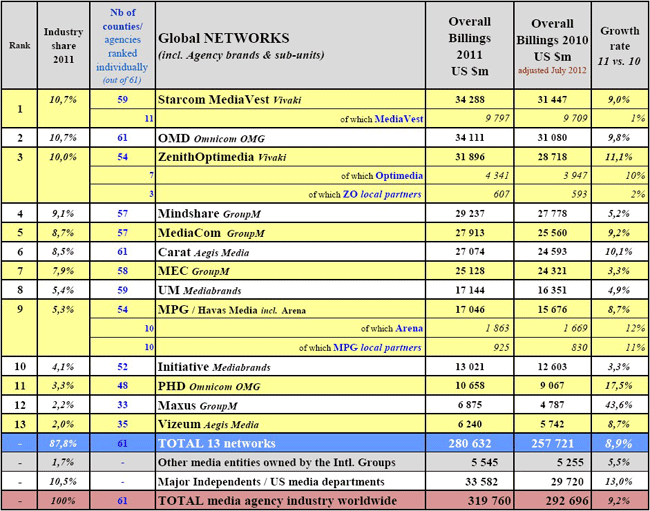
    Media agency analyst RECMA has announced the publication of the 13th edition of its Global Billings Rankings report. As many as 865 agencies in 61 countries were evaluated and all the data (10 different indicators for each agency) were consolidated in a pivot table.


    Industry indicators point to a sustained growth (+9.2 per cent) – a lower rate than in 2010 though (+13.8 per cent) – partly fueled by the continuing development of Digital activities within the agency core business.


    In the global network ranking 2011, Starcom MediaVest Group holds the lead it took over OMD last year but with a very tiny gap (less than $0.2m). SMG increased its billings by +9 per cent (or +$2.8bn) while OMD posted a +9.8 per cent overall growth (or +$3bn).


    Four networks recorded a double digit growth (vs. 11 networks last year): Maxus (+43.6 per cent), PHD (+17.5 per cent),ZenithOptimedia (+11.1 per cent) and Carat (+10.1 per cent).


    As the undisputable industry leader, GroupM showed a below-the-average growth rate with uneven performances across the regions: low billings increase in the USA(+5 per cent vs. +10 per cent on average) but high in Asia-Pacific (+$2.3bn).


    Internal hierarchy of the four WPP media networks remains unchanged: Mindshare, MediaCom, MEC and Maxus. The latter increasing its share thanks to strong performances in the USA (where it has doubled its billings), the UK and Germany.


    On July 12, Aegis agreed to be acquired by Dentsu.  The takeover of Aegis by Dentsu provides is a perfect geographical fit and does not have any impact in the billings tables of this report.


    However the addition of Dentsu Media Japan to Aegis Media’ global billings would allow this new Group to reach the third rank ahead of Omnicom Media Group (statement based on an estimated billing figure of $bn 10 for Dentsu Media Japan (about a quarter vadpends).


    The full report is accessible to subscribers at www.recma.com via My RECMA link.


  • Discovery Tamil now on Dish TV

    By A Correspondent


    Discovery Channel Tamil has announced that it will now also be available on Dish TV. Already available across all analogue homes, Discovery Channel Tamil is one of the most widely distributed channels in Tamil Nadu reaching over 10 million subscribers.  With availability on Dish TV, the channel expands its penetration in India, targeting Tamil speaking viewers around the country.


    Dish TV, being one of the major DTH platforms will drive Discovery Channel Tamil’s to reach viewers throughoutIndia, especially catering to Tamil population inNorthern India.


    Announcing the affiliation with Dish TV, Rahul Johri, senior vice president and general manager – South Asia, Discovery Networks Asia-Pacific, said: “Discovery Channel Tamil has received tremendous response from the Tamil speaking viewers for its attractive look, engaging and unmatched content. The availability of the channel now on Dish TV demonstrates our commitment to reach viewers around the country and offer them enhanced viewing experience.”


    Nearly one year of its launch, Discovery Channel Tamil, the standalone channel for Tamil Nadu market continues to grow ratings month-on-month. Discovery Channel Tamil is a customized product offering for Tamil viewers. The 24-hour factual entertainment channel has programmes scheduled as per Tamil audience tastes and preferences.


    Salil Kapoor, Chief Operating Officer (COO), Dish TV, said: “Dish TV is proud to provide content in regional language. The latest is the addition of Discovery Channel Tamil on Dish TV platform to our subscribers. The launch of Discovery Channel Tamil will provide us with a perfect offering which will help us serve our Tamil customers in a better way. Dish TV has been a trendsetter in offering its viewers the best content, service and quality.”


  • Arena Animation creates country’s first 3D commercial

    By A Correspondent


    Aptech’s education brand, Arena Animation has created the first 3D stereoscopy commercial. The commercial named as ‘Dudolls’ is the first ever TVC produced inIndiathat has undergone a 3D stereoscopy conversion. It means that the TVC can be viewed on any 3D supported device like 3D cinema theatre and 3D monitors.


    ‘Dudolls’ has been created by the reputed production house, Talking Donkeys for Arena. It shows playful animated characters (named Dudolls) in an Arena centre and the backdrop showcases facilities provided by Arena Animation to their students.


    The TVC is already being aired on many national TV channels. However, the 3D stereoscopy output will be seen in multiplexes in 3D movies. It would be seamlessly built into the ad slot during the 3D films. It is meant for any 3D device that includes television and mobile phones. The advertisement is also expected to run on the 3D televisions of the future.


    The concept is to showcase Animation & Multimedia as a fun and rewarding career.

    The concept has been collaboratively built by the marketing team at Arena & the creative agency, Quadrum Solutions.


    Speaking at the launch, Mr. Ninad Karpe, MD & CEO, Aptech Ltd said: “We have moved a step further in the world of animation with our latest TVC in 3D. It will help us reiterate ourselves as leaders in the animation arena and expand in our category. ‘Dudolls’ just reiterates how animation is gaining prominence and has become a coveted career of the youth.”


    Sonya Banerjee, Marketing Head, Aptech added: “We made a 3D commercial foreseeing the trend in 3D content. Planning on this required a foresight to integrate the 3D vision early in storyboarding stage and not as an after thought.”


  • Suresh Saraiya, RIP. A commentator with passion

    By A Correspondent


    July 18 was a sad day for many as yesteryear superstar Rajesh Khanna passed away. However, there was another man who left a vacuum in the cricket-frenzy nation.


    One of India’s best known cricket commentators Suresh Saraiya passed away on Wednesday following a heart attack.


    He made his debut in 1969 and will be missed by all for his love for the game. “He wasn’t a cricketer and it was his passion about the game that made him what he was,” remembers Ayaz Menon, veteran cricket journalist. Mr Saraiya was a public relations officer in the Central Bank of India apart from being a commentator.


    “His sheer dedication towards the game was admirable. He did his homework well before any game and listening to his commentary was like an education in itself,” Mr Memon adds.


    Agreeing with him, Hemant Kenkre, a former cricketer and commentator and a senior communications professional adds, “His sense was preparedness is what everyone should look up to. He would get into details and know nuances about a cricketer and used them as nuggets which made people feel a ‘connect’ with not just the game but the player as well.”


    The cricketing fraternity as well as the fans who grew up listening to him on the radio are mourning the death of the man who covered more than 100 Tests for All India Radio, for whom he worked for more than four decades.


    According to many, Mr Saraiya enchanted the listeners with his smooth voice and unique style when radio commentary was at its peak in the 1960s and 70s before the advent of television. “There is a huge difference between today’s commentary and that in the yesteryears. Today, we have visuals to support whereas in those commentators’ job was not only to give stats but also paint a picture for the listeners which wasn’t easy,” points out Mr Memon.


    Even microblogging platform Twitter was buzzed after the news of him passing came in. Television commentator Harsha Bhogle tweeted, “I worked with so many commentators – few with his desire and preparation.”


    “Unlike today’s commentators who are former cricketers, his style was very different. One could call him a silent-but-deadly man because of his knowledge about the game and players. And he always encouraged others especially new journalists and freelancers and was willing to teach and educate them about how to follow the game,” recalls Mr Kenkre. “I don’t think there is anyone who would have anything negative to say about a man of his stature. His demise is a great loss to the cricketing world.”


    Photograph: Fotocorp


  • Global luxe brands woo first-timers with sales

    By Vijaya Rathore


    International luxury brands such as Chanel, Christian Dior and Burberry have started discount sales at their outlets in Delhi, Mumbai and other cities to woo first-time buyers as well as to clear inventory.


    “Sale is a good way to bring down the entry point for the first-time buyers,” said Roasie Ahluwalia, general manager (marketing), at Genesis Luxury that operates brands such as Giorgio Armani, Paul Smith, Bottega Veneta, Canali, Burberry and Jimmy Choo in India.


    She said this strategy is particularly effective in a nascent luxury market like India. “Many of those who buy these luxury products at a 40 per cent lower price end up becoming regulars,” she said.


    A CII-AT Kearney study recently observed: “End of season sales have played a good role in getting more and more Indians to get their first experience of luxury.”


    Even Chanel and Christian Dior, among the best-known luxury brands in the world, have put lower price tags on select products. Chanel offers 30 per cent sale on its ready-to-wear section twice a year while Dior offers discounts on items such as clutches and shoes.


    Marielou Phillips, spokesperson for Chanel in India, however, said the luxury brand uses the sales to reward its loyal customers rather than attract first time buyers. “Neither do we put up big signage at stores nor we give advertisements in newspapers. We simply put aside a few products and inform our regular buyers about the discounts,” she said.


    Industry experts say tempering sale of high-end goods in a slowing economy and limited circulation of products due to small number of stores in the country are forcing luxury brands to put the big labels on sale.


    “Brands go on sale in India because they have to get rid of last season’s products. In case of luxury brands, the seasonality factor is much higher. Most of their products are seasonal in nature,” said Dipak Agarwal, chief executive officer at DLF Brands, which co-operates Salvatore Ferragamo stores.


    Most international luxury brands do not operate more than five stores in India, making it necessary for them to flush out the old inventory. “A brand’s ability to leverage inventory across stores goes down when it has a limited number of stores in a country,” said Mr Agarwal.


    Dinaz Madhukar, president at DLF Emporio, a luxury shopping mall in South Delhi, says the number of shoppers increase 30 per cent during any sale. “Even brands that do not go on sale benefit from the increased footfall,” she added.


    An average two lakh people visit the DLF Emporio each month. The mall also does a lot of events like corporate tie-ups to invite potential customers for sale previews.


    However, there are a few brands like Hermes, Louis Vuitton, Cartier and Tom Ford that do not offer discounts. “We do not go on sale,” said a representative at a Louis Vuitton store.


    Experts say most of these brands follow their global policy of not bringing prices down.


    An executive associated with Tom Ford brand in India said: “Many brands also want to convey a message that each of their products is worth what a consumer is paying for. They do not want a customer who has paid more for the item to feel cheated when he finds that someone else has paid 30 per cent less.”


    Fair enough, but such brands might be losing out on a certain class of luxury customers in India who buy luxury only on sales.


    Abhay Gupta, founder promoter and CEO of Luxury Connect, which offers executive educational programmes on luxury business, said there are two kinds of luxury shoppers in the country. “There are people who are brand loyal and spend irrespective of the price tags and there are those who wait for six months for the sales to begin,” he said.


    Source: The Economic Times

    Copyright © 2012, Bennett, Coleman & Co. Ltd. All Rights Reserved


  • ‘If you’re not ready for digital, your company is’: Media Rhythm 4


    By A Correspondent


    Stratagem Media Pvt. Ltd, an independent media services company, held its fourth training program called ‘ReveNEW Concepts – The Media Rhythm series and Ideas’ on July 21 in Mumbai. The workshop saw participants from The Times of India, The Hindu, Malayala Manorama, Eenadu, Amar Ujala, MY FM and other media companies.


    Among the speakers were Mr Sundeep Nagpal, Founder Director at Stratagem Media Pvt. Ltd; Mr Suresh Balakrishna, CEO, Brand Programming Network; Mr Bharat Kapadia, Chairman, Whatuwant Solutions and Mr Madan Sanglikar, a digital media expert and CEO, AD2C.


    About bending backwards with ease:

    Mr Nagpal, the first speaker of the day, delved on ‘Bending back with ease’ wherein he asked the participants to first know what they are selling. He said that instead of selling many things at one time, there has to be some clarity and certainty of what is being sold and only then the expectations of the clients can be met. Mr Nagpal also spoke about the importance of reminding the consumers about the brand even after awareness is created: “A consumer needs to see the ad frequently. Time and again we have been able to convince clients that in a crowded market, playing one advertisement is not enough. Therefore a reminder is very important.”


    He also said that even though there is awareness, reminder and high impact, the brand may not sell as the problem could be because the competition is making more noise. “At times when everything is good, there is no recall because competition is making more noise. Response measurement is very tricky and must be done in a scientific way. Low response could be because of the lack of good features, price and distribution issues,” he said.


    Mr Nagpal also pointed out that it is very important to know the client’s business or product: “If you are managing client expectations, you must also know the client’s needs. When you do consultative selling, you can reduce the discount selling.”


    He also spoke about the two ways a brand can grow. First, get new consumers and second get the same old consumers to consume the brand more frequently. Some other ‘home truths’ Mr Nagpal shared were: remove discount, adopt differential and value based pricing.


    He said it is important to know the competition as is important to calculate, permute and innovate and that you can always refuse a business instead of selling lower than what you deserve.


    Customising media usage for brand communication:

    Mr Suresh Balakrishna kick-started his session by playing a one minute trailer of the film ‘Rocket Singh, Salesman of the Year’ as an example of how one should and can sell his brand to the consumer. He spoke about going beyond media objectives and looking at communication objectives, quickly pointing out that the media objective is only a channel; the client however wants a communication objective. “You need to create a connect between communication objective and media solution. It is important to understand the communication objective of the client, his needs and aspirations as well. You must, therefore, involve your clients and listen more to what your client wants.”


    Mr Balakrishan presented three case studies – Union Bank of India, Vodafone, and Cadbury Dairy Milk Shubh Arambh. He split the participants in different groups and asked them to do various exercises on the case studies presented. He gave the participants various challenges and asked them to come up with solutions to those challenges: how they would have connected with the consumers; how they would have amplified a particular campaign in the media or solved a certain problem in a different way.


    On Motivation and Innovision:

    Mr Bharat Kapadia spoke about the importance of motivation in an individual and the need for ‘innovision’- a combination of innovation and vision. “Everyone cannot have wrong card, what is important is how you play your cards. Unless ‘You’ believe that nothing is impossible, nobody will be able to help you out. Whenever you are given a tough task, don’t see it as impossible, but instead attempt it to raise the bar for yourself.”


    On the need for innovation, Mr Kapadia stated that even innovation needs to have a vision. He said that one needs to innovate, to not only stay ahead of the competition, but also to create a new experience or even to solve a problem which at first looked quite challenging.


    Mr Kapadia shared four crucial points for innovation: Uniqueness, Impact, Achieving the goal and Sustainability. He was quick to state that ideas and creations are nobody’s monopoly as each one is capable of generating ideas. Therefore, one needs to start thinking without any baggage.


    He also stressed that an idea needs nurturing, which could be achieved with the help of family, friends and colleagues. He asked the participants to mentor the ideas of their juniors, so that they would come up with better ideas. But he was also quick to stress that the real test lies in the execution of the idea. One must always think of the end objective of their idea, and the hurdles they might have to cross.


    Mr Kapadia also warned the participants about the dangers of an idea: “Be careful that your idea is not gimmicky and irrelevant, the idea must fit into the objective of the brand. A good idea becomes a great idea if it is implemented well.”


    He also told the participants not to be afraid of mistakes and failures, but to learn from them. Mr Kapadia shared his experience about how he managed to successfully execute the Bru Coffee aroma campaign on The Hindu and the challenges he have to overcome to execute the campaign successfully.


    Mr Kapadia also gave participants some practical or exercise work during his session. He asked them to come up with an innovation for any media vehicle for any brand, whether existing one or a fictitious one. He asked them to exploit the strength of that medium. The teams were split into five groups.


    While concluding his session, Mr Kapadia reiterated that an idea is no one’s monopoly. It must however be relevant, feasible and beneficial to the client. He concluded: “There is no dearth of money in the market because it is all about a good idea. If you come up with a good idea, then the client will also shell out the money required for that idea. A good idea can even bring new advertisers.”


    Teleporting to 2015:

    Mr Madan Sanglikar shared nine concepts on digital, emphasising the growth of digital and the implication of that growth to other medium and the brands. He spoke about the future of print, television, gaming, mobile, social media, e-commerce, data visualization and eco-system transition, pointing out the need to think digital, that innovations are also happening on digital, and the fact that digital media is the fastest growing medium in the country.


    He said that the growth of digital will see more advertising categories increasing their spends on digital. He also said that digital will reduce the urban- rural gap. On the future of print media: “Print will be the biggest beneficial from the digital growth among the media categories. Dailies and magazines will get a new lease of life and static and AV (Audio Visual) formats of content and ads will co-exist.”


    On the future of television, Mr Sanglikar said that television experience will get better, a lot of which will be gesture controlled. Online video format will merge with television; it will create an explosion of online and on-demand videos.


    Talking about the gaming market, he stated that it is expected to grow to Rs3,100 crore by 2015 and there is a shift of gaming from bedroom to living room, wherein it becomes a family entertainment medium.


    Mr Sanglikar gave the example of a bakery in London who used Twitter to attract customers to his bakery as an example of how social media can be used for enhancing the business. He said that very soon there will be no emails as corporate social network will see huge growth.


    On the e-commerce front, Mr Sanglikar stated: “E-commerce market is also growing tremendously. Online shopping is getting more interactive with more pay options available and newer shopping categories soon catching up.”


    Mr Sanglikar also explained the difference between paid media, owned media and earned media and how today we are witnessing owned media and earned media share growing. He concluded: “Digital is like another medium and not imbibing the medium will not work. If you are not thinking about digital, your companies are certainly thinking about it.”


    What the participants say:

    At the sidelines of Media Rhythm 4, MxMIndia spoke to some of the participants for their views on the daylong event. According to Mr Subin Thomas from MY FM: “It was very interesting and fun too. Mr Suresh Balakrishna’s session was especially very good. There has been lot of learning, especially about innovation and communication objective.


    Ms Zeenat from Eenadu said: “The workshop was definitely helpful for us as it helps us with new ideas. After being in the industry for a long time, you tend to get a rigid mindset but, when we attend such forums where so many different issues are discussed, it refreshes our thoughts and allows us to think differently. The session on digital will probably help us in our work in digital.”


    A Times of India participant said: “It was a good way of looking at certain things and even on media selling. All in all it was a good and interactive sessions. There have been some good learning and takeaways too. I would also be taking some of the takeaways from these sessions to my clients.”


    Mr Soham Khimani from Malayala Manorama said: “The sessions were really wonderful and the speakers too were good. There was lot of creativity in the session which is very important in media sales today.”

     

  • Nachiket Pantvaidya to replace Nitin Vaidya as head of Star Plus

    Nachiket Pantvaidya

    By A Correspondent


    Nachiket Pantvaidya, Executive VP and general manager at Star India and incharge of Star Pravah, the Marathi GEC of the Star bouquet of channels, has been appointed as incharge of flagship GEC Star Plus.


    Confirming the appointment, a spokesperson told MxMIndia that Mr Pantvaidya will take over from Nitin Vaidya who has put in his papers after a stint of 14 months.


    Mr Pantvaidya has been with the group since 2009 when he was appointed managing director of Fox Television Studios, the TV production unit of Newscorp’s Fox Entertainment Group. Earlier, he has been general manager,South Asia with the BBC and Executive Director, Programming and Production, for Disney where he managed the localisation of the Disney brands. An IIM-Ahmedabad alumnus, Mr Pantvaidya has held several key positions MSM (Sony) network.


    Nitin Vaidya

    Meanwhile, confirming the news to MxMIndia about his resignation, Mr Nitin Vaidya said: “Yes, I have quit and it has been a nice and exciting experience. Star is a great organization to work with and the team has been remarkable.” Mr Vaidya had joined Star India in May 2011 and was heading Hindi channels Star Plus, Star One (which is now discontinued), Star Gold and Star Utsav.


    On his next move, Mr Vaidya said: “I have plans of my own and as of now I’m not joining anywhere for the moment.” Without disclosing any dates, Mr Vaidya assured that only after a smooth transition will he move on from the organization.


    Nitin Vaidya, Photograph: Fotocorp


  • Percept Live takes flight with Rs 200cr investment

    By A Correspondent


    There’s no denying the endless opportunities that live events manage to throw up. Ask the owners of Percept who’ve organised some memorable – and of course profitable – events in the recent past. With the number of properties seeing an upward spike, the media and communications powerhouse has decided to house all its event properties under a newly instituted division, Percept Live.


    Percept Live businesses will include all the IPs created and owned by the Percept Group, including IPs in the live entertainment, sports, celebrity management, digital and media space. Some of the renowned IPs currently owned by Percept Limited includes Sunburn, Fight Nights, Bollywood Live, Lost Music Festival, Fan Football Championship, Champions of the World and Windsong Music Festival.


    The group would be pumping in close to Rs200 crore to execute its plans over the next three years. While Rs100 crore will be raised through equity, Rs50 crore will be raised through debt and the remaining Rs50 crore will be through internal accruals. Of this amount, Rs50 crore has already been raised and will be used in creating innovative IPs with global appeal as well as scaling up existing IPs.


    To take their plans in the space forward, the group has bought back former head Manuj Agarwal who has been appointed CEO of Percept Live and will be responsible for providing strategic direction to Percept’s IP business.


    Prior to coming back to Percept, Mr Agarwal was CEO-Television at Balaji Telefilms Ltd.  Mr Agarwal said: “I am delighted to take on this new and challenging role. This new initiative is designed to consolidate our efforts in the area of IP creation and management, and will ensure that we take ownership of our ideas and convert them into assets that would benefit our clients and Percept in the long run.”


    Elaborating on the prominence being laid on the new venture, Shailendra Singh, Joint Managing Director, Percept Limited said that for long Indian companies have been dependent on ideas from outside and failed to produce something spectacular from their own home ground. But all that is changing now and Indian ideas are now finding acceptance with the outside world. It was therefore essential to come up with ideas that are ‘glocal’ in nature.


    “We have been in the ‘Ideas’ business for the past 28 years and have been instrumental in creating many legendary Intellectual Properties in the past for our clients. The launch of a dedicated IP vertical is but a further extension to our existing knowledge and expertise in the Entertainment, Media and Communications domain and is in keeping with the growth plans of Percept in the coming years. Our vision is to convert path breaking innovative ideas into assets in order to create long term value for brand Percept as well as our clients and investors,” said Mr Singh.


    Of the several properties, Sunburn has been Asia’s biggest and most desired electronic dance music festival. It has completed five years and in its 6th year the brand is going truly global with Sunburn already finalized for SL, Singapore, Jakarta and Dubai, besides a big domestic calendar. Other events include Fight Nights – India’s first ever indoor boxing bouts between leading Indian and International boxers; Bollywood Live – the first ever multi-city Bollywood Dance Music Festival; Champions of the World – bringing together under one roof celebrated super-icons in the arena of Sports, Cinema, Business, Entertainment & Entrepreneurship; and Lost – a music festival extravaganza featuring International and domestic talent across various live music genres such as Pop, Rock, Dubstep, House, Reggae, Metal and R&B. Lost will be India’s largest Live Music Festival.


  • Cadbury’s ‘nayi dosti ka Subh aarambh’

    By A Correspondent


    Cadbury Dairy Milk celebrates the beginning of new friendships with its latest TVC – ‘Nayi Dosti Ka Shubh Aarambh’. The TVC showcases the first magical moments of a blossoming friendship between a young girl and boy on the sidelines of a wedding, an occasion that in itself connotes new relationships. The traditional setting, combined with the contemporary twist results in an easily relatable and youthful TVC which hit TV screens nationwide on July 21 and is expected to have a presence in over 70 television channels.


    To further strengthen the brand’s digital presence, the TVC was released online on YouTube and Facebook on July 13. The response in the first 6 days has seen close to 573,000 hits on YouTube and 10,600 likes on Facebook.


    Speaking on the campaign Chandramouli Venkatesan, Director, Snacking & Strategy, Cadbury India said: “Cadbury Dairy Milk encapsulates an enormous breadth of emotions, from shared values such as family togetherness, to the personal values of individual enjoyment. The latest TVC celebrates and honours another very important aspect of relationships- the start of a new friendship.”


    Abijit Avasthi, National Creative Director, Ogilvy India added: “The campaign is perfectly timed to coincide with Friendship Day on August 5. This is an exciting, action-packed time for youngsters since colleges re-open around this time and they get to meet new people and start new meaningful friendships that last a lifetime.”


    The TVC will be supported by a robust integrated marketing campaign, including on-ground activations in 80 colleges, creative print placements, interesting radio capsules in leading radio stations across many cities and outdoor, to urge people to make new friends and celebrate special “friendship moments”.


    The new commercial plays out at a traditional wedding ceremony. A teenage girl and boy exchange notes on how every family has a “dancing uncle/aunty” and an “allergy aunty/uncle”. They quickly realize that the two families have much more in common than they thought. When the girl excitedly asks, “Tumhaari family mein mere jaisa kaun hai?”, the boy smiles and replies “Main”. A piece of Cadbury Dairy Milk is exchanged to celebrate their new found friendship and the closing VO states “Nayi Dosti Ka Shubh Aarambh. Kuch Meetha Ho Jaaye.”


  • MSLGROUP wins three Golden World Awards 2012

    By A Correspondent


    Hanmer MSL, MSL New York and MSL China, part of MSLGROUP (Publicis Groupe’s strategic communications and engagement company) have been recognized by the prestigious IPRA Golden World Awards for Excellence in Public Relations 2012. MSLGROUP is one of only three agency networks to walk away with a hat-trick of awards in the global competition.


    Hanmer MSL won in the Consumer PR for an Existing Service category for its Bringing Bond Back campaign for STAR Movies; MSL New York was recognized in the Launch of a New Product category for the introduction of P&G’s Scope Dual-Blast mouthwash at the Gilroy Garlic Festival. MSL China was awarded for its Sweeten China with Small Acts of Kindness campaign for Perfetti Van Melle Confectionary in the Reputation and Brand Management Online category.


    Jim Tsokanos, President, MSLGROUP Americas said: “We are pleased to have been recognized on the international stage for the third time in the last month for our work with P&G. Congratulations to the MSL New York personal care team for P&G and to our client for partnering with us to develop creative and effective campaigns.”


    All campaigns were recognized for their creative engagement.  The campaigns for Hanmer MSL and MSL China also were cited for their integrated communications approach.


    Glenn Osaki, President, MSLGROUP Asia said: “We are honoured to receive two wins at this year’s IPRA Golden World Awards, and I congratulate our colleagues from Hanmer MSL and MSL China on what has been a year of outstanding achievements. Both of these campaigns reflect MSLGROUP’s commitment to insight-guided thinking, and big, compelling ideas – with thorough execution.”


    The Golden World Awards for Excellence in Public Relations 2012 is a global, highly-respected awards program that commends world-class public relations campaigns. Inaugurated in 1990, the competition is conducted by the International Public Relations Association and judged by some 50 senior PR professionals drawn from over 40 countries.


    The awards follow a string of accolades in 2012 for MSLGROUP Asia, including India Agency of the Year from Public Relations Council of India (PRCI) in February; Asia PR Agency Network of the Year by Campaign Asia-Pacific in March; and China Consultancy of the Year by The Holmes Report in June.


    The IPRA Golden World Award is the second global win for Hanmer MSL this year, having also been the only agency in India to be recognized by The Bees Awards, the leading international social media marketing awards, for their social media engagement campaign for eBay India.


  • Is there money to be made in e-commerce?


    By Tuhina Anand


    There has been a lot of buzz surrounding e-commerce, what with new sites being launched every other day, investment galore and customers finally warming up to buying more than air or train tickets online, one would think that the category come of age.


    However, if the front-end gives an impression that everything is hunky dory, a closer look will throw up a completely different picture. There are several reports doing rounds on how Flipkart, the site which is largely responsible for rewriting the game of e-comm is bleeding profusely and unofficial estimates put the losses to around Rs6-7 crores monthly. One does wonder if this is the scenario, then how it is with other e-comm sites and what lies ahead for the players.


    Kashyap Vadapalli

    Kashyap Vadapalli, Chief Marketing Officer, eBay India said: “There is a lot of buzz around e-commerce – new funding, new player announcements, consolidations and closures, expansions into new areas of business – all making news and hitting the consumer consciousness. However, it is certain that e-commerce is here to stay. Reputed players in the e-commerce industry are focusing on building consumer trust by evangelising online shopping’s benefits to them. This is probably of as much importance as it is to convert internet users to online shopping.”


    “There is a significant increase in supply side dynamism, especially over the last 2-3 years, where we have seen large brands, manufacturers and offline retail chains increasingly showing interest in the e-commerce opportunity. Once brands with offline recognition participate in e-commerce, comfort levels for end users will also increase. The fundamental characteristic of building a successful e-commerce business is one that provides consumers with ‘selection’ or ‘variety’ and not just ‘deals or value for money’,” he added.


    An interesting facet is that for the many outside the few cities where modern retail has penetrated, online shopping provides access to brands which are not available in their city or town, bridging distribution inefficiencies. eBay India Census 2011 identified buyers from 3,311 Indian cities which are shopping online covering all 28 states & 7 union territories of India.


    The Internet & Mobile Association of India (IAMAI) has estimated Indian eCommerce market to be worth Rs46,520 crore or $10 billion in 2011, with a user base estimated at around 10 million people.


    Ravi Vora, VP – Marketing, Flipkart said: “The e-commerce story in India is still to reach its full potential. 2011 was the year when this industry finally started to come of age. Today, increased attention from serious players and investors has given this ecosystem a much needed boost. Consumers too are slowly buying into the concept of online shopping – and as online companies continue to improve on their service experience, we see this trend continuing. It’s true that we are seeing the entry of lots of players in the current scenario – and going forward we do expect to see some consolidation in this space. However, the India n e-commerce story is far from over. In fact, in the near future we expect to see it become as robust a model as offline retail is in the country today.”


    Mr Vora of Flipkart elaborates that the domestic market has a lot of potential: “The company is scaling up business in order to be able to make the most of it. Our initial customers were the urban, net-savvy youth. However, with our current campaign we have started focusing on offline shoppers, especially in tier 2 and 3 cities. We believe this is where the growth will come from in the coming months – and our aim is to convert these offline shoppers to the online mode. Additionally, we are betting big on the digital business. We think it will expand a lot in the near future and have already made our debut with our online music download service – Flyte.”


    K Vaitheeswaran

    While the players talk about potential, and the largely untapped, market in tier II and III towns, there is another side of the story. K Vaitheeswaran, Founder & CEO, India plaza.com, one of the pioneers in online shopping in India, having founded www.fabmart.com in 1999 and later acquired and rebranded as Indiaplaza.com, has been through two cycles of boom and bust in the dotcom. He is of the opinion that the category has already begun to see some correction: “Unlike the first time when most e-comm companies had to shut shop, I think now the scenario will be different. Now the customers have experienced online shopping and know its merits so what one would see is consolidation in this category.”


    For him the mantra for success has been by “keeping a ruthless focus on cost management”. So no snazzy address and definitely no stocking inventory or having a warehouse, but focus is on great selection of products, good pricing and timely delivery. It’s a simple market place structure where they have vendors who provide goods and they manage the backend. Mr Vaitheeswaran said: “If you look at our ROCE (return on capital employed), I think we will top in profitability. Today most players are burning money; I mean how can a business be profitable if you are losing money faster than you are making and you are mindlessly growing operations cost? I think its high time people look at e-comm as a business and not merely as hobby.”


    The estimated size of the e-commerce industry is Rs2,000 crore (that is if one is looking at margins) minus the travel. This has been growing at 50 per cent, especially last year.


    In this growth, Flipkart has played a role which cannot be undermined. With its superfast delivery mechanism and COD (cash on delivery) option, it has revolutionized the e-comm market in India. Its high decibel campaign addressing deterrents in e-comm has also helped in making e-comm amenable to Indians, besides helping the company create a brand name for itself, which has a high recall. However, this has come at a cost for the company. Its investors – Tiger Global Management and Accel Partners (the latter did not revert on our query) – it seems are not keen on investing any further. Hence, now for Flipkart, which has recently acquired Letsbuy.com, the option is to be either open to acquisition by a global giant or look for a larger PE investor.


    Mahendra Swarup

    Giving his take, Mahendra Swarup, Partner, Avigo Capital, said: “In the long run, e-commerce will grow, given that internet penetration in India will only rise and more number of population will become comfortable with the medium.”


    He believes what has gone wrong is the way e-comm companies have been structured. What the companies have been selling on the net is a value proposition, while at the same time, the cost of customer acquisition remains high. In fact, in many categories like the books there is hardly any margin. He said: “The VC’s have taken the e-comm business to scale, but after a point there is a need for large PEs to come to rescue as in the case of Flipkart.”


    Mr Swarup’s company Avigo Capital has not invested in any e-comm sites as he said: “we are not interested in that game”. He makes a relevant point when he says that most e-comm sites have failed to create a mature management and have been stuck at the entrepreneur level, unlike in other parts of the world where entrepreneurs take back seat and hand over the reins in able managers while still remaining the face of the company, fine example being Google and Facebook.


    Also their supply-chain management is not that mature, so in reality, they haven’t created anything that will be attractive for a PE to invest: “I think many small e-comm companies who are non-funded have a better chance to survive than the funded ones.”


    Mr Swarup said that the whole talk of Amazon buying Flipkart holds no value as the latter has created no value or attractive proposition for the former to buy and as far as customer loyalty on the web is concerned, none exists. He feels niche players providing specialized merchandise like bikes, mountaineering equipments or kids clothing and accessories have a better chance of survival.


    However, the whole e-comm buzz has helped players who remained dormant after creating e-comm platforms on their sites. A large player has seen 100 per cent growth in last year by just tweaking its website and catalogue changes with no additional cost. In fact, most players follow no inventory, no warehouse model, unlike Flipkart whose losses is attributed to its business model of stocking products, which has helped it in delivering fast but cost a dent to the company.


    Also, the COD model, which has lured many customers to order from the net, is seen as a complete ‘con game’, as one doesn’t get cash immediately and margins gets reduced immensely plus products get returned, thus creating additional cost burden. In fact, this problem could be solved by creating a database which can be shared by the e-comm players with suspect customers similar to banking sector.


    Ashutosh Lawania

    However, all is not lost, Ashutosh Lawania, Co-Founder & Head of Sales, Myntra.com, said: “We have been doubling every six months and it has gone as per the plan. Currently there are 120 million internet users in India which is estimated to grow to 300-400 million users. Out of the 120 mn internet users today, only 10 per cent are transacting online. This number will only grow as more and more people will have trust on online shopping. Overall, this is a big market and there is enough for all the players. In the next 12-24 months, I do see some kind of consolidation happening.”


    Myntra, which started with offering personalized merchandise, now sees almost 55 per cent demand from the footwear category. There is potential and there are ready customers so the e-comm story which began as a roller-coaster ride will see some correction to pave way for future growth.


    However, one should pay caution to the business model as speedy growth comes at a cost and for running a business what one must always remember is the basic – be profitable and do whatever it takes to achieve that. However, e-comm in India right now has become nothing less than a soap opera.