Category: NEWS

  • Montreux Switzerland Festival 2024 opens entries

    The Golden Award of Montreux has welcomed submissions from agencies, advertisers, media, digital, production, design and event companies worldwide, offering a platform for both national and international campaigns. Ass Montreux Festival has been a precursor to Cannes for 30 years now and is one of Europe’s premier advertising, media, digital, film and design festivals.

    Last year India secured five Gold Medals, with BC Web Wise triumphing in the Digital category, Tree Design in Design, Viacom18 Media and Leo Burnett excelling in Use of Media, and Cog Culture clinching two Golds, one in Design and another in Events.

    Ajay Chandwani, senior advertising professional and active member of the Abby Awards Governing Council is part of Montreux Festival 2024’ international jury.

    Details of the entry categories and 2024 entry form are at www.goldenaward.com

  • Ideosphere to drive Magnite’s communication programme

    Ideosphere has announced that it has been selected to support Magnite, the independent omnichannel sell-side advertising company, with its public relations needs in India. Ideosphere will support Magnite’s India communication programme and elevate Magnite’s share of voice as the company’s presence in India expands, informs a communique.

    Speaking on their ambitions for India, Gavin Buxton, Managing Director of Asia at Magnite said, “With programmatic adoption in India forecasted to increase steadily over the next several years, our presence in India allows us to more easily help our clients navigate the quickly changing landscape. The competitive nature of the market requires consistent and impactful messaging, and we’re confident in Ideosphere’s ability to deliver this. Their understanding of our business and strong team will be of immense value in amplifying the exciting work we’re doing in market through impactful PR and communications.”

    Commenting on the partnership, Minal D’Rozario, Co-Founder Ideosphere, added: “Indian brands and agencies are experiencing a seismic shift due to large-scale digital technology advancement in the programmatic advertising and OTT space. Magnite brings yet another world-class technology offering to the Indian advertising market. We are leveraging our team’s insights and strategy capabilities to ensure Magnite is well-positioned in the Indian market. The mandate would require us to focus across multiple industry personas to drive custom narratives with an intention of education, behavioural change and brand advocacy.”

  • Tarun Jha moves on from Havas Worldwide

    Tarun Jha, who had joined as the Chief Executive Officer of Havas Worldwide not too long again, has decided to move on, to pursue other interests. Anupama Ramaswamy, Chief Creative Officer, Anirban Mozumdar, Chief Strategy Officer and Kundan Joshee, Managing Partner, will continue to lead Havas Worldwide India jointly and will report to Rana Barua, Group CEO, Havas India, Southeast Asia, and North Asia (Japan & South Korea).

    Said Barua: “Tarun was an intrinsic part of the team, playing a key role in establishing a robust foundation for Havas Worldwide India. He actively contributed to important discussions and helped in putting together a strong and capable second line of leaders. I wish him all the best for the next chapter.”

  • Nasscom Foundation appoints Six Degrees BCW

    Nasscom Foundation has appointed Six Degrees BCW as its strategic communications partner. The collaboration with Six Degrees BCW aims to strengthen Nasscom Foundation’s brand presence and expand the reach and impact of its TechForGood initiatives across India.

    Said Nidhi Bhasin, CEO, Nasscom Foundation: “We are excited to partner with Six Degrees BCW to advance our mission of leveraging technology for social impact. Our organization has been instrumental in driving digital inclusion in marginalised communities and creating equal opportunities for all sections of the society, and we hope that this collaboration will enable us to amplify our impact even further. Six Degrees BCW’s expertise in strategic communication and the team’s understanding of the socio-technological landscape aligns with our vision. We believe this partnership will enable us to communicate our initiatives more effectively and inspire greater participation from all stakeholders.”

    Added Vandana Sandhir, India Lead at Six Degrees BCW: “With India at the cusp of digital transformation, we are thrilled to be partnering with Nasscom foundation on its journey towards driving inclusive digital progress. We will leverage our strong presence in India and our expertise in reaching diverse audiences via a focused approach to drive increased visibility for the foundation’s initiatives and further strengthen its position as a catalyst for positive change.”

  • Lowe Lintas gets Akshay Kumar to promote cattle feed

    India’s leading cattle feed brand, Kapila Pashu Aahar, has recently launched its latest brand communication with a multi-film campaign. Conceptualised by Lowe Lintas Delhi, the campaign stars Akshay Kumar.

    Said Taru Shivhare, Director and Head of Marketing, Kamdhenu Cattle Feeds Pvt. Ltd: “Our main motive behind this campaign is to prioritise on health and reproduction of cattle. It’s our duty as a feed manufacturer to educate the farmers on the importance of giving clean, unadulterated, quality feed which has a direct impact on timely byaant (fertility in cattle).”

    Sharing more insights about the campaign, Vasudha Misra, Regional Creative Officer, Lowe Lintas Delhi said, “An exciting category to be dipping our toes in. The films come at the back of some stellar research and insight. Addition of Mr Akshay Kumar was the cherry on top to not only create trust and dependability with the brand but also to add the X factor in the films.  All credit goes to Mohit Arora and his team for this.”

  • Pitchfork Partners appointed by Civic Studios

    Civic Studios, a global media company, has appointed Pitchfork Partners Strategic Consulting – as its communications partner. With this appointment, Pitchfork Partners will spearhead corporate communications for Civic Studios to build and elevate awareness for the company.

    Expressing her enthusiasm for the association, Roohi Bhatia, Director of Strategy & Operations, at Civic Studios, said: “We are thrilled to have Pitchfork Partners on board as our communications partner. Their experience and capabilities will be instrumental in helping us achieve our communication goals. We look forward to working with them and crafting a compelling brand narrative in India.”

    Sharing his views on the appointment, Jaideep Shergill, Co-Founder of Pitchfork Partners, added: “Civic Studios is at the forefront of content production, and we are honoured to be their partner of choice for building the India narrative. We believe that our skills and domain expertise will significantly help in crafting strategic communications that will strengthen Civic Studios’ reputation and brand awareness.”

  • Psychographic Segmentation Framework – The R&D Effort Indian Marketing Needs

    Psychographic Segmentation Framework – The R&D Effort Indian Marketing Needs

    Ashoke AgarrwalIn my over four decades in the business, I have found that the critical psychographics that drive advertising are that of the client and the creative team. For example, if both the client and the creative honchos are introverts or extroverts, it leads to a happy meeting of minds, and if there is a mismatch, there is trouble ahead.

    Seriously though, over the decades, I have been part of teams that have devised marketing communication strategies for a wide range of brands – market leaders and challengers from multinationals and desi companies in FMCG, durables, fashion, and services – and yet to come across a case where psychographic segmentation was a crucial part of the strategy.

    Even the demographic segmentation that drove strategy was, by and large, of the broadest stroke – the young or mature adult, affluent or middle class, EMT (English Medium. Type) of VMT (Vernacular Medium Type) and, of course, male or female.

    Over the decades, I have seen the “young” morph from Gen X to Millennials and now Gen Z, but the picture of the young that most brand managers and advertising people cater to has remained more or less the same, except for external attributes that Gen Z are digital natives while the Millennials were partially there and so on.

    The reason for the benign neglect of psychographics among marketers and advertising people is not laziness or ineptitude but the realities of the Indian marketplace.

    For most of the past decades, the Indian people have been striving to meet basic needs, with some at the top of the income ladder doing it relatively easily and the rest. in a daily struggle for “roti, kapada and makaan”. Therefore, India’s consumer and media markets cater to basic needs with a thin patina of demographic segmentation.

    India and Indians are now climbing the income ladder.

    Household income projections by PRICE, a think tank, show that in 2016, 37 million Indians lived in households with annual income levels greater than INR 30 lakhs a month (at constant 20-21 prices). By 2021, this had gone up to 56 million, and the projections are that by 2031, there will be 169 million, and by 2047, there will be 437 million. Given the Purchasing Price Parity (PPP) conversion, as determined by the World Bank, is roughly INR 25 to 1 USD, the INR 30 lakhs plus income bracket translates to USD 1,25,000 plus income bracket in the US. Based on these numbers, Martin Wolf, the Chief Economic Commentator of FT, London, has predicted that the purchasing power of India will be 30% higher than that of the US by 2050.

    As India becomes increasingly affluent, social, cultural, political, and consumer choices will be nuanced and driven by personality, lifestyle, and attitudinal factors, in addition to basic needs.

    Therefore, it may be time for India’s marketing, media, and advertising communities to develop and invest in a common psychographic framework.

    Through the Market Research Society of India (MRSI), the community has created a solid framework for demographic segmentation through the SEC (Socio-Economic) system of classifying Indian households. It has taken a couple of decades for this system to mature and become universally applied across all marketing and media data sets. The latest tweak, released in February 2024, fine-tunes the system. While the SEC system is reflected in most data sets related to traditional media (for example, BARC and IRS), syndicated studies like TGI and Kantar World Panel and ad-hoc research studies, the community should push the social media giants like Meta and Alphabet as also the likes of Comnscore to adapt the system to the extent possible in their reporting and their targeting algos,

    Psychographic segmentation will become increasingly relevant in an increasingly affluent India. It is time for a body like the MRSI to start discussing, with all relevant constituencies, the first step to creating a psychographic segmentation framework for India. The objective should be to develop a segmentation framework that is most predictive of primarily consumers and media choices and secondarily of lifestyle, attitudinal, cultural, and political choices. Whether lifestyle and attitudinal choices will be dependent or independent variables will depend on the classification framework. To choose the framework with the highest discrimination power, we need a benchmarking study before settling on a final framework.

    We will need to evaluate a wide range of global frameworks:

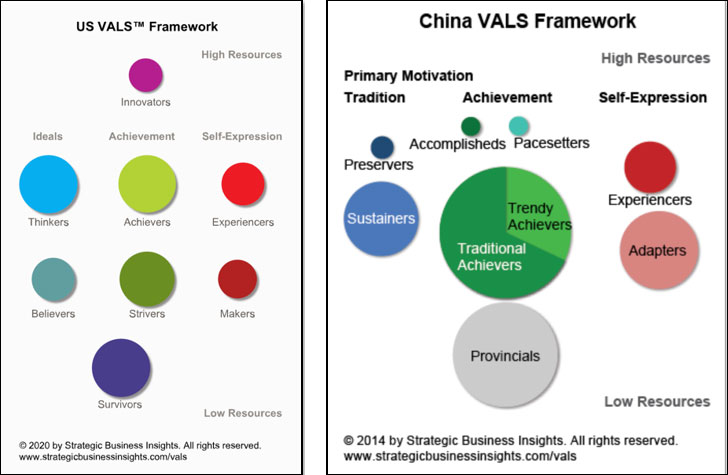
    • VALS (Values, Attitudes and Lifestyles)
      • Developed by SRI International, VALS divides consumers based on their primary motivations and resources.
      • It develops unique VALS systems for each country.
      • For example, the VLAS systems for the US and China differ widely.
    • PRIZM (Potential Rating Index by Zip Market)
      • PRIZM segments consumers into lifestyle types based on demographics, behaviours and geographic location
    • OCEAN utilises personality traits to predict consumer behaviour: openness, conscientiousness, extraversion, agreeableness and neuroticism

    The Myers-Briggs Type Indicator (MBTI), once very popular, is a psychographic framework that has recently been controversial.

    Kantar’s TGI is an audience profiling study that captures various data points—from product use to leisure activities to attitudes and media engagement. Since TGI has been present in India for decades, it offers a rich trove of data that can help develop an effective psychographic segmentation framework for India.

    Academic studies exist in the broad area of psychographic profiling of Indians, some of which can provide useful data sets or insights.

    It will take a decade or more to drive consensus and establish credibility for a Consumer Psychographic Segmentation Framework (CPSF) to become widely accepted and part of every essential marketing and media data set. If we start today, the marketing and advertising community will be in time to function optimally in an affluent and increasingly complex market called India.

    The use of CPSF will begin as early in the marketing process as product or service design and, of course, be central to marketing communication planning. A CPSF would also usefully inform social interventions and political campaigns.

    Developing a widely accepted psychographic segmentation framework is a vital R&D effort that ranks along with the attempt to create India-contextualised AI-driven martech and adtech. Let’s get on with it.

  • India Today Conclave is back with 21st edition

    The India Today Conclave is back, with its theme of ‘Brand Bharat: An Assertive Nation in an Uncertain World’. The 21st edition of the conclave is all set to “redefine India’s narrative” on March 15-16, 2024 in New Delhi.

    Notes a commuique: “The 21st edition of the India Today Conclave will host thought-provoking discussions, exploring how India, with its political stability and unique social vibrancy, can ascend to the forefront of geopolitics and business. The event promises concise yet impactful debate on India’s role in shaping the global landscape.”

    Speakers at the conclave include Prime Minister Narendra Modi, Home Minister Amit Shah, External Affairs Minister S Jaishankar, and Finance Minister Nirmala Sitharaman, Sadhguru – Founder Isha Foundation, Egyptian Comedian & TV Host Bassem Youssef, Member- Rajya Sabha G V L Narsimha Rao, MLA from Mizoram Baryl Vanneihsangi, Vice President RP Sanjiv Goenka Group Shashwat Goenka, Author & Historian Hindol Sengupta, among others. The line-up also features renowned figures from the entertainment industry, including Akshay Kumar, Tiger Shroff, Orhan Awatramani (Orry) and others.

  • Voltas launches campaign for new range of ACs

    Voltas launches new campaign brand for its latest range of air-conditioners. The campaign, created by Ogilvy India, with tagline ‘Shor Kam, Kaam Zyaada’ to capture the essence of the campaign.

    Commenting on the new campaign, Deba Ghoshal, Vice President & Head of Marketing, Voltas Limited said: “Yes he is back! Quietly and effortlessly like our new product offering. And this time, more witty, more sharper and more contemporary. Check out our teasers to get an idea of what is planned ahead for this summer. Voltas ACs have always been a popular and a leading choice among consumers, and over the past decade, Murthy has become synonymous with the brand. However, this time it’s all about being smart, yet silent – Shor Kam, Kaam Zyada!

    Added Ritu Sharda, Chief Creative Office, Ogilvy India (North): “Bringing back Moorthy felt natural – given the fact that Voltas and Moorthy have always clicked and Moorthy’s witty aura left a lasting impression last time around. With Summers approaching at warp speed and Moorthy’s chatterbox-like brother-in-law ready to turn up the heat, the campaign seemed like a perfect way to break the ice.”

  • Rajkummar Rao and Patralekhaa team up with Kenstar

    Kenstar air-coolers has roped in actors Rajkummar Rao and Patralekhaa for its latest summer campaign.

    Said Sunil Jain, CEO – Kenstar: “We are thrilled to welcome Rajkummar Rao and Patralekhaa as the face of Kenstar Coolers. Kenstar has always prided itself in being the leader in innovation in the coolers category, a value we share with Rajkummar in his ability to continually portray path breaking roles. With Technology, Performance and Style at its core, Kenstar is ready to beat summers with a magnificent lineup of coolers which is simply unmatched: A choice of 50+ coolers, ranging from 12L to 150L.”

    Added Neha Khullar, Head Of Marketing – Kenstar: “Rajkummar and Patralekhaa are just the perfect choice of brand ambassadors for us for our coolers. Rajkummar’s ability to deliver flawless performances, reinvent himself role after role, deliver at the box office consistently, and establish trust and honesty with his fans, aligns perfectly with our values of quality, style and durability. Having the star couple on board for our coolers is sure to prove a shot-in-the-arm for the brand, enabling Kenstar to build a stronger bond with our customers.”

  • Content Innovation: AI and Beyond

    Content Innovation: AI and Beyond

    Shailesh KapoorIt’s hard to have a business discussion these days without a mention of AI very early into the conversation. Since the emergence of ChatGPT, artificial intelligence has been a buzzword that everyone wants to use. And not for the wrong reasons entirely. In the digital age, the role technology can play in businesses across the spectrum, including media and entertainment, is undeniable. And we have not seen it all. Not just as yet, anyway.

    Innovation is at the heart of many businesses, often featuring in core values of many companies, including some of the most traditional, brick-and-mortar ones. Technology is at the center of this innovation, and AI is expected to lead the way towards innovative creation and transformation of businesses.

    But there’s an irony in this idea too. I asked ChatGPT to define innovation in a business context. I got: “Innovation in the context of business refers to the process of creating new ideas, products, services, processes, or business models that add value to customers, improve efficiency, drive growth, or create competitive advantage. It involves transforming creative ideas into tangible outcomes that meet market needs or solve existing problems in new and better ways”.

    If we look at the keywords in this suitably verbose definition, the creative abilities of the human mind seem central to many of them. The deep linkage of innovation with technology can, hence, be a limiting thought. Especially because it can make those in “innovator” roles think only in one way. Yes, that’s the irony, right there.

    Tech-led innovation is great, but it will be heartbreaking if innovation begins to lose the human touch. In technology companies, this is a non-issue, because the innovators are also the technology guys. But if we look at something like entertainment, innovators are essentially writers, producers, directors, actors, marketers, salespersons, etc. The nature of the product relies on giving the audiences something compelling yet fresh. Self-learning technologies could simply be at cross-purposes with this idea.

    Suggestions that Generative AI can be used to write movie scripts is preposterous, for example. Think of the three most memorable movie dialogue lines of all time, across any language, and ask yourself: Can a “human-like” bot create the same human-like magic? We all know the answer.

    It is therefore crucial that entertainment businesses carefully craft the dos and don’ts of how to use technology for innovation. Technology, and AI within it, can be a content creator and distributor’s best friend. But like with all friendships, expectations must be set right. And the entertainment business worldwide runs the risk of erring on the wrong side here.

  • Abby Awards adds new categories in 2024

    ABBY Awards powered by One Show in 2024 continues to stay connected with global festivals like The One Show, Cannes, and ADFEST by adding categories that are trending in the world.

    Introduction of Best Use of AI sub-category, keeping in mind the trending subject of the year, has been added in both Digital and Technology Verticals.

    Copywriting for web and digital craft has been added in Still Digital and Digital Verticals.

    With the growth in Health and Wellness communication, a new vertical called Health has been added this year with sub-categories like OTC Oral Medicines, OTC Products, Nutraceuticals among others. A new specialist agency award being introduced is Health Specialist of the Year for the best performance by a company in this vertical.

    Red Abby has introduced Sustainable Development and Meaningful Practices to cover Climate Action, and Responsible Consumption.

    Green Abby which covers planet conservation has added Life on Land to cover protection of forests and prevention of ecological destruction.

    Commenting on the new categories, Ajay Kakar, Chairman of the ABBY Awards powered by One Show 2024, said: “The world around us is changing by the day, and the Abby awards are at the forefront of reflecting these changes. And this year is no exception. Be it in or within categories like Digital, Mobile and Technology. Or the introduction of a Health category. Every year we start the Abby journey by first engaging with the industry stalwarts, informally, to listen to the changes, suggestions and asks. The changes in the categories that have been introduced this year are thanks to these rich engagements.”

    Dheeraj Sinha, Co-chair of ABBY Awards powered by One Show 2024, added: “Health is a growing business in communication and it is fitting to now have an entire vertical dedicated to it. Advertising with a purpose and a social message has now gathered steam and the Green Abby and Red Abby are adding sub-categories in Forest Conservation , Sustainable Development and Meaningful Practices.”