Category: NEWS

  • Zee5 celebrates 6th anniversary

    Zee5, the homegrown video streaming platform, and the OTT arm of Zee Entertainment Enterprises Ltd. (ZEEL), has completed six years of existence.

    Speaking on the occasion, Amit Goenka, President – Digital Businesses & Platforms, Zee Entertainment Enterprises Ltd. said: “Over the last six years, Zee5 has played a pivotal role in delivering accessibility and affordability to its consumers across the globe. As we cross yet another milestone in our journey, our aim is to further fortify the synergies between content and technology to build a robust consumer experience across connected devices. While we remain committed to offering immersive entertainment experiences to our consumers across our digital platforms, the parallel growth trajectory of the linear and digital ecosystem will enable us to further strengthen our capabilities. As the digital landscape matures steadily, and improved infrastructure further proliferates the ability for transactions on digital platforms, the opportunities remain endless. As pioneers in the industry, we will continue to maintain a strong focus on growth and innovation, simultaneously enabling a conducive environment for the industry at large.”

    Added Manish Kalra, Chief Business Officer, Zee5 India: “At Zee5, we envision to be the platform of choice for billions of viewers with real, relatable, and relevant stories in languages that resonate with them. Over the last few years, we have focused on improving user experience and launching multiple blockbuster movies and originals while using technological innovations to improve our platform experience significantly. 2023 has been eventful with many firsts and multiple successful projects strengthening our presence across markets with significant penetration in the tier III and IV cities. Tech adoptions across business touchpoints for increasing efficiency and enhancing in-app experience have been a priority. 2024 has already started on a strong note with the release of ‘Sam Bahadur’ and “The Kerala Story”. As the industry scales newer heights, Zee5’s unwavering commitment will remain centered around delighting our users with more focus on delivering quality content seamlessly.”

    Said Archana Anand, Chief Business Officer, Zee5 Global said: “From the initial idea of taking our South Asian content global, to growing out the business to become the No.1 South Asian streaming platform internationally, it has been a remarkable journey. Today, Zee5 Global stands as the premier destination for South Asian content, connecting the diaspora across the world with their language content. And as we continue to grow out our massive leadership in the US., our recent pivot to becoming an Aggregator of South Asian streaming platforms with the launch of Zee5 Add-ons, only further cements our position in the market as the singular largest hub for South Asian content. South Asian stories are finally claiming their well-deserved spotlight on the global arena, and we look to be at the forefront of this conversation, setting the stage for even more disruptive growth.”

  • The Morphing of Social Media & the Putative Rise of Conversation Marketing

    The Morphing of Social Media & the Putative Rise of Conversation Marketing

    Ashoke AgarrwalAt the dawn of the internet era and, a bit later, of the social media era, many sociologists believed they would lead to a more informed and enlightened world. The events at Tahrir Square, the subsequent Arab Spring, and later the Maidan revolt in Kyiv seemed, for a period, to support this contention. Marketing gurus posited the dawning of the age of interactive and one-to-one marketing, much like the bazaar of yore but on a global, post-modern scale.

    But then the medium took over the message.

    Marshall McLuhan, in his 1964 book, ‘Understanding Media: The Extensions of Man’, coined the phrase, “The medium is the message”, which went on to become a pop phrase that was widely quoted, right or wrongly, in a wide variety of contexts.

    Marshall’s theory posits that the form of the medium embeds itself in the message, creating a symbiotic relationship by which the medium influences how the message is perceived. A corollary of Marshall’s theory was that a dominant medium would influence societal norms, politics and personal identities.

    By 1964, TV was the dominant medium in the US and most of the developed world. In its days, TV as a medium was supposed to build a sense of collective experience and this community. Instead, it promoted a culture of consumerism and passive consumption. Advertising, of course, gorged on this medium that was so much in synergy with its objectives.

    Sidney Lumet’s 1976 movie ‘Network’ is a trenchant yet entertaining critique of the Age of TV and its social impact.

    When the age of social media dawned with Facebook and Twitter, the initial hope was that the medium would redefine interaction and create a participatory culture. Instead, it became another gatekeeper medium controlled by shadowy algorithms that created echo chambers promoting tribalism across many dimensions while delivering audiences to advertisers. The fact that it could provide a more narrowly targeted audience to advertisers than could TV resulted not in a more informed consumer but in an increased ability of brands to insinuate into the social and consumption profile of the consumer. Also, more brands could get into the act as social media lowered the threshold level at which advertising budgets were effective.

    Going by the ultimate societal effect of the TV and social media eras, another corollary to McLuhan’s theory can be posited: that the societal impact of a dominant medium settles into the lowest common denominator in human nature!

    With the rise of TikTok, social media is morphing, creating and strengthening a new medium.

    Initially, social media sites like Facebook showed chronological updates from users’ friends and contacts. As the volume of posts grew, the networks employed algorithms to prioritise posts that had proved popular among the user’s friends.

    TikTok changed that. As a recent article in The Economist notes, “TikTok decided that, rather than guessing what people liked based on their “social graph” – that is, what their family and friends liked – it would use their “interest graph”, which it inferred from the videos they and people like them lingered on. And rather than show content created by people they followed, it would serve up anything it thought they might like.”

    TikTok’s growing popularity forced every other big platform to follow suit – Reels on Facebook and Instagram, Watch on Pinterest, Spotlight on Snapchat, and Shorts on YouTube.

    The result is that social media is morphing away from an interactive medium into a video-first, highly curated engagement platform. In that sense, social media is on its way to becoming a TV-like medium. Thus, marketers and advertisers are beginning to adopt a grammar akin to their TV campaigns for their social media campaigns.

    While social media platforms become places for passive consumption, users move their conversations and arguments off the open networks and into closed private groups like WhatsApp and Telegram, with implications for the business of political campaigns and the news media. Political parties like the BJP have made WhatsApp groups a key pillar of their campaign strategy. As social media platforms have moved away from highlighting news stories in their feeds, news media are increasingly trying to create channels on instant messaging platforms like WhatsApp and Telegram.

    Currently, in India, the tendency is to use it as a mass promotional channel, sending messages to an undifferentiated mass of “mobile” numbers.

    Marketers need to recognise that the platform offers two unique opportunities:
    1) it allows for a convenient one-on-one interactive platform and
    2) it allows a brand to create, communicate and enthuse a “fan group”.

    WhatsApp marketing can become the communication edge of a whole-of-marketing Big Data and data analytics-driven approach. I call this Conversation Marketing. Data collected from retail outlets, e-commerce platforms, loyalty cards, and first-party data can enrich conversations with consumers and groups. Conversation Marketing allows marketers to open a genuinely interactive, one-to-one channel with consumers. Whether this turns out to be a chimaera as from the early days of social media depends on how both the owners of the messaging platforms as they move to monetise them as well as the campaign strategies of brands.

  • MSL India appoints Pallavi Bahuguna as Senior VP and Head North operations

    MSL, Publicis Groupe’s strategic communications and engagement firm, has appointed Pallavi Bahuguna as Senior Vice President and Head of MSL’s North operations.

    Said Amit Misra, CEO, MSL India, South Asia: “We are thrilled to have Pallavi onboard. With her outstanding credentials and multifaceted communication expertise, I am confident of her leadership skills. We understand our clients’ growing need for omni- and multi-channel communication and reputation management services, as well our internal need to consistently nurture the next line of leaders, and this strategic appointment will bridge both needs.”

  • Adani Wilmar appoints Jignesh Shah as the Head – Media and Digital Marketing

    Jignesh Shah
    Jignesh Shah

    Adani Wilmar, the Food and FMCG company, has appointed Jignesh Shah as its new Head – Media and Digital Marketing.

    Notes a communique: “In his capacity as Brand Custodian for Fortune, Shah will ensure its relevance and resonance in the dynamic FMCG landscape, leveraging his extensive marketing prowess and strategic insight.”

  • Ranjona Banerji: Life has always been cheap in India…

    Ranjona BanerjiA couple of years ago, Prime Minister Narendra Modi surveyed the Pragati Maidan tunnel in the national capital, as it was being completed. This inspection meant that he was driven along in an open vehicle festooned with flowers as he, umm, “inspected”.

    Soon after, he inaugurated the tunnel and declared it was the Centre’s “big gift” to the nation.

    Today, the Public Works Department has declared that the tunnel is dangerous, unfit for us, full of cracks and seepage.

    The cost of this gift that we the people of India have paid for? About Rs 1000 crore, give or take.

    This is not the first disaster involving some “gift” from the Prime Minister. But it is the latest, and I’m using it as an example.

    Obviously, the media cannot ignore this event, especially since the PWD has squarely blamed the construction company, Larsen & Toubro.

    And thus, the canny media has sidestepped Modi’s role in gifting us a substandard, unusable, dangerous tunnel and presented this disaster as a fight between a government agency and a construction company. Which incidentally, is one of India’s most trustworthy.

    https://www.ndtv.com/delhi-news/delhis-pragati-maidan-tunnel-beyond-repair-major-overhaul-needed-report-5018203

    It is impossible for the mainstream media to now link the tunnel’s collapse to the BJP government, although it had no qualms about blandly reporting on Modi’s comment that the tunnel was a “gift”, and they happily added to his propaganda machine by publicizing his photoshoots riding up and down the tunnel on a fake inspection run. He gets the credit, someone else gets the blame.

    As we approach a crucial general election, the mainstream media has once more surrendered the right to show truth to power and opted again to be one more arm of the BJP’s public relations wing.

    This guarantees that an unmindful public, brainwashed by religion and violence and stories of future greatness, will ask as few questions of the BJP and the Central government as possible.

    This strategy of the media makes it very convenient for the BJP and Modi – or have I got the order wrong? – to carry on with its divisive policies, which encourage sectarianism and promote Hindu supremacy at all costs.

    A Hindutva “scholar” – an oxymoron if there ever was one – writes in The Indian Express, the beacon of “journalism of courage”, that “caste is a western construct”. Nonsense like this justifies caste discrimination in the minds of upper caste “educated” Hindu supremacists. That’s using media as a propaganda arm, at one level.

    At the same time, we have this piece of new, not really mainstream, about an Adivasi tea worker dying of starvation in North Bengal because of glitches in the Aadhaar system. This is because this government keeps changes its mind about Aadhaar – a bad system anyway – and the bureaucracy does not care and does not keep up.

    Life has always been cheap in India, especially the lives of the poor and the marginalized. Incompetence is now a given, with the Centre setting the standard.

    https://www.downtoearth.org.in/news/governance/unable-to-get-food-adivasi-tea-worker-in-north-bengal-estate-dies-of-starvation-94331

    The Prime Minister in a garbled speech in Parliament – the mainstream media will not tell you this, but it is troublesome – claimed that the Opposition is trying to create a “North-South” divide. This is a bit rich, from a Central government which consistently tries to impose Northern customs and languages on other parts of India, is looking at a delimitation exercise which will badly affect the more prosperous South and which does not give the Southern states their due of Central grants and taxation shares.

    This analysis by P Thiaga Rajan, finance minister of Tamil Nadu, explains cogently and clearly just how it is not possible for the Centre to claim that Uttar Pradesh is doing better than Tamil Nadu (only a BJP fool would believe that UP is superior anyway).

    https://frontline.thehindu.com/economy/uttar-pradesh-economy-comparison-with-tamil-nadu-south-india/article67821390.ece

    Now we reach Uttarakhand. The latest BJP laboratory for sectarian division and creating Hindu-Muslim tension and violence. The state just passed a suspect and unconstitutional Uniform Civil Code bill.

    https://www.livemint.com/politics/news/uttarakhand-assembly-passes-ucc-bill-becomes-indias-first-state-to-implement-uniform-civil-code-11707310389777.html

    And the state has carried on with its anti-Muslim crusade, this time by attacking Masjids, Madarsas and Mazars. Haldwani has seen violence and death. This is not normal in Uttarakhand and nor should it be acceptable. The link below says two dead, current figures say at least six.

    https://indianexpress.com/article/india/haldwani-uttarakhand-violence-demolitions-live-updates-9152347/

    The tragedy for those who follow the media and its commentators, is that they will be fed analysis of the BJP’s electoral prowess and the Opposition’s weakness. This clever juxtaposition by liberal and fence-sitting journalists crafts democracy as a largely electoral exercise, while ignoring the ground realities.

    It is important, therefore, to remember a flower-festooned prime minister gifting an unusable tunnel to the nation which has literally thrown almost Rs1000 crore down the drain. And the juxtapose that image with people who die from starvation and state-sponsored violence.

    Ranjona Banerji is a senior journalist and commentator. She writes on MxMIndia on Tuesdays and Fridays. Her views here are personal.

  • Television in 2024: A Story of Two Half-Years

    Television in 2024: A Story of Two Half-Years

    Shailesh KapoorIt’s that time of the year, when the General Elections are round the corner. While the dates are not out yet, we may be less than 75 days away from the first round of polling. Even if the outcome seems somewhat like a foregone conclusion, the next three-four months will be full of political and media frenzy.

    One of the direct impacts will be felt on the IPL. The dates have not been announced yet, pending the announcement of election dates. In the past, IPL has moved to outside India during the election years. But it is unlikely to be the case this year, and that could complicate the international cricketing calendar more than just a wee bit.

    It’s a golden period for news channels, who are having a windfall year, which started with the mega Ram Mandir event, before the elections programming takes over. June will feature theT20 World Cup in US and West Indies, a summer bonanza for news media, despite the odd match timings.

    Going by how things have been, there isn’t much new one can expect from our news channels in the coverage of these elections. Innovation in Indian elections coverage came to a standstill about a decade-and-a-half ago, and since then, news channels have focused on speed rather than engagement as the primary target, creating a sense of sameness across platforms, as they battle each other to be first to report new information. Legacy brands like Aaj Tak will continue to hold the advantage, when the content across platforms is differentiated per se.

    Neutrality is, of course, a thing of the past, and not even on the table right now. And a potentially one-sided contest allows news channels to legitimise their bias, as the “voice of the nation”, even if the idea is in direct conflict with core tenets of good journalism.

    It will be more exciting to see how digital news brands manage to cover elections. They do not have the luxury of big budgets that the TV channels have, but seem to have more intent to drive innovation and engagement, which can lead to a few compelling shows.

    Television seems to have become a medium where events, whose existence is outside the television ecosystem (politics, sports, etc.) are driving the buzz, even as content native to the medium (GECs, movies, etc.) remain inert and unexciting.

    The first half of 2024 will do well for television. But it’s from July that the real challenge will begin, of being able to sustain interest in the medium, and the revenue it earns, when the big-ticket events are all over. I’m afraid that we may soon be entering the trickiest phase of Indian television in July this year. More on it when we get there.

  • Narayana Health unveils brand film

    Narayana Health has released a brand film that emphasises its commitment to an integrated approach to cancer.

    Commenting on the brand film, Dr Ashish Bajaj, Chief Marketing Officer of Narayana Health, said: “Through this film, we celebrate those exceptional individuals who consistently go the extra mile in their everyday lives. At Narayana Health, empathy is not a choice; it is an integral part of our DNA and forms the essence of our caregiving philosophy. Every member of our team, including our dedicated doctors, nurses, technicians & support staff exemplifies the power of care in both their personal and professional lives. Through these small gestures, we make a big impact on the journey of healing and hope for our patients. This film is a tribute to the genuine care that defines us and strengthens our mission to make a difference in every life we touch.”

  • Sania Mirza features in Samsonite ad


    View this post on Instagram


    A post shared by Sania Mirza (@mirzasaniar)

    Samsonite, the luggage manufacturer, has rolled out a campaign showcasing a century-long legacy of excellence.  As part of the ‘Tested Like Samsonite’ campaign, the video features tennis star Sania Mirza.

    Said Anushree Tainwala, Executive Director – Marketing: “Samsonite products are not just luggage; they are a testament to our commitment to quality and durability. ‘Tested Like Samsonite’ is a celebration of resilience and quality. Our carefully crafted marketing campaign captures the very essence of the Samsonite – resilience and perseverance. This campaign highlights our strong commitment to excellence. Our ultimate goal is to ignite inspiration in our audience by showcasing the enduring spirit of each Samson creation.”

  • Curativity unveils new leadership team

    Aarti Srinivasan
    Aarti Srinivasan
    Neha M Dhanani
    Neha M Dhanani

    The marketing services agency set up by former Lowe Lintas group captains Amer Jaleel and Virat Tandon, Curativity Brand Partners has appointed Aarti Srinivasan as Head of Creative and Neha M Dhanani as Head of Business.

    Said Tandon: “Aarti’s creative brilliance and Neha’s dynamic experience make them invaluable additions to our leadership team. In them we have found the leaders who are both capable and hungry to build a future facing marketing services agency. With so many brands vying for the consumers’ attention across multiple media, the traditional methods of brand building are not working. What brands need is an “Ownable Distinctiveness” that can be delivered through various touch points. We are confident that with our model of access to the best of the independent talent, Aarti and Neha will foster a new culture of collaboration in the service of delivering to the promise of distinctive brand work that’s ownable.”

  • Ranjona Banerji: Screaming Media goes quiet on Electoral Bonds

    Ranjona BanerjiThe Supreme Court’s judgment striking down electoral bonds as unconstitutional has led to…


    What do you want me to say?


    Because as far as the bulk of the Screaming Media is concerned, well… it’s not silence but it just as well could be.


    So we have some plain bread and butter reporting: the court said this, the government said that, the petitioner said the other thing. There’s a little welcome history about the scheme: what it wanted to achieve, what its provisions said and such.


    There is not quite as much on the Centre’s submission to the court that citizens do not have the right to know.


    What can our captive media say about this?


    They have capitalized on this notion for the past 10 maybe more years. The citizen does not have the right to know anything that significantly impacts her. Rather, the citizen must be fed a constant diet of hatred against some communities and ideologies and at the same time a non-stop glorification of one particular person and perhaps a few others.


    Here’s a look at TV channel websites between 10.30 and 11 this morning.


    The Times Now website had the news of the Supreme Court striking down the electoral bond scheme as unconstitutional low down on the list (farmers, crimes, a Bharat bandh possibility, and plenty of Bollywood stuff dominated the headlines). The focus of the coverage was not on the court judgment, but rather on how much money each party got from electoral bond funding.


    News18’s opening page had nothing on the Supreme Court judgment. A distressing case of sexual assault allegations against a Trinamool functionary in Bengal, the farmers and how they were wrong and greedy, and Bollywood news were displayed prominently.


    The India Today website led with the farmers, the role of Qatar as a global negotiator, cricket and crime. There was however a link to electoral bonds, which provided bog standard reporting on the subject.


    NDTV’s landing page was very similar to India Today’s, except there was nothing on the Supreme Court judgment.


    This gives one a clear idea that the judgment has upset the Central government to such an extent that it has not formulated a proper response for its captive media channels and nor for its Rs 2 trolls, who were every quiet on social media yesterday. I did not get even one tweet asking me to “deal with it aunty” or “keep quiet” or the usual threats of bodily harm, although the older I get the more those have reduced.


    The only responses were from popular outliers. A YouTube video maker who shills for the BJP, about how political parties other than the BJP have also received electoral funding from the bond scheme. And interestingly, both a former journalist and a former corporate honcho argued that secrecy was important because of possible vindictiveness of political parties. It was unclear why two loud BJP and Modi supporters would latch solely on to the vindictiveness angle when the BJP has been in power for so long.


    For the general public, a 223-page judgment is laborious reading. These a few links from digital and print news sites which aid comprehension:


    https://www.moneycontrol.com/news/business/mc-explainer-electoral-bonds-demystified-conditions-benefits-validity-and-more-12277871.html


    https://www.livelaw.in/top-stories/supreme-court-electoral-bonds-1scheme-249553


    https://timesofindia.indiatimes.com/india/why-supreme-court-struck-down-electoral-bonds-scheme/articleshow/107710972.cms


    I will repeat here what I say all too often. This is a landmark judgment. An important government scheme has been knocked down by a five-judge bench of the Supreme Court of India as unconstitutional. Whatever your politics, it is the most important news of the day, week, month. The media would be going to town on this, if it hadn’t picked a side and surrendered its basic right of showing truth to power.


    It is surprising to many that the Supreme Court has batted for the citizen of India and her right to know.


    Sadly, it is not surprising to anyone that the bulk of the Indian mainstream media has chosen to suppress this news.


    Ranjona Banerji is a senior journalist and commentator. She writes on MxMIndia on Tuesdays and Fridays. Her views here are personal.

  • Aggregator apps- One step forward? Nah!Definitely two steps backwards

    Aggregator apps- One step forward? Nah!Definitely two steps backwards

    Vikas MehtaWith apologies to none at all


    I am an ancient relic. When I started working, forget email or computers even faxes were a rarity and corporates had STD phones (no, not the disease-inducing ones but the ones which enabled long-distance calls), which were always under lock and key lest they were misused. Telexes were the most often used mode of communication.


    In three decades, the evolution of technology in workplaces and for an individual has been astounding. And the last one decade has seen the emergence of new type of companies, brands and technology.


    But what stood out were the aggregator companies. These companies used technologies to aggregate various goods and services to be available at your fingertip and one could access it through the smartphones. Mobility, hospitality, food delivery, grocery delivery, in fact any type of delivery are all assembled under one platform. Now one did not have to go to a taxi stand or a travel agent or a market but the aggregators put everything together under one roof and it was all available at your doorstep.


    Personally, I revelled in the emergence of Ola and Uber, Swiggy and Zomato, Amazon and Flipkart, Make My trip and Oyo, sorry strike out Oyo. But I did enjoy the offerings of these aggregators. Planning a trip at a short notice, intra-city travel, ordering food, all became child’s play. And also, one experimented, tried new travel routes, destinations, hotels and of course food. Initial hiccups were accepted with a pinch of salt and improvements were always expected to be round the corner. But, when the novelty disappeared, the frustrations mounted. Improvements were far and few. Same problems were being encountered and overall standards of these new kids on the block was shockingly abysmal. On my travel two weeks ago, I used most of these aggregator apps and following is my review of these.


    I will start with Oyo. Inspite of persistent advice from my well-wishers, not to touch Oyo with a bargepole. I decided to try it out again, after a gap of maybe 6-7 years. Earlier, I have had mixed experience with Oyo and at least twice I was pleasantly surprised with their offerings in Gurugram. So, this time when I had some work in Delhi, in an area where Oyo seemed to be the only option available, I had to clock in by 8:30 am and I did want to stay, preferably, walking distance away, so I opened my Oyo app.


    I had about 6-7 Oyo options available in a kilometre radius and most were pretty cheap. The photographs were decent and approval ratings hovered between 3-3.5. I took the plunge. I even prepaid as the amount was not big. Big mistake, as I learnt later. One day before the trip I get an automated call saying there is a problem at the Oyo I have chosen. So, I was given an option to cancel or get my booking transferred to another Oyo. No mention of which. I just disconnected, worried about what to do next.


    After 15-20 minutes, a customer service executive called. Like a rote she repeated the automated message. When I ask her about the option she mentioned some hotel 500 metres away from this one. I was tempted to change but I asked her about the charges of this place and will it be adjusted against my payment? Oh, for that I need to call the helpline, she said. And she volunteered the number. Irritated, I ask her why should I call? You are changing my booking so please first tell me the rate and refund/ adjustment status, I retort. Sorry, sir. She replied without any hesitation, I do not have access to that information. You just tell me if I need to cancel or transfer your booking. By this time, I had lost my patience so I asked her to cancel my booking.


    I go back to my app and I find a message that my refund has been initiated. Emboldened, I look for alternatives and this time choose a Oyo Townhouse. Supposed to be a Oyo-owned property. So must be good. I book it and pay up. In the meantime, I got a message that my full money has been refunded. Since it was a UPI payment, I got it back the same way. I felt relieved and happy.


    Next day, I land up in the area and I find at least 4-5 Oyos exactly in the same place where my townhouse is supposed to be. In adjacent buildings. I trudge up one of those. The receptionist looks at my app, scrolls up and down, calls someone else who repeats the process and then tells me that ‘aapka Oyo’ is two buildings away. Off, I go again. Find my Oyo. Am checked in a jiffy and someone escorts me to my room. On the way up I see two young couples coming down. No bags. Nothing on them. They just handover the key to the guy accompanying me and say, check out. And leave.


    I entered the room. It was basic. Paint peeling off. The bathroom looked okay at a glance. The room had no towel or soap. On asking I was given a towel and two small bottles of body wash. I suddenly realised that I have not been given any room key. My escorter, searched the room for a lock and then saunters out saying I will get one.


    Ten minutes later, I was down, wanting to go out and I asked for my room key. The guy looked around and then asked me to wait. He was busy taking photocopies of Aadhar cards of another bagless couple. Another gent sauntered in and asks if his room was ready. He had been told to come back in 15 minutes and it was now 30 minutes. He was told to go upstairs and check it himself. He gulped. I rolled my eyes and realised that I have made a mistake. I ask for room key again and am told not to worry as CCTV cameras are everywhere.


    At this stage, I told them I want to check out and did some namedropping. Suddenly, a suitcase lock emerges and I am asked to please not cause a problem. I lock my room and leave. I returned late around 9 pm and found that my toilet was very dirty. The cold and my tiredness precluded me from checking out but I was clear: I will check out first thing in the morning.


    I was tired and late because of my experience with Ola, the second aggregator I tried. I booked an Ola to come back at around 6:30 pm and first, my ride was cancelled. Finally, another driver turned up. As I settled down amidst the Gurugram traffic rush, my driver told me that he will take a shorter route, it’s on the map but road is not good. Positive is that it will save 15 minutes. This was what his app told him. I agreed. Another mistake. The road was not all that bad, but the route was through narrow lanes and bazars and we ended up lost. At that stage, I put the map on my phone on and started directing the driver. On my app I was getting a message to rate my trip and the driver was getting messages to pick up another passenger! It was total breakdown. Chaos. Imagine if the passenger was a female.


    Technically, I should have not paid the driver as my trip was over and rating was being asked for. But I paid him in cash when he dropped me, not at my destination but a kilometre away. Oh, did I tell you? Ola now gives the option of paying online before your trip is over. Else you have to pay the driver in cash. And sometimes one pays, one gets a payment done message and 5 minutes later Ola sends a message that the transaction failed. If the money has been debited from your account please call Ola helpline. The onus is on the customer, not Ola!


    Two apps down, next morning I open Make My Trip. The first surprise was that when I broadened my search to a 3-4 km radius the majority of the hotels being shown were still Oyo. This time, I researched properly. I shortlisted 3-4 options. I did not even look at the cheap ones, I read at least 5-6 reviews, read the AI generated review summary and finally picked one hotel 3.5 km away from my meeting point. I must confess, the MMT app seemed easier to navigate, its reviews seemed balanced and it had more parameters like quality of food, closeness to metro station etc.


    And the place I chose, was good. The experience was as promised by the app. So, a thumbs up to MMT.


    But, and there is always a but. After I paid, I was sent an offer. I could buy through Swiggy and get a discount. It was very tempting. But the fine print said that the offer was valid only for some NCR restaurants. Here I am booked near Saket. So why would you send me offers for NCR? I know Swiggy can deliver from there. But the delivery time could be more than an hour and the delivery charges will be higher.


    So, is this how Swiggy or MMT use their data? They know I am in Saket so why can’t they give me an offer from nearby? I guess all this hype about using data to do targeting is an overblown proposition? Is it?


    On the positive side after abandoning Ola, I took up Blu. It was a very good experience. I prebooked cabs twice. Both times the cabs were on time. They were electric cabs so environment friendly. The drivers drove safely and were polite to a fault. The app was very user friendly. It seemed a huge improvement on Ola.


    But overall, I was really disappointed. It seems the new age product offerings have actually deteriorated, rather than improving. Oyo is really pits and I guess all these stories about being used mostly by unmarried couples for two hours is true. Is that its business model now? Ola seems to have lost focus completely. My trip was shown as finished without any payment or actually being finished. The driver was lost. And a one hour trip as predicted at the start ended in a two hour trip? And I do hear some pathetic stories about Ola electric scooters too. Quality, service. Is this an Ola trademark now?


    These could be exceptions but it shows major flaws in the product. If after 10 year these brands have gone from bad to worse and not improved, then they fail the first test of marketing. Bad product.


    And the worst part is that after I abandoned Oyo after one night, even though I had a three-night booking, even though my Ola trip had gone horribly wrong, there was no follow-up. No calls. No feedback mechanism. Both of them asked me to rate them. I gave the worst rating and then there was silence. Don’t they follow up if the rating is 1. Or maybe they cannot, as the number of ratings with least score is way too many. And therein lies a tale.


    Vikas Mehta is a senor business strategy consultant and educator based in Dehradun. He writes on MxMIndia every other Monday. His views here are personal.

  • Swiggy Instamart launches new OOH campaign

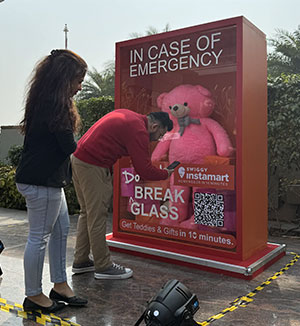
    Swiggy Instamart has launched a new OOH campaign to promote the concept of eleventh-hour gifting. The campaign is conceptualised and executed by Havas Media Tribes.

    To gain maximum visibility and engage consumers in a memorable way, these installations were strategically placed at Worldmark 2, Gurugram and the Bandstand at Bandra, Mumbai.

    Talking about the innovation, Aparna Giridhar, VP – Marketing, Swiggy, said: “During such occasions, the challenge is to consistently distinguish ourselves with a disruptive concept and push the boundaries. With this Valentine’s Day campaign, we marked a paradigm shift in how we approach festive marketing.  Swiggy and Havas Media Tribes team worked in close collaboration in identifying and precisely tapping into customer sentiments, making this campaign a success.”

    Added Uday Mohan, Managing Director, Havas Media India: “As we strategically placed these interactive installations in high-traffic areas, Swiggy Instamart’s Valentine’s Day campaign redefined moment marketing. We seized this opportunity to captivate audiences by offering a distinctive fusion of convenience and romance, thereby reaffirming the brand’s dedication to customer satisfaction.”