Category: MxM JOURNALISM REVIEW

  • Of 25-year-old TV journos and their half-baked ideas

    Ranjona Banerji


    This week was a roller coaster as far as news was concerned. It started with the continuing aftermath of the Anna Hazare-led anti-corruption movement, with members of what has so trendily been named Team Anna felt they were being targeted by the government  for saying nasty things about MPs, for being exposed in a sting operation and for not paying their income tax.

    But soon Amar Singh, discredited and beleaguered, had his moment in the sun as he was hoisted off to join his political friends in Tihar jail for his role in the cash-for-votes scam where BJP MPs walked into Parliament waving bundles of money, claiming they had been bribed by the UPA. But one more horrific bomb blast on Wednesday morning, this time outside the Delhi High Court, meant that TV attention moved away from Singh. TV attention is a bit like the eye of Sauron in Lord of the Rings. While it is on you, you burn under its gaze but when it goes away, you can scurry into Mordor and do what you want. It may be advisable for Indian TV news channels to get eyes like a housefly instead which looks everywhere.

    Since the Delhi police and India’s one zillion other investigating agencies had no clue about who was behind the blasts, TV reporters have to be commended for coming up with their own theories within 10 minutes. Why waste time reporting on the events when you can hold forth like an expert, pretending that you know what you are talking about? After all, no one in your studio is going to stop you, question you or, shock, horror, cut you off.

    I realize that youth must be worshipped in India today but there is something disconcerting about inexperienced 25-year-olds running around with mikes and cameras, bombarding us with their half-baked ideas. (My advice for young journalists: spend the first five years with your mouth shut, learning! Radical, eh?)

    It would perhaps be more sensible if TV news channels in India tried to first report and then speculate. It seems incredible that that they go back to the same experts over and again in spite of no one having any clue about who has actually done what. One would have thought that the embarrassment of every expert blaming some Islamic group of the other for the Norway attacks would have been lesson enough, but clearly, no. The evening shows with the star anchors were full of former police commissioners and general celebrity experts holding forth. The amount of hot air released in TV studios could be used as a form of renewable energy once fossil fuels disappear.

    Most language news channels switched from their normal combination of astrology and Bollywood to cover the blasts but some like Sahara Mumbai were happy with their comedy corner. The ticker at the bottom kept us informed of events. Guess you have to keep laughing, no matter what.

    Business news channels are rarely if ever distracted from the stock markets and sometimes even major global monetary policy changes in which politics is involved, pass them by.

    International channels airing in India like Al Jazeera, BBC World and CNN are all gearing up to the 10th anniversary of the September 9 attacks on the USA. The rest of the while they keep us informed about what’s happening in Syria, Sudan and such like places that are too far away for Indian news channels to acknowledge.

    **

    The newspapers had it easier. Early in the week, they focused of course on Amar Singh’s arrest and his fall from grace. The Telegraph, Calcutta (it does not use Kolkata) also talked about him being a Calcutta boy. The prime minister’s trip to Bangladesh also got space, with fans and detractors of West Bengal chief minister Mamata Banerjee and her refusal to agree to the water-sharing agreements with Bangladesh having their say. The boxing bout between Mayawati and Julian Assange also front-paged, including with the Hindu which of course printed the Wikileaks revelations in India.

    The Reserve Bank of India asking banks to allow borrowers to pay back floating home loans without penalty got second billing in Mumbai, perhaps understandably. The Hindustan Times called the BJP to task over protection to the Reddy brothers in Karnataka in a hard-hitting editorial.

    The Times of India did an analysis of three versions of the Lokpal bill on its edit page and seemed to agree the most with Aruna Roy and the NCPRI’s version. This is a break surely from Times Now’s vociferous championing of Anna Hazare’s version and no other.

    Mid-Day launched its new look on Tuesday, with bolder lines, less clutter and better use of pictures. It also reintroduced its edit page.

    By Thursday, the bomb blasts were everywhere with legitimate rage over the fact that the authorities neither had improved intelligence nor security measures in place. It is easier to read these arguments than to decipher what several guests shouting at the same time are trying to say.

    By Friday, Praful Patel’s defence of a CAC report slamming the merger of Air India and Indian Airlines and the acquisition of several aircraft took the headlines. The probe into the Delhi blasts is veering between Harkat-e-Jihad-al Islami and Indian Mujahideen, both of whom have claimed they did it.

    The Times of India chose not to front-page LK Advani’s announcement of an anti-corruption yatra and his impassioned speech in Parliament, while Hindustan Times made it the second lead, focusing on the fact that Advani took his own party by surprise. The gist of the newspaper angle seems to be one more political drama, while TV milked what they could from it before moving on.

    The brewing revolt in the tennis world between the top players and the International Tennis Federation over rain problems at the US Open also got play.

    International media is mainly looking at the tenth anniversary of 9/11, stories of victims and heroes and some new chilling tapes of voices from one of the planes which crashed into the World Trade Centre. Irfan Husain in The Dawn has an excellent piece debunking all the 9/11 conspiracy theories. A threat to New York on the anniversary is being taken seriously, making ample effort not to spread panic.

    It seems likely that 9/11 will dominate over the weekend although it will be interesting to see if the BJP is taken seriously in this new effort to regain political centrestage.

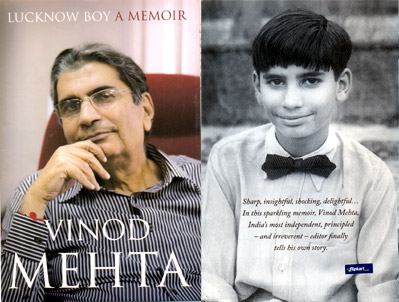
  • Book Review: Lucknow Boy is a fluent, easy & juicy read

    By Ranjona Banerji


    If you want a fluent, easy and juicy read there’s nothing quite like hunkering down over a weekend with Vinod Mehta’s Lucknow Boy – especially of course for a media person. Yet, thanks to the letters page on Outlook, where so many readers seem to know him so well, one suspects that anyone interested in the news or the way the media runs will want to pick this one up.

    The story starts at the beginning with a solidly middle class upbringing in quieter, gentler times in charming and civilised Lucknow, which Mehta describes movingly but not in a maudlin manner. All those Outlook readers who fume at Mehta’s secularism can blame his childhood and this rather inclusive town in which he lived – as he himself does. Not quite sure what he was going to do with his life – apart from being a table tennis champion – a young Mehta landed up in England looking for opportunities and it must be said, girls. The swinging sixties provided the latter in plentiful apparently and also a variety of odd jobs. Mehta returned to India still with little clue about what he wanted to do and then headed for Bombay and advertising.

    From here it was a few skips and jumps to becoming the editor of Debonair which some might remember as India’s first “girlie” magazine. Mehta is one of a small but significant breed which started a career in journalism as an editor, without doing the slog. Those who are old enough (waaaaah!) will remember that in spite of the uncomfortable semi-nudes, Debonair had some good reading matter, using the Playboy model.

    The next episode in Mehta’s life led to his becoming a legend – starting and editing two classy newspapers from scratch (Sunday Observer and Independent) and recasting one (Indian Post) and resurrecting another (Pioneer). All four were well-planned, classy, stylish and paid attention to good writing. There are and must be a variety of views on them and not all of them positive but there is no doubt that they shook the establishment and frightened the fuddy-duddies.

    Not all were successes and Mehta himself suffered for decisions taken or managements changing tack. It is here that he is at his most acerbic about his fellow journalists and editors. The debacle at Indian Post where owner Vijaypat Singhania could not withstand political pressure was followed by another at The Independent. Mehta quit this paper a month after it launched when a huge scandal broke out over a story which said that YB Chavan was an American mole.

    Mehta describes all these quite candidly. The animosity he mentions shown by Times of India staffers to The Independent was quite amusing for those of us who were outside both: where the nose-in-the-air ‘we are Times journos and no one can touch us’ battled against the ‘we are the intellectually and stylishly superior’ Independent brigade. To be honest, both sides were a bit full of themselves!

    Mehta doesn’t hold his punches when it comes to Dileep Padgaonkar, who was editor of Times at the time and later with Lalit Mohan Thapar, owner of Pioneer. The end of his one month at the Independent also led to his shifting to Delhi and then to The Pioneer. The creation of Outlook follows a low period in his life and from here on, the way is up which is where the story pretty much ends.

    Lucknow Boy is a good nostalgia trip for those who are familiar with the place and time and will remember names and incidents. It is also a good lesson for those starting in the profession.

    Mehta also adds his views on people he has known and who have influenced him (yes, Sonia Gandhi is in one section and Editor the dog in the other) as well as tips to budding journalists. Expectedly, there is both humour and insight here.

    I have to thank Mehta for the huge space he has given to my old friend, the late designer MG Moinuddin whom he met at Debonair. Moin was indeed a massive talent and we were colleagues for many of the years that he moonlighted for Mehta’s various papers.

    In this very compelling read, there are some negatives, primarily when we reach the Outlook story. It gets a bit tedious and self-congratulatory – perhaps acceptable but still mildly annoying: all publications after all can come up with lists of some good story or the other it has done. However the sections on the letters to the editor, full of communal rants, as well as the fights between Ramchandra Guha and William Dalrymple are amusing.

    Although Mehta writes about the Radia tapes, where Outlook played a sterling role, I would have expected also some more stringent comment on the fallout as far as journalism is concerned. Mehta discusses Vir Sanghvi’s decision to step back from journalism but lets Barkha Dutt off the hook.

    There is one error which I have to point out because I take it personally. Mehta mentions that Bombay magazine wrote an item after the launch of Outlook. As one of the last employees of that wonderful magazine I can very confidently state that since it closed down in early 1991, there was no possibility of it having commented on Outlook’s launch in 1995!

    Also I must admit that I do not know Mr Mehta – I have met him fleetingly a couple of times so it is unlikely that he will remember. But this was undoubtedly one of the most enjoyable books I have read in recent times. Personal anecdotes and revelations are sparse but they are illuminating and even endearing. Every autobiography is entitled to its one-sided-ness and its quirks and that of course is why we read them


    Lucknow Boy by Vinod Mehta, Penguin Viking, hard cover, 325 pages, printed price Rs 499.

    Flipkart price: Rs 349.

  • Times for news media to report on each other

    By Ranjona Banerji


    Uttar Pradesh chief minister Mayawati’s move to divide the state up into four parts obviously hit the headlines on TV on Tuesday night, competing with tycoon Vijay Mallya and his attempt to save Kingfisher Airlines. Since every political party other than the Bahujan Samaj Party took exception to this plan on some grounds or the other, it had news impact. Also as was eagerly pointed out, this took the shine off just-launched Rahul Gandhi’s UP poll campaign.
    Oddly though, Hindustan Times decided that the news did not deserve the front page in Mumbai – although it made it in Delhi – and only scant treatment within. Most other papers decided that this bold move was front page-worthy. Perhaps HT is going with the old belief that Mumbai is not interested in anything that happens in its own backyard. In which case it could have given it a local spin like ‘If UP breaks up, then Maharashtra becomes India’s biggest state’ or something equally parochial.
    **

    The fact that most media bodies are taking on the judiciary in the Times Now-PB Sawant defamation case is most heartening. If Rs 100 crore is the penalty for using the wrong photograph, most media houses would have long been bankrupted and had to close down. While using Sawant’s photo instead of PK Samantha’s photo in a judicial bribery case was unfortunate, the channel did apparently correct itself and apologise. There does not seem to have been any malice on the channel’s part here. In which case, Rs 100 crore is excessive.
    It would be wise not to get into too many “freedom of the press” arguments here. Clearly, the media is not free to defame, slander or libel anyone. But the media is liable to make mistakes and those mistakes cannot be misinterpreted as being deliberate and malicious.
    Largely thanks to the aggressive and sensationalist posture taken by television news channels, the conduct of the media has itself become a topic of conversation in India. While in itself this may not be a bad thing, it is dangerous when it becomes obsessive and every sundry TV guest becomes an “expert”. The media is open to scrutiny but a Katju-like approach is unnecessary and unlikely to be fruitful.

    **
    Having said that, how about a contrarian point of view? Is it time that newspapers and channels started reporting on each other? The Guardian took on Murdoch and The News of the World over phone-hacking. The Independent has now exposed the BBC over a set of documentaries about Malaysia. But in India, we are terribly polite about each other. Barring the Hindu – which has taken on its competitors like exposing holes in the Hindustan Times’s Bhopal editions sensational stories about babies having sex change operations – most media outlets spare each other.
    Is there room for change or should we give this British method a wide berth and live together with each other’s mistakes in perfect harmony?
    It may well be likely that owners and journalists have two different viewpoints here. Owners stick together very closely and as we have seen, the Indian Newspaper Society operates almost as if with a single mind, often to the detriment of journalists and sometimes, journalism.
    Any ideas?

  • Rantings of a Federer fan: give us more sports coverage!

    By Ranjona Banerji


    I have to confess that my weekend was consumed by tennis – the last ATP tournament of the year before the finals in London, where of course only the top 8 men in the world compete. Roger Federer’s amazing run was my focus and Sunday night was a wonderful triumph as he defeated Jo-Wilfried Tsonga for his first title at the indoor tournament in Paris.

    Which led to Monday morning’s papers with great excitement. Yet, hardly to my surprise, the Mumbai edition of the Times of India was happy to reduce the news to a brief. Over the past few years, sports coverage in TOI has become rather pedestrian and predictable. It sticks to cricket and then willy-nilly fits in whatever other sport it thinks is the flavour of the week – again predictably, football and Formula 1. This is a far cry from the early 2000s when the TOI was lively and dynamic in its sports coverage. Even more strangely, in these jingoistic times, peppered with aman ki asha, the victory of the Indo-Pak tennis duo of Rohan Bopanna and Aisan ul-Haq Qureshi was also given short shrift.

    The Hindustan Times when it launched in Mumbai had an excellent sports section – good writing, mixed coverage, giving ample space to all the sports which people are interested in these days. Of course, they carried the Federer and Bopanna-Qureshi stories.

    Mid-Day has always had an excellent and comprehensive sports section and a good understanding of news.

    But my vote has to go to DNA’s Mumbai edition which had held firm against the falling standards in other sections of the paper by providing, for my money, the best sports mix in the country. Pictures are given importance as are stats and facts and there is an attempt to cover every sport. Hat’s off.

    I have to make it clear that I have worked for DNA, TOI and Mid-Day and enjoyed my time at all of them and have never worked at Hindustan Times.

    TV news channels are very fair to all sports in their sports bulletins. I might suggest to TOI that someone in their sports section might check exactly which events are shown by the sports channels to try and increase the scope of their coverage. Of course, then it might be all about golf and pro-wrestling!


    **


    The unfortunate death of former player and cricket writer extraordinaire Peter Roebuck was covered extensively in Indian papers and on TV. It took some time about his suicide and alleged sexual harassment/assault charges to emerge but the tributes certainly have poured in and continue to do so. Again, Mid-Day’s sports pages have a good package – a well-considered tribute by Clayton Morzello, details about his last moments and a gem of a Roebuck piece from the past.

    Ayaz Memon’s piece in Deccan Chronicle (and perhaps Asian Age as well?) on Roebuck is not just expectedly well-written but also insightful and moving.

    **


    The appalling attack on journalists by apparent henchmen of the sacked and perhaps disgraced Rajasthan minister Mahipal Maderna was covered by everyone. It should be noted by all such feudal Indians that this kind of behaviour will no longer be tolerated. Henchmen and goondas have to be either retrained to be acceptable bodyguards or vanish. Just like “public sentiment” is an unacceptable excuse for violence so is “love” for some invariably shady politician or fixer.

    **


    The imminent collapse of Kingfisher Airlines has taken up much air time and newsprint but perhaps no one has had as much fun as tweeters. It’s worth taking a trip there to check the jokes as well as the support!

  • Amitabh Bachchan and the circus and the King of Bad Times!

    By Ranjona Banerji


    What seems to be the imminent collapse of Kingfisher is now looking to dominate the news. Newspapers are full of it – and not just on the business pages – and one can expect TV to follow soon. Ironically there was Vijay Mallya celebrating the “success” of India’s entry into Formula 1 just a few weeks ago; now he is described as “cash strapped”.

    On top of that, we have Air India employees claiming they have not been paid for months, which means that the glory story of Indian’s aviation industry may be heading for some dark days ahead and should also move out of business pages and papers into the mainstream.

    It would be fitting if our umpteen business channels would get their heads out of the stock market and examine a collapse like Kingfisher’s. We spend so much time congratulating ourselves for every teeny achievement by any random Indian anywhere. Surely we can expend a little effort to explain to readers and viewers why things have gone wrong?


    **


    Given the amount of excitement the collapse of the News of the World generated earlier this year, the second questioning of James Murdoch by a group of British MPs should have got some more airtime, surely, from international channels. Especially since firebrand MP Tom Watson likened the young Murdoch to a mafia chief. Indian TV and newspapers both covered the questioning but the BBC remained obsessed with the Eurozone crisis and so on.

    Interestingly it also took a long time for the BBC to acknowledge the riots which broke across the UK this summer. Is there some decision to keep home news quiet and just show prime minister David Cameron making a speech every now and then? Like Doordarshan of the old days?

    **


    Edits in most newspapers focused on the first convictions in the Gujarat riot cases of 2002, pointing out that while this was a rare occurrence which must therefore be lauded, there was a lot to do before peace and harmony could be established in Gujarat. TV channels need to get their heads around some basics of journalism: first report the facts and then get obsessed with reactions. For almost 30 minutes the other day the ticker on Times Now told us that Zakia Jafrey was happy with the verdict without telling us what the verdict was. Jafrey’s response is not the primary news. Time to go back to school? Oh, sorry, I forgot, most young journalists today have come out of some journalism school or the other.

    **


    Am curious to know whether anyone is going to tell us anything about the impending birth of the child of Aishwariya and Abhishek Bachchan. The fight between Amitabh Bachchan and the media is not new – it existed for most of his illustrious career and seemingly made no difference either to his fortunes or indeed to the film media’s. But to have a code of conduct over a celebrity event is surely too precious. Celebrities would not exist if it wasn’t for cooperation with the media. I guess Bachchan senior will send out tweet at the relevant moment and the whole world will know. The circus acts can follow later.

  • Mediaah! Extra: Now, Vice Prez Hamid Ansari calls for debate on erosion of editor

    Pradyuman MaheshwariIt had to happen. Everyone has a view on how a newsroom should be run. The aam aadmi (and aurat) has a definite opinion on how newspapers and news channels ought to be run. They also know how Sachin Tendulkar must bat to score that hundredth hundred, but that’s another story.

    Here’s what the Vice President, Government of India, said while inaugurating the Press Council of India’s National Press Day celebrations.

    “Finally, I venture to hope that your debate would also focus on the erosion of the institution of the editor in our media organisations. When media space is treated as real estate or as airline seats for purpose of revenue maximisation, and when media products are sold as jeans or soaps for marketing purposes, editors end up giving way to marketing departments.”

    The Vice President didn’t go into  the controversy over his host Marandey Katju’s recent outbursts, but did talk on paid news. But it would be interesting to note how the big boys in the business (especially @ The Times of India group) have to say to this. Am sure they’ll laugh it off. After all, if the editors (and the tribe of journalists) don’t have a problem, why bother.

    Here’s what the VP said, courtesy the Press Information Bureau’s communiqué:

    “It gives me great pleasure to inaugurate the National Press Day. I congratulate The Press Council of India, its Chairman and Members, on this occasion.

    In over 45 years of its existence, the Council has fulfilled to a significant extent its mandate, as a quasi judicial body, of preserving the freedom of the press and of maintaining and improving the standards of press in India, and adjudicating complaints.

    Ours is an age of great change – social, economic, political and above all technological. Each has impacted on our individual and collective thought processes. Major premises are being revisited and the certitudes of an earlier era called into question. The answers are often disconcerting, in many cases tentative.

    The theme of today’s celebration is Media as an instrument of public accountability. A useful starting point of discussion would be to enquire into the basic premise of being a democracy.

    An essential feature of democracy is constraint on unlimited exercise of power. Democratic practice seeks to bring about accountability of actions of institutions and individuals in an objective, verifiable and transparent manner. While common understanding of constrains on power is limited to exercise of ‘public power’ by state actors, it is important to remember that it also extends to ‘private power’, of non-public authorities, especially when such entities acquire or exercise power traditionally associated with state structures.

    It is a truism that humans are social creatures who formulate rules of interaction aimed at furtherance of harmony and common good and avoidance of anarchy.  Rules and rule-based regulations are thus essential and unavoidable, more so in a democracy that eschews arbitrary exercise of power.

    Another truism is that some form of media has been integral to human civilization since time immemorial. Its principal purpose, to inform, remains unchanged. Technological innovations like the invention of paper and the printing press, radio transmission, TV broadcasting, and the World Wide Web have spawned new media platforms and devices for consumption.

    Today, the convergence between news media, entertainment and telecom has meant that the demarcation between journalism, public relations, advertising and entertainment has been eroded.

    The new trends in technological development and media conglomeration characterized by an emphasis on commercial values and outcomes, pose challenges to traditional public service values in news broadcasting.

    How do they impact the lofty ideal of journalism – of communicating reliable, accurate facts in a meaningful context?

    This aspect is of relevance because the media is the fourth estate in a democracy. It plays a major role in informing the public and thereby shape perceptions and through it the national agenda. Its centrality is enhanced manifold by increased literacy levels and by the technological revolution of the last two decades and its impact on the generation, processing, dissemination and consumption of news.

    Media outlets today assume importance not only for marketing and advertisement but also for the ‘soft power’ aspects of businesses, organisations and even nations. It is a harsh reality that media entrepreneurship is now a necessary condition for a business enterprise, a political party and even individuals seeking to leverage public influence for private gain.

    It would be instructive to study how other democratic systems have dealt with the media revolution and the convergence of communication technologies. Three stable democracies, namely the United Kingdom, the United States and Australia can be studied for best practices.

    In December 2000 the United Kingdom published a White Paper entitled A New Future for Communications in Britain. It suggested conceptual restructuring to bring together the five sectors of telecommunications, television, radio, broadcasting standards and radio spectrum allocations under a single-umbrella communications regulator. In addition, it proposed covering access, choice, content and competition.

    The White Paper proposed a new three-tiered regulation of broadcasting so as to provide a level playing field between the broadcasters, depending on the extent of their public service role. It stressed that all broadcasters be subject to minimum standards, impartiality in news, provision of protection of minors and access of people with disabilities.

    Emanating from this, The Communications Act 2003 established the Office of Communications (OFCOM) as the regulator for all communications industries to further the interests of citizens and consumers. It was tasked with ensuring optimal use of electro-magnetic spectrum, availability of electronic communication services, a wide range of TV and Radio services of high quality, maintaining plurality in broadcasting, applying adequate protection for audiences against offensive or harmful material, and against unfairness or infringement of privacy.

    The British experience of transition from a multi regulator to a single umbrella regulator, accountable to Parliament, and covering telecommunications, broadcast media and wireless spectrum, indicates that turf battles between economic sectors, government departments and individual companies have to be carefully managed in the midst of building a national consensus and enacting legislation.

    The experience of the United States and its Federal Communication Commission in regulating communications by Radio, Television, Wire, Satellite and Cable for over 75 years is also instructive. It promotes competition, innovation and investment in communications, encourages the best use of spectrum and revises media regulations so that new technologies can flourish alongside diversity and localism.

    American law imposes limitations on multiple ownerships and cross-ownership of media establishments across radio, television and print media to prevent emergence of monopolies and to ensure adequacy of independent media voices in the market that could serve public interests, localization of news and bring about diversity.

    In the case of Australia, it is The Australian Communications and Media Authority which is responsible for the regulation of broadcasting, the internet, radio communications and telecommunications sectors. In its role as a broadcast regulator, the ACMA plans the channels that radio and television services use, issues and renews licenses, regulates the content of radio and television services, including digital services, and administers the ownership and control rules for broadcasting services.

    The regulator enforces statutory control rules based on license area and audience reach, limitations on multiple and cross-ownership, limits on foreign control of the mass media, regulations on transfer of media operations and media groups, and determines acceptability or otherwise of media diversity. It seeks to bring about programme diversity, help foster a national cultural identity, bring about fair reporting of news and ensure respect for community standards.

    While media outlets in Australia have the main responsibility for ensuring that the broadcast content reflects community standards, most aspects of such content are governed by codes of practice developed by industry groups. The regulator registers these codes once it is satisfied that the codes contain appropriate community safeguards and are a product of public consultation. National content and children’s programmes on commercial television are regulated by compulsory programme standards determined by the regulator after consultation with the industry and the general public.

    You would notice that the experience and practice of other democracies indicates that media licensing and regulation is seen as a normal and essential activity to help its functioning as the watchdog of public interest. One is reminded of Gandhiji’s dictum that “an uncontrolled pen serves but to destroy”.

    In our country today, media represents a sector of economy that is the envy of others because of the extremely buoyant growth rates witnessed over the last two decades, in an environment characterised by minimal or no regulation. In the absence of any other government regulator, the focus has shifted to self-regulation by the media organisations, individually or collectively.

    Collective self-regulation however has yet to succeed in substantive measure because it is neither universal nor enforceable. Individual self-regulation has also failed due to personal predilection and the prevailing of personal interest over public interest.

    In an address at the Indore Press Club earlier this year, I had mentioned that while economic deregulation has been the dominant trend of the recent past, it is premised on a dynamic market place with a system of independent regulation, especially competition regulation, to prevent cartelisation, abusive behaviour by dominant firms and corporate transactions that derail the competitive processes in the market.

    Two questions arise here. In the first place, who will step in to address the gap when the government, the polity, the market and the industry are unable to provide for full-spectrum systemic regulation that protects consumer welfare and citizen interest?

    Secondly, can the constitutional safeguards on freedom of speech be used to evade regulation of the commercial persona of media corporates and groups? Where does public interest end and private interest begin?

    The experience of other countries shows us the way. The ongoing national debate on the subject should involve all stakeholders leading perhaps to the publication of a White Paper. This should lead to further consultations and evolution of a broad national consensus so that appropriate frameworks can be put in place combining voluntary initiative, executive regulation and legislative action, as appropriate.

    Such an effort can cover issues of multiple-ownership and cross-ownership, content and diversity, and a cogent national communications policy that covers print, radio, television, cable, DTH platforms, video and film industry, internet and mobile telephony, and electro-magnetic spectrum.

    Our democracy is poorer without active media watch groups engaged in objective analyses of the media, discerning prejudices and latent biases, and subjecting the media to a dose of their own medicine. For an industry that has over fifty thousand newspapers and hundreds of television channels, systematic media criticism is non-existent in India. This should be remedied and I hope your deliberations would address this important aspect.

    A related matter pertains to the recent controversy over ‘paid news’. It has been debated extensively in the Press Council and other fora, including Parliament. It is a matter of some satisfaction that the ‘culture of silence’ on the subject is being replaced with an attempt to grapple with this malaise at multiple levels.

    Finally, I venture to hope that your debate would also focus on the erosion of the institution of the editor in our media organisations. When media space is treated as real estate or as airline seats for purpose of revenue maximisation, and when media products are sold as jeans or soaps for marketing purposes, editors end up giving way to marketing departments.

    I would like to conclude by saying that all stakeholders – the government, the media organisations and the industry, civil society, advertisers and sponsors, and the audience and readership of the media – must address the various concerns regarding the profession and work towards securing and defending the public good.

    I thank the Press Council and Justice Katju for inviting me to the National Press Day Celebration. I wish you all success in your deliberations”.


    You’ll read more on this on MxMIndia (and Mediaah!) in the coming weeks.

  • Obdurate Katju sparks walkout by INS members in Press Council meet

    By A Correspondent

    The four publisher members representing the Indian Newspaper Society (INS) in the newly constituted Press Council – Dr R Lakshmipathy (Dinamalar), Mr V K Chopra (Filmi Duniya), Mr Sanjay Gupta (Jagran) and Mr Vijay Kumar Chopra (Punjab Kesari) – strongly protested to the Chairman of the Press Council for his remarks that “he has a poor opinion of the media” and “majority media people are of very poor intellectual level with no idea of economic theory or political science, philosophy, literature”. The publisher members were attending the first ever meeting of the newly constituted Council of the Press Council of India.

    However, Justice Markandey Katju, the PCI chairman, was firm on his stand and refused to withdraw the remarks made by him. The publisher members walked out of the meeting in protest.

    Earlier in the day, the Executive Committee of the INS took strong objection to the remarks made by the Chairman of the Press Council of India in a television interview and in subsequent statements issued by him to the press. The Executive Committee of the INS noted with dismay that the Chairman’s remarks demonstrated a deep bias against members of the Fourth Estate and that such bias would adversely affect the functioning of the Council in its quasi-judicial role.

    The Executive Committee strongly felt that the Chairman had undermined his own position as Chairman of the Press Council of India and that of the Council, by categorizing a majority of media people as being of poor intellectual level. In a strongly worded letter addressed to the Chairman of the Press Council of India, the INS President urged him to withdraw his remarks.

  • Our fascination with Musharraf

    By Ranjona Banerji


    Wednesday night provided some interesting debates on television. NDTV looked at whether Manu Sharma, convicted for killing model Jessica Lal, should have been given bail to attend a family wedding, especially since he violated his parole conditions the last time. Headlines Today and Newsx both examined cricket issues – why ticket sales were down and the consequences of match-fixing. Times Now looked at the granting of bail to the Malegaon accused and whether there was institutional bias against Muslims, also examined parole then moved on to Mamata Banerjee and her changing stand on the Maoists. My cable operator has decided that I do not need to view CNNIBN, so I am a bit handicapped here.


    Is it heartening that the anchors behaved better than most of the guests? The tendency to shout, interrupt and refuse to allow others to speak is not just vastly annoying for viewers but also reflects quite badly on our standards of civilisation. For instance Mahesh Jethmalani did not even allow Kamini Jaiswal to speak on Times Now. Whatever their past animosity, a certain minimum level of decorum is expected here. Even Arnab Goswami seemed to have had enough. Interestingly, perhaps tired of being told that he does not do enough homework, he quoted chapter and verse of the parole laws to lawyers to make his point – and score a couple of brownie points.


    I saw on Twitter that former Pakistan president Pervez Musharraf had been shooting his mouth off in an interview on NDTV. I have never been able to understand the media’s fascination for this former general, who is so desperately searching for some space in the limelight, and as a result I did not bother to watch. Did I miss anything? Apparently that Dawood Ibrahim masterminded the 1993 Mumbai bomb blasts a few years in advance as retribution for the 2002 Gujarat riots, according to Twitter. I always thought that the 93 blasts followed the post-Babri demolition riots but am sure that NDTV and Musharraf know better. Or perhaps all the people on Twitter got it wrong. The point is, why keep going back to Musharraf if you’re not going to ask him about Kargil and his role in bolstering ISI support for the Taliban?


    **


    But on a similar note, is there any purpose served in getting Pakistani guests on a panel discussion on Indo-Pak relations and then allowing your guests to get into a slanging match? It makes for distasteful television for sure. It may make better sense to hold one-on-one interviews with relevant Pakistanis so that viewers can at least understand what is going on instead of having to watch people trading insults. Everything in life does not have to be a copy of Big Boss/ Big Brother.

    **


    After all the flak which Markandey Katju has faced for his remarks about the media in India, he did earn some kudos for his views on the defamation case on Times Now. He made it quite clear that Rs 100 crore for a mistake was excessive. He also indicated that India has a long tradition of judicial restraint.

    Perhaps it is time to build some bridges and a better relationship with the new chairperson of the Press Council of India?

    eom

  • Upclose with Paid News


    By Johnson Napier


    Imagine being told by a news channel or a newspaper that the minister you voted for was as right a choice as could be or that the zonal officer from your local municipal ward has done an inimitable task or that the food that you consume from a particular brand has the ingredients to unleash the hidden potential out of you or even better, that if you carry out an assignment on an auspicious day as predicted by the pundits your fortunes would change forever…? You’d fall for the bait, right? If not all, a majority of the consumers would be taken in by the promises being unleashed as the source that it is coming from couldn’t be doubted in the least. But that is the irony. From being the messengers of truth and entrusted with the task of upholding the morals of society, the fourth estate of India’s democracy is increasingly being looked upon with uncertainity. And there is every reason for readers’ and viewers’ apprehensions, as docu-filmmaker Umesh Aggarwal would want us to believe.


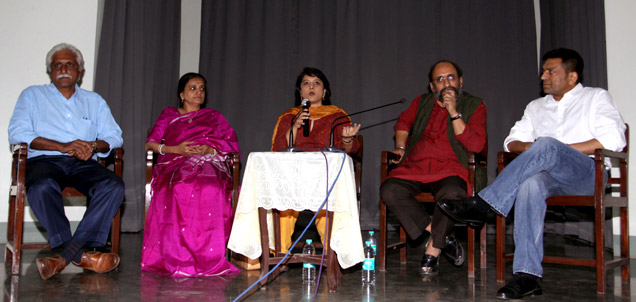
    Presenting his take on the sorry state of affairs prevailing in the print and news broadcast sector, Aggarwal presented a one-hour documentary titled ‘Brokering News—the inside story of paid news.’ The film is the initiative of the Delhi-based non-governmental, not-for-profit Public Service Broadcasting Trust (PSBT). The event was held at Mumbai’s Madame Cama Hall and was organised by Moneylife Foundation and Citizens Action Network with the support of industrialist Cyrus Guzder. MxMIndia was the media partner for the event.


    Being the first of its kind initiative on the sector, the documentary provides a harsh outlook on the filthy mannerisms being employed by most prominent newspapers and news broadcast houses where consumption of news is concerned. Spanning the streams of politics, business, sports and entertainment the film addresses a significant challenge facing Indian democracy today—which is the state of its media. The film looks at three aspects of paid news—how politicians are paying for positive coverage during elections, with the result that those who don’t pay are blanked out by the media; how the coverage and reviews of movies are orchestrated and paid for and of course, paid news about business and industry. It depicts in detail how journalists were forced to broker deals to offer editorial coverage to politicians.


    Following the screening, the event headed for a lively panel discussion and comprised of the following notable panellists: Umesh Aggarwal, director of News & Entertainment Television, Ayaz Memon, veteran journalist and currently consulting editor at IMN News, Paranjoy Guha Thakurta, educator & commentator, Bhawana Somaaya, noted film critic and columnist and Sucheta Dalal, Trustee of Moneylife Foundation and Managing Editor of Moneylife Magazine.


    When left to express their initial comments on the screening, Paranjoy Guha Thakurta began by highlighting the last action that was shown in the documentary – the disqualification of a local MLA from one of the constituencies in the North by the Election Commission of India because of the malpractice the individual resorted to with the help of the media. “It was the first ever such judgement that was carried out by the ECI and we hope to follow that when a judgement is pronounced on the former chief minister of Maharashtra Ashok Chavan.” According to Mr Guha Thakurta, while SEBI has made it mandatory for news and print houses to disclose their relationships and dealings with corporate hoses and influential individuals, there is still no transparency on such a ruling as nobody has even challenged the visibility or the outcome of this ruling as yet. “We hope to do a lot more and see a lot of action going forward.”


    Sucheta Dalal began by questioning the level of dishonesty that existed in business journalism. “Having worked as business journalist myself for many years, I can say that most of the stories that appear in newspapers are advertising-driven. And the sorry part is that it is a trend that is gaining ground with nobody doing a thing about it. I haven’t even heard of reports of anybody approaching the RTI for finding information of such corporate dealings with the business news organisations.”


    Probably, the most straightforward answer was unleashed from Ms Somaaya who vouched that in her entire career spanning over 30 years, she has never resorted to the concept of being entertained at the gesture of the entertaining parties. “I am an idealist. I can proudly state that I am not the same as the others in the space. Even today, there is a place for ethics and integrity in journalism,” she quipped.


    Presenting his rationale on the tale, Ayaz Memon asserted that there was a turmoil being currently witnessed in the media sector what with the explosion of several mediums in the space. “As a result there are not enough checks and balances leading to dangers lurking in every nook and corner of the business.” Citing the example of cricket, Mr Memon went on to describe the state of affairs of players who played in the earlier days and how they were paid minimal dues to the players of today who aspire to be paid huge sums. “This has led to match-fixing and spot-fixing being introduced to the sport today. While it is still not as widespread as is made out to be, the danger of such things going unchecked is huge.”


    When questioned by a member from the audience on which is the bigger worry – watching damaging news versus news that is paid for and how to distinguish between the two, Ms Somaaya reverted by stating the practice that she follows when reviewing films. “I’ve always refused offers for special screenings as after they lavish you with undue attention they expect that you judge the film in their favour. Reviewing films has become a big business today and one cannot predict the veracity of the reviews that get published.”

    Mr Guha Thakurta added here that it was largely the media that has played a huge role in giving damaging news or news that is paid for. “The need of the hour is to amend the Act and make paid news a cognisable offence.”


    Mr Aggarwal added here by saying that “we have our priorities misplaced. We need to figure out what kind of news gets featured and whether it is a pertinent one.” He cited the classic example of the small kid Prince that was covered live on almost all television channels for three days but another important news of 57 miners being trapped underground the same day was totally missed by everybody.


    Proceeding to the immediate solutions that were required to be taken by the industry, Mr Guha Thakurta called for an underlying need to have a regulation in place. “The thing about self-regulation is that in most cases it is not an effective thing to do. Recently there were two channels who were questioned for showing obscene content but what about the judgement? The problem is that we do not have an independent regulatory body which could govern and control the media; a body that acts as a statutory ombudsman for the electronic media.” Continuing further, Mr Guha Thakurta said that the issue was also how we strengthen the defamation laws in the country. “We need to go beyond individuals and focus on the systems. That should be the immediate priority.”


    Ms Dalal stated here that it was essential that media houses portray the right picture and not otherwise.”Most media houses are going in losses amounting to several crores of rupees but they are putting up are brave front and are getting help from the media to hide their plight. The owners need to question themselves as to what is it that we are doing to broadcast the right news?” Summing up, Mr Memon added that “we don’t live in a perfect society. It’s a time-bound initiative and will require the industry to come together and fight the menace.”

  • Stand up and be counted against paid news!

    By Ranjona Banerji


    The best TV news programme I watched all weekend was the BBC’s Panorama on the August riots which hit England, with particular emphasis on the city of Manchester. As you might remember, the riots started in London over what appeared to be a clash between the police and residents of a locality over the shooting of a black man. However, it soon became clear that race had little to do with the rage of the citizenry as anger spread from city to city and then manifested itself in arson, looting and attacks on the police.

    Panorama concentrated on Manchester, how the police – who had spent officers to London as the capital was struggling – watched and waited. How many had little idea why the riots hit Manchester and how quickly they spread. How those who worked in the poorer areas – like Salford – were not surprised at the extent of the anger against the establishment.

    The programme spoke to the police, to some rioters and tracked the process of how video footage helped in making arrests. The home minister was also interviewed.

    However, there were no “general” experts who put forward any psycho-babble theories and nor did the reporter pontificate. Instead, here was an old-fashioned report, minus glitz and packaging. It made, perhaps obviously, for compelling viewing.

    I’ve heard endless theories, as have we all, about how TV news in India is in its nascent stages, how TV is all about rating points and can never look further and how sensationalism is the only way competition can thrive. But I have never yet heard or seen any competent research which proves that Indian TV news viewers are all uniformly dumb. In which case, surely once in a while, TV can allow some good journalism to sneak through?


    MxM partnered a film viewing and a seminar on paid news organised by Moneylife Foundation last Friday – paid news. Umesh Agarwal’s documentary Brokering News was a hard-hitting look at the scourge of our times – paid news. The film looked at the trend of media houses approaching politicians and political parties to sell them editorial space for positive coverage. The reader or viewer of course is not informed that the coverage has been paid for. This has become an across-the-spectrum practice during elections for four or five years.

    It has long been known that smaller newspapers particularly in the regional languages use their reporters to get advertisements as well as get stories. Sometimes, the information gathered is used to blackmail politicians and businesspeople to increase the newspaper’s revenue. Brokering News tells the story of Rakesh Sharma who decided he could not be used like this any more his employer – Dainik Jagran – and is now fighting a lone battle against the newspaper. Sharma pointed out that other newspapers – he named Dainik Bhaskar and Hindustan among others – were also involved.

    The film looked at corruption in the sports and entertainment sectors of journalism and ended with the Niira Radia tapes and its impact on the media. It was interesting to see Rajdeep Sardesai of CNNIBN, who was interview in the film, damning the practice of cosying up to PR people or subverting the cause of journalism and then copping out when it came to actually taking on the people exposed by the tapes. The biggest fish caught in the net were of course Barkha Dutt, Vir Sanghvi and Prabhu Chawla.

    The film should be seen by every journalist. There was a bigger caveat I think to the media, which can sometimes become too complacent. The film played to a packed audience, with standing room only in a hall which seated about 300. For a documentary, that is remarkable. The media ought to take heed that the general public is not completely oblivious to its shortcomings. The warning signals are quite visible.

    I think those of us who are not caught up in the seamy side need to come out and speak out, with more strength. The panellists – Paranjoy Guha Thakurta, Ayaz Memon, Bhawana Somaiya, Umesh Agarwal – and moderator Sucheta Dalal examined and slammed paid news and acknowledged the degradation in the media. Now we need more.

    eom

  • HT’s series on medical malpractices

    By Ranjona Banerji


    I have to congratulate the Mumbai edition of the Hindustan Times for its hard-hitting series on medical malpractices – particularly the way doctors take patients for a ride by prescribing any number of fake tests. Almost everyone I know has been a victim of this scam at some time or another and it is shocking the way it has proliferated. Well done to HT – we have so many stories telling us about some celebrity doctor importing some ground-breaking medical practice at some exorbitant price or about the dismal state of government hospitals. Both aspects are undoubtedly true. But it’s also necessary to highlight the problems within the medical community which in keeping with the zeitgeist appears to be greed!


    I must admit to not being a fan of the Mumbai edition of Hindustan Times – being better than what DNA has become is hardly something to be proud of. On a normal day, The Times of India just whitewashes the competition with its total city coverage. But targeting issues which affect citizen and packaging them well is a time-tested and intelligent way of increasing reader interest and HT has done it well here.

    **


    It is quite amusing to compare last night’s television to this morning’s newspapers. So while some channels decided to focus on the Special Investigation Team’s submission that the Ishrat Jahan encounter case was actually murder, others were taken by the BJP’s plan to boycott Union home minister P Chidambaram in the Parliamentary session. Mayawati’s quickfire session to chop Uttar Pradesh into four also got airtime as did Pakistan’s problems with what has been dubbed ‘memogate’.


    The Times of India used the rupee’s downslide compared to the dollar as its lead tying into general economic woes, with Ishrat Jahan as second lead. Hindustan Times did a DNA and gave us everything – Mayawati as lead, then Ishrat, then NDA and Chidambaram with the rupee as a single col. The Indian Express has Anna Hazare and his wax likeness as a lead pic, with Ishrat Jahan as the lead, Mayawati second and the NDA boycott as third.


    The Telegraph, Calcutta, stuck to a local story as lead, went with Pakistan and memo-gate as second lead and Ishrat Jahan as third.

    So what then is “news”. The general news-entertainment channels would usually leave the rupee to the business channels so that could not be “news”. Besides it is almost impossible to have a sensational TV debate on the subject. Ishrat Jahan and Mayawati obviously deserved top billing. Pakistan’s memogate is one more in a list of problems to for most newspapers it was international page news. But Pakistan makes for TV drama, so it makes it there.

    The NDA boycott possibly got stuck in the news spin cycle because the bigger story will be about Parliament was disrupted, not the announcement of the disruption plan.


    **


    Having forced myself to watch NDTV, I was lucky to get a bit of a laugh when during Nidhi Razdan’s evening show, she played a clip of Srinivasan Jain’s interview with Anna Hazare. As is his wont, Hazare held forth on his normal procedure of flogging those who drink alcohol after being warned off three times and then taken to a temple the fourth time (I am guessing there are no Muslims, Christians, Buddhists, Jews, Sikhs and Parsis and anyone else I’ve missed out on in Ralegan Siddhi). Jain, rather than question Hazare on this frankly outrageous practice, proceeded to repeat and expand on it, presumably for us who didn’t understand Hazare the first time around. Razdan was rightly outraged, but her guests – Manish Tiwari, Nirmala Seetharaman, Jyotirmay Sharma and Shoma Chowdhury were even appropriately very amused and could barely hold back their laughter at Hazare’s absurdity.

    **


    By the day, did anyone read Shoma Chowdhury’s defence of all the allegations made against Tehelka? Too much explaining never works in journalism. Brazen defiance works better.  Therefore, a tedious read.

    eom

  • Let’s look beyond Kasab!

    By Ranjona Banerji


    Newspapers in Mumbai this week will be full of articles and opinions about 26/11 this week as it’s been three years since terrorists ran amuck all over Mumbai in November 2008, killing and maiming. I have to confess that I have done it as well with my column in Mid-Day. However, I cannot quite understand why there is so much focus on the money spent on Ajmal Kasab, the sole terrorist who was caught. Kasab has been sentenced to death and is awaiting a Supreme Court appeal. Most of the money, as the newspapers tell us, has been spent on securing Arthur Road jail which surely should have already been done considering the number of terrorists and underworld characters who live there. In which case, the story should be: why was Arthur Road jail not secure enough to house one terrorist?


    The big stories for me out of 26/11 start with the shoddy investigation into whoever helped the terrorists on the ground – considering the two put forward by the police were acquitted? After all, convicting Kasab was inevitable, given the evidence against him and he is now within the judicial process on his way to the gallows. But what about those of us who are still alive – what has been done to secure Mumbai since? What about all the promises about equipment for the police? Is there enough electronic surveillance? Where are the boats which the Coast Guard can actually use?
    Hopefully, our newspapers will give us more and get out of this Kasab focus.


    **


    It is good to see Indian TV getting interested in the renewed revolution in Cairo. Suddenly, it’s been headlined on a few channels after the Arab Spring was ignored for weeks in India as if a Bollywood-cricket-faff-filled Indian brain could never be interested in anything else.


    **

    Is it good journalism or bad that the birth of Aishwariya and Abhishek Bachchan’s first baby was treated with kid gloves? I would have thought that in these hard-boiled, in-your-face paparazzi times, good manners would have been thrown out of the window. Even worse, everyone just fell in with Amitabh Bachchan’s requests? Come on, this is not the way a free, independent media behave. Whoever said that we had to be polite and non-intrusive?


    It is true that I care a hoot about this child (I think it’s been born because I saw a picture of Amitabh carrying it out of hospital) but the rest of the country surely wanted to know? Who does the media owe first loyalty to? Readers and viewers, surely!


    **


    Those interested in the run up to the US presidential election should try and catch the debates between the Republican Party hopefuls on CNN. It actually makes for compelling and amusing viewing as candidates rip into each other or trip up. Nothing like watching a politician looking bad – whichever country he or she belongs to!