Category: MxM JOURNALISM REVIEW

  • Amid firecrackers, the papers are quieter

    By Ranjona Banerji

    Although Mumbai is my normal hunting ground, I have spent this Diwali in Hyderabad. And it is wonderful how easily you can get into another news cycle, no matter how unfamiliar at first. There are no large well-packaged newspaper campaigns about roads or health or public transport. The outraged citizen is also more subdued than in Mumbai – Dear sir, I have not yet received my aadhaar card after so many reminders, gentle stuff like that.

    Politics is far more in evidence and clearly Tellywood has not overtaken every page of every newspaper the way Bollywood has done to our Mumbai papers. No one can suggest that the Telugu film industry is not huge and does not command a massive fan following or commercial presence. Yet, no film star has jumped out of the pages wishing us Happy Diwali, Halloween or anything else. Happy Days!

    Telengana is a big issue obviously, but everything has been a bit quieter over the holidays. Diwali-related allergies, pollution and injuries also got their fair share of attention, proving that social consciousness is a seller.

    Between the Times of India and Deccan Chronicle, the former is more national in its outlook and the latter more local. The day after the Metallica concert was cancelled in Gurgaon, TOI led with the story while DC was happy with a single column.

    The colour pages however are as full of the vacuous page 3 stuff and the scale varies, presumably depending on celebrity activity, which appears to have been quite slow. Or it could be that local celebs are not yet professional party goers who make deals with photographers to ensure themselves so many pics a week and all from the most flattering angle!


    **

    Not surprisingly, the Formula 1 race and the continuing travails and protestations of Team Anna hogged TV and newspaper headlines. The Big Fight on NDTV had a discussion on the corruption charges against Team Anna and its anti-Congress stand at Hisar, featuring former Delhi police commissioner Maxwell Pereira, actor Kabir Bedi, politician Renuka Chowdhury, former TOI editor Dileep Padgaonkar and a young girl from Team Anna. Anchor Vikram Chandra tried to ensure that Team Anna got fair treatment but even he was a bit stunned when Kabir Bedi said that he was not bothered by Kiran Bedi’s creative accounting. Audience members were far more critical.


    **

    The fiasco over the Metallica concert in Gurgaon demonstrated how TV needs to up its reporting skills. Anchors and reporters clearly did not have the wherewithal to probe what had gone wrong and relied on unsubstantiated claims made by fans. Oddly, TV channel websites appeared to have more clarity. It took the newspapers the next day to answer most questions. Yet, even now, the facts seem a little hazy, that is, juicy details of why the concert was not held are missing.


    **

    Most intriguing of all is the fate of some 130 tourists who have apparently been kidnapped in Lakshadweep. TV ran the story late one night and forgot about it the next morning. Newspapers have been silent and the web, normally a fount of information and misinformation both, has provided only sketchy details. So what’s happened to them?


  • Gouri Dange: Most art reviews leave us feeling weak & witless

    Introducing Naming no Names, an all-new mid-week column by well-known novelist, columnist and counsellor, Gouri Dange.

    Dange is a brilliant writer (disclosure: MxMIndia only publishes brilliant writers!). And exceedingly funny.  But it’s not forced humour. Her simple, middle class-y view of life and everything around it will be evident from her observations of the strange and often pointless stuff we see in the media.

    Without much ado, presenting Gouri Dange. The column: Naming no Names. Every Wednesday, on MxMIndia’s Journalism channel:


    Most art reviews leave us feeling weak and witless


    Why does one read reviews? To get a little glimpse of what to expect when you read, view, or listen to creative effort, right? Works fine with most reviewing. For instance, a music review will clearly tell you that a singer was in peak form and reminded you of his illustrious grandfather in the rendition of his Bhairavi. A book or film review will tell you what works and what doesn’t, at least for the reviewer. A dance performance will be reviewed in terms of the dancer’s grace, rhythm, expression…you get the point.


    It’s the art reviews that stand quite apart, leaving most people completely flummoxed not to mention gobsmacked. Take a look. I swear I am not making any of this up – I couldn’t write like this even if there was a gun held to my head:

    “For this artist of course colour is almost another type of vessel – rather than just a vehicle, it is a protective continuum for a soft and vulnerable molusk-like feel that she besets her canvasses with. The motifs of chaotic profusion resonate against the happenings of frontal development that bring functional ethos to a standstill.”


    Now in this mindblowing welter of words and ideas, it may be nit-picky of me to say this, but molusk is not spelt right. But what’s a little misspelling in the midst of all this gobbledygook? I mean somebody please, please tell me what frontal development is…and what, pray what, is the functional ethos that has been brought to a standstill? And how does one beset the canvas with this so-called molusk-like feel. I mean, did this writer go to the same kind of schools and colleges that we did…or is there some secret institution that teaches you to write gibberish, especially to review art.


    There’s more priceless twaddle:

    “Interestingly known more for her impressionist zeal the paper works in this show reveal that the artist is busy shedding its primary historical role as a representation of the object in favour of the dynamic engagement of physical form in real space. …The whole symbolism unravels in essence as a container for visual but in-depth illumination in thought.”


    When I read bits of this out to an art historian and curator friend of mine, she laughed, and then cried a little at the sorry mess that masquerades as art reviewing. She tells me that all contemporary Indian art reviews in the newspapers and magazines are full of gormless gabble of this kind.


    P G Wodehouse would have had a field day if he read any of these. Remember his favourite piece of inanity: “Across the pale parabola of joy…”?


    Ever the anxious language lover, not understanding what I’m reading used to eat me up. I had then taken to reading these sentences out loud over and over again, hoping to tease the inner meaning out like I do to extract a tick from inside the dog’s ear. All I got was a headache and a bit of a stammer.


    Here’s some more, from another place:

    “The function of colour in her palette is like a mooring of moments, of deeper shades or shifts that create a vortex of lines around the contours of a heady sprinkling of forms to the articulation of a surface and the evocation of more than a fleeting shadow. Full dense volumes in tiny notations oscillate happily with solid forms. The complex tensions between the parts and the whole that animate these spellbound paintings are all around her.”


    Spellbound paintings? Again I quibble, but can we at least have the grammar go right when talking bunkum?


    My question is, who is this stuff written for, in the newspapers? Must be for the aliens amongst us. I can’t see real people read this and call out to their spouse or sister: “Hey we must go see this show, it has cartloads of functional ethos and oscillating notations… come, let’s hurry there now“!


    And the other thing I am just dying to know is whether reviewers who write like this, talk like this too? Meaning writing claptrap is one thing, but actually mouthing it with a straight face, can they do it? You try it – try reading that molusk excerpt out loud to someone in your home, with a straight face. Guaranteed to bring the house down.

    This confirms one theory, that the word vocabulary has an Indian origin. It comes from: voh-kya-boli-rey?

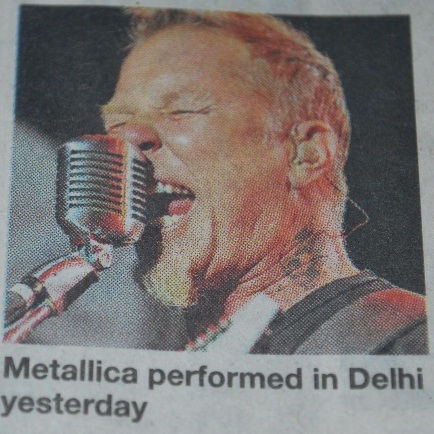
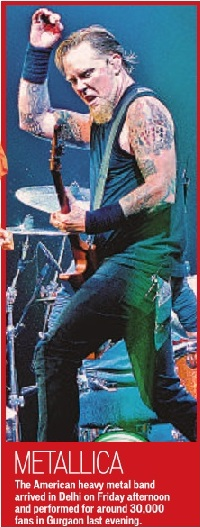
  • Mediaah!: When Delhi Times and HT Cafe reported that Metallica performed

    By Pradyuman Maheshwari

    The Delhi Times clip
    The HT Café photo-story

    It’s not something that’s not happened before. I recall Time magazine doing it in the late 1970s when it reported that an Indian politician had visited China when in fact he had called off the trip last-minute.

    I was alerted on this thanks to a Facebook post by a former colleague, Narendra Kusnur. The city supplements of both the Hindustan Times and Times of India in Delhi reported that the Metallica concert had happened on


    Friday. While the front page of the main paper did make a mention of the chaos at the venue, that of their supplements – which Kusnur believes happened because of an early deadline – was incorrect.

    I am sure this is more than just a severe embarrassment for the editor and management of both publications. It’s not the case of an error in reportage or a typo or even a wrong picture that was printed. And mind you it doesn’t appear to be an inadvertent error.

    Here was a case where the paper’s editors cheated their readers by deliberately printing incorrect information. We got to know about it thanks to a vigilant reader and also because it was a much-hyped event.

    But my worry is what if the editors do such acts habitually, with other events too. Also a cause of concern is that the city supplements of the two leading newspapers in the capital carried a similar error. The Times of India blanked out the news item on the epaper, while HT didn’t do that. So obviously the decay exists not just in one publication.

    I went through the front page of HT City and Delhi Times on Sunday to see if there’s any apology. I didn’t see any in the epaper edition. Times magazine, btw, had apologised for the error.

    This only further accentuates my distress that the reader is being taken for a ride and no one really appears to care.


    The Niira Radia exit. Good riddance or sad to see her go?


    I still remember the days when Vaishnavi was setting up. The Tata group accounts were consolidating under an agency with a name unlike the other PR agencies. In the early days, the folks were working out of makeshift office at the Taj Mahal hotel and the Army and Navy Building in Mumbai.

    But the proof of the pudding is in the eating, and I found it very pleasant interacting with Vaishnavi staffers. For a period when I was with the Dainik Bhaskar group, we had recruited Vaishnavi with an assignment which again was executed very well.

    The PR industry grapevine always had assorted stories about how the Vaishnavi bosswoman Niira Radia had managed to net the entire Tata group account. Needless to say most of it was out of jealousy. Guess they found some merit in getting the entire business group to go to just one agency for PR just as you tend to do for, say, media buying.

    My sense is that this policy doesn’t work. It’s always good to get a few different players, given their strengths in various business areas and have experience professionals available in the locations you want them.

    Two questions: now that she’s gone (well, as of close of business today), what’s the view. How would the world remember Niira Radia? High profile lobbyist or a quality communications professional? Lobbyist yes, but perhaps incorrect to stretch it to her being a wheeler dealer.

    There’s a lot that exists as part of the deliverables under public affairs, and there’s nothing wrong if the influencing has to happen beyond media folk. For instance, if a senior politician from Kerala thinks he or she is not being recognised by the powers that be in Delhi, then there’s nothing wrong in pushing your way around in Delhi.

    And if there’s a journo or bureaucrat who is amenable and can get influenced, it’s surely not the crime of the practitioner.

    That both the Tatas and Reliance groups entrusted their responsibility to Radia speaks volumes for her skills.

    There is a lot on Radia that the various enforcement agencies are busy with. I don’t see anything happening to her. She has enough contacts to get her out of any mess and has enough dirty stuff on people to pull the trigger if anyone gets naughty.

    Question 2: were the Tatas wise by going in for Rediffusion? I would be interested to know what swung it for Arun Nanda. After all, he doesn’t have the best PR brains with him any longer.  Perhaps that’s why tied up with Edelman.

    But then 10 years back when the group went in for Vaishnavi, similar questions were being asked. Radia’s team put up a decent show. The Tatas can obviously spot talent where not many of us can.


    PostScript: Are news media professionals worried about the mutterings of Press Council chief retired Justice Markandey Katju. Read this hilarious account on Legally India. Must-read. More on Katju’s comments on the media next time (which I promise you won’t happen after three weeks!)

  • Shika Mukerjee: Mamata dream sequence ends

    By Shikha Mukerjee

    Like a grand infatuation that is pursuing its natural course towards an inevitable end, the heady, halcyon days of the media’s romance with Mamata Banerjee as the harbinger of “change” or “parivartan” are coming to an end. Sunday, October 30: the mainstream print media is showing distinct signs of doubt about Didi’s capacity to deliver on her promises; her announcement that for the next one month all her attention would be focused on “industry,” her “Diwali-gift” of projects to the people of West Bengal produced sceptical headlines.

    Of the two dozen or so daily newspapers in Kolkata, the story of the Diwali gift or Industrial Revolution was the lead in many, the second or even third lead in some and appeared below the fold in a few rare exceptions. It is not a categorical imperative that Mamata’s initiatives on industrialisation must be the universal lead in every newspaper or even television. The Telegraph said, ‘A Diwali ‘gift’ but not so perfect’. The Times of India said, ‘Industry bonanza hits Singur hurdle’. The Ananda Bazar Patrika said, ‘Mamata takes the field to gain Industry’s confidence.’ Ekdin said, ‘Assurances of Industrial revolution in West Bengal to restore its golden past’. Pratidin said, ‘Now the Industrial Revolution.’ Bartamaan said, ‘Migration in search of jobs to end: Mamata.’

    On television, especially the top five 24X7 Bangla news channels, more widely watched and consequently of greater significance in terms of reflecting popular sentiment, the story was listed a long way after news on crib deaths and the newest Maoist demands. National news channels insistently reported on the growing number of crib deaths and the failure of the political leadership, namely Mamata, to respond to the situation as an emergency.

    A month or two earlier, no market savvy newspaper or television channel would have given a negative spin to any story featuring Mamata as the principal actor. By describing her Diwali gift as old projects repackaged as new, the newspapers are signalling that the romance is nearing its end. Some newspapers even listed which of the 10 projects that Mamata had announced as new initiatives had been sold to the public before. Some said that the list included so many public sector projects that the lack of interest of private investors was obvious. Some even quoted unnamed industrialists and public sector officials on why the list was a made up story of possibilities.

    One strong indication of the romance going stale was a story in The Telegraph on October 21, ‘Mamataisms at the Crossroads’, that analysed and checked off the status of her initiatives on her priority issues during the long, long campaign against the Communist Party of India Marxist’s misrule and arrived at the conclusion that she had made little headway though many starts, even if most were false ones.  The clash between the suave and pedigreed Trinamool Congress finance minister Amit Mitra and the former less socially elite, but no less academically qualified finance minister Asim Dasgupta was a delicious play off in which Dr Dasgupta has certainly scored a bull’s eye. As the story appeared, it was evident that The Telegraph, The Ananda Bazar, Ekdin, The Times of India were all clued in on who would win the fight.

    Assisted by the media, Dasgupta launched a methodical and technically sound demolition job on Mamata’s claims that a mere 6 per cent of the state’s money was available for development. The apparently academic point that Dasgupta made – on how the calculation was wrong – is in effect a lit fuse, politically. The positive play that Dasgupta received is the measure of the decline of Mamata’s magic in the media. The contrast is particularly striking because three months ago, when he made a similar point and was very critical that the new government had not presented a conventional budget, the media found ways of converting the criticism into the peeve of a loser. It dragged in seriously negative evaluations of his tenure as finance minister of the CPM government and quite openly jeered at him.

    It is intriguing that whereas Dasgupta’s earlier salvos did not get any support from the popular band of economists, this broadside had several economists, including one or two known CPM baiters and Trinamool Congress admirers confirming the accuracy of the ex-finance minister’s statement.

    In contrast, the very soft treatment that Mamata has received over crib deaths underscores her star quality.  The “failure” of the health system in tackling a crisis was played up in terms of the numbers of crib deaths at the BC Roy Memorial Hospital for Children. Media went out into the districts to find more instances of failure, in a show of initiative that indicates that the story has regained its own life instead of being a frame within which Mamata and her government are artfully displayed. But the media did not pick on her when she brushed aside questions at a press meet, declaring, “ask the health secretary” and “this is about industry”. Nor did it bay for her blood when she responded “What can I do.”

    The quagmire in which negotiations with the Maoists have been stuck, the declining credibility of the negotiators, the revision of strategy for dealing with the obviously reinvigorated ultra Left has not led to direct criticism of Mamata, but it has produced a shift in treatment. Even though the media has not underlined the abrupt change in Mamata’s stand, from declaring “There are no Maoists-Phaoists in West Bengal” to calling them “supari-killers” and “cowards,” it has turned watchful and cautious about the chief minister’s capacity to handle the problem, classifying it as one of the “Mamataisms.”

    Industry, finances, health, Maoists covers much of what Mamata promised as part of her Parivartan politics. By reserving judgment on the promises that she made – return of land to unwilling farmers of Singur, now mired in a legal battle, ending the Maoist problem, opening the doors to a flood of fresh investments, delivering better governance, extracting more money from the Centre – the media has played fair or even handled her with kid gloves. It has not clamoured for answers at the gradually but noticeably fewer press meets. She has not been cornered or pushed up against a wall.

    In fact the media has been unusually, almost unethically, gentle in its interactions with Mamata Banerjee. It has tolerated, even after she became chief minister, the ferocious regulation of access that she exercises with the media. It has accepted with good grace the fact that there are some newspersons who have 24X7 access to her and that the rest have to depend on these select few for camera footage and reporting. The band of faithful is privy to the best footage at every photo-opportunity; they are welcome in her office and get interviews. The rest have to make do with crumbs cast their way. The absence of protest is, as one journalist said, a measure of her “charisma.”

    Put differently, the news media cannot function without the crumbs because its audience or public remains loyal to the charismatic leader. No media publication or channel can afford to black out the things that Mamata does or says. No media channel can complain on air that it never gets a chance to interview the leader. No media channel can protest if a newsperson from another “house” sits in on an interview when it is finally granted. If after this prolonged discriminatory treatment the media has chosen to suck it up rather than raise a furore then it signals the popularity of Mamata Banerjee and the risk of annoying her. Therefore even when media persons privately complain bitterly about the “humiliation,” “discrimination” and “difficulty,” they have not as yet turned critical or even objectively analytical. The stories that the media does not report vastly outnumber the stories that it does; the discretion is exercised over what the public and positive image of Mamata can bear versus the stories that reveal the negative in terms of faults, whims, bad decisions.

    A year back, the CPM government would have been excoriated if it had spun the funds available for development story in the manner in which Mamata presented her desperate case at the National Development Council meeting in New Delhi. It would have trashed stories about promised bailouts by the Centre, especially Prime Minister Manmohan Singh to the West Bengal government for reasons of political sympathy. It would have gleefully pointed out that the Centre’s failure to deliver on promises was a pointer to the declining clout of the political leadership of West Bengal. In other words, Mamata is getting the best deal that the media has ever offered to any member of the political establishment anywhere; it has suspended disbelief and meekly accepted its assigned role in the Mamata era, as a faithful purveyor of designer messages.


    The writer is a senior journalist.



  • Mediaah! Katju ko bolo katli maaro, says NBA

    Pradyuman MaheshwariPardon the forced usage of Bambaiyya, but with a name like Katju and this being the season for mithai, one couldn’t help the play on Kaaju Katli. With apologies to the lovers of the Kaaju Katli. I am not too concerned about how Mr K reacts… in any case he finds journalists irresponsible and unintelligent.

    There’s been a lot of song and dance about the Press Council of India chief Markandey Katju’s outbursts to all and sundry. Yesterday, the News Broadcasters Association asked the Prime Minister to ask the Press Council of India to mind his own business and stop effing around with the news TV wallahs.

    The Prime Minister is in Cannes attending the G20 summit and I won’t be surprised if he does precious little about it.

    There have been various reports on the News Broadcasters Association asking the Prime Minister to restrain the Press Council of India chairman to not comment on areas that are beyond his jurisdiction. I found the one on former friend and benefactor Anil Wanvari’s Indiantelevision.com the most exhaustive. Here goes: http://www.indiantelevision.com/headlines/y2k11/nov/nov28.php

    But before you slam the man any further, as our editor-at-large Anil Thakraney writes, there is a point that Katju is making. There are scores of occasions when you do have our news channels transgressing all lines of decency. I have stopped some of the channels – especially a few in Hindi – because of the trashy content that’s there on them. Even on Big News Days, these guys don’t seem to get over their obsession with the Occult. And the Inane.

    Former Aaj Tak CEO and also bossman of a dozen industry associations G Krishnan would often argue for the trade about this with a “We are like this only refrain”.  Whoever says news has to be only current affairs. And whoever said current affairs shouldn’t include who Ranbir Kapoor was in bed with last night.

    (aside, these days channels could also do similar stories about mediapersons, but we’ll come to that some other time… or perhaps will never do it.!)

    (aside 2: the last time, Mediaah! tried to write on the private life of a mediaperson, we had to kill ourselves).

    I am not armed with the stats, but the fact of the matter is that all news broadcasters aren’t members of the NBA. And it’s impossible for the NBA to coerce channels to turn members. There’s nothing out of the ordinary about this. In other trade associations too, large players don’t become members.

    So, as the NBA has said, let its self-regulation policies rule over all news channels. In fact the uplinking and downlinking policies must make it mandatory for all news channels broadcasting out of India to subscribe to a self-regulation code of the NBA.


    Should the Press Council be made the Media Council?


    First, do we need a Press Council. The newspaperwallahs have their INS, the magazine guys have an AIM, internet and mobile dudes have IAMAI, the ad folk have their AAAI and ASCI, so why the Press Council.

    It’s a body with no teeth. It can’t do a thing to police newspapers. I remember receiving a few letters from the Council in the ‘90s asking my paper to apologise for some flimsy reason. I was advised by my publisher to ignore the notice, and when one realised there was no need for the paper to issue an apology, I trashed the missive. It’s not that the newspaper lost its licence or was penalised. We went about our business peacefully only to trash the next letter that came in.

    I am a little surprised that the Press Council didn’t have news channels under its jurisdiction all these years. When it was set up in 1966 (with the Press Council Act taking coming into existence only in 1978), we only had the government-owned Doordarshan and All India Radio so I guess no one found the need for policing the airwaves.

    Para 1 of the ‘about us’ section of its site says:

    The Press Council of India was first set up in the year 1966 by the Parliament on the recommendations of the First Press Commission with the object of preserving the freedom of the press and of maintaining and improving the standards of press in India. The present Council functions under the Press Council Act 1978. It is a statutory, quasi judicial body which acts as a watchdog of the press. It adjudicates the complaints against and by the press for violation of ethics and for violation of the freedom of the press respectively.

    There is a self-regulator for news and non-news television and advertising and there is none for print and digital media. So I guess there is merit for a self-regulator, but ideally it should be done by an industry body and not someone set up by the government. As for ensuring the freedom of the press, we surely don’t need a Press Council of India to police that.

    Our democratic set-up will ensure that governments can’t get away with stifling the press. As for media owners muzzling their own employees, I don’t think the Press Council or any minister or Parliamentarian can do anything about it. The owners almost always have the final say.


  • Freaking News: One event, two interpretations

    By Ranjona Banerji


    One event, two interpretations: Monday morning’s Times of India and Hindustan Times had two completely different interpretations of LK Advani’s rath yatra’s entry into Gujarat. TOI found in an empty chair between Advani and Gujarat CM Narendra Modi a symbol of the growing distance between the two leaders and described their interaction as cold. Advani apparently added to the distance by praising Modi’s bete noire, Bihar CM Nitish Kumar. Hindustan Times however perhaps read nothing into empty chairs and said that Advani and Modi put up a united front to turn the heat against the Congress.

    Surprisingly, Headline Today, known for its slightly rightwing stance – No, Mr Katju, not all media outlets have identical reactions – also perceived a freeze in Advani-Modi relations.


    **


    Mamata Banerjee’s dramatic declaration – although her speech itself was very well-reasoned and delivered most matter-of-factly – of withdrawal of support to the UPA over the petrol price hike did not turn into a weekend drama. Mainly because the Congress barely responded and Banerjee herself said she would wait till the PM returned from his travels.

    It was interesting that Times Now broadcast her whole speech which was in Bengali and took a good few minutes to get translations up. Perhaps we need to have a more instant translation technique given the languages listed in the Constitution or at least faster paraphrasing abilities.


    **


    The death of composer and singer Bhupen Hazarika received both airtime and newsprint space and more importantly, honour and respect. Perhaps this means that we in the media are not as shallow as we ourselves feel or are made out to be – Mr Katju please note.

    **


    Our Sunday papers felt the need to reconnect us with the “other India’ and we had special reports on our labour policies and how unfair they are to labourers, the problems of contractual workers as well as focus on our perennial health problems. Not sure if this was proving a point to Mr Katju or in fact, it was the Katju effect at work.


    **


    Mumbai’s law and order problems were highlighted once again as the spotlight remained on the deaths of Keenan and Reuben in a Mumbai suburb in October. Most say this as an opportunity to focus on similar problems elsewhere in the country as well as on the treatment of women on our streets.


    **

    The Hindustan Times has been running a series of accusations and counterpoints between Goa theatre veteran Hartman de Souza and Tehelka editor Tarun Tejpal which has now spilled over into cyber space. Tehelka has been holding a “Think Fest” in Goa and de Souza and others have accused the journal of having double standards when it comes to the issue of exposing the mining lobby in Goa. It is a fascinating series of accusations, some petty and some serious. This is one more example of how the media is looking more at itself as a “story” as well as how the internet has changed the game when it comes to public interaction.

  • More confusion and pyrotechnics

    By Ranjona Banerji

    At last television managed to extract some excitement from the news. NDTV’s Nidhi Razdan tried to get her guests Renuka Choudhary, Subramaniam Swamy and Vinod Sharma of the Hindustan Times to decode the 2G intra-ministry note controversy, the call to prosecute P Chidambaram and the arrest of former LK Advani aide Sudheendra Kulkarni in the cash-for-votes scam. Sadly, the verdict was the same as it has been all these days – confusion. The audience however was not convinced with the explanations provided in the cash-for-votes episode by the BJP and Sharma just laughed at all political parties. Chowdhury was her normal dismissive self while Swamy was a bit nonplussed by the CBI’s refusal to listen to the government, saying it was an autonomous body.

    Thus it was left to Arnab Goswami to provide the pyrotechnics. However, the subject of his choice – NGOs breaking the law – can only create foam-in-the-mouth for the most diehard supra-nationalists who see Maoist conspirators around every corner. Even the news that an Essar general manager had been arrested for paying protection money to Maoists could foment the crowds or the viewers. Goswami was pained that NGOs were breaking the laws of the Government of India. This from a man who just last month appeared to have been quite happy when members of Team Anna tried to destroy the entire Indian system of parliamentary democracy.

    However, as far as television was concerned, the arrest of Kulkarni was big news as the BJP scrambled to prove it was being victimised and the Congress retained its disdainful position regardless of how foolish it sounds and how little anyone believes it. Still, the fact that Parliament was sullied by MPs waving wads of cash around apparently rankles in many Indian hearts. The goodie-goodie whistleblower explanation does not cut much ice when confronted with patriotism.

    **

    The death of Mansur Ali Khan Pataudi obviously caused great pain to the Indian nation as tributes and obituaries to the great cricketer carried on for more than a week. This was surely unusual, made even more unusual by the fact that few of the writers actually knew the man very well and had to depend on hearsay and legend to bolster their articles. It showed if nothing else, an interesting view of contemporary Indian life and one where the truth cannot ever come in the way of laudatory praise.

    Or, as it happens, criticism. Some stray remarks made by controversial Pakistani cricketer Shoaib Akhtar about Sachin Tendulkar created a little tizzy, causing the launch of Akhtar’s “controversial” book to be cancelled. However, most of the tizzy was created by the pre-release publicity machinery to drum up a little extra interest. Instead, the tactic appears to have backfired. The publicity tiger is a dangerous beast to ride. Remember the limerick about the Lady of Niger, who smiled as she rode on a tiger? They came back from the ride with the lady inside and the smile on the face of the tiger.

    **

    I see that little news items about transgressions by Reliance Industries have started to make their way into newspapers. Will track this and see if it goes any further.

  • Hard Knocks:Journos,keep your distance from celebs

    By Anil Thakraney


    The Twitter boom has helped celebrities the most. Politicians, movie stars, sports icons, authors, etc, now have direct access to their fans. And it also helps them promote their own work and speak their minds without having to deal with the “middleman” (mass media). Nothing wrong with that. And more power to twitter!


    As it turns out, many of us journalists are also on Twitter. Not only does the platform help us break news, it also gives us a firsthand report on what the celebs are doing and thinking. Most of it is garbage like “I am eating a piping hot masala dosa” or “Traff&cked in Chennai”…. Still, it’s a useful medium for quick info.


    So far so good.


    However, I have noticed some over-eager journalists bond with celebs over Twitter, as if they were conversing with close buddies. I notice a huge amount of backslapping and general bonhomie. It’s quite possible some journos feel a high with this instant celeb connect. But quite frankly, this is an unhealthy thing to happen.


    At the root of good journalism lies the Lakshman Rekha between reporters/editors and celebrities. Because this line of control helps to keep reportage and analysis unbiased and free. This detachment is absolutely essential to journalism. While it’s okay to wish the celebs now and then on momentous occasions, the interaction must remain at that level. Because the truth is, you cannot write bad and embarrassing things about friends. You will hesitate in doing so, and that’s human nature.


    Already we saw what happened during Radiagate. Some journos, because of their good friendship with politicians, crossed the line. And made fools of themselves. And Twitter has made possibilities of such things happening at a higher frequency.


    So yes, let’s tweet. Let’s read their tweets. Let’s even re-tweet. And that’s where it must all end.


    PS: Speaking of Twitter, some days back there was a massive rumour going around that the J&K CM Omar Abdullah is in a relationship with a senior TV journo (speak of crossing Lakshman Rekhas!). And that he was even planning to marry her. Not sure if there’s any truth in this. But if true, the journo in question must examine the past history of neta/journalist alliances. It’s doesn’t read very well.


  • Why democracy can so easily be an ‘obstacle’

    Four days of a severe throat infection meant little TV news and or newspapers. This I thought would save me from minute by minute updates on the condition of Gujarat chief minister Narendra Modi’s fast for amity or goodwill or whatever he called it. But as it turned out, I was wrong. The fast may have been covered but Modi’s condition was left out of it. So unlike with Anna Hazare, whose weight, blood pressure and such were reported in detail, we were given few clues on how much weight Modi had shed. Also, since the earthquake struck Sikkim on Sunday evening, even our hysteria-obsessed TV channels realised that a natural calamity was more newsworthy than a man-made one.

    Unfortunately, not only is our knowledge about the North-East of India decidedly dim, so is our television coverage as few channels have correspondents or camera crew stationed close by or even perhaps adequate arrangements with local channels. Thus we had to depend on telephone reports and as usual it is not till you get the next day’s paper that you really know what’s going on. Also given our India-obsession, our channels behaved as if the earthquake only affected Sikkim, pretty much ignoring the damage in neighbouring Nepal and Tibet. This is, one assumes, a form of patriotism.

    The damage which obsessive TV – with regard to the coverage of the Anna Hazare movement in particular — can do was brought home to me quite severely while addressing students of a media course at a Mumbai college on Saturday , when one wanted to know how we can get around an obstacle like democracy when it comes to reducing corruption!

    Changes made to the Board of Control for Cricket in India were examined threadbare on television and with many anchors palpably upset that there had been no public executions or floggings after India’s losses in England. It becomes clearer every minute you watch TV news why democracy can so easily be an “obstacle”.


    **

    Newspapers covered Modi’s fast as well but with far more scepticism, many choosing to concentrate on the fissures within both the BJP and the NDA. The Telegraph, Calcutta, has a story with Bihar chief minister Nitish Kumar of the Janata Dal (United) making it clear than Modi was not a suitable prime ministerial candidate. Of course, all this jumping the gun a bit since the next general election is in 2014 and it is unlikely that Modi will be fasting all the way up to then, amity or no amity.

    Tuesday’s Hindustan Times underlined its scepticism of Modi’s amity fast with an editorial, a lead edit page piece by Sitaram Yechury as well as a column by its senior political analyst Vinod Sharma.

    The Times of India reduced Modi to a second edit, ‘Strange Sadbhavna’. The front page concentrated on its Social Impact Awards, to honour people who make India a better place. The Times of India has fine-tuned the knack of being all things to all people, greedy, socially conscientious, middle of the road and of course as with Times Now, decidedly rightwing.

    Also expectedly, newspapers concentrated on the devastation and death toll in all the quake-affected areas and not just on Indian casualties. Clearly, whatever the sure signs of degradation of standards in the Indian media, some of the better practices still manage to rise about the sludge.

    Most mainline daily choose to downplay or ignore US president Barack Obama’s plan to increase taxes to cut down the country’s budget deficit. The pink papers however could not. And weeks after Warren Buffett wrote an impassioned column in the New York Times on how he and his rich friends did not mind paying more tax, Indian papers picked up on it. Of course, this was because of a throwaway line in Obama’s speech – but since the speech was telecast live by all international and business channels, you could not escape it. Indian newspapers and channels seem to have one mantra down pat – never upset rich people. Obama apparently – and the New York Times for that matter – has no such qualms.


    **

    We need someone to explain our country’s nuclear policy to us cogently and intelligently as ever since the Japan tsunami there have been very real fears and very strong protests. Indian television goes overboard and Indian newspapers play it down. Help?!

  • Newswatch: News cannot be customized

    By Parsa Venkateshwar Rao Jr


    It is the old story of a death foretold, and which is for ever deferred. The novel died and it has managed to live on. Poetry died, but a Swedish poet gets the Nobel for literature this year. Philosophy has died. And still there are a few too many philosophers around. So it is with the print media. The newspaper is dead. This was what that ostensibly venerable but really pseudo-ish news paper, The Economist, had prophesied not too long ago. And in the middle of market meltdown in the western world, most of the newspapers editors and owners are singing the dirge as well.

    India seems to be bucking the trend as of now. Newspaper circulation, including that of the English language ones, is rising and rising briskly too. Many social and economic factors have been invoked to explain the phenomenon. It is being said that the explosion of literary in a billion plus country means millions of readers every year, and that the high will persist longer than imagined. There is of course the cliche that we are a booming economic power in a world flattened by recession.

    Whether the newspaper survives as we know it is indeed a billion rupee question with long-term implications and with no philosophical or existential strings attached. Newspapers may change and even disappear but news will remain with what the 1930s British (Anglo-Irish really) poet Louis MacNeice summed up in a sardonic spirit, “Give us this day our daily news.” I an information age, news is not going to disappear into a black hole though there is the real danger of too much trivial news creating a mountain of information trash.

    Beyond the playful and woeful prospect of dealing with too much news, what seems to be of greater interest is whether the reader should be able to choose what he or she wants, the so-called customized news, whether in the newspaper, on the radio, on television and on the Internet. This seems to make immense market sense, and the idea is being bandied about as the ultimate winner in the business of purveying news.

    The dangers seem to be obvious to anyone except those who want to live by a new, untested and unexamined idea. News by definition should not be customized. The consumer – the reader in this instance – should not be choosing what he wants and ignoring the rest. For that he can walk through the libraries and go for the books he wants to read or even browse through racks of DVDs to get the sub-genre of films he or she is interested in. A similar exercise can be carried through on the iInternet as well, where you can Google and Yahoo the subject or theme you are interested in. You will not have to know anything about anything else.

    The idea of news is that a person gets to know things which one is not necessarily interested in. The Greek economic crisis is indeed of no interest to anyone but the Greeks themselves, and thanks to the overvaulting ambition of Eurozone, it has become the nightmare of rest of the European Union as well. News is all about something that has happened which may or may not impact you either in the immediate or in the distant future. The fact that it has happened needs to be noted – the word recorded sounds a little too pompous – for whatever it is worth and relegated to the archives. Someone interested in it will retrieve it sometime somewhere.

    So, those in the business of news cannot afford to package things for the consumers. That is a retail exercise that can take place lower down the supply chain as it were. The basic issue is that news – whatever has happened or said – has to be collected and gathered. Newsgathering is the primary function. The choices come much later. Customization of news cannot be made the basic premise.


    The writer works with the DNA newspaper at its Delhi office.

  • Of Tarun Tejpal’s travails

    By Ranjona Banerji


    Last night on Times Now was terribly entertaining. The media’s romance with Mamata Banerjee as Bengal chief minister seems to be over and Arnab Goswami exchanged nation-saving passion for sarcasm while discussing with Banerjee’s rather odd decision to enter a police station to rescue party workers. Trinamool Congress’s spokesperson Derek O’Brien also bore the brunt as he spluttered and exploded his way through the discussion.


    He also made some strange digs at Arati Jerath, editor with Crest (and a former colleague I must admit). Arati very graciously laughed it all off but O’Brien did not show himself as a gentleman. Goswami put up a spirited defence and all the other panellists seemed quite amused.

    **


    Sadly, Wednesday mornings’ newspapers largely ignored Banerjee’s police station search and rescue but they did focus on the high-octane pull out threat on Friday which has now dwindled into a ‘if you ever do it again we shall think about it again’ damp squib.

    Sometimes you wonder why India needs Bollywood at all when it has our political masters for entertainment.

    **

    Having reported that LK Advani and Narendra Modi were at loggerheads on Monday, by Tuesday, the Times of India decided they were not – but then added the rider that the negative publicity had made the two BJP leaders decide to put up a united front. The Hindustan Times also reported the same thing so now everyone appears to be on the same page.

    **


    Deccan Herald reported that the Think Fest organised by Tehelka last week in Goa had run into all kinds of problems, starting with a controversial comment made by Tehelka founder and editor Tarun Tejpal, apparently exhorting his guests to drink and “sleep well with anyone you think of”. There was much outrage, either because he advocated sex or he insisted that they do it well or indeed because he implied that that’s why people go to Goa.

    Apart from this, Tejpal is already in trouble with Goa’s environmental activists and journalists for his apparent closeness to the government and the mining lobby.

    As a result, not must has appeared on the thinking that was done – if indeed there was any time for it amidst all these other admittedly more interesting activities.

    **


    Speaking of sex (well, in a manner of speaking), Indian politicians are very lucky that the Indian media does not chase or publicise their sexual escapades. Like most US presidential candidates, Republican Party hopeful Herman Cain finds himself tumbling down the ratings as at least four women have accused him of sexual harassment and misconduct.

    Perhaps one day the day will come?

  • Newswatch: Katju, a harmless Rip Van Winkle

    By Parsa Venkateshwar Rao Jr


    Justice Markandey Katju, the chairman of the Press Council of India, has written a long-winded piece in The Hindu of November 5, expressing his views on the state of Indian society, economy, media and what to do with it all. It is a meandering argument with usual college textbook learning thrown in, with quotes from Firaq Gorakhpuri, Tulsidas, Shakespeare, some kind of socialist critique, some talk of a transition from the feudal age to an industrial age.


    The basic premise of the good judge is that India is in the age of 18th-century Europe, and what Voltaire, Diderot and Rousseau did then should now be done by the Indian media; fight the establishment, fight feudalism, fight superstition and worry about the plight of the poor people and the suicides of farmers as does P Sainath in The Hindu (Katju mentions Sainath by name). That is, fight the evil windmills.


    Then he talks of the need to regulate the media, especially the electronic media, which have programmes on astrology, devote more newstime to Lady Gaga and Kareena Kapoor’s wax image at Madame Tussaud’s than to the health and educational problems of the country.


    It is clear that Katju is a confused man. He has a bird’s-eye view of the situation, and he seems to miss both the woods and the trees. The judge is gravely mistaken in saying that India is passing from the feudal to the industrial age. There is no feudalism except in the minds of Marxist historians. The rural social set-up we find today, including the rightly hated caste panchayats, is not an example of good old feudalism but of an undeveloped rural bourgeoisie, with false sense of honour and tradition, with enough money and little wit. To think this is feudalism is reading the situation wrong with the help of dated textbooks, especially banal liberalism of the HAL Fisher-type A History of Europe, which is a silly book in retrospect or the CPI-type NCERT history textbooks in India.


    Katju is worried as to what will happen to displaced farmers moving to cities and not finding jobs because steel and automobile companies are producing more with less workforce. This is a perennial problem that has been with us for the last 60 years and more.  Farmers will pick up new skills as time goes along. All migrations involve changing lifestyles and working conditions.


    Then he makes the futile observation that more than 90 per cent of Indians are migrants, excepting the pre-Dravidian tribal populations. Now that statement is neither true nor false in any meaningful sense of the term.


    So, why was the media, especially the electronic media, getting angry with Katju? He uttered the word ‘regulation’ and said that no freedom is absolute. In themselves there is nothing wrong with the two ideas. Regulation if translated to transparent and fair rules is indeed the basis of any institution or sector. And even ardent liberals would accept that no freedom is absolute. We do not have radical liberals who argue for absolute freedom of speech, including hate speech. Our liberals are timid and politically correct.


    The real red rag in Katju’s long homily is that he wants to set himself as the watchdog of the media, which is what the Press Council is supposed to be. Either there should be no Press Council, or if there is one it has to be watching over the media. The only effective way of refuting Katju is to dissolve the Press Council. If the council is allowed to exist, then this Katju-type of exhortation – vain and in vain – will have a place in the public sphere. It will be interesting to pick holes in it. And it can even be ignored.


    Katju’s attitude does hint of paternalist socialism, the kind favoured by the Congress in its unconscious mind, where the government wants to tell people what is good for the people. Katju is no Stalinist – he would be horrified to know that there are intimations of Stalinism in his pompous obiter dicta – but he sounds very much a schoolmaster. It is, perhaps, nice to hear a schoolmaster once in a while, especially when you do not have to fall in line which is the case with Katju and the Press Council. But the truth is that Katju is a harmless intellectual Rip Van Winkle, speaking in the dead debating terms of a bygone era.


    The media should not have gone into a frenzy over what he said. As always, the media was looking for a good bone of contention and Katju provided one. The media should be grateful that Katju chose to be provocative in his own outdated manner.


    The writer works with the DNA newspaper at its Delhi office.