Category: MxM JOURNALISM REVIEW

  • Ranjona Banerji: Media sackings have little to do with incompetence

    By Ranjona Banerji


    Information and Broadcasting Minister Manish Tewari has taken a leaf from Markandey Katju’s book. He thinks that journalists should be given some kind of “licence” before they can work. Katju, in his early days as Press Council chairman, had felt that journalists needed some minimum qualification.


    All this concern about how and why journalists function! Should we be touched? Laugh it off? Or get really worried that the government is trying, in whatever way it can, to inveigle its way into press matters? Freedom of expression has always irked those in power and while they pay lip service to the tenets of the Constitution what they would really like is to control the press. There are obvious ways – like withholding government ads (see how many ads there are in newspapers today, August 20, about Rajiv Gandhi to see what I mean). And there are more subtle ways like these sly little suggestions on how journalists need to be controlled and cordoned.


    Do we need to have a licence to work? We already have some bizarre system of “accredited” journalists, which allows you some government freebies and perks. Is it strange that most of the names on the list are fixers and operators? Should journalists get freebies and perks from the government? I have a radical view on this: journalists should not even accept awards from the government and that includes all the Padmas. We as a tribe must maintain that distance from authority as well as from our sources. (All right, all right, I can hear the loud and raucous laughter you know. But this is a “high horse” moment.)


    In fact, there is no need to explain to the government how and why the media works the way it does. There are enough laws in this country to deal with transgressions. The media however needs to constantly assess how and why it works. This laughter is getting too loud. Moving on.


    **


    Tiwari however did make one cogent suggestion: that TRAI keep in mind how it impacts the media and business models when it makes its rules – like limited advertisement time. He was referring to massive layoffs at TV18 where more than 500 people are on the hacking list according to various sources. Some have already lost their jobs and as usual, they are people at the bottom of the food chain. I have always thought that sacking CEOs and a couple of senior management honchos would be more effective…


    **


    The loss of jobs in the media has only created little whirlpools of gossip and mires of misery. The “media” itself has been silent: as a senior colleague pointed out, contrast this silence to the raucous outcries of injustice when Jet Airways was on a sacking spree. In the past few months, I count over 100 from NDTV, 100 from the Outlook Group and now a supposed 550 from TV18. These are a lot of people made jobless and with dismal prospects because managements get infected very fast by the downsizing bug.


    What is worse is that the sackings (I refuse to give these actions legitimacy by calling them “downsizing” or even worse, “right-sizing”) have little to do with incompetence. They have to do with bad management which led these companies into unprofitable territory. Told ya, sack the CEOs first.


    **


    The Times of India’s edit page carries an intriguing opinion piece by Srijana Mitra Das which suggests that all the general carping about chaos and cacophony on Indian news channels reflects an outdated school of thought. “Shrill TV is not Indian media adopting loud, pushy Americana over polished Britannica – it is ordinary India reshaping its democratic space, demanding answers after 66 patient years, making an OB van the opposite of a red beacon car.”


    Without getting into the specifics of TV discussions on American, British, Russian, French or German TV, there is one suggestion that I would like to make. Ordinary India might just reflect on the fact that if everyone shouts at the same time, no one can hear the nuggets of wisdom falling from their eager lips. That’s all.


    Ranjona Banerji is a senior journalist and commentator based in Mumbai. She is also Contributing Editor, MxMIndia. She can be reached via Twitter at @ranjona. The views here are her own
     

  • Reviewing the Reviews: 2.5-4 stars for Madras Cafe

    By Deepa Gahlot


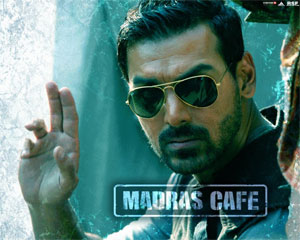
    Madras Cafe

    Director: Shoojit Sircar

    Main Cast: John Abraham, Nargis Fakhri, Rashi Khanna and others


    Shoojit Sircar’s Madras Cafe is one of those films that put critics in a quandary. It takes up a subject unusual for Hindi cinema, and treats it with a no-frills realistic style, so it deserves praise. But then, it is an uneasy blend of fact and fiction, has lapses of logic and below par performances, and that is a problem.


    In the end, it won some heartfelt praise, some grudging, and ratings from 2.5 to 4, which can confuse readers of multiple media. There was also the controversy raging, with Tamil groups protesting against its release.


    Anupama Chopra of Hindustan Times wrote, “Watching Madras Cafe is both frustrating and satisfying. The thriller, set against the backdrop of the Sri Lankan civil war, is, in equal parts, muddled and moving. There are sequences of power and eloquence. And passages in the first half that had me so confused that I couldn’t figure out who was chasing whom.”


    Rajeev Masand of CNN-IBN was all praise. “Solidly directed by Sircar, who steers clear of typical Bollywood machismo and avoids oversimplifying characters or their motives, the film – at a little over two hours – is a compelling watch….  Until the climate is more conducive for filmmakers to boldly make real-life stories without fear of controversy or censorship, this may be the best way to approach important stories that must be told.”


    Sukanya Verma of rediff.com commented, “When done right, few combinations have the allure of fact meets fiction. The veracity of one pitched against the ingenuity of another can produce awe-inspiring results. Though not entirely above faults, Shoojit Sircar’s Madras Cafe marries the two to direct an engaging political thriller about a fictional character’s experience against real events and references, namely Sri Lankan Civil War and the assassination of ex-Prime Minister of India, Rajiv Gandhi.”


    Nandini Ramnath of Mint came close to panning it. “Madras Cafe hints at a conspiracy within the conspiracy, but it’s never really clear what exactly is the untold truth being revealed. The nationalities of the Caucasian men with whom LTF cadres are consorting? The extent of corruption within RAW? The notorious inefficiency of the Indian state?”


    Karan Anshuman of Mumbai Mirror was lenient. “In a predictable trend, if a film’s opening titles are a classic text-on-black you may assume with near certainty that it is going to be a sensible film. Not that experimenting with opening credits doesn’t often make for sensible cinema, but the simplicity of the concept usually foretells complexity of the story to follow. And Madras Cafe is a complicated film.”


    Saibal Chatterjee of NDTV.com was warm in his praise. “Madras Cafe is a sinewy and riveting espionage thriller that entertains without having to play to the gallery. That isn’t the only departure from norm that director Shoojit Sircar makes. He also attempts a risky tightrope walk between staying true to recent geopolitical history and the need to serve up an imagined, dramatised spy story. He succeeds on both counts. At no point does Madras Cafe appear to be in danger of losing its balance and plummeting into a void. Sircar hits the right strides, and blends fact and fiction with great narrative aplomb and visual flair.”


    Srijana Mitra Das of the Times of India raved, “Madras Cafe’s true star is its story which builds up to an agonizing end. It brings to life the Lankan war which many viewers were too young to have known. It highlights India’s ambiguous role, moving sensitively, taking no sides, except those of relationships involving respect – but no romance – between Vikram and Jaya, duty, victory and loss. Its second half grows more fraught and taut, conspiracies and compulsions becoming clearer. John stays low-key and competent as Vikram while supporting actors, like agents Bala, SP and Vasu, stand out. Restrained performances by the LTF suicide bombers are chilling.”


    Anuj Kumar of The Hindu was impressed too, “After a rather uninspiring start, Sircar has plotted a gripping tale where the action shifts from South Block to South India in almost real time. Here, it is not just the people in a scene that you have to listen to; you have to keep an ear out even for those who are not in the frame. Considering he starts with a handicap, where we know the end from the start, he manages to keep us riveted for the most part. His victory lies in the fact that he makes us believe that the tragedy could have been prevented. His hint at a larger conspiracy of a syndicate with business interests in the region echoes what Agent Vinod also hinted at, but Sriram Raghavan got carried away with the demands of the box office. Sircar chooses to keep it closer to reality.”


  • Ranjona Banerji: Lack of professionalism and sympathy in gangrape coverage

    By Ranjona Banerji


    The morning on Twitter after the gangrape of a young photojournalist in Mumbai was an unnerving experience. Suddenly, the discussion was about how the media does not report rapes that happen in slums, about the class of the people raped and raping and how people react only when people of their class are raped.


    This is a stomach-churning sort of justification of rape and such reactions (the area was deserted, it was late in the evening, when women in slums are raped no one cares) are symptomatic of why rape is seen as a legitimate threat on social media. Sadly, some of these reactions were coming from journalists – showing, together with everything else, a lack of sympathy for a member of the community.


    Pop sociology is the scourge of journalists and of course of anyone who has access to a public platform. Which is fine as far as it goes. We are all entitled to our own opinions. But in Ye Olde Worlde, journalists had to clock in more than 365 days in the profession before they became final arbiters on just about anything. Now, of course, you turn on the TV and you are bombarded with the “new shrill India” – according to The Times of India’s worthy edit page – exercising its right to be heard.


    I am not sure however that being new and shrill is a justifiable excuse for lack of professionalism at least as far as the Indian media is concerned. Somewhere, editors have taken the backseat in a frenzied campaign to let youth have its say. No need to denigrate youth but no need to follow all its opinions and pronouncements either, minus discretion and better judgment.


    The fact that TV journalists get shrill and unprofessional in their coverage of such events does not help. On Times Now, the anchor wanted to know the class of the accused — a needless interjection at this stage. The Lower Parel area of Mumbai is introduced as a corporate hub – again making subliminal societal suggestions extraneous to the case, especially at this early stage. TV anchoring is all about editorializing before the facts are known or processed. That is of course part of the reason why watching TV news can be so exasperating. And dare I say it again, being bad for blood pressure.


    **


    The miserable side of all this is that despite all the largely excellent coverage of the Delhi gangrape of December 16 and the public upsurge of anger in the way women are mistreated in our society, nothing has changed. Our police, investigative and political responses are as incompetent and asinine. The Delhi case is limping along in the courts. And the cynic suggests that this Mumbai case will go the same way.


    Regardless of how people and people in the media get excited by the impact of their work, there is only so much that the media can do. Society and the system have to do their part as well to make a substantial difference.


    And there’s the rub.


    **


    In other news, the apparent collapse of the Indian economy has had varying reactions from different media outlets and big ticket commentators. A person with limited knowledge of money matters would be left impossibly confused if she read a variety of reports and comments. The rupee falling is good, is bad, is terrible, is wonderful, X is a genius, X has no idea about anything, listen to Y, Y is a fool…


    At the end of it, the media tracker is as confused as the economy. Mission accomplished?


    Ranjona Banerji is a senior journalist and commentator based in Mumbai. She is also Contributing Editor, MxMIndia. She can be reached via Twitter at @ranjona. The views here are her own


  • Ranjona Banerji: Kneejerk reactions to gangrape coverage

    By Ranjona Banerji


    “The Media” has been getting into a bit of trouble with the Mumbai gangrape case, for a variety of reasons. The silliest first: critics who assume that “The Media” is a single entity which thinks and moves as one gigantic slug. In fact, “The Media” is a bunch of separate publications, TV channels and now websites, all of whom are in competition with each other. “The Media” does not in fact attend the same meeting every day or week or month or year to discuss strategy and coordination. All the elements in “The Media” hold meetings everyday to try and trump each other.


    Then there is anger that “The Media” does not give publicity to, expose, investigate crimes against people of classes which are below their average newsroom class and never goes to remote hinterland areas. This is partially true but easily understood. Each individual publication and news channel caters to a particular readership in a particular language. Newsgathering will largely be restricted to that constituency. Sounds terrible? But somewhere there will be some media covering another constituency. That you have not heard of it is hardly “The Media’s” fault. Having said that, there is always scope for increasing coverage of the “other India” in both English language news publications and news channels.


    But I also know this: most people will read about film actor Om Puri’s marital troubles in today’s newspapers than anything at all on the edit page for instance. Usually a media outlet has to be at least as shallow as its readership or viewership.


    Then there are the serious problems with rape coverage. I am surprised at the transgressions made by The Times of India’s Mumbai edition here. Kalpana Sharma has gone into them in detail for The Hoot (http://www.thehoot.org/web/TOI-s-foot-in-mouth-rape-coverage/6990-1-1-25-true.html) and it is hard to improve upon that.


    It is true that calling a person who has been raped a survivor and not a victim reeks a bit of tokenism when you can’t get anything else right (including a sanctimonious front page declaration). Also, why senior journalists needed to invade so much of a victim’s privacy seems strange. Why inform people in the victim’s building? Why name the magazine where she worked?* Details of the extent of her injuries may have eventually become public knowledge, however. Where investigative journalism ends and intrusion begins is a tough call and both “The Media” and its critics need to be aware of this.


    However, TOI is not the only publication to blame. Rape is a difficult subject to cover and on the run, mistakes are made. Better communication between editors and reporters, good debriefing systems and a desk that is aware of the laws are vital here. Yes, I know that is asking for the moon.


    **


    What can be done within the media, since the victim/survivor and her accompanying colleague were part of the fraternity? It is ridiculous in the extreme to even entertain Maharashtra home minister RR Patil’s suggestion of police protection for working women journalists. If the police had worked harder at tracking/picking up anti-social elements in the Shakti Mills area, may be this crime may not have happened.


    Besides, the life of a working journalist is too unpredictable to make police protection practicable. Also, everyone needs help from the police, not just journalists. A media which constantly exposes the loss to effective policing because of VIP security can hardly appropriate some of that security for itself.


    Can or will media houses become more aware of the problems faced by their employees? It would be a shame if this “protection” idea led to a curtailment of assignments to women journalists who are still fighting hard to get equal status. We need more women, not less and we need less kneejerk reactions.


    * MxMIndia is also to blame for this. We did name the publication that the photojournalist interned at in our comment on Friday. We figured later that it wasn’t the right thing to do, and deleted the reference. Our apologies. – Editor.


    Ranjona Banerji is a senior journalist and commentator based in Mumbai. She is also Contributing Editor, MxMIndia. She can be reached via Twitter at @ranjona. The views here are her own


  • Ranjona Banerji: Which news channel do I watch? Help!

    By Ranjona Banerji


    The media is now a topic of conversation as much as it is a vehicle for topics of conversation. In spite of the irritation of explaining how journalism means to “outsiders”, on due consideration this has to be a good thing. Given the intrusive nature of television and the discursive nature of social media, the days of newspapers being a medium twice removed from you are long over. The rather classist ads by I think Airtel about a liftman asking to become a Facebook friend or a girl being rather rude to a woman at a bus stop who offers use of her phone’s email facilities point to the way technology is breaking barriers.


    How much this will make journalists take objections into account is another matter. I see no difference in the way TV news operates in spite of their many transgressions. This brings me to a question: which English news channel does one turn to for the best all round news through the day? The prime time debate dramas I discount as they come under the entertainment sector.


    CNNIBN used to be good but I feel that their standard has slipped since all the sackings – or perhaps that’s my imagination. Times Now is so full of errors and editorialising in the day that it is useful only when something happens in Mumbai since that is where they are based. NDTV is bearable in the day but they have a tendency to branch off into long docu stories and entertainment guff right when some big news is “breaking”. Headlines Today is very shrill and sometimes operates at a disturbingly high level of jingoistic outrage. No longer smart news for smart people I think. News X is a sober option but their anchors are so bad that it is impossible to understand what they’re saying.


    I have given up on grammatical errors on TV but pronunciation errors still amuse me, I’m afraid. There is so much emphasis on getting some faux phoren accent right that much-used words are completely mangled. “Register” and “available” are common casualties and in fact and of course are in fact of course overused.


    The day may well be coming when we have to give up on the idea of English news channels. In any case, the news gathering skills of the language channels are often superior – the gem stone, astrology and ghost hunting programmes notwithstanding.


    **


    The insularity of India as a putative superpower is quite fascinating. Economies across the world have been suffering since 2008 for a variety of reasons. But the situation in Syria is quite frightening, with Europe and the US poised for military intervention. We however are so obsessed with our internal petty dictators and their fan clubs and our corruption scandals and the falling rupee and poverty alleviation schemes that we seem unaware of the horrors going on and imminent not that far away from us. I know the media does what its readers want but here perhaps the media needs to step away from management principles and apply some basic journalistic thought to Syria.


    **


    For the past two days, the Mumbai edition of The Times of India has been telling us Saturday’s rainfall figures. Tomorrow is Saturday so they have one more day to get away with this…

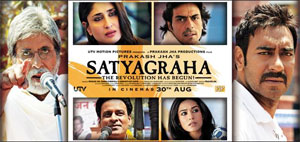
  • Reviewing the Reviews: Serious critics give ‘Satyagraha’ 1-2.5 stars, rah-rahs upto 4.5

    By Deepa Gahlot


    Satyagraha

    Director: Prakash Jha

    Starring: Amitabh Bachchan, Ajay Devgn, Kareen Kapoor


    Prakash Jha doing his patented small-town politics, issue-waving films, draws a line between the serious critics and the ones who provide the rah-rahs for the purpose of providing 4 stars ratings for ads.


    The serious critics ripped the film apart and give it 1 to 2.5 star ratings, while the rah-rahs went up to 4.5.  So audiences confused again and will either go check out the film themselves on opening weekend, or wait till is shown on TV.


    In a line, Jha took a topical theme and made a hash of it, but is saved by the stars.


    Shubhra Gupta of The Indian Express ranted, “The trouble with cobbling together your film’s plot from current headlines is glaringly evident in Satyagraha, Prakash Jha’s latest take on What Ails The Nation. It becomes a case of putting on celluloid events that have just finished unfolding, and are still unravelling in front of our eyes: if it is happening in real life, why do we need a reel version? Especially a version which doesn’t add anything of significance to the narrative: it’s all been-here-seen-this-and-that before.”


    Sanjukta Sharma of Mint was scathing: “Jha is more a pamphleteer rather than a director here. Besides the blinkered view on the politics of the common man, he is surprisingly blind to some film-making basics. Lighting by cinematographer Sachin Krishn could suit a TV soap opera. Editing is slack. The production design of this film is so poor, that even if there are some weighty scenes and some snatches of moving performances, you are unlikely to notice them.”


    Vinayak Chakravorty of India Today is a little kinder. “Raajneeti got it right. Aarakshan messed it up midway. Chakravyuh looked like Prakash Jha was not even sure of what he was doing. The writer-director’s fetish for cocktailing topical realism and box-office friendly masala continues with Satyagraha. A comparative analysis of Jha’s recent oeuvre becomes essential because in look and rendition Satyagraha reminds you of every film the director has made Raajneeti onwards.  If the Prakash Jha film in itself has become a formula, his latest does not break the pattern. The film is well-intentioned film, its message relevant. Unfortunately, not every well-intentioned film with relevant message leaves an impact. Satyagraha is more Aarakshan than Raajneeti in quality.”


    Sarita Tanwar of DNA made a valid point: “The thing that troubles me is: why make a fictional version of a subject like this? The only valid reason seems to be to not piss off the powers that be. To ensure a release. Admitting this is based on the Anna Hazare movement would have meant many hurdles. From political pressure to censor trouble to say the least. So director Prakash Jha chooses to call this a drama/love story, thereby defeating the whole message/point of making a film like this. You can’t make a film about what is wrong with the system, while surrendering to the system. It is a cop-out.”


    Anupama Chopra of the Hindustan Times commented: “If good intentions were enough to make good movies, Satyagraha would be a masterpiece. Prakash Jha is one of the few directors in Bollywood who has consistently championed political cinema. His rage at the rotten state of the system has simmered through his movies for nearly three decades. But from the National Award-winning Damul in 1984 to Satyagraha, his stories have become increasingly simplistic, star-driven and heavy-handed.”


    Rajeev Masand  of IBNLive expressed disappointment too. “With Satyagraha director Prakash Jha once again raids the headlines, this time turning his gaze on the growing public resentment towards the deep-rooted corruption in the system. Jha borrows liberally from real events and the lives of real people, including famed anti-corruption crusader Anna Hazare and the Jan Lokpal Andolan he inspired. Unfortunately Jha’s heavy-handed direction turns this well-intentioned drama into a plodding sermon.”


    Karan Anshuman of Mumbai Mirror wrote: “Prakash Jha came a full circle with his brand of cinema with Gangaajal in 2003, returning to what put him on the map in the first place with Damul (1985). He gave himself a mandate – activism through mainstream cinema – and embarked on a series of films on remarkably diverse subjects ranging from the Bhagalpur Blindings case to the state of education in the country, from an assessment of Indian dynastical politics to the Naxal quandary; always subtly offering to weigh in on a position that may not be the prevalent opinion.  But Jha’s films try too hard to sell themselves in this escapist market. Whether it’s the item song or the melodrama – in the last decade his style has been too consistent, and hence predictable – there’s reluctance to evolve.”


  • Ranjona Banerji: Juvenile hysteria on News TV

    By Ranjona Banerji


    A Headlines Today sting on Asaram and his ashram for sexual offences in 2010 is being replayed by the channel now, after the religious leader has been arrested on charges of molesting a young girl. It is not exactly clear why the sting was not aired after it was made. The channel however has to be congratulated for putting it out in the open now. It also claims that this footage is being used by the police to bolster the case against Asaram.


    It is interesting though that many of these gurus, religious leaders and cult figures have relied on the media to build them up. Times Now may have had a vociferous campaign against Asaram in this case but “godmen” and assorted “gurus” from Rajneesh to Sri Sri Ravi Shankar to Jaggi Vasudev have received plenty of support from the Times Group. The allegations of murder of schoolchildren against Asaram’s ashram have more or less been forgotten.


    The most influential of these religious leaders was undoubtedly the late Sathya Sai Baba. In 2000 India Today did a cover story on Sai Baba which included the wide range of charges of sexual misconduct and paedophilia made against him by former disciples. The enormous pressure put on all media organisations not to take the story further was remarkable. Leaders and pillars of society in all disciplines converged on newspaper and magazine offices (TV was less of a factor in those days) to stop anyone else from covering the allegations.


    It is a testament to our tremendous faith in religious figures as a society that people like this are not treated like cult leaders and dismissed for what they are in many cases: clever manipulators of human weaknesses. Instead, they are feted by the media as much as by anyone else. Every time the Mumbai Marathon comes along, readers may notice how the participation of a particular spiritual speaker who specialises in the Vedas and the Bhagvad Gita is seen on pages of newspapers. The pressure on editors from his well-oiled PR machinery run by his followers to carry this story is incredible.


    And then there are all the news channels which devote hours of news time to astrologers, gem stone peddlers and various other mystics who can fix all problems. Sybil the Psychic from Network anyone?


    **


    In a side note, the Indian media might want to think about the fact that the word Sanskrit “sant” does not translate into “saint” in English. Nor does the word “shaheed” mean the same as “martyr”.


    **


    A personal note here: In spite of knowing that the juvenile in the Delhi gangrape case of December 16 2012 could only be tried under juvenile law, I was disturbed by the three-year sentence to the accused, who was supposed to be the most brutal of the lot.


    It was however clear from discussions after the rape that since the Juvenile Justice Act of 2000 changed the age of a juvenile from 16 to 18 for boys, there was nothing that could be done in this particular case. Even if the law was amended, it would not have retrospective effect. This juvenile accused could not get more than the maximum penalty of three years.


    I was therefore amazed (why you ask, and with good reason!) to watch the most unseemly hysterics on Times Now on the issue. Some lady from the BJP and a human rights advocate got into a slanging match, Arnab Goswami was taking the moral high ground against human rights activists and the whole atmosphere was bristling with high-pitched manufactured outrage. If Goswami had bothered to pay attention to discussions on his own channel earlier this year, he would have been able to at least steer this particular conversation to a new direction.


    To reference the film Network again, after 10 minutes of this nonsense I wanted to stick my head out of the window and shout: “I’m as mad as hell and I can’t take this any more”.


    Yes, I know I have reversed the context in which Howard Beale yelled that out but it’s no less true for all that.


  • Ranjona Banerji: Spotlight on staff welfare in media

    By Ranjona Banerji


    There was a report in the papers last week about how the Government of Maharashtra had paid Jaslok Hospital Rs 1.85 lakh towards the treatment of the young woman who has gang-raped at Shakti Mills compound. I put out a tweet asking why the organisation she worked for did not contribute. Part of my cynicism, I must admit, comes from my observation and knowledge about how callous media organisations often are about the welfare of their staff.


    I received messages from the organisation asking if they could put their point of view forward. I had a very long chat with a senior person who explained their situation. Upfront, their problem is that they can do very little in the public domain for fear of giving away the victim’s identity or jeopardising the case in any way at all. This is a legitimate and understandable concern. It is of paramount importance that the case against the accused rapists is watertight.


    The organisation where the photojournalist was interning says that it was prepared to foot the bill for her treatment but once the government stepped in with its offer they decided to back off. However, they say that they have been with the victim and her colleague every step of the way since the office was informed of the incident. And all further help of various sorts that is required will be given to both. This is both heartening and welcome.


    As I told the person I spoke to, if even half of what they were telling me they plan to do is true, it is more than most media organisations are bothered with. Staff safety, security and support are not codified and can be ad hoc at best, depending on individual bosses. As media organisations have become more corporatised, personal relations have gone for a toss. HR departments may have more people and more jargon but they are often without both sense and heart. At least in the earlier days when you had some clerk-run personnel department, proximity to the owner was not remote. But it was largely hit and miss. For instance, it took years for many newspapers and magazines to even provide home drops after night shifts.
    There is plenty of scope for discussions on checks and balances for safety on the job, taking concerns of journalists and organisations into consideration. All too often any practical solutions get lost in moral grandstanding on one side and obdurate management theories on the other. Perhaps there is a slim chance we can overcome this.


    **


    The Times of India has done an expose on the amount of fuel spent by government cars – by both ministers and bureaucrats – and came to the shocking figure of a Rs 3000 crore bill in Delhi alone. In Thursday’s paper, the Rs 3000 figure was on the front page and mentioned in the intro to the report.


    In Friday’s paper, a small correction tucked away at the bottom of page 15 tells readers that the paper got its arithmetic wrong and the figure is actually Rs 30 crore. The mistake was spotted by a “colleague”. However it was evidently too late to inform the edit page by then which is why the second edit on Friday’s edit page refers to the Rs 3,000 crore expenditure.
    I don’t know about you but I am sorely disappointed in this drop…


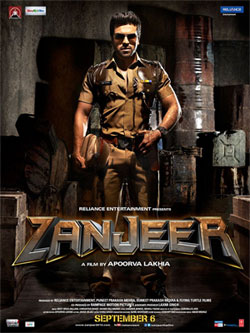
  • Reviewing the Reviews: Critics give Apoorva Lakhia’s Zanjeer a mauling

    By Deepa Gahlot


    Zanjeer

    Director: Apoorva Lakhia

    Starring: Ram Charan, Priyanka Chopra, Sanjay Dutt


    Many of today’s multiplex audiences were probably not born when the original Zanjeer was made by Prakash Mehra in 1973. In spite of having no memories of the film or knowledge of its legacy, they rejected it.


    Critics, were of course, understandably savage—Apoorva Lakhia’s remake deserved a mauling. And Ram Charan was thrashed too, for even trying to do a role immortalised by Amitabh Bachchan.  This film got 0 stars and some 2 or 2.5s, but the unarticulated question was: How dare they?


    Aniruddha Guha of Time Out ranted, “For Lakhia, this is another dud in a career that boasts of some of the most terrible Hindi films of the past decade. Without a shred of originality, no sense of aesthetics, and a major lack of finesse, Lakhia needs to reinvent himself completely if we have to sit through another one of his films. That’s a rather unrealistic hope, I must add.”


    Raja Sen of rediff.com commented, “Ram Charan Teja makes his Hindi film debut with this Bachchan remake, and my heart goes out to his fans who will have to sit through this tediously trashy film. To paraphrase an unforgettable Indian movie character who shares a name with this new hero: Teja tum ho, marks idhar hai — alas, it isn’t anywhere close to a passing grade, son. You shouldn’t have bloody tried.”


    Shubhra Gupta of the Indian Express asked ‘why’. “Implicit in all remakes is the idea that you are refreshing the film, both for those who may have seen the original, as well as for newbies ( in the screening I was at, I found someone who, gasp, hadn’t seen the old one). The filmmakers have been carefully calling it a “tribute”, and they have added a couple of elements which weren’t in the older film, but to me it was a neither here-nor-there thing: it’s neither faithful remake nor campy, knowing tribute. It’s just a poor copy. So why?”


    Rajeev Masand of CNN-IBN fulminated: “Directed by Apoorva Lakhia, who has previously unleashed such atrocities on our senses as ‘Mumbai Se Aaya Mera Dost’ and ‘Mission Istanbul’, the new ‘Zanjeer’ isn’t just a bad film, it’s a shameless exercise in laziness. As anyone who watches movies for a living will tell you, there’s some merit to be found even in awful films…a nicely picturised song perhaps, or a decent performance from a random supporting actor, possibly a relevant message buried somewhere in the mess. But I’m afraid there’s nothing polite that can be said about ‘Zanjeer’.”


    Vinayak Chakravorty in India Today rightly commented: “They shouldn’t have messed with Zanjeer. Don was still understandable, Agneepath too. But if you can’t get an actor who can use silences to emote aggression you should not fiddle with an original that pretty much defined new-age violence for the Hindi screen. It is pointless saying comparisons will not crop up, every frame of Apoorva Lakhia’s remake shouts out reasons why it shouldn’t have been made. The remarkable thing about Prakash Mehra’s 1973 original was its underplayed angst. Lakhia’s version goes over the top with dumb action and dumber drama. Essentially, he fobs off Salim-Javed’s original idea, passes it off with a few tweaks, and gives it mindless treatment.Zanjeer 2013 looks like one of those noisy south Indian remakes Bollywood regularly peddles rather than a tribute to one of the greatest commercial films of Hindi cinema.”


    Tushar Joshi of DNA deplored its weak points: “Zanjeer struggles to find its own ground. The first half is a land mine of unnecessary songs and hackneyed dialogues that seem written for an audience for a different era. Whenever Lakhia tries to create a reference point to the original or recreate a moment, the initiative falls flat. It’s not just originality but also lack of novelty that mars the film from being anything but ordinary.”


    Karan Anshuman of the Mumbai Mirror wrote: “If Salim-Javed do watch this film, one wouldn’t be surprised if they decided to give the money and ‘core story’ credit back and disassociate themselves from this embarrassment of a “remake”. In this distressing time of remakes and hand-me-down inspirations, let’s remember Herman Melville, “It is better to fail at originality than to succeed in imitation.” Zanjeer manages neither.


  • Ranjona Banerji: Of corporate and their Twitter handles

    By Ranjona Banerji


    How are corporates supposed to use social media? Some of us have found that if you send a complaint to a company’s Twitter handle, you get a quicker response than fruitless and frustrating hours spent trying to get through to a call centre. That is, the call centre calls you. I have thus successfully negotiated a couple of problems with Vodafone through Twitter. However, I really don’t know why Vodafone has a Twitter handle. Or more particularly, whether the Vodafone Twitter account exists to supplement or augment its existing customer care systems. I suspect not.


    Anyway, I now follow Vodafone India on Twitter. I observed that many of their tweets would follow this pattern: “Dear Sir, thank you for your feedback. An executive will be in touch with you shortly”. A while later it would be (usually to the same person): “Our executive tried to get in touch with you but your number was unavailable.


    For no reason except silliness, I sent a tweet to Vodafone saying that it does not look good when a phone company declares publicly that its own numbers are “unavailable” to it. Well, I paid the price for laughing at them. I promptly got a tweet in reply saying “Thank you for your feedback. An executive will be in touch with you shortly.” And shortly, (all right, bang in the middle of a Sunday afternoon snooze) there was an executive calling to say, ‘Madam, you made a complaint?”
    Rather than explain, I just said very sorry, no complaint and disconnected. The idea of explaining my joke to customer care and the irony of a phone company not being able to get through to its own subscribers was too frightening to attempt. I admit it. My courage failed. But the question remains. Does @VodafoneIN exist to answer customer complaints or is it supposed to have a wider purpose like publicising its offline and online events, promoting its products and services and drawing attention to its mainstream commercials? At the moment, it seems burdened with angry customers which might mean someone else is not doing their job?
    It is worth noting that some companies and their Twitter handles never respond. I have never got anything out of complaining to @StarSportsIndia (and its earlier avatar before the split with ESPN) over its bizarre programming re: tennis. But I have very often got responses from @ten_sports. So is that arrogance on the part of Star Sports or just an inability to answer questions that are outside its brief? The most entertaining to engage with was the Twitter handle for BBC Entertainment for as long as the channel broadcast was in India.


    **


    [youtube width=”400″ height=”220″]http://www.youtube.com/watch?v=owGykVbfgUE[/youtube]That Old Spice India failed in its conversion of its very successful commercials with Isaiah Mustafa, a former American footballer and now TV star is apparent. For some reason, they dubbed Mustafa’s voice which is a vital ingredient to the success of the “Look at your man, now back at me” line.


    This partial adaptation to Indian “needs” is as foolish as the subtitlers and bleepers for American TV programmes shown in India where the character says “bastard” and the subtitle reads “turd”. I don’t know about you, but for my money, “turd” is worse. Bastard after all just means that someone’s mummy and daddy didn’t tie the knot; better than being called a lump of faeces.


    The Park Avenue take off on Old Spice with the beer shampoo for “Man Hair” commercial is funny and effective and I would much rather a man with bouncy and shiny “man hair” with shampoo bubbles coming out of his mouth than a man concerned with the effect of the sun on his complexion. To use a phrase from Twitterland: #JustSaying.


    **


    There were no newspapers in Mumbai, today, September 10, 2013. Hence…


  • Ranjona Banerji: The Economy turns around, and so do the Experts

    By Ranjona Banerji


    As a newspaper reader, I would like an apology from all anyone at all who has written on the economy in the past three months. Because they have confused the hell out of me, pardon my French. Till a month ago, as far as I could tell, India was teetering on the edge of disaster. The rupee-dollar ratio was the worst ever, industrial output was down, money was fleeing the country, the Sensex and other indices were tanking – one more thing going wrong and we might as well run like lemmings to the nearest cliff.


    “Expert” after “expert” in newspapers and on websites told us how India can never recover, that it was foolish to blame world events and the US Federal Bank’s moves and that Sonia Gandhi and the Food Security Bill were to blame. The only person I could make sense of was Paul Krugman in the New York Times who asked what all the fuss was about. Television largely – and quite wisely — side-stepped the economy since hysterical jingoistic debates are not really possible when words like Capital Account Expenditure and Repo Rate are flung about. Then, Raghuram Rajan became governor of the Reserve Bank of India. And magically – there can be no other word – the situation turned around. The same experts now told us that everything was looking up, the CAD was not acting that caddish, the rupee was correcting itself versus the dollar, the Sensex was rising and we need not head to the cliff after all.


    Well, I don’t believe it. Both things cannot be true. Either the first predictions were hogwash or the second indications are rubbish. Or, and I think this is most likely, these experts have abandoned any semblance of interpretation for needless predictions. They never knew as we all remember that the western world’s financial system would crash in 2008. They keep celebrating random CEOs till they are sacked for mismanagement or insider trading. They follow stock exchanges as if those are the main gauge of life. So what do they know now?


    This morning’s papers tell us that industrial output is now up in India. Are we supposed to laugh or cry? I must however give a shout out to The Economic Times which steered clear of all this doomsday nonsense.


    **


    I am not sure what to make of the new look of the Hindustan Times. The headline fonts look a little too condensed to me and the pages look crowded. Also the little front page jacket flap which is supposed to be torn out and kept with the reader through the day – what’s that about? In this digital day and age who is going to keep a crumpled up page of newspaper with them all day?


    But it is good to see other writers on the Hindustan Times edit page and perhaps soon they will do without our television worthies and their anodyne banalities.


    **


    Are TV and print being ironic when they keep calling the BJP’s declaration of Narendra Modi as their putative prime minister an “anointment” or a “crowning”? It is hard to tell because in these times, irony seems to be in short supply in the Indian media. It is quite likely that headline writers and sub-editors really believe that “anointment” is another word for “appointment” and “crowning” is another word for “announcement”. On the other hand, there is a distinct undercurrent of satire when Rahul Gandhi is called a “crown prince”.


    It is another matter that there is no need for anyone to announce a prime ministerial candidate since the Constitution has some other ideas on how this “crowning” is to be done. Sigh.


  • Ranjona Banerji: Time for the media to jump left, right or centre

    By Ranjona Banerji


    The media, it seems, needs a few lessons in school civics. For instance, India is a not a presidential form of democracy, we are a Parliamentary democracy. We do not have a face-off between opposing presidential candidates but between opposing political parties. Nor are we a two-party democracy but instead a multi-million party democracy. By getting all these facts mixed up, we only end up confusing the reader and the viewer who are now waiting for Barack Obama and Mick Romney to start fighting each other in town halls with a TV anchor as a referee. TV may love to do this, but it has not happened yet. Until it does, time to go back to the textbooks. Might be worthwhile to also look up Constitutional amendments to see what is required to change the Indian system to suit all of TV news and one political party.


    It might also be necessary for the Indian media to try and understand that a party choosing a person as a prime leader into the next elections is not quite the same as being destined for sainthood or divinity. Nor is it (or should be) some excuse for monarchy. Therefore Narendra Modi was neither anointed nor “coronated” — which is also bad English, since the more acceptable word would be “crowned” – as the BJP’s prime ministerial candidate. I have said this before in these columns but it is worth repeating since this nonsensical twisting of language is only going to continue.


    **


    Is the Indian media going to go the way of media elsewhere in the world and be divided into right and left wing? So far, we have been a sort of fuzzy centrist collective, with a few extreme right or left wing elements. The last time a divide showed up was during LK Advani’s rath yatra and the build up to the demolition of the Babri Masjid. There are clear indications of this happening again. This division is not necessarily a bad thing since it would give readers and viewers a clear indication of what each media house stood for.


    Right now, The Times of India has confused me the most, since it is impossible to understand what it is up to. Is it left or right or both or all or opportunistically backing the new horse on the block? Could anyone make sense of the second edit in Tuesday’s paper on Narendra Modi, iron and irony? http://timesofindia.indiatimes.com/home/opinion/edit-page/NaMos-latest-speech-shows-terrific-irony-in-more-senses-than-one/articleshow/22634970.cms


    CNNIBN appears to have made a shift from centre to right. This has even percolated down to its very good satirical show, The Week That Wasn’t which makes both intelligent and slapstick fun out of all political parties but somehow fights shy of attacking the BJP. I’m going to try and start a social media conversation with them on this, so may have more to report later.


    Headlines Today, which I always pegged as being right, seems to be shifting centre-wards. At any rate, its “So Sorry” cartoon segment takes wonderful pot shots at everyone.


    **


    I have to end with The Times of India once more. Today’s front page in Mumbai led with racist slurs on social media about a girl of Indian origin winning the Miss America beauty pageant. Just below that was an article about 12 people being shot dead in an attack on a naval building in Washington DC – both USA stories, but apparently anything at all affecting non resident Indians is more important than death or a possible terrorist attack.

    http://epaper.timesofindia.com/Default/Client.asp?Daily=TOIM&showST=true&login=default&pub=TOI&Enter=true&Skin=TOINEW&AW=1379395340545