Category: PRINT MEDIA

  • Malcolm Mistry joins dna as CEO

    By A Correspondent


    The Zee group’s English daily dna has appointed Malcolm Mistry as CEO.


    Mr Mistry has over two decades of experience across the India Today and Indian Express groups. As Publishing Director at the former, he was responsible for the flagship India Today magazine and all its language avatars, Business Today and Readers Digest amongst others. In addition, he was the chief architect of the sales synergy process as he created a unified sales team across various brands. His last stint saw him turning entrepreneur and launching Ushta Te HR Consultancy Services to provide recruitment solutions across key verticals like media, advertising and luxury. The appointment, say industry observers, will be a boost to the sales function at dna which needed a ‘face’.


    Commenting on the appointment, Subhash Chandra, Chairman, Essel Group said: “We are delighted to have Malcolm on board. His extensive experience in leading strong media brands will help build on the momentum and navigate ‘dna’ into a phase of high growth.”


    On his new role, Mr Mistry said: “dna has strong brand equity. I am excited with the challenge of raising the bar and creating a more vibrant ‘print plus’ product with greater consumer traction and increased shareholder value.”


    dna is now part of the Zee Media Group which also comprises a slew of television channels and digital offerings. Dr Bhaskar Das, formerly President, Bennett, Coleman and Co and associated with several industry associations, is Group CEO. The position of CEO at dna has been vacant since K U Rao moved on to a Zee group firm and later exited the media conglomerate.


    In recent months dna has gone in for a new look, appointed an editor-in-chief and also undertaken an aggressive marketing campaign.


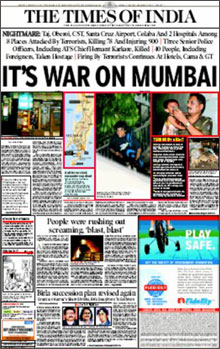
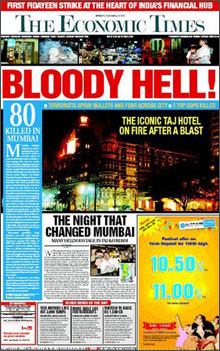
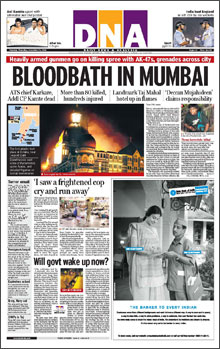
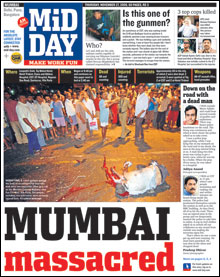
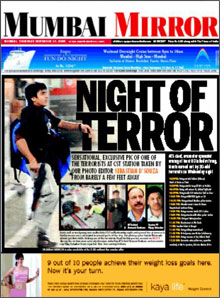
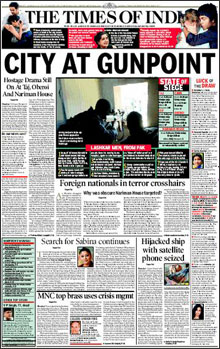
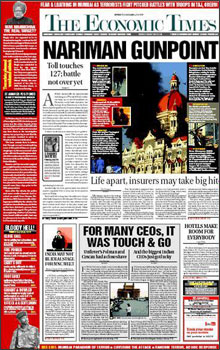
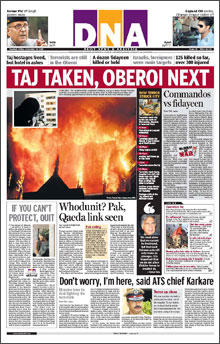
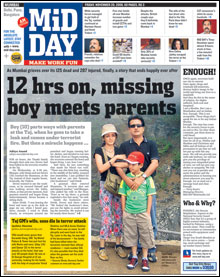
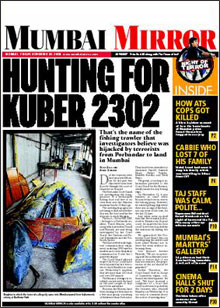
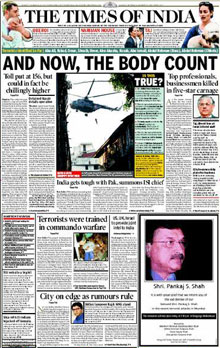
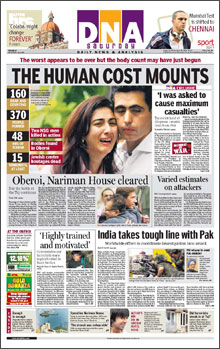
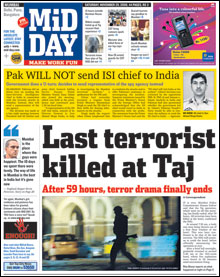
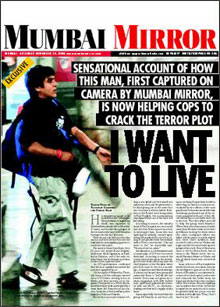
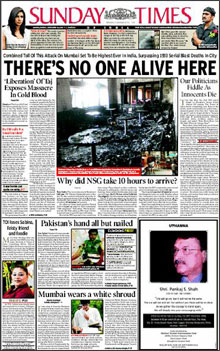
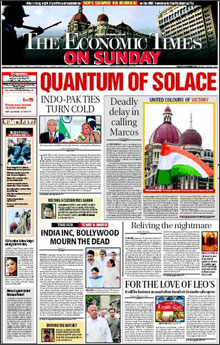
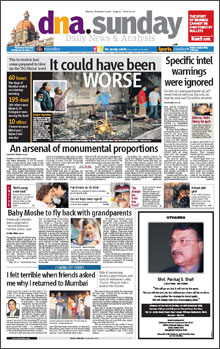
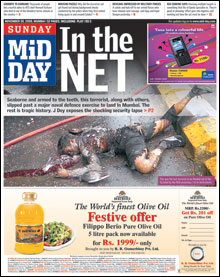
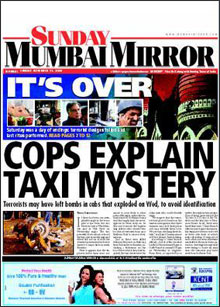
  • Page 1 of some Mumbai dailies – Nov 27-30, 2008

    And this is how the front pages of some of the Mumbai dailies were from November 27 to 30, 2008:


  • Sachin Kalbag: No time for water, no time to blink

    By Sachin Kalbag


    On the morning of November 28, 2008, around 100 reporters rushed to Chabad House in Colaba where four Pakistan-trained terrorists had taken hostage all the eight Jewish people living in the building. Chabad House, or Nariman House as it was previously known, is the outreach centre for the Jewish community in Mumbai, and is the first stop for any religious activity for the community, especially for those visiting from outside the country. It was a natural target for Islamist militants who had laid siege to key locations in Mumbai from the night of November 26.


    There were a few reporters present at the spot, but most of the attention from media houses for the most horrific terror attack in India’s history was given to the Taj and the Oberoi, both plush five-star hotels where hundreds were held hostage, and many later killed. Nariman House, on the other hand, is in a middle-class area of Colaba at Hormusji Street, and access to the building is through a narrow lane on the west, and a slightly wider but still crowded lane to the north. Escape is practically impossible.


    It was in this situation that Rabbi Gavriel Holtzberg and his pregnant wife Rivka found themselves on the night of November 26. Later, reporters at “ground zero” were told that the hostages were tortured badly before being killed.


    For the reporters, which included this writer who was reporting for the Delhi-based newspaper Mail Today, there was seemingly not much to do but wait until the well-trained National Security Guards (NSG) commandos neutralised the four terrorists.


    However, it was not all just wait and watch. Intermittent fire had already been targeted at journalists at the Taj on the night Nov 27, and the four terrorists at Nariman House could have, out of desperation, hurt any of the hundreds of onlookers and journalists, which included cameramen from news agencies all over the world. In fact, a few bullets were indeed fired at us, but they seemed more like warning shots than any attempt at killing us. The terrorists, reportedly, were told that their only aim at Nariman House was to kill the Jews. According to a Times (of London) news report, the Pakistani handlers told the terrorists that “the lives of Jews were worth 50 times those of non-Jews”.


    A unit of 22 NSG commandos arrived in the morning rappelling down a military helicopter, and entered Nariman House. Soon, the exchange of fire began. A second unit of NSG commandos, most likely snipers, took positions in a building situated 100 metres north of Nariman House. Separating them was the narrow lane, whose most remarkable feature was a large banana godown which was shut indefinitely.


    There was neither food nor any water for journalists, so we relied on the goodness of the locals to provide us with biscuits and cups of tea. The more fortunate ones were given vada pav. We could not even imagine the stamina of the NSG commandos who had nothing to eat or drink during the entire offensive that last close to 12 hours.


    The terrorists, it was immediately obvious, were well-trained in military warfare and hand-to-hand combat. How else could they survive an onslaught by some of the best trained commandos in the world?


    In the middle of all this, journalists were shooting pictures, giving live newscasts and filing stories to their respective newsrooms. The pressure on television reporters was immense. Viewers from all over the world wanted the latest, and the live pictures were not providing much context. Studios kept calling their correspondents, who had nothing much to say. This often resulted in misreporting.


    One such reporter, whom I got acquainted with, was being repeatedly called upon to give updates. In frustration, he began describing events that never took place. For instance, he would sit and chat with me for 20 minutes, and then, when his editor called, he would simply rattle off trivial stuff that was the figment of his imagination at best. When I asked him why he did that, he replied, “This is television, yaar. You print guys will never understand.” Later, at around 6:20 pm, they even claimed that the operation was over.


    I was more amused than angry. I cross-checked with a Hormusji Stree resident, Dhaval Koli, whom I had befriended during the day. He said the firing is still on, and the operation isn’t over. Koli worked at the local Baskin Robbins shop, and he offered to take me around as he had lived his entire life there. His help turned out priceless because I could add details to my reports that others could not. For instance, he was the first to tell me that Sandra Samuel, the 44-year-old nanny of Holtzbergs’ son Moshe, had rescued the toddler. The operation finally got over at night, three hours after television reporters had declared it finished.


    Around 9 pm, I ate my first morsel in 26 hours – a vegetable sandwich bought by a colleague working at India Today’s Nariman Point office. Later, after filing stories, I went to a pav bhaji stall to eat some Mumbai street food. There is a certain satisfaction you get by eating good food after more than a day of not eating. My respect for war reporters went up a hundred notches.


    I had arrived in Mumbai on November 27, and stayed on for four more days. Most of these 102 hours were spent on the streets. I could not meet my parents or my friends, who kept calling up. No reporter I knew there could find time to drink water, leave alone meet friends and family. This was one of the most horrific events of independent India, and as reporters, we could not even blink. We were, we soon realised, eyewitness to history.


    Sachin Kalbag is Executive Editor, MiD DAY


  • ‘HT for Mumbai Awards 2013’ awards changemakers

    By A Correspondent


    We should’ve carried this report Hindustan Times on Monday, the first edition after the awards happened on Friday, November 22, so our apologies to our readers. It’s one of those events which gladdened our hearts and worth the wait. It was a no-nonsense event. The chief guest, Chief Minister Prithviraj Chavan, entered the venue premises much ahead of the scheduled time of start. An emcee kicked off the proceeds, the Mumbai editor Soumya Bhattacharya spoke a bit, the speech short and sober, as the occasion demanded.


    There was just one av promo of the paper and then the six awards were given away. Very short speeches again by the winners and by the CM Prithviraj Chavan. Mr Chavan left soon after the awards and when a panel discussion on the topic ‘Giving back to Mumbai’ started.


    According to a communiqué, HT for Mumbai Awards recognized and rewarded people and organizations who share a passion for change by giving back to the city of Mumbai, and making it a better place to live in (www.htformumbaiawards.com). The inaugural edition of the awards saw an eminent jury: Dr Aroon Tikekar (distinguished historian and former editor), Chandra Iyengar, an IAS officer, Rahul Bose (actor, director, sportsman) apart from , HT’s Special Projects editor Smruti Koppikar and Mr Bhattacharya.


    The winners in the Individual Category were Kishore Bhatt, Pankaj Joshi and Sunjoy Monga, whereas the winners in the Organization category were Majlis, LEARN and Akhsara. There was a Popular Choice Award category too where the winners were selected by voting via SMS and a digital microsite. The Lifetime achievement award was awarded to the noted historian and author, the Late Sharada Dwivedi.


    Our view: excellent event. We think the ‘HT for Mumbai’ awards evening should be conducted on a bigger scale next year. It should be promoted on television like various other ‘awards’ are so that it motivates more citizens and organizations to turn changemakers. There could be an award for corporates doing great work in an effort to encourage them to take up work for the community. And while it’s a healthy sign that the event happened without seniors from Delhi (Nitin Chaudhry, Business Head – West and team were of course present), it would be seen as a huge commitment to Mumbai and the Mumbai edition if the big bosses from Delhi were also in attendance.


  • Tooning Tarun Tejpal’s Toxic Tale + Jaldi 5 with Hemant Morparia


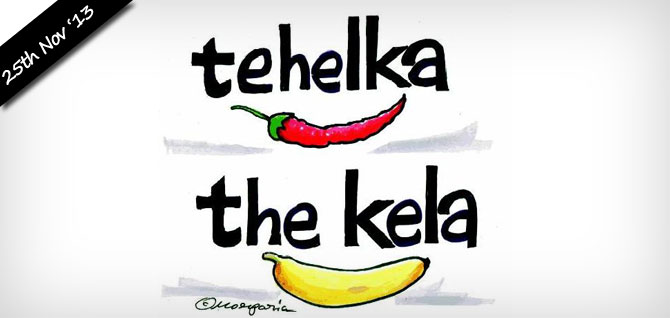
    There’s been a lot spoken and written about the young journalist being subjected to sexual assault (rape as per the law). Many mails have been leaked, some officially released. Many statements have been made. And there’s been the resignation later from managing editor Shoma Chaudhury earlier today (Nov 28).


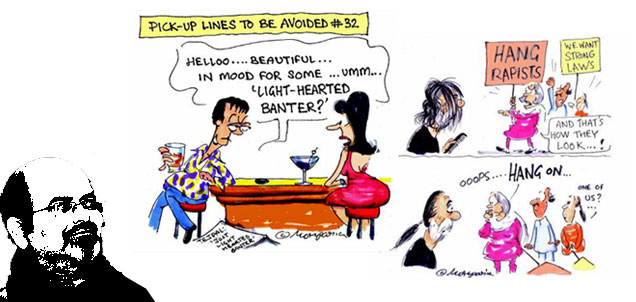
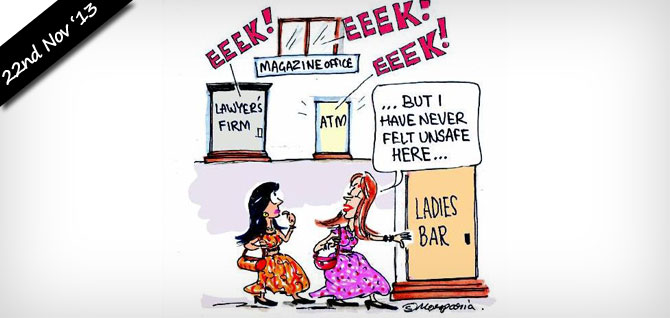
    We present here five cartoons by Hemant Morparia, one of India’s best known editorial cartoonists, who draws a daily pocket cartoon for Mumbai Mirror and group publications. These, according to us, tell give us a view that’s sharper and thought-provoking than a lot that we’ve heard and read so far.


    There’s also a Jaldi 5 Q&A with him alongside  the toons.


    Jaldi 5 with Hemant Morparia: The seedy is not necessarily as Sleazy as the Mainstream can be
     

    Hemant Morparia is one of India’s best known editorial cartoonists. Other than a daily pocket for Mumbai Mirror, he toons for various Indian and international publications. When he not drawing, he’s into photography, travelling, archery and assorted reading. He’s also a radiologist and sonologist at Mumbai’s Breach Candy Hospital.
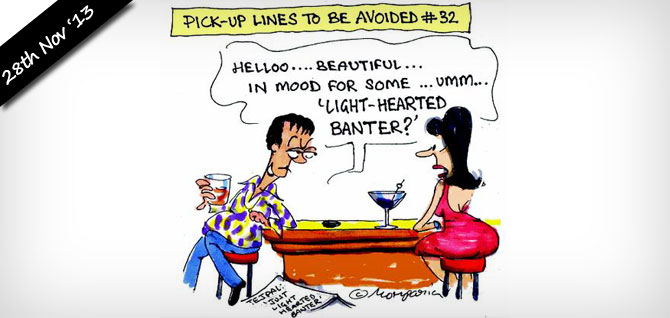
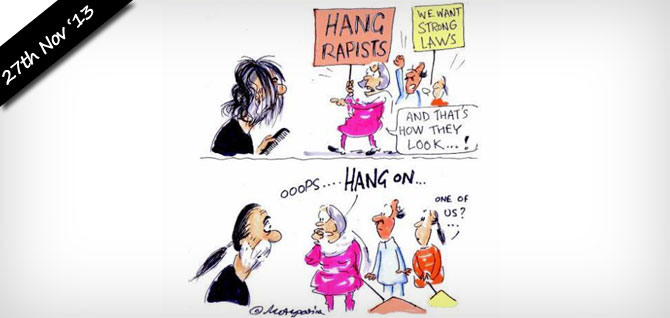
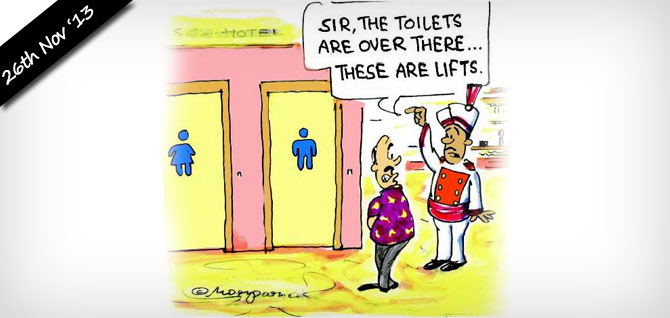
     

    01. They’re funny, but given the nature of the event, you can’t really laugh on viewing the five toons you have drawn thus far on the Tarun Tejpal episode. The one on the ladies bar is perhaps the most telling comment on the state of safety.

    That is my favourite of the lot. Sort of speaks my view that the seedy is not necessarily as sleazy as the mainstream can be. It’s hypocrisy that makes one think so.


    02. What happened to the young journalist is reprehensible. But what made things worse was that the assailant was allegedly her boss, someone who has been revered in journalistic and activist circles. From the point of view of an observer of news events, do you think this possibly rates as one of the worst acts of the powerful in our country in recent times?

    That jobs and promotions could be linked to ‘giving in’ is equivalent to trafficking by the perpetrator. One is making an employee a whore, by force – so it’s a grave crime. I have no problems with consensual encounters without professional inducement or threat.


    03. Would you now see people doubting all the rich, powerful and famous. As in when you meet Editor X and Y, will you now be asking yourself whether he (or even she) could be in indulging in such acts?

    This is as old as time. Nothing shocking here. All humans are potentially capable of depravity anyway imho.


    04. Many well-known cartoonists and commentators have been muted in their response on this episode.  Possibly because they know him? Didn’t you feel the same? No more invites to Thinkfests? If you had been drawing for Tehelka, would you have done the same?

    The test for any commentator is how he sticks to his point of view honestly, without fear or favour. Personal equations colouring views will be the beginning of the end for him.


    4a. You attended the first Thinkfest. Regret having attended that? If invited, and if organized by the same set of people, will you attend it?

    There’s no reason to regret. I won’t attend in future. Probably won’t exist in future, anyway.


    05. On a lighter note, Do you really think there could be a day in India when we’ll have separate elevators for men and women?

    Ha ha! Someone commented on Twitter that such already exist in Saudi Arabia. Well, it would be safer for both sexes you know. The decent male, due to the pervading issues connected to some bad apples of his gender, is a beleaguered creature today. In this charged atmosphere, false accusations could rise too.


    Reproduced here with permission from Hemant Morparia. All cartoons published in Mumbai Mirror on dates mentioned along with the cartoons. 


  • Former Hindu CEO Arun Anant moves to Hindustan Times

    Arun Anant

    By A Correspondent


    He faced the axe at Chennai-based newspaper company for doing his job well. And in less than two months of the controversial coup that saw editor Siddharth Varadarajan and his exit, CEO Arun Anant’s next port of call has been announced.


    Mr Anant, the affable media former CEO of The Hindu, is all set to join HT Media this month. He is to take place in the Leadership Team of the group and will report to Executive Director Benoy Chowdhury. Although the nitty-gritty of his role has not been revealed, Mr Anant is likely to be taking up a top media marketing responsibility.


    Having successfully fought the onslaught of The Times of India in Chennai and also launched the Hindu’s Tamil edition, Mr Anant has had rich experience in multiple media entities. He was part of the launch of what is now Bloomberg TV India from 2007-08 and for two years with Myiris.com, a B2C financial markets portal. He had a decade-plus stint with Lintas India in various functions and in a start-up advisory for a few years post the UTV job.


    Mr Anant is an engineer from IIT-Varanasi (BHU) and a postgraduate in management from IIM Ahmedabad.


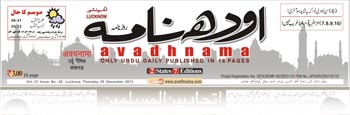
  • Mumbai to get new Urdu daily ‘Avadhnama’ from Jan 9

    By A Correspondent


    Mumbai has a 35 lakh Urdu-reading population, and hoping to reach out to as many of them as possible with his new Urdu daily Avadhnama is senior media professional Yunus Siddiqui. Mr Siddiqui, who has spent a bulk of his career with the Mid-Day group which included the Urdu daily Inquilab, is Director (Editorial & Printer-Publisher).


    Avadhnama daily is already in existence with editions in Lucknow, Faizabad, Aligarh, Azamgarh, Saharanpur and Kanpur. Launching on January 9, the Mumbai edition will the seventh, and other language editions are set to follow – specifically Marathi, Hindi and English, notes a communiqué.


    According to a note circulated to advertisers, 44 lakh Muslims in Mumbai constitute 20% of the population with all major Muslim groups well-represented in the diverse population. More than 35 lakh of these 44 lakh Muslims are native readers and speakers of the Urdu language.


    The launch edition of the Mumbai edition will see 50,000 copies and Mr Siddiqui hopes to double it “very soon”.


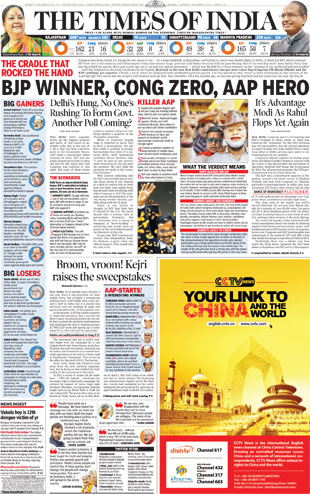
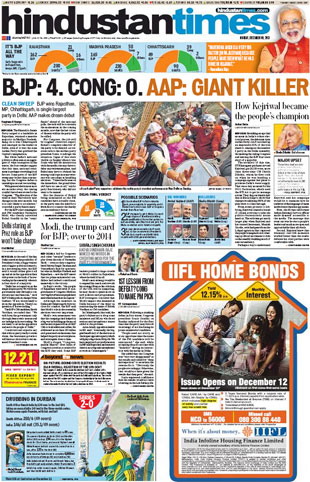
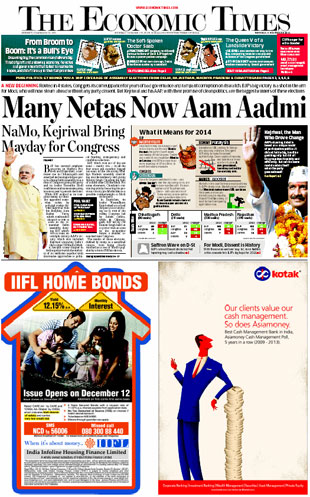
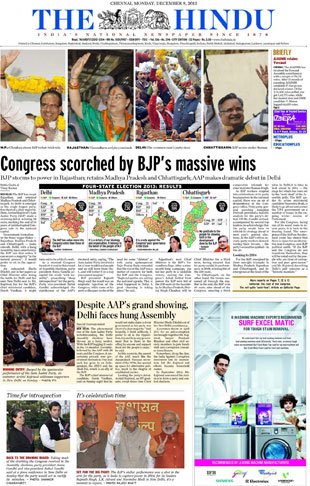
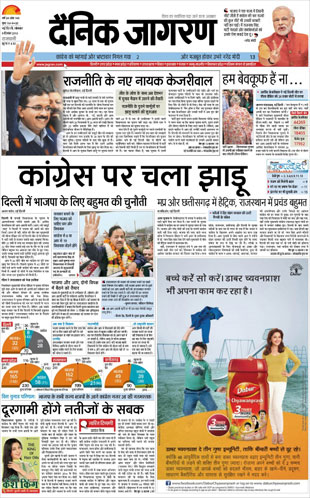
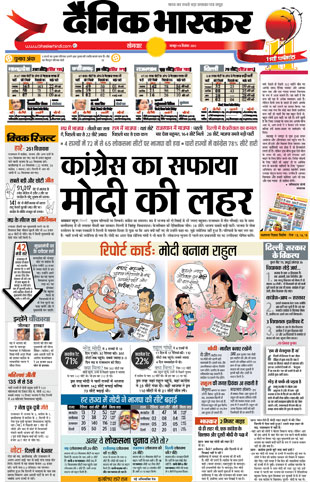
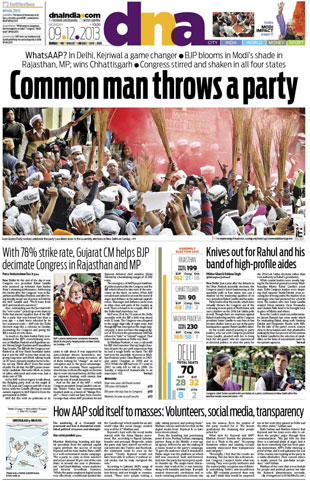
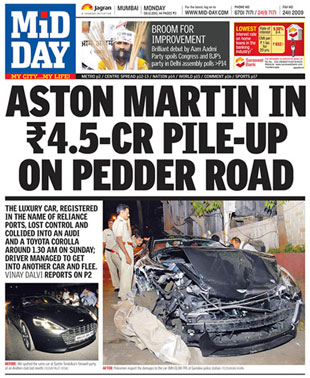
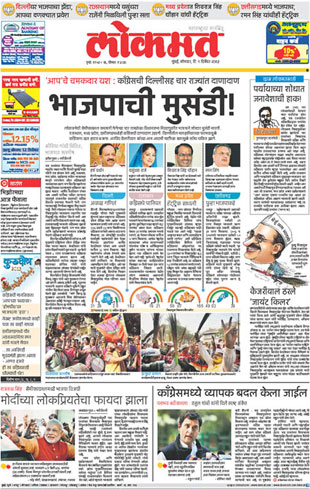
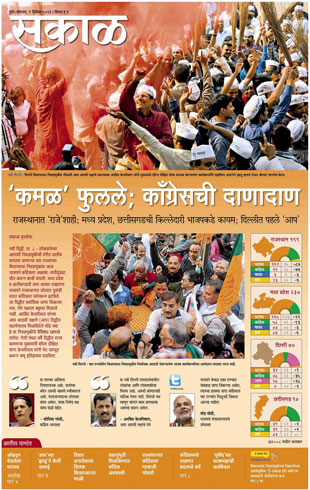
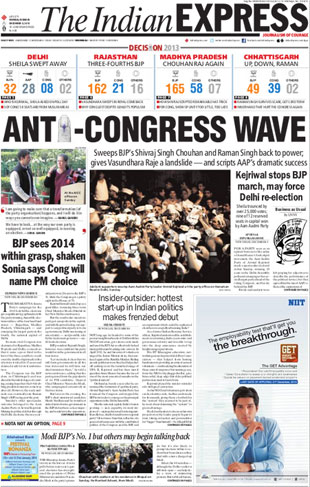
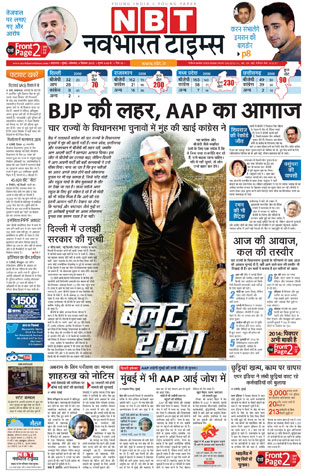
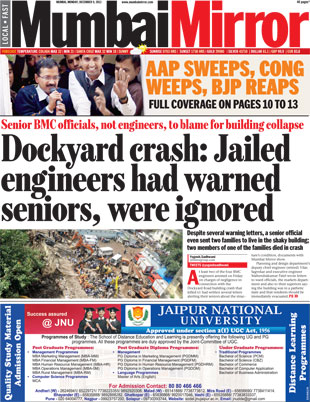
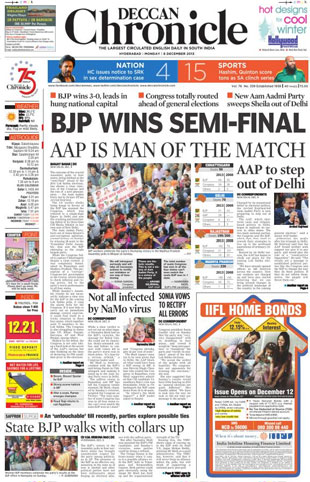
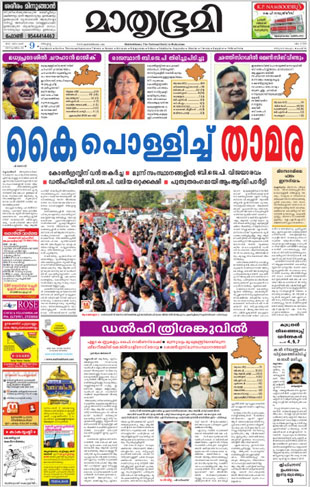
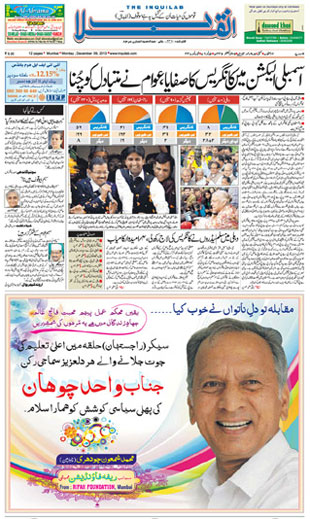
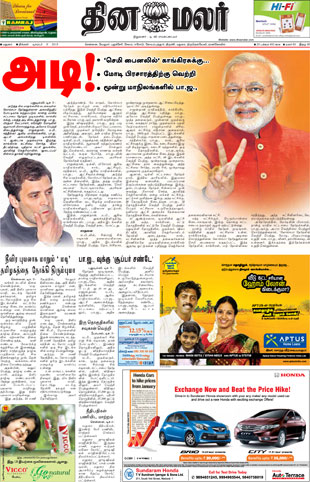
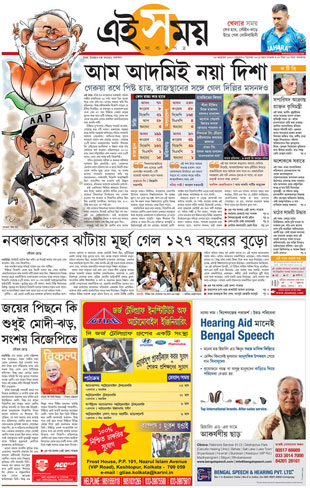
  • AAP appeal! This is how Page 1s of leading dailies looked today

    Every major news event merits a special display by newspapers, as we saw on the morning after the historic Assembly election results on Sunday, December 8. Here are some of the frontpages, in random order.


    The Times Of India

    Hindustan Times

    The Economic Times

    The Hindu

    Dainik Jagran

    Dainik Bhaskar

    dna

    Mid-Day

    Lokmat

    Sakal

    NBT

    Mumbai Mirror

    Deccan Chronicle

    Mathrubhumi

    Inquilab

    Dinamalar

    Ei Samay
  • Femina forays into B2B segment with Femina Salon & Spa

    By A Correspondent


    Bestselling women’s magazine Femina  has announced its its entry into the Business-to-business (B2B) magazine sphere with the launch of Femina Salon & Spa.  The magazine will target beauty professionals across the country. It will have 10 issues a year.


    Speaking about the launch, Tarun Rai, CEO, Worldwide Media said, “Beauty is a booming business in India. The numbers of salons and spas across the country are increasing every month. And so are the professionals in the space. Femina, has been in the beauty business itself for the past many decades. It has been advising its readers about the latest trends and products. We decided to leverage Femina’s knowledge of the industry and the Indian woman and produce a specialist magazine for the specialists in the beauty industry.”


    Tanya Chaitanya, editor, Femina , added, “When it came to launching a beauty manual, a go-to guide for all those in the salon and spa business, it became Femina’s prerogative to introduce to the industry a high-quality product that focuses on all trends and techniques that are tried-and-tested for the Indian market.”


    Femina Salon & Spa was launched in Mumbai recently. Other than the flagship English edition, Femina is also published in Hindi and Tamil.


  • Dainik Bhaskar returns with second edition of ‘Brain Hunt’

    By A Correspondent


    The Dainik Bhaskar group has announced ‘Brain Hunt 2- Challenge your Imagination’ your Imagination as a nationwide initiative to stimulate and encourage the imagination of young minds to a new high of free and constructive thinking.


    Said Vinay Maheshwari, Vice-President, Sales and Market Development, Dainik Bhaskar group: “As an organisation, innovation and new thinking continues to be one of the key pillars of our growth. The youth have always been one of our key audiences with we whom we truly enjoy engaging with. What better way to harness and nurture the potential of this huge force and align it with our philosophy of innovation and change!”


    “We truly believe that Brain Hunt 2 will be another wonderful experience for students and the school community at large while also being a welcoming stress buster”. In 2010, the DB Group created the Bhaskar Champs Club to provide a creative platform to students to interact with other students on a common ground of exciting activities to foster intellect, acumen and brainpower. The Club now has about 10 lakh student members and 4,500 partner schools across the group’s geographical spread.


  • HT gets aggressive in Mumbai, replaces TOI as Kala Ghoda festival partner

    By A Correspondent


    The Hindustan Times is finally exerting itself in Mumbai via various city-linked activities. First it was promoting the various editorial features on improving Mumbai’s infrastructure. Then it was the awards for public-spirited citizens and organizations. And, now, there’s partnering the Kala Ghoda festival which has been a property The Times of India has supported for the last 8 years.


    The festival will now be titled ‘Hindustan Times Kala Ghoda Arts Festival’.  The theme of this year’s festival is ‘Momentum’ and the festival will also have a new section on Urban Design and Architecture.


    Speaking on the collaboration with Hindustan Times, Maneck Davar, Chairperson of the Kala Ghoda Association, said: ” Starting with its 16th edition in Feb 2014, the Kala Ghoda Association is proud to be associated with HT. In the period that it has been in Mumbai, HT has been aware of the aspirations of citizens and has instituted many campaigns that reflect the needs of the city.”


    Commenting on the collaboration, Nitin Chaudhry, Business Head, HT Mumbai said, “It is a great moment for Hindustan Times to be hosting one of the biggest traditions in Mumbai city. It reiterates our belief in the city and gives us a great opportunity to offer more to the city.”


    Speaking on the Kala Ghoda Festival’s role in building the HT brand in Mumbai, Shantanu Bhanja, VP Marketing said: “The true goal for us in Mumbai is to bring meaningful change in the city – change that is socio-economic, infrastructural and cultural. Hosting Kala Ghoda Arts Festival is a significant step in that direction since it integrates us with the arts and culture of the city.”


    The Hindustan Times Kala Ghoda Arts Festival (HTKGAF) will be held over nine days from Feb 1- 9, with 450 programmes conducted across 15 venues in South Mumbai.


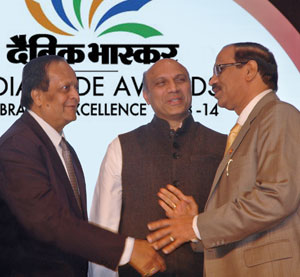
  • Dainik Bhaskar hosts India Pride Awards 2013-14

    By A Correspondent


    Punjab National Bank CMD K R Kamath felicitated by Union HRD Minister Dr M Mangapati Pallam Raju as Dainik Bhaskar group chairman Ramesh Agarwal (left) looks on

    The fifth edition of the India Pride Awards, instituted by Dainik Bhaskar Group in 2009 to acknowledge excellence in public sector units (PSUs), was held in Delhi last week (December19).


    Dr. M. Mangapati Pallam Raju,  Union Minister for Human Resource Development was the Chief Guest, Dr. Harak Singh Rawat, Minister of Agriculture, Medical Education & Soldier Welfare in Uttarakhand, was the Guest of Honour and Dr. Charan Das Mahant, Minister of State of Agriculture and  Rajeev Shukla, Minister of State Planning and Parliamentary Affairs, were special guests at the event.


    The award, which is highly regarded, was judged by meticulous evaluation by jury supported by analysis by ICRA  as Knowledge Partners.


    In his address Dr. M. Mangapati Pallam Raju emphasised ,”PSUs play a vital role in the making of the nation. Where everything in the nation is affected by what happens in another part of the world, PSUs have been playing a stabilising role.”


    Said Ramesh Chandra Agarwal, Chairman, Dainik Bhaskar Group in his address: “Ours is a large nation- whatever is happening- whatever  changes are happening – are more apparent in the Tier-II and Tier-III towns. PSU have a lot role to play in the stability of these markets as they are the prime employment provider in these markets. These towns and changes therein define the country.”


    The highlight of evening was the felicitation of K R Kamath, CMD, Punjab National Bank with the Lifetime achievement award.