Category: PRINT MEDIA

  • The Hindu launches luxury supplement – Watches, Luxury & beyond

    By A Correspondent


    Followed by a successful launch in 2011, The Hindu Group of Publications, South India’s most read English daily, has launched Watches, Luxury & Beyond as a monthly glazed tabloid on April 28. The supplement will focus on luxury products and services including high-end automobiles, travel, jewellery, watches, living spaces and fashion.


    Targeted at high net worth individuals, corporate managers and discerning buyers, WL is a one-stop shop for information on the finer things in life.


    The format will be engaging and dynamic with a focus on collages, trend meters and snapshots on the most important moments in the world of luxury.


    This supplement will be published on the last Saturday of every month and will be circulated in 7 important markets along with The Hindu and Business Line: Chennai (with The Hindu) and in Delhi, Mumbai, Bangalore, Hyderabad, Coimbatore and Kochi (with Business Line) with a total circulation of 3,50,000 copies.


  • The Hindu releases book on Sachin Tendulkar

    By A Correspondent


    Sachin Tendulkar rang in his 39th birthday at Mohali on April 24 by releasing the book Sachin: Tribute to a Legend – a collector’s edition compiled by The Hindu.


    The book is a celebration of the man who went from prodigy to phenomenon, after debuting as an international superstar when he was just 16. The book catalogues Sachin’s incredible journey fromManchesterto Mirpur. It strives to convey the sparkle of the moment as it was recorded, so older readers can experience the delight of nostalgia, and younger ones, the excitement of discovery.


    The book is more than just a narrative of the man who achieved a hundred hundreds – it is also a window into the mind of one of cricket’s greatest personalities. It includes freewheeling interviews, and interactions that happened after major milestones such as the ones after 100 tests and after 20 years of international cricket. Sachin is engaging, honest and interesting in each of these interviews. The book also has a statistics section and an essay on Tendulkar, the brand.


    Arun Anant, CEO of The Hindu Group of Publications said: “This book is our tribute to his unparalleled contribution to the game”. As a part of the team working on this project Suresh Srinivasan, VP-Advt stated: “Sachin is a source of inspiration to millions of people across the globe and is India’s pride. We trust Sachin’s fans and readers at large will find it as exciting and interesting as we did when we were putting it together.”


    Speaking at the release function, Sachin Tendulkar expressed his gratitude to The Hindu: “Readingvarious articles and opinions (in The Hindu) has played an important role in my career. I want to take this opportunity to thank you for putting this book together in a matter of a few weeks. It’s a mammoth effort and thank you very much.”


  • No half-truths with Millennium Post: Ganguly

    By A Correspondent


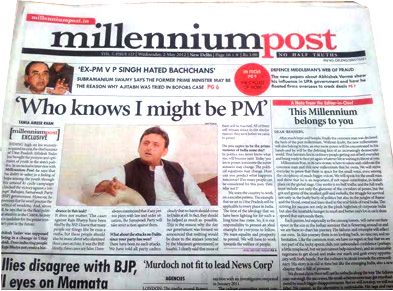
    Readers in New Delhi woke up to a new newspaper offering on the morning of May 2. Millennium Post, the all-colour daily was rolled out by Durbar Ganguly – promoted by Frontrow Media – who will act as the Publisher & editor-in-chief of the newspaper.


    In fact, the paper is not new and existed in a small way since 2005. Highlighting the takeover from its previous owners Mr Ganguly asserted: “The paper was in existence in a small way in 2005. We have taken over the management and the ownership of the title from its owners. Since much of the ground work for the launch had already been laid, we decided to go ahead with the same title. But having said that, the content, team and positioning would be different from what it previously was.”


    Though the team went low-profile with their promotional activities, what is assuring is the positioning that they have zeroed down on, which reads: thinking man’s newspaper. Mr Ganguly said: “We are positioning it as a thinking man’s newspaper. We don’t call it a pro-reach paper – in the sense that if you have breezed through our content you will see that this millennium belongs to the common man. When you say the thinking people they are those who believe in invention, are educated and upwardly mobile, and so on. At the same time, it is not like other large papers such as The Economic Times that are only promoting the cause of big people. So that’s how we plan to be different.”


    When asked on how they plan to measure up to the known players who have already made a mark in the capital, Mr Ganguly said: “Honestly, we are not competing in any way with any of the big players and want to create a niche of our own. If you see, people, in general, are getting fed up with the quality of journalism being provided – as I call it, sponsored corporate journalism. They have converted journalism into extension counters of PR activity. So our core focus would be to promote good quality journalism.”


    Going a step further with its promise, Mr Ganguly affirmed that one of the biggest positioning stands that it has adopted is ‘No half truths’. “Most papers today do not present the whole fact as it is and that’s what we refer to as ‘half truths.’ Our focus would be to present certain issues that others do not take up at all.”


    Alongside its physical presence, the company also plans to lay emphasis on providing content through the web. And the reason for that is rather different too. “We’d really like to promote ourselves in a big way in the digital space because we believe that after certain point of time we wouldn’t be able to expand our paper so much to other areas due to financial limitations. That’s one of the reasons we want to go heavy on the web with our content.”


    The newspaper has already found favour with advertisers, who have evinced interest and advertised in the inaugural issue itself. Mr Ganguly said: “The advertisers have been appreciative of our product and have supported us in a big way from the very first issue itself. We are very excited with the initial response that the paper has managed to evoke amongst the fraternity. We have been receiving queries from many advertisers since we launched yesterday and in the days to come you will see an increased participation from their end.”


    As of now, the paper would be circulated only in Delhi – the print run of which stands at 75,000 copies. Going ahead, the plan would be to launch it in Lucknow, Ranchi, Bhubaneshwar and Chandigarh. But that’s for later; right now the focus would be on establishing Millennium Post firmly in Delhi, affirmed Mr Ganguly.


  • Possible for ethics & profit-making to co-exist: Paranjoy Guha Thakurta (Text & Video)


    By Shruti Pushkarna


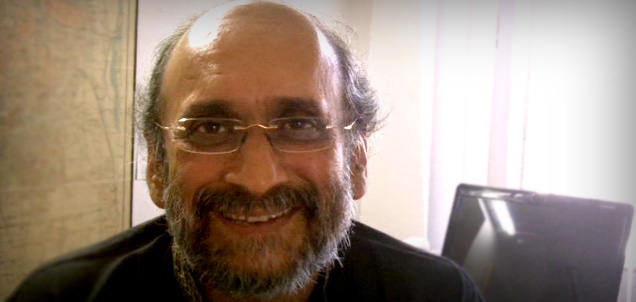
    As he launched the second expanded edition of his book, ‘Media Ethics: Truth, Fairness and Objectivity’,  in the capital last week, MxMIndia caught up with veteran independent journalist and educator,  Paranjoy Guha Thakurta for an exclusive interaction. In this candid one-on-one, Mr Guha Thakurta spoke at length about ethics in media today, self-regulation vs. regulation; the debate on the freedom of expression on the internet and the need for media to be ethically and socially responsible.


    Mr Guha Thakurta’s experience spanning nearly 35 years, cuts across different media: print, radio, television and documentary cinema. He is a writer, speaker, anchor, interviewer, teacher and commentator in three languages, English, Bengali and Hindi. His main areas of interest are the working ofIndia’s political economy and the media, on which he has authored/co-authored books and produced documentary films. He lectures on these subjects to general audiences and also trains aspiring and working media professionals.


    Mr Guha Thakurta has served as a member of the Press Council of India nominated by the University Grants Commission between January 2008 and January 2011. In April 2010, as a member of a two-member sub-committee of the Council, he co-authored a 36,000-word report entitled ‘Paid News: How Corruption in the Indian Media Undermines Democracy’.


    Does an expanded edition mean a lot more to discuss in media ethics?

    The first edition of this book came out more than three years ago, since then a lot has happened. Moreover, after the book came out, there were a lot of people who came up with suggestions on how this book could be improved. So this book is about 40 per cent bigger and thicker than the earlier edition. There are new chapters – there is an entirely new chapter on corruption in the media based quite a bit on my experience as a member of the sub-committee of the PCI, which inquired into corruption in media and how it undermines democracy, the entire phenomenon of paid news. There’s also a new chapter on reality television and some of the existing chapters have been drastically rewritten and revamped, notably the chapter on the internet because a lot has been happening in the internet space; also the chapter on advertising, which was particularly weak in the first edition – I think it has been strengthened substantially in the new edition.


    Also a whole lot of major developments have taken place concerning the media in the recent past; these have all been incorporated in the new edition. Among these would be the News of the World and Rupert Murdoch controversy in UK, the entire Wikileaks and Julian Assange phenomenon and back home here in India, the entire Niira Radia conversations; all of these have raised significant questions pertaining to media ethics and these have been incorporated in the new edition of the book.


    How important is the ‘code of ethics’ in today’s commercialized scheme of things?

    Ethics is very important in every sphere, particularly so in the case of media, because you are dealing with information which is akin to a public good. The problem essentially arises because this information is being disseminated by privately owned corporate bodies with an important goal to maximize profit; therein lies the conflicts of interest. The problem arises because there are sections of the media that are interested in profit maximization to the exclusion of other goals.


    It’s become a bit of a cliche – once upon a time it used to be said, ‘journalism is a mission’, today journalists work only for a commission. We are seeing the corporatization and commercialization of the media having an impact on the kind of content that is being produced. The viewers of television channels, the readers of newspapers, and the listeners of radio stations are being perceived more as ‘consumers’ rather as citizens. They are ‘consumers’ of products and services which are being provided by companies which advertise.


    Can journalistic ethics and profit-making can co-exist?

    I do believe it can, it’s not easy but it is possible for ethics and profit-making to co-exist.


    What is your view on the issue of regulation v/s self-regulation? What works for you?

    In an ideal world, self-regulation is the best form of regulation. But what do you do with those who cross that proverbial ‘lakshman rekha’, what do you do with those who don’t follow the code of conduct which is supposed to be self-regulatory in nature. I’ll give you an example, in the US, when Janet Jackson had a wardrobe malfunction in the middle of a live broadcast, the channel was fined immediately by the Federal Communications Commission because the wardrobe malfunction happened during a live broadcast, it happened during primetime and the channel had to first pay the fine and then appeal against the decision in a court of law.


    What happens in India? Not very long ago, there was a series of incidents involving Bhanwari Devi Maderna episode in Rajasthan and content was put out during the day on television, which many considered to be pornographic in nature. When the Ministry of Information and Broadcasting issued show cause notices against these TV channels, all of them came to Shastri Bhawan saying, ‘we apologize and we won’t do it again’. That’s the nature of self regulation in this country.


    As far as print is concerned, we have a Press Council of India which has no powers to punish anybody, it cannot impose a fine, leave alone put a person behind bars, and its recommendations are not even binding on the government. We don’t have statutory organizations which are empowered in the manner in which say the Federal Communications Commission is, or the Office of Communications in the UK is. So it’s fine to talk about self regulation but what do you do when somebody doesn’t listen to you, do you have the wherewithal to punish them?


    Do you think we need an independent official regulatory authority for television news channels as against one set up by the channels?

    Yes, I do personally believe that it is possible and desirable to have an independent regulatory authority which is independent of the government as well as the media. Such a regulatory authority can be funded by the government, but it can nevertheless be autonomous and independent of the government, in the manner in which bodies like the Supreme Court of India, or CAG or Election Commission of India function.


    So, I do believe it is possible to have such a communications commission. The problem is that for the last decade we have been debating the need for such a commission and the joke is that every time the government proposes to form such a commission, the government collapses. There have been 10 or 12 avatars of a Bill to set up such a commission; time alone will tell when and if such a commission is established in India.


    Your view on Dirty Picture not being allowed to air during the day on Sony?

    The whole Dirty Picture episode has thrown up a number of issues pertaining to censorship, pertaining to what content is appropriate or not, and if adult content can be shown on television, if so when. I think these issues are contentious and debatable and they are going to be debated for quite some time to come.


    Would you agree with Justice Katju’s view when he says people in media are of poor intellect?

    I think Justice Katju is exaggerating. There are journalists who are dumb and there are journalists who are not dumb. I think Justice Katju is not being fair to the media fraternity but that’s his personal point of view, he also thinks 90 per cent of Indians are fools, I beg to disagree with him.


    There’s a belief that the Indian media doesn’t take too kindly to criticism. Agree?

    Who among us are willingly going to accept criticism? All of us have our egos, in that sense, I don’t think the media is unique. I think there is neither any individual nor any group who likes criticism but the point is if you do believe in democracy, if you believe in fairness, and if you are in the public eye, then you better get used to criticism otherwise you’ll end up like Ms Mamata Banerjee who could not take being lampooned online. This shows not only lack of tolerance on part of individuals, especially public figures, but I think it fails to appreciate the nature of freedom of expression.


    Isn’t it upsetting that all the journalists’ organizations like Press Club, Editors Guild are tightlipped about Paid News?

    I won’t entirely go along with you on that, I mean there was a conspiracy of silence about corruption in media and paid news, even the report of the subcommittee that was prepared by me and my colleague for the PCI, was sought to be suppressed by a powerful lobby of publishers within the PCI. Finally in October 2011, the PCI was literally forced to make that report official, place it on their website with a disclaimer saying that entire council had not approved of its content. But I won’t say all journalists’ organizations conspired to put under wraps this report. There have been sections of the media who have been reticent of highlighting corruption within the media fraternity, but I don’t think it’s true for the entire media.


    Do you think that Public Relations has adversely impacted the quality of journalism?

    No, why blame the PR person…she or he is doing his or her job. You can also say the government has bribed the media, you can say that corporate captains have bribed the media. So I don’t think we need to look for excuses, I think journalists have to look within if they have to introspect about why there is corruption in the media. You can always hold somebody or the other responsible for your sins but at the end of the day, you are yourself responsible I believe.


    Your views on the ongoing debate on the freedom of expression in the internet age

    I think this is a huge debate. The internet is not just the newest medium of mass communication, it’s also a form of personalized communication, and it’s difficult to control. Issues relating to freedom of expression on the internet have acquired many new dimensions and these are very contentious and not easy to resolve. And we’ve seen this debate been going on for a while…the ‘infamous’ Danish cartoons on the prophet Mohammed were all drawn ostensibly to generate a debate on freedom of expression. Yes, that cartoon was widely circulated on the internet, as was the gruesome video showing Daniel Pearl getting beheaded. But it’s also worth remembering and underlining the fact that the mainstream media were restrained in reprinting, publicizing either the Danish cartoon or Daniel Pearl’s beheading.


    The point is, sometimes in the name of freedom of expression, you want to generate a debate but you end up generating one huge controversy which goes out of control. It was the Danish PM who argued that the cartoon controversy was the biggest crisis that small Scandinavian country faced after the Second World War and he was particularly worried because it even had an impact on the economy of Denmark because countries of West Asia stopped buying dairy products made inDenmark.


    So very often we might want to start a debate without realising its wider ramifications. But the bigger question of what constitutes the right to offend, what is freedom of expression and the new dimensions these issues have acquired in the day and age of internet, these are very important, they are being debated and I think these debates are going to go on for quite some time.


    And given all of this, your view on the future of news media in India?

    The future of news media in India is very bright. Unlike many countries in the world, all media in India continue to expand, whether it’s print, radio, TV or internet. According to 2011 census, one out of four persons in India still cannot read or write her or his name, so as more and more people become literate I think all sections of media are going to expand. At the same time, media has to become more responsible, not just socially responsible but also more ethical if it indeed has to contribute to building democracy, to building a better country.


    If you were still a kid getting out of college, would you get into journalism given the ethical standards followed?

    That’s a difficult question…when I became a journalist 35 years ago, the Emergency had just got over. That was a unique 19 month period in the history of the country where for the first and so far the only time in politically independent India, the government of the day sought to abridge freedom of expression. For 19 months, during the Emergency, freedom of expression was sought to be curbed. I don’t think that will happen again, but the very fact that I was a student during that period did influence my decision to become a journalist. If I was born 35 years later, I don’t know if I would have preferred to become a rock star, or an airline pilot or a heart surgeon instead of a journalist.
     

  • Press Club Bombay honour bigger than Padma Shri: Vinod Mehta

    By A Correspondent


    Acknowledging to the audience that his heart still favoured Mumbai over Delhi and it was Mumbai that saw him at his pioneering best, Vinod Mehta, now advisor to the Outlook Group, was a picture of pride and fulfilment as he received the coveted Lifetime Achievement Award bestowed on him by the Press Club of Mumbai on May 4.


    Receiving the award from Kapil Sibal, Union Minister of Communications & IT, Mehta thanked the members of the fourth estate and said that this award means more to him than even the Padma Shri. Mr Mehta was felicitated for his selfless contribution of more than 35 years to his passion – journalism. Mr Mehta joined a host of winners from the fourth estate that were honoured by the Press Club for outstanding contribution to the trade.


    The evening also witnessed two special awards being given to late Pradeep Vijaykar (formerly with Times of India) and eminent journalist Madhu Shetye for their outstanding contribution to the domain. Gurbir Singh, President of Press Club of Mumbai delivered the keynote address while veteran sports journalist Ayaz Memon was the emcee for the evening.


    Prior to the awards ceremony, the evening witnessed a scintillating panel discussion on the role that media was portraying in the country and whether it was headed in the right direction. The panellists included Arnab Goswami of Times Now, who moderated the session, Vinod Mehta of Outlook Group, Kumar Ketkar of Divya Marathi and Uday Shankar of Star India.


    Mr Goswami began by stating that there is no shortage of attention being showered on media but expressed concern when he said that never has the media done so wrong. “The question that all journalists and editors need to ask ourselves is, are we doing everything right today? Is the chase for news headed in the right direction?”


    Replying to his question, Mr Mehta said: “There is no problem with the direction, what is essential is for us to judge the media in the environment it works in. The judiciary and press media still function with a degree of idealism and integrity but there is so much of self-congratulation that is happening; that is something that is slightly out of proportion.”


    Expressing his views on the issue of responsibility, Mr Mehta said: “Where the young journos are concerned, I feel they have a good sense of idealism and integrity but if there is somebody who has to take the blame for the current state of affairs, it is the editor. Even if somebody from the team has committed an error, the editor has to take ownership of that and find a solution to it. The problem is that the editors have forgotten what their job is and are pursuing their own agenda. The need of the hour is self-examination; we need to introspect and be accountable for our actions.”


    Replying to Mr Goswami’s query on whether there was unity between members of the fourth estate and the role that editors essayed, Kumar Ketkar said: “It is the editors who stop news from being published and not the management as many think. The editors try and control their reporters and that should not be the case.” Mr Ketkar cited the example of the slain BJP leader Pramod Mahajan, who was shot by his brother a few years ago. “When his brother was arrested for his murder, he had written a letter from the jail explaining his stance and he wished to supply the letter to all in the media. I was told that most editors had agreed to play up the letter in their publication and so I went ahead and planned a big editorial spread for the news. But the next day, I was surprised to see that only my paper had carried the news. This shows the lack of unity existing between the media players today.” According to him, “The media today is not clear on the role that it has to essay. They are not mature enough and lack understanding skills. Journalists themselves are timid and lack courage.”


    Uday Shankar, CEO of StarIndia went on to describe how television as a medium emerged in a big way first during the 90s and then again during 2008-09. “A lot is being said about how news television has been crowded space but I feel it managed to rediscover its own agenda during 2008-09. I cannot understand when some people say media doesn’t do self-introspection. If that is what is claimed, then how come they’ve come to rediscover themselves? Personally, I feel media has done the right thing by chasing news. If there are people who still have questions about the role of news channels, then I cannot understand whether media should be responsible for what it does or whether it should concentrate on doing the right thing?”


    The panel went on to discuss how urban centres led by metropolitan cities were receiving maximum attention from the media and how stories from the rural and less important towns were being ignored in a large way. The need of the hour, the panel highlighted, was to bring out stories from these small cities and towns which were inspirational in nature.


    Winnerspeak:

    Ashish Khetan, Editor – Investigations, Tehelka

    “I bagged the top award for my story on the national rural health mission scam that was unfolding in UP. The story was not about the bonds between the corporation and ministers but how corruption was actually killing people. The funds which were allocated for improving healthcare for the needy and rural people were being siphoned off and embezzled by the whole gravy train of bureaucrats, including politicians. Unfortunately the story did not get much play in the national media because it was centered around the poor but I feel the story was more important than 2G, CWG or other scams that were covered by the media.”


    Abhijit Sathe, Sr Asst Editor, Mumbai Mirror

    “I won the runners-up award for Crime (Pradeep Shinde award) for my story Hiranandani vs Hiranandani. The award means a lot to me. The story was a big one that chronicled infighting between families of one of the biggest names in business today. I exposed how two siblings were sabotaging each other’s interests. I am greatful that I was selected for, and eventually won the award.”


    Rafique Baghdadi, Business India

    “More than react to the win, I would like to say this: more than 62 years ago, a lady called Ms Panna Shah, had done a PhD in Indian Cinema and since then there is nobody who has done that course in the industry as yet. It’s high time the business houses, film industry and the state government should give grants and scholarship to aspiring candidates to pursue that course.”


  • Today’s ad industry is all about business: Sanyal

    By A Correspondent


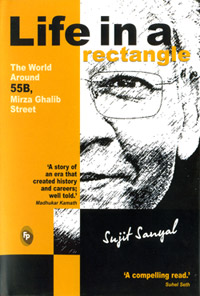
    Title Waves, the new bookstore at Bandra, Mumbai was teeming with several old-timers who are associated in some way or the other with Sujit Sanyal, a former advertising veteran who worked with Clarion Advertising in old Calcutta. The occasion was the launch of Mr Sanyal’s debut book – Life In A Rectangle, The World Around 55BMirza Ghalib Street.


    The launch was made special by the presence of Madhukar Kamath of DDB Mudra – an ex-Clarionite himself who was among the four individuals with an MBA qualification to have joined the agency when it was at the zenith of its success – who unveiled the book to the gathering.


    Published by Fingerprint, Life In A Rectangle is a candid memoir where adman Sujit Sanyal narrates some revealing, some intriguing and other whacky stories about the advertising world from his Clarion days, his first agency, which he joined as a trainee and whose Kolkata branch he later went on to lead.
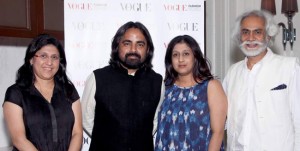

     

    When asked on the factors that led him to script a book on his days at Clarion, Mr Sanyal said: “Life in a Rectangle happened while I was toying with the idea of writing a book on my formative days in advertising. The book is a fun reading piece that chronicles the advertising era of the 70s and 80s in Calcutta.”


    On the choice for the name of the book, Mr Sanyal said that “the name for the book came from my mentor who said that all advertising that you see today are flashed on screens that are rectangle in shape, be it television, computer, mobile, magazine, i-Pad, etc.”


    According to Mr Sanyal, what made him even more convinced to write a book on the agency with a glorious past is because at one point in time, Clarion Advertising was India’s No 2 agency after HTA (now JWT). “That was around mid-70s to early 80s. In the early 80s, it started falling apart due to differences between theUnion, the Management and the Board. In fact, the agency had seen downfall on many occasions and I, myself, was there during a couple of occasions. Once when I was a newbie and the second time when I was heading Clarion’s profit-sharing centre from Calcutta and I saw the fall from a much closer distance. So since I was writing the book, I said to myself why not add these bits of information too.”


    Mr Sanyal added that there are just 2-3 people whom he has slam-banged, but the others have been given due credit for playing an influential role in his life. Highlighting the era of advertising that existed in those days also served as an inspiration for him to pen down his thoughts: “In those days, a man was judged by the way he used to hold his drink. But all that has changed today. I am not at all in favour of the pub-going trends of today where it is about ‘wham bam thank you ma’am’; holding your drink in a particular fashion was an art in those days. Also, we were unofficially trained on how to be a bartender. So if there was a client who came and he was drinking whiskey with water, it was our job to see that he kept getting his refills and not asking him on what else would you have. It was all great fun and at the same time you had to work too. The days of yesteryears were so much more exciting.”


    Admitting the factors that have led the industry to undergo a sea-change, Mr Sanyal stated: “The advent of technology has made things a bit easier for everyone in advertising. The times have really changed today. Anyone who has a mobile and a laptop becomes a filmmaker and can do his own work at his own pace. But this has also led to things becoming more clinical; everything now has got into a box including media plans that are largely TRP-driven.”


    Being direct, Mr Sanyal didn’t hesitate when asked on his views on the state of the advertising industry today: “The advertising industry today is all about business. There are a few legends who still are wowing the industry with their work but they will all go away.  At the end of the day what are you doing in advertising – you are playing with human emotions. Also, what is happening is that I may have a relative who is the boss of a big client company but he cannot give me the business because the diktats are decided by people who sit across the transatlantic ocean. In a nutshell, globalisation is taking its toll on the industry. They are not allowing the Indian agencies to grow.”


    Still basking in the accolades that are coming his way from friends and family over the first book, Mr Sanyal is already tempted into writing a second book that may see the light of the day soon. If he were to go by suggestions thrown up by his friends at the venue, it would well be a book on his first job at Junior Statesman (JS, as it was popularly known), a magazine that was far ahead of its time.


    Life in a Rectangle: The world around 55B, Mirza Ghalib street; published by Fingerprint Publishing; price Rs 395/-


  • Vogue announces first fashion fund with FDCI

    By A Correspondent


    After years of success in several countries, the prestigious Vogue Fashion Fund makes itsIndiadebut this year. VogueIndia, in collaboration with the Fashion Design Council of India (FDCI), is launching this annual event to give centrestage toIndia’s next generation of fashion designers. The Vogue Fashion Fund was originally conceptualised by US Vogue, spearheaded by the iconic Anna Wintour.


    Announcing the launch of the Vogue Fashion Fund inIndia, Priya Tanna, Editor, VogueIndiasaid: “For a country that takes great pride in its indigenous fashion and boasts such a stunning array of embroideries, textiles, and craftsmanship, it’s no surprise that we consistently produce exceptional design talent. With the launch of the Vogue Fashion Fund, our endeavour is to strengthen the foundation for these designers and help marry their creativity with commercial success. It is a truly special project for VogueIndiaand I look forward to the fund changing the lives of promising young designers in the years to come.”


    Mr. Sunil Sethi, President, FDCI said: “I once heard the proverb, ‘Give a man a fish and you feed him for a day, teach him to fish, and feed him for life.’ It’s an apt metaphor for the Vogue Fashion Fund, which supports the winning designer through a one-year mentorship. With this initiative, Vogue is putting its weight behind young talent-I look forward to seeing what’s in store for many years to come.”


    The judging committee comprises an eclectic mix of fashion authorities, including Sunil Sethi and the Vogue India experts – Priya Tanna – Editor, Anaita Shroff Adajania – Fashion Director, Bandana Tewari – Fashion Features Director and Oona Dhabhar – Marketing Director, Conde NastIndia. The jury also features renowned fashion designers Manish Arora, Sabyasachi Mukherjee and Suneet Varma as well as retail experts like Alka Nishar and Tina Tahiliani.

     

    Sabyasachi Mukherjee commented: “This is a wonderful initiative. It is fantastic that Vogue India recognizes this fact and is creating the platform to nurture upcoming design talent. I feel privileged to be a part of the jury panel. Hopefully, I will be able to use my aesthetic skill and business acumen to make Vogue zero in on the right choice.”


    VogueIndiahas invited entries from emerging fashion designers based on pre-defined eligibility criteria. The judging panel will shortlist 20 designers at first from the entries, further narrowing this list down to top 5 finalists based on interviews and the creation of a special capsule collection.


    The winner will have the opportunity to be featured in VogueIndiaand also win a grand cash prize. Besides this, the design talent will also get a chance to commercialise his/her brand with a leading retailer, and gain access to prominent platforms in the industry like Wills Lifestyle Fashion Week and a one-year business mentorship with an industry professional.


    Vogue, the ultimate fashion bible, which launched inIndiaon September 22, 2007 is the 17th edition of the ultimate style bible and is a 100 per cent owned subsidiary of Conde Nast International. VogueIndiais a monthly magazine and available across 100+ towns.


  • DNA scores high in Brand Trust report

    By A Correspondent


    The Brand Trust report 2012 has mapped trust scores on the basis of 61 primary components & has ranked brands accordingly. The 2,718 respondents to this survey were influencers of society, all SEC AB, proficient in English and salaried. Besides trust scores, these influencers ranked the media that influenced them.


    On the basis of these factors, DNA has been ranked India’s second most informative newspaper, India’s second most read newspaper and third most trusted newspaper brand.


    Gautam Dalal, VP, Marketing, DNA said: “A lot has happened in the last year, leading to these trust scores. The Mumbai edition has ramped up to 6 lakh copies a day, ensuirng reader-centricity by quality journalism, path breaking engagement initiatives. The survey has ranked us well and placed us on a national pedestal.”


    “At the core of every brand lies trust. A seasoned marketer would agree that increased trust in a media brand leads to growing readership/viewership and eventually high response. Advertisers in DNA over the last year have experienced this already,” he added.


    According to the report, DNA was present in just 6 of the 15 cities surveyed, yet it managed to overtake some of oldest regional and national players. In an overall ranking of 17,000 brands, DNA was India’s 3rd most trusted newspaper brand.


    “Principles always came first to DNA. Under the platform of ‘Principles First’, DNA has recently published its journalistic code of ethics, followed shortly by its business principles. The trust scores are really an echo of the brand’s principles,” said Mr Dalal.


    The Brand Trust report survey is conducted by the Trust Research Advisory. The data was analysed by the Indian Statistical Institute, a government body founded in 1931.


  • Mahindra Retail launches ‘Mother’s World’

    By A Correspondent


    Taking another step in cementing their philosophy of striking innovations that enrich communities and enable people to rise, Mom & Me, the flagship brand of Mahindra Retail is introducing its first ever publishing initiative with the launch of a maternity magazine titled ‘Mother’s World’. This new consumer-centric initiative is an extension to their commitment to provide relevant information, assistance, tips and guidance to the world of early parenthood.


    After their very successful venture into retail with Mom & Me, Mahindra Retail will now focus on providing expecting and new mothers with world class services to care for their bodies and souls during the fragile and overwhelming beginning to motherhood.


    Commenting on the launch of Mother’s World magazine, K Venkatraman, CEO, Mahindra Retail said: “Today’s mothers are highly involved decision-makers and look deeply into every aspect of their babies’ well being. The launch of the magazine marks our commitment to consumer-centric initiatives, and we hope this magazine will be a perfect companion for parents.”


    The inaugural issue offers readers a host of stories, features, tips and advice. It also speaks to three celebrity moms – Sonali Kulkarni, Tara Sharma and Mandira Bedi and their experiences of motherhood.


    Mother’s World magazine serves as an extensive and comprehensive guide for young parents to deal with parenthood and its challenges. With this subscription based magazine for parents-to-be, Mahindra Retail aims to provide insightful information, carefully researched articles and quotes from real parents who share their experiences, besides tips on fashion trends in maternity wear.


    The magazine has been divided into relevant sections covering all aspects of parenthood: conception, infancy, toddler hood and relationships, with all the information verified by in-house experts.


    While Mother’s World magazine adopts a serious approach to parenting, it does have a light-hearted side to it as well with lots of tips, tweets and fun facts about pregnancy on almost every page. It also features a host of relevant products, all easily available to the reader at Mom & Me stores. What also sets the magazine apart is its take on lifestyle and fashion. From maternity fashion to toddler fashion – beautifully taken, theme-based shots give the magazine that classy edge. Occasional celebrity covers, photographs and interviews set Mother’s World distinctly apart from other parenting magazines inIndia.


    Mother’s World quarterly issue will be available on stands across the country from May 14, at a cost of Rs100.


    Mahindra Retail is an extension of the $14.4 billion Mahindra Group’s trading foray in the domesticIndiamarket. The Group believes that this is the favourable time to extend its distribution business into direct retailing, when the organized retail market is expanding inIndia.


  • More Mediaah!: Indian Express, Shekhar Gupta & Co send notice to Open, Vinod Mehta. Demand Rs 500 cr as damages

    By Pradyuman Maheshwari


    The Indian Express group and four of its senior journalists (including editor-in-chief Shekhar Gupta) have sent a legal notice to Open magazine, its editor and other professionals. And above all to Vinod Mehta. The reason: in an interview to Open, Outlook’s Vinod Mehta rubbished the Express expose of a coup-like situation in the Capital.


    The Express is also upset with the publication of reactions that the interview elicited.


    I strongly recommend a read of the legal notice (currently posted in a blog that seems to have been created for the purpose — http://nobodyisusingthedword.wordpress.com/2012/05/15/indian-express- shekhar-gupta-threatens-to-sue-vinod-mehta-hartosh-singh-bal-open-magazine-c-repor/ .  Please don’t miss Pages 6 and 7, where the notice highlights a contradiction in Mehta’s statement on how he quit The Independent in the interview (as also made in a speech at the Press Club Bombay awards recently) and his book Lucknow Boy.


    The lawyer has asked for an apology, removal of the interview from the site and Rs 100 crore each for her clients. Note the money must be remitted even after the publication of the apology.
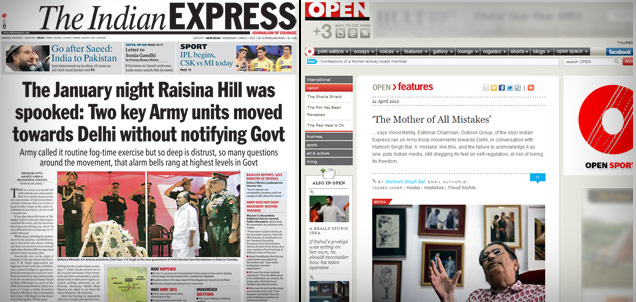
     

    Mediaah! view: I think the Express should’ve just let the interview be (link: http://www.openthemagazine.com/ article/nation/the-mother-of-all-mistakes). I don’t think the interview is damning the reputation of the Express or its editor-in-chief. And even if there is a belief that Vinod Mehta ought not to have said what he did and Open shouldn’t have published it especially since the coup story hasn’t been proven to be wrong, initiating a legal procedure is perhaps a bit much.


    Moreover, though it has established itself as an independent, gutsy publication, Open isn’t mass-circulated as, say, The Times of India. I must confess that even though I had been told about the interview, I read it only yesterday, after I heard of the notice. There is sure to be a fair bit of buzz in the social networks.


    I spoke to a senior member of the Open team who said the company lawyer was planning to respond to the notice and the magazine has no plans to pull the story off the Web.


    Final words: It’s imperative that while the media subjects everyone to criticism, it must be willing to take the heat whenever it’s subjected to it. Now, let’s hope Mediaah! doesn’t get a legal notice for writing all of this 🙂


    Buzz me if you have a story to tell. Confidentiality assured. There are various ways you can reach me:

    pradyumanm[at]mxmindia.com, BBM 23050B5D, Gtalk pradyumanm@gmail.com, Twitter @pmahesh and of course the mobile: 98338 76278.


    Disclaimer: Although he is CEO and Editor-in-Chief of this site, Pradyuman Maheshwari’s views in Mediaah! are not necessarily those of the rest of the team and MxMIndia.com.


  • Apology + Rs 500cr: Is Indian Express right in sending Open a legal notice?


    By Pradyuman Maheshwari and Shruti Pushkarna


    Shekhar Gupta

    It was the most read story on MxMIndia yesterday. As the news of the legal notice served by a lawyer representing Indian Express, Shekhar Gupta and three others filtered in, there were heated discussions in newsrooms on whether the Express and its legal eagles were right in serving a legal notice to Vinod Mehta, Open and its senior staffers.


    First some background. On April 4, The Indian Express carried a story by editor-in-chief Shekhar Gupta with Ritu Sarin and Pranab Dhal Samanta on two key army units moving towards New Delhi without informing the government. Ajmer Singh contributed to the report.


    Vital Links
    The Indian Express report (April 4, epaper)
    The Open interview (April 21)
    The ‘notice’ (May 15, note: source unverified and unknown)

    There was outrage and denials issued by all and sundry in the government and armed forces. However, save the outbursts, it wasn’t proven that the Express story was incorrect.


    Meanwhile, ever since the report appeared, The Indian Express – while still respected as a no-nonsense, credible newspaper – was the butt of ridicule by commentators and on social networks. Those in print may have been a lot more gentle, but a few television discussions were indeed scathing.


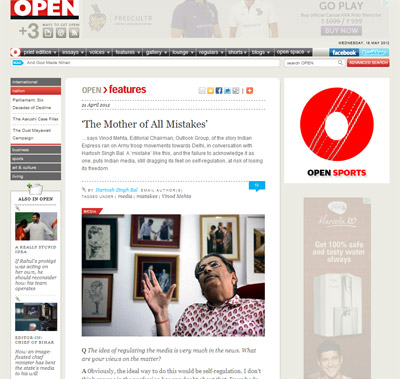
    And then came this interview with Outlook’s editorial adviser (and former editor-in-chief) Vinod Mehta in newsmag Open on the issue. The headline of the interview said it all: The Mother of All Mistakes (issue dated April 21, 2012). In his inimitable style, Mr Mehta suggested that Mr Gupta was taken in by a story that was planted on the Express.


    While a magazine has a limited readership, since the article was freely available on the internet and it carried a very pointed allegation by one high profile editor on another, the interview viralled in the media fraternity a great deal.


    This legal notice by a lawyer representing The Indian Express and the four writers of the story – Shekhar Gupta, Ritu Sarin, Pranab Dhal Samanta and Ajmer Singh – came less than a month of the publication of the interview.


    One would’ve let the notice be, but its contents make for interesting reading. So while Mr Mehta may be suggesting in the interview (and he also said  amidst some cheer at the Press Club Bombay awards recently) that he quit the Independent owning moral responsibility of an incorrect story, the notice points out that in his memoirs (Lucknow Boy), he projects that he was compelled to do so. “Till now, I am unsure why I had to quit.”


    The notice asks for an apology and pulling the story off Open’s internet edition openthemagazine.com. At the time of filing this report, Open hasn’t done either and two senior staffers told MxMIndia that the magazine does not intend to do either.


    The notice also demands damages of Rs 100 crore each to the lawyer’s clients. That’s five of them – the Indian Express, Shekhar Gupta, Ritu Sarin, Pranab Dhal Samanta and Ajmer Singh. The Rs 500 crore damages have to be paid regardless of the apology.


    MxMIndia asked a few senior editors for their views on the issue. While many of them did not want to be drawn into the controversy, there were a few who told us that they didn’t know enough of the matter to be able to comment.


    Our questions were: Is the media too sensitive to criticism? Just as the Express, Shekhar Gupta & Co sent a legal notice to Open and Vinod Mehta, can governments, politicians, businesspersons and even film-makers who are critiqued by the media also send notices and ask for crores as damages?


    Here are reactions from four veteran commentators:

    Dileep Padgaonkar

    Dileep Padgaonkar, former editor-in-chief, The Times of India:

    Of course it is… the media is sensitive to criticism. The media thinks it is fit to criticise everyone but the minute everyone points a finger at the media, the media bristles. I think media should take criticism directed against it in its stride, this is part and parcel of democracy. And I don’t think one should be too prickly in these matters unless of course there is a clear case of personal attack, defamation… in that case legal course is available but otherwise one should ignore these things and go on.


    As it is, the censorship of cartoons was a dismal warning of the sensitivity of the political establishment. Now if media is going to go at another section of media, there is going to be a free-for-all and the big casualty out here would be good, decent, honest journalism.


    Sevanti Ninan

    Sevanti Ninan, editor, The Hoot, columnist and media-watcher:

    Criticism is not an accurate word for what Vinod Mehta called The Indian Express story. He essentially said it was a planted story and it was a huge mistake to carry it. Considering that the first byline on the story was that of the chief editor, that is quite statement to make. You are saying the chief editor and his colleague are susceptible to plants, thereby seriously questioning their credibility. So I guess the Express could hardly ignore it. IE did come in for a lot of criticism on the import of the story and the display given, including a critical editorial in the Hindu but nothing quite as damning as Mehta’s statements.


    This is the 3rd 100 crore notice involving the media over the past year, in any case. So it is becoming more common.


    Paranjoy Guha Thakurta

    Paranjoy Guha Thakurta, independent journalist and commentator:

    I think The Indian Express has over reacted. I think it’s gone a little over the top. They may disagree with what Vinod Mehta has said… my personal view is that it’s a point of view which obviously the Express doesn’t agree with but I don’t think that what Mr Mehta has said can be construed to be criminally defamatory. And the kind of damages sought are excessive. They are as excessive as the damages that Justice Sawant has sought from Times Now and what Times Now has sought from TheHoot. I mean these are ridiculous sums of money.


    I think we’ve become an extremely intolerant society. I think people talk about freedom of expression being a fundamental right but I don’t think people are really believing in Article 19(1)A of the Constitution of India. Like so many sections of Indian society, including our political leadership which is very upset about these political cartoons that have appeared in textbooks, I think even sections of the media are becoming extremely intolerant of criticism. If you are in a democracy, you have to give the right to everybody to disagree with you.


    Sucheta Dalal

    Sucheta Dalal, senior journalist and commentator, consulting editor, Moneylife:

    Well, not the media, but The Indian Express is too sensitive to critcism… It’s an interesting thing, it’s the first time it is happening and we should see where this goes, whether they follow through by actually filing a case. It’s the first time that somebody in the media is suing another person in the media, we need to look at how it goes… as I said everybody else is sensitive, everybody else does send defamation notices but I don’t know how many of those notices actually get converted into legal action. So we have to wait and watch.


    Otherwise the notice is also a way of making a point, it’s a way of putting pressure. It’s not just Vinod Mehta, if he looks at what was said about that story on the social media, then there are a lot more people that they would probably need to sue. So maybe he is making a case out of Vinod Mehta and Open magazine, we need to see whether they follow through. I would say that the test is not in the legal notice, the test is in seeing whether they are actually going to follow through, stand in court and argue it out.


  • AV Birla group buys 27.5% in India Today group

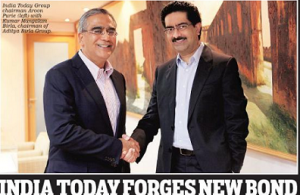
    A Mail Today news article with Aroon Purie with Kumar Mangalam Birla in the photograph

    By A Correspondent

    The Aditya Birla group has announced a financial investment of 27.5% in Living Media India (better known as the India Today group).

    The move has been confirmed by a way of a communique to the stock exchanges. Says Kumar Managalam Birla, chairman, Aditya Birla group, “The media sector is a sunrise sector from an investment point of view. I believe that Living Media India offers one of the best opportunities for growth and value creation.”

    Comments Mr Aroon Purie, chairman of the India Today group, “I am delighted to partner with the Aditya Birla group to aggressively address the current and futre potential of the Indian media business which is at a tipping point. The Aditya Birla group with its strong leadership global footprint, diversified business interests and its shared values of integrity, commitment and social responsibility make it a perfect fit with the India Today group.”

    The transaction is of course subject to the statutory approvals.