Category: MEDIA

  • ABP News launches campaign for elections

    ABP News has launched a campaign ‘Jeetna Aapka Zaroori Hai’ aimed at reinforcing the significance of the nation’s voters in shaping the course of democracy – the power of the people.

    Said Avinash Pandey, CEO of ABP Network: “Democracy thrives on the power of the people, by the people and for the people. Elections serve as a grand celebration of this fundamental principle, where each vote holds the potential to shape India’s destiny. Through our ‘Jeetna Aapka Zaroori Hai’ initiative, ABP News is steadfastly committed to reminding every Indian that their vote, their choice, constitutes the true victory to be achieved in this election above all else. We are rallying the nation to exercise their invaluable franchise and amplify their voices through the ballot.”

  • Ranjona Banerji: Not my normal rant!

    Ranjona BanerjiI’ve suddenly become very popular with India’s public relations companies. This is astounding to me because I have not worked in a newsroom since 2010. This means for 14 years I have not held a position of mild influence, let alone any kind of importance.


    And yet, my inbox is flooded with press releases and various kinds of offers to collaborate with me, help me with inputs and give me “exclusive authored content/articles” which it has taken me ages to decipher as a readymade article written by a PR person which I am then supposed to carry in my publication. I still have not figured whether I use my own name or the name of the PR person as the byline.


    The range of products and services which I am being urged to promote is wide. Several make no sense to me – these are usually to do with gaming, AI and some kind of internet-related things. Then there is anything from health to education to films to TV to real estate to corporate stuff. At a huge risk to my claims to modesty, I googled myself (gosh, google does not even require a capital G according to Microsoft Word’s spellcheck!) to find out if I have ever written about any of these things for the past 14 years. Or as long as internet searches can go back. In case my memory had dimmed. The answer was a dismal “no”. Any regular readers of this column know that I usually bang on about the cowardice of the media in the face of a fascist onslaught. However no press release relates to this aspect of my work.


    If I set aside my annoyance (and block all these senders), I have to consider what this onslaught tells me about the relationship between journalism and PR since I stopped working in a newsroom. And it is glaringly obvious: that the laziness of some journalists is through the roof. A PR company, I would posit, will only offer “exclusive authored” content, if such articles are regularly used. So also with all these inputs, the offered guidance and the constant bombardment.


    It is not that PR companies are not needed or not useful. Often, they are your only recourse, as a journalist, to get information, especially from those who are wary/chary about sharing information. The glamour world has long hidden itself from journalists. So no option there, unless you are old enough to have made your own personal contacts.


    I have interacted with some great PR people, some of whom became friends. But these were consummate professionals, who knew who you were, what sort of information you wanted and understood that praise or a positive story was not a given. And they had always done their homework.


    What I see now is no homework and this speaks unprofessionalism to me. The outcome however, professional or not, as it stands today still means that I will mark all such messages as spam. I write my own “content”, I rant by myself without outside assistance, I don’t interview film people (I can count them on my fingers, pretty much, the ones I have), I don’t write for a living about films or TV, or real estate, or gaming, or bitcoin. Funnily, I do review books but I get very little from the publishing world!


    And aren’t you glad that I didn’t do my normal rant?


    Happy Voting everyone. I did that by myself too, minus any exclusive authored help…

    Ranjona Banerji is a senior journalist and commentator based in Dehradun. She writes on MxMIndia on Tuesdays and Fridays. Her views here are personal.

  • TikTok fears point to larger problem: Poor media literacy in the social media age

    TikTok fears point to larger problem: Poor media literacy in the social media age

    By Nir Eisikovits


    The U.S. government moved closer to banning the video social media app TikTok after the House of Representatives attached the measure to an emergency spending bill on Apr. 17, 2024. The House voted on each of the four components of the bill, and the one affecting TikTok passed 360-58 on Apr. 20, 2024. The packaging is likely to improve the bill’s chances in the Senate, and President Joe Biden has indicated that he will sign the bill if it reaches his desk.

    The bill would force ByteDance, the Chinese company that owns TikTok, to either sell its American holdings to a U.S. company or face a ban in the country. The company has said it will fight any effort to force a sale.

    The proposed legislation was motivated by a set of national security concerns. For one, ByteDance can be required to assist the Chinese Communist Party in gathering intelligence, according to the Chinese National Intelligence Law. In other words, the data TikTok collects can, in theory, be used by the Chinese government.

    Furthermore, TikTok’s popularity in the United States, and the fact that many young people get their news from the platform – one-third of Americans under the age of 30 – turns it into a potent instrument for Chinese political influence.

    Indeed, the U.S. Office of the Director of National Intelligence recently claimed that TikTok accounts run by a Chinese propaganda arm of the government targeted candidates from both political parties during the U.S. midterm election cycle in 2022, and the Chinese Communist Party might attempt to influence the U.S. elections in 2024 in order to sideline critics of China and magnify U.S. social divisions.

    To these worries, proponents of the legislation have appended two more arguments: It’s only right to curtail TikTok because China bans most U.S.-based social media networks from operating there, and there would be nothing new in such a ban, since the U.S. already restricts the foreign ownership of important media networks.

    Some of these arguments are stronger than others.

    China doesn’t need TikTok to collect data about Americans. The Chinese government can buy all the data it wants from data brokers because the U.S. has no federal data privacy laws to speak of. The fact that China, a country that Americans criticise for its authoritarian practices, bans social media platforms is hardly a reason for the U.S. to do the same.

    The debate about banning TikTok tends to miss the larger picture of social media literacy.

    I believe the cumulative force of these claims is substantial and the legislation, on balance, is plausible. But banning the app is also a red herring.

    In the past few years, my colleagues and I at UMass Boston’s Applied Ethics Center have been studying the impact of AI systems on how people understand themselves. Here’s why I think the recent move against TikTok misses the larger point: Americans’ sources of information have declined in quality and the problem goes beyond any one social media platform.

    The deeper problem

    Perhaps the most compelling argument for banning TikTok is that the app’s ubiquity and the fact that so many young Americans get their news from it turns it into an effective tool for political influence. But the proposed solution of switching to American ownership of the app ignores an even more fundamental threat.

    The deeper problem is not that the Chinese government can easily manipulate content on the app. It is, rather, that people think it is OK to get their news from social media in the first place. In other words, the real national security vulnerability is that people have acquiesced to informing themselves through social media.

    Social media is not made to inform people. It is designed to capture consumer attention for the sake of advertisers. With slight variations, that’s the business model of all platforms. That’s why a lot of the content people encounter on social media is violent, divisive and disturbing. Controversial posts that generate strong feelings literally capture users’ notice, hold their gaze for longer, and provide advertisers with improved opportunities to monetise engagement.

    There’s an important difference between actively consuming serious, well-vetted information and being manipulated to spend as much time as possible on a platform. The former is the lifeblood of democratic citizenship because being a citizen who participates in political decision-making requires having reliable information on the issues of the day. The latter amounts to letting your attention get hijacked for someone else’s financial gain.

    If TikTok is banned, many of its users are likely to migrate to Instagram and YouTube. This would benefit Meta and Google, their parent companies, but it wouldn’t benefit national security. People would still be exposed to as much junk news as before, and experience shows that these social media platforms could be vulnerable to manipulation as well. After all, the Russians primarily used Facebook and Twitter to meddle in the 2016 election.

    Media literacy is especially critical in the age of social media.

    Media and technology literacy

    That Americans have settled on getting their information from outlets that are uninterested in informing them undermines the very requirement of serious political participation, namely educated decision-making. This problem is not going to be solved by restricting access to foreign apps.

    Research suggests that it will only be alleviated by inculcating media and technology literacy habits from an early age. This involves teaching young people how social media companies make money, how algorithms shape what they see on their phones, and how different types of content affect them psychologically.

    My colleagues and I have just launched a pilot programme to boost digital media literacy with the Boston Mayor’s Youth Council. We are talking to Boston’s youth leaders about how the technologies they use everyday undermine their privacy, about the role of algorithms in shaping everything from their taste in music to their political sympathies, and about how generative AI is going to influence their ability to think and write clearly and even who they count as friends.

    We are planning to present them with evidence about the adverse effects of excessive social media use on their mental health. We are going to talk to them about taking time away from their phones and developing a healthy skepticism towards what they see on social media.

    Protecting people’s capacity for critical thinking is a challenge that calls for bipartisan attention. Some of these measures to boost media and technology literacy might not be popular among tech users and tech companies. But I believe they are necessary for raising thoughtful citizens rather than passive social media consumers who have surrendered their attention to commercial and political actors who do not have their interests at heart.


    This article was updated to indicate that the U.S. House passed the TikTok measure on Apr. 20, 2024.The Conversation Nir Eisikovits, Professor of Philosophy and Director, Applied Ethics Center, UMass Boston. This article is republished from The Conversation under a Creative Commons license. Read the original article

  • Indian Magazine Congress in Mumbai on May 3

    Association of Indian Magazines (AIM), is all set to organise the 13th edition of its flagship event, the Indian Magazine Congress (IMC). This will be held in Mumbai on May 3. This year’s theme is how “Magazine Publishers in India are Innovating for Building New Revenue Streams”.

    Speaking on the congress, Anant Nath, President of AIM and Executive Publisher of Delhi Press said: “In the digital age, marred by information overload and cluttered digital spaces, the need for highly engaged and involved communities is ever more important. Magazine brands nurture spaces for readers to break away from this clutter, allowing them to find solace and comfort in a manner that is aligned with their interests and with like-minded peers. Magazines have therefore innovated new ways of monetizing their rich content and the highly engaged and invested audiences, and the IMC will throw light on these evolving paradigms.”

    The conference will have a daylong programming on following themes:

    • Subscriptions and New partner alliance
    • Leveraging e-commerce for subscription growth
    • Editorial credibility and robustness at the heart of new publishing models
    • Building new IPs on magazine content
    • New paradigms in branded content
    • Creators as collaborators for engaging content solutions
    • Product management innovations for digital age
    • Magazines nurturing and monetising niche reader communities

    Speakers at the event include:

    • Elsa Esparbe Gener, RBA
    • Kerin James O’Connor, Atlas
    • Shashi Sinha, IPG
    • Thampy Koshy, ONDC
    • Prasanth Kumar, Group M
    • Alastair David Lewis, FIPP
    • Raj Chengappa, India Today
    • Gaurav Banerjee, Disney Hotstar
    • Suagata Mukherjee, Sony Liv
    • Sameer Nair, Applause Enterntainment
    • Hormazd Sorabjee, Auto Car India
    • Naresh Fernandes, Scroll.in
    • Alex Kuruvilla, formerly Conde Nast India
    • Pradeep Gairola, The Hindu
    • Manavdeep Singh, Pub Live
    • Aditya Berlia, Apeejay Education
    • Abhishek Baxi, Independent journalist/ tech influencer
    • Vanita Kohli Khandekar, Business Journalist
    • Rati Choudhary, Decor creator (Instagram)
    • Neha Anand, Mahindra and Mahindra
    • Aditya Gurwara, Qoruz
    • Arti Raghavan, Free speech lawyer
    • B Srinivasan, Ananda Vikatan
    • Anant Nath, Delhi Press
    • Manoj Sharma, India Today
    • Dhaval Gupta, Cybermedia
    • Anurag Batra, BW BusinessWorld/ Exchange4Media
    • Riyad Mathew, Malayala Manorama
    • Girish Mallya, NextGen Publishing

    The conference agenda is available at https://aim.org.in/imc13/


  • Ranjona Banerji: Journalism of No Courage

    Ranjona BanerjiThe Prime Minister of India, Narendra Modi while on the campaign trail in Rajasthan last Sunday, made one of his trademark speeches. In which he referred to Muslims as infiltrators, and claimed that the Congress, if voted to power, would prioritise Muslims over all others.


    I should correct the first sentence to “trademark communal hate speeches”. When it comes to Modi, there is nothing new or surprising here. His speeches are usually BJP campaign-related, and thus dripping with sectarianism and hatred for minorities and the less privileged, regardless if we have elections or not. And time and again, he gets away with it.


    And so, this time too, of course, the excuse-makers jumped in, which includes commentators, journalists and know-it-alls, all of whom belong to what I can the neo-lib-con brigade, with a strong emphasis on the “con”.


    One tranche of excuses goes like this: You must not point this out, because it is a diversion, it will only benefit him if you call him out, some politician in the past also said similar things once, someone in some other country did something similar.


    Another is: He is a master strategist with his finger on the pulse of the people, et cetera et cetera.


    We have heard all this, ad nauseum. It doesn’t say much for us as a people if a rabble-rousing liar has his finger on our collective pulses.


    This is one aspect of how Modi has got away with his hateful invective.


    The other is the state agency in charge of conducting “free and fair elections”. Sometimes known as the Election Commission of India. Which has been booking all sorts of politicians of other colours for hate speech and whatnot. But when it comes to the Prime Minister, well, reporters at a press conference were told that the EC “declines comment”. Perhaps the EC had no option. What could it say after all? We can infer from this that the EC also declines action.


    And finally, my dear, dear friends in the media. So many conversations.


    Was Modi referring to a speech given by Manmohan Singh when he was prime minister and had claimed that all benefits would go to Muslims? Some fact-checking was done. Turned out that Modi was indeed misrepresenting a speech made by Singh in 2006.


    Others looked at whether Modi’s snide remark that Muslims have more children and therefore get more benefits were true. Clearly not.


    And so forth.


    Actually everyone, from his most ardent admirers to his most fervent critics, knows that he lies and is a faithful follower of the RSS’s sectarian, Islamophobic principles. But we continue to play the game.


    Having sorted that out, the bulk of the media decided to play it safe. And here I tip my hate to former NDTV journalist and presenter Nidhi Razdan, who pointed out that while TV is often blamed for its biased coverage and its cowardice when it comes to the BJP, the print media was no better in this instance. In fact, worse if you consider that it has been marginally better than TV usually.


    Major newspapers like the Indian Express (journalism of the colour saffron) and The Times of India (all things to all people) were like the Election Commission – they “declined comment”.


    Instead, they presented his speech as it is, without context and framed it as an attack on the Congress Party. Together with his attacks on Muslims, they also showcased his attack on Sonia Gandhi.


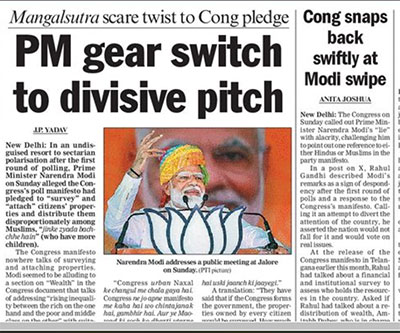
    The Telegraph stood out with its front page (see screenshot): “PM gear switch to divisive pitch”.


    Some editorials were forthright.


    The Hindu:

    “One of the main features of Narendra Modi’s politics is his reliance on an unapologetic brand of right-wing rhetoric that is moored in demagoguery, hate speeches against minorities and the use of dog whistles — political messaging intended to please the bigoted sections of his support base.”


    Others urged all politicians to abjure hate speech for the sake of democracy – not that too many other than BJP members resort to hate speech to win votes.


    But not one of the members of the media that I came across had the gumption to demand action from the Election Commission. Or demand that democracy be respected. Spare me the lectures about fear and money and spare me your interpretation about how the media must fall into the bothsides-ism trap. I have worked for any number of publications which have run campaigns for the public good.

    And stopping hate speech is for the public good.


    With no state agency and no media to help, it is left to citizens who have the most to lose, whichever way the chip falls:

    https://scroll.in/latest/1066924/2200-citizens-write-to-election-commission-seeking-action-against-pm-narendra-modi-for-hate-speech


    Ranjona Banerji is a senior journalist and commentator. She writes on MxMIndia on Tuesdays and Fridays. Her views here are personal.

  • Is Marketing coming Full Circle?

    AI-generated image


    Ashoke AgarrwalTime was when marketing was confined to the bazaar. Goods and services were sold in one-to-one transactions between a buyer and a seller. More often than not, the buyer and the seller had a relationship, if not of trust, then at least of familiarity.

    Then, the eras of mass manufacturing and mass media dawned. After World War II, the industrial age shifted into high gear, leading to a proliferation of products and services. The prosperous 1950s and 60s, driven by the economic boom in the USA, marked the birth of the consumer era.

    Marketing underwent a significant transformation, shifting from the traditional model of building one-to-one relationships to a new era of mediated one-to-many brand-building. Modern media made this shift possible, revolutionizing how mass audiences could be reached.

    Marketing and media forged a symbiotic relationship, each playing a crucial role in the other’s success. With its ability to attract and retain audiences, media provided the platform for marketing to communicate its messages. In turn, through advertising, marketing financed the accumulation of these audiences, ensuring the continued viability of media.

    In the initial days of mass media marketing, brands were the pegs through which information about the product or service was conveyed. In the early days of the consumer age, many products and services had differentiated features, and advertising was then the art of conveying unique selling propositions (USPs) memorably.

    A few decades into the consumer age, as categories matured, competition heated up, investment flowed into consumer businesses, contract manufacturing emerged, and brands in many categories didn’t have differentiating features to hang their stories.

    Brands morphed away from information providers to signalers of personas and lifestyles. For example, the Nike user was a never-say-die enthusiast, while the Adidas guy strived for perfection.

    Brands’ dependence on mass media increased. Signaling a persona or a lifestyle on mass media allowed the entire market–loyal users of your brand, potential users of your brand, and, as importantly, loyal users of your competition–to know what your brand stands for. Brand equity was built on what the brand stood for and what it did not. The acceptance among loyal users complimented the rejection by the faithful users of the other brand. Pepsi’s equity depended not just on its persona but as much of the persona of Coke.

    While mass media might have been primarily financed by marketing, its importance went well beyond its role as a vehicle for advertising.

    In its heyday, mass media offered society a shared cultural arena that builds societal cohesion. Most religiously read the same one or two newspapers in the morning covering the same news, watched the same prime-time TV programs and went to the same movies.

    The arrival of Facebook and the subsequent social media juggernaut fractured this cohesion. Today, the average person gets his information, views, entertainment, and cultural content from various social media and OTT sources that may have little in common with those in his family, his colleagues, or his neighbors. The cohort that shares his principal information, entertainment, and cultural sources is not a community in the traditional sense – they might not reside in the same city or even country, they might not share the same profession or educational level, and they may not be even in the same age group. The only thing they have in common is the echo chamber of partisan views and attitudes they share. They are the modern tribe – divorced from the shared everyday space and civic responsibility that defined traditional communities.

    This fracturing of societal cohesion has also fractured the rationale that drives modern brand-building.

    The core function of a brand as a widely accepted signal of a persona or a lifestyle is fast losing its potency, mainly because, in post-modern society, there is little that is widely accepted. In an era when even facts have alternate facts, what chance does a brand have as a widely accepted symbol?

    In light of failing mass media, brands have shifted their marketing resources to new media. However, the paradigm that drives their brand-building effort remains the same as in the modern era. By and large, they are yet to find a new paradigm that better suits the changed reality.

    Lately, I have heard murmurs from the marketing fraternity that perhaps digital and social media are better suited to “performance marketing” (another name for baiting someone to click on a link) than brand-building. And they must reweigh their mass media spending to strengthen their brands.

    Instead, the new reality calls for re-examining the very purpose of brands. Instead of brands being broad-based signalers of lifestyle or persona to a market, brands in the emerging new marketing era become builders of permission-driven one-to-one relationships with their consumers. Like the shopkeepers and the shoppers of the bazaar of the old days, a brand and its consumers must develop an interactive relationship of trust and constantly deepening understanding of each other.

    With the maturing of Big Data, a digital-immersed consumer, e-commerce, and the economies of scale of cloud computing, marketing can today shift to a paradigm where a brand can build and nurture a one-to-one relationship with consumers at scale.

    Given my current obsession with AI, as marketing reverts to building one-to-one relationships, the day is close when the one-to-one relationship will be between the brand’s AI avatar and the consumer’s AI avatar, as I have written in many of my MxM columns, starting with the first one.

    Marketers at the cutting edge, including many D2C start-ups, have started working on this new paradigm.

    Post-modern marketing could address another shift. The younger generation of consumers – Gen Z and, over the next decade, the Alphas (those born after 2010) – are opposed to marketing messages touting lifestyles and personas and, simultaneously, intensely devoted to a chosen cause. Can tomorrow’s brands be built based on a cause it espouses, not just in communication terms but through on-the-ground action? An exciting area to ponder in a MxMIndia column to come?

  • Thinkin’ Birds secures Royal Empire digital media mandate

    Thinkin’ Birds Communications has bagged the digital media mandate for Royal Empire by MB Infra, real estate developers in Maharashtra.

    Commenting on this association, Amit Babaria, Founder & Managing Director, MB Infra, said: “In today’s digital age, a robust online presence is key for business growth and profitability. That’s why we decided to partner with an agency capable of enhancing our brand in the online realm. Their successful track record with renowned real estate brands and proficiency in utilizing the latest technologies gives us confidence that they’ll deliver positive results for our company. We are optimistic about the positive impact they can make on our brand.”

    Speaking about the win, Bhavik Mehta, Brand Chief and Founder, Thinkin’Birds, added: “We are thrilled to welcome another esteemed account into our portfolio. Prepared with innovative ideas, we aim to enhance its digital brand presence and assist in achieving its objectives. This presents a significant opportunity for us, and we anticipate an outstanding beginning to this partnership.”

  • Vishal Sharma is back at LS Digital

    LS Digital, the digital marketing transformation company, has appointed Vishal Sharma as its new Deputy Vice President (DVP) of Media Buying and Trading. His expertise will be instrumental in enhancing the Media Buying division at LS Digital.Sharma will be responsible for the growth of Non-Biddable Media; branding and performance partnership solutions, building trading strength and brand planning for brand subscribing to media services and help build trust in the minds of the clients.

    Maanesh Vasudeo
    Maanesh Vasudeo

    Commenting on the appointment, Maanesh Vasudeo of the leadership team at LS Digital said: “At LS Digital, we recognize the ever-evolving landscape of media buying and the transformative impact it can have on businesses across industries. As we propel towards a landscape of digital marketing transformation (DMT), omnichannel presence and consistency, it is essential for us to continually integrate media and marketing practices to offer tailored solutions to our partners.”

    Vishal Sharma
    Vishal Sharma

    This is Sharma’s second stint at LS Digital, Vasudeo added, “Vishal in his earlier role at LS Digital was responsible for pre-sales, media planning and execution. In these years, I have seen Vishal grow as a professional and his strength in media buying will further help LS Digital’s ambitious global growth plans.”

  • JioCinema goes premium at Rs 29/month

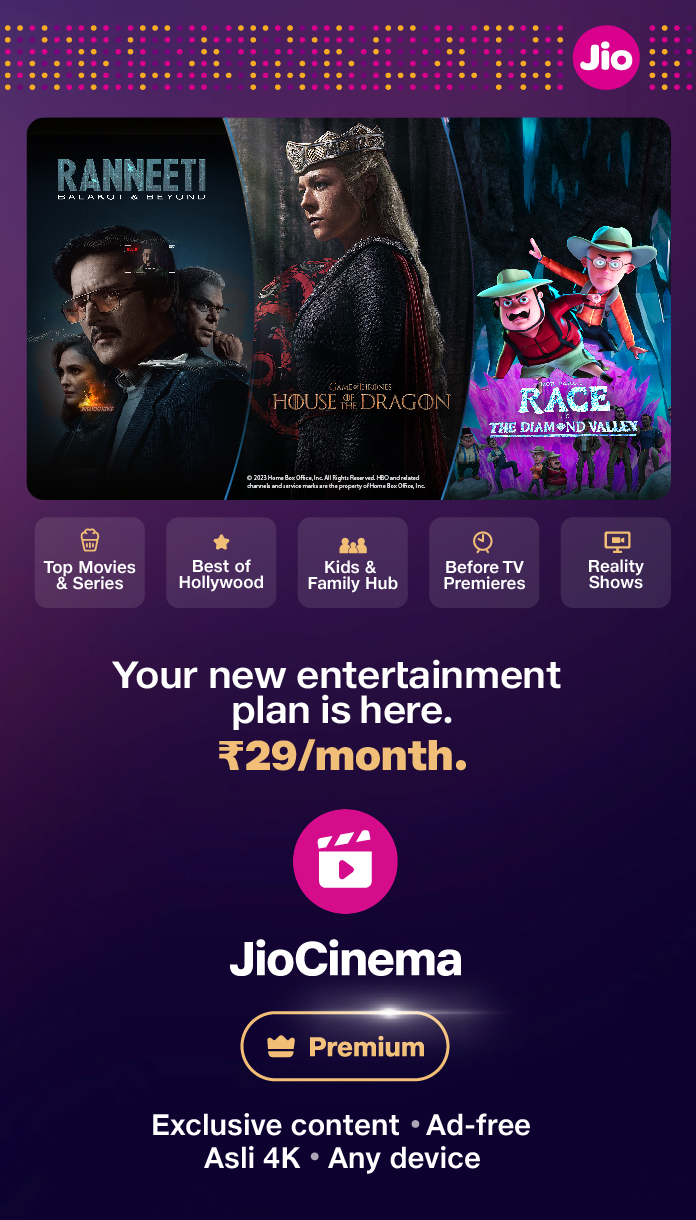
    JioCinema has announced its new subscription offering, ‘JioCinema Premium’, with a market-disrupting Rs 29 per month subscription offer. A ‘Family’ plan was also announced at Rs 89 per month which offers the additional benefit of four simultaneous screens access. Existing JioCinema Premium members will now enjoy all the additional benefits of the ‘Family’ plan at no extra cost. The ongoing Indian Premier League  will continue to be available for Free as part of its Ad-Supported offering.IPL

    Speaking on the launch of JioCinema Premium, Kiran Mani, CEO, Viacom18 Digital said: “Creating and building an entertainment ecosystem with a product that is made for every Indian household, is not just a business strategy, but a vision to empower our country and users with an unmatched entertainment experience. JioCinema Premium aims to redefine the narrative of premium entertainment for every Indian while building a daily viewing habit.” adding: “The introduction of JioCinema Premium breaks the numerous cost and quality barriers that exist in accessing premium entertainment. With 4K streaming, best-in-class audio, offline viewing and no device restriction all at a customer-centric pricing is sure to democratise access to quality entertainment for all of India.”

  • Indiatimes 2.0 redefines digital storytelling for modern youth

    Indiatimes, a publication from Times Internet, has announced embarking on a new content creation journey with Indiatimes 2.0. From the latest trends to timeless classics, the brand, informs that it curates diverse content reflecting the preferences of today’s youth.

    Said Abhijeet Anand, Business Head of Indiatimes: “As the premier lifestyle platform under Times Internet, Indiatimes has always been at the forefront of creating trendsetting narratives that resonate with the nation’s youth. This metamorphosis marks our most thrilling chapter yet, as we strive to set new trends with unprecedented vigor to engage with our audience like never before. As we embark on the journey for Indiatimes 2.0, we have a robust pipeline of IPs (Intellectual Properties) centred around themes such as “Make in India” (showcasing India’s rich cultural heritage and innovation on a global scale), education and personal finance.”

  • AI market burgeoning: Kantar research

    According to Kantar’s Icube data, Artificial Intelligence (AI) is already touching the lives of 9 in 10 internet users in India, “powered by the enormous computing capabilities on their phones, connectivity, and cloud infrastructure”,

    As per Kantar, the current AI user base of the country stands at 724 million and poised to grow YoY at 6%. These are users who have used any of the AI features like image filters, personalised recommendations, smart devices, etc till now.

    Kantar also found that ‘fitness’ and ‘social media’ apps are driving AI adoption with an average of 2.3 AI led features embedded in these applications. ‘Entertainment’ apps are a close second, standing at 2.0 AI features on average. AI is also touching ‘digital commerce’ and ‘pharmacy apps’ at an average of 1.8 AI features each. Kantar also anticipates that many more digital commerce & entertainment apps will adopt AI features to enhance quality of customer experience and stay in line with the emerging trends. Adoption however is slower in the ‘BFSI’, ‘job search’ and ‘short video’ apps segments, at an average of 1.2 features each.

    As per Kantar, adoption of AI among users is currently high for popular features while enhanced AI functionalities are catching up. Incidence among AI users in 2023:

    1. 88 % consumers used AI based algorithms which analysed their preferences, behaviours, and interests to create personalized recommendations for tailored experiences. This segment grew at 6 % YoY.
    2. 88% consumer also automated various tasks and streamlined routines to enhance efficiency and productivity in their daily lives using AI. This segment grew at 6 % YoY.
    3. 86% used ‘image enhancement filters’ so that the resulting image is improved in terms of sharpness, contrast, brightness or with other features. This segment grew at 5% YoY.
    4. At 21%, ‘smart home automation’ is a smaller segment but growing at 25% YoY.
    5. 15% consumers enhanced their ‘user experience through virtual assistants’. This segment is the fastest growing at 27% YoY.

    While AI technologies are touching most internet users of India today, their usage is expectedly higher among the youth (19–24-year-olds) at 92% and interestingly, at a high 81% for the older (45+ year old) age bracket as well.

    Speaking about AI and addressing the marketers, Soumya Mohanty, Managing Director & Chief Client Officer- South Asia, Insights Division, Kantar said: “AI is inevitable. Historically, technology adoption has always been a dominant determinant of a brand’s trajectory. We at Kantar feel that it is important to help marketers humanize AI to innovate successfully, help activate AI to predict future performance, maximize ROI and use AI strategies to build competitive advantage for sustainable growth. We have created a range of offerings which will benefit marketers and consumers by extension. LINK AI is one such solution, which helps evaluate creative effectiveness at scale and has helped uncover new insights into creating better video ads on YouTube which has a proven track record of growth, following Google’s ABCD framework. Similarly, we have introduced best in class offerings like LIFT ROI, Trend AI and NeedScope AI for various stages of brand growth as well.”

    Added Puneet Avasthi, Senior Executive Director, South Asia, Insights Division, Kantar: “Generative AI is set to become a $1.3T market by 2034 with a possible 42% CAGR growth over the next 10 years. We are sitting at a point of inflection where the next few years will enable a competitive edge between businesses who adopt early and others. As the usage of AI grows rapidly, it is critical for marketers to not use AI in isolation and as a gimmicky fad, but weave in consumer behavioural data into it to remove biases, continue to focus on building equity and not just to run activations. Kantar is at the forefront of this AI revolution and is assisting brand builders to strengthen creative testing, innovation using it’s AI based solutions.”

  • Republic expands top deck

    Republic Media Network has expanded its top management team. Objective: “solidifying” its position for a “mega growth journey ahead”.

    Here are the higlights:

    • Arun Rawat takes over as the Nation Head for Republic Bharat
    • Satabadi Sharma Pathak takes over as the Head of Republic Kannada
    • Purnasha Sharraf takes over as the National Head of Republic Bangla
    • Abhinav Sharma takes over as the Head of Republic TV
    • Sanjukta Kapoor takes a leadership role in Business Branded Content
    • Joy Michael Dsouza takes a leadership role in Government Business

    Commenting on the appointments, Hersh Bhandari, CEO (Broadcast Business) of Republic Media Network said: “I am delighted today and wish the leaders all the very best on their new roles. We know they’re going to deliver exceptionally and take Republic Media Network to heights yet to be reached in Indian media. What’s particularly satisfying to me today is that Republic cultivates talent and unleashes them in positions of top decision-making. At a time that the Network is on the brink of a mega wave of expansion, we are confident that this team will shoulder the business objectives with passion, aggression, and innovation.”