ZenithOptimedia has won the media mandate for Foodpanda.in after a selection process that involved a multi-agency pitch. This mandate covers all aspects of the company’s media planning & buying, and will include digital duties as well. Foodpanda.in is an online food ordering platform has launched a new TV ad campaign. The two TVCs, created by Cheil India, highlight the core value proposition of foodpanda, that of ensuring customer delight at every point in the food delivery process. The key message, “If foodpanda likes it, you will love it!†spells out the fact that anything one orders through the portal has already been screened through stringent yardsticks of quality to ensure maximum satisfaction.
Hari KrishnanAnupriya Acharya
Commenting on the win Hari Krishnan, MD, ZenithOptimedia said, “We are happy to bring on board a client like Foodpanda and look forward to doing some really exciting work with them.† Rohit Chadda, MD and Co- Founder of Foodpanda.in added, “We needed a partner who has a deep understanding of consumers and their ever-evolving relationship with media. ZenithOptimedia impressed us with their strategic framework and ability to execute with speed and accuracy.â€
Anupriya Acharya, Group CEO, ZenithOptimedia says, “Over time we have expanded our presence in this sector where the ROI can be tracked 24X7. Also, this further consolidates our relationship with Rocket Internet, beyond Jabong and FabFurnish.â€
Home shopping network Star CJ has launched its m-Commerce website, bringing its products and services closer to its consumers. This move has been taken to take advantage of the growing number of mobile internet users in India, which presently is estimated to be 120 million, much more than the users using internet on their computers (estimated at 100 million). The other major reason behind this step is the overwhelming success experienced by the company for their mobile DM service, which was launched as a pre-requisite to this m-commerce website in June this year. The mobile DM service has been growing at an average month-on-month rate of 250 per cent fetching the company 55 per cent of the total sales through internet as compared to 45 per cent achieved from the e-commerce front. The company informed that a special team from Korea was assigned to develop the M-commerce website of the company, which is going live on 19th November 2014.
The biggest differentiating factor for Star CJ’s m-Commerce website is the live access provided to the consumers buying products from distinct sellers on the platform to view Star CJ alive on their mobile phones. This will also allow the consumers to view live demonstrations of the products, over and above their images and specifications.
Commenting on the launch of the new website, Kenny Shin, CEO Star CJ Network says, “M-commerce has grown phenomenally in India due to rapid growth in the smartphone sector. Star CJ looks at this platform as one of the greatest opportunities to penetrate further into the Indian market. The team has done an impressive job with the design, making it extremely easy for consumers to access and navigate through the website.â€
The website has been specifically designed for easy access and navigation on all types of mobile phones with internet. A direct link would be provided to the users, which will connect them to the Star CJ call centre on a simple click. This will smoothen and simplify the purchase, freeing the consumers from the tedious online payment process. Special discounts would be offered to the early birds, celebrating company’s presence on the m-commerce platform.
BIG Magic has announced the appointments of Sahil Kangotra as Business Head and Shalini Gupta as Chief Marketing Officer for the television networks as BIG Magic, BIG Magic Ganga, BIG Thrill & BIG Magic International. In their respective functions, Sahil and Shalini will report to Lavneesh Gupta, COO, Reliance Broadcast Network Ltd. and will be the torchbearers, leading the television team through its next level of growth.
An IIM Lucknow alumnus, Sahil Kangotra joins Reliance Broadcast Network from ICICI Lombard GIC Ltd., where the last position held was in the capacity of Vice President – Corporate Solutions Group. With over 12 years of work experience Sahil’s expertise lies in building growth through effective trouble shooting and leading through people management. With an astute business sense and high resourcefulness, Sahil will be responsible for growing revenues and the P&L of the television business.
Shalini Gupta
Shalini Gupta, an MBA in Marketing, with her extensive experience of over 15 years, will be responsible for driving market share and viewership along with creating brand saliency and buzz for the television network. Shalini has been associated with brands/organizations as Bharti Airtel, Loop (BPL) Mobile, Parle Agro and Grey Worldwide across roles as Corporate Communications, Brand Communications and Marketing. With diverse expertise, Shalini comes across as an innovator, team player and motivator and will be responsible for creating a distinct perception for the television network.
Lavneesh Gupta
Commenting on the key recent appointments, Lavneesh Gupta, COO, Reliance Broadcast Network said, “Shalini and Sahil each bring on board extensive and diverse experience which will further augment our brand’s growth and performance. It is our immense pleasure to announce their association with our television business, and we are confident that their proficiency will enable us to lead us to our next level of growth.”
The contempt our social media elite have towards mass Indian television is well-known. Barring an odd Bade Achhe LagteHain, all fiction content on Hindi GECs (and most non-fiction too) is frowned upon by the upper echelons of Twitter. Even then, I was surprised by the attention MasterChef India going vegetarian in their latest season received over the last week.
MasterChef India has never got media attention in the past. But earlier this week, a story in The Economic Times suggested that the show going vegetarian this season could have much to do with one of its two principal sponsors – Amul and Fortune (The Adani Group).
Anyone who knows how Indian television works would laugh that conspiracy theory off. MasterChef India is not an ‘advertiser-funded programme’, where the creative control is shared between the channel and the advertiser.
Twitter picked up the news, and soon, it was the hot topic of discussion, with a largely negative sentiment surrounding it. Not that Star Plus would be bothered. They would know that those commenting are not the target audience, and more importantly, they have little understanding of the real target audience.
When we see the decision of turning the show vegetarian from the viewership lens, it makes perfect sense. I must clarify that I’m as non-vegetarian as one can get, and would have personally liked to see a non-vegetarian-only MasterChef. But TV shows are not made for individuals, are they?
If you’ve been brought up in a progressive, cosmopolitan environment, it would be impossible for you to understand the issue at hand. That would have been the case with me as well. But over the last five years, we have conducted extensive research on food and lifestyle television. The disgust that the sight of meat can generate in certain audiences (and by “certainâ€, I mean 30-40%) has to be seen to be believed. We have had live examples of upper middle class housewives instinctively turning their faces away from the screen when something as basic as a bowl of chicken pieces is shown. We’ve seen this happen across India, city after city.
I know there are studies that suggest that the consumption of non-vegetarian food is increasing in India. But there are many caveats on how to read that data. A lot of this consumption is infrequent, once in a fortnight, for example. Also, a lot of it is ‘out of home’. When we talk Hindi GEC, we are talking of ‘family viewing at home during dinner time’. All three parts of that phrase (family, at home, dinner time) support a vegetarian idea.
In MasterChef Australia, meat is called ‘protein’ and if you fillet a fish well, you are ‘respecting’ it. In an episode a couple of seasons ago, a trout was called ‘lucky’ because it was going to be cooked on the show. In the latest season, when there was a vegetarian challenge, where all ‘protein’ was removed from the pantry, half the contestants cooked Indian!
It’s easy to argue that Indian television channels should be ‘progressive’ and help India’s outlook evolve towards a more global one. I would totally support that point when it comes to issues related to woman empowerment, education, health, gender equality, sexuality, racism and the likes. But maybe we can leave food out of this? It has no social impact whatsoever. And there is a deep, religious aspect to this all, which should not be questioned in all fairness.
Like always, the choice of viewing or not viewing is with the one who controls the remote. I think we may do well to respect the viewer before respecting the ingredients.
Times Television Network (TTN) has announced the appointment of Anup Vishwanathan, as the Marketing Head of the English Entertainment Cluster which includes premium channels such as Movies Now and Romedy Now. Based in Mumbai, he will work closely with the business and leadership teams at TTN and will report directly to Vivek Srivastava, Senior Vice-President and Head of the English Entertainment Cluster.
Speaking on the announcement, Vivek Srivastava said, “Anup’s expertise in working with a cross section of brands, along with his deep understanding of Media businesses will add great value to our business. I would like to welcome him on-board and I look forward to having a wonderful working experience.â€
Speaking on his new role, Anup Vishwanathan said, “I am really happy to be an integral part of the Times Television Network Team. I have had some wonderful clients and colleagues who have enriched me with knowledge and experience with every interaction I have had with them. That’s going to stand in good stead for me. And finally, I have managed to sync my work and my passion- which has always been movies. Looking forward for a blockbuster run here.â€
Anup Vishwanathan moves to Times Television Network after a successful stint at Leo Burnett which started in 2006. He has worked on some prominent brands like HDFC Life, Tata Capital, McDonalds, Sony Entertainment Television, Sony Pix, AXN, to name a few. Anup’s career has been an interesting mix of new account wins and accolades for his work on Sony Entertainment Television as well as other brands.
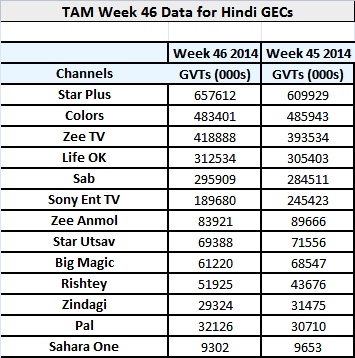
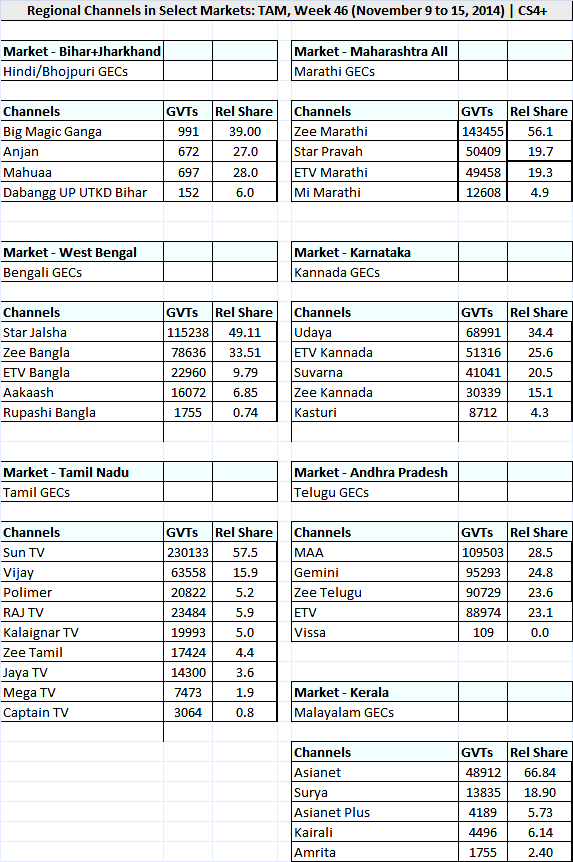
Presenting TAM data for Hindi general entertainment channels (GECs) and various regional GECs in select Indian markets. Note this list is not exhaustive and does not include some key and growing markets. But, as we go along, we’ll add them. Also, as you possibly know, this data is not sourced from TAM, which, we believe, has been restrained from giving out this info to media. So we’ve sourced it from a friendly subscriber. While we are confident of its authenticity, we urge advertisers and our readers in general to verify the data below and/or buy it directly from TAM.
Consumer confidence to shop online will continue to rise and India will have 100 million online shoppers by 2016. This was revealed by Google, in its annual online shopping growth trends report, compiled by combining an extensive research conducted by Forrester Consulting and Google search trends. The report revealed that India’s e-tailing market is at an inflection point and will see rapid growth to become a $15 bln market by 2016.
The research conducted by Forrester Consulting by interviewing 6859 respondents covering both online buyers and non-buyers in 50 cities/towns, revealed that online shoppers base will grow 3x by 2016, and over 50 million new buyers will come from Tier 1 and Tier 2 cities. The confidence to shop online was on the rise as 71 per cent non-buyers from Tier 1 and 2 cities said they plan to shop online in next 12 months. The findings also revealed that women buyers in Tier 1 cities were more engaged in online shopping, and outspend men by 2x. Women were also responsible for driving growth in categories like apparels, beauty & skincare, home furnishing, baby products and jewelry.
Looking at the growth trends of the categories, the report also projected that 40 million women are estimated to shop online in India by 2016. 2/3rd of online shoppers highlighted Convenience and Variety as major reasons to shop online in addition to discounts. Over 60 percent respondents also felt that buying online was directly correlated with social status. Mobile phones emerged as an important access device for online shoppers with 1 out of 3 online buyers transacting on their mobile phones in Tier 1 and Tier 2 cities. In Tier 3 cities, 1 in 2 buyers said they use mobile phones to purchase products online. This was also reflected in Google search trends with mobile phones queries growing 3x in last three years. Today, over 50 percent of shopping queries were coming from mobile phones, this share was as low as 24 per cent just two years back.
Speaking at the launch of the report, Nitin Bawankule, Industry Director for Ecommerce, Local and classifieds, Google India said, “The consumer confidence to shop online has grown significantly in last year and a half, and our objective was to understand the factors that are driving this growth and arrive at indicators that will help propel the Industry forward. As the report indicates, behavior of Indian online buyer is fast mirroring buyers in more developed markets as more subjective product categories have started to see significant growth. The e-tailing Industry needs to act now to cater to this strong user growth trend. Improved customer experience across all touch points, easy to use mobile apps can create a strong pull for non-buyers to shop online in Tier 1 and 2 cities. Women buyers are set to become the most significant contributor to the growth of online shopping and there is a huge opportunity waiting to be unlocked in this user segment.â€
Amongst the challenges, 62 percent buyers said they were not satisfied with their online shopping experience. 67 percent buyers also highlighted that the current return process was too complicated and expensive. Trust was a major issue with Non buyers, 55 percent non buyers did not trust the quality of products sold online, 63 percent said they were concerned about the safety of transacting online and 65 percent said, they don’t feel comfortable sharing personally identifiable information online. 66 percent of total respondents said that poor connectivity was also a major barrier for them to shop online.
Once upon a time there were the seasons for sports. But now with the various leagues in play, we have them all year round – be it the summer, winter or the rains. The formatting and packaging have led to even sports like kabaddi attract revenues and viewers.
We asked Vinik Karnik, National Director, Sports and Live Events- GroupM ESP, to give us his views on why and how non-cricketing sports are attracting sponsorship money. Here goes:
By Vinit Karnik
1. Increase in awareness about sports
New Age India consumes multiple sports and is exposed to world class leagues and formats. Real-time broadcast and analytics have ensured high degree of interest within the younger audience to watch and follow sports they like. This is leading to an increase in fans following sports on television.
2. Multiple language broadcast
Sports being promoted and broadcasted through multiple platforms and languages is the next big thing. This will increase the reach of sports in a big way. For instance, IPL 2014 reached a total audience of 191 million, Pro Kabbadi league reached 128 million. Expect ISL to create new benchmarks in terms of reach because of its broadcast strategy
3. Digital is the new Traditional
An increase in digital penetration has helped the sports business substantially. The live streaming of most sporting leagues helps fans to catch live action on their mobile phones or tablets while on the move. The world of apps help the fan with statistical data and trivia which they love to share on social media.
4. Improved performance by Indians at the highest stage in the World of Sports
The likes of Saina Nehwal, Mary Kom,Yogeshwar Dutt etc and the Indian hockey team have helped respective sports other than cricket stay relevant and aspirational
5. Mushrooming sporting leagues provide for more career opportunities for budding sportspersons pushing the performance envelope higher
Sporting leagues have generated a new ecosystem which develops high interest in the catchment areas. Grassroot development programmes ensure penetration of sports in rural areas. Very soon we will see young India take to sports as a profession. Talent and support functions both will be seen as professional careers
6. Sports is Entertainment
In a land where movies and cricket rules the roost, sports is slowing becoming an avenue of entertainment. Film stars investing in sporting franchise and sport stars premiering on TV or in some cases movies comes as a culmination of the two biggest passion points of India.
7. Multiple sports like Football, Badminton, Kabaddi and Hockey vying for No 2 spot makes for competitive pricing and lucrative deals
Sporting leagues are actively investing to make their sport the No 2 ensures a well-balanced on-air + on-ground entitlements packaging. Marketers will look at sports to involve and engage their target audience through their passion points. Sports will become one of the most effective and efficient way of engaging the target audience
With the sports industry on a high, advertisers have more options and opportunities to consider. Sports sponsorship helps and advertisers drive the communication in the most engaging manner. While advertisers chase eyeballs, sports is garnering more followers which translates into eyeballs. It’s a win-win situation for both and hence sponsorship in sports as an ecosystem is growing leaps and bound and will continue to challenge the status quo and create new benchmarks.
This article first appeared in ‘dna of brands’ in October 2014.
This column has to be dedicated to the power of Twitter. Or, as Bachi Karkaria, well-known journalist, columnist and noted punster would put it, “extraneous noiseâ€.
The Times Literary Carnival invited Tarun Tejpal as a panellist on the subject of the “Tyranny of power†in the first week of December. Manu Joseph, journalist, was to be the moderator, with journalist, editor, writer and now scriptwriter Basharat Peer and politician Mani Shankar Aiyar as the other participants.
Is there anyone here who has forgotten the Tejpal story from last November? The apology letter from the founder-editor-owner of Tehelka, the “recusing†of himself from the job and the “penance of lacerationâ€, the determination of the young colleague to expose his assault on her, the escalation of events from an admission of sexual harassment (hence the penance blah blah), the private mails made public, the police action on a rape case, the filing of charges?
It did not stop there either. Tejpal evaded arrest, was taken dramatically to Goa and put in jail. Once the lawyers entered the picture, the apology mails were retracted and his accuser was blamed for, well, the usual defence in such cases, asking for it. Collateral damage in all this was the reputation of Tehelka’s managing editor Shoma Chaudhury and Tehelka itself. Certainly one of Indian journalism’s most sordid scandals, except that we have such short memory spans.
Not that it ended there of course. Once Tejpal’s defence was settled on “the victim asked for it†or “why was she in a short dress†or “why did she get into a lift with meâ€, some attempt at rehabilitation was in order. It began with articles on video footage of the corridor outside the lift where the assault happened. Reams of high flown text on the corridor in defence of Tejpal from Manu Joseph, yes indeed, the man picked as the moderator.
It was apparently Swapan Dasgupta, columnist and good friend and defender of the BJP, who first set Twitter off by pulling out publicly from the “carnivalâ€. The outrage and protests grew on social media. Some people felt that the principles of free speech and presumption of innocence could be applied to the decision to invite Tejpal. Others felt this was just a way to rehabilitate him as a public figure and public “thinkerâ€. And the overwhelming feeling was one of anger that such an attempt was being made at all.
The problem with the presumption of innocence argument is that Tejpal himself apologised, publicly and privately before the matter became a police case. This was not a forced police confession to be retracted in front of a magistrate pleading torture or coercion or seen as inadmissible in law. Add to that the largely unaddressed issue of sexual harassment in media offices – for all our posturing and pointing fingers at other industries – and the problem is magnified.
One assumes therefore that the Times Literary Carnival knew what it was doing when it invited Tejpal as a panellist. And yet it found itself unable to come up with an adequate defence against the anger on Twitter. So Bachi Karkaria, organiser of the literary festival, announced on Twitter that Tejpal had been asked not to attend because the festival did not want “extraneous noiseâ€.
I have discussed the notion of extraneous noise in a piece for the opinion website, DailyO, and will not repeat that here. Instead, let us salute extraneous noise and the power of public opinion on social media, which can make a behemoth notice a pesky ant and change direction. Not a retraction, not a “recusalâ€, not a “penance that lacerates†but at the very least, a shift in “adamantine resolveâ€.
Dabur, BJP, Infosys, HUL, Satyamev Jayate topped the list of campaigns shortlisted for the Indian Marketing Awards 2014 (IMA), which will be handed out at the awards gala on December 12 at Hotel Leela, Gurgaon. The shortlist includes 88 cutting-edge campaigns hailing from different parts of the country and reflects the finest work in setting new standards of marketing excellence today, while also pointing to the trends that will drive tomorrow’s marketing arena.
The first part of the two-stage judging process was completed last week by a pre-screening jury comprising of leading industry leaders. The members of the pre-screening jury include Debabrata Mukherjee of Coca Cola, Vivek Sharma of Philips, Dinesh Garg of TTK Prestige, Prabhakar Tiwari of Ceat India, Aarti Ahuja of TCNS Clothing, Girish Shah of Godrej Properties, Sandipan Ghosh of Ruchi Soya Group, Anshul Punhani of Monster.com, Sandeep Aurora of Intel, Apurva Chamaria of HCL, Devendra Chawla of Future Retail and Saujanya Shrivastava of Bharti Axa Life Insurance.
The IMA jury is headed by Vinita Bali, former Managing Director, Britannia and the jury members include RanjanKapur, Country Manager – India at WPP; Prema Sagar, Principal & Founder at Genesis Burson-Marsteller; Thomas Puliyel, President at IMRB International, Mumbai; Vijay Subramaniam, Managing Director – India & South East Asia, Bacardi India; Kamal Bali, Managing Director, Volvo India; Dr. Amarnath Anantha narayanan, Managing Director & CEO, Bharti AXA General Insurance; Amit Burman, Vice Chairman, Dabur; Geetu Verma, Executive Director – Foods & Refreshments, HUL; HaritNagpal, CEO, Tatasky; Sangeeta Pendurkar, Managing Director, Kellogg and Saugata Gupta, Managing Director & CEO, Marico.
350 entries were received across 14 categories, which comprise Brand Activation; Brand Extension; Brand Revitalisation; Business-to-Business Marketing; Cause Related Marketing; Consumer Insight; Customer Relationship Marketing; Digital Marketing, Social Media, Mobile Marketing; E-Commerce; Global Marketing; Marketing Communication; Marketing on a Small Budget; New Brand, Product or Service Launch and Not-For-Profit Marketing.
Leading communication agencies Contract Advertising, Genesis Burson-Marsteller and Landor have partnered with Indian Marketing Awards 2014. The awards are presented by Hindustan Times and powered by Colors, VIACOM 18.
Anurag Batra
Announcing the shortlisted campaigns, Anurag Batra, Chairman & Editor-in-Chief, Exchange4media group, said, “Indian Marketing Awards is our biggest and most prestigious competition, aimed at advancing the marketing profession and identifying the emerging trends in marketing. The awards will be presented to organizations, individuals and teams who have achieved extraordinary success from innovative and effective marketing practices, having regard to the particular circumstances of different industries and diversity of marketing programsâ€.
“Indian Marketing Awards 2014 offers the chance for the next benchmark to be set for marketing effectiveness within the country. We have an exciting mixture of work on the shortlist and we will watch with interest to see which pieces the jury deem worthy of being elevated to prize winning status and in turn, set the new precedent,†says Vinita Bali, Non-Executive Director CRISIL, Titan Industries Ltd., The Wadia Group Companies and Piramal Glass Limited.
Vuclip has announced that 67 per cent of 12,000 global survey respondents prefer mobile as their primary method for watching their favorite movies, music videos, and TV shows. Overall, 81 per cent of survey respondents were from emerging markets of India, the Middle East, and Southeast Asia. This illustrates that mobile video popularity, in the emerging markets has moved beyond just a few early adopters and is fast becoming mainstream.
Survey respondents in emerging markets showed an increased desire to pay for a better video experience, such as HD and unbuffered video content, and for payment to be through their mobile carriers.
The overall global study results found that:
:: 70 per cent of men and 56 per cent of women prefer to watch their favorite videos, TV shows, and movies on mobile; compared to 20 per cent of men and 29 per cent of women who still prefer their televisions
:: 85 per cent of men and 75 per cent of women said they will increase the amount of time they watch videos on mobile in the future
:: 73 per cent of men and 61 per cent of women said it is important that the video not buffer while they are watching it; with 54 per cent of men and 49 per cent of women saying they would pay to download videos just to avoid buffering
:: 65 per cent of men and 54 per cent of women prefer to pay through their mobile carrier to purchase mobile videos; followed by credit/store payment and net banking payment, respectively
“Mobile is fast becoming the medium of choice for consumers in emerging markets to watch their favorite music, movies and TV shows,†said Arun Prakash, COO of Vuclip. “It is only natural for consumers to expect an unbuffered viewing experience in their primary method of consumption, with relevant and high-definition content, and simplicity of payment methods. This expectation and need continues to inspire us as an industry leader to innovate in these areas. We see a strong and fast-growing mobile video economy in emerging markets where the entire ecosystem will come out a winner.â€
All of the statistics in this report were gathered via a global survey of more than 12,000 people predominantly from India, Southeast Asia and the Middle East conducted in October 2014. Users were provided with multiple-choice questions and had the option to opt out. No incentives were provided for responding.
ZeeQ has rolled out a new TVC for its young audience. Keeping in mind the objective of establishing itself as a provider of ‘clean entertainment but with unlimited masti’, the channel has picked up an important element of a child’s characteristic – ‘Masti’. The new TVC establishes the position that ‘Masti’ keeps both the body and mind of the child active.
The TVC showcases four distinct situations in a kid’s life where fun plays a pivotal role. The acts show children in a regaling act full of fun, playing innocent and fun-filled pranks which amuse and add cheer to every person around them. Be it jumping into the puddle with the friends and laughing away to the little joys of life, to playing smart pranks on family members, the common factor that is all encompassing in this campaign is mind-full fun.
Aparna Bhosle, Deputy Business Head, ZeeQ said, “Our vision is to make ZeeQ India’s best suited entertainment channel for kids that offers mind-full content but with endless entertaining masti and our new TVC conveys just that.â€
Apart from the on-air telecast of the new TV campaign, ZeeQ will also be leveraging their campaign concept “Ham hain Mastikhor kids†on a 360 degree promotional platform spanning Digital, Radio, etc through exciting audience outreach programmes namely contests and other engagement activities across various cities in India.




 By Shailesh Kapoor

 By Ranjona Banerji