Category: MEDIA

  • Mediaah!: Oh MiD-Day, my MiD-Day!

    By Pradyuman Maheshwari


    Its paid content strategy is rubbish, but it’s a great newspaper. It’s a Mumbai institution, just as The Times of India is (see disclosure below). Sadly, it flopped miserably in Delhi and Bengaluru (and Pune) in the past and I wasn’t surprised to learn that the paper was shutting shop in the two metros. Pune stays, but it’s serviced totally by Mumbai, save the local reporting talent.


    When Jagran bought Midday Multimedia last year, it was evident that the group was interested in the flagship Mumbai edition, Inquilab and Gujarati Mid-Day. In fact, Inquilab fitted the gameplan perfectly to dominate UP.


    While we mediapersons sermonise endlessly about how corporates should deal with retrenchment, we are awful in handling such situations in our own backyard. The mail from the CEO was very casual and while he may have thought it was cool, there are better ways to do effect a closure.


    Do it face-to-face. Personally visit one of the centres and request your editor who was in Bengaluru to interview the Apple co-founder to stay back and break the bad news.


    Those in power must never forget that the same fate could strike them.


    Now what? The team in Delhi is up in arms. Over social networks they say that they were being asked to voluntarily resign and have heard that bouncers will stop them from entering the office today. I don’t know what’s the state in Bengaluru, but some protestors asked MxMIndia to report on the matter. We haven’t done a story on the issue, because it was too late to get a comment from the Mid-Day bosses.


    From what I know of the Jagran management, the Guptas are cool and considerate. They are open to reason, and I’m sure they’ll correct the wrongs. They are interested in the big picture, and will not want to dirty their image with such petty matters. Mid-Day is just one of the publications in their acquisition plans… there are many more in the pipeline.


    Yes, the Delhi and Bengaluru editions didn’t work. With abysmal readership and a nil score on the IRS Q2/2011 numbers for urban centres like Gurgaon and Noida, even the journos knew that the editions weren’t going anywhere.


    But you’ve got to give the jhatkas with compassion. Jaago, Jagran, jaago.


    * Disclosure: I have spent some of the best years of my professional life working with Mid-Day from 1993 to 2000.


    Hey Minister! Leave the cyberspace alone!

    My heart goes out to our dear central mantrijis. They’ve are subjected to the whims and fancies of all and sundry. The Prime Ministerji, Madamji, Babaji, Betiji, Saaleji, other Mantrijis and Mukhyamantrijis, various MPjis, some friendly Opposition leaderjis too. And the Babus, the secretaries, chaprasis and even the drivers. Not to forget the barber and the occasional masseur.


    But in the mother of all wtf-ness, I was shocked to see the otherwise reasonable Kapil Sibal making a hash of himself (literally, with an idiot prefixed on Twitter) by asking social networks etc to regulate content. Sibal, poor man, is under hajaar fire. 2G, 3G and of course the G family.


    There has been furore on the twitterosphere and for that matter all media. Monsieur Sibal should know that the internetwallahs aren’t divided and won’t sit quiet after a while like broadcasters and newspaperwallahs. Consequence: the issue has got internationalised and India is being compared to China. Which is silly. We aren’t.


    Time for credible awards

    I was at the Time-Out food awards on Tuesday evening, and the creme de la creme of restaurantwallahs were in attendance. Funnily, every other winner had just one thing to say: that being from Time-Out, the awards were credible.


    I think the credit for this goes to editorial head Naresh Fernandez and owner-bosswoman Smriti Ruia Kanodia. I’ve known Naresh for a bit, and must say he can be brutally credible. Which is perhaps why I trust Time-Out thoroughly. If Time-Out says the food at Restaurant X is good, you can be sure it’ll be good. Can’t say that about some other reviewers who love the free stuff, or at least whose publications do not have a policy of serving honest content. Ms Kanodia deserves credit for having survived Naresh and been successful despite his (and the Time-Out parents’ ) insistence that they will not bow to  advertiser diktats. Okay, okay credit also to the business and sales folk for being able to sell despite all these odds.


    Back to the point of awards not being credible. It’s unfortunate that the general perception is that awards instituted by media companies aren’t aboveboard. More on that some other day.


    Who’s the most IMPACT-ful of them all?

    It’s the big night for media professionals. It’s also for the first time I will not be attending an Impact Person of the Year. Guess the promoters there are still peeved that I quit to set up MxMIndia. As a career journalist, I couldn’t have turned to farming after moving on. Yes, I could’ve gone back to mainstream media or set up a Firstpost-like site that I was intending to, but, heck, I think it’s possible to have a good, clean media and marketing portal. With content that’s not got strings attached. Like afaqs and a few others.The market is waiting to grow.


    For the record, none of the ex-e4mers who’ve joined MxM were pulled out of their jobs. They’ve either joined me after quitting, or moved out because they saw a brighter future. The fact is that I did attempt to poach a few, but they didn’t join us.


    Before I digress any further, here’s my take on the nominees. First, I think it’s a great idea to have just eight nominees. Yes, there will be people who’ll be unhappy to have not made it to the List, but that’s fine.


    It’s a tough call… all the people are very, very worthy winners.


    Let’s take a look at the Eight:

    > Agnello Dias, Chairman & Co-founder, TapRoot India
    > Haresh Chawla, outgoing Group CEO, Network18 and Viacom18
    > Madhukar Kamath, MD & CEO, Mudra Group and Chairman, AdAsia
    > Man Jit Singh, CEO, Multi Screen Media
    > Rajiv Verma, CEO, Hindustan Times
    > Ronnie Screwvala, CEO and Founder Chairman, UTV
    > Sandeep Goyal, Non-Executive Founder Chairman, Dentsu India
    > Vineet Jain, Managing Director, Times Group


    I must confess I know who the winner is. So it would be incorrect to be a spoiler. I wish I had written this a week back, but I didn’t get down to it.


    But if I were to do a shortlist from the above and for their spectacular performance this year and also the way the voting works, here’s my shortlist:


    Agnello ‘Aggie’ Dias, Madhukar Kamath, Man Jit Singh, Ronnie Screwvala and Vineet Jain.


    > Aggie for producing some marvellous work in an industry dominated by Ogilvy and JWT.

    > Madhukar for dressing up Mudra beautifully and making it matter in the creative world and finally hawking majority stakes to an international major.

    > Man Jit Singh for finally getting all MSM channels in top gear

    > Ronnie Screwvala because his UTV Stars is doing so very well, the others are on action mode, Bloomberg-UTV is near-sold to Reliance and cementing the deal for 100 per cent stake to Disney.

    > Vineet Jain: well, you know about my reservations about Medianet, but otherwise the company rocks. Editorially, both The Times of India and Times Now set the agenda. The Anna Hazare movement and Commonwealth Games scams gave the government sleepless nights thanks to the belligerence of TOI and TN. Times Internet is doing well, and other brands are also flexing their muscles.


    As for those not in my shortlist: both Rajiv Verma and Haresh Chawla have been running run their empires with entrepreneurial zeal , and as for Sandeep Goyal, the man who sold his stake to Dentsu for Rs 240 crore, this line from ‘3 Idiots’ comes to mind: ‘Ustaad, tussi great ho!”


    Buzz me if you have a story to tell. Confidentiality assured. There are various ways you can reach me: pradyumanm[at]mxmindia.com, 23050B5D, pradyumanm[at]gmail.com, @pmahesh, 98338 76278.


    Disclaimer: Although Pradyuman Maheshwari is CEO of MxMIndia other than being editor-in-chief, he chucks those hats while writing Mediaah! So, the views expressed here are entirely his own and not those of the website and the team that runs it (especially the National Sales Head!).
  • PRCAI 2011 Report Unveils ‘Talent Crunch’

    By A Correspondent

    The Public Relations Consultants Association of India (PRCAI), in their first ever report on the public relations consultancy sector, has reported a positive business outlook for the PR industry in 2011. More than half the PR industry expects an achievement of 15-20 per cent revenue growth, despite majority of respondents being conservative with their revenue forecast indicating the underlying degree of competition and uncertainty of retaining existing clients.

    The report further outlines that with economic growth becoming broad-based, tier II & tier III cities will become relevant for most PR firms in India. In fact, nearly 55 per cent of the respondents acknowledged hinterland as an important area of growth in terms of business in the selected categories of premium products.

    Mr Sharif D Rangnekar, President, PRCAI said, ”While industry is looking towards expanding horizons, PR firms in India are finding it difficult to fill vacant positions despite the recovery in job markets due to a talent mismatch and lack of requisite skill-sets. Nearly 80 per cent people believe that the Indian education system is not geared up to cater to the PR industry needs.

    Similar to other industries, the hiring mood has been positive and showed an upward trend for the Indian PR sector. In spite of the dampening global economic reports, the industry is witnessing a tremendous spurt in the recruitment drive. Nearly 30 per cent respondents had been thinking of giving salary hike in the range of 20-30 per cent.”

    Hiring is the top priority for PR industry at the moment and improving the writing skills of the PR executives is the focal point of training for most companies. Basics like meeting client’s expectation and increasing efficiency come second. Talent management has emerged as the biggest impediment towards growth in the PR industry.

  • Business Standard joins the iPad gang

    By Akash Raha


    Business daily newspaper Business Standard has extended its digital presence with the launch of its new iPad Application. Attracting readers for its business content, Business Standard has translated this phenomenon into a very strong presence on the web with over a million unique visitors from around the world accessing its website. According to Business Standard sources, a fifth of its online visitors are from outside India. A mobile website that can be accessed on most handsets has also been providing news feeds on the go to readers for a while now.


    Talking about the development, Arun S Natesh, Head – Marketing, Business Standard, said, “To cater to the fairly evolved, widely travelled and tech savvy Business Standard readers’ requirements, and to keep pace with the emerging content consumption landscape, an iPad application has been designed keeping their interests in mind. The BS iPad application chooses to focus on the selection of key breaking stories, incisive analyses and insightful opinion in an easy-to-navigate, clutter-free format.”


    A highlight of the app is its coverage of stock market information. Readers can access stock price information, charts and news on India’s top 500 companies through a simple search. The app also features videos on top business events of the day and updates on the stock market. Sharing stories on social and professional networks apart from emailing is a one-click exercise.


    The app can be downloaded for free from the App Store, and is optimized for iOS4 and above. The Business Standard iPad App can be downloaded at: http://itunes.apple.com/us/app/business-standard/id482532990?ls=1&mt=8

  • History soars to No 1 in genre

    By Rishi Vora


    History, the channel from Network 18 and A+E Networks joint venture, has worked its way up to the No 1 position in the factual entertainment genre if one looks at the six metros market cluster. The channel’s market share is 33 per cent as against Discovery’s 31 per cent and National Geographic’s 13 per cent share in the same market.


    What is seen as a significant achievement for the channel is the fact that it has reached this peak in a timeframe of three months after launch. As a result, the genre too has expanded, say officials from the company.


    Sangeetha Aiyer, General Manager-Marketing, A+E Networks and TV18 JV, said, “While we are happy about the leadership status in the 6 metros, I think the real big story is about the growth of the genre. And that was pretty much our objective – to see if we can expand the genre from the current 1.5 per cent that it is at, to maybe 3 to 4 per cent, or even five. Given the genre growth of 57 per cent, led by History, I think we will be in a position to be able to achieve this sooner than later. Also, the leadership status in the six metros is an indication that all our endeavours in programming and content, marketing and distribution is resulting in rewards as planned.”


    She added, “Going forward it will be our conscious and concerted effort to hold on to our leadership status in the six metros market and consolidate leadership in other market clusters (1mn+ and All India) as well. We believe that our differentiated programming line-up, innovative marketing and focus on distribution will propel us in the direction of widening the gap and consolidating our position as the leader in the factual entertainment space.”


    The channel, according to Ms Aiyer, garners the highest time spent per viewer (40 minutes) vis-a-vis Discovery (29 minutes) and National Geographic (16 minutes). “History’s success is a result of differentiated programming and the stickiness quotient of its content,” she said.


    History reaches out to 50 million homes and 40 million viewers across India on cable TV platforms such as Hathway, In Cable, Den Networks and DTH platforms such as Tata Sky, Dish TV and Airtel.


    Source: TAM, Week 49’11, CS AB 15+, 2400 hrs

  • [PR CHANNEL] We are happy being No 1 as MSL group: Jaideep Shergill

    By Johnson Napier


    It was a year of jumps and gains as also of twists and pains for one of India’s leading PR agencies Hanmer MSL. After a fruitful 2010 that saw the company acquire a host of clients leading to a healthy growth story for the agency, 2011 was a challenging year given the lull in financial markets and the possibility of another slowdown striking the industry. But the company did post a 20 per cent growth rate in 2011 that was followed by the launch of a host of new ventures.


    Jaideep Shergill, CEO, Hanmer MSL India puts on his thinking cap and scrutinises the year gone by in a brief conversation with Johnson Napier of MxM India. From an increased focus on digital – led by social media – to acquiring a host of new clients and getting the talent platform right, Hanmer MSL is on track to be amongst the best in 2012, he says. Excerpts:


    Q: As the year 2011 draws to a close, how would you describe the journey so far for Hanmer MSL?

    The year has been a good one, I would say. From a business point of view, the year was good because we tried a few things differently. We started focusing on certain practices and industries; started looking at offering better solutions for our clients… Also, in areas like content and insights where we were not doing much earlier those are the areas that we have invested in now. We have started pursuing digital very aggressively although we were doing that in the past few years as well. The other area that we have gotten into is employee engagement and working with companies on their employee communication.


    But while we had a good year it was also a tough one – partly because the market has become very competitive. My feeling is that 2010 has been a bit better than 2011 and that’s also because of the fact that there has been a slowdown in the second half of 2011. Overall, it has been an okay year for us.


    Q: How would you rate your company’s performances in the last two-three quarters since you took formal charge from Mr Sunil Gautam?

    We continue to do the things we did when Sunil Gautam was around. It’s been a year now that I have been running the company. Sunil and I have been working with each for a long time now and we both had a common vision, which we continue to follow even now. So in that sense there is nothing new that we are doing.


    Q: Could you quantify the growth story of your agency with appropriate figures?

    I would say both in 2010 and 2011, we have grown by 20 per cent plus. We couldn’t grow at that rate in 2009 because of the slowdown.


    Q: While your roster of clients boasts an aggressive line-up, how has the client acquisition exercise panned out for you in 2011?

    It has been fairly good. Like I said, from the market point of view 2011 was not as good as 2010 although we did grow by 20 per cent – the thing is that we could have grown by more than 20 per cent. Normally what happens is when you’ve grown by 20 per cent one year, the next year you are expected to grow by 25-30 per cent. In terms of business development too, it was an okay year for us. We did win a lot of business. As for the centres, Delhi is an important market for us. In Mumbai we keep winning accounts consistently given our size and reputation but I think we need to do more in Delhi. We have grown to 60 people in Delhi though now. Bangalore is another market that has been performing well for us. There are already markets where we are established and are doing well like Pune, Chennai, Ahmedabad, etc. But with Delhi the thing is that there were a lot of agencies who were bigger than us when we entered that market, so they have a natural advantage over us.


    Q: Any (client) win that was worth the effort more than the others in 2011?

    I don’t just want to talk about 2011 but the last couple of years. Airtel, Star, World Gold Council, Western Union…and also across industries like Biocon (pharma), Volkswagen (auto), etc. So there has been a fair mix of clients and across sectors.


    Q: How would you rate Hanmer MSL on the parameter of client retention? How faithful have your clients been to your group?

    The retention levels have been fairly good. I would say 2010-11 have been our best years so far. We have hardly lost any business – less than two per cent, so to speak. This is a good number where the industry in concerned. For a long time the problem would be the inability of the agency to hold on to a business and clients too would not stick to an agency for a long time. But that is not the case here also because of the fact that we are investing in the right people and systems and making things work.


    Q: There was the famous recession of 2008 and now there is financial turmoil that has gripped Europe and to an extent, the US as well. How do you see the PR and communications industry being affected going forward?

    I don’t see an immediate impact right now. But there are signs that it is about to take place – pitches are slowing down, new clients coming and investing in communications is on a downward slide…and it is being observed across sectors like media buying and planning, advertising, etc. Moreover most of it is also psychological; it’s an artificial fear that is created in the market because of which companies start cutting back on their budgets. But after the 2008-09 slowdown, we should have learnt how to tackle the problem, which I believe we are ready for this time around.


    Q: How has the social media as a unit under digital grown over the past year for Hanmer MSL? What can be predicted from the unit going forward?

    It’s a medium that is going to continue to grow. Digital as an industry is growing by over 100 per cent. Currently it’s a very small pie in the entire media mix. As for the budgets, only 2-3 per cent of the budgets go into digital, which is very less. But I would say that digital is a medium that is here to stay. We started investing in the medium in 2008 itself and this year we have seen fairly good numbers.


    Q: You recently announced the launch of a separate Crisis Network unit; what was the need to branch off and launch it as a separate vertical under Hanmer MSL?

    We’ve only now started calling it by a separate name. Actually all global PR firms do crisis communications and we also have been doing it for a long time. The reason we have decided to package it and launch it like this is because we see that the world is changing very quickly and crisis and issues is becoming an integral part of people’s and companies lives and futures. 10-15 years ago nobody cared as such when crisis broke out as there was no social media – digital was largely undeveloped. So something would happen in the US and we in India wouldn’t know about it until later. But today the rate at which it spirals is a matter of concern.


    For us, there are a few things that we see as trends. The first is trust. People don’t trust companies as much as they used to. There’s more accountability because ever since banks and financial systems collapsed in 2008, people have started raising doubts on trusting people and systems. There is also a trust issue when it comes to government. So when there is a lack of trust, an issue or crisis can become much bigger. And the other big reason is digital, as I already explained. So that is the reason we launched the unit in a formal way so that we can strategise and build around it going forward.


    Q: What is the rationale behind agencies hiking their budgets when tending to clients in crises? Is this a common practice that most agencies follow?

    Crisis communications is a very big part of the PR business. I wouldn’t say that clients are over-charged; it’s just that we charge them the right amount of money. Normally they undercharge, so this is the right charge. The fact is that when there is a crisis then money is not the concern – things like reputation and all takes precedence. Also, what happens is that because it’s a crisis, the PR agencies and clients are willing to invest more time in more people and more money because they have to make it work. I am not saying that they would be overcharged but that you will have to spend a certain amount of money or resources or people to make the crisis work in your favour. Moreover we don’t have to do it on a day-to-day basis so it is okay to go the extra mile.


    Q: While pleasing the client is an attribute sacrosanct to any PR firm, is it right to gloss over the wrongs when engaging in a damage control exercise?

    I think the best thing that one can do is have a point of view. So if there is a negative sentiment floating around a company, it’s their job and that of the PR agency to correct that and give the right perspective or message. But that doesn’t mean that media or people can be gagged or stopped from writing; I don’t think that should be the approach.


    Q: How would you analyse the entry of foreign entities into India? Do you see more standalone Indian agencies being acquired in the future?

    The PR industry will see the coming in of more foreign players and also the existence of domestic players. There are advantages of multinationals coming in as they get in systems, practices and other such things. There is also an opportunity for talent acquisition. But at the same time the domestic agencies will continue to exist and operate as well.


    Q: How would you rate Hanmer MSL’s standing amongst your peers in the industry?

    As a group we are definitely No 1 but Hanmer as an agency is amongst the top 3. If the market is valued at Rs 400 crore (rough estimates), then MSL occupies double digit numbers. But it’s difficult to put a specific number as there is no clear indicator of the size of the industry. Even the figure that’s being put out by ASSOCHAM puts the industry at an unthinkable number whereas industry experts peg it to be in the vicinity of Rs 700-800 crore.


    Q: On the industry per se, do you see an order in the way the industry is organised or is it still work-in-progress?

    I don’t think there is a single solution; time is the best healer — like advertising agencies got consolidated with time. There will still be fragmentation – small, medium and large agencies will coexist. In a country like India, you will need to have agencies of different sizes and shapes to service an array of clients. Our market is still not mature enough; it will be another 5 years for that to happen, I guess.


    Q: What is the roadmap you have charted out for the agency for 2012?


    To survive another year and keep on posting healthy growth. If there is a slowdown this time we will be better prepared because we have a game plan. So let’s see how it pans out.


    Q: When do you see Hanmer becoming a clear No 1?

    Only Hanmer becoming No 1 – maybe two years, but we are happy being No 1 as MSL group. We prefer to operate as a single brand under MSL.

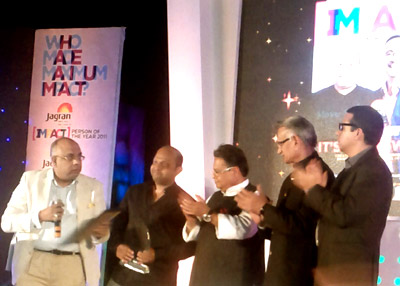
  • Mediaah!: Aggie – well-deserved Impact Person of the Year

    By Pradyuman Maheshwari


    So it’s Agnello Dias as Impact Person of the Year. For the first time in the seven-year history of Impact Person of the Year, an adperson has won the coveted accolade. Guess there have been times when people have come very close, but given the way the selection is done whoever is top of mind in the second half of the year, generally forges ahead (see disclosure).


    Deserving choice, and in every way echoes the sentiment of the industry. Aggie, with his Airtel ad, has been the toast of adland. I did a quick dipstick on Tuesday asking for names of the top creative folk in the country. The sample: 11 people from three metros. And this is what 90 per cent of the people said: Piyush Pandey, Prasoon Joshi and Agnello Dias.


    Feel sorry for the rest of the immense creative talent that India has, but guess these things happen and I don’t think anyone minds it. While Piyush is around, there is a laaarge creative pool at Ogilvy. Ditto in JWT, Mudra and the mom-and-pop shop based in Patna and Panjim.


    Should it have been one of the others?


    Haresh Chawla, outgoing Group CEO, Network18 and Viacom18

    Madhukar Kamath, MD & CEO, Mudra Group and Chairman, AdAsia

    Man Jit Singh, CEO, Multi Screen Media

    Rajiv Verma, CEO, Hindustan  Times

    Ronnie Screwvala, CEO and Founder Chairman, UTV

    Sandeep Goyal, Non-Executive Founder Chairman, Dentsu India

    Vineet Jain, Managing Director, Times Group


    Guess since it’s the fraternity who decides on who the award should go to, I think the question should be asked to each of us and not the exchange4media group management. For me, Agnello Dias represents the new face of Indian advertising. He is young, dynamic and has done some super work when with JWT and now as an entrepreneur running Taproot.


    What you can ask them (and the editorial team) is why they chose Haresh Chawla as Editorial Choice and not Vineet Jain, Sandeep Goel, Ronnie Screwvala, Man Jit Singh, Rajiv Verma and Madhukar Kamath? I think Haresh Chawla deserved it awesomely and since he’s moving out of the Network/Viacom/Web/etc 18 group, there can be no nasties like he was given the award to get more ads.


    So just as you may ask as to why cricketer x wasn’t selected for the Australia series, there will be questions asked as to why Haresh and why not Vineet Jain or Ronnie or Madhukar or Rajiv Verma or Sandeep Goel or Man Jit Singh?


    Pointless discussion. Many congratulations to Agnello Dias and Haresh Chawla.


    (Disclosure: I worked with the exchange4media group until May this year and ran the Impact Person of the Year for the last three years)

    Photograph: Bharat Kapadia


    The PR Channel

    Must mention here that I have been think of a specialised PR publication ever since Hanmer & PR founder-bossman Sunil Gautam asked me a question of whether it would work here in India. I didn’t think it would as a standalone, but in a broadbased site like MxMIndia, it should.


    SRK: India’s biggest endorser

    His Ra.One may not have worked as well as he would have, but the publicity around it was phenomenal. Clearly the biggest we’ve seen in India. Little wonder that an Economic Times report says that SRK emerged as the most visible celeb on TV followed by Katrina and Kareena. I missed reading it in the Mumbai edition of ET, but here’s a web link: http://economictimes.indiatimes.com/news/news-by-industry/services/advertising/shah-rukh-khan-fmcg-cos-lead-tv-advertising-charts/articleshow/11041079.cms


    Buzz me if you have a story to tell and gossip to share. Confidentiality assured. Andar ki baat will stay under. There are various ways you can reach me: pradyumanm[at]mxmindia.com, BBM @ 23050B5D, pradyumanm[at]gmail.com, @pmahesh, 98338 76278.


    Disclaimer: Although Pradyuman Maheshwari is CEO of MxMIndia other than being editor-in-chief, he chucks those hats while writing Mediaah! So, the views expressed here are entirely his own and not those of the website and the team that runs it (especially the National Sales Head!).

  • Introducing the MxMIndia PR Channel

    Welcome to MxMIndia’s exclusive ‘channel’ for Public Relations. And corporate communications. While there are blogs and groups and forums and newsletters doing the work reasonably well, content around the business is kinda scattered. Also, none of the media and marketing publications care too much about PR.


    PR and PR practitioners in India are regrettably lower down the business value chain. Part of the problem is the way PR is practised in the country. And our practitioners have fashioned/ conducted themselves. So, well, PRwallahs may be much higher in the pecking order than suppliers like the stationery printer, but marketing folk don’t really give them the respect they deserve. The last time I said something like this, there was a furore in a section of the trade.


    But, then, this status of PR ought to change. And it will, as it has in many places in the world.


    The MxMIndia PR Channel will not necessarily discuss issues such as these. We are not here to damn Niira Radia either. It’s here to celebrate the business. And give practitioners a forum – and a neurtral one — which they can call their own. From basic things like account wins and exec movements to case studies and success stories. Plus views, interviews, research. Sab kuch. Anaitum/Yellam (Tamil for everything).


    So, PRwaalon, make this your home. While we will update five days a week, a newsletter will be sent out once a week. Every Wednesday.


    Email my colleague and senior assistant editor Johnson Napier who is coordinating the channel. He can be reached at johnsonn[at]mxmindia.com and with a cc at editor@mxmindia.com. And feel free to call any of us.


    Cheers!


    Pradyuman Maheshwari

    Email: pradyumanm[at]mxmindia.com,

    BBM: 23050B5D

    Gtalk: pradyumanm[at]gmail.com,

    Twitter: @pmahesh

    Telephone: 98338 76278.


    PS: Our National Sales Head requests to put in a word that sponsorships and ads for this channel are welcome. As also dosh for events, seminars etc. And awards, where we will make sure it’s only the jury who decides on who to give the awards to. For sales, please mail Alok Kapuria at alokk[at]mxmindia.com and sales@mxmindia.com

  • ESPN acquires Cricket Australia rights

    By A Correspondent


    ESPN Star Sports has announced a five-year contract for the exclusive rights to broadcast Cricket Australia’s (CA) domestic and home international matches across various platforms including television, internet, mobile and radio, covering the entire Asian region.


    As a part of this deal, the current Future Tours Program (FTP) sees ESPN Star Sports broadcasting more than 191 days of live International cricket action from Australia, which includes 27 test matches, 44 one day internationals and 12 twenty-twenty games.


    This is the first time ever that a broadcast deal with Cricket Australia will give ESPN Star Sports rights to showcase two India series. India is slated to play four Test matches and a tri-series with England as the third team in the 2014-2015 season. This tri-series, featuring India, Australia and England and scheduled right before the ICC World Cup in 2015, is positioned as the ‘Clash of the Titans’. India will visit Australia again for seven one-day internationals and two twenty-twenty matches in the year 2015-2016.


    Over the next five years, all of the leading teams will be visiting Australia. In addition to the Ashes between arch rivals England and Australia in the year 2013-2014 which, based on the current FTP, will see 5 test matches, five ODIs and three twenty-twenty matches; other top cricket nations including South Africa, Pakistan, Sri Lanka, West Indies and New Zealand will tour Australia to test their mettle in the fiercely competitive environment of cricket down under.


    James Sutherland, Chief Executive Officer of Cricket Australia, said, “We are delighted that a telecaster of ESPN Star Sports’ standing and class will be putting Australian cricket in front of many cricket fans.”


    Manu Sawhney, Managing Director, ESPN Star Sports, said, “We are very pleased to announce this partnership with Cricket Australia with whom we share a very strong relationship. Australian Cricket has always been exciting and is played with utmost competitiveness in a super charged atmosphere which makes for every fan’s delight. It is therefore not surprising that it is called the ultimate test for any cricket player”. “This partnership with Cricket Australia is a testament to our commitment to serve our fans with more action packed cricket for years to come, he added.


    In addition to the cricket action, ESS also plans to broadcast Cricket Australia’s domestic cricket over 280 days. This includes popular tournaments such as the KFC Big Bash T20, the four-day Bupa Sheffield Shield tournament and the Ryobi One Day Cup.

  • Rocky road for Digital OOH?

    By Robin Thomas


    The ‘Global Digital Out-of-Home Media Forecast 2011-2015’ revealed Digital Out-Of-Home media as the fastest growing media in the world with the US as the largest global market and China, the fastest growing.


    However, in India, the medium is yet to make a huge impact. Advertisers are said to be sceptical about investing in the medium due to the lack of an effective measurement system, which is seen as the single biggest challenge. In fact, the effectiveness of digital out-of-home, as per experts, is not evangelized to advertisers and media planners, and as a result, India has not been able to catch up with some other markets.


    Ishan Raina, MD and CEO, OOH Media observed, “The OOH TV medium in India is still in its growth phase. India provides tremendous opportunities to advertisers to reach out to their target group. This has also resulted in the development of various new media formats, and digital OOH being one of them. In general, digital OOH space is expected to see a tremendous growth in the future, given the expected infrastructural growth, increased amount of time spent outside home, and the general economy boom in the coming years.”


    According to industry estimates, the OOH industry, estimated to be around Rs 1,500 crore, commands around 15 to 20 percent of the total advertising share, of which digital Out-of-Home commands 1 to 2 percent and is expected to further grow to 4 to 5 percent in the next two years. It has telecom, banking and finance as its top spenders, among other categories such as retail, FMCG, consumer durables, education and media.


    OOH media players are very optimistic about its future in India, and feel that as infrastructure develops, the economy grows and consumers spend more time out of home, there is high possibility for the medium to grow tremendously.


    Gourav Tandon, Managing Partner, Apex Integrated Marketing said, “India is still at a very nascent stage; however I strongly believe that digital OOH has immense potential in the Indian OOH scenario. The transition has already begun and we do have very large format digital media in places like Gurgaon. Clients today are immensely demanding and the onus is on the agencies to provide high quality mediums.”


    For Digital OOH to grow, there has to be significant number of innovations in the medium, the effectiveness of the medium also has to be evangelised to the advertisers and the media planners, and most of all the industry must come together for an effective measurement tool for digital out-of-home.


    R Venkata Subramanian, Senior Director-Investments, MPG India said, “Advertisers are still sceptical about Digital OOH as there is no effective measurement in place. It is a very good medium and its future is bright, the only draw is the lack of effective measurement to showcase the effectiveness of the medium. However Digital OOH is growing and one of the reasons is because consumers are increasingly spending most of their time out of home.”


    But not all are so positive about the potential of the Digital OOH industry. Ashish Pherwani, Associate Director, Advisory Services Ernst & Young said, “I currently don’xt see Digital OOH crossing 4 to 6 percent of the total OOH segment in the next two years. It requires a different mindset to create ads for Digital OOH, as well as a separate sales technique.”


    Harish Bijoor, CEO, Harish Bijoor Consults Inc, underlined the need for a scientific exploration of the Digital OOH space. “Digital OOH is a medium with potential, but I do not believe the potential has been exploited. What is needed is a scientific exploration of this space. It is time for digital OOH companies to do pressure tests in limited number of cities to prove the efficacy and true value of the medium. As of today, there is a gap in terms of acceptance and faith in this medium, and in the bargain, the medium writes a self-fulfilling prophesy of stagnation in terms of value and use,” he said.

  • FM radio: Waiting in the wings for how long?


    By Ritu Midha


    Television and print continue to be the mainstay of any media plan. The buzz around launch of new channels and publications (largely newspapers) is difficult to ignore. Digital media, too, has become a medium of ‘now’. Meanwhile, radio continues to struggle, with cost to operate being quite high while profitability is still an issue. Is it time, then, to ring the alarm bells? Is radio getting lost even before it has acquired a national footprint?


    Prashant Panday

    Radio: Today

    Prashant Panday, CEO, ENIL, emphasises: “There is no evidence of that yet, though if Phase III expansion gets delayed, this is bound to happen. The Indian media scenario has new brand launches happening all the time. Newspaper reports say that since August this year, the Ministry of I&B has given permission for 745 new TV channels – about half of which are news channels. Likewise, if you look at newspapers, there are editions opening across the country almost every month. It’s the same with outdoor sites and internet portals. In a scenario like this, if there is no addition in the number of radio channels, then the sector will get affected. That is one reason we are waiting for the 800 odd new radio licenses to be issued under Phase III. At present though, radio continues to grow, and its share continues to be just under 5 percent of total advertising spends.”


    Media planning and buying fraternity, in turn believes that radio as a medium is gaining popularity, and that is largely because of its content which touches a cord with the local consumers. Mohit Joshi, Managing Partner, MPG India, explains, “While there is not as much buzz about radio, I don’t think it is losing out. It has developed a unique role in the communication mix, which straddles ATL and BTL. Advertising support on the medium has been growing at 11 percent over the years.”


    Ashit Kukian

    Increase in FDI Limits: Low impact

    Media owners are of the view that increase in FDI in radio would not really impact the sector, unlike retail where the proposal for FDI in multi-brand retail has raised a storm. The common belief is that not many foreign players would be interested in the medium because of low profitability.


    Mr Panday says, “Remember, FDI only enters sectors where there is profitability and where the regulatory regime is favourable and stable. Today, most radio broadcasters are barely hitting EBITDA break-evens. This, after half the license period of ten years, is already over. I personally feel that the higher FDI/FII limit will help increase trading in listed radio stocks like ENIL and RBN, but apart from that, the impact might not be that high.


    Ashit Kukian, COO and President, Radio City, agrees, “The increase in FDI in radio sector from 20 to 26 percent is not really going to make any dramatic impact on the industry.”


    Vinish Joshi

    Slowdown: Whither goes Radio?

    While FM in India continues to struggle, impact of the slowdown, interestingly, on radio, as per the expert opinions might be the least, courtesy its local content. As per Mr Panday, with a slowdown in ad spends, the overall ad industry is unlikely to grow at more than 5-8 percent. His belief is that radio may grow slightly higher at 10-12 percent. “Almost all sectors are seeing a slowdown. We attributed the slowdown in the 1st quarter to the higher spends in the preceding 4th quarter on account of the cricket. However, the 2nd quarter also has been weak,” he says.


    Vinish Joshi, GM, Mediacom, too believes that radio might see a higher percentage growth than other media – largely due to its reach and content. He says, “Increasingly FM-enabled mobile phones are driving radio growth in India and phase III is expected to extend radio’s reach to 294 towns and 839 stations. If any medium stands to gain from this slowdown, it is radio, as during the periods of slowdown, marketing activities get more focused. The concern remains on accountability, as marketing will also be more accountable during this period and comprehensive measurement tool for Radio industry will be critical.”


     Mohit Joshi

    Measurement currency: A catch-22

    Indeed, the tighter times lead to a lot more stress on RoI, and measurement currency becomes very important. The radio players feel that there is need for a more robust radio measurement system. Mr Panday says: “The present system is a diary system which has many flaws. What we need is an electronic measurement system which accurately captures listenership. We also need more sample sizes to better capture the heterogeneous habits of our cities.”


    This sentiment of the media players is shared by media planning and buying fraternity. While, they agree that attempts being made to capture a larger listener base are commendable, they believe that it needs to broaden further.


    Mohit Joshi says, “Effort is already on for increasing the coverage of the network of the current Radio Measurement systems. Today, when we have radio stations across most of the key cities, the coverage also needs to mirror that growth. The better the data, the easier it would be to establish the role of Radio.”


    It would be interesting to find out how much is the fraternity ready to invest in improving the measurement system and currency. It is a known fact that research and measurement is cost-intensive. With RoI being an issue, most of them might find it difficult to make a major investment in anything.


    FM stations: Same, same – no different

    Radio, at the moment is suffering from me-too syndrome – which to a large extent can be attributed to investment constraints. There is definitely a need for differentiation – enter localised communication.


    Mr Kukian says, “Radio as a medium has the ability to create customized communication for pocketed audiences and impact millions of Indians due to its wide coverage and personal connect. This coupled with the medium’s innovation quotient gives it one up over other media in terms of fulfilling advertisers’ requirements.”


    Vinish Joshi shares a similar opinion, but he qualifies, “Inserting rapid-fire weather forecasts and traffic reports is just providing minimum local content. Local radio, by my definition, is the real interaction of radio personalities, announcers, the people on the air, with listeners both on and off the air. As long as radio maintains its local presence, something that other syndicated forms cannot provide, there will always be a need for its services.”


    Unfortunately local content on radio, largely restricted to traffic reports and contests, seems to be similar on all the stations. The reason for this, yet again, is operating costs and limited number of stations. The game might change once there are more radio stations post Phase III.


    Mr Panday states, “Very little content differentiation will happen unless more frequencies are released. Let’s take an example. Suppose only 10 TV channels were allowed by law. Which channels would exist then? My guess is that the 4-5 GECs would still exist, there would be 1-2 news channels and 2-3 other channels. The reason for so much content differentiation in TV is that there are so many channels. The second reason is that broadcasters are allowed to own and broadcast several channels, so that the cost of operating smaller format channels is reduced.”


    He continues, “In radio however, we suffer from restrictions on both the above mentioned requirements. There are only 7-8 channels in the major markets and broadcasters are allowed to operate only one channel per market. The Phase-III regulations are going to relax the second condition, but till the number of channels increases significantly, we cannot expect much content differentiation. And if the auctions happen the way they are planned – e-auctions for one frequency in Delhi and two in Mumbai – then the license fees will shoot up and niche formats will become unviable. The government needs to release more spectrum BEFORE auctions are conducted. We have even given them a formula to do this – just reduce the “separation” between two adjoining radio channels from the 800 kHz at present to 400 kHz.”


    If the separation between two adjoining channels is helved, the number of channels would double – broadcasters will be able to compete better with TV and print, the government will get more license fees through auctions. And it just might help in increasing FDI investments in the sector by raising the bar and the competition.


  • Hindustan launches 9th edition in Aligarh

    By Akash Raha


    Hindustan Media Ventures Limited (HMVL) launched its 9th edition in the state of UP from Aligarh on December 10, 2011. With the addition of Aligarh, Hindustan is now printed from 17 centres across the states of UP, Uttarakhand, Bihar, Jharkhand and Delhi.


    Commenting on the launch, Amit Chopra, CEO, HMVL said, “Aligarh is a unique region, culturally rich and prosperous. Its traditional segments like manufacturing and agriculture trade have made the region prosperous. And, education adds to its cultural heritage. It is the perfect setting for a progressive newspaper like Hindustan to enter. The team at Aligarh is setting the stage to making this a success right from the start.”


    Hindustan has launched in Aligarh with a strong 75,000 circulation that is unsurpassed in that zone. Aligarh edition launch comes a year after the launch of Gorakhpur edition which has continued to progress strongly.


    Shashi Shekhar, Editor-in-Chief, Hindustan said, “This is the city of Sir Syed and Maulana. We are honoured to have Aligarh as a key part of our network. For long, readers have had limited choice. Hindustan will offer a refreshing change for Aligarh and its surrounding region. High standards of integrity and journalistic reporting have made Hindustan a much loved and read newspaper in other areas. I am confident that Aligarh will respond to us in the same manner. We will understand and partner with the residents of this belt in their march towards progress.”


    Speaking on the launch Rajan Bhalla, Head-Marketing, Strategic Businesses – HT Media said, “The core proposition of Hindustan is ‘Tarakki ko chahiye naya nazariya’. We have approached Aligarh with the respect that the ‘Mecca of Education’ commands. Recognizing this we sought participation from college and school students in a unique initiative. We asked them to express themselves on the topic of ‘Aisa ho mera naya Aligarh’. Needless to say the response was overwhelming.”

  • HT celebrates Capital’s 100th bday with conclave & campaigns

    By Akash Raha

    Hindustan Times, the top English daily in New Delhi, has been celebrating the 100th Birthday of New Delhi under the banner of ‘I Love Delhi’ throughout 2011 and is getting ready for a high point on December 15 – which is the day the foundation stone of New Delhi was laid and which paved the way for the metropolis to develop.

    Shantanu Bhanja, Vice President – Marketing, Hindustan Times, has said, “I Love Delhi is a continuing initiative for Hindustan Times since it encapsulates our feelings for this beautiful city perfectly. Every year, we have a theme for the initiative and this year, what else could it be except the Centenary of the Capital. We have done a series of events already and hope to bring it to a grand closure now.”

    Hindustan Times is organizing the New Delhi 100 Conclave (on December 15,), inviting Delhi’s most prominent citizens to share their vision of Delhi over the next 100 years. On the occasion, Delhi Chief Minister Sheila Dikshit will release a coffee-table book that puts together Hindustan Times’ entire coverage of New Delhi 100 over the last year.

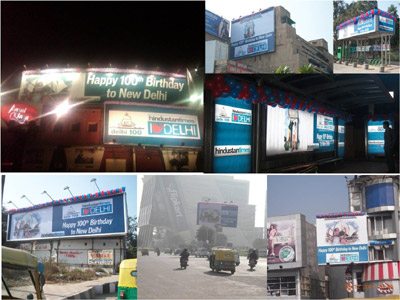
    Hindustan Times has a large outdoor campaign around Delhi-NCR on currently. In the campaign’s innovation, most sites have been decorated with red and blue balloons, wishing Delhi on its 100th birthday. The balloons give the city a festive and colourful look.

    Hindustan Times kicked off the celebrations for New Delhi’s 100th birthday on January 1, 2011 with an editorial series around various aspects of the evolution of the city. Chronicling how the political, cultural, social and architectural landscapes of the city have changed through the decades, this series was done at regular intervals throughout the year. One of the highlights of this series was the 100 Icons of Delhi – a listing of 100 buildings and institutions that define New Delhi as we know it today.

    In addition to the editorial features, Hindustan Times carried out several initiatives to increase reader engagement throughout the year under the Delhi 100 platform.