Category: MEDIA

  • Dial MSL if you’e a client in a crisis

    By A Correspondent


    MSLGROUP has announced the launch of a global Crisis Network of 50+ experts, to provide the best advice, guidance and support for clients in troubled times. Connected to each other by a proprietary real-time platform, the network is devised to help business leaders prepare for a new normal: today’s fundamental reset in dynamics between individuals, influencers and institutions around trust, power, risk and crisis. Alongside 24×7 access to the platform, the crisis experts are also able to leverage the network’s crisis planning framework and crisis simulation workshop — to help clients plan for and respond to crisis situations effectively. MSL is represented in India by Hanmer MSL and 20-20 MSL amongst others.


    Pascal Beucler, MSLGROUP’s Chief Strategy Officer commented, “Today, business leaders must master the three key interplays shaping crisis in the “new normal”: the interplay between mainstream media and social media, the interplay between local and global dynamics, and the interplay between crisis planning and response. MSLGROUP’s Crisis Network is a one-stop shop to help guide companies and institutions to do just that.”


    Marking the Crisis Network launch, the team has also published its first report, an e-book titled When Every Crisis is Global, Social and Viral. Section one explores how social media is changing trust, power, risk and crisis. Looking first at the role of social media in societal upheavals in the West, the authors then move to the East and review how social media is changing the news ecosystem in China, eroding the wasta system of personal influence in the Middle East and uniting the Indian middle class in a grassroots movement against corruption.


    The second section outlines how corporations can leverage social media to manage risk and reputation. The team of experts then take a look at how social media can play a role at each stage in the crisis curve, describe the art and science of crisis simulation, recommend engaging third party influencers in crisis planning, share lessons from managing the global Crisis Command Center for BP, provide a playbook for handling a crisis on Facebook and end with tips and tricks on crisis management.

  • Viacom 18 uses Measat for Asia beaming

    By A Correspondent


    Viacom 18 has tied up with MEASAT Satellite Systems Sdn Bhd to use the Measat-3a satellite for the international distribution of Viacom 18’s channels across the Asian region.


    “With wide coverage and a powerful Asian footprint, Measat -3a is the obvious satellite choice for distribution of our international services,” said Piyush Gupta, Chief Technology Officer, Viacom 18.


    “Measat is excited to be working with Viacom 18 to distribute its popular international channels via Measat-3a” said Yau Chyong Lim, Senior Director, Sales and Marketing, Measat. “The addition of Viacom 18’s channels further enhances the assortment of premium channels on Measat’s 91.5°E Asia video neighbourhood.”


    Viacom 18 is a 50/50 joint venture operation in India between Viacom Inc. and the Network 18 Group. The joint venture includes leading brands across television, film and digital media to build one of India’s leading multimedia entertainment powerhouses. The brands include MTV, Nick, VH1, Colors and Viacom18 Motion Pictures.


    The Measat -3/3a satellites distribute News, Lifestyle, Music, General Entertainment, Sports and Documentary channels across Asia over a bouquet of SD, HD and 3D channels.

  • Thakraney: Sony after KBC. Reality shows must face the music

    By Anil Thakraney


    I really don’t know what Sony’s revenue model was for the recently concluded KBC. As in, did the channel actually make money on advertising and sponsorships after deducting the massive costs? Which include phenomenal sums going to the host Big B, not to speak of all the prize monies (Mr Sushil Kumar alone walked away with five crore rupees). Maybe they did make a little profit on the show, maybe they did not. But here’s what has happened immediately post the show: On the ratings chart, the channel slipped to No 3 from its position of No 2.


    Now, traditional programming logic suggests that expensive reality shows and blockbuster cinema films play the role of a magnet, of getting a channel some stickiness with the viewers. Having come onto the platform, viewers would taste the regular fare on the channel and hopefully stay on. Well, KBC doesn’t seem to have delivered on that promise. After enjoying the show, clearly many viewers defected to the other channels. This naturally raises a doubt in the mind: Are reality shows over-hyped in the desi entertainment channels? Are they worth all the effort and the expenditure? Is too much expectation being loaded on them?


    There are no easy answers to this one. But one thing is clear: You can tempt patrons into a restaurant by offering an outstanding dessert, but they will only return if the food is delicious. You can’t build loyalty through window dressing. The idea should be to first build a powerful back-end… which is to create super regular programming. And then run a huge reality show, so that viewers like what they taste when it comes to the ‘bread and butter’ shows.


    In this context, one has to wonder if Sony put the cart before the horse. Star Plus’s consistent No 1 position should provide a way forward for other channels: Which is to first do the basics rights. And then dial Mr Bachchan’s number.

    ***

    PS: LOL! Watch this ad for Snickers. A good example of how to (literally) use research methods in advertising, AND make it work very nicely!

  • FDI’s 26% allowance: Are radio players happy?

    By Shubhangi Mehta


    The government has enhanced the foreign investment limit for FM radio to 26 percent from the earlier 20 percent.


    This change ensures conformity of the foreign investment limit with other similar activities in the Information and Broadcasting sector.


    Rana Barua

    Is the increase adequate or was there more that was expected?

    Mr Rana Barua, Chief Operating Officer at RED 93.5FM, put forth his views by stating,” it’s a positive sign for sure for the industry .

    Whether Red Fm is looking at upping the Astro stake, Mr Barua said, “We will try and look at that but this will all depend on internal decisions hence there is not much to be said on this as of now”.


    “It is a welcome change but we will be able to gauge its real value closer to the bidding date of phase3 when migration policy is clear.  While radio in india is possibly one of the highest CAGR media in the world, the global economic situation needs to be accounted for in order to ascertain foreign investment’ interest,” said Mr Vineet Singh Hukmani, MD, Radio One.


    Apurva Purohit


    On this Ms Apurva Purohit, CEO, Radio City 91.1 FM said,”The increase in FDI in Radio sector from 20 to 26 percent is not really going to make any dramatic impact on the industry. It is too less and even now not on par with other media like TV or DTH.”


    Prashant Panday


    Mr Prashant Panday,CEO,Radio

    Mirchi, remarked, “A higher FDI limit will help FIIs to trade more in radio stocks that are listed. Till now, the limit was 20 percent and when FIIs approached that number, they had to take special permission from RBI to buy more. Now that limit has been raised to 26 percent and that will help increase volumes on listed radio stocks.”


    Will this encourage more foreign players to invest in the market?

    On this Mr Panday said,” Whether it will have any impact on strategic investments from foreign companies in India or not remains to be seen. On the one hand, the radio sector in India offers tremendous growth opportunities. But on the other hand, the sector’s profitability has been in question for much of the last five years. Even going forward, if bidding in Phase-3 becomes unreasonable, profitability could be in serious jeopardy. Further, foreign ncompanies are themselves operating under uncertain conditions in their own markets. Whether they will be willing to invest in India at this point in time remains to be seen.Also, given the condition of the money markets in India right now, it is unlikely that fund raising will be very easy. Given all of this, I think FDI investments into the radio sector in India will be limited.


    Mr Barua on the same said,” I’m still not sure if the rise will encourage new players to enter the market. The rise is there but when it comes to analysing it, I have always encouraged a higher percentage. In my opinion this rise is not high enough and leaves us with a doubt if it will actually egg on more foreign players”.

  • UTV Movies India to launch in UK

    By A Correspondent


    UTV Movies India is set to launch on December 12 in the UK. Premiering on the Sky platform, the Hindi language movie channel, which will also carry English subtitles, draws on the universal passion for Bollywood.


    The channel upholds the promise of ‘Jeeyo Bollywood’ – living the Bollywood dream, giving viewers a direct experience of the spirit of Bollywood. The channel has a library of more than 400 titles.


    Advertising representation for the channel in the UK will be handled by Sky Media. Richard Hawking – Operations Director commented, “It’s a fantastic opportunity for us to add UTV Movies India to our portfolio of channels; it adds a new dimension to our offering for advertisers and great content for a growing and important audience.”


    Commenting on the expansion in UK, MK Anand, CEO – Broadcasting, UTV said, “With the launch of UTV Movies India in the UK we further expand our international footprint. The UK is a vital market for us as it has a large South Asian diaspora who are avid Bollywood movie lovers. We are proud to be associated with the UK’s largest media sales house – Sky Media, which comes with extensive media prowess in the region. We look forward to a successful entry into the region.”


    Kamlesh Patel, CEO, TVMedia3.com who concluded the deal between Sky and UTV said, “UK television viewers will be able to enjoy a rich and vibrant Bollywood movie experience that will appeal to mainstream television audiences. Bollywood movies are massively popular in the UK and with UTV Movies India we hope that this popularity increases further. It has been a real pleasure working with the teams at Sky Media and UTV Movies India.”


    Along with the United Kingdom, UTV Movies International is now also available in Canada on Rogers Digital Cable TV. With this development, UTV Movies’ international footprint now encompasses the United States, Australia, New Zealand, Malaysia, Sri Lanka, Nepal, the United Arab Emirates, East Africa, the United Kingdom and Canada.

  • Citing profitability, Mid-Day bids ‘ta ta’ to Delhi & Bengaluru editions; to concentrate on Mumbai

    By Rishi Vora


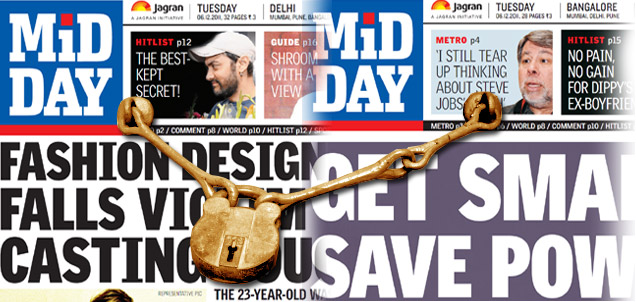
    Mid-Day, Mumbai’s leading English daily, has announced the shutting of its Delhi and Bengaluru editions. The reason: profitability. Mr Manajit Ghoshal, MD and CEO of the company, confirmed this to MxMIndia. “Both Delhi and Bengaluru editions will shut down with immediate effect. Tomorrow is the last time the papers will be circulated in the respective markets,” he said.


    Elaborating on the reason behind the decision, Mr Ghoshal  said, “We have decided to shut down both editions in the strategy to be more profitable. Advertising revenues in the two markets was on the decline, and so we decided to focus on our Mumbai edition.”

  • Magnaglobal predicts 15% ad growth in India

    Magnaglobal, a division of IPG Mediabrands, released updated Global Advertising Forecasts, showing media owners’ revenue growth for 2011 and 2012 to be slower than previously projected, but still resilient.


    Key and detailed Findings, all from the Magnaglobal communique

    -2011 global growth is revised down to +4.7% (downgraded by -0.5%), totaling $427 billion.
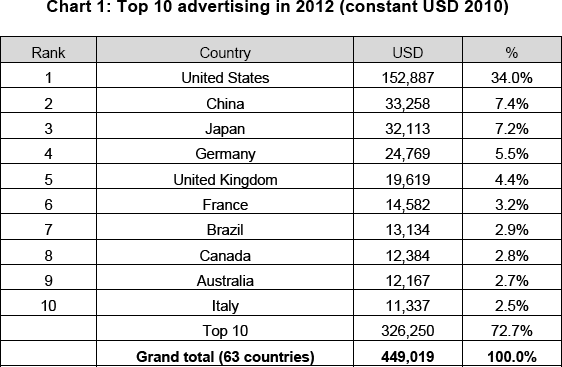
    -2012 global growth is revised to +5.0% (downgraded by -1.5%), totaling $449 billion.
    -Quadrennial events, combined with the scale and dynamism of the BRIC countries will help sustain global growth despite worsening economic outlook. They contribute to 45% of the global growth in 2011.
    -Internet will become the second biggest media category in 2011, reaching a 20% global market share in 2012.
    -China will become the second largest advertising market in 2012, outgrowing Japan.


    2011: The Slowdown
    In 2011, media suppliers around the world will see their advertising revenues grow by +4.7% to total $427 billion (constant USD 2010 basis). That estimate is down slightly (-0.5%) from our +5.2% forecast published in June 2011, due to the softening of some markets in the second half of the year. Our media suppliers advertising revenue projection includes: television (pay and free), Internet (search, display, video, mobile), newspapers, magazines, radio, cinema and out-of-home (traditional and digital). It excludes direct marketing categories such as direct mail or traditional “yellow page” directories. We monitor media suppliers’ revenues in 63 markets (including all major markets), representing more than 95% of the world’s economy.


    The geography of growth. More than ever, emerging economies drove global advertising revenue growth in 2011, posting an average +15.0% growth during the year. Among these developing economies, Latin America posted the strongest growth rates, averaging +13.2%, closely followed by Central and Eastern Europe (+13.0%). Developed markets, meanwhile, grew at much slower rates, such as +1.6% in Western Europe and +3.1% in North America, due to a number of factors including: a strong 2010 comparison (revenues were up +8.2% compared with 2009); macro-economic slow-down and persistent financial uncertainties; the absence of major sporting events or U.S. elections; and natural disasters in Asia. Among individual countries, the strongest growth rates came from: Argentina (+37.9% in the context of a strong inflationary economic growth), China (+22.5%), Kazakhstan (+25.6%), Russia (+20.4%), India (+15%) and Brazil (+10.2%).


    Eleven countries (out of the 63 analyzed by MAGNAGLOBAL) suffered a decline in advertising revenues, including countries in Southern Europe hit by protracted economic turmoil and political instability (Greece: -19.3%; Portugal: -6.9%; Spain: -6.3%; Italy: -2.5%); emerging markets temporarily destabilized by the Arab Spring (Egypt -21%); and Asian countries hit by natural disasters (Japan -2.0%, Thailand: -2.0%). Many of the large markets of Western Europe and North America wound up in the middle, typically showing low single-digit growth (UK: +1.8%; Germany: +3.0%; U.S.: +2.9%).


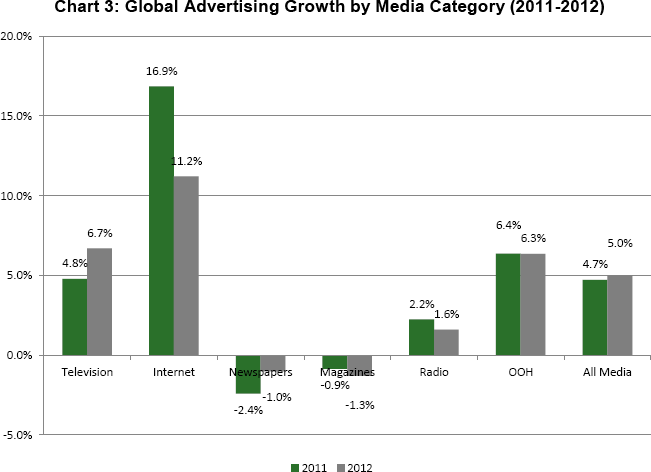
    Among media categories, television, an unexpected winner in 2010 (+12.7%), continued to show strength in 2011, despite the absence of cyclical sporting events or elections in the U.S. Broadcasters’ advertising revenues grew +4.8% to $175 billion, in 2011, maintaining TV’s leadership with a 41.0% market share globally. Strong audience levels and audience measurement improvements – such as the integration of time-shifted DVR viewing into ratings for the first time (e.g. France) – made the medium attractive. Out-of-home (OOH) media fared even better. Including cinema, OOH grew +6.4% globally, driven by the incremental revenues generated through digital billboards (+19.9%), which have rolled out in various parts of continental Europe and Asia. Other traditional media categories, however, had a tougher year. Radio grew only +2.2%; newspapers’ revenues were down -2.4% and magazines declined -0.9%.


    Declining circulation, shrinking readership, Internet competition and short term media buying patterns (which penalizes monthly magazines), all contributed to print’s decline in developed markets. Things are different in emerging markets, however, where literacy is still increasing and broadband access is still relatively low. In those markets, magazines are growing along with the middle class, and there is enough advertising demand for every media beyond TV to benefit. Overall, print advertising revenues are up by high single digit percentage points in emerging markets.


    The big winner of 2011, however, was Internet media. Total Internet advertising revenues increased +16.9% to $78.5 billion. While Display subcategories increased +15%, Paid Search reaped the benefits of usage growth and algorithm improvements to reclaim its position as the largest digital revenue driver (+19%). Within Display, online video continues to show impressive growth (+58.5%), reaching $4.7 billion in revenues.


    Pre- and mid-rolls in online videos now generate 6% of total Internet advertising revenues and one percent (1.1%) of global advertising revenues. Even more than online video sharing specialists, TV broadcasters offering free, ad-funded online “catch-up” of long-form, full-length episodes are driving category growth.


    Overall, coming after a strong 2010 and in a poor macro-economic context, media suppliers displayed a resilient performance in 2011. But the global market is barely back to where it was in 2007 ($423 billion in constant USD), and still smaller in the case of Western Europe (2007: $112 billion, 2011: $106 billion). This reflects that media costs that are still low from a historical perspective.


    2012: The BRIC Engine
    For 2012, we now forecast media owners’ advertising revenues to grow by +5.0% to $449 billion. This is -1.5% below our previous prediction published in June 2011 (+6.5%).


    This downward revision is due to deteriorating macro-economic perspectives. Our forecast model is based on current, official economic forecasts that are generally predicting weaker – but still positive – growth next year. However, the uncertainty remains high, especially in Europe. In September, the IMF reduced its global output forecast (real GDP growth) from +4.5% to +4.0%. Although that forecast suggests the world economy would still grow, it’s an awkward average between emerging economies that are growing at healthy rates and developed economies that are still sputtering (average +1.9%, US: +1.8%).


    In late November, OECD revised its own global output forecast to +3.4% (including +1.6% for OECD countries and only +0.2% for the Euro area) warning that 4Q11 and 1Q12 could tip negative in most European countries, in line with 3Q11 slowdown. Greece, Italy and Portugal, in particular, are now expected to suffer full-year recessions in 2012. Other economic indicators (industrial production, personal consumption and business confidence) have been similarly downgraded in recent months and some independent forecasters have expressed increasingly gloomier views.


    Despite the worsening economic outlook, we are still projecting a positive growth rate based on a few factors:
    -First, the well-known “quadrennial” cyclical driver is back, and we believe it will be stronger than ever. The incremental ad spend generated by major sporting events (London Summer Olympics, Poland/Ukraine European Soccer Championship) and the U.S. Presidential Elections will bring an additional +1% to +2% on top of organic revenue growth across markets. In the U.S., Political and Olympic (P&O) money will account for three billion dollars of incremental ad spend, mostly on television ($2.4 billion related to the Elections, $600 million generated by Olympic Broadcasts). Meanwhile, major sporting events will help in European markets that are otherwise hit by economic stagnation, such as the UK (which is hosting the Olympics, although the games are broadcast on the ad-free BCC) and Italy (where the Games and Soccer tournament will mostly be broadcast by RAI, one of the few European public television groups still allowed to carry a full, all-day advertising load).


    -Second, big emerging countries will increase their share of global economic and advertising influence. At the end of 2012, emerging markets will represent 24% of global advertising revenues (compared with 7% in 1999) and the four BRIC countries alone will account for 14% (compared with 3% in 1999). Adding scale to dynamism, the BRIC markets have the capacity to offset part or all of the Western weakness. The four BRIC markets equated to only 10% of Western Europe’s advertising revenues in 1999. That ratio will grow to 59% by the end of 2012, and by 2016 the BRIC countries will almost match the size of Western Europe (94%). The BRIC countries contributed to 45% of the global market growth in 2011 ($9 billion out of $19 billion). With a growing proportion of the BRIC countries’ population adopting Western-style media consumption patterns, and with Western and local brands competing for top-of-mind among the emerging middle class, media demand is in excess of supply and inflation reigns. BRIC countries lag behind the global average advertising spend per capita ($80) – Russia: $70, Brazil: $60; China: $21, and India: $4. With such structural factors, we expect advertising spending and revenues in those markets to keep growing faster than the general economy, supporting global revenues in their wake.


    -Thirdly, some lessons learned in 2009 may help avoid a replay. Some major advertisers, e.g. in FMCG, have since admitted that they may have over-reacted back then by cutting advertising expenditures too hard and too quickly, harming their brands. We believe that this time, even if sales forecasts are being revised downwards, marketers will remember that market shares are subject to losses or gains, including – and perhaps even more so – during a recession, as consumers reconsider their choices. In addition, the Western advertising market is still smaller than five years ago, which means prices and net costs per thousand – despite some inflation in 2010-2011 – are still competitive and attractive by long term standards. Therefore, brands in various sectors have both the incentive and capacity to invest smartly to boost or defend their market shares.


    In 2012, advertising revenues will grow by +12.4% in emerging economies, with Latin America still leading the charge (+13.0%) followed by Central and Eastern Europe (slowing down at +7.7%). Asia Pacific will re-accelerate to +8.3% due to the recovery of Japan and the continued growth of China. Western Europe will slow down at +1.1%. The sports driver will not be enough to offset recession in many European countries: Greece, Portugal, Spain, Ireland will decrease again (between -2% and -6%); Italy and France will be flat at best. UK and Germany will grow below +2%.


    The biggest growth rates of 2012 will come from Argentina (+26.4%), Ukraine (+21.0%), Indonesia (+16.0%), China (+16.1%), Brazil (+12.0%), India (+13.5%) and Russia (+9.6%).


    In terms of media market share, Internet will grow by 11.2% and outrank newspapers to become the second biggest media category globally, accounting for nearly 20% of global advertising dollars (19.5% at $87.4 billion). The category already stands at 23% in both North America and Western Europe (where it even takes the #1 spot in a few markets, such as the UK). Television will receive the bulk of the “quadrennial” bonanza and will benefit from the typical concentration of advertisers into leading media at the expense of secondary media during harsh times. TV will grow by +6.7% globally to $187.1 billion. Newspaper and magazine revenues will shrink by an average -1.0% and -1.3% respectively, with much deeper drops in Western markets, where circulation losses of 2011 will be reflected in 2012 ad pricing. Radio will grow by +1.6% to $30.4 billion. OOH will also benefit from the “quadrennial” events and the roll-out of new digital (+6.3% to $28.3 billion) platforms. In the UK, the innovative upfront auction process conducted last summer to allocate the most premium London inventory during the Games did not quite meet the high expectations, but the industry is still expected to grow healthily next year.


    China Takes the #2 Spot
    China’s advertising market is expected to continue outperforming its already impressive economic growth in 2012, with a +16.1% growth. At $33.3 billion, China will become the second biggest advertising market, ahead of Japan, now third at $32.1 billion. Germany remains the fourth biggest market, some distance behind ($25 billion). Other top 10 markets are – in order – UK, France, Brazil, Canada, Australia and Italy. Russia will enter the top 10 in 2013, at the expense of Italy.

     

  • Move to promote South Indian film industry globally

    By A Correspondent


    The Federation of Indian Chambers of Commerce and Industry (FICCI) recently concluded the third Media and Entertainment Business Conclave (MEBC) 2011 in Chennai. The two-day conclave in Chennai welcomed the recommendation from Wizcraft International, that the South Indian film industry join hands to create a global platform which presents the South Indian film industry at key markets across the world.


    Sabbas Joseph, founder-Director at Wizcraft International, the global event management and communication company, shared the IIFA success story, wherein key global markets were opened and quantum growth was achieved by the Hindi film industry. The IIFA story also demonstrated the attention that is being given to Indian culture and business by global counterparts, he said.


    The weekend for the South Indian film industry would be a huge step towards recognizing the growing importance of South Indian cinema, by celebrating it on a global platform. Joseph spoke of IIFA being a channel for the expansion of the regional film business, generating revenues from International avenues.


    Mr Joseph added, “The talent in the South Indian film industry is enormous. We wanted to seize this opportunity to establish a platform for talent to be promoted and honoured on a national level and international level for South Indian films. Regional Indian cinema has grown into a global phenomenon and we would surely look at promoting and leveraging it on a global platform through brand IIFA.”


    Pioneered and executed by Wizcraft International, the International Indian Film Academy (IIFA), is supported by key members of the Indian film fraternity. IIFA is the most respected South Asian film academy and its main highlight, the IIFA Weekend and Awards, are India’s biggest media event, with a viewership of almost 600 million worldwide.

  • Mid-Day shuts Delhi & Bengaluru editions, to focus on Mumbai


    By Rishi Vora


    After having tried out the Delhi and Bengaluru markets for a few years now, MiD-Day has finally decided to shut its editions in the two metros. The focus, as company officials inform, will be on Mumbai from now on, where the idea is to increase the paper’s circulation and enhance profitability.


    Mr Manajit Ghoshal, MD and CEO, Mid-Day Infomedia said “Advertising revenue in the two markets was on the decline, and so we have now decided to focus on our Mumbai edition.”


    Addressing the staff, he wrote in a mail on Monday evening, “It’s with a heavy heart that I have to announce the closure of MiD-Day – Delhi and MiD-Day – Bangalore editions. Tomorrow’s issue will be the last issue for both the editions. This has been necessitated by the prolonged losses we had to incur on these editions. The idea behind starting these editions was to establish these brands in these cities and make a difference in the lives of the citizens there. We had begun well and were appreciated for the quality of product we put out. However, in a corporate scenario, the books need to be balanced. Due to the ever increasing competition in the print media space, the funds required for breakeven in these cities kept escalating. Finally, we had to take this call. We will however, continue to maintain a news bureau in Delhi and our sales offices in Bangalore and Delhi.


    “By cutting our losses in Delhi and Bangalore editions, we will be able to bolster our circulation in Mumbai. Apart, from the plan to channel these investments, Jagran group (our parent company) will invest a large sum in boosting MiD-Day’s circulation in Mumbai. This will give our sales guys across the country to pitch Mumbai MiD-Day to clients and agencies in a new light. We need to now concentrate on building brand MiD-Day in Mumbai and monetizing Mumbai MiD-Day’s large increase in circulation and in this our sales colleagues in Delhi, Bangalore and Pune will have to play a significant part. Gujrati MiD-Day and Inquilab continue to go from strength to strength. We are increasing the circulation of GMD at a brisk pace and will continue to do so. Inquilab has flourished in the north and we now have 14 editions in all and are far ahead of any competition in the Urdu space.


    “MiD-Day Pune is an extension of MiD-Day Mumbai just as the Pune city is an extension of Mumbai. MiD-Day Pune will continue to run at an ever increasing pace and we will be monitoring the Pune media market keenly to spot opportunities to improve the circulation of MiD-Day Pune.


    “We will continue to invest aggressively in our digital properties as we believe that this is a medium whose time has come.


    While the shutting of the Delhi edition has been rumoured for a while, the same cannot be said for Benguluru. A senior member from the MiD-Day Benguluru office who did not wished to be named said that the letter took everyone by surprise.


    The paper was launched in the garden city in 2006. On why the edition failed, Mr Anil K Sathiraju, AVP and Head – Mudra Max Bengaluru said, “MiD-Day is a Mumbai paper, positioned as the traveller’s paper. The reason it didn’t work in Bengaluru is before it was launched, there were newspapers that had been in the market for ages and MiD-Day came with a different positioning which wasn’t right for a market like Benguluru.” He further added that the paper’s stagnant circulation was an indication that brand MiD-Day wasn’t very popular among readers, which led to a greater perception problem.


    The Delhi edition, as is known, was first launched in 1986, and within three years of launch, it was sold to industrialist Lalit Suri’s family. Then again in 2006, it went up for sale and was bought back by Mid-Day Multimedia. Madison Media CEO Ms Basab Datta Chowdhury feels that it was purely on the basis of market reality that the Jagran Group chose to shut the Delhi edition. “It’s a call that you need to take. If a product is not delivering as per expectations, and if you feel that shutting shop is the only way, then the sooner you do it, the better it is. The paper tried its best in Delhi, it didn’t work out. It’s doing well in Mumbai, so the decision to focus there.”


    Citing similar reasons is Mr Sundeep Nagpal, Director of Stratagem Media and a veteran planner who has been following the print media (and MiD-Day specifically) closely. In fact, he is of the opinion that the daily could have done better in its marketing efforts, especially in Benguluru to increase circulation and readership. Mr Nagpal said, “The scope for a No 4 or No 5 newspaper in any language category, to generate both readership or advertising revenue, especially in a cosmopolitan market/ metro, is quite minimal. Both, Delhi and Bengaluru were already dominated by giant groups like TOI, HT, and even Deccan Herald, not to mention others like Indian Express etc. And so they proved to be the big hurdles for Mid-Day, despite the fact that Mid-Day was always supposed to be an evening paper. Also, given the landscape of the public transport in these cities, vis-a-vis that in Mumbai, the scope for Mid-Day to find traction as a commuter’s paper, was also considerably lower than that in Mumbai. And lastly, as a late entrant in these markets, the paper also required very aggressive promotion, perhaps of the likes that we saw in the case of DNA and Hindustan Times in Mumbai.”


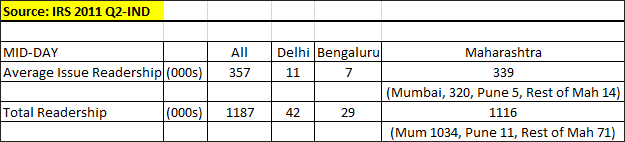
    The recent IRS figures (2011, Q2) indeed don’t show a good picture. The papers average issue readership in Delhi stood at 11,000, while in Benguluru, it was 7,000 (see table). Now that the two non-performing markets have been shut, and with investments to pretty much go to Mumbai, it will be interesting to see how the paper picks up on circulation in the city and whether it is able to pose a greater challenge to the market leaders.


    Lock image: Nuttakit

  • Mid-Day Delhi & Bengaluru closure a shame

     Ranjona Banerji


    The day started with the sad news that Mid-Day was closing down its Delhi and Bangalore editions with immediate effect. Undoubtedly the owners have their reasons but it is still a shame.


    Having worked with Mid-Day many years ago and also having been part of a publication which shut down years before that, I can feel the pain. Commiserations to all involved.


    **


    Part of Tuesday on television and twitter was about Kapil Sibal wanting websites like Google and Facebook to screen “offensive” content on the internet. Outrage broke out on all levels. So far, except for China, no government has had much success with patrolling or reining in the internet, so good luck to Sibal and the government. Initial reactions have been largely over the top with twitterers and TV commentators rushing to protect India’s democracy, Article 19 A and so on. Without irony (actually irony is conspicuous by its absence on Indian television), Times Now rushed to Varun Gandhi to get his opinion on free speech, he of course, is known for an infamous hate speech.


    **


    Kudos to Mumbai Mirror on its story that “fans” were paid Rs 300 each to cheer for Hollywood star Tom Cruise, who was on a Mission Impossible promo visit to India. Since almost nothing in the media appears to be real, when it comes to entertainment, why not pay for a few people to cheer? The whole celebrity-entertainment culture appears to be a carefully constructed falsehood – and the media is an integral part of this.


    Sadly for the PR genius who came up with this scheme, the death of cinema stalwart Dev Anand pushed Cruise off the main Indian news pages and segments. Also, isn’t Rs 300 a bit cheap for a star as big as Tom Cruise?


    **


    Congratulations to film star Aamir Khan and his director wife Kiran Rao on their new baby. Good for them that they told the world it was through an In Vitro Fertilisation-surrogate process, thus giving untold free publicity to the expensive IVF process and its doctors. But is this headline in Hindustan Times’ HT Café appropriate: “Baby Boy! Produced by Aamir Khan, Directed by Kiran Rao’?


    Cleverness gone too far, I think.

  • The Anchor: 5 reasons you know your OOH campaign is working

    By Ishan Raina


    #1 Flexicreation:

    The medium offers an advantage of Flexicreation i.e. creating customized ads and content according to the medium. This can be done by customizing the existing ad for the medium or digitizing an existing ad / leaflet and making it an audio visual ad. Flexicreation for the same medium is impossible in any other audio visual medium. The future will be and has to be the contextualization of the content and advertising messages. For Colgate, we customized the ad for the medium by highlighting the important messages to make it more impactful.


    Example – Colgate Pro-Sensitive Relief:

    Ad Recall: Of the people who had seen the ad 39 % have linked it correctly to Colgate Sensitive Pro – Relief.

    Reach Builder: 32% of the respondents (in the exposed set) were exposed to the ad for the first time through OOH MEDIA screens.


    #2 Flexicasting:

    OOH Media has been the most flexible medium today and gives a chance to slice and dice the message of the campaign as per the kind of audience an advertiser would like to reach. The client can select the locations, cities, frequency and language as per their requirements. Flexicasting provides an advantage of getting as local as possible just like an outdoor but with the power and capability of Audio-Visual. Other mediums are struggling with it and it comes naturally to Digital OOH. For Maruti, we used Flexicasting to advertise different brands in different locations to reach the correct audience.


    Example – Maruti

    Screen Recall: More than 90% of the respondents recall seeing OOH Media screens

    Ad Recall: 65% unaided recall of the ads on OOH Media.

    Reach Builder: 45% of the respondents were exposed to the ad for the first time on OOH Media


    #3 Content Integration:

    Content Integration helps in creating a contextual connect for the brands. The role of content is thus becoming very important in this medium and OOH Media continuously experiments with content to make it more relevant for the audiences and thus attracting more eyeballs. We have always been creating many on-screen properties which are topical, social or based on current happenings. Content Integration is another important area with a huge scope of dynamism and properties like travelogue, home-sweet-home, calorimeter, Green horns etc creating L-Band, Aston Band with the brands which helps them build a perception rather than direct selling. OOH Media customizes in-house content as per the client’s requirement and offering to make it contextual. For GSK- Horlicks Foodles we had created an L-Band on the Content Property called Caloriemeter which was the calorie consumed in the food and Foodles was talking about healthy and tasty eating habits on the LBand.


    Example: GSK Horlicks Foodles:

    Screen Recall: More than 100% recall for OOH Media screens

    Ad Recall: 69% of the respondents recall seeing the Horlicks Foodles ad at a Spontaneous Level

    Reach Builder: More than 24% of the respondents at work and play were exposed to the ad for the first time on OOH Media


    #4 Static Fabrication:

    Static Fabrication is one of the important aspects developed lately. Any brand offering is fabricated around the screens in the static format to create a better impact and creates the visibility for the brand 24 X 7. While the campaign runs on the screens, the static fabrication around the screens adds to the visibility. For Samsung, had advertised for Galaxy Tab in selected screens to reach the target audience and had done static fabrication on these screens to create hype for the brand.


    Example: Samsung Galaxy Tab Campaign:

    Screen Recall: More than 100% recall for OOH Media screens

    Ad Recall: 43% of the respondents recall seeing the Samsung Galaxy Tab ad at an unaided level.

    Reach Builder: More than 26% of the respondents at work and play were exposed to the ad for the first time on OOH Media


    #5 Vicinity Marketing:

    Vicinity Marketing is something that can be used very well by clients in this medium and is ideal for retail. This helps in creating awareness about the brand or the offer in the vicinity to drive footfalls. We have a lot of case studies where the use of vicinity marketing has resulted in the increase of footfalls. Citibank, did Vicinity Marketing for high net worth individuals by selecting limited screens with a very high exposure in Mumbai, Delhi NCR.


    Example – Citibank Reward Points:

    Screen recall: 100% of the respondents recall seeing the OOH Media screens

    Ad recall: 80% recall amongst 157 people who were interviewed of which 52% recall it at a TOM level and 93% recall it at an unaided level


    Reach Builder: OOH MEDIA Reaches Out To MEDIA LIGHT/MEDIA DARK/HIGHLY MEDIA FRAGMENTED AUDIENCES : 35% Respondents Were Exposed To The Ad For The First Time On OOH Media


    Ishan Raina is MD and CEO, OOH Media (I) Pvt. Ltd.

  • Govt approves Walt Disney’s shareholding in UTV to 100%


    By A Correspondent


    The Cabinet Committee on Economic Affairs of the Government of India has approved the proposal of Walt Disney Company (Southeast Asia) Pvt. Ltd., Singapore for increasing its shareholding of UTV Software Communications Limited, on fully diluted basis, from 48.02 per cent to 100 per cent, pursuant to the Foreign Investment Promotion Board recommendation in its meeting held on November 15, 2011.


    This approval is expected to result in FDI inflows amounting to Rs.8250 crore.