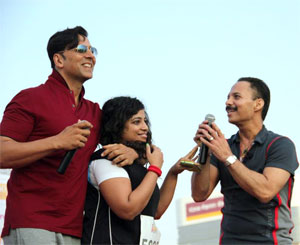
Actor Akshay Kumar with radio jockey Malishika and fitness expert Mickey Mehta
All roads in India’s new corporate district of the Bandra Kurla Complex led to the flag-off of the DNA women’s half-marathon on Sunday. It was the festive day of Mahashivratri, but that didn’t deter the 3800+ women who participated in the three runs (21km, 10km and 5km) which were part of the Stayfree Women For Change DNA I Can Women’s Half Marathon.
Just the second edition of the event, the half-marathon drew participation from regulars in the running circuit as well as first-timers. Actor Akshay Kumar led a committed showbiz contingent at the event. While cheering participants, he said his key to fitness was getting to early to bed and rising early.
Uttarakhand’s Kiran Tiwari from Western Railway won the Half marathon in 1 hour, 24 minutes. Ms Tiwari won a bronze medal in 2009 Asian Championships in China in the 3000 metre staple race. The others who followed Ms Tiwari were: Nilam Rajput (1:28:3), Nikite Nagpure (1:29:1), Rashmi Gurnule (1:33:6) and Sunite Wasghmode, (1:36:2). Â In the 10 km run, the winners were: Supriya Patil (38:35:7), Heena Mali (39:10:9) and Priyanka Patil (40:43:0). And in the 5 km run, the winners were: Â Teja Naik (21:22:7), Mrudula Bhande (24:37:5) and Rekha Haldipur (25:25:0) (Info source: DNA news report)
Johnson & Johnson’s Stayfree was presenting sponsor along with a host of partners and associates. SportzConsult executed the event.
ESPN Star Sports has expanded the sports bouquet with the addition of a new channel – Star Sports 2. The new channel is being launched especially for the Indian sub-continent today (March 11). Star Sports 2 will be the sixth channel to be launched by ESPN Star Sports in India after Star Sports, Star Cricket, Star Cricket HD, ESPN & ESPN HD. Meanwhile, the fate of the new identity for ESPN and ESPN HD is not known after NewsCorp’s acquisition of ESPN in the region. An MxMIndia report that the channel may be rechristened Fox Sports and Fox Plus was denied by the ESPN spokesperson. However, the PR team at ESPN was in denial mode on Star Sports 2 too, so the rechristening to Fox Sports cannot be ruled out.
Star Sports 2 will showcase live and non-live events across sporting categories like Cricket, Soccer, Tennis, Motor Racing and golf. The new channel promises to offer more sports, more action, more excitement, more passion, more emotions, more exhilaration and more heroes to follow for sports fans across the country.
Sanjay Gupta
Speaking on Star India’s strategy for sports business, Sanjay Gupta, Chief Operating Officer, STAR India, said in a communique, “Our vision is to expand the sports viewership in the country. Star network has acquired some of the best sporting properties in every genre and is committed to taking sports broadcasting to a new level. These include broadcast rights to the BCCI national and domestic Cricket for 6 years; broadcast rights of Spanish La Liga, Italian Serie A and English FA Cup and England international matches.”
Apart from exciting live content, we are also innovating in the way we present sports, Mr Gupta added. “Our brand new Hindi presentation on the live cricket broadcast allows audiences to enjoy the game in their preferred language, which was very well received by viewers. Similarly our recent launch- www.starsports.com- enables us to engage with passionate cricket fans like never before, and we are delighted with the site’s ramp up in the last 2 months. The launch of our new channel – Star Sports 2- is an extension of the same strategy. It allows us to broadcast a wide array of sports content across channels, and cater to multiple live events simultaneously. Star Sports 2 will further our commitment towards continued, effective and unprecedented coverage of all major events which are of interest to a diverse set of audience across the country.”
The sports broadcaster has launched a high decibel on-air campaign to promote Star Sports 2. This campaign is running across the Star India network. In the first month of its launch, Star Sports 2 will cover tournaments like Serie A and La Liga soccer, BPL action, Nascar racing and prime tennis from the Men’s ATP Tour amongst others. It may be recalled that many tennis fans were upset with the coverage of the Australian Open (see link: http://www.mxmindia.com/2013/01/ranjona-banerji-an-open-letter-to-espn-star-sports/). One hopes that with the entry of the sixth channel of the bouquet, sports lovers will not feel slighted.
The data from DTH operators and MSOs indicates that more than 87.7 lakh Set Top Boxes (STBs) have been installed in Phase II cities against the target of 1.60 crore, registering an achievement of over 55 percent digitization. Out of 87.7 lakh, DTH connections accounted for 40.7 lakh, whereas cable STBs accounted for 47.0 lakh. A release from the Ministry of Information and Broadcasting said that it has been constantly monitoring preparedness for the implementation of digital addressable cable TV system in the 38 cities of Phase II. We speak to a cross-section of stakeholders for their views (in alphabetical order of their last names):
Phase II: 38 Cities that need to be digitized by March 31, 2013
1. Bangalore
2. Hyderabad
3. Ahmedabad
4. Pune
5. Surat
6. Kanpur
7. Jaipur
8. Lucknow
9. Nagpur
10. Patna
11. Indore
12. Bhopal
13. Thane
14. Ludhiana
15. Agra
16. Pimpri Chinchwad
17. Nashik
18. Vadodara
19. Faridabad
20. Ghaziabad
21. Rajkot
22. Meerut
23. Kalyan-Dombivli
24. Varanasi
25. Amritsar
26. Navi Mumbai
27. Aurangabad
28. Solapur
29. Allahabad
30. Jabalpur
31. Srinagar
32. Vizag
33. Ranchi
34. Howrah
35. Chandigarh
36. Coimbatore
37. Mysore
38. Jodhpur
Anuj Gandhi, CEO, IndiaCast
All stakeholders are playing their role efficiently. We are playing our role and getting the deals done. We are using the learnings of Phase I when it comes to the issue of carriage fees. None of the MSOs are complaining this time. In Phase I, we did not have a refence point and now we have the signed deals of Phase I. This time it is a lot easier.
Joydip Kapadia, Executive Vice President, What’s On India Media
It will happen but in a phased manner. My logic is based on the fact that MSOs who are present in the metros are also present in these 38 towns. MIB has an upper hand now, and industry is prepared that Phase II has to happen unlike the Phase I where in the Delhi and Mumbai people thought that deadline would be extended. The towns like Ludhiana, Chandigarh, Pune etc are almost on track to become digitized while towns like Nagpur might take more time.
Ashok Mansukhani, President, MSO Alliance
Digitization has become a habit, and that is definitely good news. The consumers want the STB, doesn’t matter if it belongs to MSO or DTH operator. Of course, the markets in Phase II cities are more price sensitive than the Phase I cities. One also needs to understand that in the 42 cities that will be digitized by the end of Phase I and Phase II, a lot of people live in the slum areas. Hence, new packages will have to be announced on three price points: 100-150 Rs, 200-250 Rs and 300-350 Rs. The packages need to be tolerable to broadcaster, consumer and MSOs.
My only request would be let us not bother too much about the date; we have achieved a big task. I am sure that out of 38 cities, 25 cities will meet the deadline but switch off pay channels in the cities that do not meet the deadline if you want faster progress. MIB has taken stricter stock of progress this time around.
We MSOs have taken loan of about Rs 500 crore; no matter what we cannot afford to let digitization fail. I foresee that in the coming months, prepaid will gain more prominence as mode of payment.
P Mohan, President, Karnataka Cable TV Chamber of Commerce
I do not agree with the figures. The digitized homes are close to 35-40 percent in Bangalore. The national MSOs are focusing on meeting the supply for Phase I, only then would they concentrate on Phase II. We have been asking for boxes for more than four months, and even if they offer us STBs now, installation takes time. How are we supposed to install, offer packages, explain the packages to each customer is so less time when the deadline is approaching fast?
We are not against digitization. It was in 2002 that we had proposed DAS. Today, MSOs, broadcasters and DTH operators have formed one group. And LCOs are not even asked or consulted.
Bangalore has many additional TV homes. And the homes which installed digital boxes 4-5 years ago are today asking for replacements. The quality of STBs and the technology they support is also a concern.
Digitization is happening at a smooth pace in our area, and we are positive of meeting the deadline. We have no problems or concerns regarding digitization. The consumer is aware and knows how they will benefit with digitization. Yes, the prices of STBs was Rs 600 when we ordered it two months ago and now it has increased to Rs 999. But thankfully, we do not need boxes as of now.
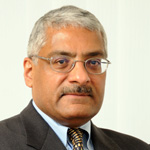
Man Jit Singh, President, IBF
The consumers are aware, the communication is reaching them. As broadcaster, we are aware that there will be a short-term reduction in profitability but we are positive that going forward, thanks to digitization, the ratio of our revenues from advertisements and subscription will be 50:50. The stakeholders have worked together, and are facilitating dialogue all across. With transparent systems in place, the industry will only progress. The numbers are impressive, and hopefully we will meet the deadline.
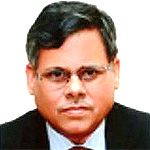
Uday Kumar Varma, Secretary, Ministry of Information and Broadcasting
We stand by our figures. The figures have been collated with industry feedback. We have not come across any negatives regarding meeting the deadline. Yes, some issues will obviously crop up but are sure to get resolved as well. Of course one issue leads to another: complete opaqueness, incomplete subscriber data etc will a little time to solve.
My own understanding is that digital cable is a better platform than DTH as it can provide other services as well. In the long run, common sense suggests that digital cable will see a bigger comeback.
Regarding the carrying capacity of STB, I am sure that domestic industry associations will step up to meet demands.
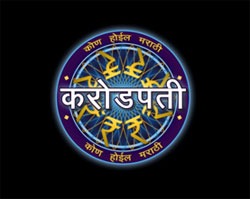
ETV Marathi has announced the launch of ‘Kon Hoeel Marathi Crorepati’ – a regional version of Who Wants to be a Millionaire, best known in India as Kaun Banega Crorepati. The channel has secured the production and broadcast rights from format owner Sony Pictures Television and has partnered with Big Synergy to produce it for Marathi viewers.
Kon Hoeel Marathi Crorepati, set to go on air in summer 2013, is dedicated to the Marathi Manoos who are educated and up-to-date on the latest happenings in India and the world. The show draws inspiration from Kaun Banega Crorepati and stands for power of knowledge and education. It will offer the opportunity for every Marathi-speaking person to exercise their vast knowledge and possibly change their destiny through their participation in what has been called the most successful game show ever.
Speaking on the show, Amit Phalke – Non Fiction Head, ETV Marathi said, “I am delighted to announce Kon Hoeel Marathi Crorepati, the world’s most popular format show, especially for Marathi Manoos. The show is a game changer, as it goes beyond the realm of entertainment and enters into a space that changes people’s destiny. We invite all Marathi viewers to the biggest and the most powerful game show so that they can put their knowledge to the test and have a fair chance to win the grand prize of rupees one crore.”
Siddhartha Basu
Siddhartha Basu from Big Synergy further added, saying, “We are very optimistic and excited about our foray into Maharashtra with Kon Hoeel Marathi Crorepati. This is a culturally rich region, with its own history and highly developed literature, and people thirsting to prove themselves – which makes it a fertile ground for this life-changing knowledge game. Having broken ground in the southern and eastern regional markets of India with multilingual productions of ‘Kaun Banega Crorepati’, we are now looking forward to creating the same magic on ETV Marathi.”
Let’s face it. Customers are no longer loyal or rather they are loyal but to brands that understand and engage with them in the new world. The messages carried by the advertisements are no longer compelling. For years, brands were able to suppress the consumers’ voice. But now, all it takes is a Tweet or a Facebook update from an irate customer and the world knows about it. Honesty has become most brands’ top priority.
Maintaining brand loyalty has suddenly become the biggest challenge. Moreover, the entire concept of loyalty is vague. All thanks to Facebook, where one person is interacting with several competing brands, all at once. In such a scenario, traditional branding exercises are no longer effective in getting the attention of customers. This is further complicated by the variety of devices where such micro eco-systems exist.
This is the result of the digital convergence of culture, business and economy into bits and bytes. So, this is where lie not only the challenges but also huge opportunities for brands to understand their customers. Digging into the wealth of social media data, brands can today discover consumer insights like never before.
By A Correspondent
Having taken the corporate world by storm, social media today is today spreading its wings far and wide and is no longer just a casual hangout for users. The possibilities that it offers are endless, and it’s been proven beyond doubt that social media is no longer a fad. It means serious business for brands. But with this realization there is also the truth – about enterprises not being equipped with right tools and human resources to leverage social media.Simplify360, a firm that enables organizations to effectively implement social media concepts into core business functions, has released an e-book titled ‘Predictive Analytics 2013: The future of social media.’ The study saw the firm connect with different professionals active in the field of social analytics and learn from them about the future of social media. The book is an attempt by Simplify360 to reach out to the experts in the social media field in order to learn the meaning of what predictive analytics meant in social media and its role in the future of social media.
Predictive analytics has been around for a long time and slowly these analytic tools are finding their way into the marketing and social media arenas. What predictive analytics does is use behavioural data from past to predict how individuals will behave in the future. Some of the experts who have contributed in the book include Ajay Kelkar of Hansa Cequity, GK Suresh of ITC Foods, Ankita Gaba of Social Samosa, Bhupendra Khanal of Simplify360 and the others. MxMIndia presents extracts of the article by GK Suresh who has written on ‘How Social Media can reveal the mystery of brand loyalty’.
There are 4 steps to understanding customer insights through social media:
# Find out what people are talking about and why
# Find out who is talking and influencing the crowd
# Use this intelligence to optimize your brand’s message to impact in real-time.
# Measure your interaction and influence of the messages and optimize them.
One brand that has successfully utilized the above steps is Bingo! with the launch of Bingo! Tangles on Facebook. With over 3 million fans, Facebook offered Bingo! a great window into understanding consumers conversations. Consumers use these forums to talk about their likes & dislikes and welcome new information on product as they find it appetizing, tempting &satisfies their need for variety. Consequently we decided to launch the new Bingo Tangles first on Facebook and give a chance to loyal Bingo! fans to discover the product and also taste it before it hit the market. A teaser contest was created for Facebook fans which encouraged them to decipher the brand name and the winners could taste the product before it was made available in the market. Thousands of fans participated in the contest and packs of Bingo Tangles were sent to the winners. This campaign helped us connect with the brand advocates and also use Facebook as a launch platform for various other brands.
Data is a vital raw material for building the business infrastructure in the information age. Brands that can put systems in place to access, process and utilize the data will be the most successful in connecting with the customers and influence their decisions.
The key idea behind customer loyalty is customer retention. There are already different programs, which  businesses employ like reward programs, referral programs and 1-to-1 marketing campaigns to ensure that customers stay with the brand. But social networks are taking over these programs in terms of gaining a deeper relationship with the brand.
There are 3 ways to use social media data to improve and make social programs much more effective:
1. The Brand should genuinely care
When you embark on the social media journey, be prepared to respond to negative as well as positive feedback and genuinely do something about consumer problems. On the Aashirvaad Multigrains Facebook page one of the fan brought to our notice unavailability of Aashirvaad Multigrains atta in her area. We used this info to investigate the issue with our sales team and figured out that there was an issue with the sales person operational in that area. Action was taken immediately and we called back the consumer to validate that her problem had been addressed.we figured out that this was an issue due to the sales person operational in that area. Thus listening to a single fan, who was representing a cluster of consumers in that region, we were able to resolve issues faced by many such consumers in that region.
2. Engage without losing focus on your brands
Many times the focus on the content posted on Social Media platform goes to extremes. Either it is too generic or it is too brand centric. There should be a proper balance.
3. Brands have to learn to converse with consumers as equals
Brands are too used to speaking to consumers from a position of authority & knowledge and not as a friend. But today brands need to learn to converse with the consumers on equal terms & be seen as an enabler.
The key thing is to do it without compromising on the brand “personality”. Hence the voice of Bingo! is more youthful & contemporary; the voice for Aashirvaad is always joyful & optimistic while that of Kitchens of India is authentic & welcoming.
So we now know why and how social media can help decipher the mystery of brand loyalty. But the last portion and the most vital one, is to understand how to measure this in social media. There are 4 factors, which one must consider while looking into brand loyalty in social media:
1. First of all, what are customers talking about your brand and how? What are their attitudes and sentiments towards your brand? What is their feeling towards your brand? Are they neutral, friendly, hostile or ignorant? This helps brand not only understand the emotion but also map them along the brand attributes and identify the missing bits.
2. Secondly, to understand the emotional connection between a customer and your brand and measuring the strength of the bond. Most often an out-burst by a customer is temporary, and can be mitigated easily. Hence, identifying such customers is vital. Many a times the reverse is true as well. There was once a complaint on Facebook by a consumer on the quality of Atta. Before we could begin to address the problem, 3 other consumers had responded asking the fan to check the storage conditions at the outlet of purchase as well as her kitchen.
3. Thirdly understand that the customer is likely to buy more than one segment of products from the brand. This sends much a stronger signal of loyalty.
4. And finally, know which platforms are more effective in communicating with the customer. Email, Social Networks, Mobile, TV, Tablets and the list goes on. The avenues where customers are present are wide. Hence identifying the top engaging platforms and optimizing them is vital.
Mining social data and building your decision systems on top of it is the secret of successful customer retention. The main goal is to make an emotional connection with the customer in each interaction to increase referrals, retention and acquisition.
It’s been a hectic fortnight for DNA’s vice-president – marketing, Sorbojeet Chatterjee. The women’s half-marathon was a show of strength for the newspaper and one wrong move could lead to much embarrassment. But, as those who visited the event tell us, there is much reason to cheer for Sorbo, as the CMO is better known as, since not only was the event a big success but it also offered reason to cheer as a positive rub-off to the newspaper brand and as a successful sports-cum-cultural property. He took some time off to respond to MxMIndia’s questions a day after the event.
01. It’s been an all-new team at the helm at DNA… organizing a successful event like the half-marathon must be a marathon effort?
A new team also brings in some fresh thinking and added dynamism…This year the mandate was to scale up on all fronts.
Since the event has been fully sponsored, wouldn’t it have been nicer for the entire entry fee to have gone in to the charity cause selected?
We are the only half-marathon of stature that contributes 50% of the registration fees to charity. Going forward we plan to make the scale bigger by adding more NGOs and a larger corpus
02. From the point of view of the benefit to the brand, would you say DNA benefitted?
A newspaper brand needs to be a relevant and integral part of the local milieu. Marquee events like a women’s half-marathon allow us to create special engagement opportunities that deepens the bond with our readers. Besides differentiated and innovative offerings are the best way to widen the reader family. Thus a one-off women’s half marathon will add some value to the brand, but the larger objective is to create a steady flow of events and engagement platforms that will strongly seed the brand in the “DNA” of our readers.
03. We’ve seen events run by publications becoming big and standalone properties of the publishing company (eg Filmfare, Femina awards). Do you see the Stayfree I Can Women’s Half-Marathon also becoming that?
‘I Can’ is an extremely powerful ethos and the long-term strategy is to extend it to various round the year engagement opportunities for women across multiple interest areas. There will be always be a finite limit to how much one standalone event can grow. However, the moment we create a strong umbrella brand the opportunity to scale up is infinite
04. We know it’s too early, but a couple of things that you would like to do to make it bigger and better next year?
We would definitely like to grow in scale in terms of participants in the existing market as well as expand to newer markets. While we have almost doubled the registrations this year – there still exists a tremendous potential that can be tapped. Besides, every year we have been looking at ways of bettering the “runner experience”. We need to continue to innovate to further broadbase participation.
05. DNA is also published from other cities. Will you take this to other publishing centres (like Bengaluru, Pune, Ahmedabad etc)?
This is only the second year. This year the focus was in terms of scaling up the event in Mumbai. The integration with Zee TV helped get national awareness. The logical step is to take it to the other ‘DNA’ markets in due course.
It’s unfortunate that other media vehicles do not report on what their competition is doing… even if it’s for a good cause. Your comments?
This year the media coverage for the event has been fantastic. Every news channel has covered it extensively. They realize that if an event is an integral part of the city – they must be true to their consumers and cover it.
While you may be taking some time out to browse through this story, hundreds of delegates from different corners of India, and a few from around the world, would have converged at Hotel Renaissance in Mumbai. In fact it would suffice to say that those who have anything and everything to do with Media & Entertainment would have made it in large numbers today to be part of the biggest and only convention for the sector in India – FICCI Frames 2013.
In its 14th edition, the event has a host of activities that have been planned out over a three-day course. To begin with, Day 1 would begin with a bagful of high-profile dignitaries who would be presenting their viewpoints and observations on the way forward for the industry. It would begin by a welcome address by Naina Lal Kidwai, President, FICCI and would be followed by a theme address by Uday Shankar, Chairman, FICCI Media & Entertainment Committee. Joining the two dignitaries on stage would be Uday K Varma, Secretary, Ministry of Information & Broadcasting, Govt. Of India who would be providing a vision statement for Information & Broadcast Industry. He would be followed by Guest of Honour Dr. Soon Tae Park, Deputy Minister, Ministry of Culture, Sports & Tourism, Republic of Korea who also would be highlighting his observations on the industry. Andy Bird, Chairman, Walt Disney International would be the next to hog the limelight as he would be presenting the keynote address at the event. Preneet Kaur, Union Minister of State for External Affairs, Government of India would be the other high-profile guest who would be delivering the inaugural address at the opening ceremony. The event will also see the felicitation of Subhash Chandra, Chairman, Zee Entertainment for his two decades of contribution to the broadcast industry.
According to the organisers of the event, the aim of FICCI Frames 2013 would be to deliberate on the growth of the industry and find ways to maximize both its creative and economic potential by engaging with the billion strong consumer base in our country. To do that, there are key international thought leaders, studio heads and academics who’ve been lined up to speak on a range of topics covering the main objectives of the sector – digitization, making big budget films and being successful in Bollywood, censorship, marketing, exhibition, distribution, viability of the sports broadcasting business, the future of content consumption in an era progressively getting defined by the digital media, innovation and planning required in various policy issues within TV, cinema, animation and gaming.
Uday Shankar
Sharing his viewpoint on the event, Uday Shankar, Chairman, FICCI Frames 2013 said, “While the industry has made spectacular progress in the last 20 years in increasing the intensity of engagement with the Indian consumer through superior content, there is still a gap in our ability to monetize the engagement and use the resources generated to advance both access and content. The year 2013 is one of many milestones in the media and entertainment industry and Frames will offer an opportunity for us to put these developments into perspective, look at the larger picture and engage on such a bold and important theme.”
Leena Jaisani
Speaking on the core theme that has been shortlisted for the event, Leena Jaisani, FICCI senior director – M&E remarked, “This year the theme is ‘Engaging One Billion Consumers’. We work to make sure the entire media and entertainment sector takes the next big leap in maximising monetization, therefore the theme of engaging a billion consumers.” Adding further, Ms Jaisani said, “While the industry has made spectacular progress in the last 20 years in increasing the intensity of engagement with the Indian consumer through superior content – there is still a gap in our ability to monetize the engagement and use the resources generated to advance both access and content. Frames will offer an opportunity for us to put these developments into perspective, look at the larger picture and engage on such a bold and important theme.”
Karan Johar
Highlighting his outlook for the event, Karan Johar, co-chairman of FICCI Frames 2013 said, “It is a platform that brings best of the creative and business minds to engage with delegates. Delegates come to the event to seek different things. Someone’s agenda is to scout talent and another person may have just come to look for finance. Whatever time I have spent in attending sessions, I have learnt the most from them. In fact, I admitted this on the podium last year. There are certain things you are not aware of and sitting on the panel or in the audience you imbibe new things. This must be the experience that others also go through I guess.”
In fact Mr Johar has a larger agenda that he’d be taking up where the film fraternity is concerned. He affirms, “The Rs 100-crore benchmark is limiting the growth and content of our films and we have to aim for Rs 1,000 crore from a film. It may not be possible today but we have to have a mandate to achieve that. FICCI will work towards a roadmap for Indian films to gross Rs 1000 crore for a film. It is not an impossible task. In fact we have a session on planning and creating a Rs 1000-crore blockbuster that promises to be interesting.”
One of the reasons why the event manages to attract so many delegates is the quality of speakers who land up at the venue to share and dish out mantras and growth strategies. This year too there are a host of stalwarts that have been lined up including Andy Bird, Chairman, Walt Disney International, Anne Sweeney, Co-Chair, Walt Disney International & President Disney ABC Television Group; Bob Bakish, CEO, Viacom Media International, Teri Schwartz, Dean, University of California, Los Angeles (UCLA), Colin Maclay, MD, Berkman Center for Internet and Society, Harvard University, Andy Kaplan, President, International Networks, Sony Pictures Television, Mira Nair, film-maker, Dominic Proctor, President, Group M Worldwide, Seymour Stein, Vice President, Warner Bros Music, David Womart, the Producer of the Oscar-nominated Life of Pi, film maker Gurinder Chaddha, Jonathan Taplin, Director, Annenberg School of Innovation, The University of California school of communications and journalism, Andy Weltman, the international head of Pinewood studios, and Graham Broadbent, the British producer of the Best Exotic Marigold hotel.
As is the norm, this edition of Frames too has a partner country and South Korea has bagged the honour this year. Pointing out the advantages of the association, Ms Jaisani said, “South Korea is the partner country at Ficci Frames 2013 and this year is significant as Korea and India celebrate the 40th year of the establishment of diplomatic relations. There is huge potential for collaboration in films, animation, gaming, technology and service offshoring between the two countries. Leading Korean companies in animation, broadcasting, mobile gaming and film will be available for biz matching. There is a huge synergy as India is looking at innovation from Korea and vice-versa they are looking at engaging Indian media companies for offshore services – especially in animation, gaming and VFX.”
While there is nothing as beneficial as knowledge, there is nothing more harmful than a lack of it or, what is commonly referred to as Half Knowledge. Half Knowledge is all around us – in office corridors, on the train commute back home, in conference room meetings. Sometimes it provides us a laugh or two by making a blunder. But most other times, it can be damaging in the way it steers conversations with dangerous consequences. Not only is it contagious but hinders an individual’s growth.
The Economic Times is proud to stand up against Half Knowledge by launching a campaign to draw attention to this malaise, thereby helping arrest its growth. ET provides incisive and analytical coverage of developments, and is rightly positioned to take on Half Knowledge.
This campaign contextualizes Half Knowledge situations in people’s daily lives, and will be seen extensively across mass media in print, TV, outdoor, radio, digital, social media, corporate parks and coffee shops.
Lowe Lintas + Partners conceived the campaign. Arun Iyer, NCD said that, “While we started thinking upon the campaign, we hit upon this thought that the most subtle evil that exists in Corporate India is Half Knowledge. And this Half Knowledge is masked usually with over-confidence. There are opinions and very firm ones at that, flying all around us. We feel that the biggest contribution that ET can make to this country is to increase the depth of knowledge. Because the more we know, the more we grow as individuals and as a country.”
Ravi Dhariwal, CEO – Bennett Coleman & Co. Ltd. said, “This initiative has been launched to highlight the pitfalls of Half Knowledge. ET has always focused on providing readers with the complete picture on every news story so that they never take decisions based on superficial intelligence. And, in that endeavor, lies our commitment to fight Half Knowledge.”
Publicis Groupe has announced the acquisition of Mumbai-based digital marketing consulting firm Convonix. Convonix will align with Starcom MediaVest Group (SMG) in India. This transaction brings together two complementary organisations – Convonix’s strength in Search, Social and Analytics combined with Starcom’s strength in Media strategy creates a unique offering for the burgeoning digital marketing space in India and expands Convonix’s geographical presence in India to Delhi, Bangalore and Chennai besides Mumbai. This news follows a number of recent acquisitions announced by Publicis Groupe in India and fortifies its position as India’s largest digital marketing operation.
Founded in 2003, Convonix has evolved from being the Search Engine Optimization organization in India to becoming an Integrated Digital Marketing Solutions provider, and currently employs over 200 internet marketing specialists serving clients such as Taj Hotels, Reliance Industries, Kotak Mahindra Group, Club Mahindra, Kodak, Aditya Birla Group among others. Convonix has a strong international footprint with over 60% of its business coming from overseas. Convonix has also recently developed a proprietary in-house brand monitoring and social listening platform called IrisTrack which enables clients to gather market insight on their products and competitors and also engage customers online to improve their customer service.
The three founding members: Vishal Sampat, CEO; Sarfaraz Khimani, co-COO; and Pallav Jain, co-COO, will continue to lead the agency. Convonix will sit within SMG and will operate as SMG Convonix, with two market-facing brands: SMG Digital and Convonix.
“As the first SEO organisation in India, Convonix has continued to innovate and build the very best digital capability whilst being highly respected for its ability to recruit the best talent from universities each year, and transform them into digital advertising experts through a rigorous training program,” said Laura Desmond, Global Chief Executive Officer for Starcom MediaVest Group, adding, “combined with our existing talent in the market, this deal strengthens our offering to ensure we are the market leaders in digital.”
Year-on-year, Convonix has increased revenues on average 66 percent since 2008. According to the latest ZenithOptimedia adspend forecast, Search Marketing continues to expand rapidly in India and is forecast to increase 35% in the region during 2013, and more than 70% in the next two years.
Vishal Sampat, CEO for Convonix, said, “We have built our reputation by focusing on talent, training, technology and performance, and doing so has enabled us to rapidly evolve with the consumer. Aligning with SMG gives us global scale and a more powerful face to the market which we can leverage to constantly improve our offering and give our clients the best tools and solutions available.”
Srikant Sastri, VivaKi Country Chair for India who is presiding over the acquisition and transition of Convonix said, “After the Convonix acquisition, we are now clearly the digital marketing leaders in India, ahead of any other global network. We are positive that this acquisition will set the tone for our next phase of digital pre-eminence both in terms of expertise and revenue and we are continuing to explore other agencies that can help us capitalize on the outstanding potential of the digital marketplace in India.”
K Jayaraman, erstwhile CEO and MD of Hathway Cable and Datacom and a veteran of the broadcast business, has joined the Zee group to head distribution and placement business. He will report to Punit Goenka, MD and CEO, ZEEL.
Mr Jayaraman had spent close to 15 years at Hathway group of companies. At Hathway Cable and Datacom, he was instrumental in the company foraying into the broadband, digital cable and HD service segments. In December 2012, he was appointed as Vice-Chairman of the company. However, in January this year, Mr Jayaraman quit the organisation.
With digitization phase II reaching the deadline, this move may also help MediaPro – a joint venture between Star Den and Zee Turner.
Despite repeated attempts, Mr Jayaraman was not reachable.
With reality shows becoming norm on every channel, MTV has launched a brand new TV series, MTV Reality Stars. The theme is that everyone knows and sees reality shows but no one knows the comedy and chaos of what goes on behind the scenes.
So from the makers of reality shows like Roadies and Splitvilla, comes a series which apart from other things takes a healthy dig at MTV and the madness that goes into creating these block buster reality shows. MTV Reality Stars will premiere on March 16, 2013.
Aditya Swamy, EVP and Business Head, MTV India, says, “MTV brought reality to India and today it’s everywhere. You can love it or hate it, but you can’t run away from it. In this show, we take healthy digs at our biggest shows and the ability to laugh at ourselves has always made us more endearing to our audience. Unlike daily soaps, this is a finite series that is built around a tight script, a truly delightful cast and film level production standards. This is the future of Indian television and this is a genre we are committed to building.”
Reality Stars is a 12 episode, 22-minute comedy TV series based on the lives of four crazy friends – Krish, Kuldeep, Zameer and Tania, who get caught in the world of reality television.
The campaign for the show will see 360 degree marketing promotion through various media verticals, including on-air promotions, digital activations, and on ground activities. The campaign will also see a contest run across 200 plus colleges in the country where selected students will get a chance to be a part of the new show.
Alan Rusbridger, Editor-in-chief of the British daily ‘The Guardian’, will give a presentation at the Press Club, Mumbai, on The Future of Journalism in a Digital Age, on March 19 at 5.15pm.
The presentation will cover a wide gamut of issues from the changes wrought by technology to concerns about regulation and ethical standards in journalism.
It will be followed by a Q & A session. Seating will be on a first-come-first-served basis, and reporters and local editors may cover the event.
Mr Rusbridger, known for his fierce independence and his liberal views, has been the editor of The Guardian since 1995, having joined it as a reporter in 1979. He recently wrote the book ‘Play It Again’ about how he took a year off from news to rediscover himself as a pianist.
The Guardian, known until 1959 as The Manchester Guardian (founded in 1821), has grown from a 19th-century local paper to a national paper with a wide web presence. It has a certified average daily circulation of over 200,000. The paper currently identifies with social liberalism.
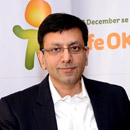

 Anuj Gandhi, CEO, IndiaCast
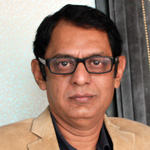 Joydip Kapadia, Executive Vice President, What’s On India Media
 Mukund Babaji Pednekar, Distributor, Hathway cable at Thakurli, Dombivli & Kopar
 Man Jit Singh, President, IBF
 Uday Kumar Varma, Secretary, Ministry of Information and Broadcasting
 ETV Marathi has announced the launch of ‘Kon Hoeel Marathi Crorepati’ – a regional version of Who Wants to be a Millionaire, best known in India as Kaun Banega Crorepati. The channel has secured the production and broadcast rights from format owner Sony Pictures Television and has partnered with Big Synergy to produce it for Marathi viewers.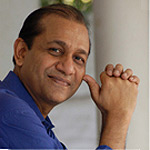

 It’s been a hectic fortnight for DNA’s vice-president – marketing, Sorbojeet Chatterjee. The women’s half-marathon was a show of strength for the newspaper and one wrong move could lead to much embarrassment. But, as those who visited the event tell us, there is much reason to cheer for Sorbo, as the CMO is better known as, since not only was the event a big success but it also offered reason to cheer as a positive rub-off to the newspaper brand and as a successful sports-cum-cultural property. He took some time off to respond to MxMIndia’s questions a day after the event.



 With reality shows becoming norm on every channel, MTV has launched a brand new TV series, MTV Reality Stars. The theme is that everyone knows and sees reality shows but no one knows the comedy and chaos of what goes on behind the scenes.