Category: Digital

  • InMobi report finds 15% increase in m-commerce

    By A Correspondent


    Independent mobile ads major InMobi announced the results of its 2014 Global Mobile Media Consumption Report, which provides insights into changing trends in mobile media consumption habits. The 2014 report findings reiterate that mobile devices have become integral to everyday life, but moreover, that trust and reliance on mobile devices has increased and are expected to have a significant impact on mobile commerce in 2014.


    Specifically, the report predicts a 15 percent increase in mobile commerce in 2014, with 83 percent of respondents planning to conduct mobile commerce in the next 12 months. Mobile has become a key factor affecting purchasing decisions, with 48 percent of respondents worldwide listing mobile as a key media which impacts purchasing decisions, and reliance on mobile is even higher in important consumer markets, like India, at 60 percent.


    “In last year’s report we found that mobile had touched most aspects of modern life. But this year, we find that mobile has really become an essential part of daily life, even a daily workhorse, that has replaced the desktop and TV for everything from gathering key information, media consumption and accomplishing daily tasks, like shopping and paying bills,” said Naveen Tewari, CEO, InMobi. “Furthermore, with mobile content gaining similar prominence as TV, mobile advertising is now impacting consumer behaviour across the entire purchasing lifecycle from small day-to-day purchases, to bigger purchases, like cars.”


    Key 2014 mobile media consumption statistics:

    • The average mobile web user consumes 6.0 hours of media per day.
    • 60% of the average global mobile web users now use mobile as either their primary or exclusive means of going online.
    • Multi-screen behaviour is common, 61% of mobile web users engage in mobile activities (e.g., social networking, text messaging) while watching TV.
    • Mobile is an important companion particularly for in-between times, 83% of respondents use mobile while waiting for something, and 81% while lying in bed.
    • 40% of Indonesians use mobile as their only means of web time, followed closely by 34% in India and South Africa.


    In response to mobile advertising:

    • 78% have downloaded an application;
    • 68% have visited the website of an advertiser;
    • 56% have visited a store for more information;
    • 52% have bought something via their mobile device;
    • 44% have located an advertiser on a map; and,
    • 43% have called an advertiser by clicking on the phone number in the ad.


    Mobile commerce insights include:

    • 68% of respondents have spent money on an activity via mobile, and commerce behavior is extending past digital goods, and now includes physical and financial goods.
    • 83% are expected to spend money on an activity via mobile in the next 12 months, a 15% increase from today.
    • Mobile ads in different formats appeal to different segments.


    The full report is available for download on the InMobi Insights website at www.inmobi.com/insights/on-demand.


  • CDOspeak | Do less, but effective


    By Rishi Vora


    From the many aggressive moves Star India has made in the past two to three years in the area of content, it is evident that the broadcast major is leaving no stone unturned in ensuring its continuous dominance in the industry.   Digital, which is seen as central to consumers’ lives, is at the core of Star India’s strategy to augment growth, says vice president and digital marketing head of Star India, CVS ‘Venke’ Sharma. A former marine engineering officer with the Indian Navy and an MBA gold medalist, Mr. Sharma, who comes with around 17 years of experience in shaping the digital strategy for brands, was last with Leo Burnett in Indonesia where he built the digital practice in the agency.  Prior to that, he built a marketing services agency Arc for Leo Burnett India and a digital agency Tribal DDB India for Mudra DDB..

    Excerpts: 

     You joined as the digital marketing headfor Star India network a little less than a year ago. What was the brief given to you and how far have you reached in achieving your goals?

    We are  making steady progress. The brief remains  to increase the demand for the network’s content using digital marketing.   As you know Star India is a leading broadcast network in India with 40 plus channels. And digital being central to consumers’ lives today, it certainly forms a critical part of the network’s overall strategy.    Over 600 million watch television in India, of that, about 90 million are on Facebook and other social networks.  In Sports, the English cluster and even general entertainment channels Star Plus and V, there are a lot of young audiences who engage with these brands on social media on a daily basis.

    Generally in India, the dominant social conversations are about sports, entertainment and politics.  As a network, we cover a wide gamut with definitive content in sports and entertainment. Thus our content inspires conversations on social media. Consumers are interacting while consuming content on TV or on any other device. Our endeavorto shape meaningful conversations that can help create content demand for our channels/shows. So that consumption increases and ultimately morepeople watch our channels.

     Has it changed from what it was earlier?

    The fact is that the network is leading across many genres – like Hindi GEC and English, Sports.  We have made progress in reaching out to people via digital media and engaging with them.   We have been far more focused in terms of not doing too much and doing stuff effectively. It’s more about listening, analyzing, and connecting the dots with actionable insights. I wouldn’t say we are already there but with the effort we are putting in, hopefully we should be.


       What are the kinds of mobile initiatives the network comes up with?


    All our digital marketing initiatives are mobile centric.  Social media usage itself is largely on mobile. So whatever digital marketing we do is to connect with the audience on the go.  In addition, we do build  appsif there is a genuine consumer context.  For example, we have an app for Mahabharata where consumers can get some exclusive content and keeps them engaged. The app was an important part of the show launch strategy.  We launched an app for Channel V called Vith U. It is an app devised for women’s safety. It has received a phenomenal response.

    The Star Sports app as you know  is very popular, so yes we do invest in mobile and we believe that mobile and social is the way to go.  

    From a brand’s perspective, do we have enough penetration of 3G to support mobile initiatives? Interestingly, social media platforms are aware of this problem and are coming up with ideas to tackle this. Twitter, is promoting an initiative where you can give a missed call on a certain number and you can converse with or follow a brand without an internet connection via SMS.   What’s happening is that the smartphone penetration is really increasing rapidly and also the operators are pushing usage. There is a reasonable amount of usage happening even from lower end handsets.   In fact, the discovery of internet for many people in India is happening via the mobile phone.  And for these new consumers, the digital initiation happens not through email but social media or search. And that’s a very interesting trend.

     With so many brands across categories trying to reach out to the consumers, is there a method to the madness? What is your view on this from the point of view of promoting Star India’s content via digital media?

    The point is that you need not do too much in the digital space. Do less but be effective and disruptive. That’s our mantra. It is not about how loud and how much we can talk but how interesting can we be. That can come from having the social voice being led by the brand  personality.  A brand is an experience and that has to have a voice. This voice will attract consumers to take part in conversations with brands and that’s how the bonding happens. When you’ve established the voice for your brand, you don’t need to do too much. You don’t need to tweet every half hour. Not required at all. On Facebook, if you do too many posts, the actual reach will go down drastically. It’s better you do limited; do the posts which are content rich and which can get meaningful engagement and a wider reach.   If you look at the Facebook page of Channel V, you’ll find we are far more focused. We are not trying to be excessively funny or  irreverent. We are just trying to be what Channel V is as a brand – “Politically Incorrect, Emotionally Correct”.

    Can you share initiatives undertaken to promote the sports channels of the network in the digital space?

    Take the case of  Wimbledon in India. You got about four to five million fans of tennis on social media, and as you know, tennis is a niche sport. So how do you promote it online so that many people would end up watching it?   We came up with an idea of giving out alerts to tennis fans. The insight was that people follow their favorites and they do not typically know when they are playing.   So we said we will send you an alert when your hero is playing. That was the proposition and we got a terrific response. We gave them a site, a number they can give a missed call on and choose the players for receiving alerts. Thousands of people subscribed and  consumed more tennis on TV. These are the kind of initiatives where digital marketing  increases the buzz and viewership on TV.


    From a network standpoint, is there a bigger thrust on digital marketing vis-a-vis traditional advertising?

    Of course the network strength is in favor of TV – that is a given. But is there a bigger digital push? Definitely there is a lot of thrust on digital marketing from a network standpoint. Star is a very progressive network and have taken to digital marketing earlier than most other brands. Every media has got its own role to play. The network’s digital thrust is very interesting as it goes into areas where no other media can venture.   Digital media engages with consumers when the TV is on (via mobile) and it of course engages with them deeply when the TV is off.

     For the network’s regional channels, do you think language is a barrier as the most preferred language for digital which includes mobile, social and web is English? Is there an attempt to engage with them in their local languages?

    Language is not a barrier. Our regional and GEC channels use the local language to connect with audiences on digital.

    Are audiences moving away from TV and consuming content only on Digital?

    There are over 90 million social media users (whom we can consider as heavy internet users) and the usage varies from user-to-user. There are people who consume everything on the smart phone and there are also people who are active internet users but when it comes to entertainment-they want to lean back and watch their favorite shows onHD television.   We believe one size doesn’t fit all. We need to be prepared to engage with all of them in the way they are most comfortable with. At Star India, our endeavor is to do all of this with a singular goal which is to create demand for our content and increase overall consumption. There is scope to use digital marketing to increase TV consumption as well as digital consumption.


    Wish to feature in MxMIndia’s CDOSpeak? Write to MxMIndia Digital Lead Rishi Vora at rishiv@mxmindia.in with a cc at editor@mxmindia.com.


     

  • Chill! Facebook won’t let WhatsApp lose its mojo


    By A Correspondent


    Diehard Whatsapp loyalists needn’t worry about the Facebook impacting the messaging platform. Like it happened post its Instagram buy, WhatsApp’s brand will be maintained.


    On Wednesday, Facebook announced it had reached a definitive agreement to acquire WhatsApp, the rapidly growing cross-platform mobile messaging company, for a total of approximately $16 billion, including $4 billion in cash and approximately $12 billion worth of Facebook shares. The agreement also provides for an additional $3 billion in restricted stock units to be granted to WhatsApp’s founders and employees that will vest over four years subsequent to closing.


    WhatsApp, according to a Facebook communiqué, has built a leading and rapidly growing real-time mobile messaging service, with:

    • Over 450 million people using the service each month;
    • 70% of those people active on a given day;
    • Messaging volume approaching the entire global telecom SMS volume; and
    • Continued strong growth, currently adding more than 1 million new registered users per day.


    “WhatsApp is on a path to connect 1 billion people. The services that reach that milestone are all incredibly valuable,” said Mark Zuckerberg, Facebook founder and CEO. “I’ve known Jan for a long time and I’m excited to partner with him and his team to make the world more open and connected.”


    Jan Koum, WhatsApp co-founder and CEO, said, “WhatsApp’s extremely high user engagement and rapid growth are driven by the simple, powerful and instantaneous messaging capabilities we provide. We’re excited and honoured to partner with Mark and Facebook as we continue to bring our product to more people around the world.”


    According to a communique, Facebook fosters an environment where independent-minded entrepreneurs can build companies, set their own direction and focus on growth while also benefiting from Facebook’s expertise, resources and scale. Whatsapp’s headquarters will remain in Mountain View, CA; Jan Koum will join Facebook’s Board of Directors; and WhatsApp’s core messaging product and Facebook’s existing Messenger app will continue to operate as standalone applications.


    Neeraj Arora: The man who played key role in WhatsApp’s rise

    From the WhatsApp blog:


    By Anumeha Chaturvedi


    Neeraj Arora says he is responsible for “all things business at WhatsApp” and considers himself “generally a good guy” on his website. His friends and batchmates agree, at Indian School of Business, where he earned a management degree.


    From Times Internet to Google to WhatsApp, Arora has had an uncanny ability to identify opportunities, said Mohit Garg, co-founder of training software firm MindTickle and a batchmate at ISB. “He is well-connected and this has helped him move up the ladder. He’s also very unassuming and down-to-earth.”


    With Facebook buying WhatsApp for $19 billion, Mr Arora, the vice-president for business development, is likely to be a very prosperous man indeed although everyone is tightlipped about just how prosperous.


    “I feel great” was all that Mr Arora, 35, would tell about the financial implications of the deal for him.


    “His career really took off with Google, where he was also thinking of either launching a startup or funding one,” said Shameek Chakravarty, director of product management at Yahoo, who was also the president of the entrepreneurship and venture capital club at ISB.


    When Mr Arora went to Mountain View, his role involved hunting down startups for Google and that meant meeting and connecting with numerous people in the Silicon Valley to understand what was happening in the market, Mr Chakravarty said.


    “It was not an engineering role and meant forging crucial connections with people in the Valley.” He joined WhatsApp in November 2011 when it had about 10 employees. He was specifically recruited for his corporate development background at Google. Text messages are the most costly form of data transfer and his role meant travelling to different geographies to connect with phone firms to negotiate SMS rates (users get an SMS after downloading WhatsApp; 450 million users means 450 million SMSes) and striking distribution arrangements and partnerships with them.


    “Over the years, we have connected to discuss how I should manage my startup, which I sold in 2012,” Mr Chakravarty said, adding he had even told Mr Arora that WhatsApp would make a really good exit and that he should fund his friend’s startup with his share of that fortune. In May 2013, Mr Arora said in an interview that WhatsApp is very different Google, Facebook or Yahoo.


    “Our founders came from Yahoo and they actually saw how the mechanism works with advertising. You have to collect a lot of data to have targeted advertisements. It’s a very strong stance that we have taken and I think we are going to stick with it.” Mr Arora, who studied mechanical engineering at IIT-Delhi, met his future wife Ruchi Bansal at ISB. She is a chartered accountant. “He is a really smart guy and had it all — the looks, the brains,” said Shrutkeerti Khurana, another batchmate.


    “He always got things done on time, and used to wake us up after finishing assignments. We knew he will go places as he was not a cookie cutter guy, was diligent and knew where he had to reach in life.” Mr Arora said life will not change very much after the blockbuster deal.


    Source:The Economic Times

    Copyright © 2014, Bennett, Coleman & Co. Ltd. All Rights Reserved

    Licensed to republish


    Almost five years ago we started WhatsApp with a simple mission: building a cool product used globally by everybody. Nothing else mattered to us.


    Today we are announcing a partnership with Facebook that will allow us to continue on that simple mission. Doing this will give WhatsApp the flexibility to grow and expand, while giving me, Brian, and the rest of our team more time to focus on building a communications service that’s as fast, affordable and personal as possible.


    Here’s what will change for you, our users: nothing.


    WhatsApp will remain autonomous and operate independently. You can continue to enjoy the service for a nominal fee. You can continue to use WhatsApp no matter where in the world you are, or what smartphone you’re using. And you can still count on absolutely no ads interrupting your communication. There would have been no partnership between our two companies if we had to compromise on the core principles that will always define our company, our vision and our product.


    On a personal note, Brian and I couldn’t be more proud to be part of a small team of people who, in just under five years, built a communication service that now supports over 450 million monthly active users worldwide and over 320 million daily active users. They have helped re-define and revolutionize communication for the 21st century, and we couldn’t be more grateful.


    Our team has always believed that neither cost and distance should ever prevent people from connecting with their friends and loved ones, and won’t rest until everyone, everywhere is empowered with that opportunity. We want to thank all of our users and everybody in our lives for making this next chapter possible, and for joining us as we continue on this very special journey.


    Sanjay Menon, Global Capability Lead and India Marketing Services Lead, SapientNitro:

    “The WhatsApp acquisition will enable Facebook to achieve a wider youth user base in the mobile segment along with access to real users since it is anchored to a phone number unlike Facebook users. There could be a possibility of intersecting data from both for context based promotion or targeting. We might also see a flurry of acquisitions in the wireless messaging/chat segment in the next few months. Typically, one would have imagined a company like Google to acquire WhatsApp since they have the infrastructure to leverage this additional massive consumer base to bolt on from mobile.”


    Dippak Khurana, CEO & Co-Founder, Vserv.mobi:

    Mobile is disrupting the dominance of PC Web era companies. Online-first companies are struggling to innovate in the mobile space, as many of them look at it as a mere extension to the PC Web, instead of leveraging it’s unique aspects. Many of the big players have realized this and have rapidly acquiring mobile first companies – for eg. Google acquired AdMob in 2009, while Apple bought Quattro Wireless in 2010 and Facebook acquiring Instagram 2012. The current generation of users is making the mobile their primary screen for living a connected life, so it comes as no surprise that companies are focusing their energies and investing top dollars to have the best mobile experience for their audience.


    Facebook’s overarching charter has hinged on ‘connecting everyone’ in the world. Interestingly, the global youth population, a very relevant demographic is slipping away and exploring other social apps outside of Facebook. Estimates show 62% of global teens claimed to be active on Facebook in Q2 2012, which dropped to 51% in Q2 2013, demonstrating that a vital audience is on the decline as far as Facebook is concerned.


    On the other hand, Whatsapp is the most successful and fastest growing social communication app. If you compare the growth rate over the first four years, Whatsapp also has the sharpest growth trajectory as compared to other social communication platforms such as Skype, Twitter, Gmail, Facebook etc. Over 450 million people are using Whatsapp every month, and 70% of them are active on any given day. This makes Whatsapp, a strong logical extension to Facebook’s ‘connecting the world’ goal, by helping them develop new mobile experiences which until recently was restricted to the Facebook app.


    It will be interesting to see if WhatsApp moves away from its subscription model and adopts advertising. After all, in effect, Facebook is going to be able to have access to 450 million verified mobile numbers, many of whom may not even be on the Facebook app. Additionally with Google pushing Hangouts as a default mobile messaging app, Facebook was forced into doing something in the mobile messaging space and this was the best way to capture that market. This presents a distinctive opportunity for Facebook to garner increased user engagement and a greater fillip to their mobile strategy.


  • Wills Lifestyle appoints iContract for digital marketing

    By A Correspondent


    Wills Lifestyle, the fashion and lifestyle brand from ITC, has appointed iContract, a part of Contract Advertising, to handle its digital marketing and social media portfolio.


    After a rigorous selection process involving 12 top agencies, from which three agencies were shortlisted for the final round of consideration, iContract was selected for its creative strategy and execution plan to build the brand in the digital space.


    Karan Kumar

    Speaking on the selection process, Karan Kumar, General Manager, Lifestyle Retailing Business Division, ITC said, “The marketing paradigm has changed with the dawn of digital age. Consumer engagement and consumer dialogue has taken the forefront to drive brand salience. With online shopping going live it was inevitable for us to mandate an agency with the brand’s digital duties. With iContract on board we look forward to strengthen brand presence online including social media platforms.”


  • MobileMix study puts Apple, Samsung on top in APAC

    By A Correspondent


    MobileMix, the mobile device index from the house of Millennial Media is out with its findings for the year 2013. Highlighting the various trends that shaped up the mobile device platform last year, the report sheds light on the key advertising trends in Asia Pacific, with a focus on mobile manufacturers, devices, operating systems, connected devices and more.


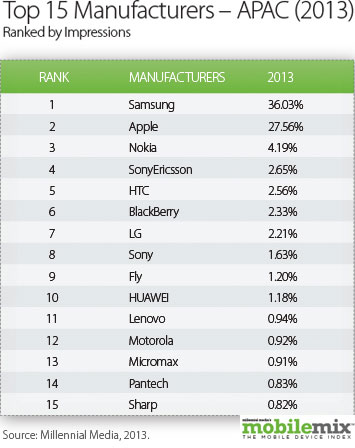
    Where the APAC region was concerned, the report confirmed Samsung as the largest manufacturer in 2013 growing over four percentage points year-over-year. It was followed by Apple that retained its position as the second largest manufacturer, but growing nearly six percentage points year-over-year. Nokia was third on the list followed by Sony Ericsson that occupied the fourth spot.


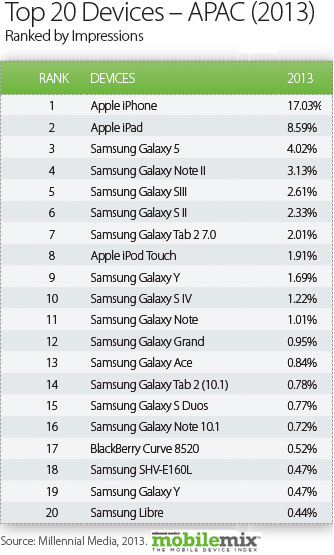
    When it came to devices, the report put Apple’s iPhone in the number one spot as it saw the largest amount of impressions in 2013, a 20 per cent year-over-year growth over the previous year. Next in line was another Apple product – iPad, that registered the second largest amount of impressions in 2013, registering a 51per cent year-over-year growth. Samsung Galaxy 5 was the third device on the list as it registered a 4.02 per cent share in 2013. A key trend in 2013 was that three tablets made it to the list of the Top 20 devices, accounting for 11 per cent of platform impressions in 2013.


    Where the device mix was concerned, smartphones accounted for 72 per cent of platform impressions while non-phone connected devices drove 21 per cent of platform impressions in 2013, representing a 35 per cent year-over-year growth from 16 per cent impression share in 2012.

     

    Where the operating system mix was concerned, the report put Android as the leading OS in 2013, accounting for 66 per cent of platform impressions in 2013, growing two percentage points year-over-year. iOs was the second on the list accounting for 31 per cent market share followed by BlackBerry in the third with a share of 3 per cent followed and Windows at the fourth spot with a 1 per cent share.


    Moving on to performances by individual countries, in India it was Samsung that emerged the top manufacturer, accounting for 48 per cent of platform impressions in India, followed by Apple with 13 per cent of platform impressions in 2013.


    As for devices, Apple was the top device in India representing 8 per cent of platform impressions in 2013 but Samsung had 14 devices in the Top 20 Device list, accounting for 36 per cent of platform impressions in 2013.


    As for the operating systems, Android led the category with 79 per cent impression share, up from 65 per cent in 2012. iOS was the second largest operating system with 15 per cent impression share in 2013.


  • Infibeam to acquire digital marketing firm ODigMa

    By A Correspondent


    Ahmedabad-based ecommerce company Infibeam has acquired a 100 percent stake in ODigMa, a leading digital marketing company headquartered in Bengaluru. The buy will help the seven-year-old ecom firm strengthen its offerings.


    ODigMa is a specialist in customer engagement via social networks and Twitter and Whatsapp. Infibeam, on the other hand, runs a B2C platform Infibeam.com and a B2B platform at BuildaBazaar.com.


    With more than 400 brands as clients, ODigMa will help Infibeam’s merchant on its B2B service. Said Sachin Oswal, COO, Infibeam.com: “The OdigMa acquisition will expand our digital marketing capabilities in the key areas of social media and SEO, SEM etc. complementing our existing strengths.”


    Advit Sahdev, CEO of ODigMa, added: “We are excited to build tools and processes to deliver transformational marketing services for SMEs and enterprise clients by attracting the best talent in the industry.”


  • Flying high! 22feet sells out to DDB Mudra [updated today]

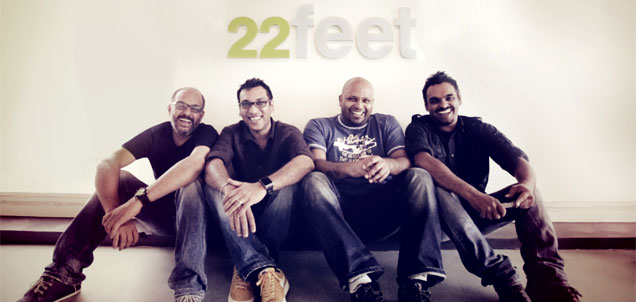
    L-R 22feet co-founders Deepak Nair, Vineet Gupta, Brijesh Jacob and Vinod Moolacherry


    By A Correspondent


    One more Indian digital major gets gobbled up. Bangalore-headquartered 22feet has been acquired by media and marketing services conglomerate Omnicom Group.


    On Monday, Omnicom’s DDB Group announced the acquisition of 22feet. The five-year-old digital marketing firms in India will merge with nine-year-old Tribal Worldwide India creating a new entity known as 22feet Tribal Worldwide which will be a part of the DDB Mudra Group.  22feet has in its roster brands such as Café Coffee Day, Fastrack, Lenovo, Heineken, Kingfisher, Red Bull and Axe.


    Madhukar Kamath

    The new entity – 22feet Tribal Worldwide – will be spearheaded by the core team of 22feet and not that of Tribal. Vineet Gupta will be Managing Director, Brijesh Jacob is Joint Managing Director and Deepak Nair will be Chief Operating Officer. The three will report directly to Madhukar Kamath, Group CEO and Managing Director, DDB Mudra Group. They will also work closely with Tribal Worldwide network in APAC and across 42 countries.


    The fourth 22feet co-founder Vinod Moolacherry will take charge of White Canvas, the Bengaluru-based full-service agency set up by the foursome. White Canvas has not been acquired by Omnicom as part of the deal on 22feet. Meanwhile, Venkat Mallik, president of Tribal India and RAPP, the marketing and CRM agency, will now move to look after RAPP, with what a spokesperson told us is an expanded and new global vision for that business.


    Said Mr Kamath on the acquisition: “With digital at the heart of DDB Mudra Group’s agenda, we are extremely happy about joining forces with 22feet. In just five years, 22feet has grown leaps and bounds. With this energy and Tribal Worldwide’s global reputation and reach, I’m excited to see what this magic of mergers can create.”


    John Zeigler

    Added John Zeigler, Chairman and CEO, DDB Group Asia Pacific, India and Japan: “We see this as a strategic move to continue evolving our capabilities in the fast-moving Indian market. DDB Group has accelerated its capabilities to offer clients the best-in-class local digital expertise at 22feet, coupled with best-in-class global knowledge of the Tribal Worldwide network. I believe this is a game-changing event for the DDB Mudra Group in India.”


    According to a financial advisor to many media M&A deals who requested anonymity, the acquisition is a win-win for DDB and 22feet. For digital media entrepreneurs who have sold out to advertising majors, the scale of a large network and international clients is a huge pull. And for ad firms, who have not been very strong on digital, acquiring smaller firms and thereby talent, legacy and clients is a sureshot way of getting digital prowess that clients seek. The added advantage, said the M&A specialist, is that networks could also look at converting a part of these digital shops to delivery hubs for offices elsewhere in the world.


    According to Prasanth Mohanachandran, CEO of AgencyDigi, who sold his agency eDeltaC Communications to Ogilvy in 2001, the 22feet buy will do a world of good for Tribal in India. “It’s an excellent agency worldwide, and the acquisition will help leapfrog the operations here,” Mohanachandran said


    Meanwhile, there is excitement amongst the 22feet co-founders who will now steer 22feet Tribal. Said Vineet Gupta on the announcement: “We are extremely excited to be a part of the DDB Group family. At 22feet, we share DDB’s passion for innovation and technology and look forward to delivering best in class digital solutions to our clients across markets as 22feet Tribal Worldwide.”


    Brijesh Jacob and Deepak Nair echo similar sentiments. “We are extremely happy with this opportunity to operate on a global canvas,” said Nair.


  • MTS: Making 3G access a child’s play

    By a correspondent


    Internet and broadband solutions company MTS has launched a quirky campaign that delves on the benefits of its latest offering – MTS 3GPLUSâ„¢ Network.


    Conceptualised by Creativeland Asia, the campaign features a new born baby who is familiar with technology and is seen exploiting the internet straight from birth. The TVC opens in a labour room, where a woman is being coaxed by the doctor to ‘push’, as the father and the nurses watch anxiously. Suddenly, the baby’s hand pops out from under the cover and gestures everybody to stop.


    The baby crawls from under the sheet and sits on the mother’s chest. From here on the baby does a series of activities that leaves people in the room shocked. He searches for ‘how to cut the umbilical cord’ and then cuts it, takes a selfie with the nurse on a mobile phone and posts it to Instagram, creates accounts on multiple social networking sites and broadcasts himself, makes a video and even uses the GPS system to navigate out of the hospital.


    Amitesh Rao, Director – Brand & Media, MTS India, said, “We needed a campaign to reinforce our strongest differentiator – the fact that we have designed and optimized the MTS 3GPlus network specifically for data. At the same time we needed to be true to the MTS brand that talks to today’s 24×7, always-on, data hungry consumer for whom the internet is the biggest opportunity platform there is. The challenge of course was to do all of this in an engaging and entertaining manner, which is what the story of a new-born baby going online to announce himself to the world does perfectly.”


    Sajan Raj Kurup

    Speaking about the TVC, Sajan RaJ Kurup, Founder and Creative Chairman, Creativeland Asia, said, “The script for the film began with the simple insight that today’s kids seem so comfortable with technology, devices and the internet even as babies. When I see them (including my own daughter) handle tablets, mobiles and laptops, I have always joked that they look like they were born with it. We just pushed that thought a little further. It took six months of painful labor. And the baby is finally out there. ”


    The TVC has been produced by Smuggler films and directed by Guy Shelmerdine.


  • Neeraj Roy is guest at IAA webinar on March 5

    By a correspondent


    Neeraj Roy

    Neeraj Roy, Managing Director and CEO of Hungama Digital Media Entertainment Pvt. Ltd. will be the guest at the International Advertising Association (IAA) India Chapter’s next webinar series. The webinar is scheduled to take place on March 5, 2014 at 3 pm. (*Disclosure: MxMIndia is media partner of the IAA India Chapter webinar series)


    Srinivasan Swamy

    Srinivasan K. Swamy, President, IAA India Chapter & Vice President, Development Asia/Pacific region of IAA said, “This webinar series has had both Indian and global industry stalwarts share their insights from the digital domain. This will add more dimension to India’s online endeavours.”


    Abhishek Karnani, Director, Free Press Journal and Manish Advani, Head – Marketing and Public Relations, Mahindra Special Services Group, are co-chairing the IAA Webinar series.


    Abhishek Karnani

    “We have had some great speakers in IAA Webinar Series and Neeraj Roy our upcoming speaker, is the King of Digital. I am confident that the participants could learn how to become digital experts from this session”, said Advani.


    The hangout will be broadcast live on the YouTube channel - www.youtube.com/iaaindiachapter  on 5th March, 3pm IST.


  • Havas bags 50-crore worth Yepme.com media biz

    By a correspondent


    Sandeep Sharma
    Sandeep Sharma

    Online fashion brand Yepme.com has awarded its integrated media AOR to Havas Media Group India. The account is estimated to be upwards of INR 50 crores annually.


    Sandeep Sharma, Co-Founder, Yepme.com said, “Havas Media had a keen understanding of our audience and business. They have specialist divisions like Mobext to handle the mobile advertising which is so very critical to us. Besides all this, the sheer passion of the team made us choose them as our media partners.”


    Anita Nayyar

    Anita Nayyar, CEO, Havas Media Group, India and South Asia explained, “We have just completed a successful year and Yepme.com has added another feather to our cap. It is a young and growing company and we gave them a differentiated and targeted approach to deliver the core message. We are extremely delighted to work with their forward thinking team.”


  • Magicbricks.com turns to RK Swamy BBDO for creative support

    By a correspondent


    Advertising agency RK Swamy BBDO has bagged the creative mandate for Magicbricks.com – the property portal from The Times Group. The win comes on the back of a hotly contested multi-agency pitch that was spread over a period of two months.


    Speaking about the win, Sunil Kukreti, Senior Partner, R K Swamy BBDO, said, “This is an interesting category with a huge canvas available for creativity. We will make the most of this opportunity by creating interesting clutter-breaking work for Magicbricks.”


    Magicbricks.com is India’s number one property portal with a host of specially developed features and tools to aid the users in taking the right decision; making it the most comprehensive platform in the category.


  • Inaugural YouTube FanFest strikes a chord with viewers

    By a correspondent


    The YouTube FanFest with HP brought to India for the first time by YouTube and Branded Ltd. featured incredible performances by some of YouTube’s most popular artists. YouTube FanFest with HP was created as a platform to bring established and rising YouTube stars from around the world off computer screens closer to their fans.


    The festival featured videos and performances by American clarinetist Shankar Tucker, Canadian entertainer Lilly Singh, aka IISuperwomanII, a motivational speaker who relies greatly on comedy, American beauty and fashion expert Bethany Mota and more. The hilarious All India Bakchod, India’s highest selling comedy collective and popular YouTubers, hosted the festival. The event was sold out with fans grabbing the tickets within 48 hours of listings.


    YouTube FanFest with HP also brought some of the biggest International YouTubers to India, to collaborate with the new breed of Indian content creators. The YouTubers who together combine 14.6 million subscribers and over 1.2 billion views have spent a fantastic week collaborating with each other and producing new content as well as working on their shows for YouTube FanFest with HP.


    Live-streamed on YouTube, YouTube FanFest with HP was designed around live performances, interviews and personal meet-and-greets with fans. YouTube experts added extra layer of comprehension by delivering insights, analysis and advice related to online video communities and their trends at the YouTube FanFest Academy.


    “With amazing artists, crazy fans, incredible hospitality and stunning locations, India has proved itself as the perfect location for the first YouTube FanFest with HP of 2014. Next stop is Singapore in May but India has set the bar very, very high,” said Jasper Donat , CEO, Branded Ltd.