Category: Digital

  • Genesis delivers a Step Up

    By a correspondent


    Genesis Burson-Marsteller has announced the launch of a new initiative, Step Up that seeks to cater to the communication needs of two important stakeholders of the entrepreneurial ecosystem; the start-ups and investor networks.


    Designed to provide affordable and relevant service offerings spanning traditional as well as new digital formats, Step Up will help young companies and SMBs take the next leap in their journey to success, by not only narrating their story creatively but also by communicating on what impacts their business.


    Prema Sagar

    Prema Sagar, Principal and Founder, Genesis Burson-Marsteller said, “Step Up is our endeavour to go back to our roots. We know, feel and understand the challenges having been a start-up ourselves. With Step Up, we have already begun to partner with new and upcoming brands in their journey so as to take it to the next big thing. What differentiates Step Up from the rest is our strong understanding of the ecosystem and the changing media scape, the right talent and the ability to provide affordable services.”


    Step Up offers customised services from branding and partnerships to media engagement. The offering to start-ups have been created keeping in mind various challenges faced by early-stage ventures. These offerings aim to develop and device a compelling and effective communication strategy to narrate the story of the ventures in the most innnovative manner.


    Commenting on this new initiative, Atul Sharma, India Lead, Step Up said, “In the last few years, the Indian start-up environment has made a mark on the global entrepreneurial map by producing unique and globally relevant propositions. Being noticed by the right audience can make a great difference to a young company’s journey. This unique initiative by Genesis Burson-Marsteller, Step Up, aims at empowering these innovative start-ups to create a space for themselves in an otherwise cluttered market. We are looking to create the next ‘whatsapp’ story in India!”


  • Etailers make hay with poll merchandise

    By Harsimran Julka


    Several online retailers are cashing in on election fervour by selling a wide variety of political merchandise , helped along by the willingness of citizens to flaunt their political affiliations.


    They are hawking a range of personal accessories, home décor and utility items that are branded with images and logos of mainline political parties which will fight it out for the affection of voters this summer.


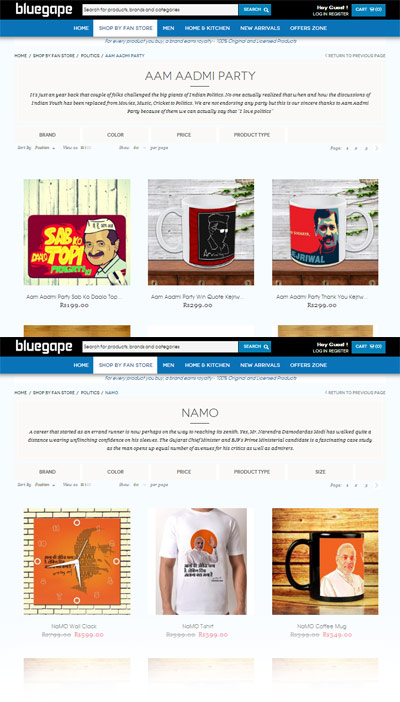
    “We just launched our political merchandise category three months ago and are already seeing 30% of daily orders coming from this category,” said Sahil Baghla, founder of merchandise portal BlueGape, who started the business in 2011 while still studying at the Indian Institute of Technology in Kanpur.


    “We capture the political messaging of a party and present in a glamorous fashion on a product just like we would do for a Bollywood movie star. It appeals to the youth instantly,” said Mr Baghla, 22, who raised Rs 1.5 crore for his venture last year.


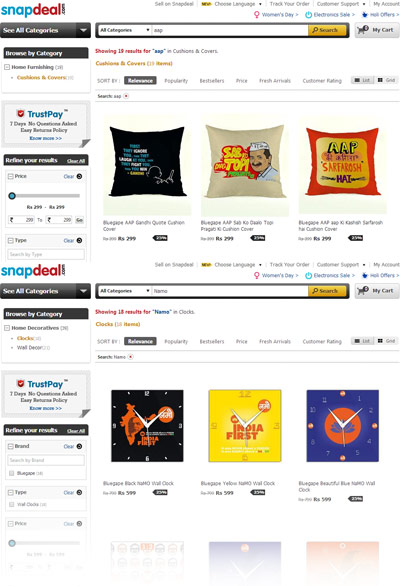
    Online marketplace Snapdeal that first launched the ‘NaMo’ brand of phones aimed at followers of the Bharatiya Janata Party’s prime ministerial candidate, Narendra Modi, now offers merchandise for followers of the Aam Aadmi Party which include wall clocks and covers for phones and tablets. For BlueGape, customers for Aam Aadmi Party’s caps and T-shirts come mostly from Delhi and Bangalore.


    Narendra Modi brand of mugs, shirts and clocks are popular amongst customers from Andhra Pradesh and Maharashtra. He added that products with Congress’ development theme or Rahul Gandhi as its ambassador are selling less, due to lack of a strong theme.


    “Other political parties such as Samajwadi have mixed messaging which makes it difficult to make a merchandise around a theme for them,” said Baghla, who is aiming for 5,000 orders per day by end of this year. Entrepreneurs said the increase in social media usage is leading to greater willingness amongst people to flaunt their political leanings, a dramatic shift from the reticence evident during even the previous general election in 2009.


    Tony Navin, vice president overseeing business development at Snapdeal, which raised $138 million from eBay last month, said sales of political merchandise have increased fourfold since last month. He said most customers for such merchandise are from tier 2 and tier 3 towns and cities, with an average age of 25- 40 years.


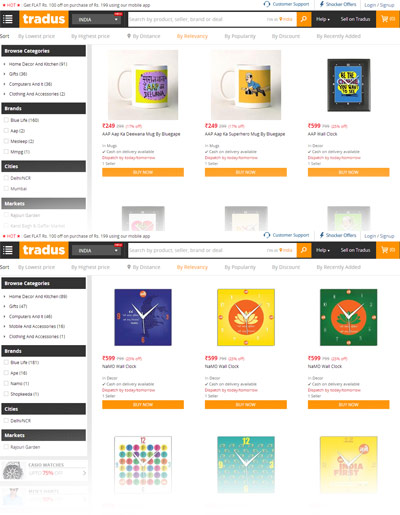
    The trigger for selling political merchandise peaked in January, when sellers on location-based marketplace Tradus started retailing Aam Aadmi Jhadus (brooms) for Rs 5 each.


    “The launch was an instant hit and we sold 2,000 brooms within two hours. Over three days, after the win of AAP in Delhi, about 6,000 brooms got sold on the platform,” said Mudit Khosla, CEO at Tradus, an online marketplace owned by South Africa’s Ibibo Group. With the maturing of Indian democracy, youth are now more open to flaunting their political affiliations, said Saurabh Kochar, founder of online portal Print-Venue , which is backed by German incubator Rocket Internet.


    “We are seeing demand even from individuals who are ordering shirts, caps and even decorative pieces for personal use and to gift to their party donors and members,” said Kochar, a graduate of IIT-Roorkee, who started the online portal in 2012. He is seeking ideas for design of such merchandise.


    Although this business is seasonal, entrepreneurs believe that with India’s large electorate of 81 crore voters, and heightened political activity, it will provide a strong stream of revenue. About 2.3 crore Indians are first-time voters, many of whom are hooked on to social media and will reach out for merchandise that proclaims their loyalties. “The youth now want to speak out about their identity,” said Mr Baghla of Bluegape.


    Source:The Economic Times

    Copyright © 2014, Bennett, Coleman & Co. Ltd. All Rights Reserved

    Licensed to republish


  • Internet accessed most on mobile, says IAMAI report

    By a correspondent


    A report released by the Internet and Mobile Association of India has revealed that about 95 per cent of the mobile Internet users are using the internet to communicate online.


    With the phenomenal growth that mobile has seen in recent times, marketers have begun to adopt it as a one of the primary tools used to generate brand visibility and awareness. Leading marketers at the Internet and Mobile Association of India’s second Email Marketing Summit 2014 were of the view that mobile will be the key driver in coming times.


    Speaking at the Summit, Kalpit Jain, Chief Operating officer – netCORE Solutions, said, “India is expected to have 185 million mobile users by June 2014, and 35 per cent subscribers view their mails on mobile, which provides a huge opportunity to market your products.”


    Stressing on the importance of email marketing, Vivek Gaur, Chief Executive Officer- Yepme said, “With over 290 billion emails sent everyday you need to keep evolving your email marketing strategies accordingly. You have to understand what a consumer wants. People have reservations in getting promotional emails. Communication which goes to the consumer should be relevant.”


    Speaking on relevance of data in email marketing, Naveen Kukreja, CMO & Director- Non Insurance business- PolicyBazaar.com, said, “‘Data has become the buzzword for email marketers. Every brand is sitting on big data for marketing. The need of hour is to make maximum use of that data. Lesser the content and relevant the communication the better it is for marketers.”


  • Simplymarry.com engages RAPP

    By a correspondent


    Multichannel agency RAPP of DDB Mudra Group has been roped in to handle Simplymarry.com. RAPP India will be responsible for bringing the brands new proposition alive. RAPP’s mandate will cover the full service spectrum with the mainline as well as digital aspects of the campaign.


    Matrimonial portal SimplyMarry.com is promoted by The Times of India group and offers a superior matchmaking experience for prospective brides and grooms to meet and communicate with each other.


    On choosing RAPP, Sanjeev Kumar, Business Head, SimplyMarry.com said, The online matrimony space in India is quite challenging with many established and new players. Over the years, we have realized that although the space has a lot of big players, the value differentiator in this category hasn’t been cracked just yet. We are re-launching into this competitive market with an offering unlike any the market has witnessed yet. We were looking for an agency that would help us amplify this difference. RAPP, with its unique strategic and media agnostic approach seemed like a perfect fit.”


    Venkat Mallik, President, RAPP India said, “The SimplyMarry team has a strategy that is designed to change the convention among Matrimonial sites. A number of new innovations are planned that will change the rules of the game. To be able to disrupt the convention is a challenge that has always got us going. And we hope to do that with SimplyMarry.com.”


  • Billion dollar baby Flipkart crosses miletone faster than Amazon

    By Radhika P Nair


    Indian ecommerce flag bearer Flipkart has hit $1 billion in sales. This is a coming of age for Indian ecommerce as the market leader hits the target a year ahead of schedule. Global ecommerce giant Amazon reached the same target seven years after its launch. Flipkart, launched in October 2007, has achieved this milestone a few months faster.


    “We are really proud and excited to announce that we have hit a run rate of $1 billion GMV (gross merchandise value) one year before our target,” said co-founders Sachin Bansal and Binny Bansal, in a joint message. “In March 2011 we announced that by 2015 we wanted to hit $1bn in GMV. At that point in time our run rate was $10 million.”


    Flipkart, which started out as an online retailer of books, has raised over $550 million in risk capital funding. The company, which is backed by South African internet major Naspers and investments funds like Dragoneer Investment Group, Morgan Stanley Investment Management, Tiger Global and Accel Partners, was valued at $1.6 billion when they raised $360 million last year.


    The company, which started out as an inventory retailer, pivoted to an online marketplace in 2012. The company, which ships out over 1 lakh orders a day on an average, now has about 1,000 merchants on its platform.


    The Bengaluru-based firm, which has over 10,000 employees, has also grown beyond ecommerce. It spun out its payment solution PayZippy into a separate entity last year. This service is used by other internet companies like MakeMyTrip, Zansaar and Yepme. The company is also opening up its logistics arm, eKart, which supplies to 150 cities, to other online retailers.


    The company is also increasingly focusing on mobile commerce, as over 20% of its sales already comes from handheld devices. Sachin Bansal, in an earlier conversation, had said that in the near future Flipkart.com would be a m-commerce based marketplace.”


    Source:The Economic Times

    Copyright © 2014, Bennett, Coleman & Co. Ltd. All Rights Reserved

    Licensed to republish


  • Yahoo launches new homepage in India

    By A Correspondent


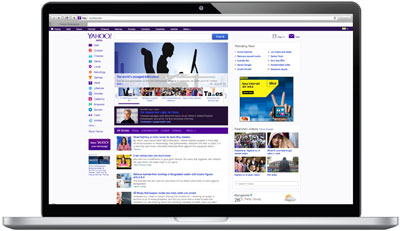
    Yahoo India has unveiled a brand new homepage delivering what it says is a “beautiful, modern, intuitive and personal experience”, available across smartphones, tablets and PCs. The new Yahoo Homepage, launched in 6 countries including Singapore, Malaysia, Indonesia, Philippines, Vietnam and India, makes it easier users to discover all the content they care about – right here on one page from any device of their choice, as per a communiqué.


    The navigation has been made simpler with an option of browsing top stories, checking mail, keeping tabs on stocks, checking one’s photos and the weather… all on the homepage.


  • Billon Dollar Bansals


    By Radhika P Nair


    It was a 10,000-a-month allowance from their parents for almost 18 months that helped Sachin Bansal and Binny Bansal launch an e-commerce website retailing books in October 2007. Today, the near-20% stake they hold, along with the top management, in Flipkart is valued at almost Rs 2,000 crore.

     

    Sachin Bansal

    Sachin Bansal, the chief executive of Bengaluru-based Flipkart, says he has a knack for underestimation. That is exactly what happened in March 2011 when he and Binny Bansal, who are not related to each other, announced they would reach the $1-billion (Rs 6,100-crore) sales mark in 2015. Last week, the site, which now sells everything from books to electronics, apparel and jewellery, reached the milestone, a full year ahead of the target.


    Flipkart, Lenskart, Myntra & Snapdeal: All have Bansals at the helm


    By Biswarup Gooptu & Harsimran Julka


    Even a decade ago, the name “Bansal” would have brought in images of coaching classes in Rajasthan’s Kota, but today it is the common factor binding the who’s who of India’s fledgling e-commerce sector.


    Five young men who answer to that name have emerged as trailblazers of Indian e-commerce, taking on global biggies like Amazon and eBay for top honours in the country’s exploding market for online retail.


    Online marketplaces Flipkart and Snapdeal, apparel retailer Myntra and eyewear retailer LensKart all have Bansals at the helm. Such is their clout that they account for nearly Rs 10,000 crore of the total online retail pie of about $2 billion.


    But their adeptness at trade and commerce is not a state secret. As a sub-sect of the Aggarwal community, the Bansals are known for running a tight ship when it comes to business and entrepreneurship.


    “We (Bansals) have the math, finance and data skills that are extremely important for e-commerce,” said Rohit Bansal who teamed up with schoolmate and Wharton alumnus Kunal Bahl to set up online marketplace Snapdeal in 2010.


    The Bansals of the new economy also sport degrees from IIT and IIMs. The five Bansals with their four companies – Flipkart, Myntra, Snapdeal and LensKart – set up shop within the last seven years and control about 85% of India’s entire e-tailing industry.


    But they have to contend with the might of $75-billion (Rs 4.5 lakh crore) Amazon, which entered India last year and is investing heavily.


    Heading the fightback are Sachin Bansal, 32, and Binny Bansal, 31- founders of Bengaluru-based Flipkart – who met each other while studying at IIT-Delhi. Their company today generates about Rs 6,100 crore in sales, half the industry total.Flipkart is also the biggest challenge for Amazon, a company where both the Bansals honed their skills before setting up on their own in 2007. Coming second is Snapdeal, whose Rohit Bansal, 31, graduated ahead of Sachin and Binny from IIT Delhi.


    “My ancestors from my paternal and maternal sides have all been businessmen,” said Rohit Bansal, who is from Malout, a small town in Punjab, just four hours from Chandigarh where the Bansals from Flipkart grew up.


    Snapdeal’s turnover is now half of Flipkart, and it is expected to cross the $1 billion mark next year. The Bansals are making a mark not just in horizontal marketplaces, but also single-category retail. Bengaluru-based Myntra Designs, founded by another IITian Mukesh Bansal, is giving stiff competition to Flipkart in apparel, one of the highest-margin categories, where profits range from 30 to 50 percent.


    “It has come full circle with me getting in fashion retail online,” said Mukesh Bansal, CEO at Myntra, who hails from Haridwar. His father had opted for a public sector job over joining the family business — ironically, clothes trading. “No family influence made me think of entrepreneurship. But the startup bug bit me in Silicon Valley,” said Myntra’s Bansal, 38, who moved to India to start Myntra in 2007. His venture is targeting sales of Rs 1,500 crore next fiscal from apparel sales, the largest in its category.


    LensKart, founded by another Peyush Bansal, 30, is considering selling his other portals such as WatchKart, BagsKart and JewelKart to a horizontal player at the ‘right price’ to focus on the eyewear market. “My parents didn’t understand while I was starting up. But they came around later. You have to understand that they are products of their generation,” said Bansal, who is targeting revenue of Rs 100 crore from LensKart next fiscal.


    RBI Chair Professor for Economics & Social Sciences at IIM Bengaluru Charan Singh says that a community’s dominance over a certain trade is a factor of its social interactions. “It can be likened to the Jewish community in the US which continues to hold top posts in US banking and technology industry.” Ashish Jhalani, head of retail advisory firm eTailing India, agrees. “Certain communities in India do encourage entrepreneurship. The Bansals and Aggarwals have definitely dominated businesses in India, particularly retail trading, for centuries.”


    (With inputs from Radhika P Nair)


    Source:The Economic Times

    Copyright © 2014, Bennett, Coleman & Co. Ltd. All Rights Reserved

    Licensed to republish

     

    “To say billion-dollar in 2011 was crazy when we were doing a $10 million (Rs 61 crore) run rate,” says Sachin, 32, in his first interview after the firm achieved the sales target. “It was just a belief.”


    Sachin, like his co-founder, grew up in Chandigarh. That is not the only coincidence. Both went to IIT-Delhi and worked at different companies for about a year before ending up in the same team at Amazon. It was during this stint that the two decided to start up.


    The duo pooled in Rs 2 lakh each and with two computers launched the site from their two-bedroom apartment in Koramangala, a primarily residential locality in Bengaluru where the company now has multiple offices. For 10 days, the site did not see a single sale and then a customer from Andhra Pradesh placed the first order for the book ‘Leaving Microsoft to Change the World’ by John Wood.


    “We were not thinking about numbers then, but we knew something big can be built out of ecommerce,” says Binny. The two co-founders, who have a tendency to finish each other’s sentences in conversations, are close friends. What has helped maintain the bond through the ups-and-downs of entrepreneurship? “By fighting every day,” says Binny, 31, as the two burst out laughing. “But seriously, it is important to know what the other guy is thinking. That becomes very important as the message and the thinking become consistent. Communication is key.”


    The two are demanding bosses, say their employees. “Both have high expectations, but that raises our bar. That makes working with them rewarding as well,” says Amod Malviya, head of engineering at Flipkart. He says the Bansals have complementary personalities. While Binny is analytical and driven by logic, Sachin is more instinctive and is driven by emotion and passion, says Malviya, who joined the company in 2010 as a senior manager.


    Employees are also impressed by the simplicity the duo has managed to retain. As they live close to work, both walk to office. They also fly and stay budget while travelling and eat with other employees whenever possible. “They are very much in the Azim Premji mould and shy away from ostentation,” says an employee, who did not want to be identified.


    Experts say the success of Flipkart can be chalked down to the founders’ attitude. “The two have the right attitude. They are cocky and confident, and along with that they have the ability to execute,” says Arvind Singhal, chairman of retail consultancy Technopak. This attitude has helped them deal with the ever-shifting baselines in Indian ecommerce.


    After raising about $190 million (over Rs 1,150 crore) until 2012 from Tiger Global and Accel Partners, industry insiders had begun questioning the viability of the business, which was burning about 50 crore of cash each month. In 2012, the company took action, by tightening its employee base, using more technology to cut costs and shutting down its music downloads category, which was not scaling up. More importantly Flipkart, which started out as a direct seller of goods, changed to an asset-light marketplace model where multiple merchants, along with the company’s own WS Retail, sell to customers on the site.


    In 2013, the company raised $360 million (about Rs 2,200 crore) in two tranches, primarily from South African Internet major Naspers at a whopping valuation of $1.6 billion (Rs 9,772 crore). At the time, Sachin termed the cash infusion as a “great validation” and one which refuted the scepticism about his company in particular and Indian ecommerce in general.


    Supam Maheshwari, founder of online babycare site Firstcry, says Sachin and Binny Bansal managed to find early investors who kept backing them. “They executed well, especially in logistics and warehouse, and did not lose focus,” says Supam. “But they have had to spend a lot to reach the billion-dollar mark.”


    Flipkart’s sales milestone could also send out a signal to international players that the Indian ecommerce market is mature enough for them to enter, says Maheshwari. One such player could be Alibaba, which only has its business-to-business portal at present in the country.


    Comparisons with Alibaba’s Jack Ma are inevitable. Jack too started out from a small apartment in China’s Hangzhou in 1999.


    Jack diversified into payments, cloud computing and multiple ecommerce models. Bansals have made their intentions to diversify clear and have already done so by opening up their online payments solution and logistics for use by other Internet companies.


    Jack has, however, already beaten Amazon in China. Alibaba expects to triple the volume of transactions to $490 billion (almost Rs 30 lakh crore) in 2016. For Flipkart, the battle has just begun. Peyush Bansal, founder of Delhi-based eyewear e-tailer Lenskart, says competition will intensify between the large multi-category portals. Amazon, which entered the Indian market a little over six months ago, has rapidly expanded into 18 categories of products and has been busy setting up its logistics and warehouse network. Snapdeal, which is targeting $1 billion in sales next year, recently raised a further 830 crore from investors led by eBay. “The site that would come out on top could be the one with the deepest pockets or the one with the best economic efficiencies,” said Peyush Bansal.


    Technopak’s Arvind says Flipkart, which employs about 10,000 people, will have to continue to maintain its lead in technology, customer experience, supply chain management and consumer logistics to hold onto leadership.


    “It is like a three-hour movie where just the first 30 minutes are over; the plot is still unfolding,” says Arvind.


    Flipkart, which has over 1,000 sellers on its platform, is now shifting focus towards scale with intelligence, which will lead its mobile commerce drive. Sachin believes mobile will revolutionise ecommerce and Internet businesses. “My four-year-old son does not even understand keyboard. He expects the television to also be a touchscreen device,” says Sachin, who expects Flipkart to become a mobile commerce platform in the near future with features customised to individual users. “The next six-and-a-half years are going to be even more exciting.”


    (With inputs from Biswarup Gooptu and Harsimran Julka)


    Source:The Economic Times

    Copyright © 2014, Bennett, Coleman & Co. Ltd. All Rights Reserved

    Licensed to republish
     

  • Watch out, TVwallahs. P&G, Coke eyeing mobile video streaming for effective & cheaper advertising

    By Deepali Gupta


    Procter & Gamble and Coca-Cola are considering launching video channels over mobile phones to deliver branded content and advertisements directly to consumers in India, because it is cheaper than running ads on television and easier to measure the impact. The launch of third- and fourth generation mobile technology is making this possible and more affordable for advertisers, allowing them to sidestep, at least partially, the traditional mass media.


    Airing ads over telecommunication networks will also allow the companies to know who is watching their ads, something that is difficult to measure in TV advertisements.


    P&G and Coca-Cola, two of the biggest advertisers globally, are in preliminary discussions with India’s top telecom operators to start their own streaming video channels which consumers could access free of charge, three people familiar with the talks said. Another executive at one of the two consumer-goods companies said it was too early to say if his company would launch such a channel. “We have just had a meeting with the telecom operators, that’s it. There is no way to say whether this will happen or if it does when,” this person said.


    Initially, the brands may make their programmes available to customers of the nation’s top two mobile operators, Bharti Airtel and Vodafone India, that roughly account for 60 per cent of the subscribers across India, said one of the three people cited above. Bharti Airtel and Vodafone did not respond to emails seeking comment. P&G and Coca-Cola declined to comment.


    The talks come close on the heels of Hindustan Unilever launching a dedicated radio station on mobile phone in Bihar which has already acquired more than five million subscribers. P&G and Coca-Cola are also encouraged by the response to their existing online video content.


    Beverages-maker Coca-Cola has branded content such as the Coke Studio musical performance which receives lot of hits on You Tube, one of the people said. “We can push that content to users on their mobile phones,” this person said, adding that the channels would also carry company or brand logo through all shows which will be interspersed with advertisements. “It is cheaper than running campaigns on national television.”


    There is huge demand for mobile video content. Bharti Airtel’s Re 1 per video offer had 22 million hits within the first two months of its launch in May 2013, with nearly a quarter of them by first-time data users, according to data released by the company. Much of the content was Bollywood or fashion. As much as 80 per cent of that was accessed on feature phones – phones that can access Internet but are cheaper than smartphones – and nearly half in rural, content-starved markets. “Now imagine this is free to access,” said one of them, referring to the video channels these companies are considering. “I think there would be much more viewership.”


    However, the concept is still in its inception, added another. It involves a content aggregator creating the channel, the brand buying bulk data and an operator pushing the site to data-enabled phones. Offering this service requires the operator to enable data connections also on phones that don’t subscribe to data service and allow free connectivity as long as the device accesses merely the streaming channel.


    For telecom operators, offering free programmes will likely help attract voice consumers to data, and once they get hooked, the companies can sell services outside the free channel. According to analyst estimates, India has around 400 million phones that can use Internet or data services, such as viewing streaming video. However, only around 140 million actively connect to the Internet.


    Smartphone maker BlackBerry too has spoken of monetising its dedicated channels that brands like Café Coffee Day, Mercedes-Benz and even some political parties such as the Bharatiya Janata Party and Aam Aadmi Party use to connect with Blackberry Messenger customers. The channels started by the brands involve posting text and pictures that are shared by followers accumulated through invites.


    Source:The Economic Times

    Copyright © 2014, Bennett, Coleman & Co. Ltd. All Rights Reserved

    Licensed to republish


  • Conde Nast unveils travel-friendly digital offering

    By a correspondent


    Condé Nast Traveller India has unveiled its digital version via cntraveller.in. The portal is positioned as a one-stop destination and resource for the digital-savvy Indian traveller, whether they are looking for travel within India or abroad.


    The revamped website comes with a slew of brand new features, including being ‘device-responsive’, that is optimized for browsing on PC, laptop, tablet or mobile; updated city guides boasting a new Insider’s section for the ultimate tips from locals in-the-know; daily news and deals; interactive toolbars where travellers can share stories, photographs, guides and advice on Facebook, Twitter, Pinterest and more.


    Commenting on the new website, Divia Thani Daswani, Editor, Condé Nast Traveller India, said, “Travel and technology are inseparable. Until now, the tech-savvy Indian audience has visited travel websites only to book tickets or research trips. Now, for the first time, they can experience and engage with high-quality content, specifically created for the Indian traveller. Whether you’re planning your vacation or looking to make the most of a business trip-or simply looking for some armchair travel, www.cntraveller.in is the new destination for anyone with a love of travel. Theme-based content that is updated regularly, expert tips and timely news will ensure that Condé Nast Traveller India continues to be the Last Word in Travel, even in its digital avatar. Remember; go here before you go anywhere.”


    The new cntraveller.in launches with ‘The Travel Bucket List’ that captures the bucket lists of 20 varied and well-travelled personalities with an aim to inspire one and all. From artist Bose Krishnamachari’s suggestions for an arty holiday, to Fatima Bhutto’s list of the most beautiful cities your embassy may warn you against visiting, the Bucket Lists are showcased in exciting ways-be it in the form of features, stunning visuals or slideshows. Other contributors include Masterchef’s Matt Preston, Suhel Seth, CNN’s Richard Quest, actress Parineeti Chopra, photographer Steve McCurry, and singer Monica Dogra among others.


  • Trendspotters.tv appointed online channel partner for ‘Kaanchi’

    By a correspondent


    Online digital channel Trendspotters.tv has entered into an alliance with Mukta Arts as their online channel partner for their forthcoming production ‘Kaanchi- The Unbreakable’. This will be the channel’s first ever film association as an online digital channel partner.


    In accordance with the treaty, Trendspotters.tv shall be associated with the film for special promotional activities of the film for the month of March and April. The film is scheduled to hit the cinemas on 25th April 2014.


    Kunal Kishore Sinha, Founder, www.trendspotters.tv elaborated, “At Trendspotters.tv, we are keen on engaging our audience with fresh developments in the world of entertainment. Bollywood being a much loved genre of films among our target audience, collaboration with the production house that has given some of the biggest hits of the industry is indeed a significant one. It is a matter of pride for us to have bagged the opportunity to endorse an upcoming film from the Mukta Arts banner. Film buffs can enjoy the first look, trailer and music of the film on Trendspotters.tv.”


  • #FF14 Day 2: Need to monetize big in a multi-platform era

    By A Correspondent


    There’s a lot that is being said on how the advent of technology has revolutionized the M&E ecosystem. With the emergence of newer technologies and players offering these services, it becomes a challenge to find a balance in providing technology with creativity and content. The session on ‘Monetization Opportunities in the Multiscreen World’ sought to throw light on how the ecosystem was witnessing an interesting shift in revenue-sharing models and how companies could monetize effectively during these challenging times.


    The panelists included Sam Balsara, Chairman & MD, Madison World; Satyan Gajwani, CEO, Times Internet Panel; Chakrapani Gollapali, General Manager, Consumer Channels Group, Microsoft India; Neeraj Roy, MD & CEO, Hungama Digital Media; Rishi Jaitly, India Market Director, Twitter; Nikhil Naik, Head – Director, Global Content and Distribution, Vuclip; Karan Bedi, Founder & CEO, Tutorific! and Ramki Sankaranarayanan, CEO, Prime Focus who moderated the session.


    Presenting an insightful outlook, Sam Balsara highlighted how the television and mobile will be the only two mediums that will continue to be dominant in the future and how the interplay between the two would result in positive growth of the industry. Balsara said that while television continued to find favour with advertisers, they were gradually waking up to the medium of digital as well. “But advertisers need to be flexible about how the viewer’s see their ads; not just on television but across multiple screens.”


    Cautioning the audience, Balsara expressed discontent on how the older norm of doing business was seeing a shift that was not healthy. “The older model of doing advertising was 50-50; half from subscription and half from advertisers. But that has changed of late with more revenues coming from advertisers allowing them to have a greater say in content. It is important that we move back to the old model of 50-50 so that equilibrium is maintained and focus around content remains intact.”


    According to Neeraj Roy, it is not true that monetization in India is not up to the mark. “Around Rs 1500-2000 crore is still being directed towards content and that was a very positive sign. But he expressed worry as he said that the monetization exercise was being limited to certain mediums only. The way out is to have a balance in the advertising-transaction ratio, said Roy. With the shift to 4G being imminent, Roy urged content providers to focus on providing content that is high on value as consumers will be willing to pay more provided they get quality content.


    Providing a synopsis of his company, Rishi Jaitly said that more than 25 million users use twitter to discover content. Jaitly said that if companies concentrated on investing in value then the monetization will actually go up. “The world today is becoming mobile-first, so content providers needs to work on providing content that is of context and relevant. As a network, our focus would continue to be on fueling public conversation across multiple platforms,” affirmed Jaitly.


    Highlighting the scope and challenges faced by his company, Satyan Gajwani said that it was great to see the digital ecosystem in India thriving but the challenge is in delivering content that is high-quality because at the end the customer is going to pay for it. Talking about the issue of piracy facing his portal gaana.com, Gajwani said that the only way to overcome that was by offering such high-value and widespread offering that the user will be forced to come back for anything and everything got to do with music. This will indirectly bring down the number of users going to pirated websites to seek such services.


  • #FF14 Day 2: Internet – playing catalyst to change

    By A Correspondent


    The year 2014 is turning out to be a turnaround year for political parties who are turning to the digital world to reach out to the masses. While their popularity with the masses on the medium is questionable, what is noteworthy is that it has managed to play the role of a catalyst in disseminating information to the people at large. But it is not as smooth for most politicians who are looking at the medium as an intrusion into their public life.


    These and many more aspects concerning the digital world were discussed in detail at the session ‘Internet and Democracy: Interloper or Catalyst?’ The panelists at the session included Chetan Krishnaswamy, Head, Public Policy and Govt Relations, Google India; Suparna Singh, Director of Strategy, NDTV, and Managing Editor, NDTV.com; Ronak Samantray, Founder, NowFloats.com; Mike Best, Berkman Center for Internet & Society, Harvard University and Roger Fisk, PR Expert, President Obama’s Campaign. Jon Sopel, Senior Anchorperson, BBC Global News was the moderator at the session.


    Chetan Krishnaswamy of Google began by warming up the audience on the spectacular growth story being put up by the medium of digital. “From what it was around a decade ago, internet has grown by 600 per cent to a $2.5bn industry today. In fact over the next six years, the country would have about half a billion users accessing the internet, easily surpassing countries like US and being a close second to China.” Krishnaswamy went on to add that much of the growth on digital was coming from the mobile platform with over 4 million users using the medium to access content. “What is interesting is the growth that is being reported from non-English websites or language websites that have grown by more than 56 per cent whereas the English websites have grown by just 11 per cent. All these are indications that the internet can only make the democracy better and act as a catalyst.”


    According to Suparna Singh, what social media, in addition with players like facebook, twitter can do is become an apparatus of change. “What is being witnessed right now is that such platforms are becoming more opinion oriented and not informational; it needs to shed its baby weight and become more mature. There needs to be more dialogues and exchange of ideas and information on these websites,” reiterated Singh.


    Highlighting the action that was being witnessed on the medium with the general elections around the corner, Singh said that though there has been an invasion from the political parties on these platforms, it is still in its infancy. “But that will change in the next general elections where a lot more political parties will take a liking to the medium and will be reaching out to the masses in a much profound manner,” affirmed Singh.


    Highlighting the work done by his firm, Ronak Somantray said that the objective of his firm was to get businesses online and promote them largely through the medium of messaging (SMS). There is a lot of response that we have generated in the marketplace and are hopeful of making a big impact in the future as well, he said.


    According to Mike Best, the role of social media is not being comprehended in a manner that it should. “If you see the impact that social media websites created on countries like Iran and Syria during the turmoil, it was quite an extraordinary effort.” Best bought up the example of Nigeria where his company had helped the country in the run-up to the elections by providing insights and data on the trends that were being spotted. This, he said, prepared the people to either vote for change or be ready for the worst. Highlighting his objective in 2015, Best said that his company will be monitor social media as well as well as observer missions at the same time when the elections take place again in Nigeria.


    The panelists went on to discuss the intricacies surrounding privacy on the internet and how the process had to be simplified so that the owners do not face a harrowing time answering questions from the consumers’ end.