Category: Digital

  • Social media users in urban India to reach 66mn by June

    By A Correspondent


    The number of social media users in Urban India reached 62 Million (Mn) by December 2012, and it is estimated to reach 66 million by June 2013, according to a report on Social Media in India, by the Internet and Mobile Association of India (IAMAI) and IMRB. According to the report, about 74 percent of all Active Internet users in Urban India use social media.


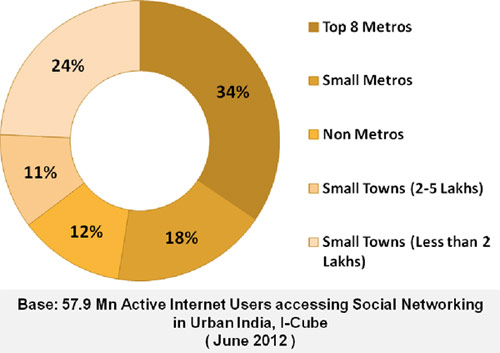
    The report also finds that of the social media users, 34 percent are from the top 8 metros while 35 percent of the total users are from small towns of population up to 5 lakh.


    Figure 1 – Social Networking Profile by Town Class


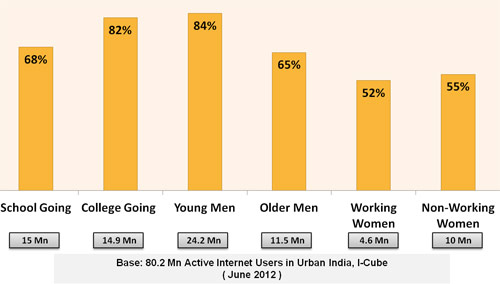
    The report further finds that the highest proportion of social media usage was observed among the demographic segments of “Young Men” and “College Going Students”, with 84 percent and 82 percent penetration levels respectively.


    Figure 2- Social Networking Profile by Demographic Segments (Proportions)


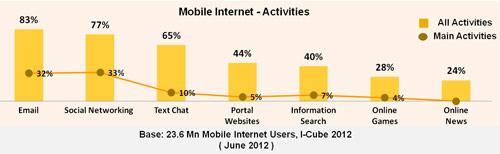
    Social media usage is also fast catching up with mobile internet users. According to the report, 77 percent of the users use mobile for social media. Email, social media, search, app store and chat / IM are used everyday by those accessing internet through mobile.


    Figure 3 – Activities Done by Mobile Internet Users (Top 35 Indian Cities)


  • Mindshare announces Siddharth Sethi as Digital Leader

    By A Correspondent


    Mindshare, the flagship media agency of GroupM today announced the appointment of Siddharth Sethi as Leader, Digital for Mindshare India. In his new role, Mr Sethi will be responsible for boosting the agency’s full-service digital offerings geared towards actively pushing Adaptive Planning, Performance and Digital Analytics to the fore. Based out of Mumbai, Mr Sethi will report to Ravi Rao, Leader, Mindshare South Asia.


    Mr Sethi’s last stint was as Director, India for Xaxis, another GroupM company. As Director, he successfully started and built up the company operations in India.Xaxis is today delivering targeted digital media products that allow advertisers to reach and better understand their audiences at massive scale. Xaxis delivers these products through the expert use of consumer data, advertising technology and media relationships.


    Mr Sethi has over 12 years of experience in Media management, Marketing and Product Management. He has spent the last 7 years focused on helping digital start-up’s create products and revenue streams.


    An alumnus of Mudra Institute of Communications (Ahmedabad), Mr Sethi has also been through Nasper’s Harvard Program in Strategic Marketing. He began his career as a Media Planner at Madison, a Brand Manager at BenQ, and was last with IBIBO as VP.


    Welcoming Mr Sethi, Ravi Rao, Leader, Mindshare South Asia, said, “We are very fortunate to have someone with such integrated expertise at the helm of our digital offerings. Sid’s experience of having led Xaxis in India will be another factor in enhancing the overall digital offering as well his entrepreneurial culture will take Mindshare into a league of its own, well within the Original Thinking Framework for all brands. He is technologically savvy, understands the brand space and is performance driven.”


    On his move to Mindshare, Mr Sethi said, “I am delighted to be joining an agency with such an impressive digital portfolio. Over recent years Mindshare has really built a strong digital team with some really impressive digital and social media campaigns under its belt. I am really looking forward to building on this reputation.”


  • Guardian ed Alan Rusbridger’s 10 mantras of Open Journalism

    Alan Rusbridger

    By A Correspondent


    Digital first has been the maxim that the Guardian has adopted over the years and with only the Daily Mail and New York Times ahead of it in Comscore ratings, the gambit has paid off. The Guardian’s Chief Editor Alan Rusbridger was in Mumbai at the invitation of the Press Club en route to New Delhi for the Big Tent Activate Summit being organized by Google and Guardian with MediaGuru.


    Mr Rusbridger said while revenues from digital is still around a quarter of the overall revenues of the newspaper company embracing digital is the only way to go. Mr Rusbridger has been editor of the Guardian since 1995. He is editor-in-chief of Guardian News & Media, a member of the GNM and GMG Boards and a member of the Scott Trust, which owns the Guardian and the Observer newspapers.


    Talking on the subject ‘The Future of Journalism in a Digital Age’, Mr Rusbridger shared the 10 mantras or traits of ‘Open Journalism’ that the Guardian has been practising with much success.


    1. Open Journalism encourages participation and invites a response

    2. It is not an inert, us-to-them form of publishing

    3. Invokes others in the pre-publication processes

    4. Open journalism helps form communities of joint interest

    5. It’s open on the Web. It links to, collaborates with others

    6. It aggregates and curates the work of others

    7. It recognizes journalists are not the only voices of authority

    8. It aspires to achieve and reflect diversity

    9. With open journalism, publishing is the start of the journalistic process and not the end

    10. It’s transparent and open to challenge, it allows for corrections and clarifications


    The session at the Press Club Mumbai was organized as part of a monthly knowledge series and is sponsored by Concept Communications.


  • R Jagannathan is Network18’s ed-in-chief for web & print

    By A Correspondent


    Network18 group has strengthened the editorial structure at its web and publishing arms by elevating veteran journalist R Jagannathan (“Jaggi”) as Editor-In-Chief. Mr Jagannathan will be responsible for leading editorial strategy and driving content synergies across a bouquet comprising some of the country’s leading news and special interest brands. This is part of the group’s progression towards an integrated publishing and digital editorial operation.


    This mandate includes Moneycontrol.com and Firstpost.com, Forbes India and Network18 Publishing, which spans a portfolio of 18 B2C and B2B titles such as Overdrive, Better Photography, Chip, T3, Entrepreneur, Search and Auto Monitor.


    Mr Jagannathan had taken charge of Moneycontrol.com and Firstpost.com at the time of joining Network18 in 2011. In this expanded role, he will be additionally responsible for Forbes India and Network18 Publishing. Editors at each of these brands will now report to him with immediate effect.


    With a career spanning over 36 years, Mr Jagannathan has been the editor of several print and digital publications across the general and business news space. Prior to joining Network18 Group in 2011, he was the Executive Editor at DNA. Earlier, he was the Executive Editor at Business Standard and he has also been the Editor at Financial Express, Indian Management and Business World. He was the founding Executive Editor of Business Today in the early 1990s and Business Editor of India Today before that. His first foray into the digital world came when he became Editor at Myiris.com at the height of the first dotcom boom.


    Raghav Bahl, Founder and Editor, Network18 said, “Platform neutrality in publishing is almost a truism now and as one of the country’s largest news and digital players, we’re best placed to lead this broadening trend. It’s critical that our brands access the best expertise across the group while they continue to fulfil their distinct content mandates and they do so through a structure which mirrors the new digital reality. We have entrusted the task of leading this effort in the able hands of Jaggi.”


    B Sai Kumar, Group CEO, Network18 said, “In Jaggi, we have one of the finest editorial minds in the industry with an unmatched breadth of experience and a proven track record, which includes the stellar performance of our digital brands under his command, Moneycontrol and Firstpost. We’re confident that in this expanded mandate, he will help us further enhance our editorial product and deepen audience engagement and market leadership.”


    Mr Jagannathan remarked, “Network18 has some of the country’s most loved brands which enjoy the highest levels of trust and credibility with audiences and each represents a unique editorial voice. I look forward to working with the teams to ensure that we strengthen our proposition across platforms.”


  • Nestle consolidates digital & social wt Maxus Digital

    By A Correspondent


    Nestle India has been successfully executing various digital initiatives on brand websites, social media and mobile across brands. Nescafe, Maggi and Milkmaid among others are some of the largest Facebook communities in their respective businesses. These digital assets of Nestle India that were being managed by multiple agencies have now been consolidated with Maxus Digital.


    Nestle India has recently established a comprehensive digital hub at its Head office in Gurgaon that will enable its marketing teams to listen to digital consumers and engage in meaningful conversation. Maxus Digital will work closely with the company and also help manage the Digital Acceleration and Services Hub ‘Dassh’. Maxus has dedicated a team for Nestle India with skills in social media platforms, measurements and creative and some of these team members will be operating from Dash in the Nestle head office.


    “We are very proud to be a part of Nestle’s digital journey. In a digitally connected world, reaching and engaging consumers requires expertise and understanding in diverse areas of Creative, content, technology, media and the ability to measure,” said Unny Radhakrishnan, Head of Digital Maxus South Asia.


    Ajit Varghese

    Ajit Varghese, Maxus MD, South Asia said, “We are excited to partner Nestle India and at being able to set up the first of its kind digital team for them. Nestle has already developed some good digital assets and we will work closely with the Nestle team to mesh them with mainstream marketing.”


  • Industry, guardians & gurus discuss Net impact @ Google summit


    By Ananya Saha


    It is not every day that one witnesses a high-power conference like this; in fact it was being held in India for the very first time. The one-day Big Tent Activate Summit, organized by Google in association with The Guardian and MediaGuru saw Indian and international thought leaders focussed on issues relating to the Internet and its impact on economy, politics, culture and society in India.


    Kapil Sibal: Committed to Freedom of Expression

    While delivering the keynote address at the Google Big Tent Activate Summit, Kapil Sibal, Union Minister for Communications and IT made it a point to highlight that the government is committed to the cause of freedom of expression. “There should be no doubt that we are wedded to the freedom of expression,” he said. He underlined that the Internet is the most important and transformative forum as there are no borders on the net, he stated, “we must move slowly but surely towards making internet the equinet.”

    He underlined the three important points for making the internet a truly empowering, transformational and inclusive force. He said that from the point of view of the State, “we must have an enabling framework – rules and regulations must not come in the way of the growth of the net. Secondly, networks in terms of fibre-optics and also wireless must be developed to facilitate access to the net. Thirdly, affordable access devices are needed for a true inclusive transformational internet revolution.” Mr Sibal also said that it will be truly transformative, if through the internet, “we can reach people in their traditional languages.”


    Haves and Have-nots

    Deep Kalra, Founder & CEO, MakeMyTrip.com spoke about how according to a recent study “SME’s who invested in internet presence have grown by 10% and those who did not, have not grown by that much.” Giving the example of China-based e-Commerce giant Alibaba, he said that a single website has helped the entire economy by hand-holding the SMEs. Elizabeth Bramson-Boudreau, Director, Economist Intelligence Unit, reasoned, “Why don’t we have Indian Google or Indian Apple? Apart from talent probably, it is also about regulation. In our research, we have found that within Asia there are many challenges facing the SME and thus, global frontier is not a focus for them. They do not know what regulations are applicable to their internet presence, there of lack of clarity about content and third-party content services and policing of content.”


    Even as India witnesses increasing internet penetration, Anu Madgavkar, Senior Fellow, McKinsey Global Institute stated, “The urban and rural penetration ratio stand at 20:2 percent. Rural ecosystem will flourish provided there is equality.”


    The very Social media

    It is a fact that many big ticket announcements, and now even political statements, are made on social media platforms. Stephanie Cutter, Political Consultant, who was also the Deputy Campaign Manager for Barack Obama’s re-election campaign, spoke about how investing in social media helped them to communicate outside of the media filter, helped them to generate donations and organise online with offline actions. While saying that he is not a big fan of Section 66A, Shashi Tharoor, Minister of State for HRD stated that social media is usually used to create brand identity for the person. Even as Ms Cutter said that all US politicians are on social media, Omar Abdullah, Chief Minister, Jammu and Kashmir said, “Social media is now taken more seriously. And hence, I have to be more careful. I am reluctant on social media because it is now taken as statement of record.” Mr Tharoor concurred.


    On the question of media restriction in volatile J&K, Mr Abdullah said, “What we say on social media is picked by traditional media. People ask me that what they say on social media is deleted or blocked, and what I say is not. What I need them to know is that what I say on social media will not get people killed.”


    Narendra Modi, Chief Minister,Gujarat, joined in the Big Tent summit via Google Hangout. He said, “The internet has therefore truly empowered the citizen. It has forced the politician to perform, not just promise.” He focussed on how the internet has been a gamechanger in the realm of information-based decision making and has transformed the policy making process. He concluded, “Technology in itself is neither good nor bad. That depends on how it is harnessed. While technology in politics plays a crucial role, it would do us great good to stay away from letting politics into technology.”


    Google’s play

    Eric Schmidt, Executive Chairman, Google shared a fireside with Alan Rusbridger, Editor, The Guardian at the summit. Mr Schmidt began by saying that there are 600 million mobile phone users in India, 130 million Internet users and only about 20 million broadband users. “India is under-penetrated. Many of the next five billion users of internet will come from India, of course in many more languages.” Talking of non-English users, he said, “You want entrepreneurs to take risk but definitely not go to jail for it in India. Fearing the outcome, many Indians might not join the Internet.” He said that interconnectivity might help the telcos and intermediaries like Google to help the entrepreneurs. Talking about privacy issues on internet, he said, “We need to fight for our privacy. As technology becomes pervasive in Indian society, privacy issues need to be considered.”


    On Mr Rusbridger comment that Google is talking about privacy, Mr Schmidt said, “If Google was not even present, the privacy issues would still be there. There is no delete button on the internet. But of I would still say that the despite the negative like privacy issues, value of internet is profoundly positive.” Talking about how mobile can adapt to a profitable business model, Mr Schmidt said, “Mobileads need to be more valuable since it is more personal. Mobilegives more info where the consumer is, what is the consumer doing unlike other screens.” In the end, being asked about India and China, he said, “In short span, China gets all the attention, but the math favours India.”


    View from the industry

    Jeff Jarvis, Professor, CUNY Graduate School of Journalism; Raghav Bahl, Managing Director, Network18; Siddharth Varadarajan, Editor-in-Chief, The Hindu and Sanjay Salil, Managing Director, MediaGuru discussed how traditional media is adapting to online media and if online is proving to be a challenge to traditional media.


    Mr Jarvis said, “It is of course challenging to cannibalise yourself to new media.” Mr Varadarajan said that while print media in India is dependent on advertisements to get revenues, online media cannot yet capitalise of ads for revenues and neither would the readers pay more for online version of news. Mr Bahl said that while India did leapfrog the disruption, “as internet infrastructure catches on, the transition is going to be very fast,” even while adding later that India been a subject of bad regulation, especially internet.


    The panellists agreed that news has become platform-agnostic as Mr Jarvis argued “we should be seen as a service industry.”


    As Mr Bahl said that TV has made an easier migration to internet, compared to print media, Mr Varadarajan said, “Even today, when there is a breaking news situation, one turns to TV since it is centrally-curated product.” However, he insisted that The Hindu is getting ready for internet, “We ask our journalists to file two reports: one for print and one for internet. The only challenge is how to integrate different forms of narration: reading, listening and watching. No one has industrialised or scaled it.”


    Photograph: video grab from an NDTV.com webcast of the Q&A that Guardian editor-in-chief Alan Rusbridger had with Eric Schmidt, Executive Chairman, Google
     

  • An Ap(p)t offering from Hungama

    By Johnson Napier


    Hungama.com has announced the launch of a next-generation music application that seeks to enhance the way users listen to and experience music and videos across devices. With the launch of this app, Hungama.com plans to break the competitive digital music market by not only bringing unique features but also elevating the music listening experience of users by allowing them to watch videos and socialise while streaming their favourite Bollywood, regional and international music.


    Sidhartha Roy

    Said Siddhartha Roy, COO Hungama, “Hungama.com has many firsts attached to our name. With the launch of the only music app with video and audio playout, and the only entertainment app that introduces a gamification and loyalty programme within the app, we are confident that we have a stellar product for our consumers.”


    Explaining the game-changing experience that the app will offer users, Roy said that there are primarily five features that differentiate it from all the apps out there. “First and foremost it is the great music experience- whether it is the way the app is presenting the music or the great quality it plays etc. Secondly, our music is derivative of our movies- we don’t just listen to music we watch it! Therefore we wanted to give the consumer video streaming so they may enjoy the entire musical experience. Also Hungama.com as a business has always been about music and video. It was a natural to take this visual experience onto our app as well.”


    He added, “We also kept in mind the fact that there are times when a consumer wants to express himself, and wants to listen to a curated playlist keeping his mood in mind. The app has a rich Mood Discovery feature that finds and plays music to match the user’s mood. This feature allows users to discover music based on their preferences – Mood, Tempo, Language, Genre or Era. And finally, the biggest game changer is our gamification and loyalty program. We are the first music app to reward the consumer for his every action on the app. With this feature, users can earn points every time they watch videos, play/share music, invite friends or create playlists. We believe this feature will increase engagement and consumer delight.”


    On the economics for accessing the content, Mr Roy said that the app is free to download on the iOS and Android devices with full-length music streaming and a 30 seconds preview on video streaming. If a consumer wishes to upgrade to a full length video streaming on iOS, the service costs Rs. 110 or USD 1.99 and on Android it is Rs. 50. Further more on android consumers can also download-to-own content, which is priced at Rs. 5 per music or video, he said.


    Explaining the monetization plan from the new service, Roy said, “The app that has been launched comes with transaction, a micro-charging model that is unique to Hungama.com, an integral part of this app. This is enabled through the telco ecosystem. As for monetization, the Hungama.com business has always been and will remain a transaction-driven business. The app is another touch point for the consumer to enjoy his music anytime, anywhere.”


  • Meera Sharath Chandra: Roaring for her own turf

    By Johnson Napier


    Meera Sharath chandra

    By now the industry may have already warmed up to news of a new agency being launched through Tigress Tigress. Founded by Meera Sharath Chandra, former ECD of Momentum Worldwide UK and former MD of WPP company Syzygy UK, Tigress Tigress will engage in higher order conversations and delivery on overall brand strategy and consumer engagement across all communication touchpoints – with digital at the heart of the experience. It’s a bold step, to say the least – floating a venture of her own in a domain that is a hot favourite.


    In fact one could very well start by questioning the thought-process that was adopted behind shortlisting a name that is pretty unusual in the Indian context. Admitting to receiving several inquiries behind the naming of the agency, Ms Chandra asserted that it is in fact a well-thought of strategy. “What I increasingly find is that brands need to mark their own territory in the competitive jungle and no one marks their turf in a better way than the tigress. Moreover once a tiger owns the space he doesn’t let go of it easily. Similarly when a brand comes to us I believe we should give them the chance of having a competitive advantage in the market,” affirmed Chandra.


    Presenting another stance Chandra added, “The other side to the name is that if you see my personality, I have been absolutely fiercely protective of my team – another trait of the tigress. When it comes to hunting for business I have been known to be fairly aggressive. So these are the two traits that are synonymous with that of the tigress and hence the name.”


    So while a strategy had been envisioned where naming of the agency was concerned, another factor that throws up a lot of questions is being tagged as just another agency in the business. But then there is something different about Tigress Tigress that makes it a player to reckon in the future. Asserted Ms Chandra, “The uniqueness of this concept is that there is no resident team which is creating overheads which I pass on to clients like what the other agencies do. The model is more of a just-in-time talent model where I draw the right resources for the brief. The thing is that whenever the client gives us a brief I would not farm it off to the same team as what most agencies do since they already have the overheads. I would look at the right talent that suits that particular challenge in the marketplace, pull together the right resources; and since creative leadership is my strength I would make sure that everybody works together in a seamless fashion – my entire talent pool is anyway people whom I know and have worked with very well.”


    This is business strategy which will draw attention from peers in the industry and also be appealing to clients in a big way. Asserted Ms Chandra, “The thing is that clients are getting a lot savvier in today’s world and if you take a look at their relationship with agencies and re-examine it you would find that the kind of lacuna that exists would be fulfilled by the model that we have to offer. If they want freshness of talent, if they want talent across all touch-points of a truly integrated campaign… nobody has everything in-house but in this model we can stretch ourselves beyond the comfort zone of the agency. I truly believe that a meaningful campaign will always put the consumer first, the brand second and the agency third. If you see today’s model the agencies are navel-gazing and are then worried about the brand and then of the consumer. Whereas it has to be the other way round.”


    Chandra said that where clients are concerned she is busy chalking out strategies for one big client – Vibrant Advertising, leaving her little time for the others. “I have just about started signing on a panel of clients and it has taken me quite some time. The first assignment that I am working on is for Vibrant Sports which is a massive High School Football exercise in the US and is completely taken care of on the digital and mobile space. This is being scheduled for August so my entire bandwidth is around that project. In fact the project is so massive that I have no time for pitching to other clients,” quipped Ms Chandra.


    Some of the other names on the roster include Digital Marmalade, C R Wolcott Ltd and Skidmore Music from UK, Liam Titcomb from Canada and Ocean Pictures from Germany.


    Assisting Ms Chandra in her venture in India will be Vijaykumar Arumugam handling animation and illustration, Deepa Kirodian on art resource and actor-director Purab Kohli, who will be working on cause-related webisodes and video content.


    Looking at how the digital landscape has evolved in India, Ms Chandra said, “I have been doing digital for the last 15 years and the last time I was in India, digital wasn’t as huge as it is now. Though it’s not at the level seen in the US or the UK it is on the verge of a breakthrough. What is happening is that TG is increasingly getting younger, becoming more net-savvy and social media active… so the centre point around any campaign has to be digital. If you stick to the old model it may work in certain instances but the new emerging audiences require a different approach with a little of the heart around doing integrated campaigns.”


    On the possibility of being open to acquisitions from big enterprises, Ms Chandra expressed caution as she said, “Where digital acquisitions are concerned, that is really not a solution because when you buy a digital company and create an integrated campaign with all the acquisitions that have been made, they are all still different profit centres and they are all pulling at the same share of revenues and they are all having the same friction. This means that the brand personality is not coming out seamlessly because different companies are working on it and therefore one is having a very schizophrenic brand experience and the consumer will get confused at the end of the day. So even if you have divisions inside an agency to create a seamless integrated campaign requires an absolute cohesive team.”


    More than that and at a personal level, the venture seems to be a perfect way for Ms Chandra to make her dream of achieving something big at an individual level come true. “As I see it, the entity is an early plan for a late retirement.” Those wanting to explore the possibility of buying out Tigress Tigress out can put that thought to rest.


  • VML Qais wins digital duties of HealthFore, division of Religare Technologies

    By A Correspondent


    VML Qais, the Indian arm of Cannes Lion-winning network VML, has won all the digital duties for Religare Technologies’ Healthcare IT service offering, HealthFore.


    Covering the entire gamut of healthcare operations for providers on all levels, HealthFore provides robust, scalable and efficient IT platforms across a wide spectrum of care delivery including a unique mHealth service where patients can talk to medical practitioners on their Airtel mobile phones.


    VML Qais will be responsible for developing the digital roadmap of all the B2B services of the HealthFore brand – including website builds, social media and SEO.


    Commenting on the appointment, VML Qais CEO Tripti Lochan said, “We are extremely excited to be working with HealthFore on this unique and dynamic service offering. Healthcare in India is growing exponentially, and we are proud to have been chosen as the agency that will partner HealthFore in their growing thrust towards bettering healthcare services in the country.”


    “We are delighted to be working with VML Qais as we grow and expand the healthcare market in India. As we move forward, digital will play an increasingly key role is helping us reach out to the right audience and educate users on our various products. We found VML Qais to be the right partner, in both capability and spirit, to take us where we want to go,” said Pankaj Vaish, CEO, HealthFore.


    The HealthFore win is an exciting addition to VML Qais’ already robust portfolio of clients in India, which includes Mahindra & Mahindra, ICICI Bank, Revlon India and Tata Motors.


  • Xpress Money appoints Gozoop as its digital media agency

    By A Correspondent


    Money transfer brand Xpress Money has appointed digital marketing agency Gozoop Online to augment its social media presence. The agency is set to lead the social media strategy and communication for Xpress Money to ensure synchronization between online and offline activities.


    The objective of Xpress Money to appoint an agency is to leverage its digital presence to increase consumer connect, said a release. Gozoop will make use of consumer-centric platforms such as Facebook, Twitter, FourSquare and YouTube to reach existing and potential Xpress Money users and engage with them.


    Commenting on the development, Vinesh Nair, VP, Global Marketing and Communications, Xpress Money said, “Xpress Money as an organization believes that digital media is an extremely important channel to engage with and have meaningful conversations with consumers. It makes perfect sense for a brand like Xpress Money to have an active and a continually interactive digital media presence. We have executed some of our biggest initiatives in the past that were purely seeded through Facebook. With Gozoop’s in-depth understanding of the medium and strategic inputs, we now have a robust social media presence and we are confident about their levels of execution.”


    Gozoop MD Dushyant Bhatia said, “We are excited to work with Xpress Money on enhancing its digital media presence. We are happy to have a client that believes in digital media and considers it as a core part of their overall marketing strategy. We look forward to adding substantial value and help Xpress Money achieve its objectives.”


    Xpress Money is a global money transfer brand with a presence in more than 150 countries. More information is available at www.xpressmoney.com.


  • Heineken upbeat about social for UCL

    By Johnson Napier


    With the rollout of the Social Reporter contest, Heineken is looking to recruit a ‘Man of The World’ from India, to live the Heineken Experience and report on it. The attempt is to recruit a lucky football fan, who is digitally and socially savvy, creative, witty, passionate and eager, to report on the UEFA Champions League Final weekend for Heineken’s social media channels in India.


    Samar Singh Sheikhawat, Senior Vice President (Marketing), United Breweries Ltd. tells MxMIndia on what makes this contest a unique experience for football fans in India and also what are Heineken’s growth plans for India.


    This is Heineken’s first association with UEFA Champions League in India. Given the huge popularity that UCL enjoys around the world, what are your expectations from the association in India?

    Heineken globally has been a sponsor of the UEFA Champions League, the world’s most prestigious club football tournament, since 1994. This makes it a perfect match for Heineken, the world’s most international premium beer brand.


    The Heineken Social reporter initiative is an extension of the brand’s global campaign The Candidate, and one of the initiatives as part of Heineken’s activation of the UEFA Champions League sponsorship in India.


    We expect this initiative and our overall Champions League activation plans to give Heineken a salience boost, and connect with young urban consumers in the key consumption months of the upcoming warm Indian summer. The winner of our search will not only experience the time of his life, but will also play an extremely important role in his assignment as Heineken’s Social Reporter. We are looking for someone not just with advanced degrees or skills, but for someone who is smart, spontaneous, witty and creative; and someone who has the ability to think out of the bottle.


    Could you elaborate on the Social Reporter contest that you’ve announced in India? How is it unique?

    With the Heineken Social Reporter, the brand is looking to recruit a ‘Man of The World’ from India, to live the Heineken Experience and report on it. The attempt is to recruit a lucky football fan, who is digitally and socially savvy, creative, witty, passionate and eager, to report on the UEFA Champions League Final weekend for Heineken’s Social Media channels in India.


    The search will begin with the profiles that interested fans create on our Facebook app: https://apps.facebook.com/heinekencandidate/. From here we will create a shortlist and then engage with the candidates on a one-to-one basis over two or three more rounds, before we arrive at our Heineken Social Reporter.


    Will you be looking at extending the contract of the winner beyond the UCL tournament?

    The Heineken Social Reporter is ideally a onetime opportunity for one successful consumer to report Live from the upcoming UEFA Champions League Final from Wembley Stadium, London.


    What are Heineken’s plans around other sporting properties (including football) in India?

    Across the world, Heineken connects with consumers through marketing activation campaigns based on its global Sport, Music and Film platforms. These include the UEFA Champions League Football and the Rugby World Cup. In India, we will be continuing on the same lines. At this moment we are concentrating on Heineken’s activation of the UEFA Champions League sponsorship in India. We do not have any other sporting associations at the moment.


    Growth-wise, what are your expectations from India for the year 2012-13?

    Heineken is our fastest growing brand. It has grown at close to 100%. We have almost doubled volumes from what they were last year.


    For the upcoming year, we are looking at increasing distribution of the brand to reach out to our target consumers.


  • Allen Solly’s end-of-season sale app generates 2,194% RoI

    By A Correspondent


    Allen Solly’s recent campaign on Facebook was focused on translating engagement with fans and customer online into footfalls and sales at physical stores. The campaign achieved a revenue target of INR 10 million, and 4 percent of the revenue during the End of Season Sale was from Facebook alone.


    Blogworks conceptualised and created a ‘Scratch Card’ Facebook application, which would allow users to scratch a card virtually and win discounts of 30%, 35% or 40%. They could then take a print of the discount coupon, take it to the store and avail these discounts on their next purchase. The application was available on mobile as well, for Android and iOS platforms. It was promoted through social ads and promoted posts.


    Speaking about their digital marketing initiatives, Sooraj Bhat, Brand Head, Allen Solly said, “The milestone is just an indicator of the dominant position we are looking at vis-a-vis this medium, as we put conversations with consumers at the very core of the Allen Solly brand.” He added, “Consumers see Allen Solly as a friend, and we will increasingly play the role of the fashion wingman, giving them advice and tips on fashion and style.”


    Rajesh Lalwani, CEO, Blogworks, said, “Allen Solly is a rich social programme that we’ve built using our ‘Three I’s’ model – Insights, Intimacy and Income. Not only do we listen to the consumers, we conduct strategic interventions by asking them for feedback, which helps us engage our fans in meaningful conversations and co-creation. We have designed a programme that has helped in generating more footfalls and sales, which we track rigorously.”