Category: Digital

  • PrecisionMatch expands presence in India

    By A Correspondent


    PrecisionMatch, provider of high quality audience data for display advertising, has announced partnership to expand its presence in Indian digital media space. Within three months of operation, PrecisionMatch has struck a new partnership with Velocity, targeted reach network, to offer data-backed display advertising.


    Nitin Chowdhary, Business Head, PrecisionMatch said, “I am very excited at the prospect of serving Velocity’s customers with our unique data targeted display offering. Velocity is amongst the top 3 ad networks in India. The future of display advertising on the internet lies in data targeted RTB; I have no doubt that with Velocity’s reach, the number of advertisers that have access to PrecisionMatch’s unique capabilities will continue to grow.”


    In addition, PrecisionMatch strengthened its team with hires in product, business development and technology roles. It recently appointed Gaurav Seth as the Director for Product & Publisher Development. Mr Seth comes with over seven years of experience in online marketing, business development, operations & technology implementation. Prior to PrecisionMatch, Mr Seth was associated with Komli Media for almost 3 years.


    In December 2012, PrecisionMatch appointed Anshul Joshi as the Director for Business Development and Pramod Sharma as the Senior Technology Lead. Both the executives have significant experience in the digital media and joined PrecisionMatch from Tyroo and Tribalfusion respectively.


    “Monetizing publisher data, enabling multiple channels and delivering scalable technology are critical aspects of our business. We will soon be announcing new categories for which consumer data would be available, thus strengthening our endeavour to make data the backbone of display advertising. I am also thrilled to have Gaurav, Anshul and Pramod in my team, they bring significant energy and capability to PrecisionMatch,” added Mr Chowdhary.


    PrecisionMatch currently offers audience data across categories such as – Auto, Mobile Handsets, Online Transistors, Travel/Holiday seekers, Technology etc. and works with industry leaders such as – Samsung, General Motors, Tata Motors, Snapdeal.com, Expedia.com etc.


  • Publicitas Digital signs exclusive sales partnership with Orbitz Worldwide

    By A Correspondent


    Publicitas Digital in India has signed an exclusive sales partnership with leading global online travel company Orbitz Worldwide, wherein they will provide Orbitz digital expertise and access to their sales network to help Orbitz enter the Indian market.


    Publicitas Digital will sell Orbitz Worlwide digital inventory to advertisers in India aiming to reach foreign tourists. Orbitz Worldwide is a leading global online travel company that uses technology to enable travellers to research, plan and book a broad range of travel products, with a portfolio of consumer brands that includes Orbitz (www.orbitz.com), CheapTickets (www.cheaptickets.com), ebookers (www.ebookers.com), HotelClub (www.hotelclub.com), RatesToGo (www.ratestogo.com) and the Away Network (www.away.com).


    “Orbitz is pleased to partner with Publicitas as we enter into a new market with tremendous growth potential,” said Josh Winkler, Vice President of partner marketing for Orbitz Worldwide. “Publicitas offers an extensive sales network coupled with a deep understanding of the local market, so we look forward to leveraging their expertise throughout the course of this partnership.”


    Namita Sahu, COO, Publicitas Digital India and Asia, said, “Travel advertisers are looking at catching the attention of their audience at the decision making stage. This is the best contextual environment where an Indian advertiser looking to connect with the foreign tourists can promote their offerings. With this partnership we have further consolidated our position in the Indian market to provide our advertisers a one stop shop for all their communication needs to reach out to the discerning travellers. Our goal is to provide Orbitz access to our extremely well spread sales network and digital expertise to help them enter the Indian market.”


  • MSM partners Affle’s Ripple for advertising on Sony LIV

    By A Correspondent


    Smart media company Affle Group has announced its partnership with Multi Screen Media (MSM) to exclusively power all advertising during the Sony LIV launch phase through its ‘Ripple’ rich media and video ad network. Sony LIV is MSM’s recently launched Video On Demand (VOD) brand. As a part of this partnership, MSM will employ Affle’s Ripple ad network to serve all video and mobile advertising on Sony LIV across all screens (Mobiles, Tablets & PCs).


    Commenting on this partnership, Anuj Kumar, Co-founder and CEO, Affle, said, “We launched Ripple with the philosophy of delivering engaging ad experiences to the digitally connected consumers of today across all screens. In MSM we have found a truly like-minded partner, as with Sony LIV they have created a best in class VOD platform, which works seamlessly across devices to give their fans an unlimited and on-the-go access to premium content. This, coupled with our technology innovations around seamless cross-screen ad experiences, creates a solid proposition for top advertisers to leverage. We remain confident that several leading brands who are targeting digitally savvy audiences will find this exciting mix of user-centric product, sticky content and engaging advertising very meaningful.”


    Nitesh Kripalani, Senior Vice President, New Media, Business Development & Digital/Syndication, MSM, said, “Sony LIV has debuted with a big bang. Within a few days of the launch, over a million Sony LIV mobile apps have been downloaded and the portal has received millions of video views. We are confident that the platform will gain greater traction amongst consumers and that a launch partnership with a leading industry innovator like Affle will give us the edge to drive greater ad experiences, partnerships and monetization on Sony LIV.”


  • Moneycontrol.com does a song-and-dance around Budget

    By A Correspondent


    Moneycontrol.com recently launched its Budget 2013 campaign “Budget Moves, Chidambaram Style”, which shows the finance minister grooving to some unique dance moves.


    [youtube width=”400″ height=”220″]http://www.youtube.com/watch?v=LDm-leYuiAI[/youtube]


    The latest commercial shows a number of quirky moves that include Kainchi Cut and Bull Walk as part of the Minister’s repertoire of dance steps. The idea for this campaign was an extension of the campaign proposition from last year’s “Rock the Sabha” which had key politicians like P Chidambaram, M Karunanidhi, Mamata Banerjee and the then Finance Minister, Pranab Mukherjee, playing guitars and jiving to the beats of rock music.


    [youtube width=”400″ height=”220″]http://www.youtube.com/watch?v=q5sFpHoBsBw[/youtube]


    The set of four entertaining films bring a dash of irreverence to the serious brand and add the right amount of masala to the Budget 2013 coverage of moneycontrol.com. Budget 2013 on moneycontrol.com is a complete package which, apart from streaming the FM’s speech live, also includes interactive elements like poll, debates, slideshows, online chats, live blogging and videos.


    [youtube width=”400″ height=”220″]http://www.youtube.com/watch?v=ShLyPCWR0HQ[/youtube]


    Speaking about the campaign, Rajan Srinivasan, Marketing Head, Web18, said, “The fact that the biggest and the best coverage of the Budget happens on moneycontrol.com is not news. But the fact that we have made it interactive to ensure that that we get a new generation of users interested in the Budget was something that we wanted to communicate with this campaign and I think that objective has been achieved. The look is fresh and edgy and will definitely strike a chord with the audience.”


    Kaushik Roy, Senior Creative Director, Contract Advertising said, “Inspired by last year’s success, we decided to push the creative further this time, to be more entertaining and in-your-face. So this time around, it’s all about dance. We’re excited and eager to see how this campaign does in the marketplace.”


    [youtube width=”400″ height=”220″]http://www.youtube.com/watch?v=37G0a3lyhbE[/youtube]
  • Responsible internet use programme for kids launched

    Integrated children’s media company Focus Kids has launched ‘Internet for Kids’, a first-of-its-kind initiative that is aimed at championing the cause of ‘Responsible Usage of Internet for kids’. Internet for Kids is a downloadable PDF guide that will help parents to have an active dialogue with their children about internet usage which is more ‘constructive’ than ‘restrictive’.


    The campaign revolves around three key principles – LEARN, TALK and EXPLORE.


    LEARN-Parents and children need to know internet better. Parents, in order to ensure their children have a safe, well regulated and effective internet usage; and children to understand the medium and how it can be helpful to them. TALK-Discussing and talking about the doubts, myths, confusions, concerns in the most open manner is very important for both parents and children. EXPLORE -It is important for parents and children to explore the various benefits of the internet, as it is a wonderful and ever evolving resource of information.


    Speaking about the launch of Internet for Kids, Swapnil Puranik, Business Head, Focus Kids said, “The Internet is an excellent medium for kids to learn and explore. Today, it has become a way of life for both – parents and kids, making it imperative for them to understand this medium better. Parents should monitor what a kid sees and absorbs on the internet; without making him or her feel intruded uppon. Restricting kids from using the internet or accessing social networking websites may not be the best solution. The ‘Internet for Kids’ parenting guide provides some simple yet effective methods in ensuring effective’ Internet Parenting’ to address these issues.”


    Advocating the need for online safety of kids Mr. Puranik further added, “According to a recent survey it is estimated that 27% of urban kids in India currently consume internet, through various screens. Subsequently there is a growing concern among parents about the digital divide between them and their kids. It is not possible for parents to control the online activity of their kids at all times. Additionally, India does not have a cyber-policy that safe guards the interests of children like Children’s Online Privacy Protection (COPPA) in the United States. These gaps have increased the instances of online bullying and threatening, which can have an adverse impact on kids. Having worked with various kid’s brands and schools in the past, our intention is to inculcate the culture of responsible internet usage in kids across India, and increase awareness among parents, through an initiative like this.”


    As an extension to the campaign, Focus Kids will be organizing interactive sessions in various schools across select cities in India, which have commenced from 8th of February 2013.Colorful posters spreading awareness about the Good Internet versus Bad Internet sessions will be displayed in the schools prior to the same. During these sessions a brief will be provided by a Focus Kids representative and an edutainment video will be played, demonstrating the difference between good internet habits versus bad internet influence. A quick quiz will be held at the end to gauge the understanding of participants. A Good Internet tracker will be provided to all participants to keep a tab on useful websites they will be visiting through the year.


    As a social responsibility aspect of the campaign, Focus Kids plans to donate desktops units to deserving schools across Maharashtra, for every 1000 downloads of the Internet for Kids guide. This donation-drive will not only help encouraging downloads of the Internet for Kids guides, but will serve needy schools with quality internet access, in a bid to usher in a fresh medium of learning. Focus Kids plans to reach out to 400 schools across the country through this campaign.


    The Internet for Kids PDF will be available on the following website www.internetforkids.in.It is an easy-to-follow guide with a colorful representation of the information. Parents or kids wishing to download the document can do so using either their email id’s, or logging-in with their Facebook accounts, which will display on their profiles participation in the initiative. The Good Inernet versus bad internet video will be accessible on the website. Information and photos capturing the desktop donation drive and Good Internet versus Bad Internet demonstrations being organized at schools will be displayed on the website. Focus Kids aims at reaching out to One million individuals across India, through this campaign at the end of one year.


  • Eureka Forbes partners Digitas for digital

    By A Correspondent


    Water purifier manufacturer Eureka Forbes has awarded its digital and social media mandate to Digitas India, digital marketing agency and a member of the Publicis Groupe. Eureka Forbes has been a pioneer in direct selling with marquee brands like Aquaguard and Euroclean for nearly 30 years.


    Digitas will be responsible for an integrated and end-to-end solution to strengthen engagement with customers across digital platforms like Electronic Customer Relationship Marketing (e-CRM), e-commerce, Online Relationship Management (ORM), Social media, etc. E-commerce will play an important role in the company’s digital strategy as Eureka Forbes is strengthening its presence not only in direct sales but also retail and B2B space as well.


    Speaking on the announcement, Marzin R Shroff, CEO, Direct Sales and Senior Vice President, Marketing, Eureka Forbes Limited, said, “We are happy to partner with Digitas as our digital agency. The core strength of Eureka Forbes is ‘relationships’ with our customers. In this digital age, it is important for us to engage with our customers real-time on the digital platforms as well and cater to their needs. For over 30 years, India has known us for our direct marketing efforts; the vision is to replicate the same on the digital space as well. We believe the integrated approach and rich experience of Digitas will help us to strengthen our customer relationships on a long term basis and wish to build a strong e-commerce channel to supplement our success of direct selling in India.”


    Kanika Mathur, President, Digitas India said, “This is an amazing opportunity and we are incredibly excited to be a part of the digital initiative for Eureka Forbes. More of Eureka Forbes customers will be online as the internet explodes in India and we believe that a significant business model can be created online.”


  • Gaana.com ties up with Simca, acquires music from 79 more regional labels

    By A Correspondent


    In a move to further reach audiences in South India and other regional markets, Gaana.com has tied up with Simca (South Indian Music Companies Association). This tie up gives Gaana access to over 55,000 songs covering the best of film, Carnatic and popular devotional music in Tamil, Kannada, Telugu and Malayalam.


    Avinash Mudaliar, Head of Gaana.com, said, “Gaana is constantly expanding its catalogue of music, and our association with SIMCA demonstrates our increased commitment to expand into the regional markets, particularly South India. We’ve seen that nearly 28 percent of our consumption on our website and new mobile apps comes from South India, and we hope to serve our users there better. Since the launch of its mobile apps, Gaana has nearly 400,000 downloads in the first 3-4 weeks, and is the top music app in the iPhone App Store.”


  • Times Internet launches Speaking Tree app for iPad

    By A Correspondent


    Times Internet Limited has announced the launch of spiritual networking website www.speakingtree.in as an application for iPads. The application will enable easy access to spiritual conversations and articles 24×7.


    The Speaking Tree iPad app hosts a range of spiritual information such as tips on meditation, spiritual blogs, forums and master discourses, as well as conversations between spiritual seekers and masters. Users can also create and share their personal spiritual diary with friends and acquaintances and help spread words of wisdom.


    Archana Vohra, Vice President, Times Internet Limited, saiad, “The Speaking Tree iPad application enables one-click access to spiritual conversations. We hope that it will revolutionize the accessibility of spiritual information on the web and help users gain answers to pertinent questions in today’s materialistic world.”


  • Is Digital eroding relevance of TV and Print?


    By A Correspondent


    The traditional media of print and television are under siege, as it were. Though they are still dominant media, they are seeing a sea change in the way they are being consumed. The explosion of new media also threatens their relevance and hold. Or so it is believed. But is it an overreaction and does digital not pose that much of a threat to TV and print?


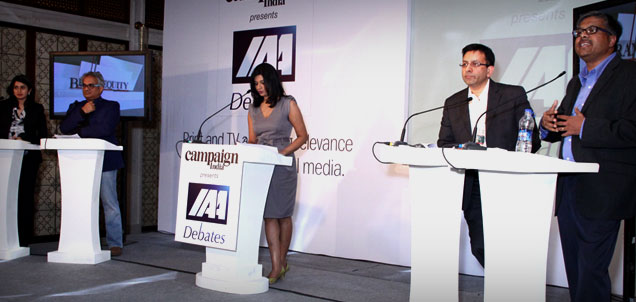
    To find out, the India chapter of IAA organised a debate in Mumbai on Monday (Feb 18) on whether television and print are losing relevance with the growth of digital in India. The debate series is being sponsored by Campaign India and the co-chairs of the IAA debates initiative are Partho Dasgupta and Neville Taraporewalla.


    Seasoned professionals Virginia Sharma of IBM and Mahesh Murthy of Pinstorm (and Seedfund) argued for the motion while Sanjay Gupta of Star TV and Arunabh Das Sharma of The Times of India group argued against the motion. The debate was moderated by Sonali Krishna, Anchor of Brand Equity show of ET Now. A cross-section of industry professionals were in attendance. As were some representatives from MxMIndia.

    We bring you some of the highlights of proceedings. Note, this is only a part of what was discussed.


    Mahesh Murthy: If you look at the Census report, if you see rural India there are just 33 percent homes that have television vis-a-vis 54 percent that have mobile phones. Overall if one compares, urban plus rural, TV used to take 32 percent penetration in 2001 which has grown and is at 47 percent at the moment. But mobile has grown from 9 percent in 2001 to 56 percent today. Mobile today is 24 percent larger in Indian households especially rural where the number is about 50 percent more.

    If you look at the numbers further, television has about 111 million viewers whereas mobile has about 133 million users – which further consist of 400 million users of SMS, 900 million SIM cards, etc. When one compares the publication number of The Times of India that is at 3-4 million which is dwarfed by 18 million users of Facebook every day in India.

    If you look from the consumer’s POV the three most desired audiences from an advertiser’s perspective is the 15-24 yr-old youth that barely reads a paper or watches TV and is highly digital-savvy; 25-34 yr-old females – Facebook alone has 11 million of those and I do not think any other medium in India can give you that kind of access to this age group; and finally 35+ age group – it will be hard-pressed to reach a CEO today as long as he is on his tablet or i-Pad or email, etc.

    When we move on to the advertisers, all of two years ago digital was all of two percent of the ad pie which has now become about 8.5 percent, meaning that digital has grown by 400 percent while the share of television or print has gone down.

    If you look at how digital has been explored by other people like politicians who have more than 200 people to handle just the digital medium, which I do not think is the case with other media. Even when one looks at the credibility factor, Nielsen states that the most credible medium is word-of-mouth, followed by what strangers write online followed by what is written on websites and then comes print.

    So what we are seeing is that print and television are not going zero; while they still have relevance they are losing their relevance because of the advent of digital. I’d like to end by requesting each one to ask themselves as to where do you see yourself in the future – whether five years from now you’ll be seeking a job in a company that does not do digital. The honest answer will decide where your preferences will skew towards the end of this discussion.


    Arunabh Das Sharma: I’d like to begin by saying that what we are discussing here is relevance. Is it about ad dollars; is it about ‘x’ percent more mobile penetration or is it about what these media have stood for the longest time – which is curated content. What digital has done is created a proliferation of choice and when that happens big becomes bigger. In such a situation everything grows. I’d like to share here an example of how the growth of social media has fuelled the growth of television and print and how they the two mediums are getting healthier now that the investment in content is becoming stronger and stronger.

    In the 1950s, it was said that radio was going to kill the medium of print and was followed in the 1970s where it was said that television would kill the medium of radio… none of that happened. There is a reason why different media play different roles in our lives. A recent study by research firm Ipsos talks about what are the global rules that different screens play in your life. So while the mobile screen is a lover, the computer screen is a sage while the tablet is a wizard but the fact of the matter is that you need a lover, wizard and a sage; the fact of the matter is that every medium has a special role to play and we ourselves will be very myopic if we assume that television is linked to a cathode ray tube or that a newspaper is linked to a piece of paper.


    Virginia Sharma: Is your motion that TV and print continue to be relevant or that they are growing in relevance?


    Arunabh Das Sharma: I think the topic needs to be redefined whether print and TV are losing relevance but whether digital will ever gain relevance? In fact I’d like to say here that 2012 saw some of the biggest gains in stock prices of print companies because of one aspect – they had figured out their business model. The issue was that in 1992 when the readership started dropping they had to figure out a business model which wasn’t to be.


    Virginia: Do you have any comparable stats to validate your observation?


    Arunabh: It doesn’t even show on the scale for India. I’d like to add here that a lot of people wouldn’t know about this but a gentleman in the US just brought a bunch of regional newspapers with the assumption that the growth of print will happen through hyper-local and regional papers, which is exactly what will happen here too.


    Virginia Sharma: I’d like to start off by answering the question, ‘What does relevance mean?’ In today’s world relevance means business impact. The fact that it was said that digital does provide a platform of choice is correct; also the fact that social as a medium has grown is also correct.


    Arunabh: If relevance is defined as business impact, are we talking the same scale in that sense in India?


    Virginia: What I am saying is business relevance to advertising agencies…


    Arunabh: But I thought it was also about ad dollars…


    Virginia: No ad dollars is about expense. Business relevance is about business outcomes and about what the CEO measures, particularly the RoI. To quote numbers from a CEO study that was conducted, the use of social and web from 11 percent to 48 percent for social and from 37 to 49 percent for the web in the primary way to interact with the customers.  That for me is business impact and what the boss sees this as a way to engage the audience. What do most brands like Coca Cola, Pepsi, ICICI, HDFC etc have in common – it’s their innate belief that this medium is relevant and their investment in this medium is not just what the ad agency says it is.

    So, two big cases. First, the primary metric of the CEO study for marketers for success is RoI. You can measure RoI based on the ability to understand customers and target them with what they need. You can only measure digital better than you can measure print and television. Therefore the future for marketing where RoI is concerned as a primary measure for success has got to be digital if you want to make the case.


    Arunabh: I think the challenge is not about measurement but about conversion and that’s how a medium works. Measurement that you are saying is how many people have seen the ad not how many people because they have seen the ad went and watched something.


    Virginia: Measurement for me is actually measuring consumer behaviour and doing it successfully. To sum up, the business case is very simple, if you want a good RoI you have to use digital as a key medium to be able to feature consumers and that ultimately is going to be key.


    Sanjay Gupta: When I started working 20 years ago I thought print is going to die and today print is about Rs 14,000 crore from Rs 6,500 crore it was a decade ago. For television the growth has been from 5,000 crore to 16,000 crore. The key points that I’d like to present here are that firstly, consumers love television and it is thriving. The thing is that if you find something relevant you spend time with it. Around 700 million people in this country spend three hours every day watching TV. When they start it is for two hours, which then picks up to three hours. Also in the last one year, 70 million new people have started watching television. That’s more than the number of people who watch digital in any given point in a month. The same is the case in developed countries like the UK and the US where the time spent is around 4-5 hours every day.


    The other thing is that big is becoming bigger on television. The belief is that proliferation of choice will make users fragment. A recent example I’d like to share is of the movie ‘Dabangg’ which was watched by 150 million people. Even shows like Balika Vadhu etc aggregate about 40-50 million viewers in that half an hour. The point I’d like to make is that social media is actually helping the business become bigger and better. The people fall in love with our characters and they do that only on television and not anywhere else.


    Mahesh: So essentially your point is that even TV uses digital…


    Sanjay: TV does use digital. To quote an example our show Satyamev Jayate was the biggest show that we did and we used the channel of social media to make people come and watch it. It was in fact the highest trending topic on Twitter. So what I am saying is that digital is driving our business to do better.


    Virginia: Is it content that drives behaviour and interest or is it the medium?


    Sanjay: It is content. To cite figures, in the UK people watch about 80 minutes of video and out of that 80 percent is either pornography or YouTube – that’s the power of that medium there. Whereas if you provide good content it makes the viewer keep coming back to watch more and more.


    As to what is changing, digitization is changing the way television companies do business. Till now only 20 percent of the revenues from digital medium came to the broadcaster but the transparency with DTH that number is moving from 20 to 100 percent. So subscription revenues of TV companies have grown five times and what does it give us – the power to invest in content. That is what will make it even more relevant in the future.


    Murthy: So your point is that television is using DTH or rather digital to deliver itself to homes?


    Sanjay Gupta: The point I am making is that the medium is powerful, profitable and is growing. The fact is that people will not consume any one or two mediums, they will consume all the mediums. The question is: how do we use the power of each of these mediums as they have to be relevant.  So print and TV will not lose their relevance they will continue to grow. The real question is that we need content aggregators and devices. Digital as a medium is just an aggregator of content and fundamentally the question we need to answer is how meaningful can this content get on the medium if it has to grow even further.


    Arunabh: Statistics do give us a picture. The fact of the matter is that both these media are huge and growing. If they were not then we could have turned around and said that it is not but like all new media they are finding newer ways – whether through a screen, a mobile, an app – of growing the medium. We are not here to debate whether one medium is better than the other, the fact is that we as consumers love to consume media and do it the way we want to. It is not about whether x, y or z is losing relevance, the fact is it is bigger and it is growing. In fact the next round of growth is already visible to us – it is coming from regional markets. Because of our infrastructural issues it will take digital some time to pick up speed but until such time our friends in the digital world would do really well to figure out what kind of content creates stickiness and what kind of content keeps readers going for 175 years. The day one of these digital mediums complete a 175 years in the form and fashion from what they started then we can talk about it further.


    Virginia: I think the four of us together have made a very compelling case for the growing relevance of digital and that it is powerful, profitable and here to stay. Such a combination would make this medium indeed relevant. Print and TV is going digital, decision-makers are going digital, politicians are going digital… the big question is, which side do you want to sit on? And no, digital does not want to be the medium it was 175 years ago, it wants to keep up with the times as well as the generation it is catering to and it will constantly evolve and is eager to change. It will make money regardless of the shape it will take. The question is, are you ready for the future – digital?


    The debate was won by the team against the motion. Before the debate started, 44 people from the audience were against the motion and 31 were for it. After the debate ended, the numbers were 42 against and 34 for.

  • Vh1 India and Hungama launch app for Facebook

    By A Correspondent


    Vh1 has announced its entry into the digital space with the launch of a new generation app, Vh1 Pulse. The app will enable fans to be in sync with their favourite tracks, any time of the day.


    Powered by Hungama.com, Vh1 Pulse is a music streaming application on Facebook which will enable over 1.7 million fans of the channel to listen to Vh1’s picks of the best international music.


    On the application, all songs will be picked by Vh1 and fans can listen to the playlist specially created which includes the best of all English music.


    Speaking about the new app, Ferzad Palia, Senior Vice President & GM – English Entertainment, Viacom18 Media Pvt. Ltd. said, “With a fan base of nearly 2 million ardent music lovers, this addition to the Vh1 India Facebook page is part of our philosophy of ‘Vh1 Everywhere’.”


    Siddhartha Roy

    Siddhartha Roy, COO – Consumer Business & Allied Services, Hungama Digital Media Entertainment, said, “Social communities are the new media real estate for brands where they can increase interaction and engagement with their consumers. There is an increasing demand for international music and Hungama is committed at satisfying this need by powering this service via its platform and content.”


  • One97 expands board; appoints CFO

    By A Correspondent


    Mobile-Internet company One97 Communications announced expansion of its key finance leadership. Raj Ahuja will be the new Chief Financial Officer and Vivek N Gour will join as Independent Board Director. Mr Ahuja comes to One97 from Star India where he was Executive Vice President of Finance. With over 21 years in the industry, he has been General Manager Business Finance with Wipro and Director, Finance & Operations at NXP.


    Mr Ahuja said, “I am excited to join the executive team at One97 that has been so smart and financially savvy with its operations. I am impressed by the team’s dedication growth and customer focus. I look forward to help driving and developing One97’s business.” He has a Bachelor of Commerce degree from Sri Ram College of Commerce and holds ICMA of the Institute of Cost and Works Accountants of India-ICWAI and FCA of The Institute of Chartered Accountants of India.


    Nasdaq-listed MakeMyTrip’s board member, Vivek N. Gour’s appointment brings the number of board members to six for One97. In addition, he will be the Chairman of the company’s Audit Committee. Mr Gour is currently the Managing Director of Air Works, an Aviation MRO Refinishing Services. Prior to that Gour was Chief Financial Officer of NYSE listed Genpact Limited where he played an integral role in transforming Genpact from a captive unit of GE into a highly profitable public company.


    “I am honoured to join the One97 board and work with this exceptional team,” commented Mr Gour adding, “Over the years, I have come to know and admire One97’s management team. I am confident they have the leadership and vision to ensure One97’s success.” He is an MBA from the Faculty of Management Studies, University of Delhi, and holds a Bachelor of Commerce Degree from Sydenham College, University of Bombay.


    Vijay Shekhar Sharma, Chairman and Managing Director of One97 said, “With the scale that we are aiming, the addition of Raj and Vivek leadership brings a great strength to us. The Mobile Internet business opportunity is immense and their experience will go long way in the creation of a great company.”


  • BoxTV inks deals with Sony Pictures Television and Disney UTV

    By A Correspondent


    BoxTV has announced content agreement with Sony Pictures Television and Disney UTV to offer premium titles on its video streaming service. Launched by Times Internet, BoxTV is a premium video service that offers movies, TV shows, short films, documentaries and much more, which users can watch on a regular web browser or through the device of their choice.


    To this end, BoxTV has also partnered with UTV Motion Pictures, Shemaroo Entertainment Rajshri Entertainment and Everymedia Technologies for Bollywood and Regional content in addition to their agreements with major International studios; Sony Pictures Television, Disney UTV and Celestial Entertainment for premium Hollywood content.


    Angel Orengo, Executive Vice President, Distribution, Asia Pacific from Sony pictures Television said, “We are happy to offer some of our premium titles on BoxTV’s on demand service. The Indian digital media industry has grown rapidly in the last few years and we support their efforts to launch this service and another exciting medium for content consumption in this evolving digital landscape.”


    We are excited to offer some of our best content from ABC Studios, Disney UTV Pixar, Disney UTV and Disney UTV Studios to the consumer at one destination. We believe that Box TV will be a great platform for us to showcase our wide breadth of entertaining and world class content,” said Amrita Pandey, Executive Director – Syndication, International Distribution & Disney UTV Media Distribution, Studios, Disney UTV. Satyan Gajwani, CEO of Times Internet Ltd, said, “We are very excited about the agreements we have forged with premium International studios. BoxTV is a one-stop source for all video entertainment and we strive to consistently deliver greater value to our customers by bringing the best anytime, anywhere entertainment on multiple platforms. With these partnerships, we provide our users access to a vast content library of popular choices to watch.”


    The service will be available across iPhone, iPad, Android phones and tablets; Kindle Fire, EvoTV, Woxi Pod and Roku. Apps for Windows 8, J2ME and Blackberry platforms are currently in the pipeline.