Category: Digital

  • Is the Indian government right in blocking the digital media?


    By Ananya Saha and Robin Thomas


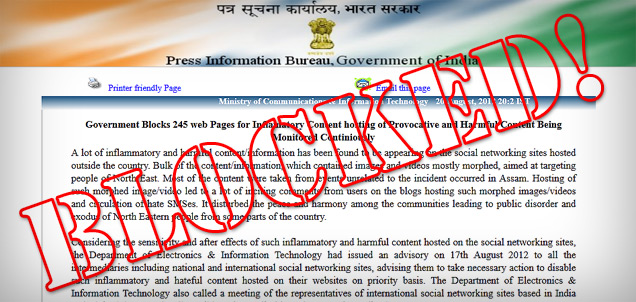
    In the recent wake of violence and riots in Assam, and against north-eastern Indians, the government ordered a ban on bulk SMS and blocked access to over 200 webpages. Even as these recent moves might seem to be curtailing freedom of expression, and have received mixed responses from the industry, the spotlight is now on internet freedom and content regulation.

     

    Sidharth Mishra

    Sidharth Mishra, Consulting Editor, Millennium Post & President, Centre for Reforms, Development and Justice said, “This is a kneejerk reaction by the government which completely failed to precede what happened with the North East residents. The government is trying to cover up its failure by indulging into such harsh measures on websites. I am not against any monitoring by the government but, there is a difference between monitoring and censorship. The drawbacks of social media domain can be stopped only by prevention and not by reactionary actions which we see from the government. If you ban one website another one will emerge and thus there will be no permanent solution to the problem. The government must therefore be pro-active and keep a vigil on these issues and then take necessary steps as and when required, rather than just putting a blanket ban.”


    As morphed images and hate messages targeted towards a certain community spread like wildfire, the Indian government is trying to tighten its noose on social media, and telecom operators. Twitter, Facebook and YouTube have been warned to pull off and remove the objectionable content by the Indian government, perhaps remembering Arab Spring that relied heavily on protests on the social media in the early stages and helped mobilise public opinion for several key social issues.


    LinkedIn, Yahoo!, and Sify did not participate in the story, but a Google spokesperson clarified, “We understand the gravity of the situation, strongly condemn acts of violence, and continue to work closely with relevant authorities. Content intended to incite violence, such as hate speech, is prohibited on Google products where we host content, including YouTube, Google+ and Blogger. We act quickly to remove such material flagged by our users. We also comply with valid legal requests from authorities wherever possible, consistent with our longstanding policy.”

     

    P N Vasanti

    But the damage has already been done, according to industry veterans. “The government should have taken steps like these earlier. Even though I am a strong supporter of freedom of internet and media, any instance that triggers communal violence should be strictly dealt with. I do not agree with censorship but penalising those who spread illegal, harmful and abusive material is important,” said P N Vasanti, Director, Centre for Media Studies.


    The government had initiated the Convergence Bill in 2000, with the objective of establishing a new “converged” regulatory framework to promote and develop the communications sector (including broadcasting, telecommunications and multimedia) in an environment of increasing convergence of technologies, services and service providers. In a multi-media environment when procedure of ownership and registration is as doubtful, the Bill would have helped in such a crisis. However, it failed to become operative.

     

    Pavan Duggal

    Pavan Duggal, Advocate, Supreme Court of India who specialises in the field of Cyberlaw, said, “The freedom of speech is relative, and is subject to relevant restriction. The govt is blocking out the content, which is anti-India. This is a legitimate step, but the govt needs to focus on the steps so that misuse of social media does not happen in the future. Only close to 200 websites have been blocked, which was a necessary step. The govt also needs to come up with specific rules for mobile operators, in time, so that the handheld tool is not misused.”


    Another industry analyst suggested that the government should plan long-term framework on the communication monitoring across the nation on the virtual and mobile platform to avoid similar circumstances in the future.

     

    BG Mahesh
    BG Mahesh

    BG Mahesh, Founder & MD, Greynium Information Technologies, opined, “SMS limit surely affects many but monitoring of social media, blogs has no effect on the majority as they are not doing anything anti-national. If my tweets are being read by the govt I am perfectly ok with it, after all it is in the public domain already. Free speech is a must but then people should not be posting anti-national content and spreading rumors. At the same time govt too should not be blocking content if it feels the policies are being criticized.”


    Giving a different perspective, Sanjay Aggarwal, CEO, Unicel Technologies, said, “What is effectively a blanket ban is actually not in the public interest. Banning communication systems in such a critical time can worsen the law-and-order situation rather than improving it. The lack of truthful news messages creates an information vacuum which increases anxiety and drives people even more toward unreliable rumors.

     

    Sanjay Aggarwal

    Despite the ban, person to person messaging is likely to continue as this is virtually impossible to control by the operators.” He further added, “Due to the SMS ban, as an industry we are looking at a 15-20% loss in this quarter, but considering the loss to our customers as well, businesses will take a hit in a multi-crore dimension and the numbers will be big. We have suffered bans in the past, and the financial impact is always large, but their effectiveness in achieving the government’s objectives is questionable.” There already exist solutions like BBM for Blackberry users and Nimbuzz, if the consumers prefer a multi-platform communication platform to avoid the SMS-related communication problems.


    Arunava Sinha, Head, ibnlive.com & cricketnext.com at Web 18, agreed. He said, “If the internet is the trigger, which I really doubt it is, then blocking the access to the websites is not the solution. It does not take much time to create another website. How many sites can only block? The solution is to act proactively, and do prompt campaigns and tell people not to believe in such messages.”


    Just as print media is responsible for it publishes, and follows self-regulation, is it time that internet be also regulated through the same protocols?


    “Any organization that wants to sustain itself will have to maintain some kind of self-regulation. They have to show some kind of responsibility towards the society. So, definitely self regulation is necessary and I am sure that most websites follow self regulation. At the same time some kind of government monitoring is also all right but, there must not be any censorship on the site or the internet,” said Mr Mishra.


     

  • Digital Literacy conclave by HT and Intel

    By A Correspondent


    With one of the key issues for India being how to integrate its citizens into an increasingly digital economy, Hindustan Times brought together a panel of experts from the government, private sector and non-profits at Digital Literacy conclave to discuss the topic ‘Digital Literacy – Keeping India Ahead in the Information Age’.


    Moderating the discussion at the conclave, Gautam Chikermane, Executive Editor (Business), Hindustan Times said, “Digital literacy is an essential but unexplored component of economic development and citizen empowerment in the 21st century. With this conclave, we hope to build the foundations upon which this idea can be built.”


    Shantanu Bhanja, Vice President Marketing, HT Media Ltd, on the objective of the conclave said, “The need of the hour is to make our country and its people abreast with the digitization that the world is undergoing today. As a newspaper working in the field of education and literary, this conclave is a great platform to bring all influencers and players in the ICT ecosystem together to drive the urgency of making India Digitally Literate and to overcome the digital divide.”


    Speaking at the conclave, Debjani Ghosh, Managing Director, Sales & Marketing Group, Intel South Asia said, “One of the biggest concerns facing us today is the lack of user awareness about what technology can do to help their lives. If used effectively, technology can play a huge role in driving personal growth, be it in developing job skills or providing easy access to quality education, healthcare and critical government services. Unfortunately a lot of Indian consumers are still not aware of how they can benefit from technology. Not only does this limit growth, but will significantly increase the problem of haves and have-nots in India. Digital literacy is essential along with technology access, broadband and local content for improving national competitiveness. We are happy that the entire ecosystem is coming together to put in place a Digital Literacy mission. The sustained focus by all of us on digital literacy awareness, education and training will help India take a lead in the global digital economy and help us maintain our competitiveness and also shape a technologically empowered society.”


    Panelists on the forum included Sachin Pilot, Minister of State Communications & Information Technology, Govt. of India, Debjani Ghosh, Managing Director, Sales & Marketing Group, Intel South Asia, Sanjay Kapoor, CEO, Airtel India & South Asia, Osama Manzar, Founder & Director, Digital Empowerment Foundation and Rajendra S Pawar, Chairman & Co-Founder, NIIT Group.


  • @dvantage Digital


    By Ravi Balakrishnan


    Never mind the famous introduction to Charles Dickens’ A Tale Of Two Cities; digital agencies today can afford to stop at ‘It was the best of times.’ Because, there has been no better time to be in this space. For one, marketers no longer need to be coaxed into going the digital route. Also unlike mainstream advertising, almost every new campaign or assignment has the scope for interesting, maybe even ground-breaking work; considering best practices are yet to be carved in stone. And finally it makes a lot of business sense. Through 2012, independents in this space both in India and overseas are being picked at a rapid clip and the people doing the picking are some of the biggest names in the marketing communications industry.


    The one player that’s yet to announce a key purchase so far, Omnicom, is said to be keenly watching the Indian market, with a representative visiting practically every month. An industry insider is confident of at least three more acquisitions being announced before the year is through.


    Amar Deep Singh

    Not bad at all considering that many of today’s hottest targets started life a little over a decade ago, as a ragtag bunch of entrepreneur driven specialist shops. Many of them began either before, during or immediately after the great dotcom bust of 2000. It seemed a quixotic endeavour. Through the early years, most mainstream advertising and media agencies opted to ignore the space entirely. Says Amar Deep Singh, CEO, Interactive Avenues, “Traditional agencies missed the bus while advertisers saw value in using digital media. They now find it easier to buy than to build. It’s a win-win for both, because it gives traditional agencies digital expertise and it helps digital agencies get scale.”


    Today, even as ‘old’ shops like Indigo Consulting and Hungama Digital Services get picked up by the likes of Leo Burnett and JWT, agencies and their holding companies are casting the net wider. While Ignitee which has survived two name changes and 12 years in the business is an obvious choice, even the three and a half year old 22 Feet which has worked on Titan Fastrack, Kingfisher and Lenovo is being approached. Brijesh Jacob, founder and director of 22 Feet, admits, “Every offer is tempting because it’s either an agency you adored growing up or someone that’s done awesome work.”


    CVL Srinivas

    In the fray are creative and media agencies, larger digital shops, holding companies and even IT firms. But among the first two, there’s a rivalry that’s as old as the days of unbundling. They have squabbled over who gets more face time with marketers and more recently over credits at award shows. And now, many senior practitioners on both sides are convinced that their firms are quite literally the best support system for a digital shop.


    Media agency heads often argue that considering digital is a measurable, accountable, result driven medium, what better partner than a business that concerns itself daily with these very issues? Says CVL Srinivas, chairman, SMG, “Media agencies are ahead of the curve when it comes to digital. We hear this from clients and not just agencies.” Sudha Natrajan, founder of media consultancy, TMC and a veteran of Lintas Initiative Media believes, “The lines between creative and content, and analytics to chase, understand and convert consumers, do not exist. The talent and understanding in a media agency is more apt to capitalise on this, rather than a creative agency. Creative agencies have stopped understanding media a while ago; some are making a feeble attempt to understand the digital medium, but are failing.”


    Sudha Natrajan

    The creative agencies on the other hand argue that in the absence of ideas and content, there’s unlikely to be any consumer response worth measuring. Says Arvind Sharma, chairman and CEO, India subcontinent, Leo Burnett, “Agencies produce TV commercials and hand these over to media agencies who release them. But if you need to manage content on a live basis, just handing it over is not the future.” He believes media agencies can possibly work only in the short run and on specific clients where the communication is less dynamic.


    Mr Sharma counters the media agency claim about being result driven with, “Human beings are persuaded by content. In a simple thing like door-to-door retail, change the message and the productivity levels are up from 20% to 80%. Around the world, who are the bigger winners of Effies, creative or media?” Madhukar Kamath, group CEO and managing director, DDB Mudra says a tad philosophically, “I disagree with the point of view saying either digital or activation should rest with a creative or media agency. It resides with whoever thinks like a full service agency; addressing brand issues.”


    Arvind Sharma

    While pretty much everyone is speaking (or has spoken to) everyone else, a pattern is emerging where the more content and social media driven digital agencies find a space within a creative network and the more result and search engine optimisation focused shops opt for media companies.


    It’s an arrangement that Atul Hegde, CEO, Ignitee finds essentially flawed: “They should be doing the opposite. Why shouldn’t a media agency acquire a strong creatively led agency? It will bring completely varied skill sets.” Some digital heads claim they don’t have a dog in the fight between creative and media. This is especially true since it’s quite impossible to go in for unbundling in digital. Says Chhaya Balachandran Aiyer, founder and managing director, BC Webwise, “It will have to be pure play; agencies are okay either continuing independently or merging with an existing digital arm.”


    Atul Hegde

    The agencies themselves have earned the right to be spoken to on their own terms. The offers are a lot less diffused than they used to be. While previous conversations were primarily about money, these days, companies attempt with varying degrees of success to draw a roadmap. And given how digital firms have grown in size and scale and the frequent inability of the acquirers getting richer, the founders can take pride in their creations continuing to exist as standalone brands for the foreseeable future.


    Says Vikas Tandon, CEO of Indigo Consulting, “Being part of Leo Burnett gives us a chance to be at the table when a strategy is formulated at the top management level.” And yet he argues, “It would be foolish to not leverage the equity of Indigo.”


    Chhaya Balachandran Aiyer

    Gulrez Alam, COO, Resultrix says “We are the leading buyer of Google in India and Performics is the biggest buyer of Google worldwide. We will be representing Performics in India.” However the name remains unchanged even post merger with the Publicis Groupe firm – Alam says the only addition will be the line ‘a Performics company.’


    There are others who have been in conversations for years and are yet to hear anything they really like. Mr Hegde admits, “There have been no compelling offers; no network that can add value to our growth plans. Being independent is our strength today, allowing us to work across agencies and brands. One of the biggest things about acquisitions is someone comes to you for what you are. Once they acquire you, they try to make you who they are.”


    Vikas Tandon

    Besides, there’s a bit of scepticism about what value an acquisition really brings to the table. An industry insider believes Webchutney is pretty much unchanged and the same applies to Quasar. For the moment though, it sure feels good to be wanted. And digital agencies with their PC, Mac and Tab saturated offices, internet meme based humour and boisterous geeky staff are the unlikely belles of the ball.


    Source: The Economic Times

    Copyright © 2012, Bennett, Coleman & Co. Ltd. All Rights Reserved


  • Resultrix appoints Tanmay Mohanty as COO – India

    By A Correspondent


    Resultrix – A Performics Company, India’s leading performance marketing agency, announced the appointment of Tanmay Mohanty as its Chief Operating Officer for Indian operations. Mr Mohanty will be directly reporting to Gulrez Alam, COO – Global, Resultrix.


    Mr Mohanty, with an extensive and diverse work experience of close to 14 years, has been a part of organisations of repute at the management level. As he joins Resultrix, he brings his vast experience in the field of Marketing, Advertising, Brand Management, Direct Sales, BTL, Strategic Account Management, Business Development, and Administration. Prior to joining Resultrix, he was the COO of Interactive Media And Communication Solutions Pvt. Ltd. (id8 Labs). He has earlier been associated with organizations like Jasubhai, Merchant Media, Dalal Street, and Urja Communications.


    Speaking on his appointment, Mr Mohanty said, “Resultrix has an excellent track record as a leading player in the search and interactive services industry. I look forward to working with the talented and dynamic team at Resultrix and being a part of the company’s future.”


    Mr Alam added, “It’s great to have Tanmay on board with Resultrix. We are looking at strengthening our leadership team at Resultrix as we continue with our focus on being at the forefront of the ever evolving digital and interactive services industry. Our clients will benefit from Tanmay’s vast professional expertise spanning across multiple industries. As Resultrix’s success story continues, Tanmay’s insights and leadership will give that extra fillip to take it to the next level.”


    Resultrix, founded in 2008, is a performance-based digital marketing agency, managing over 120 brands across multiple screens and mediums. Its bouquet of interactive services includes search engine marketing (SEM), search engine optimization (SEO), web design & development, web analytics, social media marketing & display advertising.


  • Backgrounder | Hemant Jain: What makes online travel so sought after?

    By Hemant Jain


    Back in the good’ol days, setting out on a vacation with family was not less than a whirlwind! Not only the options were scant but also the hassles of lack of hotels and commutation modes made it less alluring. But the phenomenon of tourism since 1950 has been remarkable in terms of growth, spread and diversification. The international tourist arrivals since then have grown from mere 25 million to reach 940 million in 2010. The fast growth and spread has not only resulted the globalization of people’s movements as never before but has also contributed in creating a vibrant industry and opportunities for millions of people. Little wonder that almost 20 million people are employed in India’s tourism industry.

     

    So what are the factors that have triggered the era of consumerism in the travel industry?

    Advent of Low Cost airline- Earlier air travel was considered to burn a hole in a traveller’s pocket. But with the emergence of low cost airline in India in 2003, air travel, which was just a dream for a traveller with minimum resources, turned in to a possibility. This also opened up gates for many private players who offered better services to the consumers at competitive prices. This was one of the major revolution from a consumer’s point of view because it all together explored a new avenue of travel besides roads and railways.


    Increase in travel agencies: The Indian market was introduced to the concept of planning and booking travels in early 2000. The travel industry had not achieved momentum yet but there were surely some signs of hope. IRCTC (Indian Railway Catering and Tourism Corporation) had proven to be a success and had demonstrated that Indians were warming up to booking online and ready to pay a premium for convenience. There were a couple of websites that offered air tickets but none could comprehensively claim to cater to travel needs across categories. But Innovation and differentiation are key drivers of growth today. While OTAs have gone beyond online travel to provide end-to-end travel and holiday planning solutions, innovation is the need of the hour. Cross selling of products is on the rise. Again OTAs have to engage with customers and listen to what they have to say. There is a need to make inroads into the customers’ life, without being intrusive and understand their needs better.


    Promotion by Government: The government’s ‘Incredible India campaign’ for boosting India’s image as a global destination has promoted tourism in a big way. It has promoted the destinations in India and abroad in countries like UK, Canada, Singapore, Malaysia, Russia, Australia and New Zealand. This concerted effort has not only attracted a consumer’s attention at destination in India like Leh, Kerala and Sikkim et al but also towards international destinations. Today, the top International destinations are UK, Pataya, Singapore. Moreover the involvement of state government in projecting their state as a favourable tourist destination has also escalated the inbound tourism. States like Gujarat, Rajasthan, Kashmir and Chhattisgarh et al spends millions on their marketing and advertising efforts in a year.


    Boom in Online Travel Industry: Initially online travel was marked by several challenges. Low Internet penetration was the major one. Another challenge was habit. The habit of buying an air ticket was through a travel agent and booking a hotel room was always through calling the hotel directly or by showing up. So it was a habit change that OTAs were dealing with and changing a habit obviously takes a long time. Also, there was limited confidence on online transactions. But eventually, online travel industry grew impressively. The travel boom, emergence of low cost carriers, proliferation of Internet and the growing acceptance of e-commerce, are key factors that have contributed to the emergence of this sector. The online travel industry is certainly marked for growth in coming years. The best is yet to come for the sector with broadband penetration just starting to take off. India is all set to become among the top three online travel markets in the world over the next decade.


    Increase in the No. of Woman Traveller: A study by Nielsen in 2011 tags women as the key decision makers for around 85% of all consumer purchases including everything from autos to health care and this includes the selection of preferred holiday destination also.  The study also highlighted that around 91% of the female booked trips with their friends and only meagre 8% travelled with their families. Also, shopping as an activity is widely preferred by woman enabling them to travel at far-flung areas.


    Change in Travel accessories: It is believed that the travel accessories (be it suitcase, briefcase, bags or pouches et al) a person carries during his travel says a lot about his personality. Gone are the days of bulky, ugly suitcases that threw a major challenge to passengers in terms of its handling. Today on consumers demand there is a host of lightweight travel accessories in different sizes, shapes and colours available to choose from. While female travellers can pick from the range of unusual colour palette in luggage including pink, purple and yellow, the males on the other hand can look out for cleaner and organised travel gear. There’s also a lot of innovation happening on other travel accessories in general beyond luggage. Like a travel Toothbrush that is a toothbrush and toothpaste rolled into one making a minute but simple travel accessory.


    Spurt of technological gadgets: Ever wondered what was it like to travel before the age of technology precisely gadgets like cell phones, laptops, e-Books, Music Players? Quite unimaginable, huh! Earlier books were the only tool that was used to pass away the time during long and tedious journey hours. And on top of it, a letter was the only medium to communicate to your near and dear ones about your safety arrival on a foreign land. But today, thanks to technological advancement there is a pool of gadgets that one carries during his travel. Gadgets like cell phones, laptops are not only a great mode of communication but are also used professionally. Besides gadgets like music players, e-books, cameras and all are a great source of entertainment for a person on a trip.


    The Social Media Influence: The social media plays a big role in travel. Earlier consumers use to book through travel agents. Now people use travel sites Cleartrip.com, makemytrip.com among many others. Sites like Facebook, Twitter are big influencers for travel. People post comments on travel sites, research on Google about place they visiting. Travelling in groups has been promoted in big way by websites like Thomas Cook. Even when people visit the destination, Google maps play a big role. Even the Internet on mobiles play a big role and people don’t get stuck in midway. Seeing other friends posting pictures on Facebook influences travellers. Travel blogs play a big role in making the decision where to go for a holiday.


    New avenues of travel options: This is an emerging sector with consumers moving towards more advanced forms of travel options including a helicopter, yatch or a cruise. Although the primary reason for its access remains cost but with the increasing purchasing power of the consumer’s the newer forms of travelling are gaining momentum in a big way.


    Undoubtedly there has been a magnum of changes in the travel industry over the past few years, but there is more to look forward.  According to a travel research firm, Indian travel industry is expected to grow by13% to $23 billion by next year. And by the year 2014, Indian tourism industry will contribute atleast US$16.3 billion.  The $4 billion online business is also expected to grow faster, at 28% to touch $7 billion. Now there are number of factors that can augment this phenomenal growth in coming times. Mobile penetration has increased considerable in the past few years and people are accessing the internet through their phones. Exploiting the mobile platform hence becomes very essential and going forward we can expect an influx of applications for mobiles. Application like Zomato.com, Yatra.com have already paved a way for the increased use of mobile platform for consumers to plan their leisure activities. Be it a dine out with family or planning a vacation abroad, the online travel industry is certainly marked for growth in coming years, especially through mobile platform. The best is yet to come for the sector with broadband penetration just starting to take off.


    India is all set to become among the top three online travel markets in the world over the next decade. By 2015, it’s estimated that shoppers from around the world will spend about $119 billion on goods and services bought via mobile phones, according to a study by ABI Research. Also identification of new growth sector like medical tourism is pivotal as the number of medical tourist arrival within few years is expected to cross two millions mark. So pack your bags and set out for your dream destination as the travel industry is witnessing a change that has never happened before and in a good way!


    Hemant Jain is Senior Vice President & Head – Domestic Business @ Hungama Mobile


  • 25% Indian travellers change plans post booking confirmation: Goibibo.com

    By A Correspondent


    Travel website Goibibo.com has found that 25 per cent of travellers change their travel plans after booking. The website tracked the trend of travellers on their frequency of change in their plans, based on insight from its buyers’ data. The report adds that 20 per cent more women change their travel plans compared to men.

     

    According to the research report, the top routes for travel plan changes have been found to be Bengaluru-Delhi and vice versa followed by Mumbai-Delhi. The top five reasons are said to be: ‘Change in business travel plans’, Extension of stay at destination’, ‘Travellers’ health issues’, ‘Personal or family emergency’ and ‘Change in flight timings’ by the airlines. Women have been found to change their travel plans more frequently than men. It has also been seen that Bengaluru has the highest number of women travellers followed by Mumbai, Hyderabad and Delhi.


    Ashish Kashyap, Group CEO, ibibo Web said, “At Goibibo.com we are obsessed with data and analytics and thereby leveraging the same to drive a superior user experience. We publish travel insights based on real data that we study every hour of the day.  With the insights of large volume of changes in a travelers plan, Goibibo has enabled the traveler to access the fastest re-scheduling, cancellation and refund processes.”


    Goibibo.com, which was launched in September 2009, is a part of the MIH India Group. It enables travellers to buy air, bus tickets, hotels and holidays.


  • Dhingana launches ad platform, Gokul Rajaram is advisor

    By A Correspondent


    Dhingana (www.dhingana.com), a leading streaming service for Indian music, has announced the launch of its immersive advertising platform to help brands reach a fast-growing and high-grossing demographic: the Indian population around the world. As part of this initiative, the company has named Gokul Rajaram, Facebook’s Product Director of Advertising and the creator of Google’s AdSense, to its advisory board.


    “Globally, over 11 million Indian music fans listen to their favourite music on Dhingana. We believe that this is a great motivation for brands looking at innovative avenues to reach out to them. This led us to develop a highly intuitive advertising platform,” said Snehal Shinde, CEO of Dhingana.


    “We’re thrilled to have Gokul on board,” said Swapnil Shinde, COO of Dhingana. “Gokul has extensive experience in creating user-friendly and highly profitable experiences for social and mobile platforms.” Shinde added, “Gokul’s experience will be invaluable as we expand the service to reach more users.”


    Prior to joining Facebook, Mr Rajaram spent 5 years as the Product Management Director of Google’s Adsense. He also ran a startup, Chai Labs, that was later bought out by Facebook.


    According to Mr Rajaram, “The streaming market in India is growing at an unprecedented rate, offering myriad opportunities to consumers and brands. With more than 7 million active users on iOS, Android, BlackBerry, and Nokia devices, Dhingana has also been quick in tapping the huge impact that mobile is making in India”.


    Dhingana expects the advertising platform to become a “must buy” for advertisers such as movie production studios, music labels, independent musicians, mobile carriers, and other brands that want to reach a young, engaged global audience. Dhingana is offering a number of ad formats and can help target ads based on factors like music genre, platform, geo-location, and audience demographics.


    As part of beta testing of the platform, Dhingana ran a campaign for the film Cocktail, driving 100,000 audio streams of the ad in the first 18 hours, and more than 1 million streams in the first five days.


  • Web firms fully cooperating with govt: IAMAI

    By A Correspondent


    Following the government’s clampdown on SMSes, social media and its concerns about the misuse of this media by miscreants or anti social elements, the Internet And Mobile Association of India (IAMAI) also urged authorities and citizens to use online tools positively for spreading true and useful information in the current situation.


    “Our members believe that hate speech and other illegal content should be removed when duly notified in accordance with Indian laws. All member companies have been responding expeditiously to requests from various government and law enforcement agencies,” the IAMAI said


    “All our members have been cooperating in the best possible manner to stave off the current situation since last week and we will continue to do so,” stated Dr Subho Ray, President of IAMAI. He further added that any government order to be effective should be based on the present context and not a general order to remove un-contextual or legal content.


    In a related development, the association also welcomed the notification of the government’s policy paper titled “Framework & Guidelines for Use of Social Media for Government Organisations”. With the formal adoption of this paper, the government is now said to be prepared to use social media. It may be recalled that the Department of Electronics and Information Technology has been working on this policy since September 2011 and the final version has emerged after wide consultations and an Open House discussion led by the Honourable Union Minister of Communications and IT.


    The current situation drives home the importance of this paper. It states, “One of the big challenges for government is to avoid propagation of unverified facts and frivolous misleading rumours with respect to government policies. Government must have presence on these platforms to counter such perceptions to present the facts to enable informed opinion making by the populace”.


  • Digital, the efficient earner: B N Chandrakanth, Theorem

    By Robin Thomas


    Theorem, a technology company focused on digital marketing or online media operations, started at a mere number of four, and today has over 1000 people  with offices in the Americas, Asia Pacific, Europe and the Middle East. The company provides a broad suite of digital solutions in areas ranging from creative services and media operations to reporting and analytical services. In conversation with MxMIndia, Chandrakanth B N, Co-Founder and Managing Director, Theorem India, spoke at length about the company’s journey over the last ten years since its foundation in 2002. He also spoke about his India plans, specifically post Rs 100 crore investments in India, and much more.
     

    Q: From mere 4 people in the organisation, today Theorem is said to be more than a 1000 in just 10 years, over 150 clients… What are the key drivers that have led to this success?

    We are more of a technology player in this domain. One of the biggest growth drivers for Theorem has been the growth of the digital media over the last 10 years. Even in mature markets like the US, the overall ad spends going to digital was only 7 percent; the digital ad pie has of course doubled over the years. We set up our company with the vision to focus on the digital media operations domain. What we brought was the strength of the strong Indian IT service business ie efficiency and technical knowledge, while keeping the costs low for our clients. This became very attractive to our clients in the west, and so our team achieved better quality service delivery than their own teams based in New York or San Francisco etc. Hence, it was very attractive for companies in the digital media space whether it is an agency or publishers or technology companies to work with us because we brought in both domain expertise plus we brought in the scales of operations and very importantly the technical knowhow and skills required. These are some of the factors that I believe helped us grow in the last 10 years.


    Q: What would you say are some of the learnings so far in the last 10 years?

    Digital offers the most cost-effective way of communicating or advertising. Not just cost-effective, but it is very effective in terms of reach as well. When we started, display and email were two big key drivers for digital marketing. Right after we started, Google took off, which basically brought in search marketing and so search became a key element of the digital marketing eco-system. We adapted to these changes and then obviously social media came along and mobile came along. So we have seen an evolution of different media vehicles within the digital sphere. We also saw a lot of technological innovation happen within this domain. The evolution of this space has been very fast and there has been so much technology coming in, and there has been much more efficiency too.


    Q: So, has there been a change in the way the marketers have approached digital media over the years?

    Absolutely. Since we have largely worked with western markets, we have definitely seen that change wherein marketers or brands are adapting to digital a lot more. We can see that in the numbers ie doubling of the digital ad spends from 7 to 14 percent. There is a lot more awareness about the effectiveness of digital advertising in the western markets and marketers are also a lot more demanding as far as their requirements from the media are concerned. It is a fairly mature market today.


    India on the other hand is still an evolving market. Marketers here need a lot more education to understand the benefits of the digital media, its effectiveness in delivering better ROIs, how digital is going to be different from the traditional media, and so on… So, there is still a fair bit of education that is required. We are seeing changes and I believe a company like ours can play a huge role in educating the Indian marketer. I still believe that there is a lot to be done in the Indian market.


    Q: What are your India-specific plans? Theorem will be investing Rs 100 crore in India over the next 3-4 years… What is the nature of these investments?

    We have a large facility and teams based out of India, supporting our global clients right now and so we are looking at expanding on that. In Mysore we have our own campus and we are looking at expanding that. More importantly though we are looking at India as a market and how we can take our domain expertise and add value as opposed to being a large-scale IT support organization. We are also trying to be in the forefront of the marketing itself and help with more innovation. So, yes in the next four to five years we are looking to expand our operations from both facilities and team perspective which is potentially a Rs 100 crore investment.


    Q: You have two offices in India, Mysore and Bangalore… Any expansion plans within India?

    Yes, as the industry evolves further this is definitely a possibility. It is nevertheless early years for us, but we are definitely looking at probably newer cities, newer regions. The operation centers are in Bangalore and Mysore right now so that may continue to grow in these regions but, if we see the need we may even look at other regions.


    Traditionally US has always been a very large market for us, UK would be the next largest and then Europe but, where we are really seeing growth is in regions like Australia and Middle East. In India we have to do a lot of work in terms of creating solutions and that is what we are working on right now. India as a market is very interesting for us, and we are definitely seeing growth in some of the non traditional markets as well.


    Q: What is the business model you follow? Which of your services bring bigger share of revenue – creatives, media operations, analytics, consulting? Any newer services we would see you introduce this year or in the near future?

    Right now we are an IT services company supporting the digital marketing world. Largely we provide experienced or trained resources to support online media operations. So, this is really our business model, it is a traditional IT services model but, then we are obviously trying to move up the value chain and provide more high-end services for some of the local markets.


    Our revenues are spread evenly across our services, our media operations have been a big portion of our business and all the other services are also growing quickly as well. We are working on some new solutions and products, a couple of which we will launch soon. Some time later this year we will be launching another product and some time next year we aim to bring in some more innovative solutions to the market.


    Q: What rich media services does Theorem provide?

    Theorem provides end-to-end rich media services including creative development, trafficking and QA (quality assurance), across a range of media including mobile, email, banner ads, landing pages and micro sites. Furthermore, our expertise spans technologies including MediaMind, DoubleClick Studio, Eyewonder, PointRoll, and Flashtalking among others. Theorem strength and key differentiation lies in its depth of knowledge and breadth of services in providing rich media QA that’s extremely complex and highly evolved. In fact, we are one of the very few firms globally that offer this service to our clients.


    Q: And what do you think are the biggest concerns or challenges that Indian markets face, as far as rich media ads are concerned?

    Bandwidth issues in India are a big concern as the internet infrastructure needs to mature a lot more for the mobile rich media ads to become more popular. I believe it has to evolve, the infrastructure needs to get better and I think once we see our infrastructure improve rich media ads will also get more popular.


    Q: We have been witnessing some consolidations in the digital industry, with a lot of mergers and acquisitions lately… What is your take on these developments? Good signs for the industry?


    I believe it is a sign of maturation for the digital industry in India. I personally think it is a good sign; there is a lot of focus on India. So, as the market matures, our internet infrastructure gets better, and we are able to convince the marketers that digital is a more effective medium for them to start leveraging. We have a huge youth population and they are all going to get on the internet and the easier it gets to log onto the internet, obviously the larger the population you will have to market to. Therefore all our tier II and tier III cities need to get better bandwidth and internet infrastructure.


    Q: And are we going to see Theorem too acquire some agencies soon …?

    Potentially yes. There is always a possibility of this as we grow …


    Q: What kind of impact did the global economic conditions have on your international and India business? Did it have any impact on the industry?

    Interestingly, we never saw never saw a slowdown in the last 10 years. In fact 2008-09 were one of the biggest growth years for us. During the slowdown we have been hiring and giving raises. So digital provides a cost-effective means of communication and advertising. During the years of slowdown more people look at cost benefits of digital advertising. Although the overall spends may shrink, the piece of the pie is definitely going to increase for digital during these times.


    Q: What are your growth targets and goals over the next one or two years?

    We are looking to double by the end of 2015…


  • Affle unveils integrated ad network for all smart screens

    By A Correspondent


    Affle, the digital media company, has announced the launch of Ripple – its rich media and video advertising network. With the growing convergence of connected devices (PC, Mobile, Tablet & Smart TV), Ripple is an integrated ad network that will offer cutting edge advertising solutions across all smart screens. Developed in-house by Affle, which enable it to deliver advertising contextual to the kind of video content being consumed thus making it significantly more engaging for users and valuable for advertisers and publishers.


    A recent consumer research commissioned by Affle conducted by IMRB revealed that Online Video advertising is almost 3 times more likely to get users to search for the product vs. regular TV advertising and is 2.7 times more effective for enhancing purchase consideration vs. TV advertising. Affle has been very encouraged by these findings and believes that the overall user and usage growth in the video internet market coupled with greater ad effectiveness on this medium will help grow this market substantially in months to come.


    Calling the new technology as smart media for smarter screens, Anuj Khanna Sohum, Founder and Chairman, Affle Group, said, “Three major consumer and technology trends are leading the digital revolution in developing markets – increased consumption of video and rich media over internet, greater penetration of mobile internet on smart devices, cheaper and faster access to connected wireless networks. Ripple is designed to leverage these significant trends with the aim to accelerate the digital revolution globally. Given our successful history and extensive experience, we have a comprehensive understanding of the needs of the consumers, publishers and advertisers. Our innovation on the Ripple platform enhances the consumer experience and engagement with rich media and that we believe will add significant value to all key stakeholders in the digital media ecosystem.”


    Ripple differentiates itself significantly from other ad networks by having an integrated platform for delivering intelligent advertising across all smart screens and through its array of innovations which make advertising more contextual and richer in experience.


    Anuj Kumar, Co-founder and CEO, Affle, said, “We strongly believe that effective advertising is one which is engaging and relevant for consumers. Over the last one year we have been doing a lot of product level R&D and user research to create the Ripple platform such that advertising delivered through it will reach the most relevant consumer, on the most premium content and at the most relevant context across all smart screens. I am extremely happy that a lot of those efforts have made us build a solid product which has already attracted top partners like Samsung, P&G, Star, Business Standard, Dainik Bhaskar, Beoscope, Bolanews, Sambawa and many more across key Asian markets.”


    “We have built some exciting innovations in Ripple like our new ad engagement unit ‘Storm’ which utilises image search, voice recognition, face detection like technologies to identify the most relevant context in the content, to help deliver the most meaningful advertising. Our tests on some of these innovations have been hugely successful and we have observed significant increases in user engagement levels through such formats versus the regular digital advertising formats. I am confident that once commercially available these would get a lot more advertisers and publishers to work with us. We are also working on a lot of other next generation innovations currently, as we strongly believe that a solid technology backbone for Ripple could help us significantly enhance digital advertising effectiveness and the overall market size,” Charles Yong, Chief Technology Officer (CTO), Affle, said.


  • Books & mobiles enter IAMAI’s monthly tracker

    By A Correspondent


    The Internet & Mobile Association of India (IAMAI) has released the ‘Internet Economy Watch’ for the month of July 2012. ‘Internet Economy Watch’ the monthly tracker by IAMAI, is based on absolute numbers captured from various relevant sites, encapsulates online usage for E-tailing, Online Travel and Vertical Classifieds.


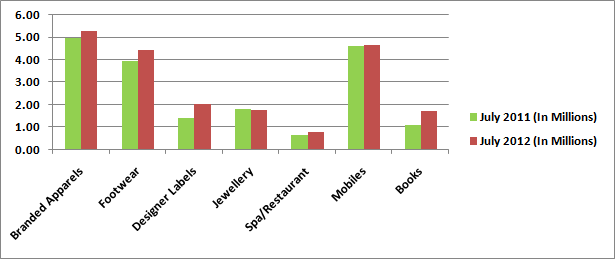
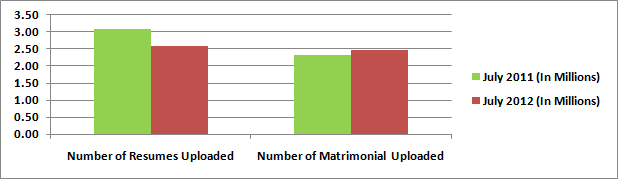
    In the July 2012 report, IAMAI has introduced two new categories – Mobiles and Books. Mobile has infact emerged as the second most popular category among the online consumers i.e. after Branded Apparels. With the exception of Jewellery, all the other e-commerce categories have shown growth in July 2012 as against July 2011. The number of resumes uploaded has continued to decline even in July 2012 as against the previous year whereas the number of matrimonial uploads continued to grow.


    So do these trends indicate that consumers in India are fast adapting to online buying? According to Dr Subho Ray, President, IAMAI, consumers have over the years have become more confident about purchasing online. “Definitely, Indian consumers over a period of time have become more confident about purchasing online. The figures from the Internet Economy Watch report for various that how internet savvy Indians have become and how comfortable and confident they are doing online transactions” he said.


    Speaking on the kind of response IAMAI has been receiving on the ‘Internet Economic Watch’ report, Dr Ray explained, “The Internet Economy Watch report has helped marketers and brands to map the consumer behaviour online and devise their digital strategy accordingly – to be in sync with the online behaviour of consumers. Having said this, we must also keep in mind that the ‘Internet Economy Watch’ report is at a nascent stage and will be of comprehensive use in the months to come.”


    In the months to come IAMAI not only aims to add more categories in the report but, also plans to make the monthly report more comprehensive by giving it a holistic view of usage of internet in India.


    Source: IAMAI/e-Commerce sites


    E-Commerce Sites:

    As per the data captured by the report there has been a significant increase in the online user visit to books and designer label category during July 2012 when compared to the numbers of last year. While 1.74 million hits were registered for the books segment in July 2012 as compared to 1.11 million hits in July 2011, designer label segment registered a y-o-y growth of 45 per cent with 2.04 million user visits in July 2012. It is in comparison to 1.41 million user visits in the corresponding period last year.


    While branded apparel and footwear segment witnessed a marginal rise, y-o-y growth of 6 percent and 12 percent respectively in number of online user visits in July 2012 as compared to July 2011, Jewellery category saw a decline from 1.84 million hits in July 2011 to 1.76 million hits in July 2012.


    Online Travel Portals:

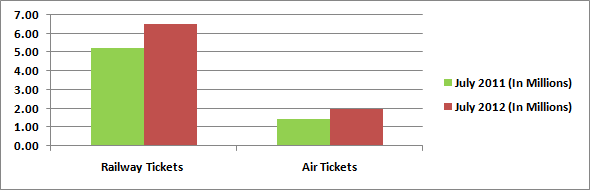
    In e-ticketing segment irctc.com clocked 6.53 million bookings in July 2012 as against 5.23 million in July 2011. The e-ticketing on airlines witnessed a y-o-y growth of 34% with 1.95 million bookings in July 2012 compared to 1.46 million in corresponding month last year.


    Source: IAMAI/ Online Travel Portals


    Verticals Classifieds:

    Data captured from prominent recruitment websites reveals that the number of resume uploads have gone down from 3.09 million in July 2011 to 2.60 million in July 2012. The matrimonial profile uploads has increased from 2.33 million in July 2011 to 2.47 million in July 2012.


    Source: IAMAI/ Vertical Classifieds


    The Internet and Mobile Association of India (IAMAI) is an association which is said to be representing the entire gamut of digital businesses in India. It was established in 2004 by the leading online publishers. IAMAI is also said to be the only professional industry body representing the online and mobile VAS industry in India.


  • I-Cube Report: Mobile crucial for rural India to access Net

    By A Correspondent


    There are about 38 million claimed internet users in rural India today. The penetration of claimed internet users in rural India has grown from 2.6 per cent in 2010 to 4.6 per cent in 2012, a CAGR of 73 per cent. On the other hand the penetration of active internet users has grown from 2.13 percent in 2010 to 3.7 percent in 2012. These are some of the findings from the latest I-Cube Report on ‘Internet in Rural India’ which was released by the Internet and Mobile Association of India (IAMAI) and IMRB.


    According to the report, the number of claimed internet users in rural India is expected to reach 45 million by December 2012. The report further states that mobile phones are fast emerging as an important point of internet access in rural India. As of June 2012, there were 3.6 Mn Mobile Internet Users in India, a growth of 7.2 times from 0.5 million in 2010.


    In a prepared statement, Dr Subho Ray, President of IAMAI stated, “This is just the tip of the iceberg, in the next two years, a combination of affordable smart phones, optic fibre backbone and local language content is likely to change the beat all projections of internet growth in rural areas.”


    Anurag Gupta, Founder and MD, DGM India explained the possible impact of a growing rural internet usage on digital advertising. He was also of the view that local language contents, hyper local information etc will lead to higher internet usage in rural India. “Internet penetration is growing in the urban areas and now it is percolating to the rural areas, this is very good news as it bridges the digital divide across the country and empowers dual India with a level playing field of knowledge and information. There will be a growth in digital spends as the users grow, so for the digital advertising industry this is a very heartening sign.”


    Usage of Indian language or local language content is also said to be on the rise. According to the report, the availability of content in local language encourages the rural user to go online and although 79 per cent of the users access content in English, 32 per cent of the users access content in Hindi.


    A whopping 42 per cent of the respondents said they were not aware of internet. This is also one of the reasons for the non-usage of the internet. As more and more people begin to use the internet, infrastructure facilities is also bound to grow. While more initiatives are certainly needed to build the internet infrastructure, evangalising of the medium to the rural masses is equally the need of the hour for further growth of the medium. In addition to this, local language content is also said to play a critical role in order to fuel the growth of internet usage in India.


    Point of Access:

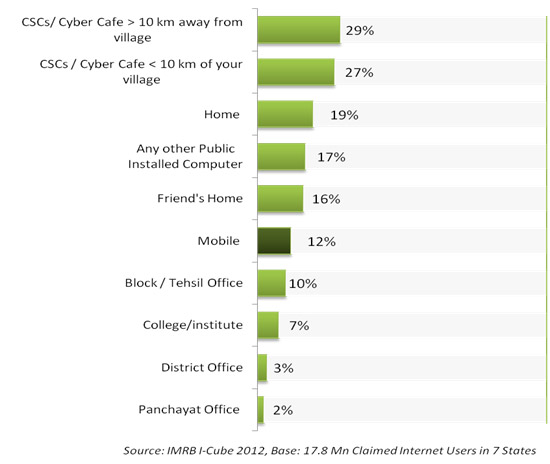
    One of the reasons for the increase in rural internet usage is probably because of the availability of cyber cafes and community service centres. Interestingly, majority of internet users in rural India (i.e. 57 per cent) have access to internet via cyber cafes and community service centres, only 19 per cent are said to have internet access at home and 12 per cent of the internet users access internet through their mobile phones.


    Purpose of Internet Access:

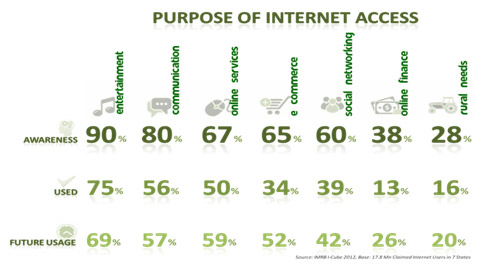
    Entertainment is the primary driver of internet use in rural India. 75 percent of rural users use internet for entertainment while 56 percent use it for communications Users like to access Music, Videos and Photos for entertainment.


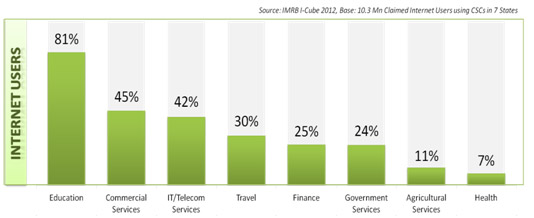
    There is a growing interest amongst the rural constituents seeking information on education. 81 percent of claimed internet users seek information pertaining to school / university and exam centres.


    Primary research is said to have been conducted in line with ‘I-Cube’ reports, an annual syndication of eTechnology Group, IMRB International. The syndicated research is based upon a primary research survey that interviewed about 15000 people from various age groups, across SECs and genders from the states of Assam, Maharashtra, Orissa, Tamil Nadu, Andhra Pradesh, Rajasthan and Uttar Pradesh.


    The Internet and Mobile Association of India (IAMAI) is an association which is said to be representing the entire gamut of digital businesses in India. It was established in 2004 by the leading online publishers. IAMAI is also said to be the only professional industry body representing the online and mobile VAS industry in India.