Category: Digital

  • Hungama Digital bags Best Campaign award at PMAA

    By A Correspondent


    Hungama Digital Media Entertainment Pvt Ltd has won four awards at The Promotion Marketing Awards of Asia (PMAA) – The Dragons of Asia 2012.


    Hungama Digital Media bagged the PMAA Dragons of Asia for ‘The Best Campaign from India’ for its Maruti Suzuki Cricket Stock Exchange campaign. It also bagged a Gold in ‘The Best Innovative concept’ category, two Silvers for ‘The Best Use of the Internet in a Promotion Marketing Campaign’ and ‘Best Use of Social Marketing in a Promotion Marketing Campaign’.


    Said Sunila Dhar, Deputy General Manager Media, Maruti Suzuki, “We are very happy to have got this award. Our association with CSX has been for two years and it is overwhelming to see the response to the game. It was based on the correct consumer insight of the passion for cricket, and the fact that we all have an opinion on the players and like to give a calculated opinion. Besides, the game has been made highly engaging by Hungama with many new segments in its second avatar.”


    Speaking to MxMIndia on the news, Siddhartha Roy, COO, Consumer Business & Allied Services, Hungama Digital Media Entertainment  said, “To be acknowledged by the PMAA for our campaigns is a great boost to the team’s morale, but it does raise the bar for them to keep creating successful, clutter breaking campaigns . Our Biggest winner – Maruti Suzuki Cricket Stock Exchange was a well thought out and superbly executed project by the team.” Speaking about the product, he added, “Cricket by far dominates and drives consumption on digital gaming, and with CSX we created a differentiated offering for consumers. With a trading game that is impacted by the real world cricketing news and stats, consumers have the opportunity to be more involved within the game. Ayaz Memon’s expertise ensures that users have the most accurate knowledge and info to make the trade on the stock exchange so as to maximise their earning.”


    Added Ms Niloufer Dundh, Head – Integrated Media, Hungama Digital Media Entertainment  said: “I am delighted, and thrilled with the awards we won, hats off to the team for creating Maruti Suzuki Cricket Stock Exchange campaign and for constantly improving and innovating. This is the second year we aired a campaign for this product, it was first launched during IPL 2011. I am also very happy because we had a brand like Maruti who supported us and had faith in us for these two years.”


    This year, the awards witnessed the introduction of the Dragons of Malaysia, in partnership with Marketing Magazine, as a plan to recognize more local agencies. All winning campaigns were then judged locally and then again in the Dragons of Asia, with 50 Gold, Silver and Bronze winners now taking part in the 2012 MAA Worldwide Globes.


    Awards won by Hungama at PMAA 2012 – The Dragons of Asia (Orders of Merit)


    The Dragons for the Best Campaigns in their Country

    Dragon Campaign Client
    Best InIndia Cricket Stock Exchange Maruti Suzuki


    Best Innovative Idea or Concept

    Dragon Campaign Client
    Gold Cricket Stock Exchange Maruti Suzuki


    Best Use of the Internet in a Promotion Marketing Campaign

    Dragon Campaign Client
    Silver Cricket Stock Exchange Maruti Suzuki


    Best Use of Social Marketing in a Promotion Marketing Campaign

    Dragon Campaign Client
    Silver 7 U Lemon Pattalum 7 UP


  • GullakMaster to launch in August

    By Tuhina Anand


    The enforcement of DND (Do Not Disturb) in many ways has spelt doom for SMS marketing in India. However, the same played a key role in the genesis of GullakMaster – a customer engagement platform for merchants. Still being piloted in Mumbai, GullakMaster is due to be launched in the last week of August in Mumbai followed by Bangalore and Pune and then in a span of six months time in Delhi and Ahmedabad.


    The venture is being spearheaded by Abhishek Dadoo who explained it as ‘intelligence on SMS’. Explaining the mobile advertising network, he said: “There is still a big market for SMS advertising which remains untapped because of the restriction. So what we are offering is on demand advertising. We ask permission and then sms promotions tailor made to the person’s requirement. We have TRAI approval and we do not fall into the DND list as we are not sending unsolicited messages.”


    So how does GullakMaster work? To start with when one visits a mall, if GullakMaster has an association there, then one could see information as one enters the mall. If interested, one could sms on the number given and get information on the deals available in the mall. Mr Dadoo explained that the concept can be taken beyond the malls; in fact anywhere that is close to the merchant’s location.


    For starters, the company will be advertising heavily in malls and outdoor locations like auto rickshaws to spread awareness of their offering. The same will be taken to the radio medium if their funding plan comes through.


    Mr Dadoo dubs his offering as providing a dashboard to the merchants to communicate to potential customers in an effective way. The company is a subsidiary of Dadoo Pvt Ltd, which is a Singapore-based company. The company is also eyeing the markets in Indonesia and Philippines.


  • InMobi acquires Metaflow Solutions

    By A Correspondent


    Bangalore-based mobile advertising network InMobi announced the acquisition of Metaflow Solutions, leaders in mobile app management and distribution solutions.


    Metaflow technology simplifies the global deployment and content management process for developers through its intelligent submission tools optimised through six years of operations, servicing the biggest publishers in the market.


    Metaflow’s management and distribution of content to consumer portals has consistently provided the fastest, lowest cost way to publish apps to hundreds of independent, OEM & operator app stores across the globe. “As a global leader in the mobile advertising space, InMobi is committed to growing the mobile ecosystem. Our acquisition of Metaflow Solutions will help us to continue to rapidly expand the distribution and monetisation of content for our developers and publisher partners,” said Naveen Tewari, Founder and CEO at InMobi.


    The Metaflow team will become an integral part of InMobi’s developer oriented efforts, led by Piyush Shah, VP and GM of Developer Platforms and Performance Advertising at InMobi. Mr Shah said: “With the recent acquisition of MMTG Labs, along with today’s acquisition of Metaflow, we will augment our value proposition by offering highly compelling distribution, monetisation, and engagement solutions to app developers globally.”


    “At Metaflow, our mission has been to simplify and unify the complex process surrounding content management and deployment of apps to a distributed and highly fragmented marketplace. The global reach and technology backbone provided by InMobi is hugely exciting for us. InMobi provides app developers with even greater opportunities to acquire millions of users and monetise their exciting apps,” said Charles McLeod, CEO at Metaflow Solutions.


    The Metaflow Solutions team will relocate to the new InMobi London office.


  • @FF12: No alternative to the cloud: Manish Agarwal

    By Rishi Vora


    Manish Agarwal, COO, Reliance Entertainment (Digital) spoke to MxM India on the sidelines of a session called “Digital Entertainment with Connected Devices and Cloud Based Services”, in which the panel consisted of Umang Bedi of Adobe Systems, Richard Craig McFeely of Tata Communications, Sameer Pitawala of UTV Interactive, Manish Agarwal, and Ravindra Velhal of Intel.


    Takeaway points from the session

    Cloud technology is all about providing an experience to the consumer. That’s one thing. The second thing is, there is no alternative for any service providers to not to go to the cloud. There is no choice to anyone; everybody has to go to the cloud. The question is the benefit of the cloud and the extent of monetization that can happen on the cloud will be limited to the extent of infrastructure investments. So, the key message is that the cloud is a reality – everybody has to work around it, be it the producer or a retailer like Big Flix or a content aggregator…


    The question is when can you really monetize and how can you provide the best consumer experience.


    [youtube width=”400″ height=”250″]http://www.youtube.com/watch?v=sSJUNAh1X8E[/youtube]

    Video By Shruti Pushkarna

    How does Reliance use cloud technology for the services it offers?

    If you look at Big Flix, all the content user information is on the cloud. And we’re already kind of using that piece. That is the only way we can provide a seamless experience across devices – across desktop, laptop, smartphones, in your office, your home. All this is not possible without the cloud. So we’re using it extensively for Big Flix. We also use the same technology when we publish mobile games, so if you want to play a game, you can play on any platform using the cloud service.


    What it means to the consumer

    For the consumer it is very simple. Keeping aside the technical mumbo-jumbo, I can watch a video whenever I want on whichever device I want from the point I left – I can restart. So it gives me a complete seamless video-watching experience across devices and locations.


  • Walt Disney India sets up DisneyUTV Digital

    By A Correspondent


    The Walt Disney Company India has decided to strengthen its digital business. On August 02, the company announced a restructuring of its digital assets with an aim to increase its growth in games, video and audio services for mobile, online and interactive TV.  The new division, DisneyUTV Digital will combine the businesses and talent from Disney, UTV and Indiagames. All content and brands from Disney, Marvel, UTV, Bindass, as well as original content and games will now be developed and managed by DisneyUTV Digital.


    DisneyUTV Digital will be headed by Vishal Gondal, who will be its Managing Director. Samir Bangara, also Managing Director, will be working in collaboration to drive DisneyUTV’s future growth. While Mr Gondal was the founder and CEO of Indiagames, Mr Bangara was the COO, Indiagames. Together they are said to have built Indiagames into India’s premier gaming company, earning close to 50 per cent market share in the country.


    The DisneyUTV Digital team will manage all mobile, video, audio, broadband, ITV, games and virtual world’s initiatives, with a combined audience reach of over 300 million in India. Some of the previous works from the Disney and UTV teams in India include products like “Audio Cinema” (a movie-on-your-phone service), “Divya Kathayein” (devotional content on mobile in 7 languages), “Digital Studio” (series of original content developed for the web and mobile), “Sponsored Tweets” ( the Twitter advertising platform ), mobile games such as “Aladdin” (India’s leading paid mobile game with over 8.2 million downloads), “DLF IPL Cricket” (the official mobile game for the DLF IPL Franchise), “Cricket Fever” with over 20 million downloads, “Ra.One Genesis” (which saw over 1 million downloads within a week of its launch) and others.


    DisneyUTV’s Digital team aims to innovate and deliver unique cross platform and cross media digital experiences focused on entertaining the Indian digital audiences across age groups.


    Disney UTV’s digital division will be structured as follows:

    Cyril Ferry – Executive Director -Mobile; Sameer Pitalwalla – Director – Video and Celebrity; Lavina Tauro – Director – Audio and Music; Deepak Ail – Director -Mobile;

    Hrishi Oberoi – Director – Games Publishing; Saishree Ashwin – Manager – Virtual Worlds; Tejraj Parab – Business Head – Games on Demand; Dushyant Saraswat – Director – Broadband & 4G initiatives; Sachin Janghel – Director – ITV; Aji Joseph – Director – Ad Sales


    The digital media in India is evolving rapidly with mobile leading the way. The country has the world’s third largest mobile Internet user base with over 121 million users (of whom 59 per cent are monthly active users) as of December 2011 in addition to the 85 million PCs and growing number of tablets. With the launch of 3G and onset of 4G services, digital consumption of entertainment is at an all time high and is exhibiting strong growth with new monetization models emerging around Freemium and Ad-funded content.


  • IAMAI Internet Economy Watch: E-com continues to surge

    By A Correspondent


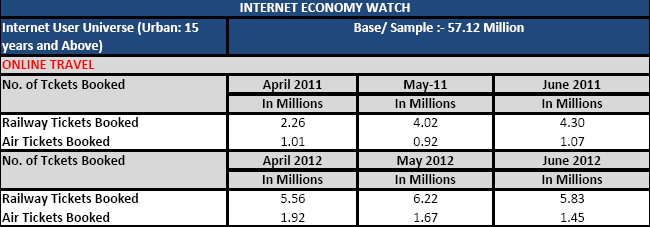
    The Internet & Mobile Association of India (IAMAI) on August 01 released ‘Internet Economy Watch’ for the month of June 2012. According to the findings, the e-ticketing category with irctc.com (Indian Railway Catering and Tourism Corporation) and airlines continues to grow robustly. It recorded a year-on-year growth of 36 per cent as compared to the corresponding months last year.


    As per the findings from the Internet Economy Watch data released by IAMAI (Internet and Mobile Association of India), there has been an increase in online railway ticketing and air ticketing. But figures for matrimonial profile uploads, activities on e-commerce sites and resume uploads on recruitment sites continue to show decline. Interestingly in the April-June quarter, the month of May has seen the highest traffic of online users across categories.


    The Internet Economy Watch data is said to be based on absolute numbers captured from various relevant sites, encapsulating online usage for e-tailing, online travel and vertical classifieds.


    In an email interaction with MxMIndia, Dr Subho Ray, President, IAMAI talked about the factors behind the surge of e-ticketing: “Technological advancement and more and more people getting internet savvy coupled with convenience is the key factor leading to the rise in online booking of train and air tickets. Online tickets can now be booked on the move, through mobile, tablets and of course PCs. A deeper PC penetration in rural areas is also one of the reasons for the rise in online booking.”


    On the takeaways for brands and marketers from these findings, Dr Ray said: “The Internet Watch Report is a recent initiative by IAMAI and is out with its third report. Going forward, the monthly data will help marketers and brands to map the consumer behaviour online and devise their digital strategy accordingly – to be in sync with the online behaviour of the consumers.”


    Besides e-tailing, online travel and vertical classifieds, in the near future IAMAI is expected to introduce newer categories: “Yes, going forward we would be incorporating more segments” added Dr Ray.


    Some of the finding of the report are:

    Online Travel Portals:

    The report states that 5.83 million bookings were registered on irctc.com in June 2012 as compared to 4.30 million in June 2011, whereas airlines witnessed 1.45 million online bookings for the month of June 2012 as compared to 1.07 million in the corresponding period last year. During the quarter April-June 2012, irctc.com registered an all time high of 6.22 million e-bookings in May 2012, while e-ticketing with airlines touched 1.92 million bookings in April 2012.


    Source: IAMAI/ Online Travel Portals


    E-tailing Sites:

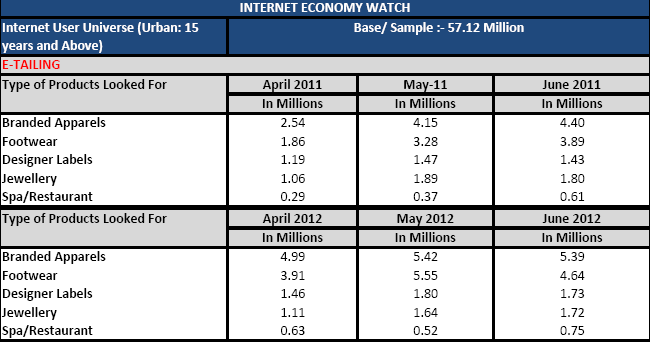
    Data captured from 29 e-tailing sites reports an annual increase in online user visit to spa & restaurant category from 0.61 million in June 2011 to 0.75 million in June 2012, showing a year on year growth of 24 per cent. The branded apparel category witnessed 5.39 million visits in June 2012 as compared to 4.40 million visits in the corresponding period last year. On the other hand, designer labels segment saw a y-o-y growth of 21 per cent with 1.73 million online visits registered in June 2012 as compared to 1.43 million visits in June 2011.


    Source: IAMAI/e-Commerce sites


    Vertical Classifieds:

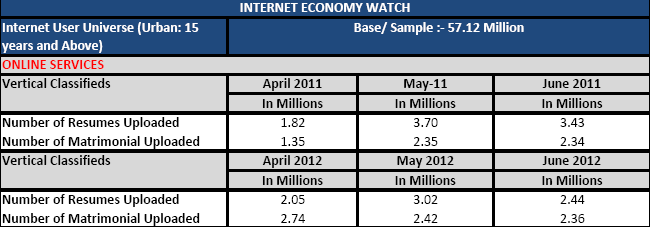
    While the number of resume uploads on recruitment sites has gone down from 3.43 million in June 2011 to 2.44 million in June 2012, the profile uploads on matrimonial sites is marginally up from 2.34 million in June 2011 to 2.36 million in June 2012.


    Source: IAMAI/ Vertical Classifieds


    Online Traffic:

    During the quarter April-June 2012, the month of May has seen the highest traffic of online users with e-ticket bookings at irctc.com, resume uploads on recruitment sites and visits in e-tailing of branded apparels, footwear and designer labels.


    Source: IAMAI


  • The Crucial Social Media Question: Have fans? Now what?

    By Tuhina Anand


    Every marketer worth his salt wants his brand to have a presence on social media. However, the truth is that the marketers are still trying to figure how to navigate this medium.


    Having heard that it’s a ‘cost effective medium, can be tracked and is ‘the’ medium’ where the customers hang out, the marketer obviously wants to be there too. But the social media still has a long way to go before it is seen as the ‘vehicle of choice’ and not just as an afterthought.


    Yes, one agrees that marketers are warming up to the medium but they are still testing waters barring a handful who have taken the medium wholeheartedly.


    Once a marketer decides to go on social media, the next move is to create a presence on Facebook and maybe on Twitter. We have often heard the marketers talking about the large number of fans they have acquired on FB, so what do these number of fans mean to them and how are the marketers leveraging these fans to engage effectively with consumers?


    Chhaya Balachandran Aiyer, Founder and Managing Director, BC Webwise agrees that there is peer pressure to acquire more fans and clients often bow to that demand: “The number of fans and likes is a visible number, hence one can’t write it off completely even though many of the numbers could be dormant fans. These numbers are an opportunity to engage those fans in a meaningful way to create brand loyalty and brand recall.”


    She added: “Two years back, the common demand of a client was to be on Facebook, but we have seen a shift now where they have realized that it’s not the ultimate answer but social media too needs a 360 degree approach.” So it’s clear that there are different kinds of marketers and the early adopters are clearly asking the right kind of questions.


    Some of the brands that have effectively used the communities on FB are Fastrack, Café Coffee Day, Sunsilk while more are getting on the engagement bandwagon. Explaining the significance of the numbers, Rajiv Dingra, CEO, WATConsult, said: “While all readers of an ad do not become buyers of the product, similarly with FB, the marketers become a publisher of its page to reach out to the consumers. The aim is not always conversion to transaction for all people on its FB page, but with a large fan base the number of potential buyers definitely increases.”


    Mr Dingra is clear that there is no replacement for good content. He added that the numbers might reflect various objectives of a brand at different points, but if the content is good, the engagement with brands will become only much more involved and meaningful.


    Vineet Gupta

    Vineet Gupta of 22feet has been relentlessly engaging with brands to enable them to use their social media tools effectively. He explained: “We have brought out exclusive sale for Fastrack fans on FB and the brand has been doing a lot of stuff exclusive to the community. Scale has its own benefit and one can’t deny that. With people becoming familiar with social media, there are lots of activities happening which take people beyond the likes and the fans.”


    The agency has recently done activation for Lee titled ‘Shadows of City’, where people were encouraged to present their photographs of the city and the shadows they create which would then be put up in the stores.


    CCD is another brand that has been using FB to listen to its customers and also engage them via the medium. Ramakrishnan K, President- Marketing at CCD elaborated: “At CCD, we not only have numbers, but also a high level of engagement. Our fan base is 2.6 million and our monthly engagement level is 60 per cent, i.e. 60 per cent of our fans interact in some form with our page every month.”


    He added: “At CCD, we use social media base for regular tailor-made communication on happenings in CCD. We have a direct consumer feedback on cafes across the country which gives us instant information that keeps us on our toes. Most importantly, we use the fan base for co-creating many of our offerings – be it new menu, suggestions for improvement, live tasting of new introductions, choice of music among others. We engage fans to co-create their brand. As a result, we drive a very high level of consumer engagement, which in turn helps us drive sales.”


    One concern is that many fans on FB might be dormant, so then do the numbers really mean anything? Sanjay Mehta, Joint CEO at Social Wavelength explained: “I think that the key is to deliver message to interested people. If people receive the message but not respond, that is not a concern, but if they do not get the message in the first place, then it’s a bigger challenge. I think one should not be dismissive of the dormant numbers, but focus more on getting the right kind of messages that will get them to engage.”


  • MxM Mondays: Why do marketers not spend enough on digital media?


    By Ananya Saha and Robin Thomas


    According to the latest IAMAI-IMRB report on Digital Advertising, as of March 2012, the total advertising spends, including classifieds, was valued at Rs2,850 crore. It is expected that by FY2013 the digital advertisement spends will be Rs4,391 crore.


    Search advertising constitutes about 20 per cent of the total online advertising spend or about Rs570 crore. Display advertisement, which has many components, forms a sizeable portion of advertising spends. Advertisements on portals and vortals form 13 per cent of the overall pie (Rs369 Crores). Advertisements on Social Media, Email and Videos over the Internet form 3 per cent (Rs94 Crores), 5 per cent (Rs144 Crores) and 2 per cent (Rs59 Crores) respectively. Mobile ads form nearly 4 per cent (Rs90 Crores). A major proportion – around 53 per cent of the overall digital advertising spends – are classifieds listings (Rs1,496 Crores).


    These numbers seem impressive, but there has been some concern that marketers are not spending enough on Digital Media. The theme for this week’s MxM Mondays is ‘Why do marketers still not spend enough on digital?’ While marketing spends may be shifting to the digital media globally, in India, television and print still rule. Is it because digital still doesn’t reach the masses, and homemakers, in particular? Or is that the bucks (hence commissions) are still big in TVCs? MxM spoke to some players in the industry to find out:

     

    Ambika Sharma

    Ambika Sharma, MD and CEO, Pulp Strategy

    The shift to digital media is not happening as fast as the industry would like it to be. However, we are witnessing an increase in aptitude and attitude with regards to usage of digital media. Marketers are not using the media aggressively as they prefer to wait-and-watch. Even then, they are aggressive on ‘search marketing’, but not other aspects of digital media.


    There is hardly any youth brand which is currently not on digital platform. Education is one prominent category that has been using digital media. The cents for digital, however, remain restricted. But as the impact of digital media grows, the impact of mobile advertising has seen a decrease as most people now do not prefer to click on banner ads on mobile screens. Some studies show that in the past one-and-a-half-year, the user has been ignoring banner ads.


    The digital spends depend on ROI, search and impressions, which needs robust backend engine. E-commerce websites have been the heavy users of digital advertising to create impressions. But there is little or no response mechanism on impressions and the visibility is highly fragmented. The numbers, like there is TAM for television, are not available for digital media. If a marketer advertisers on three digital platforms, every platform gives their own numbers. So, there is no comprehensive measurable strategy.


    Going forward, digital media will grow, but it will be a long while before it catches up with other media vehicles. Lotof factors such as measurability, reach, people not preferring to buy online are affecting the growth.

     

    Gyan Gupta

    Gyan Gupta, CEO, I Media Corp Limited (IMCL), Dainik Bhaskar

    In the US, the online spend is 29 per cent of the total advertising pie; in UK, it is 26 per cent. Now if you see the figures in India, it is not even 5 per cent. The trend shows that there will be 50 per cent increase.


    But I will not say that marketers in India are spending enough yet. The typical spender (who spends on television) is yet not on-board. Till the main spenders come on-board, the growth will be limited. FMCG’s have a deep share of the pocket, and it is necessary that they spend on digital media. Auto companies, e-commerce companies, financial companies have been heavy spenders on this medium.


    What are the marketers spending on, and how they spend also becomes important. What needs to be analysed is if the cost of acquisition is happening, if the leads are getting generated, how much a brand is spending on digital activation vis-a-vis on brand promotion. Trending is happening. This year will actually showcase the brands spending on digital media.

     

    Harneet Singh Rajpal

    Harneet Singh Rajpal, Vice President-Marketing, Domino’s Pizza India

    The use of digital media is picking up in India. For any marketer present in India, the digital media is beginning to become a part of their media plan. It is on radar for everyone, especially in the categories where youth is the target.


    For Domino’s, digital media has been important ever since we began our online ordering platform. Currently, it helps us drive traction. Hence, our media spends for digital medium have increased over the last two years. For us the return-on-investment is visible for every buck we spend on this media, since it results from direct conversion from inventory to revenue generation.


    We now spend close to 4-5 per cent of our total advertising budget on digital marketing, from almost nothing in the last two years. We work with leading publishers in the domain to create applications for Google search, Facebook and social media. I must say that on Facebook, we have the largest number of fans in the food category, and also followers on Twitter.


    Social Media management needs time and investment. It is important that the brand keeps the target in mind when planning the digital activations. Going forward, marketers will have to evaluate the prospects digital media brings. Of course, that depends on category to category. Digital media is still limited because of its reach, whereas traditional media garners higher reach. Also, the confidence about using the media is not too high among the marketers since there are no hard numbers to prove its success. The penetration of internet and the efficacy of the media will be tested over time.


    Jonathan Bill, Senior Vice President and Business Development, Vodafone India

    Digital Advertising is a growing medium in India. It will be everything we are hoping it to be and that too quicker than we think, so I think the business is starting to get in a healthy shape. The advertisers are starting to embrace digital more openly and they should do so, because India has the third largest internet population on the planet.


    On TV and Print bagging bigger ad share, I think that is a legacy issue among advertisers, but I do get a sense that it is fast changing. In the West, however, TV and Print advertising have declined in favour of online advertising. Print, therefore, has very less revenue share from advertisers as compared to online advertising and now online is beginning to even threaten television as a medium.


    I think we just need to continue on the path we are going. The quality of sales and, to a certain extent, the market needs to be made. The West took nearly two or three years to be made as far as the start of digital advertising market is concerned and in India we are only about a year ready. So, I am very bullish on digital advertising in India, particularly on mobile on three to five years timeline.


    Narayanan SP

    Narayanan SP, Senior Vice President, and Head VAS Mobile Commerce and Long Distance, Idea Cellular

    Compared to the global benchmark, certainly advertisers in India are not spending as much money on digital or mobile, but this is something which will change over a period of time. Marketers are experimenting to see if it makes sense for them to connect digitally for certain set of products/features and whether digital is the right medium to communicate or engage their brands. Thus, lot of experiments are happening.


    On the internet front, we are already seeing a significant traction which may not be as big as the international market because of the low internet penetration in India. So if you are looking at a certain type of product wherein the target audience are already digitally connected, then it makes immense sense to go digital. Digital, I believe, will evolve as more and more customer profiling is done and advertisers are able to target their customers precisely. When advertisers are able to measure the ROI (Return on Investment), then we definitely believe that a lot more investment will come into digital.


    The fact that TV and Print still bag more advertising share will definitely change over a period of time in terms of mobile being one of the vibrant channels. This does not mean print and television advertising disappear but, you will see an increase in spends on digital advertising and mobile advertising in particular over a period of time. This is because mobile is able to give the advertiser not only a more precise profile of the customer which makes it a lot easier for the advertiser to reach out to its consumers effectively, but it also allows the advertiser to interact with customers and measure the results of their campaigns effectively.


    Mobile industry, for instance, has a wealth of data in terms of customer usage, but there has not been much mining of the data which can be heavily leveraged by the advertisers. However over a period of time, you will see a lot more advertisers leveraging this data.

     

    Rakesh Rao

    Rakesh Rao, National Sales Head, Zapak Digital Entertainment

    The digital media has been growing exponentially. The year-on-year growth of this media vehicle is close to Rs2,800 crore, and is supposed to reach close to Rs4,000 crore in a year. So to say that it is not a preferred media would not be the right statement. Of course, it is not a dramatic growth, but given the growth of internet and smart phones, digital media is becoming a part of our daily life. The marketers are also following the trend.


    The ROI, when compared to TV and radio, is much more measurable. Cost per lead and cost per click measure actual conversions. This is the only interactive platform too, while rest of the media only give reach.


    Education, travel, finance are becoming the biggest spenders on digital because of conversion aspect. E-commerce, and categories like travel that look at selling inventory believe in digital media.


    The challenges that this media is encountering is getting TV-centric brands such as FMCG onboard because of reach. It is a given that while TV is cost-effective when it comes to reach, digital media will catch up in some years. About 60 per cent of these brands are on digital, but 40 per cent need coaxing. There is no hindrance apart from the fact that broadband numbers need to grow. Digital media is here to stay and grow.
     

    Sandip Tarkas

    Sandip Tarkas, President (Customer Strategy) and CEO, Future Media and T24

    As far as Future Media is concerned, our advertising spends on digital have been increasing year-on-year. Despite a lot of digital activities done by marketers specifically on social media, it does not reflect in spends. The problem with digital is not a lack of a credible or universal measurement system, but the fact that it is too measurable as people try to measure every little thing. Although there are so many metrics which evaluate the digital medium, I don’t think it is a lack of measurability at all, as in digital we are clearly able to measure our CPM’s (Cost per Thousands) and so on. Digital is something we use for more engagement rather than reach because it does not offer reach.


    We look at advertising based on two things – reach and cost efficiency. And then you look at everything else – whether the medium is interactive and so on. So, it is primarily about reach and cost efficiency. Digital media spend in India is a reflective of India’s internet penetration, whereas in a lot of markets digital penetration is very high. In those markets both print and television advertising have declined and digital advertising has been growing.


    In India too, digital is growing much faster than the traditional media, and the growth of the media certainly shows the growing importance of digital. The current size of the digital advertising pie is reflective of the kind of inroads it has made in the country.


    On digital being a 360-degree medium in itself and the role of online video and social media advertising, the biggest gain happening in digital at present is the fact that it is changing quite rapidly. Since the late 90s when we first started using digital advertising until now, the role of the medium has changed quite drastically.


    Digital today not only offers more opportunities for engaging the consumers, but the vehicles used in digital have also been changing with time. For instance, in the early days television ads would continue for quite a lot of time, but today with more options, even the television channels have begun to announce that the programme will be back in say a minute or two. So as consumers have more choices, the way the medium gets utilized also changes. Digital, I believe, be it in any form – video, social, mobile – if it is not going to be interactive, it will not be very successful.


    For anybody targeting the youth, digital is an inescapable medium. I believe the biggest change in digital advertising will take place through mobile, particularly mobile VAS and the data cost. Growth spurt in digital advertising will also come through the increase in smart phone usage and the lowering of data cost will revolutionize digital advertising.


    This is because India has a very high tele-density and today mobile phones have reached the lower-most strata. I believe digital advertising in India will explode once mobile advertising comes of age but, right now it is still in its infancy.


    Eventually digital advertising will impact television and print ads as marketers will have to allocate their budgets for digital advertising, once it comes of age. It may probably hit print advertising first and then television but for that to happen there is still some time.

     

    Sanjay Tripathi

    Sanjay Tripathy, Executive Vice President – Head Marketing and Direct Channels at HDFC Life

    There is still limited spend on digital due to lack of knowledge about the medium and utilizing it effectively as a part of marketing plan; reach/penetration of the medium; and its ability to create impact in the short term. Digital still reaches about 10 per cent of the Indian population and there hasn’t been much of a development in building infrastructure to support the growth of internet. TV continues to be the mass medium which gets the maximum eyeballs and reach.


    While the ROI variables will drive spends to digital, marketing needs a serious mind shift to look at the additional advantages which digital brings along –  a medium which allows two-way dialogue  and measurability to the last mile.


    Thirty per cent of our budgets are dedicated to digital this year – a big move from the fact that we spent a negligible amount last year. As BFSI marketing and advertising becomes more ROI focused, digital media will play an important role. Digital budgets will have a healthy growth each year and will also account for a significant part of the marketing budget.


    While marketing spends may be shifting to the digital media globally, in India, television and print still rule. This is because reach plays an important role. Penetration of Internet in India is still low compared to international markets. The consumption of non-traditional online media is still low and 360 degree integrated communication planning in India has not evolved to have online as an integral part of marketing plans. Also, online medium do not works in sync with other media.


    While there has been a tremendous amount of growth in the usage of internet among SEC A, SEC B audience, internet is yet to gain as big an audience in tier 2 or tier 3 cities. TV continues to be the mass medium due to lack of digital infrastructure. It is the reach and channel affinity which mainly drives the spending and this is where a traditional channel like TV gets one up over digital. There is also a problem of lack of content on digital. Either the content has not been customized to cater to the audience or often the language becomes a hindrance in consuming the content.


    But digital media will make a huge impact. Level of engagement, interactivity and ROI afforded by the medium means it has big role to play. For brands which don’t engage their users online will tend to lose their relevance. As reach increases, the importance and level of competition will also increase –  YouTube already affords a higher reach compared to most of the TV channels and is increasingly becoming an important part of the traditional media mix.


    Digital offers tremendous potential for business – whether it’s about spreading awareness or generating business even in the face of a slowdown. In fact, as people tighten up their purse strings, they will want to do more research before they arrive at a purchase making decision and internet remains the primary medium of product research.


    I see the spends going up because the whole media pie has been asymmetric- if you look at the reach-frequency formula and compare it to TV, print, radio and then digital. There are more people spending time on digital in comparison to other traditional media touchpoints. I see the digital percentage increasing in the overall pie.


    Youtube and pre-roll videos have become a mainstay when it comes to hosting TVCs on digital and these unique ad formats are as effective in reaching out to audience as a TVC. For print QR codes help bridge the gap between offline and online world.

     

    Saugata Bagchi

    Saugata Bagchi, Senior VP, Tribal DDB India

    The primary challenge is the need of cracking an ROI metric, which is acceptable by advertisers across the board.  The media spends are happening, but is it delivering enough clickthrough rate goes unanswered. Digital media cannot ensure high reach like television, but with 12 per cent penetration among various categories it can definitely give high frequency. Currently, only 25-30 per cent of population is online; hence, the spending on this medium will remain lower than other mediums.


    The point of advantage is that there is a big influx of youth, and they are ready to spend. While the marketers would want to catch the youth online, they (marketers) get no justification in form of numbers to spend much on media. Hence, they prefer doing mall activation to spending on digital platform. The agency and publishing community need to be more forthcoming to speak to the marketers, and in their language.


    Digital media is currently registering 15-18 per cent year-on-year growth, but it is important to note the gap between digital and television media.


    Since the offices of MxMIndia are closed on Monday, August 20, there will be no MxM Mondays next week. We will announce the theme for the next edition on Tuesday, August 21.



  • Hungama to manage digital mandate for Timex & Helix

    By A Correspondent


    Hungama Digital Services Pvt Ltd has bagged the digital media AoR duties for Timex India and its youth brand, Helix. Timex Group, one of the world’s largest watch makers that designs, manufactures and markets innovative timepieces and jewelry globally, named Hungama Digital Services as the exclusive agency working on their digital platforms, both web and mobile. The agency will manage social media for both the brands, media buying as well applications.


    Talking about this, VD Wadhwa, Managing Director & CEO, Timex India, said: “The digital medium is fast evolving and presents tremendous opportunity for brands to mark their presence. Given that the measurability of this domain is quantifiable, we at Timex are extremely focused on strengthening our brand presence on this very dynamic platform. We have strategic plans to increase our presence through the launch of brand Webstores, social media pages and impactful search and display campaigns. We chose to partner with Hungama as it is the leader in providing effective digital campaigns to brands across markets and categories. I am very confident of this partnership, as it will act as a catalyst in our journey to become the most influential brand in the digital space.”


    Speaking on the winning the account, Neeraj Roy, Managing Director & CEO, Hungama Digital Services said: “We are excited with the win and look forward to a relationship with the Timex Group. With an experienced and award winning team here, we aim to leverage this opportunity for Timex, towards a widespread exposure and an increased engagement in the digital space. Today, India is at the cusp of digital revolution with the advent of 500+ million consumers getting online in the next 3-4 years. We hope to offer integrated digital and experiential services to clients and prepare brands to connect, interact and transact with their customers.”


    JWT Singapore recently acquired a 51 per cent stake in Hungama Digital Services Pvt.


  • 1 in 4 online mins spent on social networking in June

    Digital media measurement leader comScore has released a study on the top online sites and activities in India from its comScore Media Metrix service. The report says that Google sites ranked as the top destination in June 2012 reaching nearly 95 percent of the online population, while social networking reigned as the top online activity accounting for 25.2 percent of all online minutes.


    In June 2012, Google sites ranked as the top online destinations in India reaching 57.8 million people age 15 and older accessing the Internet from a home or work computer. Facebook.com followed with 50.9 million visitors (83.4 percent reach), followed by Yahoo! sites (65.5 percent reach) and Microsoft Sites (48.1 percent reach). Local web properties secured several spots in the top 10 ranking, including Times Internet Limited, reaching 33.7 percent of the online population, Network 18 (29.3 percent reach), Rediff.com India Ltd (25.2 percent reach) and NIC.in (21.8 percent reach).


    Among the top properties, visitors were most engaged on Facebook.com, spending an average of nearly four hours on the site in June. Visitors spent 2.5 hours on Google sites, with YouTube accounting for a strong share of time spent on the property. Among local brands, Network 18 led as the most engaging property with visitors averaging 31.6 minutes during the month.


    An analysis of the top online activities in India found that social networking accounted for 25.2 percent of all time spent online in June, an increase of 0.8 percentage points from the previous year, as social media continues to be a primary driver of people’s daily digital media consumption. Entertainment sites ranked second, accounting for 10 percent of minutes (up 1.2 percentage points from the previous year), while Portals accounted for 8.8 percent of total minutes. Although it represented just 2.0 percent of total minutes, time spent on Retail sites grew 0.5 points in the past year as online shopping continued to gain adoption.


  • Zee TV creates ‘virtual temple’ for Ramayan

    By A Correspondent


    Zee TV’s latest salvo in the cyber-competitive world of social networking websites is an innovative ‘virtual temple’ on the Facebook page of its new mythological show, ‘Ramayan’.


    The virtual temple holds the promise of a few moments of daily spiritual solace for netizens. The imagery, the colors and the music used have a calming effect and can easily transport a devotee to a harmonious, divine space. Packaged beautifully, the temple is a re-creation of the Ram Durbar showcasing Lord Rama, Lakshman and Sita with Lord Hanuman. The temple has unique features that let them ring the bell, light a diya, play a choice of aartis, shower flowers and smear haldi kumkum on the deities, break a coconut and even rotate the aarti ki thali!


    In the coming days, Zee TV also plans to create a mobile application that will make the virtual temple available to smartphone users and let them interact with ‘Ramayan’ through aartis and chaupaayis.


    The launch of the virtual Ram Mandir comes in the wake of the launch of new mythological series ‘Ramayan’ which went on air on Sunday, August 12 on Zee TV and Doordarshan.


  • Vserv.mobi client portfolio grows 3X

    By A Correspondent


    Vserv.mobi, a leading mobile advertising network for app developers, publishers and advertisers announced that their client portfolio of advertisers and brands has grown three times over the last quarter. Some of the marquee names amongst the company’s clients are top brands such as Mahindra & Mahindra, Microsoft, Google, ICICI Bank, Airtel, Nokia, Titan, Toyota, General Motors, Mid-Day, Dulux, Maruti and Aircel.


    Commenting on the company’s growth and strategy for advertisers, Dippak Khurana, Co-founder and CEO, Vserv.mobi said, “Being among the frontrunners of the mobile advertising wave in India, we have always strived to push the mobile ecosystem forward. Through constant innovation on our ad formats such as premium full screen ads and a clutter free viewing experience, we believe that our ad network is creating a compelling choice for brands to commence their mobile advertising journey.”


    Berg Insight, an independent wireless analyst firm states that the total value of the global mobile marketing and advertising market will see 37 percent growth by 2016, bringing the industry’s total value to USD 22.6 billion. Riding this wave, Vserv.mobi saw an 18X increase in premium inventory clicks on its network in the last one year, which contributed to 41% of the total click mix. This growth was driven by demand for powerful monetization by the company’s flagship technology, AppWrapper. With its simple one-click and zero-coding monetisation process, the unique AppWrapper has contributed to building Vserv.mobi’s repository of 10,000+ exclusive apps from developers across the globe. These apps along with mobile internet sites serve as powerful ad inventory for advertisers on impactful formats such as Full Screen Ads, Video, HTML5 interactive ads on both feature phone and smart phone apps.


    Commenting on the prospects of the rising mobile internet usage in India, Kshitiz Randhir Shori, Head of Sales – India, Vserv.mobi said, “We have seen tremendous traction with new brands that are starting to work with us, as well as RO value increasing significantly across our portfolio. As the mobile medium grows, brands are increasingly showing interest in our differentiated mobile media offerings that offers massive reach, unique ad placement, impactful ad formats and thus offering the best bang for the buck. With the festival season coming up, our ability to carry out circle/state targeting on the mobile will play a key role for brands looking at reaching the right audience with the right regional festive message.”


    Since Vserv’s inception in January 2010, the company has been delivering App and mobile web advertising for leading Fortune 500 brands & digital media companies, in over 200 countries. KFC is one of the many companies that initiated its mobile advertising journey using the company’s ‘AppWrapper’ technology. “Companies such as KFC have been instrumental in transforming the mobile advertising paradigm and we are proud to have partnered with them for this journey. The rising demand from marketers has augured well for us and we are strengthening our team, to continue growing the market.” added Mr Shori.