Category: Digital

  • Mindshare & Google launch ‘Mobile Garage’

    By A Correspondent


    Mindshare and Google have announced the launch of ‘Mobile Garage’, a unique venture designed to use Google’s best in class mobile expertise to supercharge the use of mobile by Mindshare’s global client base.


    Mobile Garage will see the setting up of mobilehubs around the globe – initially New York, London and Singapore – where Mindshare clients will gain access via dedicated teams to mobile strategists and product experts. The hubs will consist of a mix of Mindshare and Google employees and will work across all aspects of the mobile eco-system, from search optimisation and app development, to strategy, planning and creative optimization.

    Nick Emery, CEO Mindshare Worldwide said: ‘We designed Mindshare to be open source and to work with the best partners for the benefit of our clients. It’s about trial, experimentation and speed to re-design our business. Working with Google on mobile will give our clients a competitive advantage in a key battleground both now and for the future.”


    Mobile Garage will give Mindshare clients a unique advantage in the race to harness the growing global trend of mobile device usage. Mobile search traffic has increased 400 per cent over the past 2 years, and its potential goes even further. The GSMA, the industry body for mobile operators, and research company Machina, predict there will be 24 billion connected devices by 2020 creating an industry worth $4.5 trillion and covering innovations such as connected cars, building automation and traffic management. In addition the venture will also give Mindshare clients competitive advantage in emerging markets, with KPCB’s Mary Meeker recently showing that mobile internet usage had surpassed desktop internet usage in India.

    Matt Brittin, VP, Sales and Operations, Northern and Central Europe at Google said: “We have adopted a ‘mobile first’ philosophy at Google to keep pace with the rapid acceleration in consumer mobile usage. We are delighted to team up with Mindshare on a similar strategy for their clients. Mindshare have already shown strong momentum in the mobile marketing space, and have a great opportunity to lead their clients to win on mobile in the future.”


    Mobile Garage will complement Mindshare’s existing relationship with WPP’s mobile agencies Joule and H-Art.


  • Gaana.com launches music streaming app on Win 8 tab

    By A Correspondent


    Gaana.com is the first full-fledged music streaming application for India’s store of Windows 8 Release Preview. It is also the first music serving application for Surface in India. With a vast repertoire of popular Bollywood, Hindi, regional and international music, it is currently available in 38 markets worldwide.


    The Gaana.com application in the Surface store has the slick Windows 8 metro-style tiled interface with intuitive interactions and fluid navigation. The application offers users a smooth browsing with the latest and most popular albums, artists, genres and songs. Users can easily browse through the entire database of music, and choose from curated music charts or filter music based on language preferences. Gaana.com also offers music suggestions, based on the album that a user is listening to, further enhancing the overall experience.


    Gaana.com is one of the most popular music websites with over 10 million songs to choose from. It has a user base of more than 3 million unique visitors. Satyan Gajwani, CEO of Times Internet Ltd said: “We want gaana.com to be as accessible to users as possible. The Windows 8 Surface tablet is an exciting innovation, and a fantastic new way for users to experience music on demand. The Gaana app is now available in the Surface store for users globally to listen, compile, and share the music they love.”


  • Havas arm launches mobile msgng platform

    By A Correspondent


    Mobext, the mobile marketing agency brand of Havas Digital, has announced the launch of a proprietary, next generation global mobile messaging platform. The platform allows companies to launch sophisticated, multi-country mobile messaging campaigns.


    Rob Griffin, EVP – Global Director of Product Development of Havas Digital said: “With the exponential growth in mobile and mobile’s growing importance in creating meaningful brands, Havas Digital is proud to be rolling out Mobext’s ‘SAM’ for our clients. SAM, which stands for ‘Simplified Automated Messaging’, is a mobile messaging platform managed by Havas Digital’s Mobext division and was built for global scale that can be deployed very quickly to support our clients’ increasing messaging requirements. Mobile messaging is often overlooked due to mobile rich media, smartphones and tablets but we feel it is a critically efficient element when optimizing a consumer’s experience with a brand by supporting and enhancing CRM, social media, and promotional activities.”


    Among key features of the platform is the ability to send personalized, highly targeted SMS to an opt-in mobile database. It also enables powerful, 2-way SMS marketing campaigns, allowing advertisers to launch a vast array of interactive mobile campaigns such as polling, voting, trivia, contests, data profiling, couponing, on-pack promotions, and many others.


    SAM is managed and hosted in the Philippines.  The platform is already live in the Philippines, India and Argentina, with plans to launch it before end 2012 in all other Mobext markets worldwide.


    Arthur Policarpio, Asia-Pacific Head of Mobext as well as CEO of Mobext Philippines said: “The problem with most SMS marketing platforms is the high-degree of complexity as well as lack of global scale – it is an extremely complicated process to secure short codes as well as SMS push pipelines on a per country basis.  SAM simplifies all this. SAM enables enterprises of all sizes to quickly launch a multi-country, mobile messaging campaign – all from a simplified, easy-to-use web-based platform.”


  • A Jagannath joins LinkedIn to head trade marketing

    By A Correspondent


    LinkedIn, the professional network with over 15 million members in India, has appointed AL Jagannath as Head, trade marketing for India.


    With over 18 years of experience in marketing, Mr Jagannath’s immediate focus will be to drive existing and new initiatives for LinkedIn’s Marketing Solutions and Hiring Solutions portfolios.


    As part of LinkedIn India’s leadership team, he will be responsible for widening awareness about LinkedIn’s array of customized solutions that are available to advertisers and recruiters in the Indian market.


    “Being the second-largest member base for LinkedIn, we see tremendous potential for growing our business in India. We have built a strong and viable platform for the business over the last two and a half years. Our focus, moving forward, will be to build off this platform and continue to give the best value to our advertisers and recruiters. Jagannath brings invaluable experience in building up large businesses and his addition to the India leadership team will help us accelerate our growth in the market, strengthen our operations and associate with even more businesses in India,” said Hari V Krishnan, Country Manager, LinkedIn India.


    Based out of Bengaluru, Mr Jagannath joins LinkedIn from VMWare, where he was director, marketing for India and SAARC. Prior to VMWare, he also held leadership positions at some ofIndia’s largest IT companies like Satyam Computers, Reliance Infocomm and Mudra Communications. Having worked with these companies, Jagannath comes with holistic experience in business and consumer marketing.


    LinkedIn India is headquartered in Mumbai with offices in New Delhi and Bengaluru.


  • Axis Bank appoints Digitas India

    By A Correspondent


    Digitas, the digital marketing agency, has been appointed by Axis Bank as their digital AOR. Digitas will conceptualize, design and manage Axis bank’s presence online across the bank’s verticals and practices.


    On the association, Manisha Lath Gupta, Chief Marketing Officer at Axis Bank said; At Axis bank we believe that digital media is an extremely important channel to engage with and have meaningful conversations with consumers. Over a period of time, a good digital strategy will go a long way in creating preference of one service provider over another. We believe that Digitas India is the right strategic partner to help us achieve our aspirations. Digitas will be handling all social media and online creative work for Axis Bank.


    Working with Axis Bank is extremely exciting and challenging said Kanika Mathur, President, Digitas India. “We will be using some of our worldwide learning’s and best practices to create and implement best in class strategies and consumer experiences for Axis bank. These will include helping position new and current services online as well as in social media,” she added.


    Digitas India has a full service offering across ‘paid, owned and earned’ media. Today the India team has over 160 team members.


  • IAMAI: E-commerce witnesses upward swing

    By A Correspondent


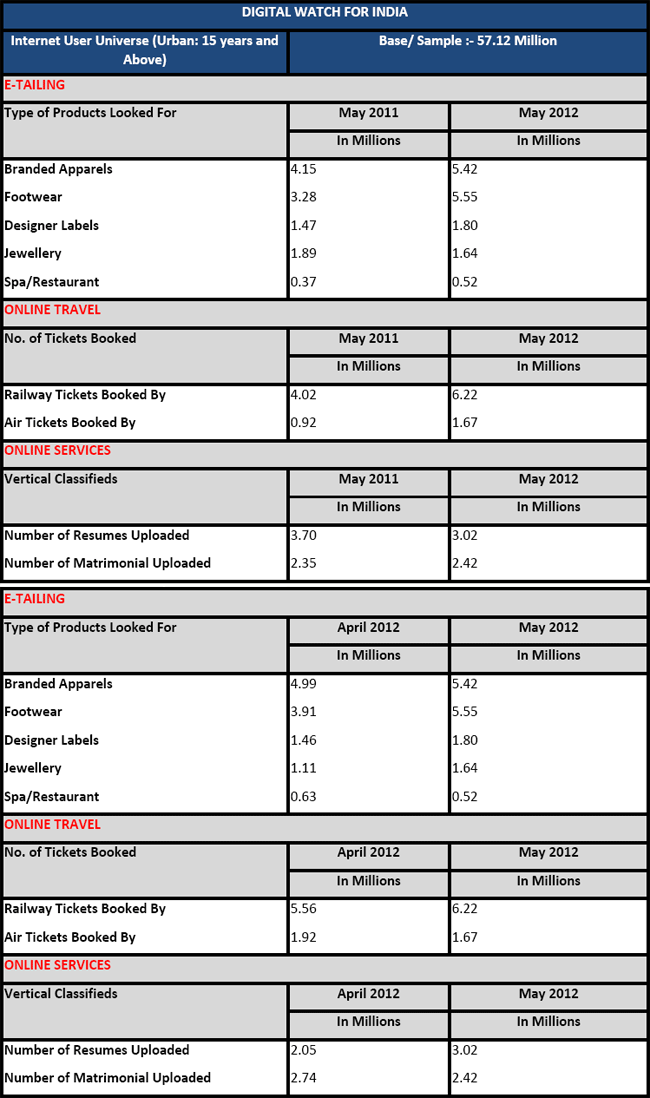
    There has been a surge in the e-ticketing category of the Indian Railway Catering and Tourism Corporation Ltd (irctc.com). In May 2012, IRCTC recorded over 6.22 million bookings as against 4.02 million bookings in May 2011, thus witnessing a year on year growth of 55 per cent.


    While there has been an increase in online railway ticketing and online air tickets, matrimonial profile uploads and activities on e-commerce sites; there has been a slight decline in the number of resume uploads on recruitment sites. These are some of the findings from the Internet Economy Watch data released by IAMAI (Internet and Mobile Association of India).


    The Internet Economy Watch data released is said to be based on absolute numbers captured from relevant sites of verticals encapsulating online usage for e-tailing, online travel and vertical classifieds.


    Besides the online railway tickets bookings, the data also reveals that there has also been an increase in the online air tickets as well. The booking of online air tickets is said to have witnessed an increase of 82 per cent year on year wherein on May 2012 online air tickets received 1.67 million in May 2012 from 0.92 million of the corresponding month last year i.e. 2011.


    Source: IAMAI/ Online Travel Portals


    Vertical Classified Sites:

    Interestingly, the number of resume uploads on recruitment sites have seen a slight decline in May 2012 as compared to the resume uploads in May 2011. Resume uploads on recruitment sites declined from 3.70 million in May 2011 to 3.02 million in May 2012. The resume uploads in April were however 2.05 million. The data captured from 28 online matrimonial sites however shows an annual increase in matrimonial profile uploads from 2.35 million in May 2011 to 2.42 million in May 2012.


    Source: IAMAI/ Vertical Classified Sites


    E- Commerce Sites:

    The study shows there has been an increase in user visits to branded apparel and footwear sites from 5.42 million and 5.55 million visits respectively in May 2012 as compared to 4.15 million and 3.28 million visits for the corresponding month last year. While the designer label segment has registered 1.80 million visits in May 2012 as compared to 1.47 million visits in May 2011. The jewelry category has witnessed 1.64 million visits in May 2012 as compared to 1.89 million visits in corresponding month last year.


    Source: IAMAI/e-Commerce sites


    Compared to April 2012, there has been a significant increase in e-ticket bookings at irctc.com, resumes uploaded on recruitment sites and visits in e-tailing of branded apparel, footwear and designer label segment in May 2012. On the other hand, there has been a notable decrease in online booking of air tickets and profile uploads on matrimonial sites in May 2012 as compared to April 2012.


    Source: IAMAI


  • Blogging site IndiBlogger helps brands talk to customers

    By Preethi Chamikutty


    For most of us a blog is a destination to put up a view, an experience, a rant, videos and photos – some vivid, others vicarious – and then get back to a mundane life. But five hardcore bloggers from Chennai decided to be an exception when they founded IndiBlogger.in, a congregation of Indian bloggers who totalled some 27,000 at last count.


    With a tagline ‘Indians by birth, bloggers by choice,’ the IndiBlogger team fields more than 70 requests daily from wannabe Indibloggers. Vineet Rajan, 27, one of the directors who set up the site said: “We started off trying to just create a directory that allowed bloggers to submit their blogs.”


    Over the years, more features have been added based on what the community demanded on its discussion forums. For instance, the site now has IndiVine, a chat application, and Indi-Rank, a ranking algorithm for bloggers in India.


    In many ways, in its current avatar IndiBlogger is a social network for Indian bloggers.


    “It’s like LinkedIn for bloggers with an exclusive dashboard, and activity feeds that let them track other bloggers’ posts, and more,” Mr Rajan pointed out.


    It’s a unique concept and community, but at the end of the day it needs to make money. IndiBlogger’s revenue stream is, what Rajan calls, “earned media”, which he says is what brands are clamouring for. “With its blogs IndiBlogger can help brands build more trust and credibility than any other online media can,” he claimed.


    Mr Rajan cites Neilsen Global Trust in Advertising survey, 2011 that shows less than a third of netizens trust ads; in comparison 92 per cent who have faith in peer and word-of-mouth recommendations.


    IndiBlogger’s first brand engagement was with Microsoft through a blogger meet in 2007. Since then IndiBlogger has organized 50 such congregations; these have been coupled with over 50 contests with brands across sectors like consumer goods, travel & aviation and retailing among others. Samsung, Pepsi, Hindustan Unilever Ltd (HUL), Castrol, Cleartrip and Tata Docomo are some brands that have engaged with consumers through IndiBlogger.


    Last November, HUL’s Surf Excel used IndiBlogger to engage with women bloggers on the site via a blogger contest called ‘Surf Excel Matic #GetSmart.’


    Targeted at urban women in the 25+ age group, Surf managed to reach a little over 25 lakh netizens using IndiBlogger and its tools like IndiRank and IndiVine, says an HUL spokesperson. Maximum readers were from the cities of Bengaluru, Mumbai, New Delhi and Pune.


    “Bloggers are publishers and the popular ones have a good readership .They know the art of expressing their views and thoughts on a certain topic in an interesting way which also wins them dedicated following over time. The popular bloggers also have good networking skills which they use to publicise the content on their blogs on various social platforms,” said the HUL spokesperson.


    When popular bloggers write about a brand and its core message, it reaches their followers and readers of the blog. This also results in a lot of user-generated content for the brand, essentially making these bloggers the brand’s ambassadors, added the HUL spokesperson.


    In the Surf Excel Matic contest, although only 41per cent of the participants were women, they garnered more than 55per cent of the entire readership of the campaign, thereby, helping the campaign achieve its objective.


    For Castrol, which wanted to engage with passionate bikers, IndiBlogger was an extension of the lubricant brand’s presence in digital and social media. In the ‘Castrol Power1 Biker code of India’ contest, bloggers were encouraged to share what biking meant to them. The contest got 170 entries and the blogs attracted an audience of roughly 1 million viewers within the first 30 days of the campaign.


    “Besides creating a powerful platform to engage with bikers, the contest enabled us to gather rich insights about our target group, which is the passionate biker,” said Saugata Basuray, deputy head of marketing at Castrol India.


    Besides being an aggregator, IndiBlogger also provides assistance to people who approach the site with technical queries about how to make a blog, how to get a domain name and so on.


    A 14-member team spread across Mumbai, Bengaluru, Chennai and Delhi are responsible for maintaining the site, providing assistance and monitoring for offensive content. The blogger meets are mostly outsourced to event management companies who liaison with core members of the IndiBlogger team.


    Started with an investment of Rs10,000, the site turned profitable in June

    2010 and, according to Mr Rajan, their blogger database grew 37 per cent in 2011-12 over the previous fiscal year. He is wary talking about the company financials but says the website is on track to achieve $2 million revenues by 2015.


    Blogs are today gaining currency as a medium for engagement and Kanika Mathur, president, Digitas India, a digital marketing agency, says the influence that blogs can have on a brand is hard to dismiss. “People who go online today are looking for a point of view, so either they get this point of view from the brand or from a third person. Bloggers are a set of experienced people whose opinion has great credibility as they are not from the brand side,” she said.


    Source: The Economic Times

    Copyright © 2012, Bennett, Coleman & Co. Ltd. All Rights Reserved

     

  • IAMAI- IMRB report: MVAS grows at 28 per cent; surge in modern MVAS in India

    By A Correspondent


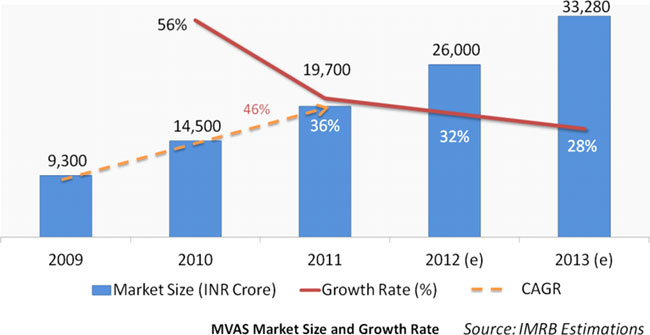
    The Indian mobile value-added services (MVAS) market is expected to become a Rs26,000 crore market by the end of 2012, growing at the rate of 32 per cent. MVAS is estimated to further grow to a whopping Rs33,280 crore market by 2013, a growth of 28 per cent. While the conventional MVAS services are still dominant, emerging MVAS services are also rapidly gaining popularity with mobile users. These are some of the findings from the latest IAMAI – IMRB report on Mobile VAS in India.


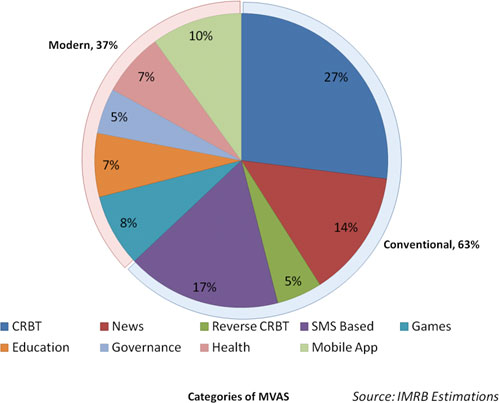
    According to the IAMAI-IMRB report, MVAS can be divided into two categories – conventional MVAS which has a market share of 63 per cent and the emerging or modern MVAS which contributes a market share of 37 per cent. While the conventional MVAS services consist mainly of CRBT and SMS-based applications, the emerging or modern MVAS mainly consist of mobile apps and games.


    Speaking to MxMIndia on the factors that would drive the MVAS revenues in the long run, Rajiv Hiranandani, Co-founder and Executive Director, Altruist- Mobile2win said: “I am a firm believer that the true growth of mobile VAS is going to come from the rural India. You will see more of services that will help the rural or the small town Indian utilizing the services. In that respect, I believe Interactive voice response (IVR) based services and SMS-based services are going to be big drivers of Mobile VAS. These services could range from basic things like finding the price of vegetables or some information over SMS or finding friends over IVR or IVR-based social networking. These are services that will catch on and will drive revenues in India over the years to come. So for VAS revenues to explode in the country, you need to appeal to the lowest common denominator which primarily resides in the rural India.”


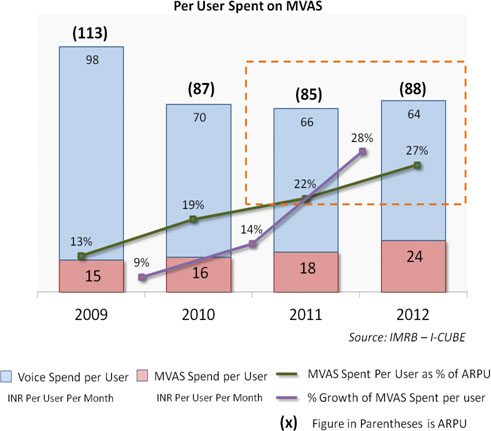
    In the last three years, the average MVAS spent per month has risen by Rs9 to stand at Rs24 per month in 2012. The percentage share of per user spend on MVAS in Average revenue per user (ARPU) has been increasing gradually. Even though the ARPU has declined over the years, per user spend on MVAS has gone up by 28 per cent in the last one year. It is now 27 per cent of the ARPU pie. The dependency on voice services is reducing and to increase the ARPU, the emphasis must be put on data services such as MVAS.


  • Mobile ad network Seventynine to launch ‘unique’ Android product

    By A Correspondent


    Launched in July 2011, Seventynine, the mobile ad network, started commercial engagement in the market in April 2012 with a focus on rich media inventory especially videos to enrich user experience. Seventynine has clocked record growth serving 700mn ad requests within three months of operation.


    Currently, Seventynine is working with brands such as Microsoft, Lufthansa, Nokia, Opera Mini, ICICI bank, ICI Dulux, Tata Docomo, Nazara, Mcarbon, Techzone  and so on and is in talks with other large brands for similar association. The mobile ad network is focusing actively on building inventories across mobile applications and mobile web.


    In an email interaction with MxMIndia, Chirag Shah, Co-founder, Seventynine spoke about his company’s journey since July 2011, its break-even plans and so on. “The journey so far has been very exciting and full of challenges. We are focusing heavily on unique product development, platform and analytics. Since March 2012, we have hit the market and managed to get some amazing response. Mobile ad spends are growing at more than 100 per cent. Spend on content such as application is growing at more than 400 per cent growth rate.”


    “We are launching a unique product on android platform and we intend to share details on that in the next 10-15 days. This unique product will be our focus for 2012-13” he added.


    “Mobile phone and mobile internet users are growing rapidly and consumers are spending more time on mobile as compared to TV, newspaper and internet. We are actively focusing on innovative technology solutions to create the differentiation that will position us ahead of the curve.” added Deven Dharamdasani, Co-Founder, Seventynine.


    The team size of Seventynine is currently 15 but, the mobile ad network company will be hiring aggressively. “We intend to have a 50 member team by the end of this year” observed Mr Shah.


    Seventynine is said to be one of the fastest growing mobile ad network in the country with Rich Media serving capability such as videos and HTML5. It is working closely with The Times Group, Network 18, Reuters, Business Standard, Nimbuzz, Angry Bird, Talking Tom Cat and others and has tie-ups with leading exchanges across the world.


  • Marmalade Digital thrusts on Demand Side Platform (DSP)

    By A Correspondent


    Marmalade Digital is making use of several technologies plugged together in one platform called Demand Side Platform (DSP). DSP offers transparent automated media buying across multiple sources in real-time.


    Buyers have complete control through a web-based interface. DSP is fully transparent and neutral, not favouring any publisher, advertiser or inventory over others. This increased transparency and targeting addresses prevailing disparities in display domain.


    Throwing light on Marmalade DSP, Hemant Kumar, founder and chief executive officer, Marmalade Digital said: “Our goal is to be the digital partner who will provides smart media buying insights and optimization to agencies, enabling them to focus more on client strategy, brand building and less on execution of media plan.”


    Till date advertisers had access to only reports which tells whether campaign has performed or not. With direct control and full involvement in media buying, advertisers will know exactly what performs best for them and how the performance can be improved. The learning stays with the agency and can be re-used.


    “Marmalade DSP is an intelligent media buying platform that will offer value beyond impressions and clicks to its advertisers. To ensure brand safety, Marmalade DSP maintains a strict compliance with IAB standards. Advertiser can also choose type, content and category appropriate for its brand,” he added.


  • We’ll continue focus on customer delight, says Myntra’s Bansal

    E-tailing in India has seen some brisk business being conducted by a few players in the recent past. While some may brand the space as crowded, there are a few players who have created a niche and are gaining handsome dividends too. Like Myntra.com, that has been consistently doubling its revenues every 5-6 months for the past 15 months and is currently doing over 8,000 transactions daily. According to Mukesh Bansal, Founder and CEO, Myntra.com, the opportunity to offer the widest catalogue across national and international brands, 24/7 shopping, 30 day returns and Cash on Delivery are some of the features unique to online shopping and have helped grow the market.


    In an interaction with MxMIndia, Mr Bansal talks about the growth story of Myntra in a crowded marketplace, on the USP that sets it apart from its peers and what are its plans to derive next phase of growth in India. Excerpts:


    What according to you are the factors that are driving the growth of the e-commerce marketplace in India?

    Some factors that are enabling the growth of the e-commerce in India:


    > Internet penetration:India, currently at 120 million users, is one of the fastest growing internet markets in the world and is expected to touch 300 million by 2015. This has led to opportunities for a vast number of businesses to mushroom online. E-commerce is the largest and the fastest growing segments online.

    > Success of online travel sites & ticket bookings: This has led to increased confidence among consumers to venture into online shopping.

    > Convenience: Widest catalogue across the best national and international brands, 24/7 shopping, 30 day returns and Cash on Delivery are some of the features unique to online shopping and have helped grow the market.

    > Investment from VCs and private players: Investors are looking at e-commerce as a long term investment portfolio as the space has shown tremendous potential to become a multi-billion dollar business.


    How would you analyse Myntra’s growth story in India over 2011-12?

    Myntra has been consistently doubling its revenues every 5-6 months for the past 15 months and is currently doing over 8,000 transactions daily. Our daily traffic has grown to over 4,00,000 visits and our network has grown to cover 1,200 towns and cities across the country. With over 350 of the best national and international brands, Myntra is, today, the largest online retailer in the fashion and lifestyle segment.


    We are also one of the well-funded companies in the space and at the current growth rate, we are confident of achieving our target of Rs500 crore by the end of this financial year.


    The e-tailing space is flooded with players offering the same set of user services, what is the USP that Myntra brings to the table? 

    Back in 2010, Myntra took a bold decision to enter the full catalogue, current season segment to retail merchandise on MRP. Along with the largest catalogue of marquee brands, Myntra was able to target untapped markets across the country coupled with on-time delivery and flexible policies.


    Cash on Delivery as a payment option became an instant hit among our shoppers and today constitute about 65 per cent of our overall business.


    Could you summarize what your core TG of online shoppers looks like?

    Our typical shoppers fall in the age bracket of 20-35 years (SECAB) with about 70 per cent of our shoppers being male. About 55 per cent of our shoppers are from tier 2 & 3 cities with the rest in top 10 cities.


    What is the emphasis you lay on the distribution/delivery across India?

    One of the biggest challenges for any e-commerce player is to effectively manage its supply chain and logistics. At Myntra, we are constantly upgrading our processes to provide a hassle free shopping experience while strengthening our in-house logistic network. We are currently operational in over 12 cities across the country and plan to reach as much as 70 per cent of our customers directly via our own logistic network by the end of this year.


    What is the impetus that you are laying on the marketing/communication plans for Myntra?

    Our latest TVC hit the networks in June 2012 across major national channels. We are now entering regional markets in the south with language specific ads in Tamil, Kannada and Malayalam.


    We are also partnering with various other properties that enhance our fashion quotient.


    Do you think e-tailing is gaining ground in India at the expense of other modes of shopping?

    The overall lifestyle category in India is pegged at approximately $50 billion, growing at 16 per cent CAGR. This is one of the largest categories, not considering travel & tourism. The industry is expected to cross $100 billion in 2015 with approximately 5-8 per cent of this being online. This clearly indicates that the market is big enough for both to co-exist.


    What are the challenges in running a successful e-tailing network in India?

    The biggest challenge for any e-commerce player is to effectively manage its supply chain (inventory, logistics etc) and customer experience. Delivery team and customer support being the two main touch point for an online retailer, utmost importance needs to be given to both these aspects.


    At Myntra, we are constantly upgrading our processes to provide a hassle free shopping experience while strengthening our in-house logistic network. We are also constantly training and motivating our CC teams to imbibe the Myntra core values and pass them on to our customers.


    What are your plans for the next phase of growth in India?

    According to recent reports, online apparel will be a $2 billion market by 2015 and we see great potential to grow in this environment. Our investments in technology, brand and supply chain is already paying dividends and we will continue to focus on delighting our customers.


    We are also adding new features on our interface to aid our customers in their buying process and helping them make the right fashion choice with our fashion blog called Style Mynt.


    Social media is a very important platform for us and we are making steady progress with over 6.5 lakh fans on our Facebook page while Twitter, Google and Pinterest are gaining momentum.


  • Phew! Over a billion online in APAC

    By A Correspondent


    The Asia Digital Marketing Association (ADMA), in co-operation with leading digital marketing companies and research houses, has published the sixth annual Asia Pacific Digital Marketing Yearbook. Among the thousands of facts and data points, readers will learn that 46 per cent of the world’s online population – 1.016 billion people – is now in Asia Pacific, of whom 623 million access the web via mobile.


    Although this enormous and growing addressable market seems to hold boundless business potential for marketers, the reality is more complicated – and more interesting.


    The Yearbook is compiled for marketers, advertisers, and their agencies, to help them understand and maximise the digital potential of their business in the region. The 2012 Yearbook has more information than ever before on online demographics, user behaviour, online advertising, mobile, e-commerce and social media.


    “The billion people online in Asia Pacific are spread across more than 14 countries, with a wide range of languages, cultures and online habits. More than half of them (513 million) are in China, which has its own media properties and consumer dynamics. In fact, seven of the top eleven sites in the region are in China,” said David Ketchum, ADMA Chairman.


    “Across the rest of Asia Pacific there is remarkable diversity; the way people use the web and interact with content and with one another differs significantly from Australia, to Korea, to Indonesia, to India. The Yearbook helps marketers make sense of what works where in Asia’s increasingly social, local and mobile web environments,” he added.


    The one billion user number is made up of hundreds of thousands of communities of users, spread across a wide variety of devices and platforms, languages and cultures, and who use the web in a profusion of different ways.


    The data in the ADMA Yearbook send a clear message: it’s time for marketers to get local and get personal.  The implications and opportunities are far-reaching:

    • Social media continues to gain in importance, but brands have to proceed with caution. Although 60 per cent of social networkers say that social networks are a good place to learn about brands, 50 per cent also say they don’t want to be bothered by brands.
    • As in past years, people still put the most trust in recommendations from friends and family over all other media channels (with 52 per cent of users in Asia Pacific trusting friends and family completely as compared with newspaper and magazine ads at 14 per cent).
    • Social commerce is on the rise, and marketers can deploy sophisticated, personalised approaches, depending on where they are in the sales funnel, to build brand awareness and understanding, create brand preference, make sales, and do CRM.
    • Search remains vital to helping customers find your brand and for you to find your audience. With crowd-sourced curation of content, natural search rises in importance and complexity, and paid search is still effective for driving “last click” results.  Search/navigation properties in the region have 84.7 per cent reach.
    • Despite the rise of social media and user-generated content, paid, owned and earned media all continue to play important roles in achieving marketing goals.
    • Although in this fragmented environment marketers must work harder to understand and find their target customers, analytics, behavioural targeting and big data are providing more and more powerful tools for marketers to reach and engage with internet users in personalised ways.


    The Yearbook, compiled by editor Rachel Oliver from government, industry, company and research data, is the single most comprehensive source available for the Asia Pacific region.