Category: Digital

  • 63% Indian pros maintain a to-do list: LinkedIn

    By A Correspondent


    LinkedIn, the professional network with over 14 million members in India , released data about professionals and their daily to-do lists. The study examined how professionals in different industries tackle tasks planned for a given workday; the differences between men and women’s to-do list habits; and global insights on where professionals keep to-do lists and what gets in the way of completing them.


    LinkedIn surveyed more than 6,500 professionals globally and over 400 in India . The study revealed that among the countries in which the survey was conducted, India ranked sixth in maintaining to-do lists. Out of the India n professionals that were surveyed, 63 per cent reported that they frequently keep a to-do list. This matches the global average, as 63 per cent of all survey respondents reported that they frequently keep a to-do list. Globally, seventy-one per cent of women say they frequently keep to-do lists. Only 60 per cent of men say they frequently keep to-do lists.


    In India , 45 per cent of respondents said that they jot down their to-do lists by hand, while 48 per cent said they create them electronically. Globally however 50 per cent of those who jot down to-do lists do so by hand, while 45 per cent create them electronically. The remaining five per cent reported storing their lists in alternative places, like “In my mind only,” “Piles of files,” or other locations like whiteboards or chalkboards.


    The study showed that the likelihood that a professional will complete their to-do list varied by industry. Globally, professionals in agriculture claim to be the most productive, with 83 per cent of agriculture professionals stating they regularly fulfill most or all of their planned tasks. Professionals in the legal industry had the lowest completion rate on their daily plans, with 66 per cent of respondents accomplishing most or all tasks.


    Art industry professionals (40 per cent) agreed the most with this statement, “I tend to be distracted easily.” Agriculture industry professionals agreed the least with that statement; only 18 per cent of professionals in the agriculture industry are easily distracted.


    When it comes to checking the boxes on their to-do lists, only 11 per cent of professionals globally reported accomplishing all of the tasks they plan to do in a given workday. Survey respondents pointed to unplanned tasks (such as unscheduled phone calls, emails and meetings) as primary cause for not completing all items on their to-do lists. In India , 45 per cent of professionals reported splitting their workday equally between planned and unplanned tasks. At 38 per cent, India had the fourth-highest percentage of survey respondents who spent most of their day on planned tasks.


    “As professionals, we constantly attempt to plan our day at work in the most effective manner. While surprise phone calls, meetings and other unplanned tasks usually make it difficult to adhere to a to-do list, professionals can rely on the intelligence gathered on LinkedIn to work smarter,” said Hari V. Krishnan, Country Manager, LinkedIn India . “Individuals from every industry can benefit from LinkedIn’s simplified solutions to achieve work-goals while being time-efficient. Even while on the move, professionals can use LinkedIn’s mobile applications to strike off tasks from their to-do-lists.”


    Follow these “to-dos” to save time in your workday and cross more tasks off the list:


    1. Make meetings more efficient

    Check out meeting participants’ LinkedIn Profiles ahead of time to get a sense for what they bring to the table. Past experience and specific skills of your meeting cohorts could come in handy to creatively solve a problem — thereby keeping your meeting time to a minimum.


    2. Crowd source your challenge

    Use LinkedIn Answers and LinkedIn Groups to tap into the wisdom of your LinkedIn network or the rest of the 161 million LinkedIn members. By posing questions and starting discussions you’ll be able to assemble solutions in record time.


    3. Get up to speed in an instant

    Rather than visiting various news sources each morning, get your daily news fix in one place via LinkedIn Today. Customize LinkedIn Today so you get news that’s relevant to you and your clients. Access LinkedIn Today from your desk, iPad or phone by downloading LinkedIn Mobile.


  • Hippo’s ‘Indian Food League’ for cricket fans

    By A Correspondent


    The ‘Indian Food League’ is an online activity in which Hippo asks T-20 fans to support their regional teams by supporting their regional dishes. The campaign is conceptualised and implemented by Creativeland Asia.


    The campaign is a crowd-sourced activity that caters to the cricket fan’s love for snacking and eating, while they watch their teams fight it out. The IFL ultimately hopes to tap into every Indian’s latent desire to voice their humorous opinions. Talking cricket online has become engrained in every cricket lover’s match-day rituals. And by bringing food to this already heated and opinionated mix, Hippo has hit on a very successful recipe.


    Commenting on this engaging activity, Nadia Chauhan, Joint Managing Director and CMO Parle Agro said: “With so many people conversing on social sites, Hippo has created the Indian Food League as a medium to interact with and engage its consumers on the social media platform during the cricket season. Today, social media is one of the most influential and emerging channels of communication. Hippo’s previous campaign on Twitter to track inventory was a huge success. This further encouraged Parle Agro to engage interactively with its consumers on the same platform,” she added.


    Commenting on the campaign, Anu Joseph, Executive Creative Director, Creativeland Asia, said, “Hippo is constantly looking for opportunities to talk about food. He, in fact, looks at the world only in terms of hunger and food. So, a ‘Mumbai Vs Bangalore’ match for Hippo is a match between Pav Bhaji and Masala Dosa. So, whoever wins, at the end of the day, hunger loses.”


    The IFL comprises nine regional teams symbolized by the region’s most popular dishes, with Chennai being represented by ‘Idli Sambhar’, Mumbai by ‘Pav Bhaji’ and Delhi by ‘Papdi Chaat’. Other dishes include ‘Kanda Poha’, ‘Aloo Paratha’, ‘Daal Baati’, ‘Masala Dosa’, ‘Roshogolla’, ‘Dum Biryani’, representing the regions Pune, Punjab, Rajasthan, Bangalore, Kolkata and Hyderab adrespectively.


    The home of the activity is www.hippofighthunger.com/ifl, a microsite where Hippo puts up a ‘Today’s Special’ poster daily, giving his unique and quirky take on the day’s food match-up.


    Over the last 40 days, the activity has received a tremendous response. Hippo has chosen a winner for every match and most winners have been already sent their Hippo Bean Bags.


    This is not the first time Hippo and Creativeland are conducting a crowd-sourced campaign on social media. Last year’s inventory tracking campaign, Plan-T has already set a high benchmark for the brand. In fact, the launch of the activity became a trending topic on Twitter and other social networks, nationwide.


  • Airtel forays into m-advtg, expects 40% growth

    By A Correspondent


    Bharti Airtel recently announced its strategic foray into the mobile advertising (m-advertising) segment in India. With this, Airtel will equip advertisers to connect with their potential customers in a targeted and personalized fashion via their mobile phones. The platform is designed to meet all the essential demands of advertisers such as inventory management, campaign management, reporting and analytics. As has been reported by MxMIndia in the past, Airtel has mandated Mogae Digital, a company owned co-owned by Sandeep & Tanya Goyal, former JV partners of Dentsu in India & the Middle East, to be its sole and exclusive monetization partner.


    Commenting on the development, K Srinivas, President – Consumer Business, Bharti Airtel, said: “We are excited to launch our mobile advertising platform. Personalization, sharp segmentation and contextualization are increasingly making this platform an exciting proposition for brands. With the mobile advertising market poised to grow by more than 40 per cent over the next few years, Airtel with its technology, scale and customer intelligence is placed uniquely to leverage this growing medium. Airtel’s m-advertising platform will enable advertisers to land their message in a simple, effective manner in an increasingly complex media environment.”


    Through Airtel’s m-Advertising platform, advertisers will be able to leverage multiple communications outlets and tools such as mobile internet (WAP), Messaging services and Airtel digital TV to engage their audiences. With this platform, companies can also extend their access to the rural audience with voice solutions.


  • The Six Ps of Data Driven Marketing


    By Rishad Tobaccowala


    Samuel Taylor Coleridge in his famous poem “The Rime of The Ancient Mariner” has a stanza describing what it is like to be stuck in a salty ocean under a withering sun:

    Water, water, every where,

    And all the boards did shrink;

    Water, water, every where,

    Nor any drop to drink.


    Today we live in a data driven, data infested, data diarrhea world where we may plaintively wail:

    Data, data every where

    So much data that we will sink

    Data, Data every where

    Pray who will help us think?


    It is clear that data itself is being created in such piles that data itself is close to meaningless and information from it is often not too meaningful. What we really need is to be able to make this torrential flow yield a waterfall of actionable insights and maybe even wisdom.


    This is unlikely to come from yelling “big data”. ” we need to own the data”, “data is critical” and other data shibboleths that the most data challenged companies and individuals brandish like some magic sword.


    A better way is consider the six Ps of Data.


    1. Perspective: What perspective do you expect to get from the data ? What connections are you hoping to see? How do you plan to use this data? Asking the questions before you collect or cull through the data can be very helpful. There are times that the data itself may yield the answers but to do so you will need the next P which is people.


    2. People: The shortage in data driven marketing is clearly not the data or the storage capacity or even the computing capacity but of this rare bird called the “data scientist”. John Rauser of Amazon in this fine talk explains how this species combines applied math and engineering with a layer of curiosity, skepticism and good writing skills.


    3. Punctuality: The half life of a tweet is probably 8 minutes and of any piece of data probably less. Collecting data is like building a museum to the past in a real time world. What is critical is to have data arrive where you need it, and when you need, both from some past archive and some just in time magic. As the world gets more mobile and place and time-based relevance increases in importance so will the punctuality of data.


    4. Privacy: As data scientists glean insights such as the likelihood of you being a valuable pet food buyer is if you celebrate/promote your pets birthday on Facebook , and combine it with the amazing technology of just in time, things may get all creepy and icky. And to ensure that this privacy issue will become a critical factor one can look to the Government. Not just the Europeans but of every country whose political structures are being disrupted by technology armed citizens. To make an example of things the Government  will come after the big companies and so data policies and transparency will be key going forward to keep things all nice and elegant.


    5. Pooling: We are living in a connected world. The Internet is a connection engine. Data APIs and access to databases from all over will be critical to make data driven marketing a reality. Here is a simple example of how Google Trends data and retail location allowed for some superb marketing. It’s not the data you have but the data you can access. Access to rather than ownership of data is key and therefore the ability to partner and leverage platforms and portholes into data clusters will be key.


    6. Partnering: As large companies like Google, Amazon, Facebook, Experian, IBM and several others around the world build data stacks, warehouses and tools,  the key will be to partner with these platforms that allow companies to process, pool and pull their own information. There are huge economies of scale that come with data collection and processing and therefore it will be key to decide what platforms to partner with rather than build a complete vertical stack.


    The age of data driven marketing arrived some time ago. Now companies and people have to catch up with how best to thrive in such an age and collecting data and running algorithms are unlikely to yield much without the six Ps.


    Rishad Tobaccowala serves as Chief Strategy and Innovation Officer of VivaKi which combines the media and digital assets of the Publicis Groupe including Starcom, Zenith, Mediavest, Optimedia, Digitas, Razorfish, Moxie Interactive, Performics and Denuo. Mr Tobaccowala can be reached at @rishadt


  • PUMA Social once again focuses on after-hour athletes

    By A Correspondent


    Every professional athlete wears a uniform, but what about the amateur athlete. The king of foosball or the reigning champion of darts? PUMA brings fun and irreverence to the sports sphere once again with the launch of ‘PUMA Social,’ a campaign bringing together after-hours athletes from around the world. With this campaign, sport lifestyle brand PUMA takes the next step in bringing the party to the playing field.


    The PUMA Social range of clothing symbolises how PUMA fuses sport with lifestyle into everyday life. It is about a distinct lifestyle rather than a specific product. The brand sets out to celebrate the lesser-known games played among friends and the amateur athletes who rarely make the headlines. The PUMA Social campaign is about paying homage to the obscure, bizarre and after-hours games that every group of friends makes up at one point or another.


    To complement the popular in-market program, PUMA has launched a mobile extension with the launch of the PUMA Social Cards Mobile Application for iOS devices. Showcasing the distinctive characters that make up the universe of late night revelers, the PUMA Social Cards app comes loaded with pre-designed and customized archetype templates, encouraging After Hours Athletes to unite in celebration of late night and after-hours fun.


    The digital deck captures the spirit of social stereotypes, playful party superstars and bar-sport warriors, allowing users to label their friends in the best way possible and share their shots via PUMA.com/Social as well as their own social platforms such as Facebook. At its core, the app is meant to embody the PUMA brand’s philosophy that life deserves to be played and enjoyed with teammates near and far.


  • LinkedIn celebrates 15 million members in India

    By A Correspondent


    LinkedIn announced that more than 15 million professionals are now using the platform in India. Indiais LinkedIn’s largest market outside the USin terms of membership. LinkedIn started its Indiaoperations in 2009 with a member base of 3.4 million.

    Hari V Krishnan, Country Manager, LinkedIn India, said: “We are delighted to reach the 15 million member milestone. It demonstrates that professional networking is becoming increasingly important to Indian professionals. In just three years our member base has grown by over 300 per cent. We attribute this growth to the tools we have developed that help professionals to stay connected, gain insights for their businesses, bag that dream job and ultimately, realize their professional potential. As awareness of our product features has grown, engagement and adoption of the platform has accelerated.”


    In India, members turn to LinkedIn to keep up with industry discussions (58 per cent), fostering their professional identity (75 per cent), networking with other professionals (77 per cent) and learning about companies (46 per cent).


    In addition to its growing membership base, LinkedIn has experienced growing demand for its marketing solutions and hiring solutions in India. A number of high profile brands are opting for LinkedIn Marketing Solutions to build conversations and influence with a highly targeted, affluent audience.


    Brands like AMEX, Wipro, DSP Blackrock and VolkswagenIndiahave leveraged the customized solutions that LinkedIn provides to its advertisers. Furthermore, companies like ING Vysya Bank, HCL Technologies, Genpact and Larsen & Toubro have been extensively using LinkedIn Hiring Solutions to recruit professionals for various positions in their organization.
    LinkedIn India is headquartered in Mumbai with 4 offices across Gurgaon, Bengaluru and Mumbai.


  • Can Facebook, the marketer’s online best friend ever become its ace salesman?

    By Delshad Irani & Ravi Balakrishnan


    In 2009, Facebook terminated the ‘Whopper Sacrifice’, Burger King’s social experiment cum marketing activation. Created by Crispin Porter Bogusky, the campaign’s premise was the more ties you sever the closer you get to your BK Whopper. The application as it turned out was a whopping success.


    Within a week 200,000 ‘friends’ were virtually burned out of existence from various lists. Facebook couldn’t handle the loss of those hard-earned friendships. Burger King, on the other hand, proved the point it set out to make – Americans sure do love their burgers. That same year, Swedish furniture giant Ikea spent practically nothing to create a campaign to promote its newest store.


    The agency Forsman & Bodenfors created a new Facebook account for the manager at the store in the city of Malmo and posted catalogue pictures of furnished rooms.


    Users could win furniture and other items in the photos if they beat their friends to the punch. All they needed to do was tag the pieces with their names first. Needless to say the prospect of first-to-tag-wins drove Facebookians crazy. The campaign was hassle-free, cheap and effective, just like the Scandinavian furniture it was advertising.


    Fast-forward to a few weeks ago. General Motors, the world’s fourth-largest advertiser and spender of $3.9 billion globally on advertising in 2010, haunted by questions related to effectiveness and ROI, pulled out its pretty penny, all $10 million of it, from Facebook’s paid-ad kitty just days before the social network’s stock went public.


    In addition to that sum, the automaker spends a reported $30 million on content creation for social media. These examples make Baccarat-crystal clear what we know already – you don’t have to pay big to make an impact via social media.


    In India, most marketers love talking about the worth of a campaign by the number of fans, or likes received on the most recent post. But even they are starting to ask a tricky question: what’s the real worth of their campaigns on Facebook? Worth more than a burger, eh?


    The site itself has been trying to tell advertisers that no longer will mere presence and innovative social media campaigns cut it. If they want scale, they’ll have to shell out the hard cash for offerings like “sponsored stories”, not to be confused with “sponsored ads”.


    For instance, products like Reach Generator guarantee that posts by a brand stand to be seen by 75 per cent of its fans every month or an estimated 50 per cent every week. Non users of the tool will have to settle for an average of only 16 per cent of fans viewing posts on a weekly basis. Not everyone’s buying though, believing that compelling content will win any day of the week.


    Anuradha Aggarwal, senior VP, brand communication and insights, Vodafone India said: “Since having high engagement scores is our goal, we focus on creating content on our Facebook page rather than on advertising. We focus on creating posts and apps to enable our 3.2 million fans to create conversations and experiences around the brand.”


    PepsiCo’s approach is to use a combination of both, posts/promotions on brand pages and display advertising. One of the cola maker’s prominent campaigns on the site was ‘Meet Messi in Miami’ where fans had to complete a series of tasks to win a chance to meet The Atomic Flea.


    During the 2011 ICC Cricket World Cup, Pepsi launched an online progamme as part of the ‘Change the Game’ campaign where fans could win a dream trip across the country for all India matches. The latter initiative was listed as one of the 19 best campaigns in the world by Facebook on their success stories blog, the only Indian effort to feature on the page.


    According to Homi Battiwalla, category director – colas, hydration and mango based beverages, PepsiCo India, it is too early to give a conclusive opinion on new advertising properties like sponsored stories and other offers. So the bottom line when it comes to the marketing on the social network is the game hasn’t quite changed. “The primary focus remains on organic content as we believe it results in better consumer connect,” said Mr Battiwalla.


    For automakers like Mahindra & Mahindra, Facebook is good for what it was born to do in the first place. Well, that and to spy on “old acquaintances”. According to Vivek Nayer, senior VP, marketing, automotive division, Mahindra & Mahindra: “Rather than looking at Facebook for advertising reach, we’ve leveraged it for what the platform is inherently good at; building communities. Today at 5 million, we are the largest automotive community on Facebook in India”


    In the case of Unilever, the company moved from almost accidentally stumbling on the power of the site – after noting a lot of action on its first Cornetto Luv Reels page long after the promotion was over – to it being a key pillar to the launch of Fruttare, its new range for the summer. Sapan Sharma, general manager – ice creams, Hindustan Unilever, said: “There’s an advertiser login where you get all the details. In the first 10 days of launch, 1.2 lakh fans signed up and there were 1.2 to 1.5 lakh conversations.”


    Arch-rival P&G is not lagging either. According to a company spokesperson: “In just less than two months, we have over 690,000 fans for our Thank You, Mom campaign. This makes it the largest, most engaged-with Thank You, Mom community globally.” For the launch of Olay’s premium skin care range, Olay Regenerist, a Facebook waiting list was created, with both fashion journalists and consumers signing up for an exclusive trial on the site; in less than three weeks, over 11,400 people had registered.


    But as the eight-year-old Facebook enters a new league as a listed company, it needs to, and rather urgently, scale its revenues to sync with its audience. Minute, often ineffective, right-rail ads aren’t exactly a juicy bone to dangle in front of existing and potential advertisers; thus the introduction of premium ads and better placement.


    According to Siddhart Rao, CEO of digital agency Webchutney, the sweet spot between organic and paid promotion is the one that will yield maximum benefit to brands looking to extract value from social media marketing platforms like Facebook. “One cannot work without the other,” he said.


    S Yesudas, managing director – Indian subcontinent, Vizeum, said: “I do not think all marketers know what to expect from the medium. The hurry to be on to the bandwagon gets them there. The fact that Facebook offers free advertising inventory for brands to test the medium gets overlooked. In my opinion, the medium can be successfully used to build relationships with the consumers.


    Targeting can be done based on profile information, relationship status, interest or based on certain words in profiles or status messages. But the truth is the brand communication will always compete with the updates, videos, etc from friends.”


    Indeed, it’s complicated; the relationship between advertisers and Facebook. Especially when one moves from the fluffy world of engagement to hard sales. Many retailers in the West like JC Penney, Gamestop and Gap pulled the shutters on their stores on Facebook this February.


    Chhaya Balachandran Aiyer – founder – MD, BC Web Wise said: “Ironically Wade

    Gerten, the founder of 8thBridge – the flower store that was responsible for the coinage of the term F-commerce as it was the first to open shop on Facebook for 1,800 Flowers – has admitted that sales never really materialised for their first or other F-outlets, adding that F-commerce deserved an F. Given the fact that F-commerce (Facebook commerce) has failed in the west for retailers, it appears that Facebook would be an engagement vehicle. Peer recommendation and product ratings are not integrated. Should it launch a brand intelligence tool which can be used by consumers – which exposes peer comments and recommendations that can be accessed by the FB community – then the ball game will change.”


    Venkat Mallik – president, Tribal DDB & Rapp India says Facebook’s ability to deliver sales impact has been a bit of a mixed bag: “There need to be more strong case studies demonstrating the sales or brand impact from the use of Facebook led engagement.”


    However while Facebook may not itself be a platform to sell it can impact sales according to some of its satisfied customers. Unilever’s Mr Sharma for instance believes there’s a definite co-relation between high levels of engagement and products sold.


    According to Carlton D’Silva, chief creative officer, Hungama Digital Media, “Opinions of family and friends matter when making purchase decisions decisions and Facebook activity will provide a lot of data to consumers, which can be leveraged in places where they make these decisions, causing a significant, if not direct impact on purchase behaviour.”


    “GM is slashing its advertising budgets by $ 2 billion, of this only $10 million or 0.5 per cent was on Facebook. They have also announced they won’t advertise on Super Bowl, either. Further, what should be noted is that GM has 8 million fans already. I am sure that they are going to continue with the engagement plans for acquired fans. It would be foolish to assume anything beyond, or assume Facebook has failed for GM, it would be just that advertising further is currently not the best bet in its media plan,” said Ms Aiyer


    The users of Facebook both on the agency and the marketer side each have their wishlist ready.


    “The analytics are available at a lag of 7 to 15 days; I’m sure it can come earlier. I’m sure there will be a time when we can talk to people from a specific city or market,” said Mr Sharma


    “They are hugely data rich. If in some way they get to using some of the data millions of people put in their hands on a minute to minute basis, sky will be the limit for them.This will surely come in with resistance from the users, unless they persuade them. They have to walk this path very carefully,” added Mr Yesudas.


    Most brands have a clear agenda from marketing spends on social media platforms like Facebook – greater outreach among target audiences through personalised interaction and engagement, leading to higher impact on conversions and sales.


    “It’s a perfectly reasonable expectation from a social communication platform with 900 million members,” said Mr Rao of Webchutney, “but whether brands invest enough thought, time, resources and action to engage audiences meaningfully is another question.” And one helluva question it is. Because for every whopper of a Scandinavian success story, there are at least a dozen marketing campaigns that have fallen flat on their face. So, ask not what you can do on Facebook but what Facebook can do for you.


    Source: The Economic Times
    Copyright © 2012, Bennett, Coleman & Co. Ltd. All Rights Reserved

  • Contract creates a cliche-free TVC for FirstPost

    By A Correspondent


    Firstpost.com, a digital newsroom and an advocate of ‘participation’ accompanying the breaking news process has debuted a new campaign with a television commercial which is set to change the way the world perceives news, or rather newspapers.


    While habits suggest people are moving to the internet more often to seek news, the perception of reading news is still dominated by ‘the morning newspaper’, which does provide news, but effectively a day late.


    The new campaign for Firstpost.com, devised by Contract Advertising, depicts what Firstpost is set out to achieve was simply to reach out to a larger audience. In the one year of its existence, digital natives had already taken a liking to this newsroom on the web and spurred the level of participation by actively engaging with Firstpost on a regular basis. However, the challenge was to take Firstpost to internet users who still thought of the ‘morning newspaper’, whenever they thought of ‘news’. The objective was to get people turn to Firstpost.com for their dose of news and opinion on the web or any mobile medium for that matter.


    Explaining Firstpost’s commitment to digital journalism, Durga Raghunath, VP Products and Exec News Producer, Firstpost said: “The news has moved beyond a static newspaper. The idea was to make readers entirely rethink their view of news as-it-happens. Therefore, the lines around reading news a day late. Contract, of course, has taken this spirit and made a stunning ad, whose concept is adorable.”


    While Firstpost.com has its dedicated following, the task was to migrate newspaper readers to Firstpost, explained Ravi Deshpande, Chief Creative Officer, Contract Advertising: “We wanted to get regular newspaper readers interested in the Firstpost. And we needed to do that in the most persuasive and effective way since reading a newspaper first thing in the morning is a hard habit to beat.We also wanted to avoid cliches such as our reporting is better or unbiased etc when we planned the communication. We focus on the fact that you not only help protect our only planet  when you consume news in digital platform but you also help yourself get the news as it happens. You don’t really have to wait for 24 hours to learn about the news”.


    Mapping out the approach, he said: “We were pretty sure that once they were there, the product itself would hook them. After all, Firstpost is a truly international news product from Indiathat has not been an offshoot of a traditional newspaper attempting to replicate itself online.


    Right from the word go, it has been designed to cater to the needs of people on the move. It enables a dialogue, not a monologue. Challenging newspapers would have to be done at a poetic level. Thus, the direction we’ve taken in the film is to display the terrible loss of trees that the planet goes through. We wanted to cue how people could read news fast on Firstpost.com without hurting the planet. While personally I feel reading a newspaper in the morning is rather romantic, the shift to digital is inevitable.”


    On aspects of execution he added “We wanted the execution of the film to serve up total honesty, total reality… that’s why we showed nothing fictional when it came to the process of deforestation, whereby trees get cut, transformed into pulp and ultimately into newspapers that serve up news that’s already a day old. The music we chose was an authentic country/folk song, that helped us present irony in an entertaining way, it kept the drama going till the commercial makes its statement about exhorting you to move to the digital platform.”


    TVC Credits
    Chief Creative Officer: Ravi Deshpande
    Creative Director: Ravi Deshpande
    Copywriter: Ravi Deshpande & Sahar
    Art Director: Ravi Deshpande & Salil Sojwal
    Account Management: Arjun Sengupta ,Anish and Namrata
    Production House: Day Dreamers
    Director: Bosco
    Producer: Deepti & Kautul
    Agency producer: Ketaki Guhagarkar


  • Dial ‘M’ for Mobile & Money!


    By Tuhina Anand


    Bharti Airtel’s foray into mobile advertising or m-advertising opens up immense possibility in this space for a country likeIndiawhere mobile penetration is much higher than internet. Also the hand held device is something personal which many have the habit of checking frequently, hence the assurance that if a message is sent, the chances of it getting noticed is much higher.


    There are players who have been trying to explore this territory for a while but the limitation has been that they are all third party players and would need support of a telco. With Airtel’s entry, this space will get the much needed fillip and advertisers a better medium of targeted advertising.


    Airtel, being a leading telecom player, has the advantage of huge database and they can facilitate a targeted and customized communication for potential consumers. Mohit Beotra, Head, Emerging Business, Bharti Airtel Ltd, said: “Our perspective on mobile advertising is straight forward. We can help in targeting the right kind of customers based on the analytics. We have access to data that can help in increasing the effectiveness of a campaign. There is an opportunity for the marketers and our customers and we can help in facilitating that dialogue to reach to the right kind of people.”


    He added: “While we would like to open eyes to the kind of opportunity that m-advertising has for the marketers, we would also like to help them in constructing effective campaigns for them on this platform.”


    Airtel has a three-year deal with Mogae Digital, a company owned co-owned by Sandeep and Tanya Goyal, to be its sole and exclusive monetization partner. They will sell advertising solutions on behalf of Airtel and also drive marketing reach for the telecom giant. While it is estimated that mobile advertising will grow by more than 40 per cent in the next few years inIndia, Mr Beotra stated that these are merely figures floating around and one can’t surely put a number to it. However, he is sure that Airtel’s revenue from this venture would be significant in the coming years.


    A recent example of m-advertising is the launch of Life OK channel by Star which allowed the channel to target the viewers just hours before the launch as the message flashed on their screens when one finished their call thus helping in targeting the right consumers in the right place.


    Giving his take on Airtel’s move, V Balasubramanium, Chief Knowledge Officer & Director, Rainman Consulting, said: “It will be a catalyst for growth rather than re-defining m-advertising. It will help the m-advertising category to grow as telco companies can use the rich consumer behaviour insights they possess for an effective connect. As the effectiveness grow through their ablility to target the right consumer with the right message, then naturally more brands would flock in to this medium. This, I see, is a good start and I am sure the same will be explored by more companies. But the secret of success is how well you use your consumer intelligence from the existing data. Innovative analytics will thus play a big role for its success and that will be heart to success! As companies latch on to that then success is near the corner.”


    Sharon Aneja, Director, Earned Innovation & Business Head West, SMG Digital pointed out that for any one who is into the business of brand building, the real handicap is lack of information. If one has data, then half the battle is already won. She said: “Today, there is a need to get people interested at various points of purchase funnel and the communication should not stop once he or she reaches the shop floor. M-advertising can help in getting people more interested in the product even before the purchase decision is made. By taking a lead, Airtel has taken the industry leader position and set a precedent for others to follow in quality messaging and point advertising.”


    Ms Aneja feels that the move will open new doors, however the challenge is how one finds interesting ways to use that data. Having worked in theUKusing mobile advertising, she pointed that while the data protection rules are stringent there, the brands have used m-advertising to explore personalized messaging and targeted reach. She added: “I think in India, since it’s still the beginning of mobile advertising, one has seen a limitation in terms of offering which usually revolves around the WAP service. This however will change as technology comes into play. Also as the purchase funnel has changed, brands need to have several touch points to let the consumer experience and know more on the product. Something like location advertising would help on the mobile platform.”


    “The real opportunity also lies with the untapped reach which m-advertising can open up. This will give brands and marketers unprecedented reach to communicate to rural consumers which hitherto has been a challenge,” concluded Ms Aneja.


    Airtel’s m-advertising will be in compliance with TRAI regulation and would not reach those who have opted for DND. As Mr Beotra pointed that their customer base is huge and those on DND is not such a big number, hence in no way would those numbers affect the reach of Airtel’s m-advertising. However, the move has definitely opened up a new channel for advertisers who are pressed in today’s time to grab the attention of their consumers, both existing and potential in the cluttered market.

    Imaging: Rafiq (images: Microsoft Clipart)


  • IPL 5 online traffic rises by 55%

    By A Correspondent


    Season 2012 of IPL concluded on May 27 with the Kolkata Knight Riders beating Chennai Super Kings to clinch the title for the first time in IPL history. The matches were streamed online by IPL official partner, Times Internet Limited (TIL) in partnership with YouTube. During this season, there was a 55 per cent increase in online viewership. In comparison with 72 million page views in 2011, 113 million page views were generated during this year’s action packed season.


    Showing a strong growth of over 87 per cent from the previous year, the page views for Indiastood at 80 million as compared to 43 million last year. The final match of the tournament generated 7.5 million page views, making it the highest single day viewership during the entire season.

    This year the IPL website offered a slew of features including interactive scorecards, high-definition streaming of IPL matches, DVR features (to rewind during a match), video-on-demand facility, and a ‘Battleground’ section.


    Rishi Khiani, CEO, Times Internet Limited, added, “Premium video content is a key focus area for us at Indiatimes and IPL is the key property as part of this vision. We promised IPL 2012 viewers a highly interactive and engaging cricket viewing experience. The record breaking online viewership numbers and advertiser traction across the season validate our delivery of this promise”.


    Gautam Anand, Director Content Partnership, Google APAC, said: “It’s heartening to see the continuous growth in the viewership of this exciting tournament online from across the globe. This season was extra special with lots of close matches and last ball finishes and we are really glad that we were able to bring all the action live to our audience on YouTube for the third consecutive year.”


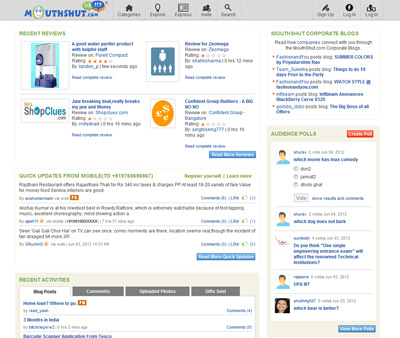
  • Mouthshut.com to turn a buyer’sguide

    By Robin Thomas


    Popular consumer review website MouthShut.com is set to shift from being a reviews-only site to a buyer’s guide. This transition is scheduled to take place within a fortnight.


    In its new role, MouthShut will position itself as a company that helps consumers decide which product they want to buy from a host of product categories — ranging from cars, bikes, cellphones and so on. Restaurants and hotels will also be part of the buyer’s guide enabling users to know the type of cuisine available, phone numbers and addresses for deliveries and so on. Moreover, MouthShut will constantly add newer categories on its portal after every few weeks.


    Speaking to MxMIndia about the transition to a consumer buying guide, Faisal Farooqui, CEO, Mouthshut.com said, “We realized that a transition from a reviews-only site to buying guide is more important today because the consumer needs are changing fast as they no longer use the internet just for emails and chats but, also for buying. As e-commerce is growing robustly in India, people are getting more comfortable buying products online. Thus we decided that we need to provide consumers not just reviews but also help or guide them buy products.”


    Mouthshut.com will partner car dealers and manufacturers and allow for registering for test drives. In fact it has tied with Maruti and General Motors already.


    The transformation to a users buying guide will also mean revamping the Mouthshut.com website, which will take place along with the roll-out. Also on the anvil is a mobile version of the site.  “The mobile experience will be totally customized for mobile users and while the look-and-feel will be different, the content will of course be the same” said Mr Farooqui.


  • Hungama Digital to manage Microsoft India’s social media

    By A Correspondent


    Hungama Digital, part of Hungama Digital Media Entertainment Pvt. Ltd., has won the social media mandate for Microsoft India’s corporate brand. Hungama Digital will manage all social media interaction on Facebook, Twitter, YouTube, blogs and other collaborative mediums on digital media.


    Besides the corporate mandate, Hungama Digital will also manage three other businesses for Microsoft India on social media – MSN India, Windows Azure and Microsoft Office.


    Commenting on Hungama Digital’s appointment, Meenu Handa, Director – Corporate Communications, Microsoft Corporation India Pvt. Ltd. said: “Over the last few years, we have invested significantly in social media, and it is today a substantial part of our media mix. To take our social media platforms to the next level of growth, we were looking for a creative and experienced team to support us and have found a passionate and engaged team in Hungama Digital.”


    Speaking on the winning the account, Siddhartha Roy, COO, Hungama Digital Media said: “With the growing number of interactions over digital, especially on social networking sites, this is a great opportunity for the team at Hungama to build Microsoft’s corporate image on the social platform. The team also brings to the table over 13 years of digital marketing experience – over the internet, mobile, and other connected platform, that have resulted in award winning campaigns over the years. We are extremely excited about the business and look forward to a long sustainable relationship with Microsoft India.”


    Currently, Microsoft’s corporate social channels in India include Twitter, Facebook  and YouTube.