Category: Digital

  • IdeateLabs wins marketing mandate for Planet Marathi

    By Our Staff


    Digital marketing agency IdeateLabs has won the mandate for Planet Marathi OTT. The company will manage the brand’s end-to-end marketing duties, including creative communication, content marketing, and media strategy, planning and buying.


    Akshay Bardapurkar
    Akshay Bardapurkar

    Said Akshay Bardapurkar, Founder, Planet Marathi: “Planet Marathi was incubated with the vision of creating a niche for Marathi content: Film, Art, and Culture and taking it across the globe. OTT makes entertainment accessible to people anywhere, anytime, 24×7. IdeateLabs married this vision to put the world’s first OTT in Marathi, in the global spotlight and has the creative ability and marketing verve. We are glad to onboard them as our marketing partners.”


    Vrutika Dawda
    Vrutika Dawda

    Speaking on the win, Vrutika Dawda, Director, IdeateLabs, added: “The next boom on the OTT medium is on the vernacular front. Marathi is the third most spoken language in the country, with loyalists all over the world. Further, Marathi content has a rich heritage and sub-titles on digital makes it universal. We are excited to partner with Planet Marathi OTT and build 360-degree conversations, keeping with our DNA, around its curated content, across borders.”


  • Identity Crisis within Social Media

    Image courtesy: https://anchordigital.com.au/


    By Indrani Sen


    Indrani SenThe discussions about the identity crisis faced by the users of social media, particularly the younger generation, started almost from the inception of social media. Lately researchers, academics and industry watchers have been talking about other identity crisises within the social media. The first crisis relates to managing one’s identity on the internet across various work related and social media related accounts/ apps and it is often said that if a person has more than a dozen of such accounts with different IDs and passwords then the person needs a ‘password manager’. A movement has ben going on for some time advocating for an unique identity per every consumer on internet which will enable them to acces all internet accounts with the same ID and password. However, this may lead to a breach of trust between consumers and their individual internet accounts as all personal information shared by them on any account can be accessed through their unique identities.
     

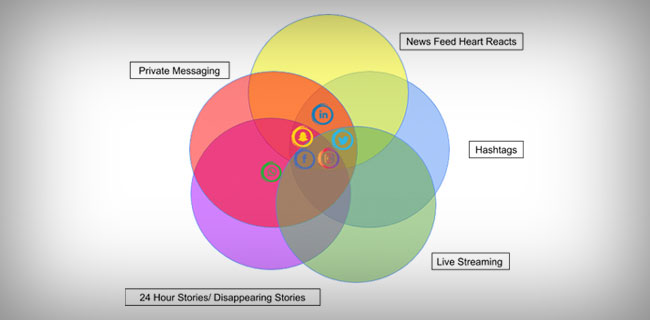
    The second crisis is the intense identity aggregation of consumers by Google and Facebook which has started pushing some internet users from the two giants to other anonymous platforms. For the purpose of marketing through their networks Google and Facebook create such aggregated buckets of identities which many consumers find unacceptable.


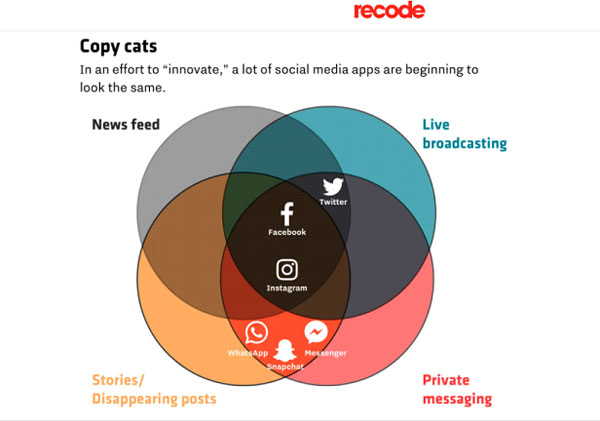
    The third and perhaps the biggest crisis is the loss of identity of different social networks / apps which has emerged during the last 5 due to the blatant copying or adopting of features of another social network. Last week I listened to an interesting podcast on www.emarketers.com talking about “…. what Facebook has become and is trying to be, what to make of social media platforms looking more and more alike, and which of these “copycat” moves might strike gold. We then talk about the significance of Nextdoor going public, how India’s social media content liability laws could impact Twitter (and others), and some changes as to what advertisers can, and can’t, do on social media.” The podcast can be accessed through the following link https://www.emarketer.com/content/podcast-facebook-and-social-media-identity-crisis-twitter-liability-retouching-ads?ecid=NL1009.


    Source: https://www.vox.com

    There is an extensive list of services/ features which have been copied since their introduction in one social media platform by others. In 2010 Instagram launched with the feature “double tap to heart react”. Instagram copied Snapchat’s stories feature first which was followed by Facebook adopting the same application from Instagram. In 2012, Facebook acquired Instagram and adopted the “heart react” feature from Instagram. In 2015, Twitter replaced it “star react” feature with “heart react”. In 2019 Linkedin introduced a set of “react” features including the “heart react”. There are many more such examples.


    In the digital age, we have seen a shift of power from organisations to consumers which has been labelled as ’transformed consumer contexts’ by Neil Perkin and Peter Abraham in their book titled Building the Agile Business Through Digital Transformation. Consumers once experiencing once a satisfactory service or a tool on a social network, expect the same capability from all other social media networks. As a result, this trend of extensively copying from each other has started in the social media sector for winning over the consumers. This trend has attracted lot of criticism as it is becoming increasingly difficult to differentiate among the social media platforms, but no immediate solution for countering this trend is in sight for reversing the identity crisis within social media.


  • Zirca launches next era in digital solutions

    By Our Staff


    Zirca Digital Solutions has launched a suite of unified solutions called Zirca iQ. Said Neena Dasgupta, CEO and Director, Zirca Digital Solutions: “Staying still is something that is not in our DNA. While nobody likes the ongoing pandemic, we tried our best to utilise this time to make a better version of us. Our new website is an effort that showcases who we truly are and what we are capable of doing. Zirca has evolved multi-fold from what we started as, and now is the opportune moment to display our true potential. Be it our proprietary tool Archetype indicator, our block chain integrated products, or any other product and service in the Zirca arsenal, all are poised and ready to handle the next wave of digital.”


    Added  Karan Gupta, Managing Director, Zirca Digital Solutions: “Over the years, Zirca has diversified its offering even during this hard time when the world was slowing down. Zirca undertook some internal changes to realign its business goals signifying the diversification of its business. Our aim is to always stay ahead and give the best to our partners and marketers with our solutions.”


  • India Shining in Ecommerce Growth


    By Indrani Sen


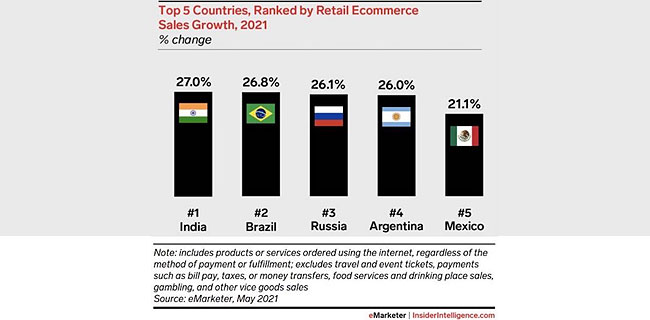
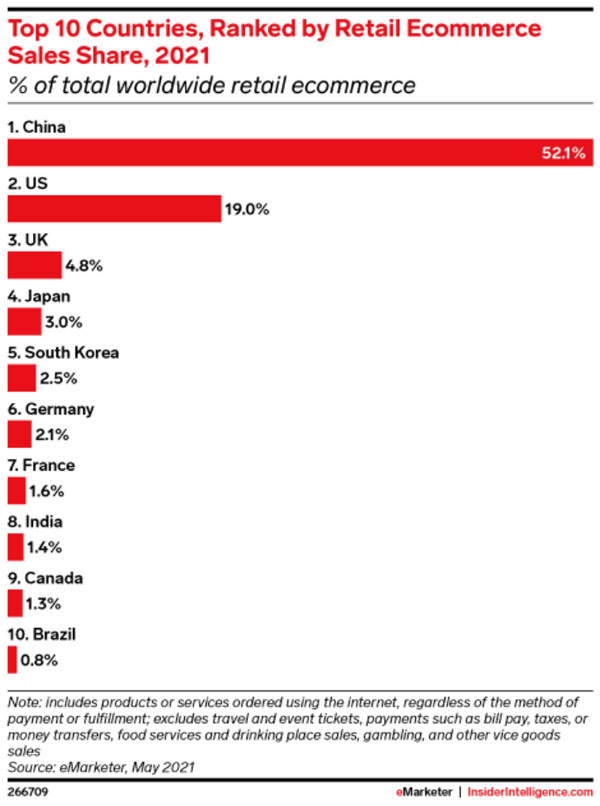
    Indrani SenA study “Global Ecommerce  Forecast 2021” conducted earlier this year, followed by articles published in www.emarketer.com recently show that India ranked eighth in the share of retail Ecommerce  sales in the world in 2020, while leading in the growth rate along with a pack of Latin American countries and Russia. The trend is estimated to continue during 2021 with China leading the pack of countries with US featuring as the poor second. India, thanks to the huge population base and the accelerating drive for a “Digital India”.


    The retail Ecommerce grew dramatically across the world at the cost of the physical stores sales in 2020 as COCID 19 raged across both developed and developing countries. In an article published on July 7, 2021 Karin Von Abrams wrote “Before the pandemic, we had forecast that total retail sales worldwide would rise by 4.4% in 2020, to $26.460 trillion. We now estimate that retail sales amounted to just $23.624 trillion last year-a decline of 2.8%. But in 2021, this figure will rebound to pre-pandemic (2019) levels, reaching $25.052 trillion.” (https://www.emarketer.com/content/global-Ecommerce -forecast-2021) 


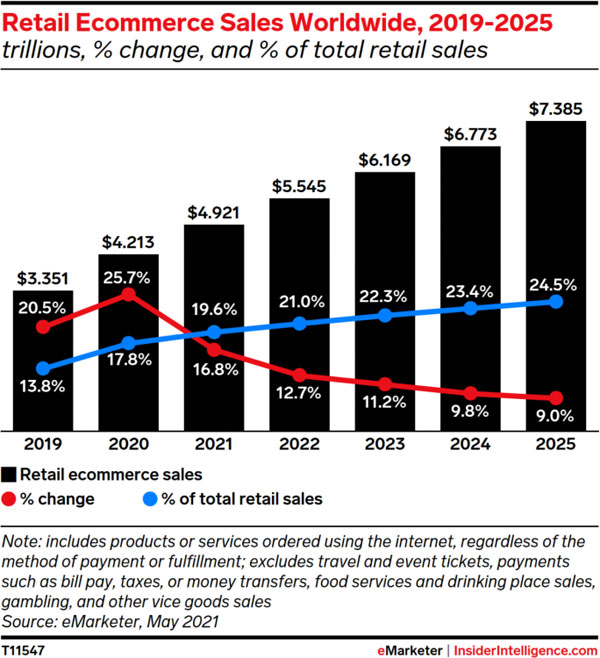
    Another chart published in the same article reflects the worldwide growth of Ecommerce  from 2019 to 2020 and the subsequent drop in the same.


    India, however is expected to have an increase in the growth rate of Ecommerce  in the coming years and reach a size of US$ 99 billion by 2024 as also indicated in another article published on May 9, 2021 (https://www.ibef.org/industry/Ecommerce .aspx)   which lists a series of initiatives taken by the Ecommerce  industry along with Government initiatives and increasing investments as the key factors behind this surge of growth apart from growing demand and attractive opportunities. The road ahead also seems to be full of promises. The growth in this sector has been beneficial for the MSME sector in India and is expected to fuel their growth in the long run.  Along with the growth, the share of India in the world wide retail Ecommerce  is also supposed to increase propelling its rank from eighth to third after US in the coming years.


  • Fulcrum Digital onboards as digital partner for Alhilal Life

    By Our Staff


    Fulcrum Digital, a leading business platform and digital engineering company, has announced its partnership with Alhilal Life, a life and medical insurance provider in Bahrain. The company  used its flagship product ‘FulcrumOne’ to enable Alhilal Life to create a seamless customer onboarding experience.


    Said Dhana Kumarasamy, CEO, Fulcrum Digital: “We are delighted to partner with Alhilal Life and its mission. We aligned with their strategic goal of delivering an exceptional experience, value, and speed for customers through a digital channel. Our business accelerator platform, FulcrumOne, enabled this digital transformation, and it is a testimony to our platform expertise. Alhilal Life has created an outstanding and collaborative thought leadership-driven culture that empowered our team to deliver this transformative digital solution. Our commitment to delivering excellence combined with insurance domain experience helps us innovate and bring forth cutting-edge solutions for customers. The Middle East continues to be an important market for us, and we are having active discussions with some of the leading insurance and financial services companies.”


  • Kaizzen bags Viacom18 corporate mandate

    By Our Staff


    Kaizzen has won the PR mandate for Viacom18’s corporate brand communication, filmed business and regional entertainment, post a multi-agency pitch. The mandate covers corporate reputation management, strengthening brand and leadership visibility, as well as network initiatives led by the media giant.


    Said Vineet Handa, CEO – Kaizzen:  “Viacom18 has cemented itself as a pioneer in the media and entertainment segment by offering groundbreaking content and innovative concepts. We are thankful to the management team at Viacom18 for believing in our vision, ideas and entrusting us with the responsibility to drive their communication strategy for the corporate brand, regional entertainment, and filmed entertainment. Our team is excited at the opportunity of working collaboratively with the team at Viacom18; to execute innovative, disruptive high-impact PR campaigns that positively impact the business.”


    Although the Kaizzen communique does not include a quote from Viacom18, MxM has independently confirmed that mandate has indeed been awarded to Kaizzen. It was earlier handled by Mondial Communications which is now taking charge of Voot Corporate, Youth Music Entertainment and the kids cluster.


  • ShareChat appoints Akshat Sahu as Director Marketing

    By Our Staff


    Akshat Sahu
    Akshat Sahu

    ShareChat, the social media platform, has announced the appointment of Akshat Sahu as Director, Marketing. He will be reporting to Ajit Varghese, Chief Commercial Officer, Moj and ShareChat.


    Welcoming Sahu to ShareChat, Varghese said: “Akshat brings in a strong set of skills and his expertise in branding and marketing will add a lot of value to our team. He is a proven marketing leader with strong strategic acumen, in-depth consumer insights and highly efficient operational focus. We hope he will bring immense value and spread our brand reputation across the diverse group of stakeholders as we continue to build ShareChat on our long-term strategy.”


    Added Sahu: “I have always been intrigued by the diversity of India and it is a special opportunity to be working with a company that is pioneering the Indic language conversations in the internet space. I am looking forward to contributing to the company’s growth with my core area of expertise and making ShareChat a household name in India.”


  • Indian online gaming biz may reach $2bn by 2023…


    By Our Staff


    The Indian online gaming sector reached US$1.027 billion in 2020, a growth of ~17.3% from US$543 million in 2016. With its current trajectory, it is expected to reach US$2 billion by 2023 in terms of rake fees earned, states the just-released EY- All India Gaming Federation (AIGF) report ‘Online gaming in India – The GST conundrum.’ While India is currently the fourth largest online gaming market globally, the industry requires a robust regulatory and legal environment to help the business scale quickly and achieve its true potential. The report highlights global best practices for taxation and provides much-needed clarity on aspects related to valuation and applicable GST rates.


    Online gamers in India are estimated to grow from 360 million in 2020 to 510 million in 2022. Additionally, there are over 400 gaming start-ups at present that are accelerating the growth of the sector. However, in India, the classification of whether a game comprises a ‘game of skill’ or a ‘game of chance’ has wide consequences for legal implications on the business operations. A game of chance attracts a higher GST rate of tax vis-à-vis a game of skill. Online games operate either on the ‘rake fee’ model wherein the gaming platform charges a rake fee for facilitating games or ‘freemium’ models wherein the gameplay is free but additional features may require users to purchase specific items for a monetary price. A rational imposition of Goods and Services Tax (‘GST’) is therefore vital for sustaining this industry.


    Said Bipin Sapra, Partner – Indirect Tax, EY India: “The online gaming industry is growing at an impressive CAGR of over 20% and holds significant potential for economic growth, job creation and contribution to the Government’s vision of a trillion dollar digital economy by 2025. To enable the industry in realising its peak growth potential, it is imperative that the GST regime for online gaming industry is kept rational and at par with other technology platforms. Adopting globally consistent standards in our tax treatment of the industry will enable it to achieve its true potential.”


    Added Roland Landers, CEO, All India Gaming Federation (and former Chief Brand Officer at Zee and Head of Zee Sports): “The valuation disputes under GST law have been a dampener to the industry. Considering the market size and future growth projections, the online gaming industry is expected to be a significant contributor to the government’s vision and provide future economic avenues considering the ubiquitous digital trends impacting our lifestyle. It is important to highlight that regressive taxation of these emerging sectors may only make the business unsustainable in India. Our recommendation is that the Tax authorities should align its policies with internationally accepted principles of taxing the online gaming sector and provide certainty to the industry. We hope that this report would provide meaningful insights and help accord focus to this sunrise industry.”


    To realise the full potential of online gaming industry, adds the communique, a levy of standard GST/VAT rates is recommended, to be treated on par with any other segments of the economy.


    The valuation mechanism in levying GST on the entire stake value vis-à-vis the rake fee element should be clearly outlined to avoid any ambiguities and potential litigations leading to tax demands. Any uncertainty and possibilities of litigation adversely impacts the business plans, operations, and entry of new players in the industry. Most industry players have a rake fee in the range of 4% – 20%. Any attempt to levy GST on the entire stake value potentially leads to economic unviability of the business model and could force the closure of businesses.


    The report outlines three options:

    (i) GST on rake fee value: Thissuggests a levy of GST only on the rake fee i.e. consideration received by the gaming platform. It is presently being followed across the industry and is in alignment with existing GST mechanism to levy tax on consideration only.


    (ii) Deemed credit model: This has only two data metrics to be considered – stake and pay-outs. This mechanism makes it easier for the Government to verify and audit entities. However, businesses would be required to undertake a change in their ERP systems to compute GST.


    (iii) GST on entire stake value but at a nominal rate of say 1.8%: Thisis simpler to calculate as it has only one data metric to be tracked by business i.e. stake value. However, the mechanism would be discriminatory for industry players having low rake since GST outflow would be high whereas margins are lower. This method is also prone to manipulation where ‘platform fee only’ players without any prize-winning model may offer nominal winnings to lower tax outflow.


    Given the online gaming industry acts as a technology enabler and facilitates gameplays through a web platform similar to software companies’ products, the report recommends a GST rate of 18% to be levied to mitigate any risks of misclassification of the online gaming industry as betting or gambling. The tax rate should not exceed 20% as it could result in the gaming operators as well as consumers entering the grey market.


    Singapore, South Africa and Australia follow the deemed credit model mechanism making it easier to verify and audit the entities. The model is in line with judicial decisions and also takes care of anticipated risk around the misdeclaration of rake fees.

  • Madison Digital elevates Chintan Soni & Kosal Malladi

    By Our Staff


    Chintan Soni
    Chintan Soni
    Kosal Malladi
    Kosal Malladi

    Madison Digital has just announced the promotions of Chintan Soni and Kosal Malladi to Vice Presidents. Both, notes a communique, have played an instrumental role in the growth and success of Madison Digital since joining the organisation in 2013 and 2018 respectively.


    Said Vishal Chinchankar, CEO, Madison Digital, “Chintan and Kosal have been a great asset to the Madison Digital team, with the same vision of growing the vertical and taking business to greater heights. Year on year, they have been delivering exceptional results and we couldn’t be happier to give them the much-needed promotion they deserve!”


  • Velocity Awards created for digital comms

    By Our Staff


    Velocity AwardsThe first edition of Velocity Awards, organised by CommsNews website, has been announced. Entries are being accepted from today (August 16) till September 28, 2021. The awards will acknowledge and celebrate the work of a brand or an organisation or an individual that has used digital mediums for outreach, between April 2020 and March 2021. There are two main categories further divided into 24 subcategories – Best of Digital Awards and Best Team Awards. These will honour professionals who are the backbone of the digital community and create a sense of pride for their outstanding digital work.


    The Velocity Awards has onboarded Grant Thornton as the Process Reviewer to ensure a transparent process and due diligence.


    The jury has been curated to leverage their experience in order to ensure the awards become the most credible. The jury members, as of now, include over 20 Chief Marketing Officers and Chief Digital Officers.


    The shortlist will be announced by November 26, 2021, and the awards will be presented on December 10. The Velocity Awards are supported by Kritical Edge as Marketing Partner; FounderIndia as Media Partner, and Promise Foundation as supporting partner. The logo is designed by Geo George. For details, write to Hina Issar Huria, the Awards Director, at director@velocityawards.in


    And since it’s Promise Foundation, you know who is behind it.


  • Josh launches JoshCam for video edits

    By Our Staff


    DailyHunt sibling Josh has announced the launch of its JoshCam app on Google Play Store and App store. This is a mobile video editing app for users and creators of short format videos.


    Speaking at the product launch, Shailendra Sharma, Senior Vice President – Product & Engineering, VerSe Innovation, said: “At Josh, we are on a mission to provide the best of opportunities to our users and creators. Our platform capabilities continue to be our biggest differentiator and the addition of the JoshCam app reinforces our mission to give our users and creators the best experience on a short-video app. While the JoshCam comes loaded with numerous features and effects, we have specifically simplified the UI of the app for more accessibility. The app’s robust technology and user-friendly interface will further allow users to impart a professional touch to their content.”


  • Control. Damn. Delete


    By Ranjona Banerji


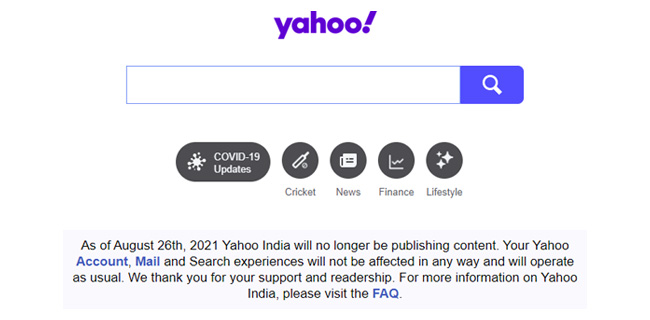
    Ranjona BanerjiYahoo has shut down all its news sites in India. The government’s new FDI laws in the digital media meant Yahoo owner Verizon had to change its ownership patterns to no more than 26 % foreign investment. However, according to news reports, Verizon has been unsuccessful since November 2020 to get the government to approve its ownership changes.


    You could look at this as a sort of technical hitch in operating in India (“ease of business”?), you could do several gleeful jumps that Indian pride had been fulfilled and no foreigner was going to control Indian news, or you could take a cold hard look at how the dissemination of news in India was being controlled in overt and covert ways.


    Here she goes again, you might think to yourself, blaming India’s most patriotic government. But news is not what makes you happy, what you want to know, what makes you proud and what fulfils your ideas of self-glory. News is everything, good, bad, ugly and mostly ugly. The more news sources you can access, the wider the range of news at your disposal for you to make informed choices. The more news sources you do access, the less of an impact fake news can have on you.


    And here is the crux of the matter. Let’s say for the sake of argument that all governments want to control the flow and composition of the news so that they can keep their citizens, subjects, whatever in darkness and ignorance, making them easier to manage. Control has been an essential component of a “successful” ruler through human history. In ancient times, it was most apparent through religious power – keep religious books away from believers so that they cannot think for themselves or question anything. Since kingly power flowed from religion, both the priestly and ruling classes were satisfied. The printing press and democracy severely hampered this age-old method of control of information.


    Since that evil invention of a printing press and with the advent of democracy and with that the birth of journalism and mass media, this hoary plan of domination got severely hampered. The lynchpin of every successful fascist ruler has always been propaganda and media control. A most unlikely ally in recent times has been social media. The internet which was supposed to make information free and easy to access has also allowed misinformation to become even easier to access.


    It is always worthwhile to go back to the Cambridge Analytica story to remind oneself of how easy it is to manipulate the minds of millions and to get manipulated.


    To get back to the beginning, the shutdown of Yahoo News means that readers have lost one more source of news. They have that much less to depend on. They are pushed that much further towards India’s many open propaganda outlets and the many that are by compulsion or fear turning into propaganda outlets.


    The threats faced by journalists has increased in the past few years, and the numbers who have been killed, arrested, threatened, harassed for doing their jobs have also gone up. We add a new name to that list: Sristhi Jatav, who works for the Dalit Times, a news website. This young reporter was arrested by the Delhi Police for covering the demolition of the Dhobi Ghat slum. Jatav was later released but ask yourself why she should have been arrested at all. Every small incident like this racks up the dangers for journalists in India.

    https://scroll.in/latest/1003748/delhi-dalit-journalist-briefly-arrested-released-after-social-media-outrage

    This week, the works of two women Dalit writers, Bama and Sukirtharini, and Mahasweta Devi’s well-known short story Draupadi have been dropped by Delhi University. One reason is that the head of the Oversight Committee, a Mr Pandit, does not believe in casteism. How much more Orwellian can you get. The other is that sentiments of the police are hurt by Mahasweta Devi’s seminal work about a tribal woman gangraped at a police station. This explanation when coupled with increasing media control tells you how much our freedoms are under threat. Welcome to the burning of the books.

    https://www.thehindu.com/news/national/du-comes-under-fire-for-dropping-texts-by-dalit-writers/article36129204.ece

    Ranjona Banerji is a senior journalist and commentator. She writes on MxMIndia every Tuesday and Friday. Her  views here are personal