Category: Digital

  • Tilt Brand Solutions partners with Dream11 for campaign

    By Our Staff

    Fantasy sports platform Dream11 has launched an ad campaign in association with Tilt Brand Solutions. The campaign encourages users to apply their skills to build the best team on the Dream11 app. There are 12 films in all, six of which are part of the #TeamHaiTohMazaaHai campaign. The other six films are part of the #Dream11PeDimaag campaign. It features MS Dhoni, who urges the viewers to use their “dimaag” on Dream11.

    Said Vikrant Mudaliar, Chief Marketing Officer, Dream Sports & Dream11: “Our partnership with Tilt Brand Solutions has delivered successful and memorable campaigns in the last three years. The 2021 IPL advertising campaign features films that bring together the joy of playing cricket with friends as a team, making it extremely relatable to all cricket fans.”

    Added Shriram Iyer, Chief Creative and Content Officer, Tilt Brand Solutions: “Each year we set out to bring alive Dream11’s mass appeal on the country’s biggest stage while keeping the cricket fan bang in the middle of it all. While our first campaign, #TeamHaiTohMaazaHai brings together the country’s 2 biggest passions – Cricket and Bollywood, our second campaign, #Dream11peDimaag urges fans in a fun way to use their knowledge and intelligence in this game of skill.”


  • Google is Most Valuable Media Brand


    By Our Staff

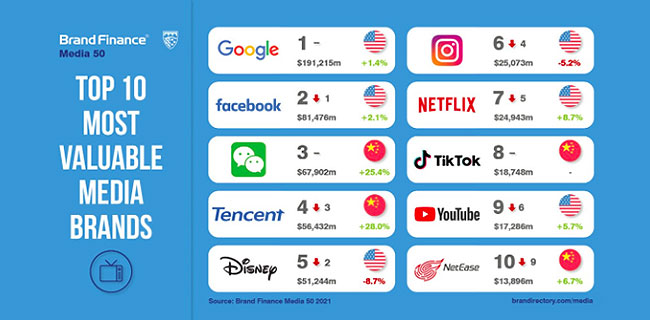
    Search engines included in Brand Finance’s annual ranking of world’s most valuable media brands for first time, with Google claiming top spot – brand value nearly US$200 billion. TikTok breaks right into top 10 most valuable media brands after its first brand valuation. Social media and gaming brands among fastest-growing in ranking, with Chinese newcomers Bilibili and Huya improving most – at 106% and 74% respectively. TV networks and film studios suffer in wake of pandemic – CBS fastest-falling brand in ranking, losing half of brand value over last year. WeChat named strongest media brand with elite AAA+ rating, while Facebook struggles to overcome reputational issues.

    View the full Brand Finance Media 50 2021 report here

    For the first time, search engines are included in Brand Finance’s annual ranking of the world’s most valuable and strongest media brands, with Google claiming the top spot, following a 1% increase in brand value to US$191.2 billion.

    Technology has become an integral part of all businesses, so Brand Finance has reclassified brands into the industries they are revolutionising. As a search engine, most of Google’s revenue is derived from advertising, leading to its inclusion as a media brand and the extension of the Brand Finance Media ranking to include 50 brands this year.

    Google also owns the majority of internet advertisement infrastructure – controlling about 90% of search ads, managing the main ad exchange and server, running popular browser Chrome, and dominating smart devices with its Android operating system. Moreover, it manages widespread data centres, as well as a large portion of the cloud, which is where most of the ad dynamics occur. In addition to capitalising on ad spend, Google has since expanded into a variety of fields such as hardware, entering the smartphone industry by releasing the Pixel, its first handset.

    The addition of search engine brands to the Brand Finance Media 50 2021 ranking follows expansions in previous years including streaming platforms, gaming brands, and social media as they continue to grow and carve out their own place in the media market, shifting the balance away from the networks, film studios, and publishers before them. Five further search engines feature in the extended ranking this year, with Yahoo! placing second highest after Google in 13th position with a brand value of US$9.4 billion.

    Said Richard Haigh, Managing Director, Brand Finance: “Significantly better at innovating than its rivals, Google changed the marketplace of search engines, spearheading the digital media revolution in a way that distinguishes the brand above all others. No better indicator of this is the fact that the name Google has become a verb – ‘I’ll Google it’ is quite arguably one of the most widely used phrases of the 21st century.”

    TikTok (known in China as Douyin) enters the Brand Finance Media 50 2021 ranking for the first time with a brand value of US$18.7 billion, launching into the top 10 most valuable media brands in 8th position.

    Another Chinese video sharing platform Bilibili has gained more in brand value than any other brand in the Brand Finance Media 50 2021 ranking, with an impressive 106% increase to US$1.9 billion. Despite being known for its cache of video content, Bilibili draws a large portion of its sales from smartphone games, which accounted for 40% of its revenues in 2020 versus over 70% in 2018, indicating an attempt to diversify its revenue stream. In the first quarter of last year alone, Bilibili reached 172 million Monthly Active Users (MAUs), placing it in the same class as video services operated by Tencent (up 28% to US$56.4 billion).

    Video game publisher Huya is the ranking’s second fastest-growing brand with an impressive 74% increase in brand value to US$1.6 billion. The brand celebrated an uptick in MAUs at the end of last year – reaching a total of 178.5 million people – as well as a boost to advertising revenues, primarily driven by its expanding and diversifying advertiser base.

    Other gaming platforms that performed well this year include South Korean NCSoft (up 68% to US$2.2 billion) and Kakao (up 49% to US$1.8 billion), as well as Activision Blizzard (up 20% to US$6.3 billion) and Electronic Arts (up 14% to US$4.4 billion).

    COVID-19 has exacerbated the widening gap between traditional media brands, with TV networks and film studios facing an uphill battle against online competitors. This is best exemplified by CBS being the fastest-falling brand in this year’s ranking, with a 49% decrease in brand value to US$5.9 billion, following a dramatic drop in advertising revenue and a disastrous merger with Viacom. However, CBS is not alone in its struggles, with NBC (down 44% to US$8.4 billion), 20th Television (down 25% to US$6.1 billion), and Universal (down 21% to US$11.6 billion) all seeing considerable declines in brand value as film and television production was halted.

    Comparatively, Netflix enjoyed a spike in usage, causing its brand value to increase by 9% to US$24.9 billion. Netflix has been a pioneering force in changing consumers’ viewing habits, taking over traditional television by providing a more appealing, flexible option in line with the modern fast-paced lifestyle. With 37 million new users by the end of 2020, Netflix’s success has driven improved revenue forecasts and brand equity scores. Despite this, the streaming platform’s growth was not as substantial as in previous years due to challenges posed by competitors such as Disney (down 9% to US$51.2 billion) and HBO (down 3% to US$4.0 billion), which recently started offering streaming services in a bid to remain competitive.

    Riding the airwaves of media revolution to offer more personalised, online consumer experiences, Spotify enjoyed an impressive 39% boost in brand value to US$5.6 billion. The music streaming platform has seen a significant increase in new users over the past year after expanding operations into 13 new markets. Spotify is now primed for further success as it continues to develop its capabilities, signing exclusive podcast contracts with Archie Comics and Joe Rogan, and acquiring Megaphone from Graham Holdings to improve its own podcast technology.

    Added Richard Haigh, Managing Director, Brand Finance: “Podcasts are one of the primary motivators for listeners to upgrade to paid subscriptions on music streaming platforms, with the global podcast industry expected to grow by nearly 30% over the next five years. With these forecasts, and rivals already showing market intent, Spotify’s reign as the leading music streaming brand will be difficult to maintain.”

    WeChat is the world’s strongest media brand with a Brand Strength Index (BSI) score of 95.4 out of 100. One of the world’s most popular social media apps, WeChat is also the strongest brand globally, according to the Brand Finance Global 500 2021 report, and one of only two brands in the media ranking to have been awarded the elite AAA+ brand strength rating, the other being Disney with a BSI score of 89.7 out of 100.


    Alongside revenue forecasts, brand strength is a crucial driver of brand value, and as WeChat’s brand strength grew, its brand value also enjoyed a rapid boost, increasing by 25% to US$67.9 billion. One of China’s home-grown tech successes with very strong equity, WeChat enjoyed high scores in reputation and consideration among Chinese consumers – according to Brand Finance’s original market research – successfully implementing a broad and all-encompassing proposition that offers services from messaging and banking, to taxi services and online shopping, becoming essential to many users’ daily lives.

    Said Richard Haigh, Managing Director, Brand Finance: “A beacon of innovation, WeChat has shown the value of constantly striving for technical development, particularly in the face of adversity. Though the company has done exceptionally well this year, lower levels of enthusiasm among younger adults in China may be a warning flag. It will be essential for WeChat to keep up its momentum to achieve similar successes in the year ahead.”

    In stark contrast, social networking site Facebook trails behind WeChat by almost 20 BSI points, scoring 77.0 out of 100. With 2.8 billion active monthly users, Facebook remains the most popular social media platform in the world. Despite recording a marginal increase in brand value and placing second overall in this year’s ranking, Facebook has battled widespread scrutiny over privacy issues and suffered significant reputational damage in the wake of several political and social scandals, ultimately damaging its brand strength.

    With an even lower BSI score of 72.5 out of 100, Twitter’s brand strength is similarly dented by issues with consumer trust and reputation. In the past year, the platform faced intense scrutiny over its handling of Donald Trump’s account, sparking raucous debate surrounding freedom of speech and accusations against the former US President for allegedly using the platform to incite violence and spread fake news.



  • MPL acquires GamingMonk

    By Our Staff

    Mobile Premier League has acquired Esports gaming platform GamingMonk. This acquisition will allow MPL to accelerate bringing to market key national, regional and global tournament IPs and allow MPL to develop a full suite of Esports and broadcasting capabilities. GamingMonk hosts Esports tournaments across multiple platforms including PC, Console and Mobile.

    MPL has also launched Esports Arena, the banner under which the platform will host fortnightly Esports tournaments in some of its marquee games such as Chess, WCC, Pool, etc. With Esports Arena, MPL aims to take Esports truly to the masses across India, with gaming titles that are smartphone friendly and can be played on a range of smartphones.

    Said Sai Srinivas, Co-founder and CEO, MPL: “In our mission to serve gamers in India, GamingMonk will augment our efforts in reaching our target audience and engage with our users effectively. With the increased consumption of Esports in the last couple of years and it becoming as competitive as any other sport, it gives us immense pleasure to present our users with the best of games to play, and enjoy their passion for gaming.”

    Added Ashwin Haryani, Co-Founder, GamingMonk: “We are extremely excited to be a part of MPL. From the very onset, GamingMonk’s vision was to change the Esports scenario in India, and I strongly believe that our collaboration with MPL will not only help us accomplish our goal, but also transform the way every individual in our country views esports. MPL has been one of the pioneers in changing the gaming culture in Asia, and it was a no brainer for us that if there was someone who could help us reach our goal at the earliest it had to be them,”


  • Rise & Shine of the Digital Duo


    By Indrani Sen


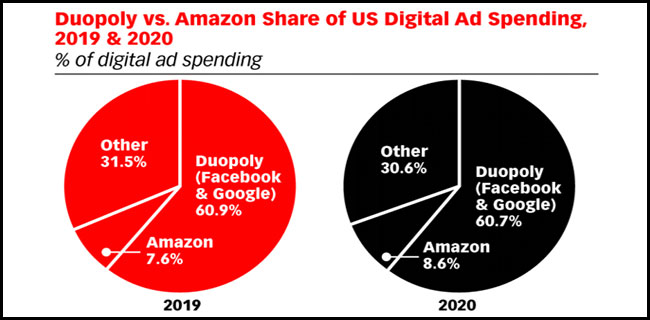
    The digital marketing trends in US indicate the trends across the world (except China). Recently, an article in www.emarketer.com indicated that the Facebook-Google duopoly will continue in the US market in spite of the amazing growth registered by Amazon which has been steadily increasing its share (https://www.emarketer.com/content/facebook-google-duopoly-won-t-crack-this-year?ecid=NL1009). Google is the leading partner in this duopoly across the world.
     

    The same duopoly enjoys together 68 per cent of India’s digital ad market and it is likely to grow as the digital advertising spending is expected to also increase by 30 per cent in 2019. Even if the growth forecast takes a dip as foretold by the less than expected yield of digital media during Diwali 2019, it will not affect the stronghold of the duopoly.


    Google India, the arm of the technology giant, reported total revenue close to ₹ 9337 crores in FY18.  A most unprecedented financial result reported by Google India for FY19 has created confusion in the market place. Google India reported a 56 per cent fall in revenue to ₹ 4147 crores in the year ended March 31, 2019 (https://www.statista.com/statistics/717633/google-revenue-value-india/). The fall was attributed to a new accounting standard introduced by the Ministry of Corporate Affairs, Government of India.


    Google is the undisputed leader in India’s mobile search engine market, but its biggest cash cow- Google AdWords, is registered under the Google Asia Pacific division. As such, the revenue and profits from AdWords cannot be filed as part of the Indian division without incurring certain burden of taxation as per the amended rules. So, advertising revenue, the biggest contributor to Google’s  overall revenue is missing from the revenue posted by Google India.


    On the other hand, Facebook Inc’s Indian operation has reported revenues of ₹ 892 crore, compared to revenues of ₹ 521 crore, a 71% jump in revenues last fiscal for fiscal year ended 31 March 2019  (https://economictimes.indiatimes.com/markets/stocks/earnings/facebook-reports-84-jump-in-net-profit-for-india-at-rs-105-crore-for-fiscal-2019/articleshow/71891826.cms?from=mdr) As a result, share of Facebook has gone up in the duopoly in Indian market, though it has a long way to go before its revenue gets closer to Google’s revenue. It remains to be seen if Amazon will be able to grow its share in the Indian market following the US example.


    As advertisers and agencies continue to use Google AdWords and place digital advertising through Google, the analysis of the revenue sources will not match with the money spend on digital advertising across various platforms offered by Google and will add to the computing confusions in media planning.


  • Online Gaming is the new Digital Rock Star


    By Indrani Sen


    Indrani Sen

    The digital gaming industry in India is currently undergoing rapid changes riding on the mobile revolution and fuelled by investment from big players such as Alibaba, Tencent, Youzu and Nazara. Many startup gaming developers are also lapping up the opportunities and providing the online gamers with new formats of online games and real-time experiences. Industry experts estimate that the number of online game developers has grown 10 times in last eight years from a mere 25 in 2010 to around 250 in 2018.


    A decade back, the accessibility to playing online games was not easy as it required downloading and installation of games on consoles and desktop computers. The rising affordability and adoption of smartphone has become one of the important factors contributing to the rise in the number of gamers and success of the online gaming Industry. The new age gaming developers are experimenting with innovative gaming formats backed by blockchain, artificial intelligence and machine learning technology. Action, adventure and puzzle are the popular gaming genres in India with fantasy sports rising at a fast rate supported by emergence of new sports leagues as well as promotion of traditional sports tournaments through online gaming.


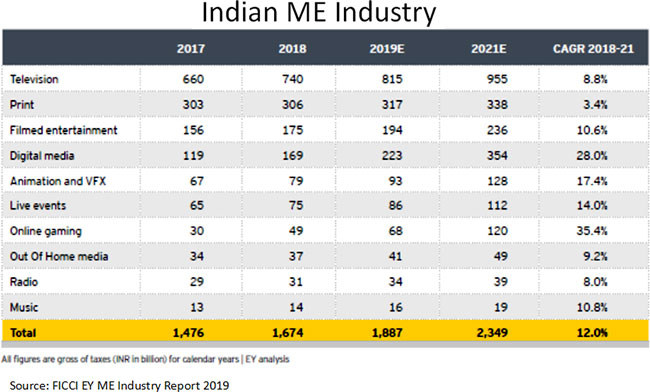
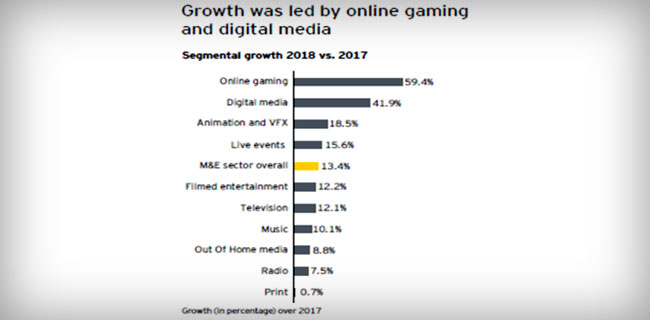
    As per the FICCI-EY 2019 report on Indian M&E Industry, the industry growth was from 2017 to 2018 was led by online gaming and digital media as shown in the following chart.


    Source: FICCI EY ME Industry Report 2019


    The report further predicts that online gaming will have the highest CAGR (35%) from 2018-2021 and along with the digital media (28%) and in three years both sectors will more than double their value in INR. While digital media is tipped off to overtake filmed entertainment 2019 and print in 2021, online gaming is already bigger than OOH, radio and music and will overtake live events in 2021 and is likely to overtake Animation and VFX by 2022 to rise to the fifth rank in terms of the share of the Indian ME industry pie.


    Indian ME Industry Source: FICCI EY ME Industry Report 2019


    This trend is going to have a far-reaching impact on the effectiveness and efficiency of the digital media planning which is expected to ride largely on programmatic buying and planning. Many advertisers would like to try out the route of developing exclusive/ branded online games targeted at their audience profile. The Freemium business model, which is currently most commonly used model in the online gaming sector in India, will attract more support from advertisers. Digital Marketing and Media Agencies will explore more innovative ways of exploiting the scope of reach provided by online gaming. After mobile and social media, online gaming will develop as a distinct media channel in the next decade. Online gaming is going to be the new rock star of all online media from 2020.


  • Amazon India goes AVOD with MiniTV

    By Our Staff


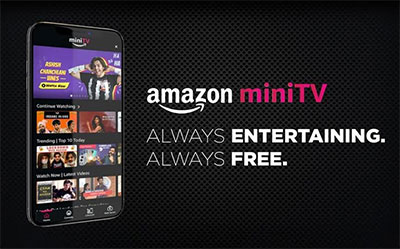
    Amazon.in has announced the launch of MiniTV in addition to Prime Video. MiniTV is a free, ad-supported video streaming service available within the Amazon shopping app.

     

    Notes a communique: “MiniTV has professionally created and curated content across web series, comedy shows, tech news, food, beauty, fashion and more. The list includes leading studios such as – TVF, Pocket Aces and leading comedians – Ashish Chanchlani, Amit Bhadana, Round2Hell, Harsh Beniwal, Shruti Arjun Anand, Elvish Yadav, Prajakta Koli, Swagger Sharma, Aakash Gupta and Nishant Tanwar. Viewers will be informed on the latest products and trends by tech expert Trakin Tech, fashion, and beauty experts such as Sejal Kumar, Malvika Sitlani, Jovita George, Prerna Chhabra and ShivShakti. Food lovers can enjoy content from Kabita’s Kitchen, Cook with Nisha, and Gobble. In the coming months, MiniTV will add many more new and exclusive videos.”


  • To Copy or Not to Copy. That’s the Question


    By Bhuvi Gupta


    Bhuvi GuptaHave you ever used any of the short video apps that sprung up after the ban on Tik Tok?
     

    At first look, you couldn’t differentiate between the apps. They have similar if not outright identical user interfaces. The differences only start peeping in when the ‘satisfaction’ achieved after some scrolling doesn’t quite match up to what was achieved with TikTok due to their much-praised algorithm.


    While the apps did receive some flak for not investing into development, innovation, and design despite having the resources to, the logic, which I believed trumped, was user familiarity that accelerated migration.


    TakaTak is designed to be mistook for TikTok


    Feature Replication has become a common practice for digital products. Snapchat’s success with stories was very quickly replicated across all platforms as was TikTok’s short videos. Substack and Clubhouse are the the latest digital groundbreakers whose formats are being replicated by tech giants or already have been launched (Twitter’s Spaces)


    So should brands copy? Or innovate? I think the right answer is to copy, but  innovatively like Apple. Apple has never launched a product category. What it has done and brilliantly, is to innovate on user experience and design on what already existed. This is true for its vast product line, be it the personal computer, the iPod or even their latest success, Airpods.  This is the holy grail of imitation.


    Why Copy? The answer is Network Effects


    All social media networks have largely been governed by Metcalfe’s Law, which states that the value of a network is 2x that of the total users using it. Metcalfe’s Law governed the success of the telephones and explains the dominance and success of all digital social networks today. By replicating popular features into their pre-existing interfaces, digital networks try to make best use of their critical mass, which helps to stem migration to other platforms.  Also, great for creators which to take advantage of monetization and different audiences often come to the legacy imitator social network.


    The Art of Imitation


    Beware though; blind replication without paying attention to brand and objective will lead to deterioration and debacle. Something, which is happening with LinkedIn. LinkedIn has tried replicating Facebook’s newsfeed and Snapchat’s Stories but both have been done without much thought and adequate content moderation filters. As a result, LinkedIn has moved away from its primary objective of a robust professional network to somehow straddle a reality that is now part social. Stories on LinkedIn are another such misfire. Stories, which by their format, are fun and frivolous, do not fit with the brand ethos of a professional network that LinkedIn is.


    This is in contrast to Instagram, which copied Stories from Snap but modified them to suit their audience rather than replicate all features of Snap. As a result, Stories has now become a useful addition to Instagram, and more successful than the original.


    Apple, which understands its brand positioning and accordingly creates products in pre-existing categories, is also able to get away with charging a sizeable premium for copycat products.


    Copying today is essential for survival for social media networks. One is already seeing the mass migration of people from Facebook to other social networks. If it was not for products such as Groups and Messenger, the platform would have been long dead. Hence, all the Snapchat-inspired features and now a Substack copycat product have ensured that Facebook has not gone the Orkut way.  Hence, it is safe to say that the copycats in the digital world are here to stay. They will live long but prosper only if they copy smart!


  • Zee5 to stream ‘Friends: The Reunion’ series

    By Our Staff


    After the high profile multicast of Radhe, Zee5 has announced that it will exclusively premiere the much-awaited reunion special of the American sitcom series ‘Friends: The Reunion’. No dates announced by Zee5 as yet, though we do know that HBO Max will debut it on May 27.


    Friends: The Reunion will feature a variety of special guest appearances including David Beckham, Justin Bieber, BTS, James Corden, Cindy Crawford, Cara Delevingne, Lady Gaga, Elliott Gould, Kit Harington, Larry Hankin, Mindy Kaling, Thomas Lennon, Christina Pickles, Tom Selleck, James Michael Tyler, Maggie Wheeler, Reese Witherspoon and Malala Yousafzai.


    Said Manish Kalra, Chief Business Officer, Zee5 India: “We are extremely excited to bring ‘Friends: The Reunion’ exclusively on Zee5 for the Indian market. ‘Friends’ is amongst the world’s most watched and loved sitcoms and it is a great opportunity for us to present their reunion, something that the world has been talking about, on Zee5 for ‘Friends’ fans in India.”


  • Wunderman Thompson backs Meesho

    By Our Staff


    Online business platform for women’s clothing and accessories, Meesho, has launched a new brand campaign to create awareness about ease of doing business on the platform for suppliers. Conceptualised by Wunderman Thompson, the campaign showcases successful sellers who are growing their business with Meesho and earning higher profits than before.


    Said Vidit Aatrey, Founder & CEO, Meesho: “At Meesho, we are aware of the struggles that small sellers go through to do business online- from listing products to handling logistics and payments. With this campaign, we intend to put forth the idea of leveraging the scope of digital to enhance MSME’s sales and help their business to grow. They are just one step away from selling online and doing business with ease without having to worry about hefty commissions.”


    Added Nitin Goyal, Account Manager, Wunderman Thompson: “The brief was to highlight that suppliers can maximize their profit by selling on Meesho at a nominal commission of 1%. The platform enables doing business with ease by taking care of all aspects of selling.”


  • Tanmay Bhat partners with LearnApp.com

    By Our Staff


    Online education platform LearnApp.com has announced a partnership with Tanmay Bhat, stand-up comedian and YouTuber, to launch a series of videos explaining the basics of trading. The 10-episode series will be launched on the channel – Honestly by Tanmay Bhat and will feature Prateek Singh, Founder of LearnApp.com, don the role of Tanmay’s financial tutor, explaining the basics of trading. The partnership is aimed at filling the gap of the need for good quality financial education.



     

    Said Singh: “At LearnApp.com we believe that good quality financial education must be accessible to everyone. By partnering with Tanmay Bhat, we will get closer to reaching 1 Million users by the end of the year from the current 200k users. This series makes free-of-cost financial education content accessible to those who never thought they could understand money. The series is technically deep, rich in entertainment with world class production value. Finance needs to be cooler to be mainstream, right now the industry is extremely uptight, this series will change that.”


    Added Bhat: “I never really understood what the whole deal about investing and trading is. I came across Prateek’s videos on LearnApp.com and found it interesting. He made trading look simple and easy for anyone. We reached out to them to partner and create a free resource of the basics in trading. We are thrilled to be able to create a wonderful resource available to everyone.”


  • Dangal Games appoints Ankit Anand

    By Our Staff


    Dangal Games, tech based online gaming platform, has appointed  Ankit Anand as a Business Head to their managerial position of its recently launched application FantasyDangal.


    Ankit Anand
    Ankit Anand

    Said Ankit Anand, Business Head, FantasyDangal: “It has been more than 15 years I have been playing fantasy sports which started as a banter with a group of friends. Now to imagine this from a lens of a platform provider gives an entirely different experience. Every day I am learning something new and exciting.”


    Added Varun Mahna, Founder & CEO of Dangal Games: “Since we are expanding and preparing ourselves for growth, hiring the right talent becomes a key driver for the company. As an organization we focus on bringing in people who will be accountable for developing the brand and shaping the future of Dangal Games. We have complete faith that Ankit is the right person to propel our business vision forward and we wish him all the best.”


  • Ruchir Khanna joins Asianet

    By Our Staff


    Ruchir Khanna
    Ruchir Khanna

    Asianet News Media & Entertainment Pvt. Ltd. (AMEL) has appointed Ruchir Khanna as the Chief Operating Officer of the digital business. AMEL has multiple digital brands in its portfolio including asianetnews.com, indigomusic.com etc. and serves consumers in multiple languages


    Khanna was Head of Product and Growth at Times Internet, the repository of everything digital of The Times of India Group. During his stint at Times Internet, he led digital growth of various properties of the group including The Times of India, NewsPoint, GadgetsNow and others. He has close to two decades of experience across product development, growth and marketing, content strategy and P&L management. Prior to his role at Times Internet, he had previous leadership stints at Hike Messenger and India Today Group and Yahoo! India.


    Rajesh Kalra
    Rajesh Kalra

    Said Rajesh Kalra, Executive Chairman of AMEL: “We’re building a media/ent-tech company of


    the future – building on our strong digital brands asianetnews.com and indigomusic.com and the significant audiences of each of these brands presently. Our mission is to significantly expand audiences of each of these brands with more innovation, content and services. Ruchir will provide significant leadership to this mission of ours. He brings with him the experience of building and growing some of the biggest and most successful digital products in India. I am really excited about the leadership team we’ve built. Ruchir joins us soon after Nachiket Pantvaidya took over as MD. We are now fully geared-up in our mission to make AMEL India’s leading Media-Entertainment Tech enterprise.”