Category: Digital

  • Info explosion has made India smarter: ‘New Realities 3.0’ study

    By Robin Thomas

    The Interpublic  Group (IPG), one of the world’s premier advertising and marketing services companies, has come out with its global ‘New Realities 3.0’ study that provides a unique window into how the Indian consumer is coping with information overload. The study provides insights on the decision-making process of the consumer in today’s era of information explosion. The study also aims to answer the unanswered queries of marketers on whether the information explosion has made consumers smarter or confused, the role of social media in a making consumers more informed, the role of brand advocates and much more.


    The study covered five countries namely, India, China, Brazil, America (US) and Germany. The India leg of the interview was conducted by Draftfcb Ulka’s independent consulting agency, Cogito Consulting. Over 600 online interviews were conducted in each of the five countries between October 26 and November 10, 2011. Some of the findings from the ‘New Realities 3.0’ study reveal that most Indian consumers feel they have grown smarter with the available product information, which is higher than the other countries. Further, the study notes that consumers in India rated a reasonable 7.3/10 when asked whether the available product information made them feel smarter compared to China that showed a rating of just 3.9/10, the US at 6.8/10, Brazil at 6.4/10 and Germany reporting 7.0/10.


    Interestingly, despite consumers in India claiming to feel smarter and not confused or frustrated with the product information available to them, they do not trust the information they see on brands, especially from the manufacturers end. Further, 32 per cent of Indian consumers say they do not trust most of the information they see on brands, whereas 31 per cent say they do not trust information from manufacturers or providers.


    The trust deficit that brands have among Indian consumers is higher than the other four countries, for instance only 11 per cent of Germans say they do not trust any information from brands whereas 22 per cent say they do not trust information from manufacturers or providers. Even Chinese consumers seem to trust information from brands and manufactures as compared to the Indian consumers. 19 per cent of Chinese say they do not trust information from brands whereas 24 per cent Chinese do not trust information from manufacturers or providers. 16 per cent of those interviewed in the US say they do not trust information from brands whereas 15 per cent do not trust information from manufacturers.


    Another interesting finding is that with the exception of Germany, the remaining four countries interviewed – India, China, Brazil and United States have said that product learning is a source of joy and fulfillment. 54 per cent of Indians have said that they enjoy researching the information for buying decision whereas 52 per cent of them say they find the information on brands fulfilling.


    Terry D. Peigh

    The findings have also revealed that most Indians learn product information to build an expertise about a certain product and brand as well as because it helps them stand out in their social circle. 53 per cent of Indians said that the reason they stay informed about certain products is because ‘people value me and my knowledge about certain products’, whereas 52 per cent of them said it helps them enhance their self-esteem.


    In addition to these, the study also revealed that consumers in India and China are most likely to turn into brand advocates and become a media channel and that in India, Brazil and China, especially, social networking sites are a good source for word of mouth information on brand experience.


    As vague and unique as it sounds, MxM India’s Robin Thomas got Mr Terry D. Peigh, Managing Director and Senior Vice President, IPG to relay more outcomes from the study, the role of social networking sites in decision-making capabilities and much more.


    New Realities… is an online study across multiple countries, including India. What is the sample size that was chosen for this study? Who are the respondents i.e. the TG for this study?

    We interviewed 600 people in each country i.e. in India, China, Brazil, United States and Germany. Out of the 600 people sampled, one-third were Gen X, one-third were Gen Y and one-third were boomers. 50 per cent of those polled were men and 50 per cent women.


    What was the key objective of the study? What, according to you, are the learnings for the Indian market, as well as the global market?

    The key objective was to better understand how the consumer has changed because of the new media. We came across the idea years ago as we noticed that the number of information sources available to consumers today has grown exponentially. So we found out if people were confused, frustrated, overwhelmed, and how are consumers viewing the overall experience of absorbing product information and using that information.


    We learnt that consumers have evolved over the years and hence they are not confused or frustrated with the information explosion. Consumers have not only learnt to easily filter or absorb the information but, they have also learnt how to manoeuvre their way through all the multiple choices of product information available to them.


    We have also learnt that surprising number of consumers, especially from India, are now very open, willing and eager to learn about product information as they find a lot of joy and satisfaction in learning about product information. In fact, our research also shows that people in India are most likely to really enjoy research and product information.


    One of the reasons why many in India are willing or open to product information is because they find it of social value as it allows them to have an expertise in certain products. We have also learnt that consumers are aggressively willing to become advocates of brand. Our research also shows that they are now interested in continuing to learn about a product even after they have purchased a product as they want to learn more about the product and advance their knowledge about that product.


    What this reveals is that communication should not stop at the time of sale and that marketers must continue to talk to their consumers even after they have purchased the product. As a result marketers may convert their consumers to brand advocates.


    The study reveals that Information explosion in India has led consumers to become smarter and helped them beat the system – much higher than what the other countries have reported. What are some of the factors that influence the consumer’s decision-making process around a product?

    We see a dominant role of family and friends in a consumers’ decision-making process. Although social media is still small, its role as a channel is growing, but too often social networking sites are limited to ‘likes’ or number of friends which is wrong. It’s too easy to get someone to push the like button or accept a friend request, even though they may really not like the brand or want to be their friend. A research from Australia finds that less than one per cent of friends are actively engaged and want to be truly engaged to the brand. So we keep encouraging our clients to go beyond ‘friends’ or ‘likes’ on a social networking page but, instead seek true engagement.


    As India becomes more tech-savvy, do you anticipate further information explosion to come about that could lead to further increase or decline in consumers who are confused or frustrated with the information?

    We were, in fact, surprised that the confusion or frustration numbers were not higher. My projection, however, is that it (frustration and confusion) will not go up as consumers have learnt the role of technology very quickly. Technology is fast reaching to the lowest common denominator very quickly so, I think people are learning to process information very quickly.


    Will there be a Phase II of the ‘New Realities 3.0’ study?

    Yes. We will soon be out with the second phase of the study in another 18 or 20 months, which will help us understand more trends. In China, for instance, during Phase I and II we have seen dramatic changes in over 18 months. We found that the Chinese were much more inclined to use the internet for product research. In China, the internet was used primarily for entertainment purposes, now it’s used for product information.


    Not surprisingly, consumers in India do not trust brand information especially from the manufacturers. This is not so with other countries, particularly Germany, US and China. How would you explain this? What must brands / marketers in India do to build the trust deficit among their consumers?

    I believe it is because of the newness of the consumer culture in India. In the US, for instance, there has been a mass market of consumer culture for 100 years and the same in Western Europe. I think consumers need to develop trust for their products. Brands must not be afraid to enter into the world of social media and hearing negative comments about one’s brand. There is probably no quicker way to gain trust with the consumer than to actually legitimately and honestly respond to criticism and fix the problem. This, I believe, is one way for brands to gain trust of the consumers.


    With the exception of Germany all other countries seem to enjoy product learning. What makes the consumers in Germany not really enjoy product learning?

    Yes, German people usually do not associate joy from product information. The Germans usually get their joy from music and food


    How has social media changed consumers’ decision-making across the globe? What role do you see social networking sites play in the near future in India?

    The role of social networking sites as a tool for brand advocates will increase. One thing we have noticed in the western world is that the number of people visiting brand pages on social networking sites is on a decline in Europe. This is not the case in India. In the western world a lot of consumers say that they do not visit Facebook for brands, but for friends therefore, it will be interesting to see if it will be any different in the developing economies. Nevertheless brands like Coca-Cola have leveraged social media well by finding ways to reach out to the consumers by engaging in a good conversation and get them to participate in brand activities. Right now the data shows consumers are willing and eager to visit social media to learn about products or brands.


    Even though broadband penetration is still low in India as compared to the US, why are consumers in the US and Germany reluctant in using social media for product research?

    This may be because brands that first started using the social media didn’t do a good job in engaging the consumers. The consumers may have clicked ‘like’ or may have become friends but, the brand may not have received anything else. Brands must, therefore, learn to go beyond the ‘likes’ and adding of friends to adding value in a consumer’s life as the consumer is not accessing social networking sites for brands but for something else. Therefore, in order to leverage the social media, brands need to operate in a different way. Increasingly, many brands are beginning to use social media effectively to engage with their consumers.


    How do you plan to reach the brands or marketers with the study? What can brands or marketers expect from the study?

    This study is important for clients because it is consumer based, is fresh, is in-depth, is broad, it looks at many different segments by product category, by demographic and it is the consumer telling us what he or she is thinking about.

     

  • LinkedIn empowers mobile professionals with the new iPad application

    By A Correspondent


    LinkedIn, the professional network which has over 14 million users in India, on Thursday announced the launch of the LinkedIn application for iPad. Taking into account the new and specific ways that professionals are using their mobile devices, this application aims at helping professionals to be better prepared and empowered to make smarter business decisions wherever they may be working.


    “At LinkedIn, our focus continues to be on increasing the productivity of our members. We realize that today’s professional workforce is a mobile workforce. Hence, we constantly strive to provide them with simple solutions to achieve success and deliver a seamless LinkedIn experience everywhere,” said Hari V Krishnan, Country Manager, LinkedIn India.


    The mobile platform is the fastest growing consumer service at LinkedIn with 22 per cent of LinkedIn traffic coming from mobile devices. The LinkedIn iPad experience has been built and designed taking into account the unique and specific ways that professionals use their iPads.


    New features of the new LinkedIn iPad application include:

    • Calendar feature which gives an informative snapshot of anyone you have a meeting with and everything you need to know about them
    • News you can use which provides timely and relevant news surfaced by what your connections and industry peers are sharing and reading
    • Build your professional brand which connects and follows up with your professional peers and share your expertise


    The LinkedIn iPad application is free and available for members to download on their iPads from http://itunes.apple.com/in/app/linkedin/id288429040?mt=8


    Founded in 2003, LinkedIn has a diversified business model with revenues coming from member subscriptions, marketing solutions and hiring solutions. Headquartered inSilicon Valley, LinkedIn has offices across the globe.


  • Yudhvir Singh joins Mogae from Videocon

    By A Correspondent


    Yudhvir Singh has joined Mogae Digital as General Manager & Head of Mobile Activation from Videocon’s Corporate VAS team.


    “We are delighted to have Yudhvir on the Mogae team,” said Tanya Goyal, Executive director, Mogae Digital, adding: “Yudhvir has many years of telecom experience spread over the entire value chain of value added services and mobile application to brands. He has worked with VAS product-based companies, system integrators and with telecom operators… his kind of experience will enhance Mogae’s cutting edge in the market.”


    “My stay at Videocon corporate VAS team was a great learning experience. Videocon being a greenfield project, I was involved in conceptualization, creating requirement documents for IT solutions, carrying out UATs, product designing, vendor selection and laying out the go-to-market strategy initially. At Mogae, I see similar opportunities to grow new businesses,” said Mr Singh.


    After completing his B.E fromITMUniversityand an MBA from IBS Hyderabad, Mr Singh started his career with IMImobile at Hyderabadas a business analyst. After a short stint as analyst, he moved to the company’s international sales team and was based out ofKuwaitfor business development covering all of Middle East and Asia. His next project with IMImobile was as Country Head Sri Lanka where he incubated a completely new mobile activation & VAS business.


    After 3 years at IMImobile, Mr Singh moved to the telecom practice of TCS (Tata Consultancy Services) with assignments on SDP (service delivery platform). As a business consultant on SDP, he worked on multiple projects including the much acclaimed Tata Teleservices SDP.


    Mogae Digital is an emerging leader in VAS and mobile activation, with products on offer across Aircel, Airtel, Tata Docomo and more. The Mogae Group is co-owned by Sandeep & Tanya Goyal, former JV partners of Dentsu in India & the Middle East.


  • Authenticity and engagement is what brands must give consumers: MTV youth summit

    By A Correspondent


    Brands today need to listen, learn and begin to engage with the youth; they need to be authentic as young people today are willing to speak positively about the brand they trust. These were some of the points discussed at the ‘MTV Power of One’- Youth Marketing Forum 2012.


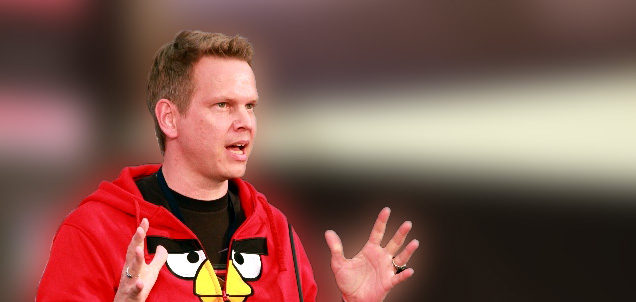
    Ms Angela Barkan, Senior Director, Marketing and Publicity, Sony Music Entertainment; Mr Chetan Bhagat, Author of five blockbuster novels; Mr Andrew Ridley, Executive Director and Co-Founder, Earth Hour; Mr Henri Holm, Senior Vice President, Rovio Entertainment, the creators of Angry Birds; Simon Smith, European Digital Director at Interbrand were some of the speakers at the Youth Marketing Forum which saw presentations and a panel discussion on ways to engage the youth in the digital media era.


    Aditya Swamy

    The MTV Youth Marketing Forum 2012 kick-started with Mr Aditya Swamy, EVP and Business Head, MTV India sharing some of the findings from the MTV’s study on the Indian youth. The study titled ‘Power of One’ was unveiled on Friday, April 27. Mr Swamy said that over 5,000 youth were interviewed across the Country and an overwhelming 76 per cent said that they are happy with their life. According to the findings, for today’s youth family is more important than their friends, as a lot of young people see their parents as their role model.


    The survey also says that 97 per cent of the youth believe that they can bring about change and that social media has given them a voice, thus making them feel empowered. “Single screen engagements are not going to work, today web and mobile are required to engage the youth. Today the youth do not need inspirations but engagement, so there needs to be a two way conversation. If brands learn to keep the promises they make to their consumers, it will see more people, particularly youngsters flocking towards their brands” Mr Swamy added.


    Andrew Ridley

    A good idea needs good platform:

    Mr Andrew Ridley, Executive Director and Co-Founder, Earth Hour spoke about how the movement first started in one city -Sydney, before it became a global movement. He spoke about how every individual has the power to change the world they live in and how social media strengthens that power and provides a vehicle to take action. Citing the example of how Earth Hour was designed to build reach and increase its reach to billions of people around the world, Mr Ridley was of the view that a good idea needs a good platform in order to reap rich benefits. “I believe that for the first time we have the power to connect. We are still at the initial stage of creating a big change, but if our core idea is relevant and connected to the young people in particular, it will lead to a huge change in the world” said Mr Ridley.


    Henri Holm

    It’s all about communication…

    Speaking on the success story of Angry Birds, Mr Henri Holm, Senior Vice President, Rovio Entertainment, said that it took the company nearly eight years to be where it is today. He also spoke about how to engage the younger generation with the powerful concept and the characters and also how the distribution channels were also chosen carefully to reach out to the millions and to be of service to the fans. Since youth is the core TG, Rovio Entertainment hopes to stay relevant, connected and constantly find new ways to engage the youth.


    Besides the online experience, Angry Birds also gave the audience offline experience of the game, thus not only engaging its TG but even getting newer audience. “One of the reasons for the success of Angry Birds is its simplicity. We put a lot of weight on communication and feedback from our audience, therefore for us it is all about building business with fans and not features. Angry Birds is a permanent part of the youth culture and our aim is to further service the youth efficiently in the years to come.”


    Chetan Bhagat

    Reaching out through social media

    Author of five blockbuster novels, Mr Chetan Bhagat, also known as the marketing guru gave his insights on marketing. He said that social media is a good way to execute the power of one: “Social media has become very popular today and one must know what a Facebook or a Twitter is. As far as I am concerned social media is a great platform, my goal is to reach out to maximum number of people and social media is one of the ways to reach out.”


    He said that one of the reasons why his books worked was because the plots were tight, they were unputdownable, the language was simple, and the characters were relatable. Mr Bhagat also gave some insights into the mind of the youth. He said that the youth today has the ‘hunger’ to do well in life, to gain respect and make money; that they want an education that could provide them skills that would help them make money. Besides the love for their careers and seeking out their love, youth today deeply care for their country and are willing to clean up the system.


    Simon Smith

    The power of one

    Mr Simon Smith, European Digital Director, Interbrand spoke about the power of conformity, and the willingness to conform publicly in order to attain social rewards. We need to understand the power of one and how powerful it is. The power of one, I believe, is simply about being human. One must not move with the crowd but, remain an individual he or she is supposed to be. “Fundamentally, as humans, we haven’t changed much, but our expressions to our needs have dramatically changed with technology, society and changing power structure. The relation between brand and consumer has fundamentally changed, so if a brand makes a promise to its consumers, it better deliver on those promises or the consumer will never trust the brand and influence others to rebuke the brand too.”


    Angela Barkan

    Authenticity and the art of listening to the youth

    Ms Angela Barkan of Sony Music International spoke about millennials, youngsters aged between 12 to 30 years. She was of the view that millenials are multi-taskers and optimists, that they expect brands to be authentic and have two way communications with them. She also said that this is a group which loves to share and that they define themselves by what they share. She also said that this unusual group is found mostly online. “Collaborations and interactions are very important when talking about music as it results in lifelong fans. However, there is a need for brands to be authentic because if a brand is authentic, then millenials are willing to speak positively about the brand they trust.”


    Reaching out to the youth

    A panel discussion which included eminent panelists like Mr Avinash Pant, Marketing Head, Nike India; Mr Sumeet Pahwa, DGM – Marketing, TATA Docomo; Mr Vikram Malhotra, COO Viacom 18 Motion Pictures; Mr Bejoy Nambiar, Director and Screen Writer; and Mr Ayushman Khurana, VJ turned Actor and was moderated by Mr Nikhil Chinappa, VJ and Founder, Summer Sunburn Festival spoke about the difficulties of marketing to the young generation and the possible ways of reaching out the youth. They also spoke on the role of social media marketing and whether social media is actually an effective tool to reach out to the youth.


    Mr Pahwa spoke about how the social media is a big platform to engage the youth citing the example of how it helped Tata Docomo successfully engage the youth by having a two way conversation with them.


    According to Mr Malhotra, “Brands need to listen a lot more, even to criticisms, and problems must be solved as and when brought by the consumers. The attitudes of the youth are fast changing, today they trust their family and friends more than the brands, hence brands need to listen, learn and begin to engage with the youth.”


    Mr Pant was of the view that the youth today are looking for innovation: “Things are moving so fast today that our conventional thought process itself needs to change drastically. We have to think a lot more digital.”


    Ayushman Khurana pointed out that the youth do not have the patience to listen, but they do have a strong opinion about films or any other product or brand. So one needs to understand its audience and find ways to connect with the audience and have a two way communication with them.


    Be authentic, have a two way communication, listen a lot more to your consumers, respond to criticisms and fix problems because young people are willing to be advocates of brands on social networking sites as long as they trust it otherwise brands must be ready for a backlash. These are some of the lessons to be learnt from the MTV Youth Marketing Forum 2012.


  • beStylish.com ropes in ‘EKA’ as ambassadors

    By A Correspondent


    beStylish.com has roped in the upcoming music band ‘EKA’ as brand ambassadors for their online shoe store. With this association, beStylish has launched the first phase of its ‘Friends of beStylish’ program that encourages partners across various walks of life to connect with the online brand.


    As the ambassadors of beStylish, EKA will play a key role in creating a brand connect with beStylish.com’s customers and prospects with its highly energetic performances, in various concerts held in music festivals, college fests, corporate events, radio and television shows, clubs, pubs, and so on across the country. Specially composed beStylish jingles will be played as part of these concerts. The brand promotion would be further amplified in the online space through co-promotion on beStylish.com’s online store, online music channels, vignettes, and others.


    Speaking about the beStylish brand value and its association with EKA, Shailen Amin, Co-Founder and CEO, beStylish.com, said: “Given our strong marketing focus emphasizing on brand awareness and building a loyal consumer base, we have associated with EKA under our ‘Friends of beStylish program’. EKA’s eclectic, original and contemporary music syncs perfectly with our own approach towards our customers and fans. With this partnership, we are confident of creating real-time public engagement opportunities for the brand, moving beyond a virtual-only space”.


    Conferred with ArtistAloud Awards 2011 for the ‘Best Group’, the renowned band ‘EKA’ comprises of Benjamine ‘Benny’ Pinto on Keyboards, Hitesh ‘Rikki’ Madan on guitars and vocals and Lokesh Madan on vocals and bass. The seasoned musicians forming Eka and have performed at over 2,000 concerts in 15 countries and have recorded over 100 songs in various capacities.


    Commenting on the occasion, EKA said: “We are excited to be chosen as the face of this youthful brand. beStylish.com aptly reflects the attributes of today’s youth and we are proud to take the brand from the virtual space to their real audience. Through this association, we hope to take our music to new audiences and hope we can help our audiences put their best foot forward with beStylish.com’s ever-growing list of top of the line fashion products. We look forward to growing with the brand and hope that our association with the brand grows stronger in the years to come”.


    beStylish.com isIndia’s largest online shoe retailer with the largest range of international, high street and popular footwear brands. It offers its customers an exceptional online shopping experience with over 130 brands and 4,600 styles in shoes catering to men, women and children. beStylish.com was launched in May 2011 under the umbrella of the Smile Group, which has consistently created trusted digital and ecommerce assets, business ideas and entrepreneurs in the digital space.


    Eka has performed at prestigious events including The Times of India Earth Care Awards, United Nations Initiative for Women & Children’s Health, International Film Festival of India (Goa), Finale of Bengaluru Habba, Chivas Studio Spotlight & The Great Indian October Fest, among others. Eka calls its music genre ‘Swatantra Rock’ – music beyond music, time and boundaries. Eka delivers a unique experience by blending its originals with selected classic rock, sufi and popular Hindi / Bollywood music.


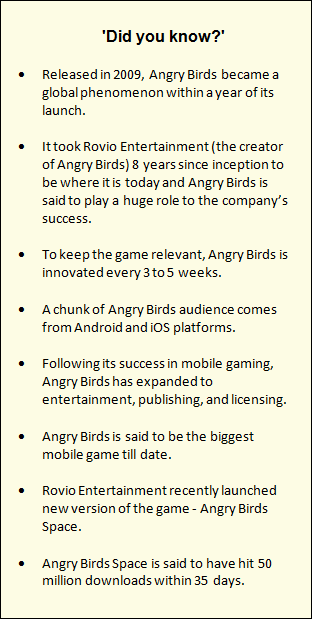
  • Angry Birds forever!

    Angry Birds Space visual Courtesy Rovio.com
     

    Henri Holm is the Senior Vice President at Rovio Entertainment, the creators of Angry Birds. Holm, a Harvard alumnus, has extensive international management experience in consumer electronics, mobile internet, manufacturing, distribution, retail and brand management. At the sidelines of the recently concluded MTV Youth Marketing Forum 2012, MxMIndia’s Robin Thomas caught up with Henri Holm  who spoke at length about his India plans, India as a market for gaming and of course about Angry Birds and much more.


    You had said that it took Rovio Entertainment eight years to be where it is today. Tell us a little more about your company and your journey so far?

    Rovio Entertainment is a company which has grown very fast. We grew from a 12 people organization to over 300 plus professionals as of today. In our operations we cover mobile gaming, entertainments which include animations, books and publications, education content or edutainment, merchandising, licensing and sponsorships. In the entertainment space, we also cover advertising, so we are a major premium advertising channel provider. Globally, in fact, our ad impressions reach over 10 billion. It’s a company of young people who believe in their course, who neither give up nor give in.


    There are talks about the slow death of console gaming in India with the onslaught of mobile gaming especially with 3G and 4G coming in. Would you agree? Is the next phase of gaming coming from mobile?

    Console gaming is not necessarily as scalable as mobile gaming because I think it caters to a different set of audience or different media consumption or entertainment consumption. The mobile devices, including the tablets, are always with you and you can consume the game anytime anywhere, so the industry is certainly changing.


    Can you please throw some light on the entire thought process behind the Angry Birds concept? How did it come about?

    Everything started from the fact that the company has gone through 50 plus games. Being an audio manufacturer, we didn’t own a brand, we wanted to have our own IP and we wanted to build a brand. The thought process started with the characters and with distinctive personalities in those characters. The story was unique too, it was not a me-too story, and besides, the mechanics of the game itself was about simplicity, quality and paying a lot of attention to the details.


    You also said that Angry Birds will continue forever and that this is only just the beginning… How do you intend to stay relevant to the audience?

    Yes, we feel that this is just the beginning for us. Angry Birds as a brand, and as a story, will definitely continue. Every three to five weeks we try to keep the game relevant and innovative or new for our audience. However this does not mean that we will not be looking at other games or characters or stories, it’s just that we need to find the right time to introduce something new.


    Where is the Angry Birds audience coming from?

    Today’s audience primarily comes from the android and IOS platforms, however there are other very significant platforms besides the androids and IOS. So today we can cover all operating systems in mobile devices ranging from the smallest screens of the feature phones to the largest of the screen which are the tablets. So the mobile space is certainly growing the fastest. When you move away from the mobile to the web we cover the operating systems where Chrome has been leading the web experience supported by flash and now the social gaming like Angry Birds on Facebook. So each one of these platforms needs to be looked after individually and what is important is that we present the channel and the content where the fans are. So, if the fans are moving primarily into one operating system or one type of access into the content, we move with it.


    What is the role social networking sites have played for the success of games? According to a survey, young people in the west visit social networking sites only for friends and not necessarily brands…

    We are an entertainment company and we engage our fans on social media so, we are living social media 24×7 and we are participating in conversation all the time. Our business is about the fan engagement, delighting them and therefore I believe that social networking sites play a huge role in the success of any brand.


    What is the business model of Rovio Entertainment? Is it advertising led and how much has Angry Birds contributed to its revenue share?

    We have different business units, we have the games business unit, entertainment business unit and merchandising and licensing business unit. Each one of them contribute their own revenue but, they also complement the entire brand experience and the brand presence because of the huge opportunity to manage and monetize the brand. So our business model is purely based on the fan and the brand.


    How has 2012 welcomed you? What are your business plans this year? When you compare it with 2011 how has the growth been so far?

    In 2011 we launched one game and this year we have already launched two and have several more to go. The year 2011 was about building the infrastructure and the making the organization ready, 2012 on the other hand is about finding the right partnership and making the entire business ecosystem stronger and more global.


    So are you looking for more expansions and new partners?

    We are constantly looking for new partners and expansions as we need to build a very robust business and country plans before this.


    What is your view on India as a market for gaming and for your business?

    India is a very important market for us, as of now we are scouting for partners and once we find the right partnerships here it will give us better footprint and presence. We are looking for partnerships in the media space, in the digital distribution space, operators, and the major brands and all the big movers and shakers in the country.


  • Guardian Media partners with Mediaguru

    By A Correspondent


    The Guardian, London has entered into a partnership with MediaGuru and is to hold one of its 2012 Activate Summits in India for the first time.

     
    The Guardian Activate events bring together many of the world’s brightest and most influential figures to debate how technology is driving positive social change on a global scale. The first Activate event took place in London in 2009 and the event expanded into the US market last year with the first Activate New York taking place in April 2011.


    Previous speakers have included Google executive chairman Eric Schmidt, LinkedIn founder Reid Hoffman, Arianna Huffington, editor-in-chief of The Huffington Post, Craig’sList founder Craig Newmark and NYU professor Clay Shirky.


    The 2012 Guardian Activate summit in India is currently planned to take place in October in Delhi, and will be organised in partnership with MediaGuru, the media consulting, technology and entertainment company which has a presence in London, Singapore and all across India.


    The Guardian-MediaGuru partnership will see the Activate brand expanding into other territories, including Malaysia, Hong Kong and Singapore. It will also see an ambitious expansion of the Activate digital platform on guardian.co.uk, which will become an online content and networking hub for professionals working with technology to drive global change.
    Announcing the expansion, Alan Rusbridger said: “Technology is bringing the world closer together and at the Guardian we’re committed to encouraging debate between diverse, global audiences in line with our open and digital-first strategies. We’re thrilled to be bringing the Guardian Activate summit to new countries where technology is having a real impact, and look forward to joining and facilitating more fascinating conversations about the influence of web technologies in person, as well as online.”


    Sanjay Salil, Managing Director, MediaGuru, said: “By 2020, it is predicted that India will have 600 million internet users, making it the biggest open internet access market in the world. MediaGuru is proud to be bringing the Guardian Activate platform to India, where a gathering of technology, media, and social innovation leaders can help shape India’s technology and new media agenda.”


  • Follow us at F-T-Y-B: Hareesh Tibrewala

    By Hareesh Tibrewala


    While on a business trip to Delhi last week.  I happened to find myself in the midst of a traffic jam (so what’s new?) and while patiently waiting for the car to start crawling, my eyes fell on a large advertising hoarding. It was a well-designed hoarding for a luxury brand with some superlative creatives and the company web URL printed in the lower left hand corner. While everything on this 200 square meter hoarding looked perfect, what triggered my discomfort were four small colourful boxes in the bottom right corner, preceded by the words “Follow us on”.


    The colourful boxes were the single character brand logos for Facebook, Twitter, YouTube and Blogger, and quite obviously the brand manager was trying to invite the reader to engage with the brand on these social networks. What I saw on this billboard is a representation of what one sees in others forms of communication as well. Lots and lots of social networking site logos and lots and lots of URLs. Does this really help?


    Here are my thoughts


    • Simply putting colourful boxes with logos of social networking sites (without the full brand URL eg www.facebook.com/yourbrand) does not add any value to your communication. If at all, it only contributes to promoting the brand value of that social networking site.
    • Putting a half a dozen URLs in a communication serves no purpose either. No one has time to visit a single URL or click on a single link, leave alone click on half a dozen links. When I see a communication which has lots “Follow us on ..” links, frankly it is a bit intimidating
    • Just because you ask someone to “Follow” you is no reason to believe that that person is actually going to follow you.


    So what should be done ?


    • Sure, social networking sites are now the default place where consumers engage with brands. Also the days when consumer went to content are over. Now content has to reach the consumer. Thus continuing the engagement with the consumer, from your bill board onto a social networking site makes all the sense
    • If your brand is present on multiple social networks, choose one where you think you have the best chance of building a community or engaging with the consumer. Promote just this one link. When the consumer reaches this page, you can always provide links to your other social media presence.
    • Display the link in full (www.Youtube.com/yourbrandname). Chance of a brand recall is much higher compared to just saying : Find us on YouTube
    • Finally if you are putting out a link, see if you can build in a strong call to action. Try to answer the question, “why should the consumer follow my link”. And use that answer to trigger a strong call to action.


    Hareesh Tibrewala is Joint CEO, Social Wavelength. You can engage with him socially at linkedin.com/in/hareeshtibrewala


  • Atul Hegde on why Digital is no longer New Media

    By Atul Hegde


    1. Serious spenders on traditional medium are now leading the way in digital spends

    When advertisers from the auto sector, FMCG, Corporate brands, Consumer Durables and other serious spenders, which for long have been spending heavily on traditional medium, begin to spend heavily in the digital media, it is the first indication that digital is no longer a new media.


    2. Large clients now have digital media/brand manager

    The very fact that large clients are investing in digital media, whether they are from the auto sector, telecom, FMCG’s, consumer durables  and so on, they have today either digital media managers or digital brand managers. This, in itself, shows that clients are spending serious amount of money to manage digital.


    3. Senior clients are regular consumers of the medium

    For any medium to succeed it is important that people who are buying it are also consuming the same medium because only when they consume that media will they realize the power of that media for their brands. Today there are senior clients who have become regular users of the medium.


    4. Movies and Cricket video consumption on digital has exploded

    Clients go where there are eyeballs, and inIndiawe view more than we read.Indiais a country where we consume films and cricket, both of which are heavily consumed on the internet. For instance IPL online has seen more viewership this year than the year before. Therefore, the more videos we have on movies and cricket, the more the audience will spend time viewing the videos and as a result, more advertisers will spend money on that medium. The explosion of video consumption inIndia, therefore, is bringing in more serious advertisers to digital media.


    5. Emergence of digital media awards (last count there were more than half a dozen)

    Today we find so many digital media awards, which only mean that clients are keen to win awards for digital. In fact, awards are a good way to boost the medium.


    Atul Hegde is the CEO, Ignitee Digital Services Pvt. Ltd


  • Full report of Assocham ‘focus’ on M&E

    By Shruti Pushkarna


    Assocham organized the 6th annual summit on entertainment and media, Focus 2012, inNew Delhion May 4 where the topic in focus was Digitization for Inclusive Growth. The event began with a keynote address by the Chairman of Press Council of India, Justice Markandey Katju, who came down heavily on the media once again, in his address.


    Justice Katju referred to the role played by the European media between the 17th and 19th century. He talked about the sacrifices made by writers like Voltaire, Rousseau and Thomas Paine to uplift the society and help it convert from a feudal state to a modern society. He criticised the Indian media for promoting superstition in form of cheap astrology shows on news television channels all day instead of promoting rational and scientific ideas. He said: “The function of the media is to uplift the intellectual levels of citizens, but our media instead has stooped down to the level of Indians, of which 90 per cent are fools.” He said that in the race for TRPs, the television channels focus on entertainment which constitutes 90 per cent of programming and leaves only 10 per cent room for real issues to be telecast.


    Justice Katju urged media professionals to play a socially responsible role at a time whenIndia, likeEuropein the 17th century, is going through a transitional phase. He emphasized on the need to promote rational ideas in this period of transition in Indian history. He also emphasized on the need for regulation as opposed to self regulation. He said, “I am the greatest fighter for freedom for press and that’s why I am not recommending control but regulation. In control, there is no freedom but in regulation there is reasonable restriction in the public interest.”


    Self regulation is no regulation, he added: “You cannot have absolute freedom to harm society. There is need for regulation, and this regulation cannot be from the government, it has to be from an independent regulatory authority which has penal powers.”


    Broadcasting & Digitization: India Goes Digital- Challenges & Way Forward

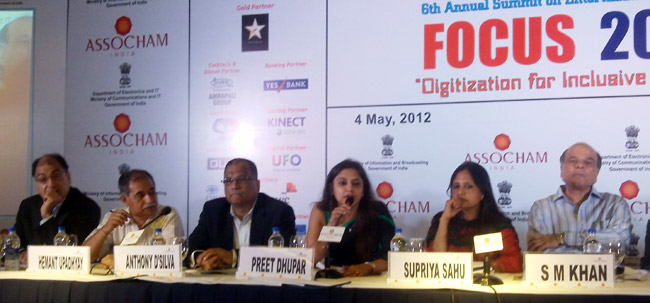
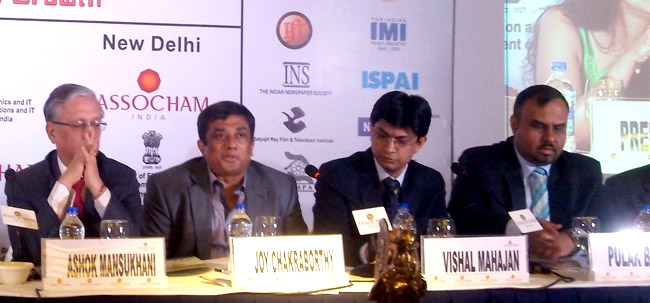
    The session on broadcasting and digitization was chaired by Supriya Sahu, Joint Secretary (Broadband & Policy), Ministry of Information and Broadcasting. The session was moderated by Preet Dhupar, Director, BBC World,India. The panelists included Anthony D’Silva, Group CEO, Sun Group; Hemant Upadhyay, Advisor, VOICE; Jehangir S Pocha, CEO, INX News; Roop Sharma, President, COFI; Vishal Mahajan, Sr. Director, Yes Bank; Himanshu Patel, COO Videocon D2H; Ashok Mansukhani, President, MSO Alliance; Joy Chakraborthy, CEO, TV Today Network; Pulak Bagchi, VP, Star India and SM Khan, DG, DD News.


    During the discussion, Ms Sahu said that the work on digitization, especially Phase 1, which looks at the four metros, was on track and with help from all stakeholders the government should be able to push digitization to happen in time. She defended the TRAI tariff order: “It is a win-win situation for every stakeholder. The clear winner, of course, is the consumer.” She said that the cities were almost ready for digitization, the government had made good progress as far as procurement of set top boxes (STBs) is concerned and the only area that needs attention is the seeding of these boxes. She agreed that for the target date to be achieved, around 20-25 lakh STBs have to be seeded and that makes it 1 lakh STBs to be seeded every day.


    Representing the MSO Alliance, Mr Mansukhani congratulated the government on taking up the challenge of digitization. He agreed that there were some concerns and issues on which they will seek clarification from the TRAI. He reiterated the commitment to digitization on part of MSOs and urged newspapers and business channels to clearly present all points of view to the debate on digitization.


    Ms Roop Sharma, President, COFI expressed hers and the cable operators’ disappointment at order issued by TRAI. She claimed that the order was unfair to LCOs and will result in putting them out of business: “Regulator wants to be the controller of the industry…the role of the regulator is very bad. We are all for digitization, but we are unhappy with the revenue share that has been decided in the order.” She added that 60 days are too less to meet the challenges of digitization and it is unlikely that the sunset date for Phase 1 is achievable.


    Jehangir Pocha, CEO INX News shared the plight of the broadcasters with the panelists on the issue of carriage fee. He said that a channel like Times Now had to pay a carriage fee of Rs50-55 crore to reach the viewers. He said: “I can’t applaud this order. Those who applaud this regulation perhaps benefit from it. It is the first time in the history ofIndiathat carriage fee is legalized, institutionalized and not regulated.” He said that the government claims to have taken the views of all stakeholders involved but their views were taken only in theory and not in spirit.


    The TRAI in its recommendations stated: “Keeping in view the fact that substantial investment for implementation of Digital Addressable Cable TV Systems is made by the MSO and the cost involved in carriage of channels, the Authority has decided that every MSO may fix the Carriage Fee.” But Mr Pocha argued that why should a channel pay for MSO investment. He said he would like the government to issue a white paper that looks at the earnings of all players.


    Sun Group CEO Anthony D’Silva said that the need of the hour is to get down to the nitty-gritties: “The lessons learnt from DTH are applicable to any other digital system. We need to look at how the subscriber management systems will work, what are the service parameters and who’ll set up the call centres because that involves huge costs.” He added that the government needs to look at  digitization as any other infrastructure project and support it by whatever means, whether its tax holiday or any other subsidies.


    Pulak Bagchi, VP, Star India expressed a need to recognize the challenge government and the regulator had in thinking through the entire process of digitization and the fact that it’s difficult to make everyone happy. He said: “Government and regulator are out there to protect the public interest and not to add to company bottom lines. We entrepreneurs need to work out our own course.”


    Responding to the issues voiced by the various panelists, Ms Sahu said: “All concerns are genuine and we would try and address them as well as we can but please read the fine print to clarify some of the concerns.” As for cable operators, she said that if cable operators don’t move to digitization fast enough, they will be wiped out by competition from DTH.


    Films, Animation and VFX: Digital Cinema- Present and Future

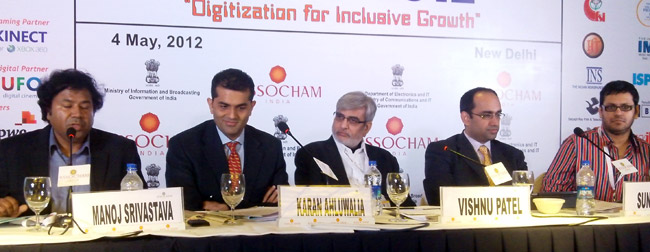
    The session was moderated by Karan Ahluwalia, Executive VP, Yes Bank and the panelists included, Ramesh Meer, CEO The FX Factory; Sunaman Sood, Co-founder, Director, Acendo Capital Advisors; Siddhartha M Jain, Producer@iRock; Vishnu Patel, CEO-Special projects, UFO Moviez and Manoj Srivastava, CEO, Enternainmentt Society of Goa.


    Siddhartha M Jain of iRock started the discussion by talking about the paradigm shift occurring in cinema: “Low budget films without stars which used to be niche earlier are picking up. We’ve had hits like Ragini MMS and Vicky Donor. So there is huge investor appetite, provided you have the right content. The key lies in keeping the budgets low and using the latest technology.” He added that there is also a huge power shift happening from Bollywood movies to movies outside Hindi cinema.


    Sunaman Sood said that producers have now begun to treat regional cinema with some seriousness, realising its potential. But Manoj Srivastava added that there is no platform or agency in the country that promotes regional cinema well enough.


    Speaking of digitization’s benefits to cinema, Vishnu Patel said that digital technology has helped revive the industry which was otherwise on a decline. He said that regional cinema has also benefitted from digital technology because digitization has cut down the distribution cost in terms of prints. Now regional film producers can distribute their films better without having to worry about prints’ costs.


    Print Media: Challenges and Opportunities in Digital Age

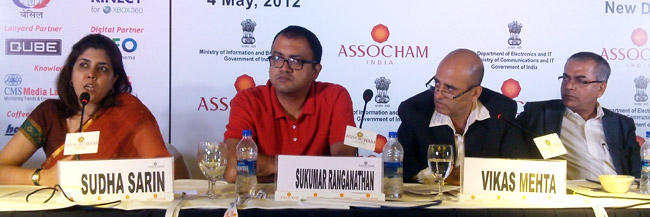
    The session was chaired by Suprio Guha Thakurta, MD, The Economist Group India. The session was moderated by Vikas Mehta, VP & Executive Business Director, JWT Delhi. The panelists included, Sukumar Ranganathan, Editor, Mint; Vandana Das, President, DDB Mudra;Sudha Sarin,MD, Ipan Hill & Knowlton and Raghav Subramanian, COO, Lintas Initiative Media.


    Sukumar Ranganathan initiated the debate by making a strong point that print is here to stay: “We often look at the western trends to decide the future of print in the country but we forget that the dynamics of the western market are very different from the Indian market.” He said that Mint has never defined itself as a newspaper; rather it looks at itself as a ‘newsroom’. Talking about integration of content, he said: “We update a story online as soon as it breaks. We also use social media to amplify the news. And in the paper, we value add with analysis and so on. I think integration is key to what a newspaper needs to do to survive in a digital area.”


    Suprio Guha Thakurta echoed Mr Ranganathan’s views but he also emphasized on the fact that content for every platform needs to be looked at differently: “You can’t just cut and paste from print to online or any other device.” He added that The Economist, which at present has about 85 per cent of subscriptions from print, aims at converting these into at least 50 per cent in digital in the next two years.


    Raghav Subramanian said: “It’s not that print is going to go away but it’s being increasingly threatened by digitization. Print is slow as a medium and now with news all over the place, the tangible paper is eroding in terms of the first choice for the younger generation.”


    Concluding the debate, all panelists agreed on the need to integrate content across different media to reach out to consumers/viewers/readers at different touch points.


    Radio and Music: New Avenues for Revenue/ Social Media & Gaming: Creating New Markets

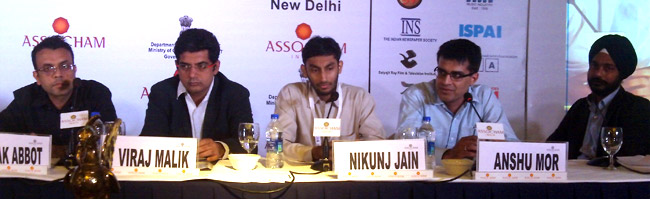
    The last two sessions on radio and gaming were merged into one discussion. The session was moderated by Uday Chawla, Secretary General, AROI and the panelists included, Anand Raj, Head- Non Traditional Revenue, Red FM; Geetanshu Anand, Head- Content, Mystica Music; Pallab Mitram Head- Consumer VAS, Tata Teleservices; Deepak Abbot, Head- Product, Zapak Digital Entertainment Pvt Ltd; Nikunj Jain, CEO, Inoxapps; Anshu Mor, Lead Entertainment & Media, Microsoft; CP Singh, CTO, Possible Worldwide; Akhilesh Saurikhia, Consultant, Department of Electronic and IT, Govt of India and Viraj Malik, CEO & MD, PK Online Ventures Pvt Ltd.


    Anand Raj of Red FM talked about alternate revenue avenues that radio stations can look at. He said that audio production is an unorganized market right now and if radio stations start looking at doing audio productions in-house, there is huge potential for revenues. He also pointed out initiative like the Mahabharata or Ramayana productions done by Fever and how radio stations can look at making money by selling productions like these to VAS mobile operators. Another area that radio stations haven’t exploited properly he said was social media. He said that radio can look at building communities on social media for commerce.


    Geetanshu Anand of Mystica Music said: “There is no lack of avenues for revenues; all we need to do is fill up the loopholes for revenues.” Radio industry, she said, plays a crucial role in promotion of music but when it comes to rights sharing then both radio and music companies get selfish and each wants a larger pie. She said that the need for the hour was to review the statutory licenses. She also said that it is important for radio to start promoting non-film music alongside film music.


    Talking about gaming and creating new markets for it, Anshu Mor of Microsoft said: “It’s important for us as an industry to change the concept of gaming and how we look at gaming.” He added that social media provides with an opportunity to promote the ‘Brand Me’ and hence plays a huge role in marketing.


    Viraj Malik added that mobile gaming is on a rise and will turn into a larger opportunity inIndiabecause mobile is fairly big in terms of reach and affordability. And this creates a huge opportunity for content and app developers, he said.


  • Moneycontrol unveils online investor event

    By A Correspondent


    moneycontrol.com has launched an online investor camp starting at 8am on May 8. The day-long event will include a host of investment experts who will answer queries from investors all over India.


    Master Your Money brings a unique opportunity to investors in India to go online and connect with leading experts, and get answers to their investment queries online. It provides a resource to millions of investors currently confronted by falling stock markets, high rates of inflation, skyrocketing real estate prices and the exploding value of gold.


    Master Your Money is open to all kinds of investors, from buyers of fixed deposits, government bonds and insurance, HNI stock and mutual fund investors, individual traders and corporate finance professionals. The unique online event covers stocks, bonds, insurance, gold and real estate. Master your Money is sponsored by Principal Mutual Funds (sponsor – Mutual Fund section), L&T Insurance (sponsor – Insurance section) and Aditya Trading (sponsor – Stocks section)


    “As a leading national portal dedicated to serving investors in India, we conceptualized Master Your Money to provide knowledge to the entire community of Indian investors,” said Joyson Thomas, COO, Web 18. Mr Thomas added that this is the fourth edition of Master Your Money and the first event which has attracted investors from all over the country.


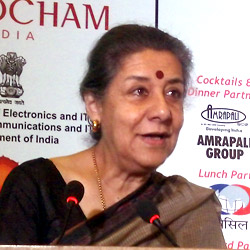
  • Digitization is going to be the biggest reform in broadcast sector: Ambika Soni

    By Shruti Pushkarna


    High drama ensued at the Assocham event inNew Delhias local cable operators (LCOs) flagged black ribbons at the Minister for Information and Broadcasting, Mrs Ambika Soni. The Minister was attending the 6th Annual Summit on Entertainment and Media organized by Assocham, Focus 2012: Digitization for Inclusive Growth. As the theme suggests, one of the primary issues discussed at the event was Digitization of Cable television.


    The LCOs were protesting against the recent tariff order issued by the Telecom Regulatory Authority of India (TRAI), which they claim is an unfair order against all small operators. Following the heated arguments between cable operators present at the event venue and the Minister, one of the cable operators, Sandeep Mcgee who is based inEast Delhithreatened to commit suicide in front of the Minister. Mrs Soni, however, tried to pacify the operators’ fraternity and asked them to file a formal letter with all their grievances against the tariff order and the regulator. She also promised to address their concerns and, if need be, raise the same with the regulator.


    Addressing the concerns of broadcasters on the carriage fee mentioned in the same order, Mrs Soni said that the government will consult all stakeholders before taking a final call on the regulations decided by TRAI under which the Multi System Operators (MSOs) are allowed to charge a carriage fee from broadcasters.


    Earlier, in her inaugural address, the Minister emphasized the importance of digitization for the entire industry and all stakeholders: “Digitization is going to be the biggest reform in broadcast sector and enable operators to expand their revenue sources by providing more choice and variety to customers. Digitization is imperative to tabulate subscriber base and reduce carriage fee. Digitization will also help reduce all human error in the process.”


    Defending the tariff order issued by TRAI recently, she said that the government indulged in exhaustive consultations with all stakeholders on all issues including the carriage fee, and the main aim of the new regulations had been to benefit the consumer. Mrs Soni said: “The TRAI tariff order makes the viewer the most important beneficiary; the choice will be with the viewer.” As for the broadcasters, she said digitization would help reduce the dependence on TRPs and bring in transparency where every broadcaster would be in a position to identify exactly how many people are subscribing to the channel.


    On the issue of media regulation, Mrs Soni said: “Let’s not condemn self-regulation per se because even though self regulation is a slower way of correcting things, it is still a surer way as it involves converting minds and hearts in the process.” She added that in the whole race to growth, the provisions of the Cable Television Regulatory Act were overlooked and it was a fault in the functioning of the government that the act had been ignored.


    On the issue of Paid News, she said that while it was the worst phenomenon that existed, it’s not as easy to detect paid news. She was responding to scathing criticism of the media by the Chairman of Press Council of India, Justice Markandey Katju in his keynote address at the same event.