Category: Digital

  • Truecaller Ads manages to deliver significant buzz for brands

    By A Correspondent


    Truecaller has announced the significant gains that brands have seen on its advertising platform. Truecaller Ads not just captures the attention of users without invasion or interruption, but also eliminates the appointment viewing condition for brand visibility. Its programmatic advertising strategy has generated a repeat customer rate of 70 per cent among existing advertisers, helping companies reach their audiences.


    Talking about his experience, Amit Tiwari, Vice President Marketing, Havells India Ltd, said: “This is the first time we used Truecaller as an outreach platform. It provided us with a large-scale India-wide reach of over 40 million unique users in a single day. We used it as a platform to connect with our potential customers and received genuine responses from quality audiences.”


    Commenting on his interaction with the platform, Sidharth Rao, CEO, Dentsu Webchutney, added: “We have always recommended Truecaller to our advertisers and have consistently seen the platform over-deliver its commitments. With the help of Truecaller, our client’s messages have been delivered to their users through a brand roadblock with absolute simplicity. We’ve had a remarkable experience in marketing several product categories such as automobile, OEM and consumer tech to name a few through this platform. We believe Truecaller will play an integral part in our media buys for the upcoming festive season of 2018, with more of our clients looking to showcase their own unique stories.”


    Speaking on the adsales foray, Tejinder Gill, VP Sales & Head of India Operations at Truecaller: “Our advertising platform has achieved some great feats since its inception, especially since the unique ad delivery system which enables a brand visibility after every call from an unknown number. With marketers and CMOs shifting their strategies from mobile first to mobile only, advertising platforms such as ours are best placed to help achieve their objectives. Around the festive season when audiences have their eyes wider open than usual, we must work together with our partners to overcome our hurdles and achieve our objectives together. Needless to say, our advertisers have been overjoyed with the results.”


  • … and appoints DCMN India as its media agency

    By A Correspondent


    Digital marketing agency DCMN India has bagged the media mandate for Truecaller app. The account was won following a multi-agency pitch that was held in New Delhi. The business will be led by Bindu Balakrishnan, Country Head, DCMN India.


    The mandate includes managing the company’s TV media duties across different markets and campaign tracking using DCMN’s proprietary TV attribution technology, DC Analytics.


    Manan Shah

    Said Manan Shah, Director Marketing – India, Truecaller: “Over 150 million people use Truecaller in India alone, primarily to know who is calling. Over the last year Truecaller has transformed into a complete communication suite with video calling, a unique instant messaging utility called Flash and integrated UPI based payments and banking features. This is a story worth telling to our users so that they can find all these features in their most-loved app, without the need to use multiple apps.”


    Bindu Balakrishnan

    Speaking on the association, Balakrishnan added: “I am very excited about this partnership as I am a Truecaller user myself. The idea of integrating video calling, payment and instant messaging into the app solves multiple purposes for any consumer. While awareness and downloads are already high, the brand is now looking at performance metrics as its main KPI for the upcoming TV campaign. Our strength lies in the experience we have in performance media marketing. DCMN’s performance approach includes data-driven media planning and tracking the direct response at a TV spot level with our proprietary TV attribution tool. We are looking at running a highly optimized media campaign for Truecaller.”


  • MMA, Kantar IMRB unveil ‘The Power of Mobile Gaming in India’

    By A Correspondent


    The Mobile Marketing Association (MMA), with Kantar IMRB have released a report titled ‘The Power of Mobile Gaming in India’, offering the latest data and insights on mobile gaming trends in the country. With India’s mobile app market growing at breakneck speed, mobile gaming platforms are increasingly commanding a substantial share of the advertising pie. The report was released in association with POKKT, a smart phone advertising platform for mobile games.


    According to the report, three out of four Indian gamers play mobile games at least a twice a day, for an average of 60+ minutes, each day. Mobile gaming is also quite prevalent in Tier 2 and Tier 3 cities, with similar amounts of time spent on gaming by users in these regions. With over 250 million mobile gamers, India has emerged as one of the Top 5 gaming countries, globally. With so much time spent on mobile devices, there lies a huge opportunity for marketers to tap into the space.


    “While it is common to assume that gamers tend come from a younger generation, this research has proven otherwise, and removes the stereotypes of a typical gamer. By changing their perception of what a “gamer” is, marketers can tap into a relatively untouched space and reach out to a sea of customers. Furthermore, since 55% of gamers perceive ads to be more personalised on gaming platforms, there is a much higher level of acceptance,” said Rohit Dadwal, Managing Director of MMA in Asia Pacific.


    “The Indian market is already known to be a mobile-first economy. The fact that mobile gamers are on their devices twice a day or more, there is ample opportunity for marketers to get creative in the way they run their marketing strategy. Whether it’s through partnerships or simply putting in an algorithm to retarget customers, the potential for monetisation is huge,” added Moneka Khurana, Country Head, MMA India.


    Said Hemant Mehta, Managing Director, Kantar IMRB and Chief Strategy Officer, Kantar South Asia: “Consumers have taken to mobile gaming in a big way, yet it still remains a relatively untapped advertising channel in India. Our study shows that mobile gaming is truly mainstream today, attracting a wide range of audiences. Besides being a highly sticky medium, it offers high engagement levels akin to OTT platforms. Personally, one of the most interesting findings was the low resistance to in-game advertising, as compared to other channels. This is a golden opportunity for marketers to communicate with their consumers, especially since mobile gamers perceive in-game ads to be more personalized and relevant than traditional media,”.


    Added Rohit Sharma, CEO & Co-founder, POKKT: “POKKT has today more than 140 million monthly users who are average spending more than 60 minutes every day playing mobile games on average. On top of this we have built huge machine learning and data capabilities to do better targeting for advertisers. Brands can certainly benefit from advertising on mobile gaming platforms due to the longer attention span given to mobile games, agreeing with the fact that mobile games is a huge platform for mobile advertising in India.”


  • Times group conducts ‘WinEasy’ to incentivise readers

    By A Correspondent


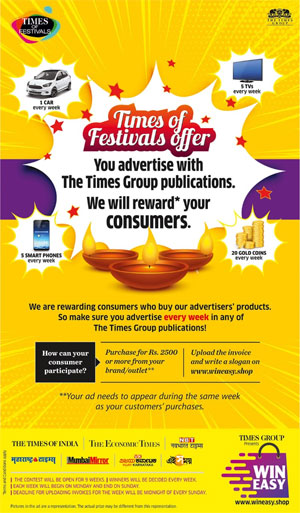
    The Times of India group has launched a big bang promotional initiative called ‘Win Easy’ which started in the Ganesh Chaturthi week and will end around Diwali.


    The aim of the nine-week exercise is to build up the festive fervour by encouraging consumers to shop to their heart’s content and get rewarded for it. The contest will be open to all consumers who shop for more than Rs. 2500 by purchasing products of any of the brands advertised in the Times Group publications viz., The Times of India, The Economic Times, Mirrors, Navbharat Times, Maharashtra Times, Ei Samay and Vijay Karnataka.


    Consumers need to log on to www.wineasy.shop to upload their invoice, write a slogan and be eligible for the weekly draw. The draw will happen every week (defined as Monday to midnight of Sunday) and invoices dated within a respective week will be eligible for that week’s draw.


    Notes a communique: “Thanks to Win Easy, brands now have one more reason for advertising in the Times Group publications, as consumers are incentivised to purchase their products. The more they advertise, the more they stand to gain.  Consumers stand to win a car every week. Other prizes include 40 inch TVs, Smartphones and 2gm gold coins.”


  • Hathway enhances OTT viewing experience with Android TV

    By A Correspondent


    Hathway Cable has launched an OTT set-top box based on Google’s Android TV. Hathway Playbox, which carries a dedicated You Tube, Netflix and Google Play button on the remote control, will give the ability to consumers to access their favourite show with a single click.


    Said Rajan Gupta, Managing Director, Hathway: “One of the strengths of Hathway Play box is our cooperation with some of the most popular play-services. In addition to Google Play and YouTube, we are delighted that Netflix, the world’s largest streaming service will be available in Hathway Play box at launch and that our customers can easily access their content via the button on the remote control.”


    “We are pleased to be working with Hathway and look forward to leveraging their extensive broadband and cable network to enable more exciting and useful Android TV experiences for consumers,” added ​Pranab Mookken, ​Head Android, Chrome & Play Business Development, India.


  • Colors Infinity, Comedy Central to air on Jio TV

    By A Correspondent


    Colors Infinity has announced its plans to make a significant foray in digital with a multi-platform experience concurrently to an additional 250 million subscribers of Jio TV.


    Said Ferzad Palia, Head – Youth, Music and English Entertainment, Viacom18: “In a very short span of time, Colors Infinity has come a long way, unthwarted by the challenging environ in English entertainment. Aiming to continuously meet the expectations of our current viewers, while attracting new viewers at the same time, we’ve boldly experimented with our programming. This radical approach has established a distinct identity for the brand, which endorses our leadership position in the category. Proud to be a truly multi-platform brand, we are now making Colors Infinity and Comedy Central available for simultaneous viewing on Jio TV. A significant growth in the advertiser base and revenue, is testament to our solid performance.”


  • Data-driven marketing strategies are the way forward: BCG & Google study


    By A Correspondent


    Southeast Asia businesses are not fully tapping the potential of data-driven marketing strategies to increase their revenue and realize cost efficiencies, according to new research from The Boston Consulting group and Google.


    The research also found that the most digitally mature brands report significant benefits from data-driven marketing, with an average incremental 11 per cent revenue impact and 17 per cent in cost efficiencies.


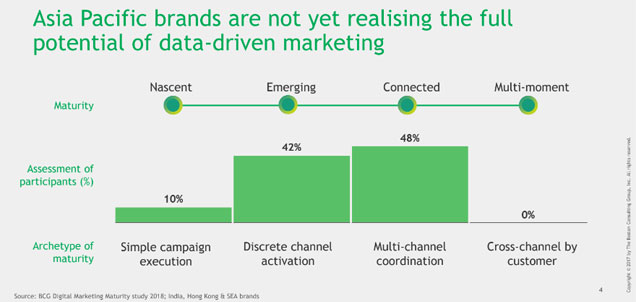
    The ‘Digital Marketing Maturity Study’ surveyed over thirty brands across seven industries from Indonesia, Malaysia, Singapore, India and Hong Kong. It found that no brands have achieved the potential of multi-moment digital marketing in the region – that is, those that exceed consumer expectations by consistently delivering coordinated, relevant and sequenced experiences across a range of online and offline channels.


    “Brands in SEA are yet to reach the full potential of multi-moment marketing, which is an approach that optimizes single-customer business outcomes across multiple channels by delivering meaningful connections with consumers. In short, there is an opportunity to establish meaningful connections with today’s consumers to improve both cost efficiencies and revenue,” said Luc Grimond, Partner and Managing Director at BCG Singapore.


    The study assessed brands across industries and their maturity levels on a four-point scale. Companies at a nascent stage typically execute simple campaigns mainly using external data and direct buys, with limited links to sales. As brands mature, they improve discrete channel activation and then go a step further to more connected, multi-channel activation, with a demonstrated link to ROI and sales proxies. The study found that it is a progressive journey for companies to navigate through the four phases of digital maturity.


    “It’s like long-distance running. You need to focus on the next step rather than worry about how far you still need to go. It sounds like a cliche, but considering how many people are involved in enabling this change in an organization, it is important to break it down into bite-size pieces and make everyone part of the journey,” according to Tom Van Den Berckt, Head of Digital & Web Services at Maxis.


    Added Grimond: “In this study we identify the steps on a path to digital maturity. The least mature brands can get started by setting the foundations, including identifying a senior sponsor, leveraging partners to fill capability gaps, understanding available data and building on that by implementing the back-end technology and analytics required to progress.”


    BCG Google – India, Hong Kong and SEA -Digital Marketing Maturity Study – 2018

  • Cyber Media ropes in Dwij Seth to head its Digital Marketing business

    By A Correspondent


    Dwij Seth

    Cyber Media Services has onboarded Dwij Seth as President to head its digital marketing business.


    Commenting on the development, Dhaval Gupta, Executive Director Cyber Media said: “I am excited to welcome Dwij to CyberMedia Services. This signals a strong intent to rapidly scale and add dynamism to our growing digital marketing business. Dwij brings rich industry experience of building teams, and I am excited with Cyber Media Services’ next phase of growth under his leadership.”


  • Shop Clues unveils its festive campaign

    By A Correspondent


    Shop Clues has launched its Diwali campaign titled, ‘Naya ye, naya wo. Iss Diwali, sab naya lo’ that features Gajraj Rao.


    Commenting on the new campaign by Enormous, Rajat Girdhar, Head – Marketing, ShopClues said: “This year’s Diwali campaign of ‘Naya ye, naya wo. Iss Diwali, sab naya lo’ is aimed at providing consumers to indulge themselves in shopping whole-heartedly during the festive season. The Mahabharat sale offers lakhs of products at low price points. Gajraj Rao’s character in his forthcoming film resonates with ShopClues’ eternal quest to ensure every shopper is happy and finds quality products within her / his budget.”


  • Three ChuChu TV videos cross the one billion views mark

    By A Correspondent


    We normally do not like to highlight YouTube views or Facebook likes because they are often (or mostly?) inorganic. But we do know that ChuChu TV is very popular, and hence this report, though we would like to say that we haven’t verified the claim on whether these numbers have been achieved without any boost.


    Three videos from ChuChu TV, the YouTube channel for kids has crossed the one billion views mark. The “ChuChu TV Johnny Johnny Yes Papa” video has more than 1.5 billion views, the “ChuChu TV Surprise Eggs Old McDonald” video has more than 1 billion views and the latest video from ChuChu TV to cross the 1 billion views is the “ChuChu TV Phonics Song with two words”.


    Said Vinoth Chandar, Founder, CEO and Creative Director of ChuChu TV: “It’s a very proud moment for all of us at ChuChu TV and is a testimony to our understanding of our audience. Our focus has always been quality content and its heartening to see the world embrace ChuChu TV so wholeheartedly. These milestones motivate us to do more, bringing joy and learning to babies and preschoolers around the world.”


  • Will Data be the Annadata of the future?


    By A Correspondent


    We all know that data is the future of the marketing services business. The immediate future at least. And those who want to maximise on things now, even the present.


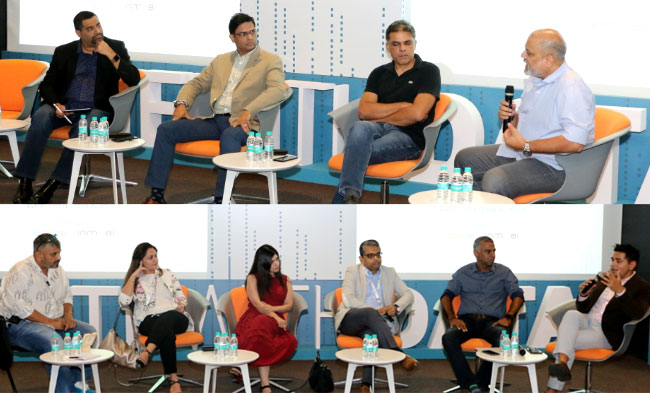
    Marketing services conglomerate WPP organised its first ever ‘Date with Data’ Summit on Tuesday with a galaxy of marketing gods and its own star-studded network.


    The idea was to exchange ideas and insights on data-driven marketing and the use of technology across marketing solutions. Keynote speakers and masterclass presenters emphasised the evolving role of data and its profound influence on the industry across all sectors. And thereby of course underscore its expertise with all things data.

    Speaking on the relevance of Audience Planning: A Journey or a Destination, Gauravjeet Singh, Head of Media South Asia, Hindustan Unilever, said, “It is a great experience to attend industry forums like this which really discuss the cutting-edge work that is happening around data. It is important to validate what one believes which helps during discussions with panellists and eventually leads to the right direction.”


    Addressing the growing need for marketeers and thought leaders in the industry to efficiently utilise the power of data, CVL Srinivas, Country Manager WPP India, said: “WPP strongly believes in driving collaboration amongst various stakeholders of the industry and this event is our attempt to create a platform for sharing different perspectives on how data is helping reshape marketing and businesses. As responsible users of data, we strive to enable thought-provoking discussions around important themes. We witnessed great participation from our clients, partners and colleagues.”


    The Summit opened with masterclasses on Data Visualisation-To Drive Data Adoption and Data Driven Thinking; Building A Data Driven Organisation; Unlocking the True Potential of Mobile Data; Data Privacy and Responsibility and Connecting Data (Data Integration) and Generating Targeted Insights (Data Analysis). These sessions were conducted by experts from Google Cloud, InMobi, Kantar and Data Alliance.


    The afternoon saw panel discussions on topics such as Decoding The Consumer: Fundamentals to Future, that addressed advancements in insights, research and analytics; Connected Commerce: Decoding The Last Mile, which highlighted how data and analytics are being leveraged to bridge the gaps in commerce. Audience Planning: A Journey Or A Destination touched upon innovative approaches of using data whilst Data As A Source of Creative Inspiration explored how data can be used to inspire creative content and communication planning.


    Speakers and participants from companies such as Vodafone, ITC, Pepperfry, Hindustan Unilever, Ford India, Google, InMobi and Nykaa were amongst those that delivered key presentations and business insights.


    And here are pointers from what the various panellists said:


    Panel 1: Decoding the Consumer: Fundamentals to Future


    Siddharth Banerjee – Executive Vice President of Brand and Marketing, Vodafone

    Data signals help to pick up on consumer behaviour. Data collection can be harnessed in days and weeks rather than months and years. Facebook analytics is used to understand consumer behaviour, it is important for marketeers to harness the information. Future models will have evolve. I would rather use two or three word acronyms over artificial intelligence. Some fundamentals don’t change.


    Tushar Vyas- Chief Strategy Officer, GroupM South Asia

    Miniscule part that buys ITC product will be open to understand consumer behaviour

    Machine and data is augmenting the human mind to make the decision.


    Shuvadip Banerjee – Vice President of Marketing Services, ITC limited

    Data is being collected, curated mined on a daily basis. Bringing this data together is a challenge. End-to-end perspective gives a richer view. Quantum has increased.

    Data will help us predict consumer behaviour. Data is supplementing something critical. Never loose contact with your consumers.


    Panel 2: Connected Commerce: Decoding the last mile.


    Vikas Agnihotri – Country Director, India Sales, Google India.

    Certain weather conditions leads to how the food ordering habits change

    Helped a client on-board payments identified catchments areas where merchants will come on board. Omnichannels is going to stay it is a big part. Eg: Maruti has more than 700 dealers in the country. 9-10 customers watch a video before buying a car. It is a yearly study done by Google. There is a very strong correlation that shows customers are able to see and buy products from the store. The customers are now more informed about the car before they purchase it.


    Kashyap Vadapalli – Chief Marketing’s Officer Pepperfry

    Control marketplace, partly how we sell it to our merchants. Data what we use is consumer behaviour. What kind of patterns lead to a completion.

    Buying behaviour is important. Life time value. Then we know category of consumers we have to tap on. Browsing behaviour, gives us an idea of what to do


    Sanjay Suri, Chief Technology Officer, Nykaa

    We save all data (click, search) earlier we used to do base level analysis. Ability to look at the cohorts who have come on week by week.

    Use different Market strategy. Breaking the cohort into a granulated level, figuring each segment and personalising it.


    Panel 3: Audience Planning: A Journey or a Destination.


    Gaurav Jeet Singh – Head of Media South Asia Unilever

    It is all sophisticated marketing. Purchase decision is important.

    Performance marketing is confused with Audience marketing

    Looking at large data structure which don’t talk to each other.

    How does our data marry 2nd party data and how does 2nd party marry 3rd and complement the other.

    You need to go after data that is most recent or refreshed every month. A lot of data set ups are not recent.


    Vasuta Agarwal- VP and GM, South Asia InMobi

    Becomes critical with partners and shares. No one solution to fit different markets.

    Define relevant signal and sources

    In the non-economic world you don’t have a single view of their customers which is a problem. Sometimes we take data we take at face value. We don’t know how many times it is refreshed and how recent it is. Another challenge is authentic data. And needing teams to check the data.


    Rahul Gautam- VP of Marketing Ford India

    Small share in the Indian context of 5%. People are going against others opinions to buy Ford cars. Taking those signals to target my audience that’s success. It will help all advertisers to be sharp on the money.


    Kartik Sharma – CEO South Asia, Wavemaker

    Cohorts of people are being able to identified through audience planning. Initially audience planning was more like demographic planning, now it has become sharper. Look at the consumer take signals and build something of it.

    Recency of data is important. How do you make meaning out of signals is difficult. If you don’t have the resources and people it is task to do.

    Audience planning is a Process


    Panel 4: Data As A Source of Creative Inspiration

    Aditya Swamy – Head of Agency Partnership Google

    Looked at data from audience POV. A strong idea laid across the tool, you are sure to win the market. Mass brands can bunch users by their spending techniques and their behaviour. 2015, YouTube had two YouTubers who had million subscribers now in 2018 there 400 solo native Youtubers who have a million subscribers. These people have looked at data analyst and constantly reading comments.

    Looking for tickets while traveling is something MakeMyTrip would tap onto but Samsonite is tapping on those queries.


    Kainaz Karmakar – Group Creative Director, Ogilvy

    Campaign creativity for awareness – Savlon Swast campaign.

    Target audience children. By simple data point of washing hands, we have reached 2.3million children. We carried out a project where children in villages were given chalk to write with and once done it was used as handwash under water. This data point has made a difference.


    Deepshikha Dharmaraj – Chief Business Growth Officer, Genesis Burson-Marsteller

    It is the biggest challenge to combine data and creativity. Data is pure info unless you can create a story with it. A great campaign is built when it starts with your assumption, thought and then with the data and add a layer of how it work with the audience. Data+ creativity= Magic. It is about storytelling. Influencers are what driving the storytelling technique. Some people don’t want to engage with influencers because of payment. But engaging with them creates a better story telling method. And it also reaches the audience faster.



  • Internet services sector to be $124bn by 2022: IAMAI


    By A Correspondent


    The Internet Services Sector in India is currently valued at US$ 33.8 billion and by the year 2022, it is expected to reach US$ 76.4 billion in conservative estimates, according to a report titled ‘Economic Impact of Internet Services in India’, published by the Internet and Mobile Association of India (IAMAI), the industry association representing the interests of the leading players of the internet industry in the country. However, the sector has the potential to reach a value of USD 124 billion by 2022 if certain recommendation made in the study fructify.


    The Internet Services sector size for 2017 and 2022 are inclusive of e-tail, fin-tech, food-tech, digital classifieds, digital advertisements, e-travel and ticketing, Edu-tech and digital entertainment sub-sectors Figures for e-tail is of GMVs. The market size in 2022 has been estimated considering the growth of existing sub-sectors in Internet Services. However, the market size in 2022 has the potential to grow even bigger, owing to rapid innovations and new sub-sectors emerging. Digital payments are not included to avoid double counting.


    By the year 2022, India is expected to become a country of 1.4 billion people. With the proliferation of affordable internet connectivity, the number of internet users in the country is projected to increase 1.6x times from 481 million to reach 762 million in 2022. Along with increased availability of internet connectivity, the number of smartphone users in India too is estimated to grow at 1.75x times to reach 526 million in 2022. On the technology and business side of the Internet Services, internet will fundamentally change the way the needs, aspirations and demands of the consumers will be addressed. Pivoting on that, the Internet Services sector is expected to witness plethora of changes in the future.


    The report suggests that the sector can reach its potential US$124 billion if certain critical factors are realized; such as forward looking and supportive government policies, better infrastructure for widespread internet connectivity, developed distribution network enabling better reach and connectivity to customers in Tier II/III cities for e-commerce, adoption of digital and advanced technologies across the ecosystem and offline sectors etc.


    The report covers some of the identifiable internet services that have gained critical mass in the Indian economy such as e-tail, OTAs, Online Classified, Digital Advertising, Edu-tech, Food-tech, health-tech, Digital Entertainment (including online gaming), Fintech and Digital payments. Digital payments as a sector has been mapped but not included in the total estimate given the challenge of double counting, as it serves as a facilitator for many of the other services.


    IAMAI stated that the numbers projected in the report are conservative estimates as several sectors like Agritech have not been included in the study because these sectors are yet to gain any critical mass that could be used as benchmark for future projections. Similarly, new technologies like IoT, AI, M2M that are expected to shape the future of internet services too have been kept outside the ambit of this study because the real impact of these sectors are difficult to determine at present. The association stated the in the coming days the internet service sector may witness sea-changes that can well inflate the overall numbers substantially.


    The report also attempts to map the socio-economic impact of digital services in terms of livelihood generation and positive linkages it generates. The study concludes that employment generation from the proliferation of Internet services will be at three levels; with the primary level referring to direct employment generation in fields of product design and development, sales and marketing teams, seller and customer management, operations such as warehousing, vendor logistics management. Secondary employment generation will occur in the forms of self-employment generation for sellers, cab drivers, utility service providers, content creators etc who will be able to avail livelihood via the online platforms. The third or tertiary level of employment generation will be by allied industries in the ecosystem providing on-ground field support to the internet service providers like third party warehouse and logistics handlers, delivery staff (first mile and last mile connectivity), affiliate marketers, bloggers social influencers, business associates for lead generation and order logging, packaging services, etc. The internet sector is estimated to employ around 10 lakh employees presently and is estimated to create 12 million net jobs by 2022.


    IAMAI stated that in course of the study the association tried to recognize the digitisation of conventional sectors being enabled by the internet services that can have long run positive consequences for the Indian economy. There are currently around 51 million SMEs in India, which contribute approximately 37% of the manufacturing output, 46% of exports and employ 117 million people. It has been observed that digitally enabled SMEs generate 2x revenues as compared to offline SMEs, attributed to the access to a wider base of customers, newer geographies/markets, additional sales channel etc. However, presently only 2% of these SMEs are digitally enabled. There is a conscious effort by government agencies and internet businesses to digitise SMEs, and this trend is expected to generate immense benefits. With advances in digitising existing offline businesses, promotion of industry 4.0, digital on boarding of micro-entrepreneurs, etc the impact of the internet services can potentially be greater with newer service categories emerging in the near future.