Category: Digital

  • NIIT hands over digital mandate to Indigo Consulting

    By A Correspondent


    NIIT has signed up Indigo Consulting as its strategic digital partner. The business was won post a multi-agency pitch, and Indigo’s Gurugram office will handle the account.


    Speaking about bringing Indigo Consulting on-board as its strategic digital agency, Kshitij Jain, Vice President – Marketing & Sales, Career Education Business, NIIT said:“We embarked on this overall brand transformation journey a couple of months ago. Digital is a critical pillar within our overall blueprint because of its potential to exponentially impact transformation. We look forward to a fruitful association with Indigo Consulting.”


    Jose Leon

    Added Jose Leon, President, Indigo Consulting: “India is likely to have the world’s largest workforce by 2027 with a billion people aged between 15 and 60. NIIT has value to offer to this entire spectrum – right from enabling the youth identify its skills and enhance them formally in a structured environment, to senior working professionals getting certified from premier institutes to explore better career opportunities. Digital Transformation experts at Indigo Consulting are crafting a strategy to create and deliver an immersive experience for all target users of NIIT, and we are excited about this partnership and the positive impact this can deliver for the brand.”


  • MMA gets a new Country Head

    By A Correspondent


    Moneka Khurana
    Namita Ved

    The Mobile Marketing Association (MMA) announced two senior leadership appointments in India. Leading the way is the appointment of Moneka Khurana as Country Head in India, joined by Namita Ved as Head of Business Development and Operations, India.


    Said D Shivakumar, Chairman MMA India & Group Executive President – Corporate Strategy and Business Development, Aditya Birla Group: “We are excited to have both Moneka and Namita on board. Given their varied experiences we look forward to fueling MMA’s growth of limitless possibilities, agility, just like a start-up company. We look forward to continue to build and help brands target audiences across the emerging range of mobile media opportunities and physical environments across the country.”


    Said Rohit Dadwal, Managing Director, MMA, Asia Pacific: “Moneka’s vast experiences with some of the top brands in the industry alongside Namita’s marketing and communications expertise will propel MMA forward as the leading trade association for mobile marketing. We are delighted to have both Moneka and Namita represent us in the Indian market and accelerate the country’s mobile agenda.”


  • Dainik Bhaskar launches CSR initiative ‘Teentalk India’

    By A Correspondent


    D B Corp Limited (DBCL) has announced a new CSR initiative ‘Teentalkindia.com,’ an emotional well-being platform for teenagers in India.


    Commenting on the same, a DB Group spokesperson said: “Today’s teenagers deal with a great deal of pressure from peers, high parental expectations, societal mores as well as academic pressures which, in some cases lead to severe depression amongst teenagers. This is compounded by the fact that there are limited support services available for emotional well-being. It continues to be a huge growing concern, more often either not discussed, ignored or un-recognised in most parts of our country.”


    Teentalk’s in-house team includes full-time personal counsellors and experts on teen issues. It has also partnered with support services like Fortis Helpline, Vandrewala Foundation and other organisations.


  • The Digital Duopoly targets a Billion-plus


    By Indrani Sen


    Last week,a roundtable discussion on ‘Disrupting Mobile Advertising Duopoly in the Indian Media Landscape’ was held in Delhi NCR, where experts from A&M industry shared their views on the future of the existing market duopoly of Google-Facebook in India. Most of them were of the opinion that the duopoly will continue to exist in India in spite of the growing competition in the market (http://businessworld.in/article/Challenging-The-Digital-Duopoly-Has-The-Change-Begun-/06-06-2018-151336/). A probability of a triopoly including Amazon and its marketing services was tabled by an expert with another expert adding that OTT platforms have began to challenge the duopoly. The need forbrand safe environment with created content rather than curated content and regulations like GDPR was tabled.

    Bharat Sanchar Nigam Limited, which has a limited tie-up with Baba Ramdev’s foray to mobile internet, has also partnered with Call2Action Communication India Private limited recently for launching a new mobile advertising platform. This platform is expected to create disruption in the Mobile Advertising Ecosystem by offering lucrative price points and challenge the duopoly of Google and Facebook in India as reported by the above article in www.businessworld.in.

    Both Google and Facebook have high business stakes in the Indian market and have been investing a lot of time, talent and funds in local development.  Some of these efforts are not well known to the advertisers and agencies that use the two platforms for digital marketing. The common users of the platforms are blissfully ignorant of the same.

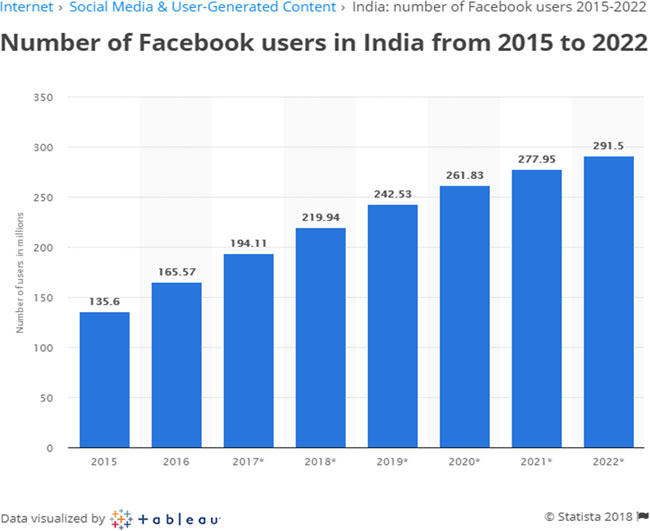
    India has been the country with the largest Facebook users since 2016. There were about 195 million Facebook users in India as of May 2016, against about 191 million in the U.S. and 90 million in Brazil (https://www.statista.com/statistics/304827/number-of-facebook-users-in-india/ ). The number of Facebook users in India is forecast to continue to grow in the coming years, and add up to nearly 320 million by 2021.The penetration of Facebook in India isexpected to jump from almost 15 percent in 2016 to around 23 percent in 2021.Facebook also owns three of the most popular social networks WhatsApp, Facebook Messenger and Instagram which help to increase its strong hold in the Indian market.

    Mark Zuberberg has claimed that globally, Facebook’s advertising-driven business has not been significantly damaged after the Cambridge Analytica bombshell dropped. Its share prices which dropped after March 2018 when the Cambridge Analytica reports broke, has climbed back to slightly above its price Facebook enjoyed before the news break.  Its ability to protect its users’ personal information shared and stored on its social network is yet to be proved to the complete satisfaction of the law makers across different countries

    Our Ministry of Electronics & IT has recently asked Facebook to explain if it allowed phone and other device manufacturers access its users’ data without taking their consent by June 20 following a recent report in media that Facebook has admitted to sharing information with a “small number” of companies including RBC Capital Markets and Nissan Motor Co., advertisers and other business partners (https://brandequity.economictimes.indiatimes.com/news/digital/facebook-kept-sharing-users-data-with-companies-even-after-saying-it-had-stopped-third-party-access-to-information/64516829).

    Google, the leading player in the Digital Duopoly, is comfortably settled in India. Google Search has 90% market share in India, Google’s Andriod OS is used by over 90% smartphone users in India, YouTube is watched by 80% of the internet users in India with a 225 million monthly user base, Gmail enjoys the largest user base in India and Google Map is consumer focussed and free to use. Google has been working steadily on India first tweaks and apps  such as offline videos for YouTube, two-wheeler navigation on Google Maps, Android Oreo (Go edition) to improve experience on low-RAM phones, Google Assistant for Reliance Jiophones, new apps like Google Go and Files Go, built from scratch, Google WiFi stations in partnership with Indian Railways and the mobile payment platform Google Tez, which within a month of its launch in September 2017, captured 60% share of m-payments in India.Facebook should take a lesson from Google and introduce some India specific social apps.

    India is a focus market for Google’s Next Billion Users Plan through which it aims to bring everyone online in India (https://brandequity.economictimes.indiatimes.com/news/digital/google-wants-to-bring-everyone-online-in-india-through-its-next-billion-plan/64457803). As a part of this initiative and based on intensive field research by its technical team, Google launched a multilingual app in Mumbai 10 days back (on May 31),  called ‘Neighbourly’ catering to only Mumbai.Thislocal discovery and community app works in English, Hindi, Marathi and six other Indian languages. The hyperlocal platform helps to find anything from a doctor, ATM or petrol pump to a mechanic or badminton coach, within 2 km radius.In coming weeks and months, Google plans to roll out the app across more cities in India.

    It is a difficult proposition to challenge Google’s total supremacy today In India as it is far ahead of its other competitors. Facebook, which has now become vulnerable, may have to deal with more competition in the sphere of social media. Itmay be compelled to spend comparatively more time to ensure protection of consumer data and implementation of its privacy policy, which may lead to erosion of its market share through competition in the global market. However, in India, there is minimal chance of a similar threat. So, the immediate future of the digital duopoly seems to be secure in India in spite of Baba Ramdev’s plan to relaunch Kimbho after a flamboyant launch followed by a silent withdrawal.


  • 5Paisa.com kicks off #InvestLikeAPro campaign

    By A Correspondent


    5Paisa.com has kicked off a brand campaign titled #InvestLikeAPro on the backdrop of FIFA Football World Cup. The campaign is built around 5Paisa.com’s positioning as the broker that doesn’t charge brokerage, but just a flat fee of Rs 10 so that the customer can #InvestLikeAPro rather than worrying about hefty brokerage as charged by other brokers.
     

    Said Prakarsh Gagdani, CEO of 5Paisa.com:“We want our customers to invest and trade like ace footballers with speed, agility and accuracy. We provide investors the best pitch by not charging brokerage and just a flat fee of Rs 10, even for Rs 5 crore worth of transactions, which is about 98% cheaper than traditional brokers and lowest in the industry. In addition we provide a robust, technologically advanced platform supported by solid research offerings. We want our customers to not just invest but #InvestLikeAPro.”


  • BC Web Wise partners Qoruz to deliver influencer marketing solutions

    By A Correspondent


    BC Web Wise has partnered with marketing technology company Qoruz, in a bid to help brands maximize the impact of their influencer marketing efforts. This partnership will give the BC Web Wise customers an integrated solution for their Influencer Marketing goals, powered by both the companies.


    Said Chaaya Bharadwaaj, Founder and Managing Director, BC Web Wise: “I was thrilled when we saw what Qoruz’s platform can do. As an agency, we represent brands that need true representation on the web, since their products have direct impact on people. It is extremely vital for marketers to know the influencers who are more relevant, local and relatable to these audiences and work out amazing campaigns with them.”


    Added Ajay Malvankar, Associate Director – ORM, BC Web Wise: “We are very excited to have Qoruz onboard, as our partner. This partnership with Qoruz doesn’t enable just us, but our clients and influencers as well, to engage in a win-win model. We are confident that together, we will be able to create a more powerful influencer marketing experience for the end-users, influencers and the brands.”


    Said Praanesh Bhuvaneshwar, CEO and Co-founder, Qoruz: “The business of Influencer Marketing has transformed completely in last five years. Earlier, influencers were celebrities, business, and public leaders, sportspeople, etc. But today, anyone with an access to the internet can become an influencer, especially in niche categories. This means that influencer marketers need to adopt a more data-driven, and focused approach involving these influencers. We are really excited that BC Web Wise shares our visions in helping businesses build deeper trust with their customers using influencer marketing.”


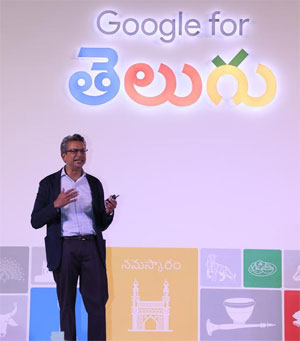
  • Google launches language support for Telugu ads

    By A Correspondent


    Google India announced the launch of Telugu language support for its advertising products – Google AdWords and Google AdSense to enable Telugu language web publishers and advertisers reach out to the large base of internet users in Telugu. With this launch, Google has now scaled up its support for Indian language advertising covering Hindi, Bengali, Tamil, and Telugu.



     

    Announcing the launch, Rajan Anandan, Vice-President, South East Asia and India, Google said:“Expanding support for local Indian languages on our ad platforms are aimed towards making India’s Internet more useful for a billion Indians. In the last few years, we have systematically addressed the barriers that prevent local language users in India to gain from the Internet. And the key to building a flourishing local language internet that serves India’s need – requires the Industry to come together and bring the richness of useful content that India needs. We hope this launch will enable publishers to create more content in Telugu language and help advertisers to connect with their users in local Indian languages.”


  • T-Series crosses 50mn subscriber mark on YouTube

    By A Correspondent


    Bhushan Kumar and Neeraj Kalyan

    T-Series has crossed the 50 million subscriber base on its YouTube channel. This milestone was achieved soon after the 40mn base it achieved in March this year.


    Said Neeraj Kalyan, President, T-Series: “It really feels good to be at 50mn subscribers position but it also brings greater responsibility to meet higher fan and industry expectations. The journey has not been easy and is a result of sheer hard work and tenacity of team T-Series over the years. Music for us has never been about excel sheets, it’s not a number on a paper. It’s a passion, driven by belief in our content, backing our belief with aggression and passion and this has remained our mantra for years which has led us here. We thank fans of T-Series for their faith in us. I dedicate this milestone to the team spirit of digital and content teams of T-Series.


    Added Bhushan Kumar, Chairperson and Managing Director of T-Series: “We are delighted to reach this milestone, and would like to say a big thank you to our loyal fans whose love and loyalty has brought us to this position. A  special thank you to our in-house digital, content and YouTube team for working diligently and conscientiously in making the T-Series YouTube channel grow at such a brisk pace. We hope to entertain our loyal subscriber base with more music and better content in the days to come.”


  • ICICI Bank makes banking easier via iMobile app

    By A Correspondent


    ICICI Bank has launched an iMobile app that offers a full-service bank over the phone. Ogilvy has brought this proposition alive with a campaign titled, ‘Ek App mein poora bank’ / ‘Your bank in an App’.


    Said Zenobia Pithawalla, Senior Executive Creative Director, Ogilvy: “ICICI Bank’s every attempt is to make banking a pleasurable experience for its customers. Its iMobile app offers the customer the experience of ‘Ek App mein poora bank’. That is the creative idea. The two protagonists in the films bring alive the ease of use, convenience and effortlessness of this product in a light hearted and humorous manner. Reiterating the joy of banking with ICICI Bank.”


    Added Walter Noronha, Senior Vice President, Ogilvy: “Our aim was to communicate all products and services in one app, with a view to cross sell the multitude of offerings by the bank and drive the brand experience further.”


  • CNBCTV18.com appoints Rohit Gandhi as National Sales Head

    By A Correspondent


    Rohit Gandhi

    CNBCTV18.com has expanded its top level management by appointing Rohit Gandhi as National Sales Head at CNBC Digital.


    Gandhi comes with 14 years of experience in print, TV and digital media. His responsibilities in the new role comprise developing effective strategies and leading the team to maintain high sales performance in the organisation. Prior to occupying his current role at CNBCTV.com, Rohit has worked with digital brands like Times Internet, Condé Nast India, Rediff.com and he had also been part of CNBC-TV18 channel, a decade ago.


    Ranjita Sehgal

    Commenting on the new appointment, Ranjita Sehgal, Business Head, CNBCTV18.com said: “We are happy to welcome Rohit to the CNBC Digital family. His extensive experience in the digital sphere, along with his in-depth understanding of Branded content both on Business and Lifestyle platforms is an excellent fit. His understanding of TV sales and CNBC TV18 is an added advantage for the integrated approach we are adopting.


  • Censorship Schizophrenia UnLtd


    By Shailesh Kapoor


    It’s been exactly a week since Netflix put up the eight-part series Sacred Games, their first serious attempt to build their presence in the Indian market. The series has since received largely positive, even glowing, reviews. Based on Vikram Chandra’s book, Sacred Games is being touted as that the watershed internet show in the short but unremarkable history of “web-series” in India.


    I’m only halfway through the series yet, savoring it at the rate of an episode a day. What immediately strikes you when you watch Sacred Games is the unbridled use of language and visuals to tell the story the makers want to. Profanities, nudity and violence are used in a very matter-of-fact manner, never quite seeming forced, and never making a fuss about their presence in the series.


    It’s par for the course as far as American television is concerned. But in the Indian context, the contrast vis-à-vis rest of the entertainment landscape is striking, to say the least. You can feel that the writers and the makers would have felt a sense of liberation, for being able to say and show what mainstream cinema, let alone television, will ever allow them to.


    Take, for example, the two-three passing comments Ganesh Gaitonde’s character (played by Nawazuddin Siddiqui) makes about the former Prime Minister Rajiv Gandhi. Or the one mention of the vasectomy drive during the emergency. They shock us, pleasantly so, as we applaud how the makers have dared to say it their way. Some of these lines have already stirred a storm, but the Congress will be too limited in its power to pursue their case much. They would rather let it die down on its own.


    Netflix is a part of the large and ever-growing internet ecosystem, and there is no censorship the Indian government has come up, so far anyway, for this medium. The idea of the internet does not lend itself to censorship conceptually, and if someone important in the government woke up on the wrong side of the bed one day and decided to implement content regulation in this space, it would be lead to chaos of the unmitigated variety.


    Sacred Games is rated 16+ and it warns you about the use of bad language, nudity, sex and violence before you start watching it. The same 16+ audiences who have watched Sacred Games had to wait for two months to watch an innocuous film called Padmavati, till the censors forced the makers to change its name and make other “important” changes like covering the queen’s torso in a dance sequence. And yet, that film could not be watched legally in three states of India till it was available on Amazon Prime about three months later.


    For years now, the entertainment business has demanded that we move to a rating system like the West, where government bodies can only decide the minimum age below which a film cannot be watched. It’s a proven method that has been known to have worked across media. It is also a lot more logical and objective, and hence, easier to implement.


    But from pulling TV channels off-air for one day for use of abusive language or nudity (nowhere close to the level seen in Sacred Games) to trying to mess with routine dialogues in a film to not being to do anything at all related to the Internet content, our governing authorities seem to enjoy their schizophrenia.


    The more you try and mess with art, the more ways art will find to get back to you. Sacred Games is that middle finger those censoring films and TV do not want to see. But it stares them in their face anyway.


  • Online video viewing in India to leapfrog to 52mins/day in 2018


    By A Correspondent


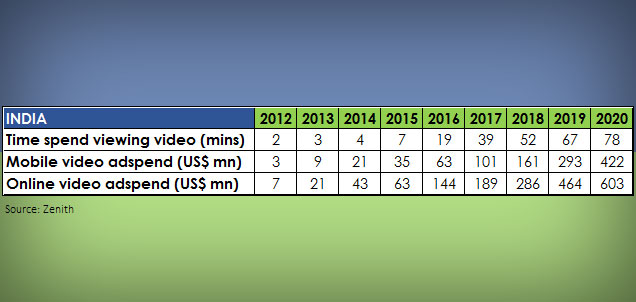
    Online video viewing will leapfrog to 52mins a day in 2018 from a lowly 39 minutes in 2017, report media agency network Zenith.Global consumers will spend an average of 67 minutes a day watching online video this year, up from 56 minutes last year, according to Zenith’s Online Video Forecasts 2018, published today. By 2020 the average person will be spending 84 minutes a day watching videos online. In that year, China will have the keenest viewers, with the average person spending 105 minutes a day watching online video, followed by Russia (102 minutes) and the UK (101 minutes). This rapid rise in consumption is leading to a shift in the way brands plan campaigns across both television and online video. India-specific numbers are in the table above.


    This is the fourth edition of Zenith’s annual Online Video Forecasts report. It contains historical data and forecasts of online video consumption and advertising, together with commentaries on the development of individual markets by local experts. This year’s edition covers 59 key markets. By online video we mean all video content viewed over an internet connection, including broadcaster-owned platforms such as Hulu, ‘over-the-top’ subscription services like Netflix, video-sharing sites, e.g. YouTube, and videos viewed on social media.


    Global online video consumption grew by 11 minutes a day in 2017, and we expect it to grow by an average of 9 minutes a day each year to 2020. It accounts for almost all the growth in total internet use, and is growing faster than media consumption overall, so it is taking consumption time from traditional media. Although some of this extra viewing is going to non-commercial platforms such as Amazon Prime and Netflix, plenty of it is going to commercial platforms, so the supply of commercial audiences is rising rapidly.


    Zenith estimates that online video adspend grew 20% in 2017, to reach US$27bn. Growth peaked at 36% in 2014 and has fallen steadily since then, but still remains very high. “We forecast 19% growth in 2018, and an average of 17% annual growth to 2020, when online video adspend will reach US$43bn. Video’s share of online display advertising is rising steadily: it accounted for 27% of display adspend in 2017, and we expect it to account for 30% in 2020,” the report notes.


    More from the report:

    The supply of online video audiences has been growing ahead of demand in recent years: online video viewing grew 91% between 2015 and 2017, while adspend grew 52%. The cost of online video advertising has therefore come down substantially. As the growth of video consumption grows we expect prices to stabilise, with mild increases from 2019 onwards.


    Online video advertising is still only a fraction of the size of television advertising, but because television is stuck at 0% to 2% annual growth, this fraction is rising rapidly. The online video ad market was 10% of the size of the television ad market in 2015, and 14% in 2017. By 2020 we expect online video adspend to be 23% of the size of television adspend.


    Online video and television complement each other well, with most brands initially using online video to add incremental reach to their existing television campaigns. But with the rapid growth of online viewing we are now seeing more brands plan television and online video together to optimise frequency.By cutting out television spots that lead to very frequent exposure among heavy television viewers, andusing online video to target – and retarget – light television viewers, brands are using television and online video together to cut out both overexposure and underexposure within the target audience, maximising recall at a reduced price.


    Online video advertising began by emulating television advertising, with most ads appearing within other video content that the viewers were really interested in as interruptive ‘in-stream’ ads. But over the past few years ‘out-stream’ ads have become common. These are stand-alone video ads that appear within text or images, or within a social news feed. Thanks mainly to the rapid adoption of video content and advertising by social media platforms, out-stream video is rapidly becoming the dominant form of online video advertising. In the UK, for example, it overtook in-stream advertising to account for 56% of online video adspend in 2017. This is changing the structure of online video creative. Because a viewer can simply scroll past them, out-stream ads need to grab the viewer’s attention from the very first second, either with an arresting image or with a celebrity with a dedicated following. They do not have the narrative leeway available to interruptive ads.


    “Online video is driving growth in global media consumption, as smartphones with high-speed data connections make high-quality video available to people on the move, and smart TV sets give viewers unparalleled choice in the living room,” said Jonathan Barnard, Zenith’s Head of Forecasting and Director of Global Intelligence. “The rapid rise in video viewing makes online video the world fastest-growing advertising format, creating new strategic and creative opportunities. Brands that do not currently have a strategy for online video need to think about getting one.”